 by Tom Gurney
Tom Gurney BSc (Hons) is an art history expert with over 20 years experience
Published on June 19, 2020 / Updated on November 29, 2026
Email: tomgurney1@gmail.com / Phone: +44 7429 011000
A Roman Lady: Introduction
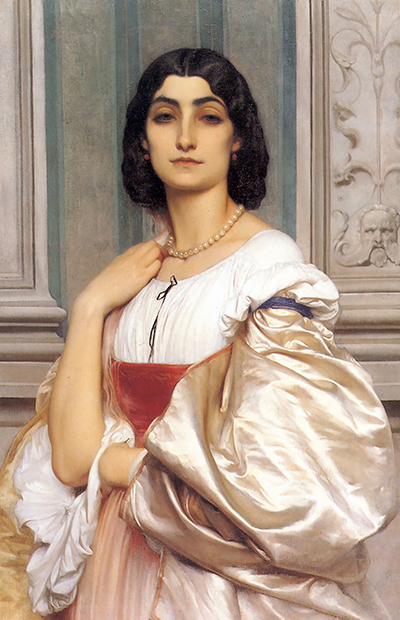
Anna Risi raises one hand to the pearls at her throat and gathers a sweep of pale fabric with the other. She looks out from between the upright lines of a paneled wall. Her face is almost square to the viewer, but her shoulders sit at an angle, and the broad folds of her sleeve pull the eye down and across the canvas. Frederic Leighton painted her in Rome in 1859. Today the Philadelphia Museum of Art calls the work Portrait of a Roman Lady (La Nanna). It is an oil on canvas, 80 by 52.1 centimetres, which the museum purchased in 1976 with the Henry Clifford Memorial Fund. [1]
Frederic Leighton, Portrait of a Roman Lady (La Nanna), 1859. Philadelphia Art Museum. Photograph by Miguel Hermoso Cuesta. Image source. CC BY-SA 4.0. Trimmed the frame and resized. The photograph and detail crops remain CC BY-SA 4.0.
At a Glance
- SitterAnna Risi (La Nanna)
- Painted1859
- Royal AcademyLa Nanna, no. 281, 1859
- CollectionPhiladelphia Art Museum, 1976-34-1
This work across Frederic Leighton’s career
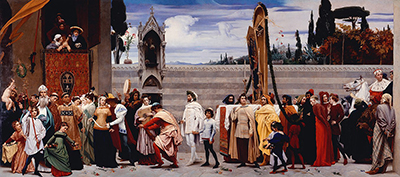
Cimabue’s Celebrated Madonna
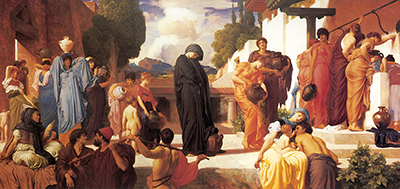
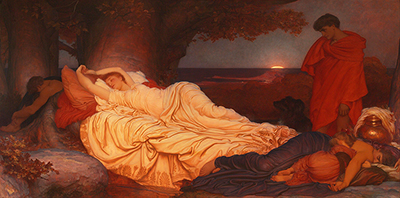
1853–55Lachrymae
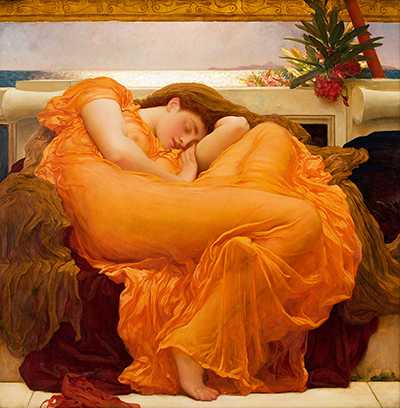
1894–95Flaming June
c. 1895Contents
- The face, the pearls and the sleeve
- Anna Risi in Rome
- La Nanna at the Royal Academy
- What the exhibition made of the painting
- Annotated details
The face, the pearls and the sleeve
Leighton gives Risi a nearly symmetrical face and sets it within the dark shape of her centre-parted hair. The pale strip along the bridge of her nose and the warmth in her cheeks bring her forward from the muted green panel. The edges around her eyes are softer. A fine shadow under each lower lid makes the steady gaze especially conspicuous against the lighter skin. Her mouth is closed, with a slight lift at one end. The warm flesh and the dark hair make the narrow line of pearls easy to follow, from the fingertips that touch it to the lit shoulder on the other side. [1]
The clothes call for a different kind of looking. Fine, almost vertical lines describe the gathered blouse, while broader strokes describe the heavier fabric that balloons over her bent arm. Where that fabric catches the light it looks almost silver. Along the deepest folds, it turns brown and grey. The narrow blue band at the shoulder and the glimpse of red bodice at her waist are small areas of colour, but they have room to register against so much cream and grey. In the painted wall a shallow ornament runs down the right edge. Its pale scrolls are close in colour to the folds below, yet the straight mouldings around it keep the background firm against the twisting cloth. [1]
Leighton had trained in Frankfurt and worked in Paris, where he drew from earlier paintings in the Louvre. A pencil study he made in 1856 after Leonardo da Vinci’s Mona Lisa survives. Giovanni Costa, a painter who knew Leighton in Rome, later recalled that Leonardo was on Leighton’s mind as he worked on A Roman Lady. The comparison draws attention to the slow transitions between light and shadow around Risi’s eyes and mouth. The Philadelphia museum also sees the costume, pose and setting as Renaissance in spirit. Leighton draws on that tradition to make Risi seem immediately present, within reach of the shallow carved wall. [1] [2]
Annotated Details from A Roman Lady
The numbered points identify visible features discussed in this article. Return from each detail to the numbered overview. Frederic Leighton, Portrait of a Roman Lady (La Nanna), 1859. Philadelphia Art Museum. Photograph by Miguel Hermoso Cuesta. Image source. CC BY-SA 4.0. The frame is trimmed. The separate numbered overview and detail crops are available under CC BY-SA 4.0.
.jpg)
Details from A ROMAN LADY
Compare the cropped details with the source images above. Notice how their colours, shapes and positions contribute to the larger compositions.
The face against the painted panels
Leighton lets the greys of the panels meet the dark hair. Small shifts in light around the eyes and cheeks give the face its forward presence.
 Detail 01 the-face-against-the-painted-panels.jpg)
A hand touches the necklace
Small lights distinguish the individual pearls. The diagonal of the arm rises towards them and breaks the upright lines of the wall.
 Detail 02 a-hand-touches-the-necklace.jpg)
The fall of the satin sleeve
The silvery surface is built from lights of different widths. Darker folds gather where the cloth turns under the arm.
 Detail 03 the-fall-of-the-satin-sleeve.jpg)
Anna Risi in Rome
Leighton spent the winter of 1858–59 in Rome. In a letter to his mother he called the works he made of Risi “studies” and told her that they had pleased painters and lay visitors to his studio. He hoped they would be well placed at the Royal Academy. His prospects in London were on his mind. In the same letter he reported that the British Institution had declined his Samson and Delilah, which he had sent on to the exhibition at Suffolk Street. [3]
Risi was a professional model. The name La Nanna, familiar to Leighton and his visitors, gives the picture a more personal connection with her than the phrase A Roman Lady on its own. Parish and civil records traced by Italian researchers place her birth in Genzano in 1839 and her death in Rome in 1900. The Alte Nationalgalerie in Berlin gives the same years and records that she had already sat for Leighton when she met the German painter Anselm Feuerbach in Rome in 1860. In Feuerbach’s Nanna of 1861 in Berlin, she turns in profile and lowers her gaze. The profile accentuates the line from forehead to nose and chin, the very features that Leighton allows us to examine frontally. A portrait by Nathanael Schmitt dated 1874, now in Karlsruhe, extends the record of her work with painters well beyond those early encounters. [3] [4] [5] [6]
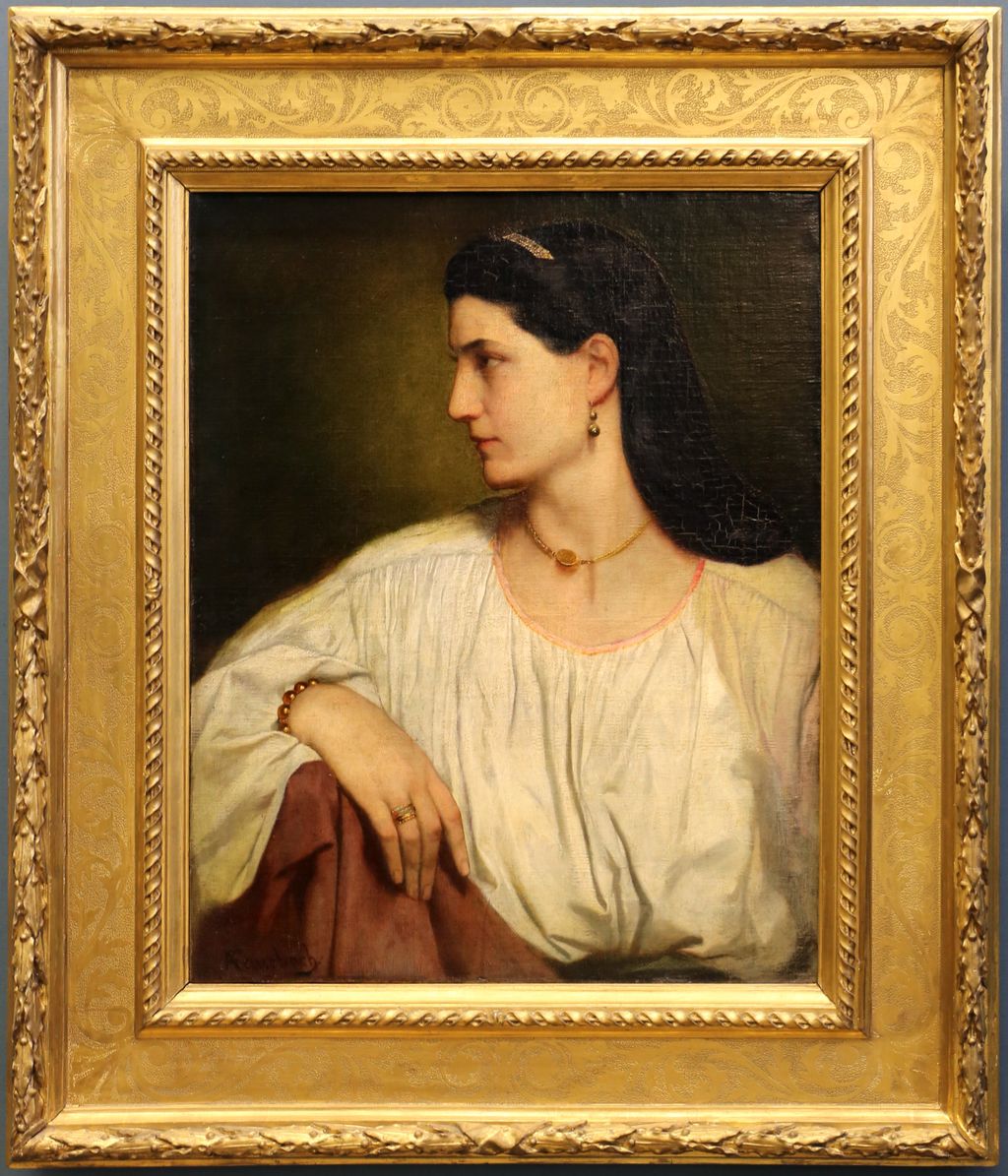
Anselm Feuerbach, Nanna, 1861. Alte Nationalgalerie, Berlin. Photograph by Sailko. Image source. CC BY 3.0. Resized proportionally.
La Nanna at the Royal Academy
The Royal Academy catalogue of 1859 listed Leighton’s La Nanna as no. 281, a few entries before the end of the East Room list. Ernest Rhys, writing towards the end of the century, identified it as the picture later called A Roman Lady and described the black-haired figure facing the spectator. No. 32 was Pavonia, in which Risi turns her head back and a fan of peacock feathers rises behind her. Edgcumbe Staley used that difference of pose and accessory to distinguish the two exhibits in 1906. There was also a third entry, Sunny Hours, no. 118. That work later appeared on the market as La Nanna (Sunny Hours), another instance of the model’s nickname passing from one painting to another. [7] [8] [9] [10]
Leighton also painted Risi in profile against peacock feathers. One of these pictures, Nanna (Pavonia), went to the young Prince of Wales, the future Edward VII. It had been promised to George de Monbrison, and Leighton made him a copy, now at Leighton House. Both profile paintings are separate from the exhibited Pavonia and the Philadelphia picture. Bowood has another small profile head called Portrait of a Lady or La Nanna, acquired for its collection in 1860. Seeing how often Leighton painted Risi in profile makes the directness of the Philadelphia picture stand out. Her hand rises between us and her body, but the gaze travels straight across that distance. [1] [3] [10] [11] [12]
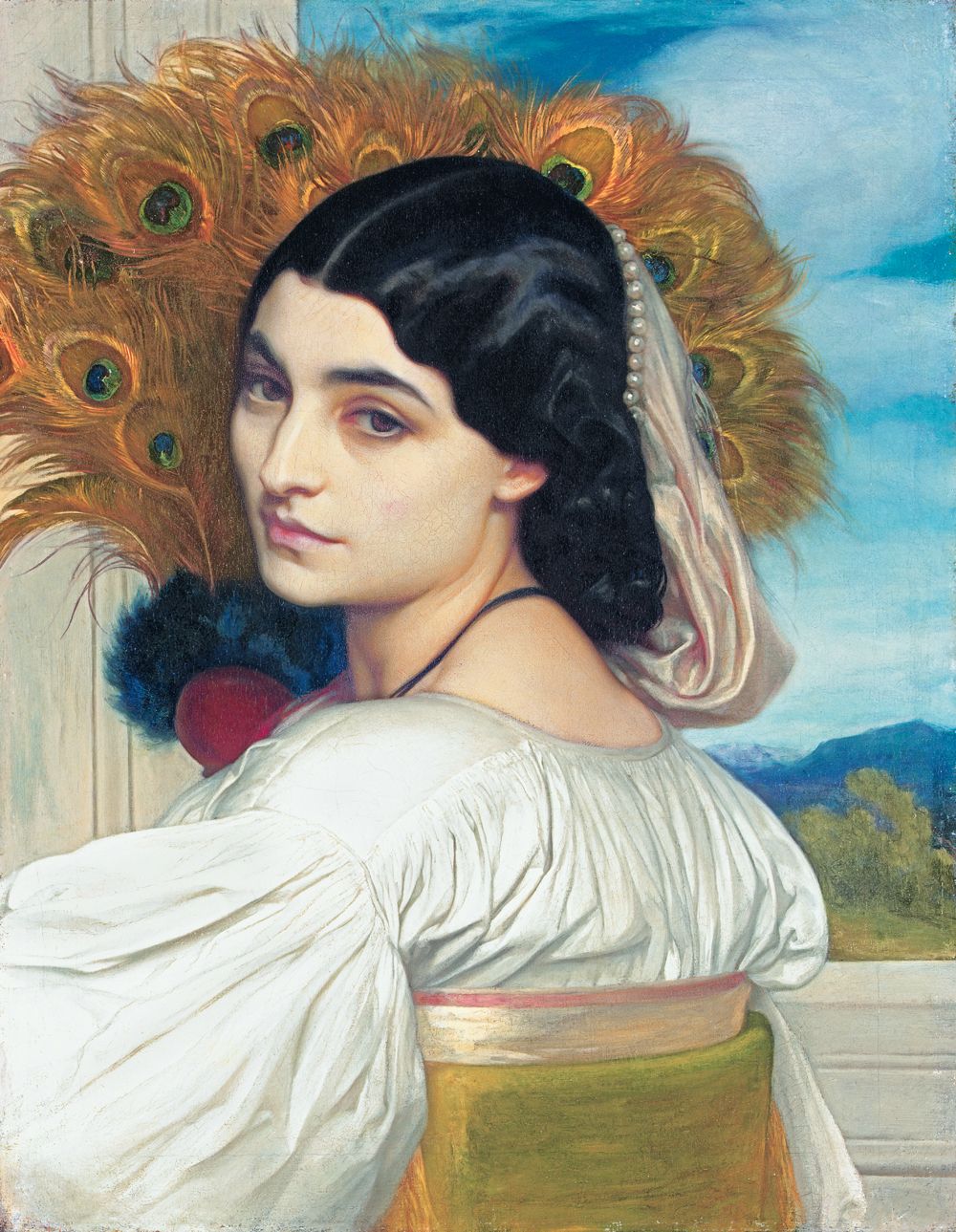
Frederic Leighton, Pavonia, c. 1859. Private collection. Image source. Public domain. Resized proportionally.
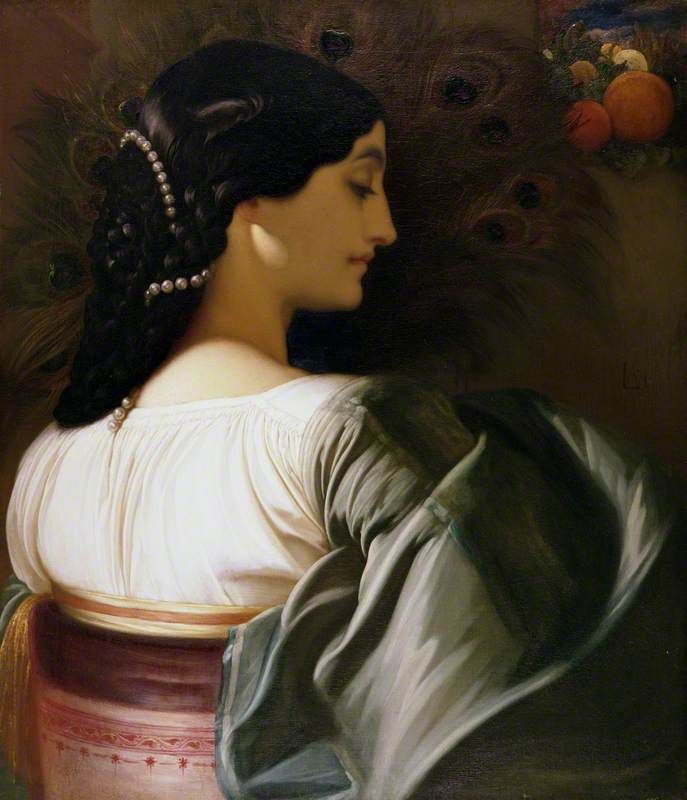
Frederic Leighton, La nanna, Pavonia. Leighton House. Image source. Public domain. Resized proportionally.
What the exhibition made of the painting
London audiences in 1859 were accustomed to paintings whose smallest details could help them work out a story. Two popular pictures at the Academy that year, Abraham Solomon’s Not Guilty and Henry Nelson O’Neil’s Home Again, even invited viewers to remember scenes the artists had exhibited in previous years. Risi’s dress and the carved setting evoke another age, but Leighton gives her no known narrative role here. The painted details reward attention in their own right. A viewer can follow the hand to the necklace and then return to the expression without settling what has just happened or what Risi is about to do. [1] [13] [14]
The Philadelphia museum describes the reception as favourable. Reviewing Leighton’s Italian heads together, The Athenaeum called their painter a “young old master”, praise that recognised both his command of oil paint and his affinity with older art. Anne-Florence Gillard-Estrada sees the Risi paintings as early examples of a kind of figure picture that would become characteristic of British Aestheticism. A recognisable model could supply the face and bearing, while the painter could use clothing, colour and scale to draw attention to the experience of looking. Here the gleam on the sleeve is strong enough to draw the viewer away from the face, yet the line of the pearls and the finger poised beside them bring us back. [1] [8] [10] [14]
More than twenty years later, as president of the Royal Academy, Leighton spoke to its students about what painting could do through form, colour, light and shade. He argued that visual art could arouse feelings that depended on seeing and could awaken more complicated associations through them. He also believed that the artist’s moral character inevitably coloured the work. The 1881 lecture puts into words an ambition already visible in A Roman Lady. The fabric, the small gesture at the throat and the expression each give us something definite to look at. What we make of her composure remains open. [1] [8] [15]
Browse Frederic Leighton’s artworks
Explore paintings, drawings, sculptures and prints, with separate rows for identified preparatory works, reproductions and casts.
| Name | Date | Medium |
|---|---|---|
| A Girl Feeding Peacocks | Exhibited 1863 | Painting Catalogue. |
| A Recognition from ‘Romola’, engraved by Swain (Tate N04054) | published 1862 | Print Catalogue. |
| A Roman Lady | 1859 | Painting Catalogue. |
| Abram and the Angel (Tate A00733) | published 1881 | Print Catalogue. |
| Acme and Septimius | Exhibited 1868 | Painting Catalogue. |
| An Athlete Wrestling with a Python (Tate exhibition bronze) | 1877 | Sculpture Catalogue. |
| And the Sea Gave Up the Dead Which Were in It (Tate N01511) | 1891–92 | Painting Catalogue. |
| Andromache in Captivity (photogravure after Leighton) | 1889 | Print Catalogue. |
| Athlete Wrestling with a Python (Anglesey Abbey cast) | model 1877; cast 1905 | Sculpture Catalogue. |
| Athlete Wrestling with a Python (Hood reduced cast) | 1877 (inscribed model date) | Sculpture Catalogue. |
| Athlete Wrestling with a Python (Saint Louis reduced cast) | 1877 (museum date) | Sculpture Catalogue. |
| Cain and Abel (Tate A00731) | published 1881 | Print Catalogue. |
| Captive Andromache | 1888 | Painting Catalogue. |
| Cimabue's Celebrated Madonna | 1853–55 | Painting Catalogue. |
| Cimon and Iphigenia, with Many Smaller Subjects (Tate T09061) | date not known | Drawing Catalogue. |
| Crenaia, the Nymph of the Dargle | Exhibited 1880 | Painting Catalogue. |
| Cymon and Iphigenia | 1884 | Painting Catalogue. |
| Daedalus and Icarus | 1869 | Painting Catalogue. |
| Dante in Exile | 1864 | Painting Catalogue. |
| Death of the First Born (Tate A00737) | published 1881 | Print Catalogue. |
| Electra at the Tomb of Agamemnon | c. 1869 | Painting Catalogue. |
| Eliezer and Rebekah (Tate A00735) | published 1881 | Print Catalogue. |
| Elijah in the Wilderness | 1877–78 | Painting Catalogue. |
| Fanny Kemble: A Study for ‘Jezebel and Ahab’ (Tate T08208) | c.1862 | Drawing Catalogue. |
| Figure Studies | Date not recorded | Drawing Catalogue. |
| Flaming June | 1895 | Painting Catalogue. |
| Gulnihal | Exhibited 1886 | Painting Catalogue. |
| Helios and Rhodes (Tate N03015) | date not known | Painting Catalogue. |
| Hercules Wrestling with Death for the Body of Alcestis | c. 1869–71 | Painting Catalogue. |
| Jonathan's Token to David | c. 1868 | Painting Catalogue. |
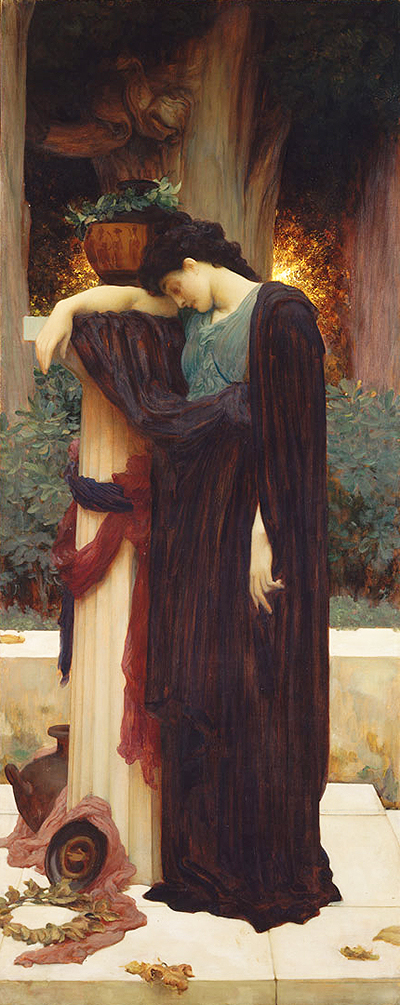
| Lachrymae | 1894–95 | Painting Catalogue. |
| Lieder ohne Worte | Exhibited 1861 | Painting Catalogue. |
| Light of the Harem | Exhibited 1880 | Painting Catalogue. |
| Moses Views the Promised Land (Tate A00736) | published 1881 | Print Catalogue. |
| Mrs James Guthrie | 1865 | Painting Catalogue. |
| Mrs John Hanson Walker (Tate N04731) | 1867 | Painting Catalogue. |
| Music Lesson | 1877 | Painting Catalogue. |
| Needless Alarms (Met cast) | modelled 1886; cast nineteenth century | Sculpture Catalogue. |
| Needless Alarms (Tate N05120) | 1886 | Sculpture Catalogue. |
| Pavonia | c. 1859 | Painting Catalogue. |
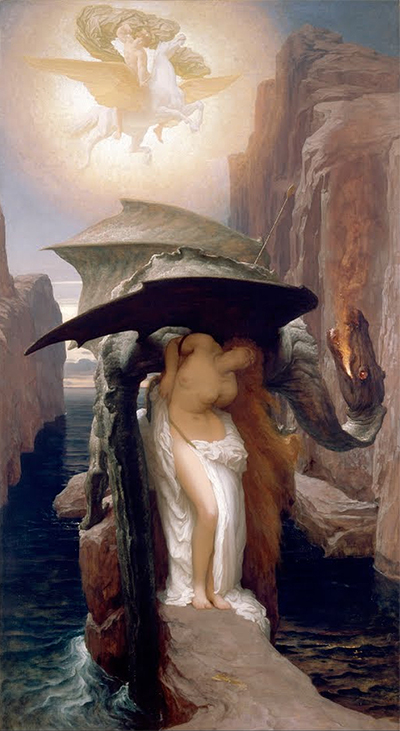
| Perseus and Andromeda | 1891 | Painting Catalogue. |
| Portrait of May Sartoris | c. 1860 | Painting Catalogue. |
| Preparing for a Festa, Florence (Tate T09062) | date not known | Drawing Catalogue. |
| Puerta de los Vientos, near Ronda, Spain (Tate N04006) | c.1886–9 | Painting Catalogue. |
| Samson and the Lions (Tate A00732) | published 1881 | Print Catalogue. |
| Samson at the Mill (Tate A00734) | published 1881 | Print Catalogue. |
| Samson Carrying the Gate (Tate A00738) | published 1881 | Print Catalogue. |
| Sketch for ‘An Athlete Wrestling with a Python’ (Tate N01761) | c.1877 | Sculpture Catalogue. |
| Sketches for Cimon and Iphigenia (Tate T09060) | date not known | Drawing Catalogue. |
| Study for The Return of Persephone (Demeter) | c. 1890–91 | Drawing Catalogue. |
| Study for The Return of Persephone (Persephone) | c. 1890–91 | Drawing Catalogue. |
| Study for ‘Needless Alarms’ (Tate N02945) | 1886 | Sculpture Catalogue. |
| Study for ‘The Discovery of Juliet Apparently Lifeless’ (Tate N01806) | c.1858 | Painting Catalogue. |
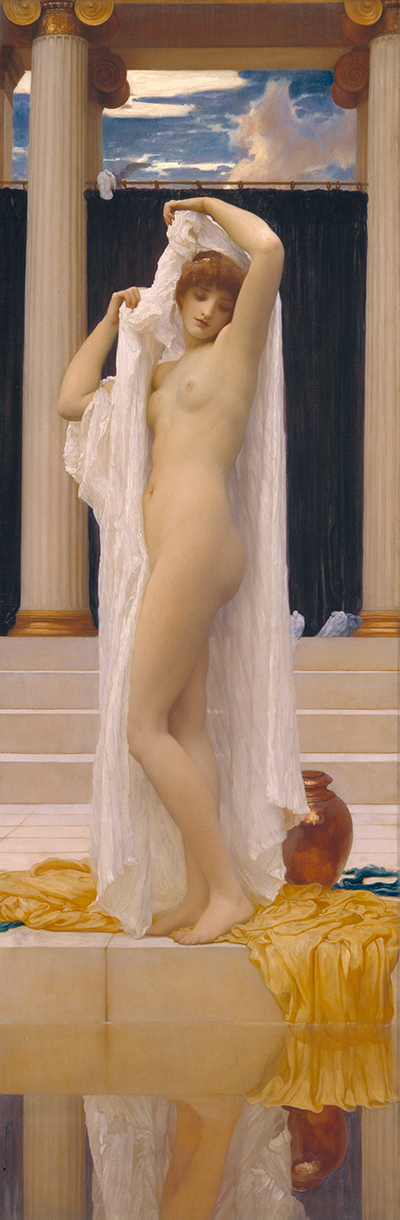
| The Bath of Psyche | Exhibited 1890 | Painting Catalogue. |
| The Daphnephoria | 1874–76 | Painting Catalogue. |
| The Death of Brunelleschi | 1852 | Painting Catalogue. |
| The Fisherman and the Siren | Exhibited 1858 | Painting Catalogue. |
| The Painter's Honeymoon | c. 1864 | Painting Catalogue. |
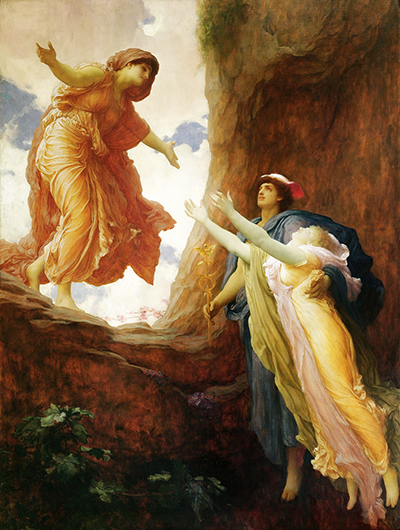
| The Return of Persephone | 1891 | Painting Leeds painting identified in the Met study record. |
| The Return of Persephone (preparatory oil) | c. 1890–91 | Painting Catalogue. |
| The Sluggard (Anglesey Abbey cast) | probably 1890–about 1906 | Sculpture Catalogue. |
| The Sluggard (Met cast) | modelled 1886; cast possibly before 1896 | Sculpture Catalogue. |
| The Sluggard (Museum Wales) | 1882–85 (museum date) | Sculpture Catalogue. |
| The Sluggard (Tate N01752) | 1885 | Sculpture Catalogue. |
| The Spies Escape (Tate A00730) | published 1881 | Print Catalogue. |
| Various Subjects (Tate T09063) | date not known | Drawing Catalogue. |
| View in Capri | Possibly 1859 | Painting Catalogue. |
| Wedded | 1882 | Painting Catalogue. |
| Winding the Skein | c. 1878 | Painting Catalogue. |
Discussion
Look again at the images and ideas explored in A Roman Lady. These editorial prompts invite your observations.
Reader Insights
Where does the broad satin sleeve lead your eye?
How does the direct look in the Philadelphia portrait differ from the turn in the fan painting?
Join the Conversation
Share a detail, comparison or question about A Roman Lady below.
References
- Philadelphia Museum of Art. Portrait of a Roman Lady (La Nanna). Collection record and image, object 70918, accession 1976-34-1. View source.
- Guy Peppiatt Fine Art. Study of the Mona Lisa. Catalogue entry for Leighton’s 1856 pencil drawing, quoting Giovanni Costa’s “Notes on Lord Leighton,” The Cornhill Magazine, March 1897, p. 376. View source.
- Barrington, Emilie, ed. The Life, Letters and Work of Frederic Leighton, vol. II. 1906. Chapter I, Leighton’s letters to his mother from Rome and Naples, 1859, and subsequent London correspondence. View source.
- Le Famiglie Brunacci. Vita di Anna Risi attraverso i certificati archivistici. 2013. Research account of the baptismal record in the Albano diocesan archive and the death certificate in Rome. View source.
- Staatliche Museen zu Berlin, Alte Nationalgalerie. Anselm Feuerbach, Nanna. 1861. Collection record A I 757 and sitter chronology. View source.
- Staatliche Kunsthalle Karlsruhe. Nathanael Schmitt, Bildnis der Nana Risi. 1874. Collection record 2202. View source.
- Royal Academy of Arts. The Exhibition of the Royal Academy, 1859. Original exhibition catalogue, pp. 6, 9 and 15, nos. 32, 118 and 281, digitised by the Paul Mellon Centre. View source.
- Rhys, Ernest. Frederic Lord Leighton: An Illustrated Record of His Life and Work. Sections on the early career and the discourses on art, and appendix I, list of works. View source.
- Staley, Edgcumbe. Lord Leighton of Stretton, P.R.A. (1906), p. 56, separate descriptions of A Roman Lady and Pavonia. View source.
- Christie’s. Pavonia. Lot 19, 13 July 2016. Exhibition history, comparison of the Risi pictures and passages from the 1859 reviews. View source.
- Royal Collection Trust. Nanna (Pavonia). Collection record RCIN 404570, 1859. View source.
- Bowood. Portrait of a Lady or La Nanna. Collection feature, 1 December 2025, with the Bowood picture and its acquisition. View source.
- Fletcher, Pamela. “1859: Sequel Paintings”. The Royal Academy of Arts Summer Exhibition: A Chronicle, 1769–2018. Paul Mellon Centre for Studies in British Art, 2018. View source.
- Gillard-Estrada, Anne-Florence. “Ideal yet Actual: Actresses Posing as Antique Heroines in Late-Victorian ‘Classical’ Portraits”. Interfaces 51, 2024, para. 22, on the Risi pictures and Aestheticism. View source.
- Leighton, Frederic. Addresses Delivered to the Students of the Royal Academy. 1897 edition. Discourse delivered on 10 December 1881, on art, morals and religion. View source.