 by Tom Gurney
Tom Gurney BSc (Hons) is an art history expert with over 20 years experience
Published on June 19, 2020 / Updated on November 29, 2026
Email: tomgurney1@gmail.com / Phone: +44 7429 011000
Mrs James Guthrie: Introduction
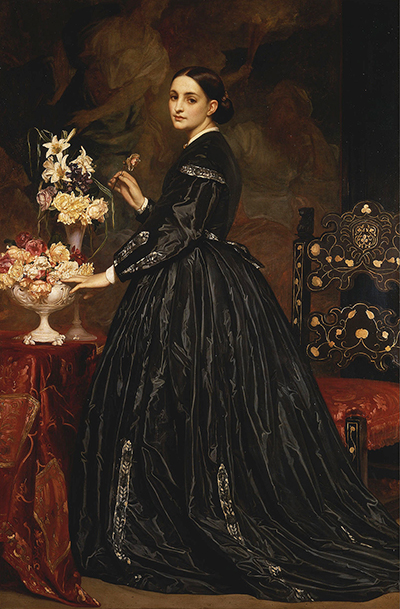
Ellinor Guthrie has stopped with a flower still between her fingers. Her body faces the table, but her head has turned and her eyes meet ours. Below that brief exchange, black silk takes up almost half the canvas. Frederic Leighton painted this full-length portrait in oil on canvas, 210.8 by 138.4 centimetres. The Yale Center for British Art dates it to 1865 and calls it Ellinor Guthrie (née Stirling). It keeps the work in the Paul Mellon Collection in New Haven. Mrs. James Guthrie appears as entry number seven in the Royal Academy catalogue of 1866. [1] [2]
At a Glance
- SitterEllinor Guthrie, née Stirling
- Painted1865
- ExhibitedRoyal Academy, 1866, no. 7
- CollectionYale Center for British Art
This work across Frederic Leighton’s career
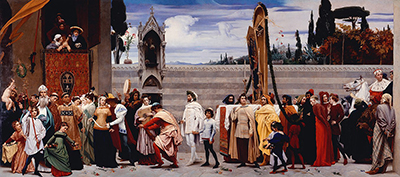
Cimabue’s Celebrated Madonna
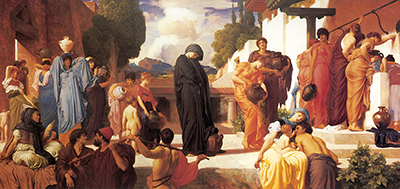
1853–55Lachrymae
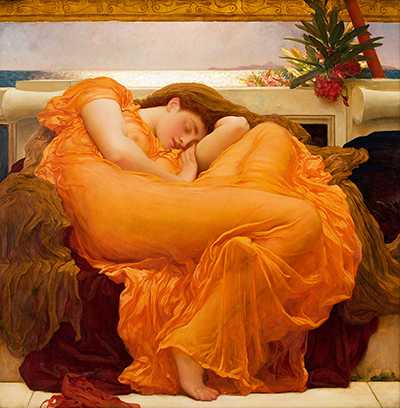
1894–95Flaming June
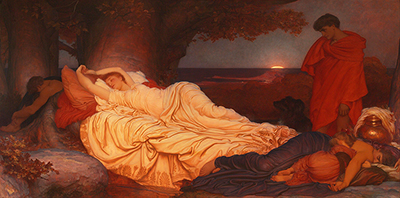
c. 1895Contents
- Ellinor Stirling and the sittings
- How Leighton paints black silk
- What is she doing with the flowers?
- Two ways to paint a society portrait
- From the Royal Academy to Yale
- Annotated details
Ellinor Stirling and the sittings
Ellinor was born in Perth in 1838, the daughter of Ellen and James Stirling. Her father was a naval officer who helped drive British colonisation on the Swan River and became Western Australia’s first governor. She spent part of her childhood in England and married the Scottish merchant banker James Alexander Guthrie in 1856. The couple lived in Portland Place, London. The Academy title followed a convention that identified a married woman by her husband’s name. Yale’s title gives the sitter her own name and restores the link to the family into which she was born. [1] [3]
Leighton knew the Guthries socially. Yale’s provenance notes consider two possible beginnings for the picture, a commission from the family or a portrait he gave them as a friend. In 1864 Leighton wrote to his father that he had put off the full-length portrait until winter because of Ellinor’s health. Yale links the delay to her recovery after the birth of her fifth child, a daughter born that October. An older museum checklist gives the painting a wider date of about 1864–65. [1] [4] [5]
James Stirling died in April 1865. Yale’s 2020 gallery label suggests that mourning for her father may account for Ellinor’s black dress. It is an apt possibility given the coincidence of date, but the dress is also the most elaborate surface in the picture. Its bands of pale ornament catch the same light as her cuffs, and its ample train occupies almost the entire lower edge. Mourning offers one way to understand the choice of black. The way Leighton paints the silk conveys the expense and ceremony of dressing for a portrait on this scale. [1] [3] [6]
How Leighton paints black silk
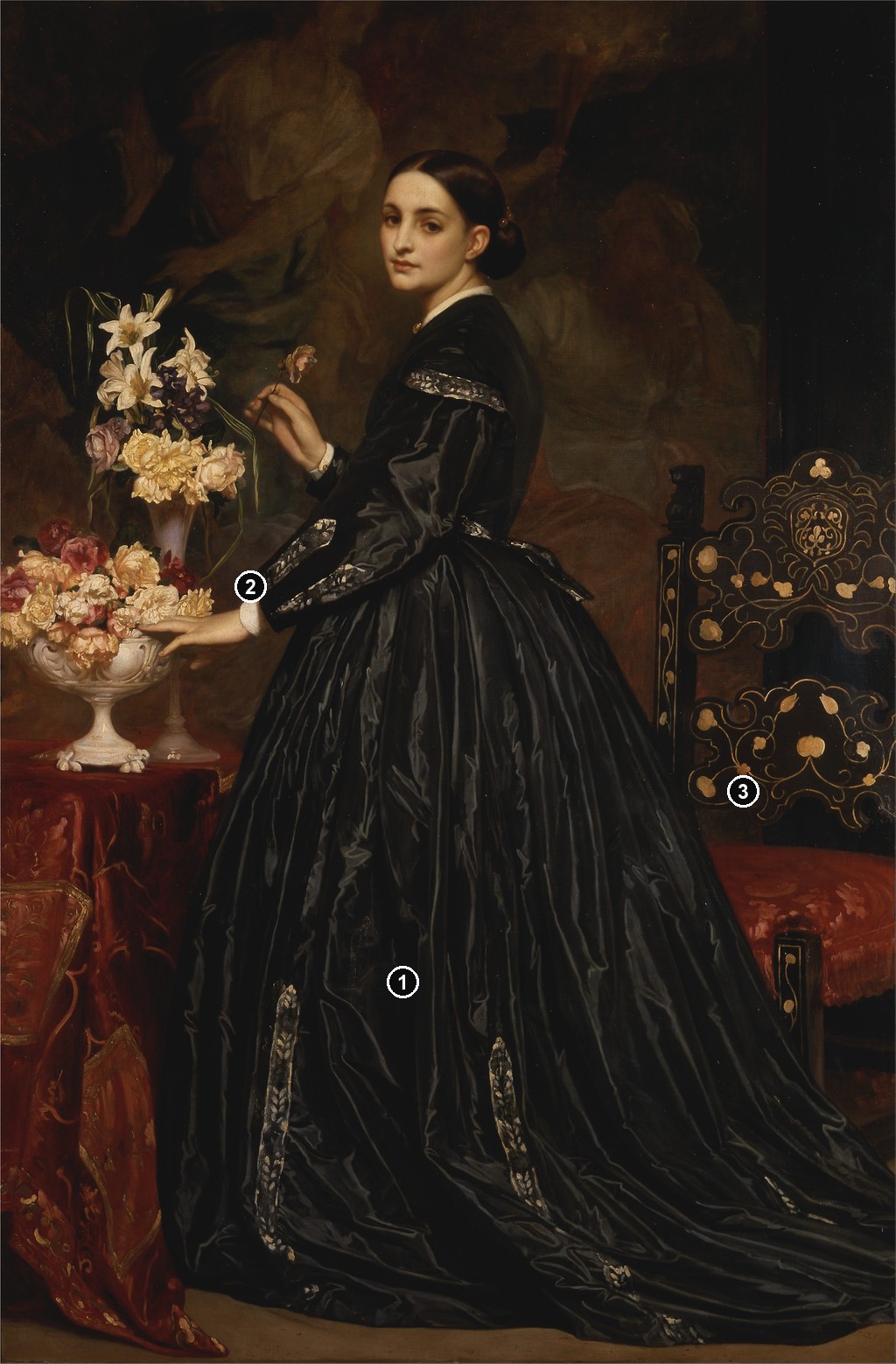
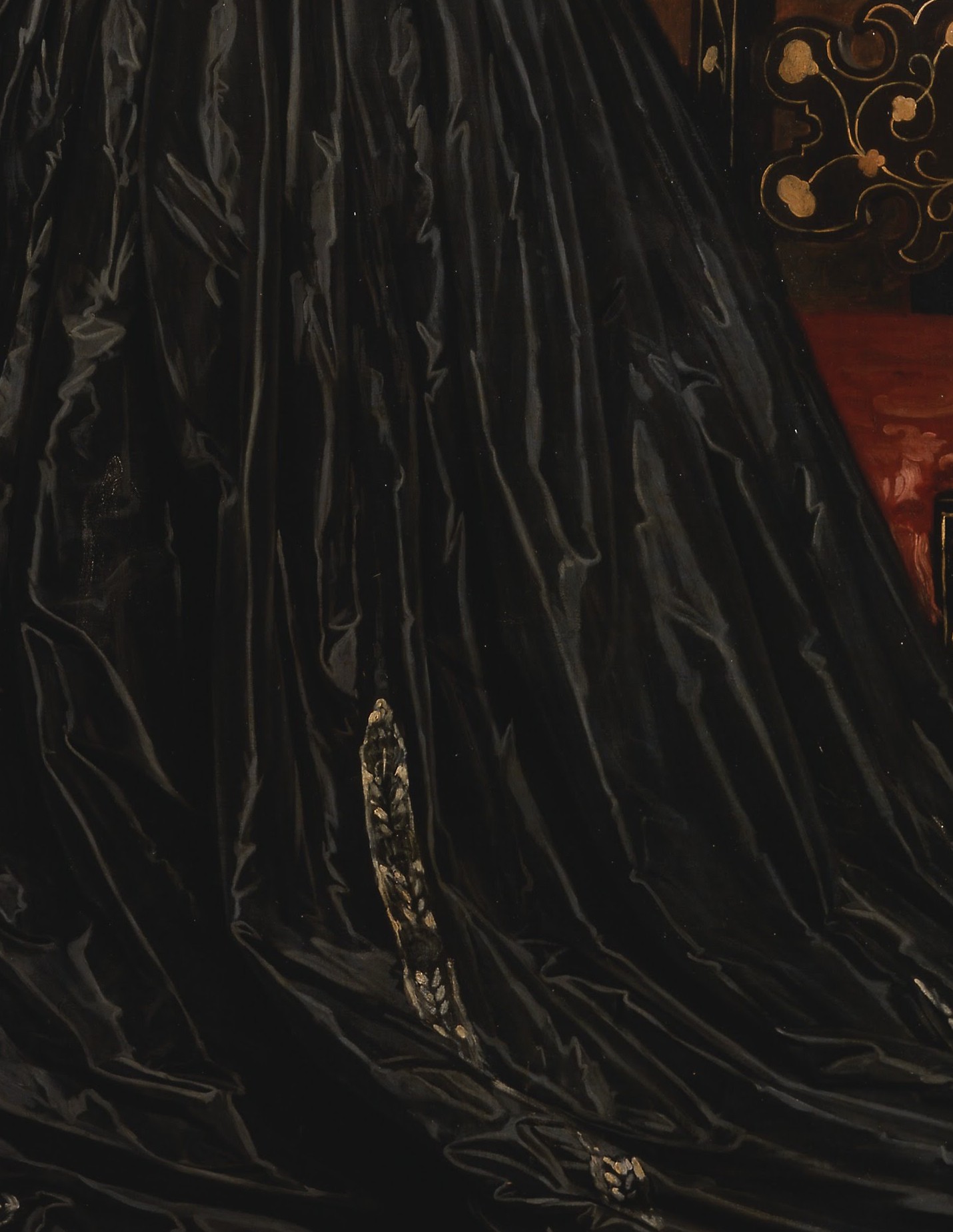
From a distance the gown looks like a single dark sweep. Up close it breaks into strokes of grey separated by deep black channels. On the sleeve the highlights turn sharply where the silk bends around the arm. Below the waist they lengthen and run towards the floor, then turn as the train spreads to the right. The fine pale bands interrupt these folds in places and disappear into them in others. By following just one edge of the skirt down from the waist, it is possible to see how he gives a seemingly unbroken colour weight and movement.
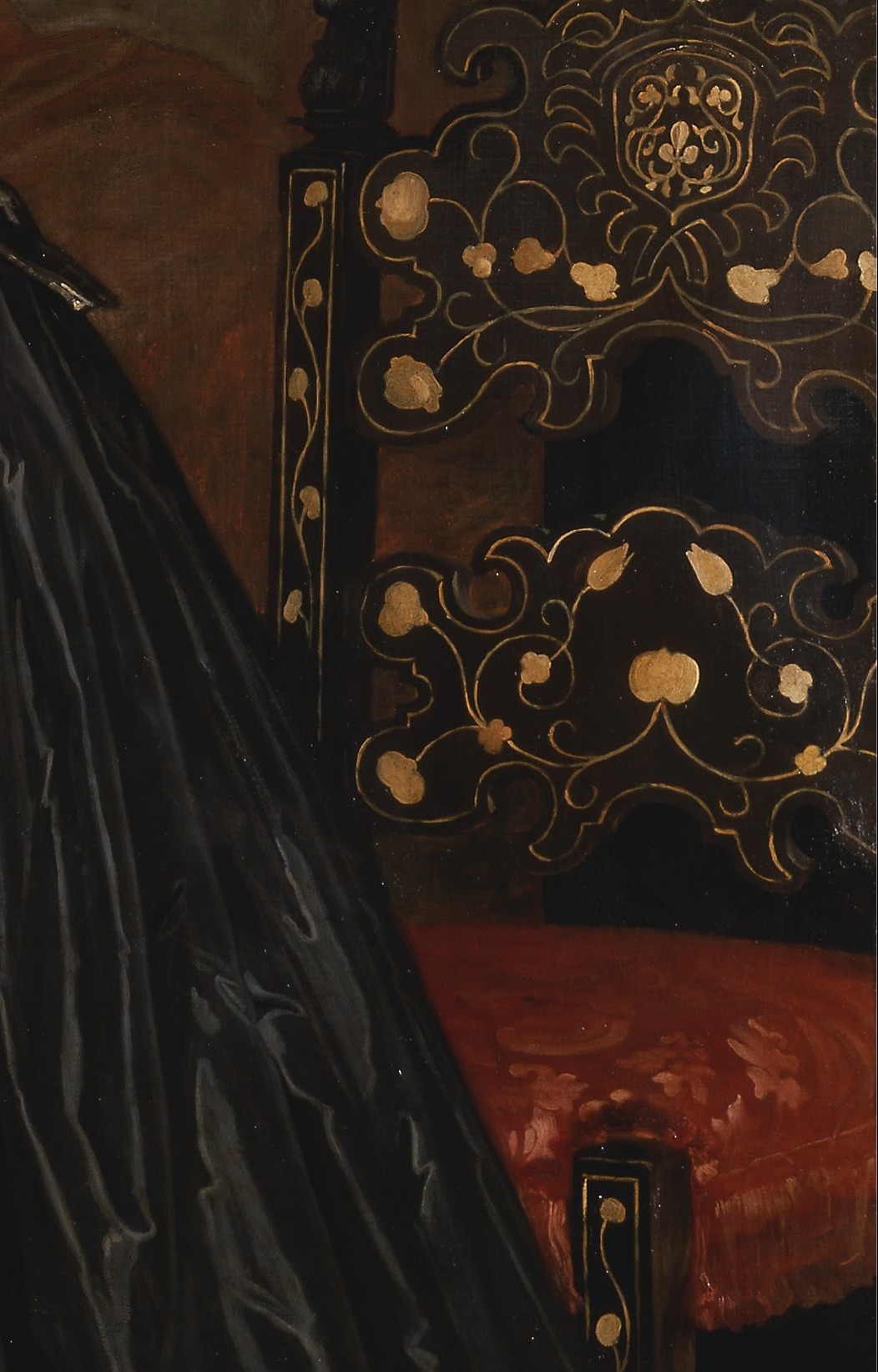
The table covering and the chair cushion pick up the warmer colours in the flowers. The scrolling gold pattern on the chair echoes the pale bands on the dress, though it stays flat against the upright back while the bands on the silk curve into the shadows. Look behind Ellinor’s head and a much dimmer group of figures comes into view. Yale curator Malcolm Warner identified that backdrop as a large Baroque painting, probably among the furnishings of Leighton’s studio. It gives the portrait the air of an interior full of art, while its softly visible forms make the sharp edge of Ellinor’s face and the precision of her hands all the more evident. It is tempting to imagine this room in the Guthries’ house. If the backdrop came from Leighton’s studio, then much of the impression of a richly furnished home was his to construct. Warner also draws attention to the colours the furnishings and the flowers share with her complexion. The muted pink along her cheek and the warm light on her fingers seem stronger after the eye has travelled through all the dark silk between them. [1]
What is she doing with the flowers?
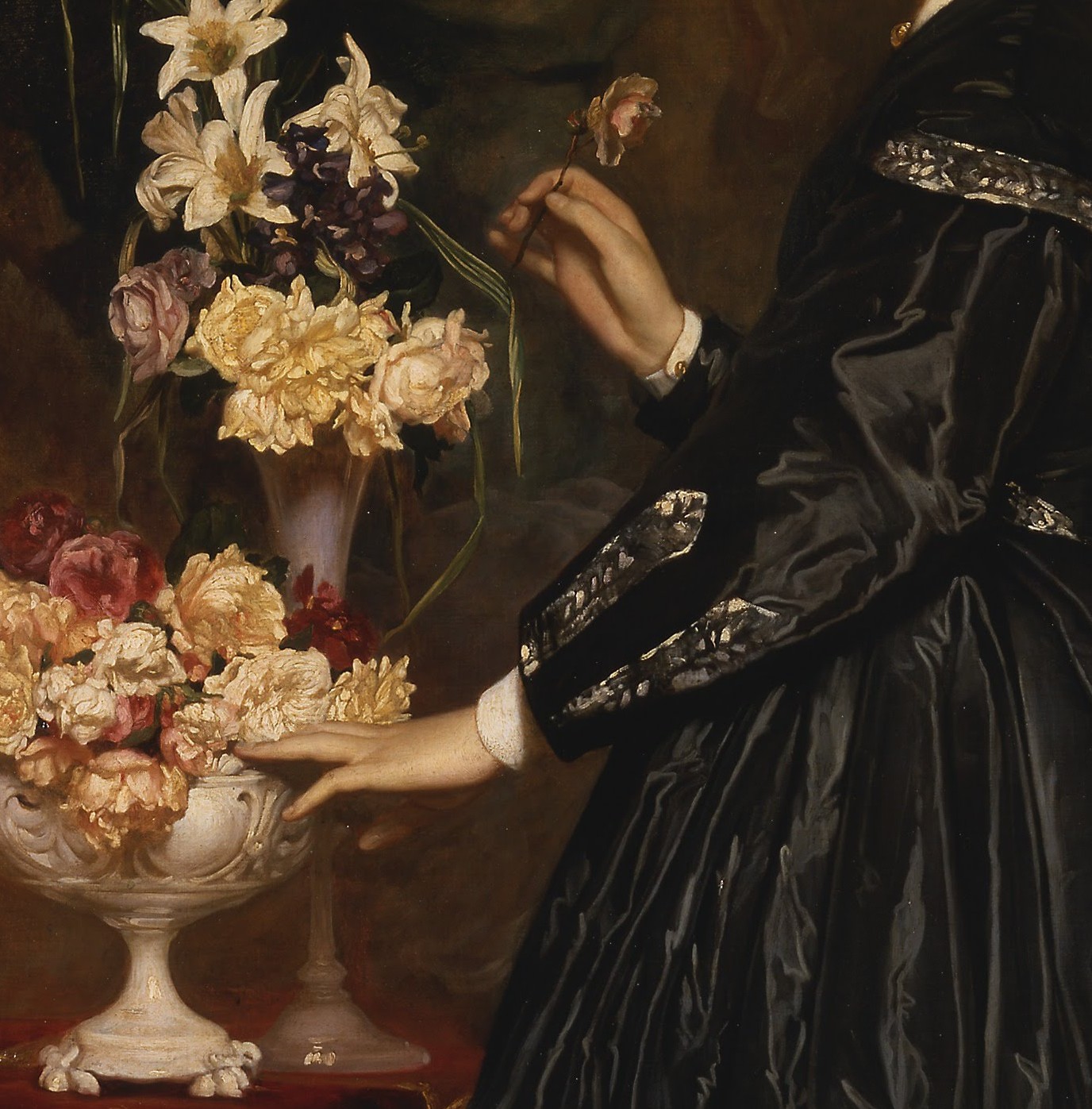
The taller vase lifts a group of white flowers towards Ellinor’s face. The fuller arrangement in the footed bowl brings pale yellow and red down to her left hand. Her right hand holds one slight, drooping stem in the space between her face and the two arrangements. The dark interval behind the stem makes it easy to pick out the curl of the petals and the bend of her fingers.
Yale’s current label suggests that the wilting flowers may allude to Ellinor’s difficult recovery. Gary and Linda Friedlaender used the same painting in their account of teaching close observation through art at Yale. They asked readers to work out whether she is taking the flower away or putting it into the vase. They point to the brown stem and curling petals as evidence for removal. The stem also looks too short to reach the water in the taller vessel from the position in which she holds it. Their reading gives the gesture a practical explanation and leaves open the question of what, if anything, Leighton meant it to symbolise. A person arranging flowers has good reason to pause over one that has wilted. [1] [7]
Annotated Details from Mrs James Guthrie
The numbered points identify visible features discussed in this article. Return from each detail to the numbered overview. Frederic Leighton, Mrs. James Guthrie, 1865. Yale Center for British Art. Image source. Public domain. Resized proportionally.
Details from MRS JAMES GUTHRIE
Compare the cropped details with the source images above. Notice how their colours, shapes and positions contribute to the larger compositions.
Light along the black silk
Long strokes of reflected light follow the descending folds. Small paler details of embroidery pick out changes where the dress turns towards the viewer.
A stem held beside the flowers
Ellinor holds one stem apart from the arranged flowers. The movement remains small against the sweep of the dress.
Gold decoration in the dark room
The patterned chair brings small gold shapes into the shadows behind her. The dark gown stands close in tone to the furnishings while light separates their edges.
Two ways to paint a society portrait
In Leighton’s earlier Portrait of May Sartoris, an adolescent in a dark riding habit gathers her skirt as she approaches along a country path. The bright scarf flickers against her jacket, and the lifted hem gives us a glimpse of her shoe. Ellinor’s gown falls all the way to the floor and spreads across it. The gesture Leighton catches is smaller here. The turn of her neck and the tiny amount of space between her fingers and the bouquet give a sense of movement within a much more formal pose. The two portraits make clothing part of what the sitter is doing, whether crossing rough ground or reaching for a flower indoors. [1] [8]
Ingres’s seated Madame Moitessier, completed in 1856, offers a different comparison. She too had married a wealthy banker, and her surroundings announce the ease and expense of her life. Writing for an Ingres exhibition at the Musée de la Vie romantique, Catherine Lépront describes how the artist spreads the skirt across the picture until it has the flatness of a decorative pattern. Leighton turns the varying sheen of Ellinor’s dress into a record of folds deepening and opening as they descend. The flowers have their own place on the table and in her hand, where one of them can be handled and discarded. [9] [10]
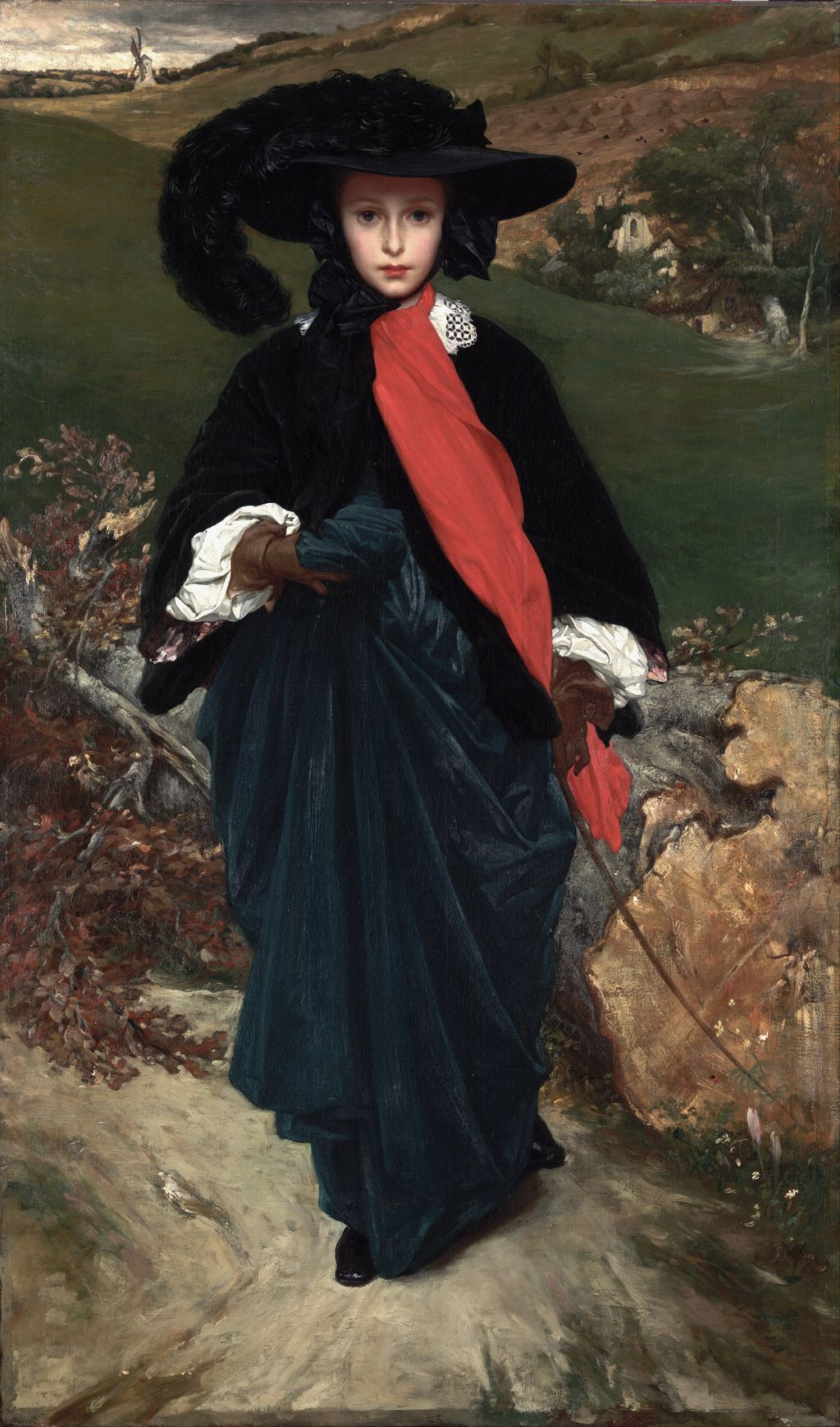
Frederic Leighton, Portrait of May Sartoris, c. 1860. Kimbell Art Museum. Image source. Public domain. Resized without changing the composition.
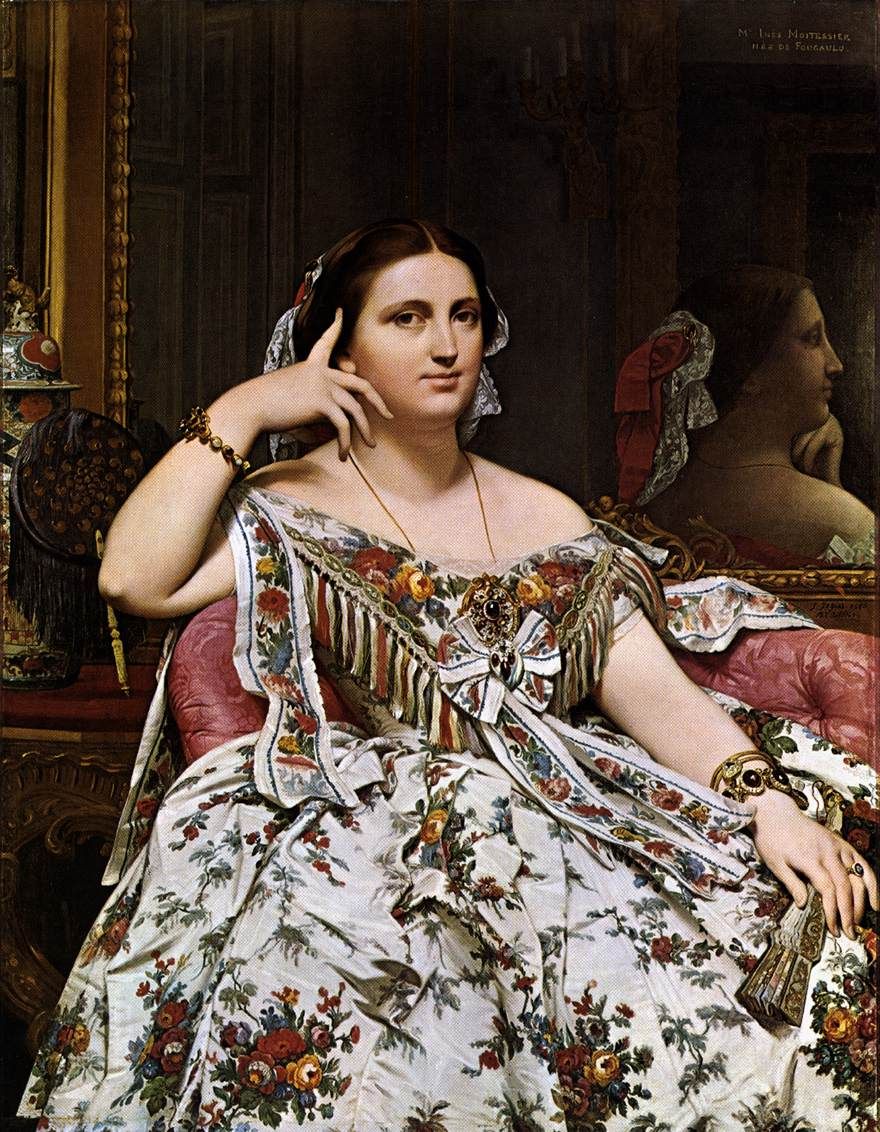
Jean-Auguste-Dominique Ingres, Madame Moitessier, 1856. The National Gallery, London. Image source. Public domain. Resized proportionally.
From the Royal Academy to Yale
At the 1866 Academy exhibition, visitors found Ellinor’s likeness in the East Room, which also contained Leighton’s Painter’s Honeymoon. They could then pass to the Middle Room to see his long processional picture, The Syracusan Bride, inspired by a passage in Theocritus. The early biographer Ernest Rhys discusses the three paintings together, and Emilie Barrington and Malcolm Warner identify Ellinor as the model for the head of the central figure in the procession. The woman who puts her flowers in order in the portrait lends her features to a figure leading a lioness in the classical scene. [1] [2] [4] [11] [12]
The portrait passed through the Guthrie family, and Paul Mellon bought it and gave it to the Yale Center for British Art in 1978. Its subsequent exhibition history includes The Swagger Portrait at the Tate in 1992–93. It is easy to see why the scale and silk suited an exhibition devoted to conspicuous display. The pose has a quieter effect in front of the canvas. Leighton builds the kind of setting that invites us to take in the whole room, then keeps drawing us back to the moment when Ellinor looks up from the flowers. [1]
Browse Frederic Leighton’s artworks
Explore paintings, drawings, sculptures and prints, with separate rows for identified preparatory works, reproductions and casts.
| Name | Date | Medium |
|---|---|---|
| A Girl Feeding Peacocks | Exhibited 1863 | Painting Catalogue. |
| A Recognition from ‘Romola’, engraved by Swain (Tate N04054) | published 1862 | Print Catalogue. |
| A Roman Lady | 1859 | Painting Catalogue. |
| Abram and the Angel (Tate A00733) | published 1881 | Print Catalogue. |
| Acme and Septimius | Exhibited 1868 | Painting Catalogue. |
| An Athlete Wrestling with a Python (Tate exhibition bronze) | 1877 | Sculpture Catalogue. |
| And the Sea Gave Up the Dead Which Were in It (Tate N01511) | 1891–92 | Painting Catalogue. |
| Andromache in Captivity (photogravure after Leighton) | 1889 | Print Catalogue. |
| Athlete Wrestling with a Python (Anglesey Abbey cast) | model 1877; cast 1905 | Sculpture Catalogue. |
| Athlete Wrestling with a Python (Hood reduced cast) | 1877 (inscribed model date) | Sculpture Catalogue. |
| Athlete Wrestling with a Python (Saint Louis reduced cast) | 1877 (museum date) | Sculpture Catalogue. |
| Cain and Abel (Tate A00731) | published 1881 | Print Catalogue. |
| Captive Andromache | 1888 | Painting Catalogue. |
| Cimabue's Celebrated Madonna | 1853–55 | Painting Catalogue. |
| Cimon and Iphigenia, with Many Smaller Subjects (Tate T09061) | date not known | Drawing Catalogue. |
| Crenaia, the Nymph of the Dargle | Exhibited 1880 | Painting Catalogue. |
| Cymon and Iphigenia | 1884 | Painting Catalogue. |
| Daedalus and Icarus | 1869 | Painting Catalogue. |
| Dante in Exile | 1864 | Painting Catalogue. |
| Death of the First Born (Tate A00737) | published 1881 | Print Catalogue. |
| Electra at the Tomb of Agamemnon | c. 1869 | Painting Catalogue. |
| Eliezer and Rebekah (Tate A00735) | published 1881 | Print Catalogue. |
| Elijah in the Wilderness | 1877–78 | Painting Catalogue. |
| Fanny Kemble: A Study for ‘Jezebel and Ahab’ (Tate T08208) | c.1862 | Drawing Catalogue. |
| Figure Studies | Date not recorded | Drawing Catalogue. |
| Flaming June | 1895 | Painting Catalogue. |
| Gulnihal | Exhibited 1886 | Painting Catalogue. |
| Helios and Rhodes (Tate N03015) | date not known | Painting Catalogue. |
| Hercules Wrestling with Death for the Body of Alcestis | c. 1869–71 | Painting Catalogue. |
| Jonathan's Token to David | c. 1868 | Painting Catalogue. |
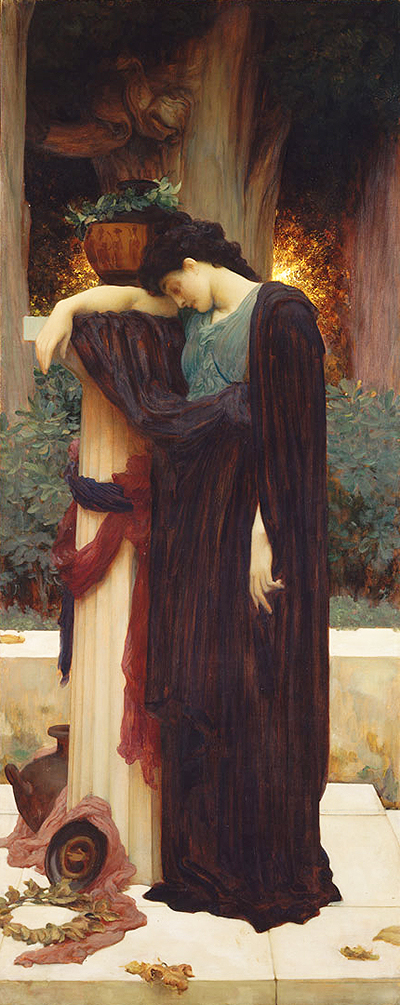
| Lachrymae | 1894–95 | Painting Catalogue. |
| Lieder ohne Worte | Exhibited 1861 | Painting Catalogue. |
| Light of the Harem | Exhibited 1880 | Painting Catalogue. |
| Moses Views the Promised Land (Tate A00736) | published 1881 | Print Catalogue. |
| Mrs James Guthrie | 1865 | Painting Catalogue. |
| Mrs John Hanson Walker (Tate N04731) | 1867 | Painting Catalogue. |
| Music Lesson | 1877 | Painting Catalogue. |
| Needless Alarms (Met cast) | modelled 1886; cast nineteenth century | Sculpture Catalogue. |
| Needless Alarms (Tate N05120) | 1886 | Sculpture Catalogue. |
| Pavonia | c. 1859 | Painting Catalogue. |
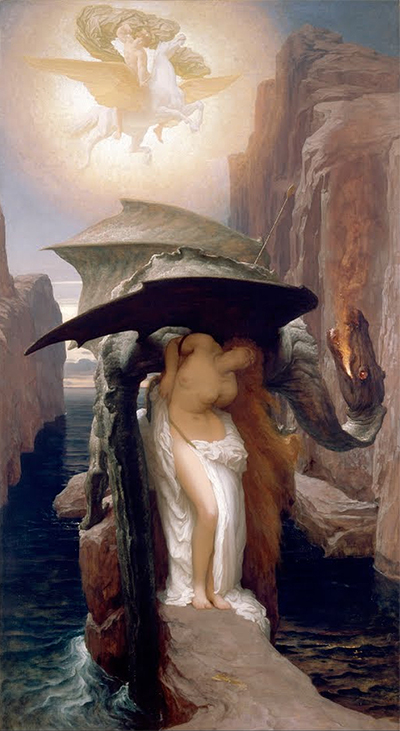
| Perseus and Andromeda | 1891 | Painting Catalogue. |
| Portrait of May Sartoris | c. 1860 | Painting Catalogue. |
| Preparing for a Festa, Florence (Tate T09062) | date not known | Drawing Catalogue. |
| Puerta de los Vientos, near Ronda, Spain (Tate N04006) | c.1886–9 | Painting Catalogue. |
| Samson and the Lions (Tate A00732) | published 1881 | Print Catalogue. |
| Samson at the Mill (Tate A00734) | published 1881 | Print Catalogue. |
| Samson Carrying the Gate (Tate A00738) | published 1881 | Print Catalogue. |
| Sketch for ‘An Athlete Wrestling with a Python’ (Tate N01761) | c.1877 | Sculpture Catalogue. |
| Sketches for Cimon and Iphigenia (Tate T09060) | date not known | Drawing Catalogue. |
| Study for The Return of Persephone (Demeter) | c. 1890–91 | Drawing Catalogue. |
| Study for The Return of Persephone (Persephone) | c. 1890–91 | Drawing Catalogue. |
| Study for ‘Needless Alarms’ (Tate N02945) | 1886 | Sculpture Catalogue. |
| Study for ‘The Discovery of Juliet Apparently Lifeless’ (Tate N01806) | c.1858 | Painting Catalogue. |
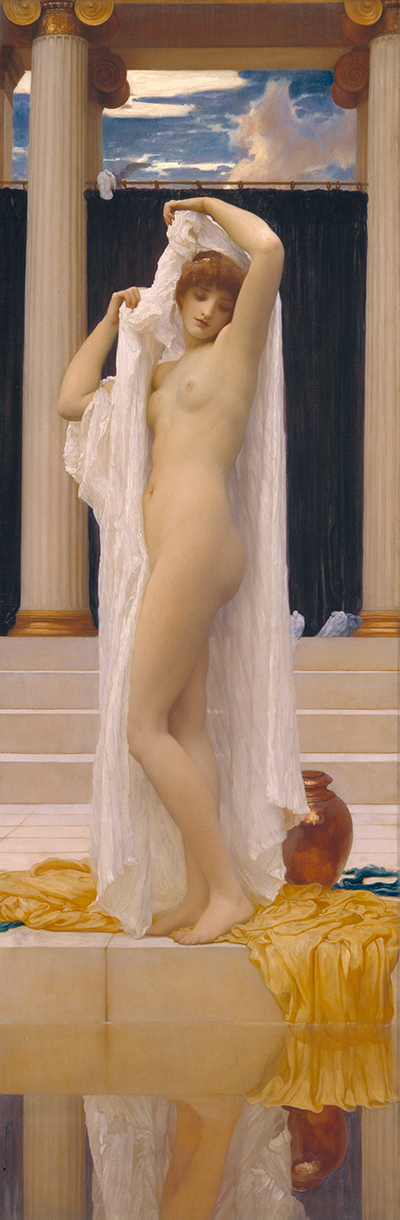
| The Bath of Psyche | Exhibited 1890 | Painting Catalogue. |
| The Daphnephoria | 1874–76 | Painting Catalogue. |
| The Death of Brunelleschi | 1852 | Painting Catalogue. |
| The Fisherman and the Siren | Exhibited 1858 | Painting Catalogue. |
| The Painter's Honeymoon | c. 1864 | Painting Catalogue. |
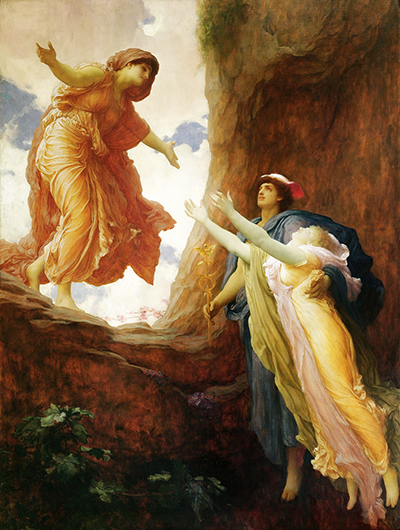
| The Return of Persephone | 1891 | Painting Leeds painting identified in the Met study record. |
| The Return of Persephone (preparatory oil) | c. 1890–91 | Painting Catalogue. |
| The Sluggard (Anglesey Abbey cast) | probably 1890–about 1906 | Sculpture Catalogue. |
| The Sluggard (Met cast) | modelled 1886; cast possibly before 1896 | Sculpture Catalogue. |
| The Sluggard (Museum Wales) | 1882–85 (museum date) | Sculpture Catalogue. |
| The Sluggard (Tate N01752) | 1885 | Sculpture Catalogue. |
| The Spies Escape (Tate A00730) | published 1881 | Print Catalogue. |
| Various Subjects (Tate T09063) | date not known | Drawing Catalogue. |
| View in Capri | Possibly 1859 | Painting Catalogue. |
| Wedded | 1882 | Painting Catalogue. |
| Winding the Skein | c. 1878 | Painting Catalogue. |
Discussion
Look again at the images and ideas explored in Mrs James Guthrie. These editorial prompts invite your observations.
Reader Insights
How does the dark silk become more visible the longer you look at it?
What do the flowers contribute to a painting that leaves their arrangement unfinished?
Join the Conversation
Share a detail, comparison or question about Mrs James Guthrie below.
References
- Yale Center for British Art. Ellinor Guthrie (née Stirling), 1865. Collection record B1978.43.10, including former title, object details, provenance, gallery labels, exhibition history and Malcolm Warner’s catalogue entry. View source.
- Royal Academy of Arts. The Exhibition of the Royal Academy of Arts, The Ninety-Eighth. 1866. East Room, nos. 4 and 7, and Middle Room, no. 292. Digitised catalogue via the Royal Academy Summer Exhibition Chronicle. View source.
- Crowley, F. K. “Stirling, Sir James (1791–1865)”. Australian Dictionary of Biography, Australian National University, 1967. View source.
- Barrington, Emilie, ed. The Life, Letters and Work of Frederic Leighton, vol. II. 1906. Chapter II, Leighton’s 1864 letter to his father about postponing the portrait, and introductory note 1 on The Syracusan Bride. View source.
- Yale Center for British Art. “Mrs. James Guthrie.” Undated Yale School of Medicine object checklist, fifth entry, B1978.43.10, dated c. 1864–65.
- Yale Center for British Art. Britain in the World 1860–Now. 2020 gallery label for Mrs. James Guthrie. View source.
- Friedlaender, Gary E., and Linda K. Friedlaender. “Art in Science: Enhancing Observational Skills”. Clinical Orthopaedics and Related Research 471, no. 7, 2013, pp. 2065–67, fig. 1. View source.
- Kimbell Art Museum. Portrait of May Sartoris, c. 1860. 50th anniversary collection feature, painting ACF 1964.03. View source.
- National Gallery, London. Jean-Auguste-Dominique Ingres, Madame Moitessier, 1856. Collection record NG4821. View source.
- Lépront, Catherine. “Drapés.” Ingres – Ombres permanentes, Musée de la Vie romantique exhibition dossier, 2008, p. 7.
- Rhys, Ernest. Frederic Lord Leighton: An Illustrated Record of His Life and Work. Chapter IV, 1866 exhibition. View source.
- Dahesh Museum of Art. Study for The Syracusan Bride Leading Wild Animals in Procession to the Temple of Diana. Collection essay on the study and finished painting. View source.