 by Tom Gurney
Tom Gurney BSc (Hons) is an art history expert with over 20 years experience
Published on June 19, 2020 / Updated on November 29, 2026
Email: tomgurney1@gmail.com / Phone: +44 7429 011000
The Bath of Psyche: Introduction
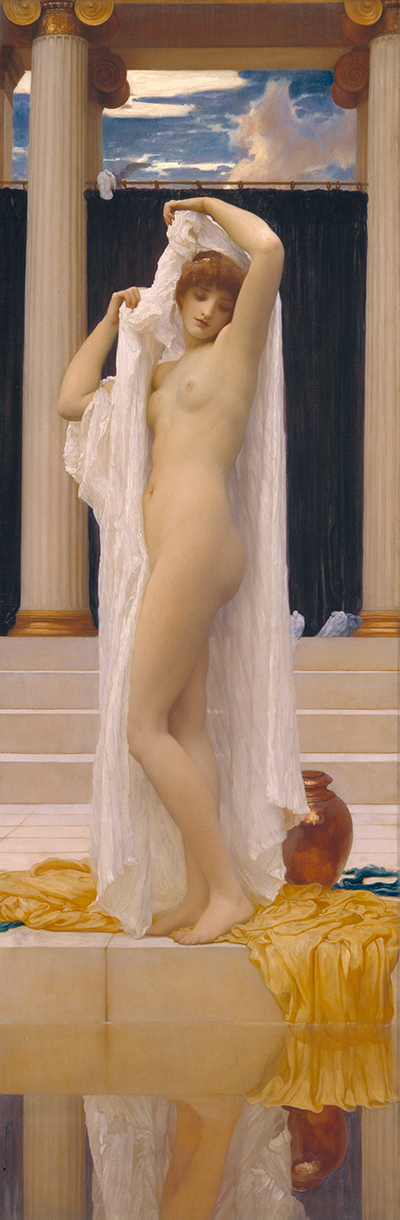
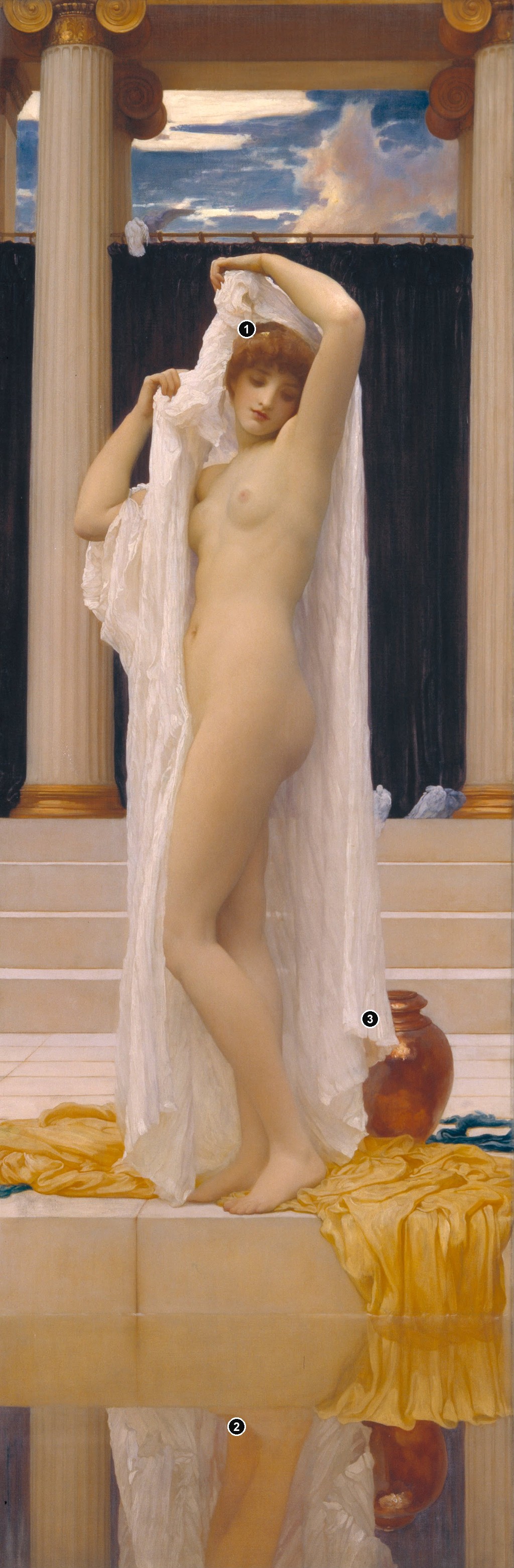
Frederic Leighton paints Psyche at the edge of a pool, lifting a white garment over her head. Her feet are still on the steps. Below them, the upright lines of the room descend into the water. The action takes seconds to imagine, yet the painting makes it seem possible for Psyche to keep her balance and hold the cloth in the air indefinitely. Leighton exhibited this oil on canvas at the Royal Academy in 1890. Now in the Tate collection, it measures 189.2 by 62.2 centimetres, a height roughly three times its width. The proportions give an intimate gesture the scale of a public monument. [1] [2]
At a Glance
- Exhibited1890
- MediumOil on canvas
- CollectionTate, N01574
- SubjectPsyche in Cupid’s palace
This work across Frederic Leighton’s career
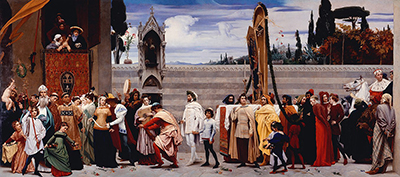
Cimabue’s Celebrated Madonna
1853–55The Bath of Psyche (current article)
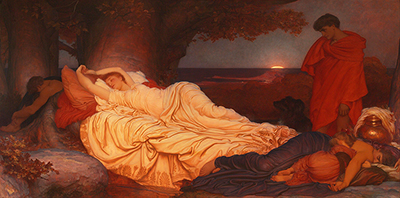
Exhibited 1890 [1]Lachrymae
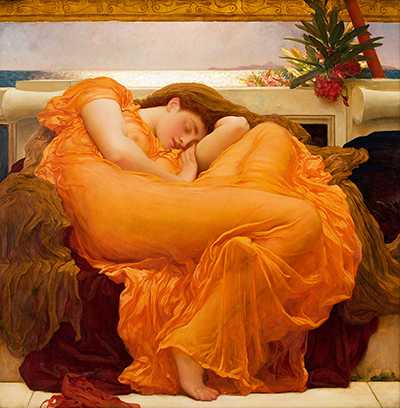
1894–95Flaming June
c. 1895Contents
- At the edge of the water
- Psyche in Cupid's palace
- What the pose owes to sculpture
- From the Hall of Panels to the Academy
- From an exhibition favourite to a study of the nude
- Annotated details
At the edge of the water
Psyche's body turns within the tight space between the columns. Her legs carry the weight of the pose while her upper body opens towards the viewer. Her elbows flare out, but the fabric between her hands gathers those spreading lines back towards the centre. Look at the difference between the drapery held aloft and the cloth hanging behind her. One is still taking shape in her hands. The other falls in long folds, a pale backdrop against which the outline of her body is especially clear. [1] [2]
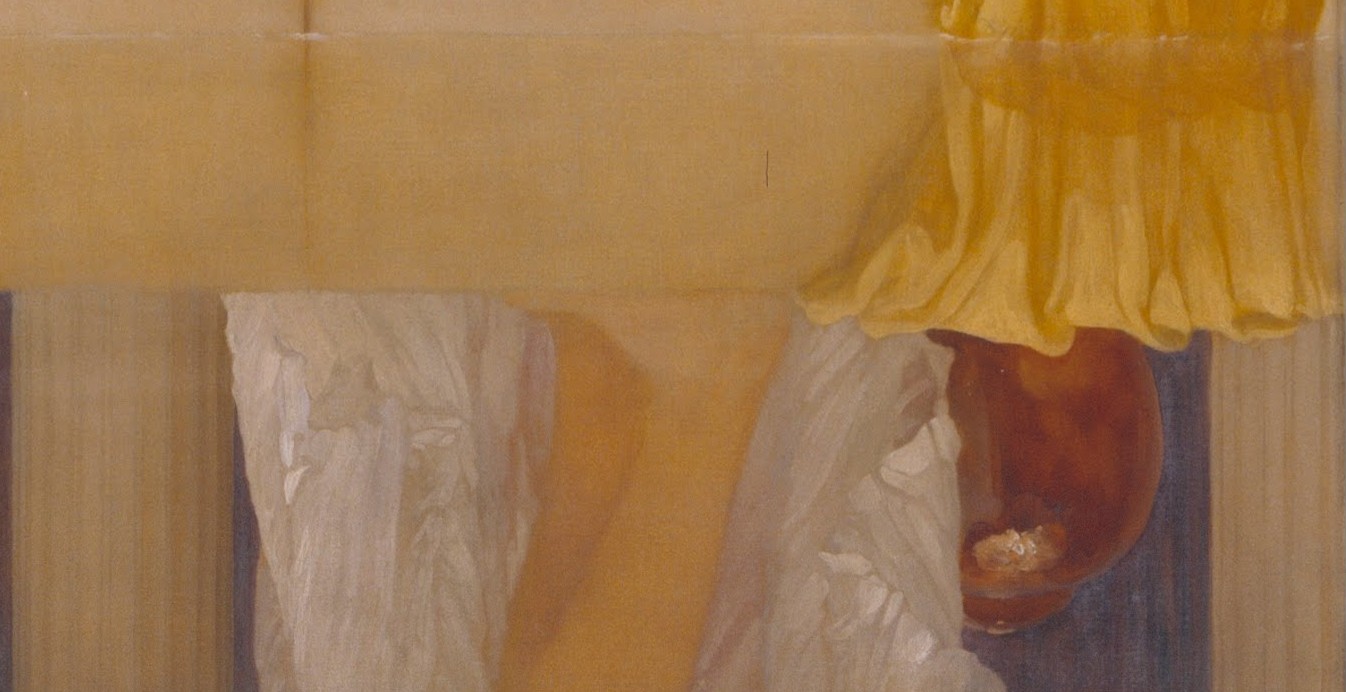
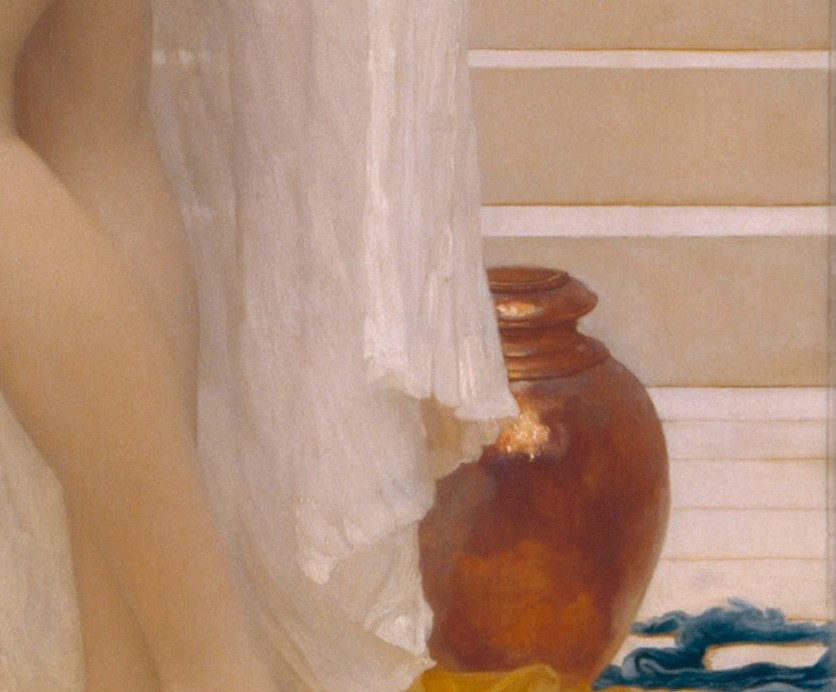
The copper vessel beside the steps catches the light at the foot of the painting. Higher up, a patch of blue beyond the columns pulls the eye past Psyche into the distance. The whites themselves move from the cool folds of fabric to the warmer stone and the softly modelled skin. Below the steps, the reflected columns extend the architecture to the bottom of the canvas. Psyche lowers her gaze towards the pool. It serves as a mirror, yet what it shows us is chiefly the room around her. The picture can suggest that she is looking at herself while keeping her experience of the reflection private. [1] [2]
Tate suggests Leighton may also have designed the frame, whose architectural details echo those within the canvas. That possibility matters for a work so dependent on its edges. The frame, the painted columns and Psyche's pose form three enclosures at progressively smaller scales. Her raised arms reach almost as far as the architecture permits, while her legs narrow to the small area of stone she occupies above the pool. [1]
Annotated Details from The Bath of Psyche
The numbered points identify visible features discussed in this article. Return from each detail to the numbered overview. Frederic Leighton, The Bath of Psyche, exhibited 1890. Tate. Image source. Public domain. Resized without changing the composition.
Details from THE BATH OF PSYCHE
Compare the cropped details with the source images above. Notice how their colours, shapes and positions contribute to the larger compositions.
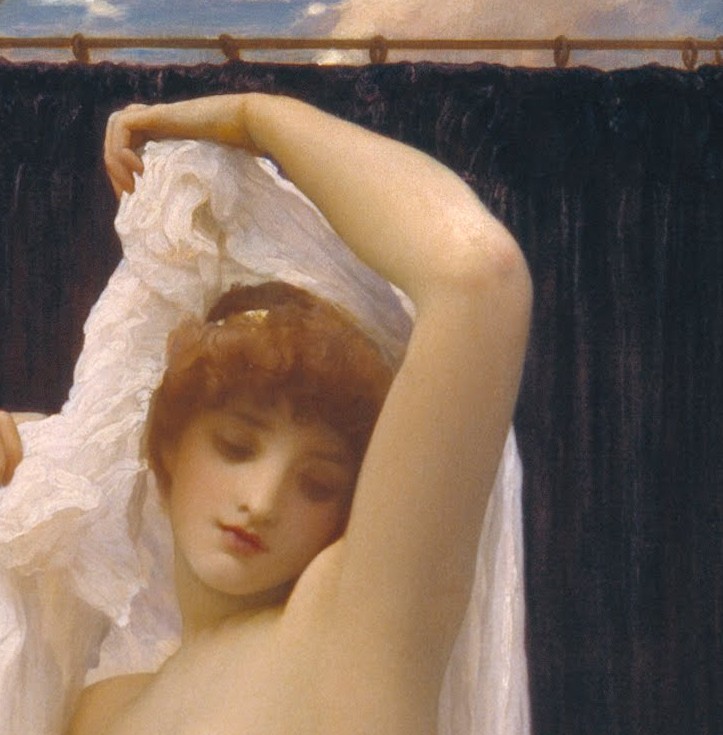
Cloth raised over Psyche’s head
The cloth loops around her arms, leaving the face visible against the dark curtain. The raised fabric makes an arc inside the two straight columns.
The pool and reflection
The pale stone edge divides the painting from its reflection. The shape of the drapery and the upright architecture reappear below it in the water.
The copper vessel
A small copper vessel glows against the stairs. Its curve and warm colour gather attention beside the long, pale folds.
Psyche in Cupid's palace
In Book V of Apuleius's Metamorphoses, also known as The Golden Ass, Psyche enters a palace where she hears servants she cannot see. A disembodied voice tells her to rest and bathe. She does so before dining, and after dark her mysterious husband comes to her. Later, urged on by her sisters, she brings a lamp to the bed and discovers that the man beside her is Cupid. A drop of hot oil falls on him and awakens him. Leighton's painting takes its cue from the bath mentioned near the beginning of that episode. Apuleius gives it little space. The raised garment, the steps and the bent head are Leighton's way of giving shape and duration to that brief passage. [1] [3]
Other Victorian artists picked up the story at moments when Psyche was in danger. In Psyche Throwing Herself into the River, an illustration by Edward Burne-Jones and William Morris, she bends forward with her hands at her face after Cupid has abandoned her. The wind pushes her hair back as she steps into the river. The broken horizontal strokes of water in the engraving quicken the scene. In Leighton's painting the still pool and the vertical folds of the curtain prolong the moment before Psyche steps down. [1] [4]
What the pose owes to sculpture
Tate traces the pose to an antique Venus that Leighton saw in Naples in 1859. Scholars have compared Psyche specifically to the Venus Callipygia, or Callipygian Venus, now in the National Archaeological Museum in Naples. The statue lifts her drapery and looks back over her shoulder at the part of her body she has uncovered. Leighton keeps the link between lifting cloth and looking down, then turns the figure towards us and raises both arms. That change transforms the work the cloth does. The marble Venus gathers her robe around her hips, while Psyche's garment defines the space above her head. Psyche's downturned face keeps the antique figure's inward attention. [1] [2] [5] [6]
The raised arm and shifted weight also recall Ingres's La Source, completed in 1856. Ingres's figure carries a vessel beside her head and releases water in a falling stream. Leighton's thin fabric cascades behind Psyche, giving the two compositions a visual kinship even though the pool below her is still. The kinship extends to the lucid outline and the gentle transitions across the torso. Leighton's surface is finely shaded enough to describe a body in the round, but its pale finish also allows that body to belong among the polished architectural surfaces. [2] [7]
Chloe Portugheis has compared Leighton's palette to Whistler's Symphony in White paintings. Whistler could place white cloth against a white curtain and let the differences in light and texture distinguish one from the other. Leighton's bath presents a similar problem in another setting. The different whites guide the eye through the fabric, skin and stone before the copper and blue give it something stronger to settle on. Berthe Morisot's The Psyche Mirror offers another comparison. A woman adjusts her clothes before a tall tilting mirror in a contemporary room. Both pictures ask us to look at a woman who is occupied with her own appearance, using the angle of her head and the arrangement of the room to make her absorption visible. [2] [8] [9]
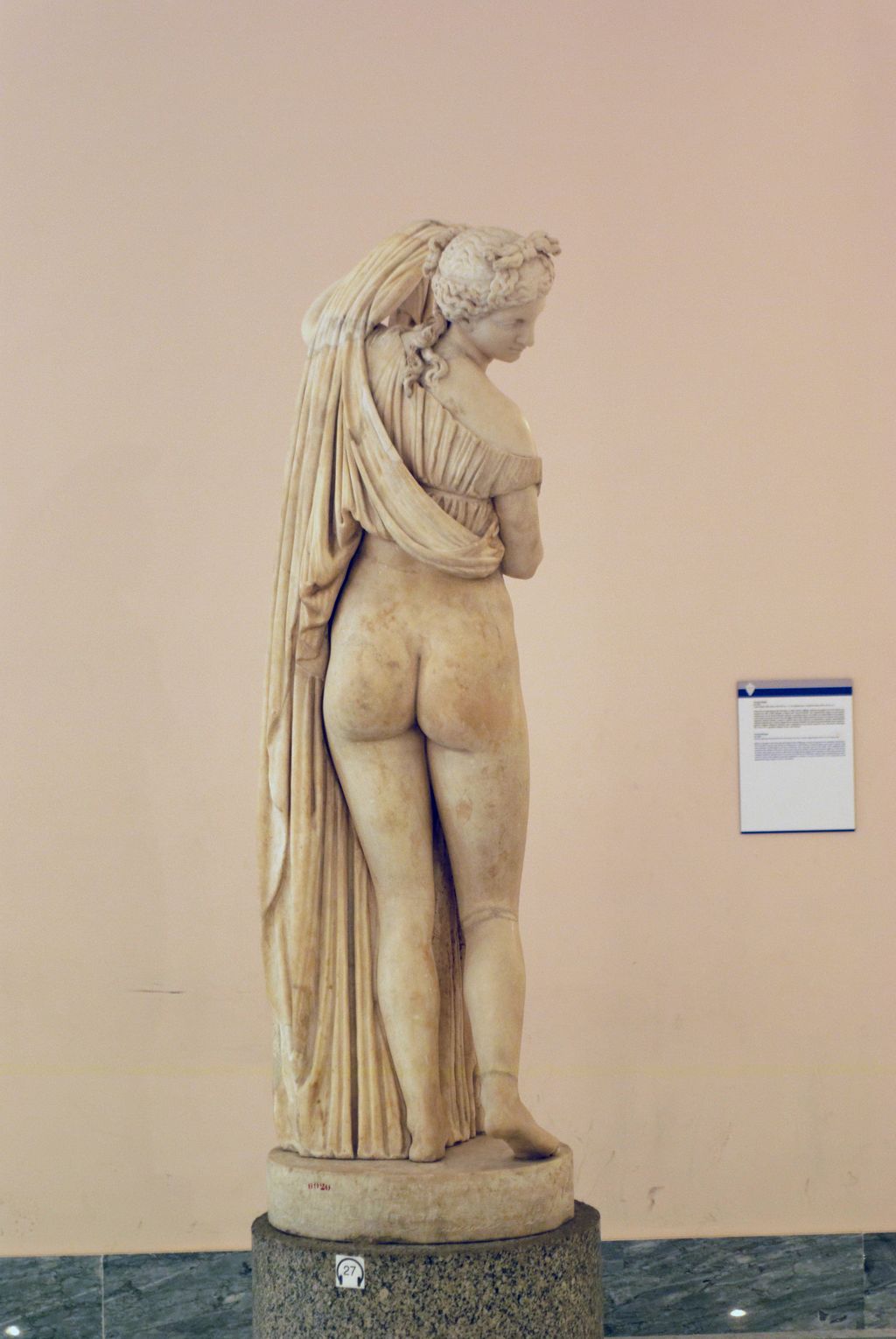
Venus Callipygia, marble. Museo Archeologico Nazionale di Napoli. Photograph by Berthold Werner. Image source. CC BY-SA 3.0. Resized, with the full photograph retained. This derivative is licensed under CC BY-SA 3.0.
From the Hall of Panels to the Academy
The design began with a separate canvas in an even narrower format. Around 1887 Leighton painted a Bath of Psyche measuring 81.3 by 16.5 centimetres for Lawrence Alma-Tadema's house at Grove End Road in London. Rhys records Leighton's nickname for it, the “paper-knife” picture. This was one of a series made by artist friends for the Hall of Panels, which called for works of uniform height and exceptionally narrow widths. Psyche's upright pose made good use of the strip of canvas. At Academy scale Leighton had more width in proportion to the height. The additional space allowed the flanking columns, distance to the curtain and foreground bath to become as important to the composition as the figure. [5] [10] [11] [12] [13]
Leighton and Alma-Tadema exchanged paintings in 1893. The slender Psyche went to Alma-Tadema and Leighton received In My Studio, a view of his friend's own workplace. Each artist took home something of the other's design. Psyche became part of Alma-Tadema's interior, and the view of his studio hung above Leighton's sofa. Historic photographs show In My Studio in Leighton's Silk Room, and Leighton House has returned it to that position. The full-size Bath of Psyche had already entered public ownership through the Chantrey Bequest. [1] [10] [14]
A small oil sketch catalogued by Christie's measures 26.7 by 8.9 centimetres, close to the proportions of the Tate canvas. [5] The National Gallery of Canada also holds an 1889 sheet of Studies for “The Bath of Psyche” in black and white chalk on brown paper. In that pairing of chalks, the paper provides a middle tone on which the artist can build highlights and shadows. Ernest Rhys reproduced a figure study in his illustrated account of Leighton's work, and an early British Museum catalogue describes a separate multi-subject sheet with a sketch of Psyche disrobing on the steps. These records show the design taking shape at the scale of a drawing as well as a painted room. [15] [13] [16]
Christie's associates the figure with Dorothy Dene, an actress and one of Leighton's principal models in his later years. Leighton House documents her work with him and her acting career, which included performances in New York. [5] [17]
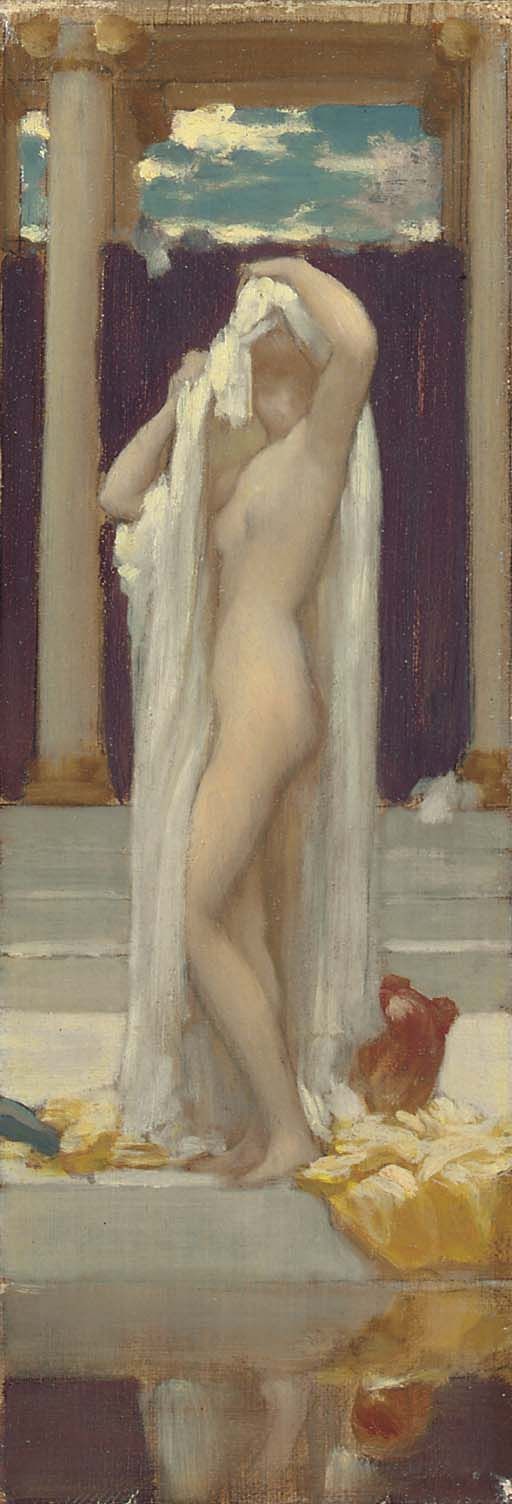
Frederic Leighton, small oil study for The Bath of Psyche. Image source. Public domain. Resized without changing the composition.
From an exhibition favourite to a study of the nude
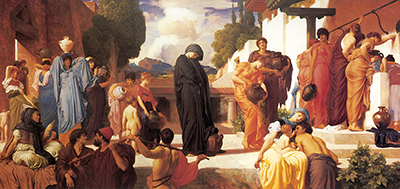
Writing in May 1890, The Spectator praised the way Leighton drew Psyche's body and singled out the curtain, sky and metals for the purity of their colour. The reviewer proposed “Soma”, the Greek word for body, as an alternative title to “Psyche”. The quip suggests how readily a contemporary viewer could leave the story in the background and respond to the painting as a study in drawing and colour. Rhys remembered it as an immediate favourite and noted how widely it had been reproduced. He grouped it with Captive Andromache and Greek Girls Playing at Ball, praising the delicacy of execution across all three, from the multi-figure scenes to the single bather. The large oil was later shown in Tate Britain's Exposed: The Victorian Nude in 2001 and in the Yokohama Museum of Art's 2018 exhibition of nudes from Tate's collection. [5] [13] [18] [19]
The contemporary review catches something still visible in the painting. Psyche's body may command attention the instant we see the canvas, but the time we spend looking at her is shaped by what is around her. The light on her skin sends our eye out to the curtain and the stone, and from the stone down into the water. By the time we return to the figure, she is still preparing to step in. [1] [18]
Browse Frederic Leighton’s artworks
Explore paintings, drawings, sculptures and prints, with separate rows for identified preparatory works, reproductions and casts.
| Name | Date | Medium |
|---|---|---|
| A Girl Feeding Peacocks | Exhibited 1863 | Painting Catalogue. |
| A Recognition from ‘Romola’, engraved by Swain (Tate N04054) | published 1862 | Print Catalogue. |
| A Roman Lady | 1859 | Painting Catalogue. |
| Abram and the Angel (Tate A00733) | published 1881 | Print Catalogue. |
| Acme and Septimius | Exhibited 1868 | Painting Catalogue. |
| An Athlete Wrestling with a Python (Tate exhibition bronze) | 1877 | Sculpture Catalogue. |
| And the Sea Gave Up the Dead Which Were in It (Tate N01511) | 1891–92 | Painting Catalogue. |
| Andromache in Captivity (photogravure after Leighton) | 1889 | Print Catalogue. |
| Athlete Wrestling with a Python (Anglesey Abbey cast) | model 1877; cast 1905 | Sculpture Catalogue. |
| Athlete Wrestling with a Python (Hood reduced cast) | 1877 (inscribed model date) | Sculpture Catalogue. |
| Athlete Wrestling with a Python (Saint Louis reduced cast) | 1877 (museum date) | Sculpture Catalogue. |
| Cain and Abel (Tate A00731) | published 1881 | Print Catalogue. |
| Captive Andromache | 1888 | Painting Catalogue. |
| Cimabue's Celebrated Madonna | 1853–55 | Painting Catalogue. |
| Cimon and Iphigenia, with Many Smaller Subjects (Tate T09061) | date not known | Drawing Catalogue. |
| Crenaia, the Nymph of the Dargle | Exhibited 1880 | Painting Catalogue. |
| Cymon and Iphigenia | 1884 | Painting Catalogue. |
| Daedalus and Icarus | 1869 | Painting Catalogue. |
| Dante in Exile | 1864 | Painting Catalogue. |
| Death of the First Born (Tate A00737) | published 1881 | Print Catalogue. |
| Electra at the Tomb of Agamemnon | c. 1869 | Painting Catalogue. |
| Eliezer and Rebekah (Tate A00735) | published 1881 | Print Catalogue. |
| Elijah in the Wilderness | 1877–78 | Painting Catalogue. |
| Fanny Kemble: A Study for ‘Jezebel and Ahab’ (Tate T08208) | c.1862 | Drawing Catalogue. |
| Figure Studies | Date not recorded | Drawing Catalogue. |
| Flaming June | 1895 | Painting Catalogue. |
| Gulnihal | Exhibited 1886 | Painting Catalogue. |
| Helios and Rhodes (Tate N03015) | date not known | Painting Catalogue. |
| Hercules Wrestling with Death for the Body of Alcestis | c. 1869–71 | Painting Catalogue. |
| Jonathan's Token to David | c. 1868 | Painting Catalogue. |
| Lachrymae | 1894–95 | Painting Catalogue. |
| Lieder ohne Worte | Exhibited 1861 | Painting Catalogue. |
| Light of the Harem | Exhibited 1880 | Painting Catalogue. |
| Moses Views the Promised Land (Tate A00736) | published 1881 | Print Catalogue. |
| Mrs James Guthrie | 1865 | Painting Catalogue. |
| Mrs John Hanson Walker (Tate N04731) | 1867 | Painting Catalogue. |
| Music Lesson | 1877 | Painting Catalogue. |
| Needless Alarms (Met cast) | modelled 1886; cast nineteenth century | Sculpture Catalogue. |
| Needless Alarms (Tate N05120) | 1886 | Sculpture Catalogue. |
| Pavonia | c. 1859 | Painting Catalogue. |
| Perseus and Andromeda | 1891 | Painting Catalogue. |
| Portrait of May Sartoris | c. 1860 | Painting Catalogue. |
| Preparing for a Festa, Florence (Tate T09062) | date not known | Drawing Catalogue. |
| Puerta de los Vientos, near Ronda, Spain (Tate N04006) | c.1886–9 | Painting Catalogue. |
| Samson and the Lions (Tate A00732) | published 1881 | Print Catalogue. |
| Samson at the Mill (Tate A00734) | published 1881 | Print Catalogue. |
| Samson Carrying the Gate (Tate A00738) | published 1881 | Print Catalogue. |
| Sketch for ‘An Athlete Wrestling with a Python’ (Tate N01761) | c.1877 | Sculpture Catalogue. |
| Sketches for Cimon and Iphigenia (Tate T09060) | date not known | Drawing Catalogue. |
| Study for The Return of Persephone (Demeter) | c. 1890–91 | Drawing Catalogue. |
| Study for The Return of Persephone (Persephone) | c. 1890–91 | Drawing Catalogue. |
| Study for ‘Needless Alarms’ (Tate N02945) | 1886 | Sculpture Catalogue. |
| Study for ‘The Discovery of Juliet Apparently Lifeless’ (Tate N01806) | c.1858 | Painting Catalogue. |
| The Bath of Psyche | Exhibited 1890 | Painting Catalogue. |
| The Daphnephoria | 1874–76 | Painting Catalogue. |
| The Death of Brunelleschi | 1852 | Painting Catalogue. |
| The Fisherman and the Siren | Exhibited 1858 | Painting Catalogue. |
| The Painter's Honeymoon | c. 1864 | Painting Catalogue. |
| The Return of Persephone | 1891 | Painting Leeds painting identified in the Met study record. |
| The Return of Persephone (preparatory oil) | c. 1890–91 | Painting Catalogue. |
| The Sluggard (Anglesey Abbey cast) | probably 1890–about 1906 | Sculpture Catalogue. |
| The Sluggard (Met cast) | modelled 1886; cast possibly before 1896 | Sculpture Catalogue. |
| The Sluggard (Museum Wales) | 1882–85 (museum date) | Sculpture Catalogue. |
| The Sluggard (Tate N01752) | 1885 | Sculpture Catalogue. |
| The Spies Escape (Tate A00730) | published 1881 | Print Catalogue. |
| Various Subjects (Tate T09063) | date not known | Drawing Catalogue. |
| View in Capri | Possibly 1859 | Painting Catalogue. |
| Wedded | 1882 | Painting Catalogue. |
| Winding the Skein | c. 1878 | Painting Catalogue. |
Discussion
Look again at the images and ideas explored in The Bath of Psyche. These editorial prompts invite your observations.
Reader Insights
How does the raised cloth change the space around Psyche?
Which features of the Venus comparison help explain the pose, and which details did Leighton change?
Join the Conversation
Share a detail, comparison or question about The Bath of Psyche below.
References
- Tate, The Bath of Psyche, 1890, Tate N01574, collection entry via Google Arts & Culture. View source.
- Chloe Portugheis, “Sir Frederic Leighton, Bath of Psyche”, Smarthistory essay reproduced in the Spanish LibreTexts edition of Arte victoriano. View source.
- Apuleius, The Golden Ass, Book V, especially sections 1–5 and 21–24, translated by A. S. Kline. View source.
- Cleveland Museum of Art, Psyche Throwing Herself into the River, William Morris and Edward Burne-Jones, accession 1981.90. View source.
- Christie's, Study for The Bath of Psyche, lot 4524291, catalogue and lot essay. View source.
- Museo Archeologico Nazionale di Napoli, Sussidi del MANN: Gabinetto segreto, historical note on the Venere Callipigia. View source.
- Musée d'Orsay, La Source, Jean-Auguste-Dominique Ingres. View source.
- National Gallery of Art, Symphony in White, No. 1: The White Girl, James McNeill Whistler. View source.
- Museo Nacional Thyssen-Bornemisza, El espejo psiqué, Berthe Morisot. View source.
- Elizabeth Prettejohn and Peter Trippi, “Introduction: The Alma-Tademas’ Studio-Houses and Beyond”, British Art Studies 9, 2018, figures 16–17. View source.
- Christie's, The Bath of Psyche, c. 1887, lot 6426684, catalogue and lot essay. View source.
- Fries Museum, “Sir Lawrence Alma-Tadema”, section on the Hall of Panels. View source.
- Ernest Rhys, Frederic Lord Leighton: An Illustrated Record of His Life and Work, “Year by Year—1878 to 1896”, “His Method of Painting”, and the plate “Study for 'The Bath of Psyche'”. View source.
- Leighton House, “Bringing home Alma-Tadema's In My Studio”. View source.
- National Gallery of Canada, Acquisitions 2023–24, entry for Frederic Leighton, Studies for “The Bath of Psyche”, accession 50675. View source.
- Laurence Binyon, Catalogue of Drawings by British Artists and Artists of Foreign Origin Working in Great Britain, vol. III, British Museum, entry 18 under Lord Leighton, pp. 49–50. View source.
- Leighton House, “The women who made us”, section on Dorothy Dene. View source.
- The Spectator, “Art. The Royal Academy. [Second Notice.]”, 17 May 1890. View source.
- Yokohama Museum of Art, Nude: Masterpieces from Tate, 2018, press materials, work 4, 《プシュケの水浴》. View source.