


 by Tom Gurney
Tom Gurney BSc (Hons) is an art history expert with over 20 years experience
Published on June 19, 2020 / Updated on November 29, 2026
Email: tomgurney1@gmail.com / Phone: +44 7429 011000
Frederic Leighton Paintings: Introduction
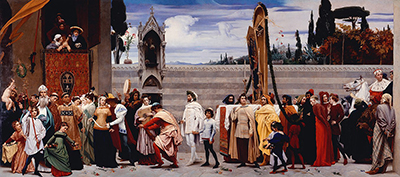
In Cimabue’s Celebrated Madonna, a gilded painting passes through a Florentine crowd. In Flaming June, a sleeping woman almost fills a square of canvas. Put the two side by side and watch what Leighton does with the folds of cloth. In the early painting they help carry the eye across five metres of street, from a bishop and his attendants to the crowd around the Madonna. In the late canvas those folds loop back around a single figure. Across his paintings, Leighton could use the same close attention to the way fabric falls to give a procession its momentum or make a sleeper seem utterly still. [1] [2]
The catalogue below can be read by following such connections. Begin with the great processions if you want to see how Leighton makes a crowd legible. Try the portraits alongside the paintings of music to see how differently he handles a known sitter and a model playing a part. And if a title turns up on two objects, look at their scale and materials. The small oil of Persephone in New York and the large painting in Leeds belong to different stages of the same undertaking. [3]
At a Glance
- Early exhibition pictureCimabue’s Celebrated Madonna, exhibited in 1855
- SubjectsProcessions, portraiture, music and classical stories
- Late comparisonFlaming June and Lachrymae, exhibited in 1895
Contents
- From the Florentine street to the Trojan well
- How Leighton paints a likeness
- Music in colour and pattern
- The moment a myth becomes a painting
- Three late figures and the shape of stillness
- Using the paintings catalogue
Explore Frederic Leighton’s paintings

From the Florentine street to the Trojan well
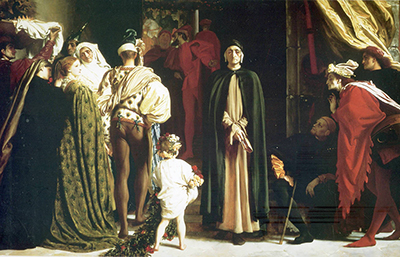
Leighton painted Cimabue’s Celebrated Madonna between 1853 and 1855. The title preserves the attribution in the story told by Giorgio Vasari. The actual panel is the Rucellai Madonna, which the Uffizi records as a commission given to Duccio in 1285. Leighton’s subject is the honour paid to the painting as it is carried through Florence. He gives the white-clad Cimabue the hand of the young Giotto and places Dante at the side of the road, leaning against a pillar. There is a public ceremony to follow and a succession of smaller encounters to discover as your eye strays from the Madonna. Queen Victoria recorded her enthusiasm for the painting at the 1855 Royal Academy exhibition and bought it. [1] [4]
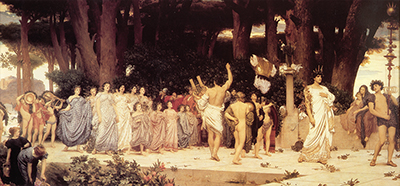
The Daphnephoria uses a similarly broad canvas for a procession in honour of Apollo at ancient Thebes. Here the chain of figures passes in the shade of trees. The branches they carry and the gestures of the singers pick up the rhythm of the walkers. In the Florentine picture, a big gold rectangle announces the procession’s purpose from across the room. In The Daphnephoria, the ceremony is distributed among the people taking part. Look along the line of raised arms and branches, where Leighton repeatedly breaks the forward motion with a figure turning or looking sideways. One of his chalk studies for the picture, in Melbourne, brings you down from that long view to the problem of arranging individual bodies. [1] [5] [6] [7]
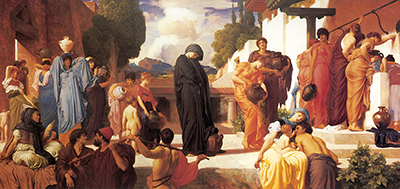
In Captive Andromache, the spread of figures across a four-metre canvas makes a woman’s isolation visible. Hector’s widow stands among people drawing water, in the situation of enslavement Hector had imagined for her in the Iliad. The figures around her are occupied with vessels, children and the business of taking their turn. Andromache, wrapped in dark cloth, stands upright and withdrawn. Where the two processions draw strength from people moving in concert, the activity at the well makes the distance between Andromache and her neighbours more painful. The Paris study for Andromache, a sheet of brown paper with black chalk and white heightening that Leighton gave to the French state in 1893, is one way to follow the attention he paid to the figure within that larger scene. [8] [9] [10]
How Leighton paints a likeness
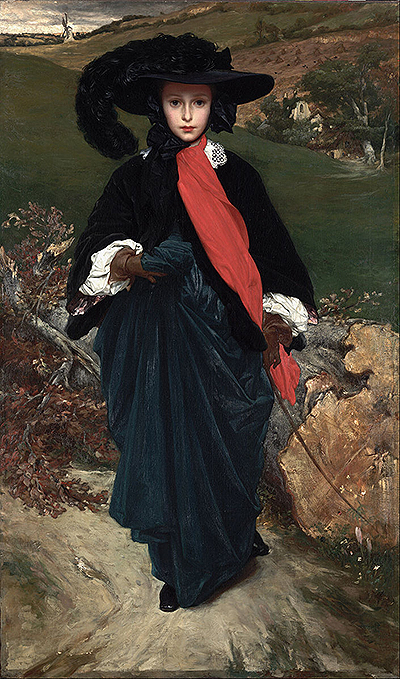
In the Kimbell’s Portrait of May Sartoris, painted around 1860, a girl of about fifteen walks towards us in a riding habit. The broad hat shades her face, her long red scarf catches the eye, and her hands are busy with her skirt and riding crop. The setting is the family’s Hampshire country residence. The fallen tree behind her gives the walk a note of transience, an interpretation suggested by the Kimbell. It also makes the upright figure appear especially alert. Leighton knew the girl’s mother, the former opera singer Adelaide Sartoris, and painted May again in later years. [11]
Set May beside Sir Richard Francis Burton, the comparatively small oil in the National Portrait Gallery. In Burton’s case the landscape falls away. Seen slightly from below, the face stands forward against the darkness, with a sharply lit collar and the red of the old scar on his cheek. The gallery’s extended catalogue dates the sittings to 1872 and records Leighton returning to the painting in 1875. That distinction matters because Burton and The Daphnephoria appeared together at the Academy in 1876. As Jonathan Law and Mary Roberts’s study of Leighton House recounts, a reviewer for The Graphic admired the perceived vigour of the likeness and treated the larger painting’s decorative grace as a weakness. Look at what registers first in each painting. In the portrait the light singles out a face. In the procession, light moves across a series of shoulders, heads and upturned hands. [5] [12]
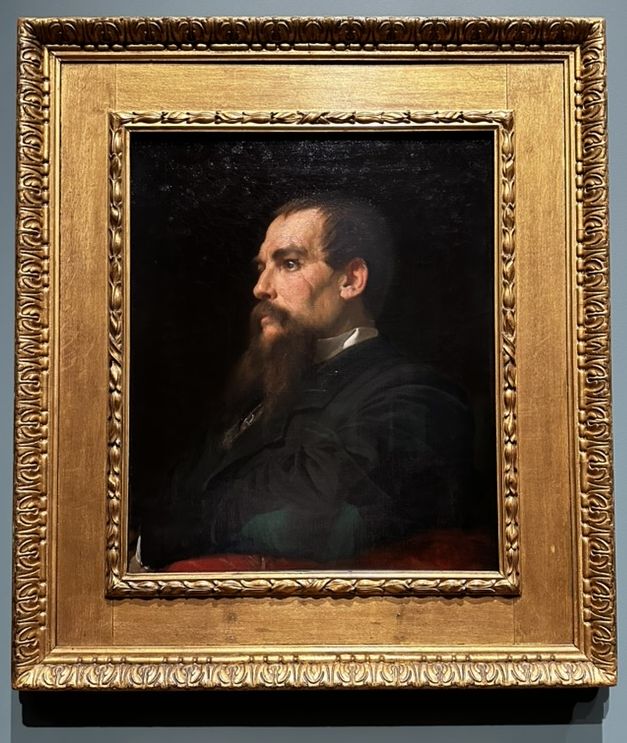
Frederic Leighton’s portrait of Sir Richard Francis Burton, National Portrait Gallery, NPG 1070. My photo from the National Portrait Gallery, London, on 5 November 2026. Image source. Public domain. Gallery photograph cropped to show the framed portrait.
Music in colour and pattern
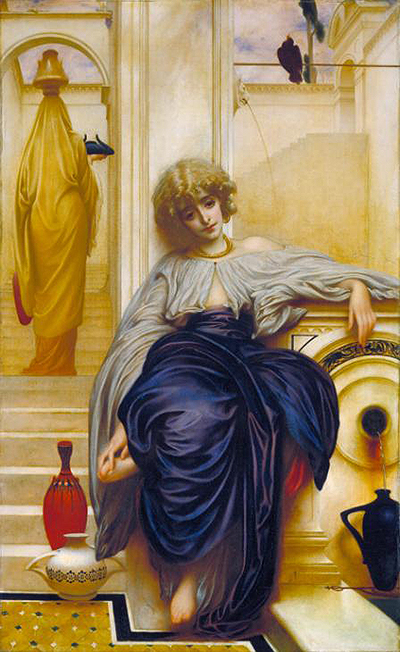
Lieder ohne Worte gives the eye a different pace. Its German title means Songs Without Words, the name of a set of piano pieces by Mendelssohn that Tate notes would have been familiar to Leighton’s audience. Within the painted scene, the sounds are a blackbird and trickling water. The girl leans at the fountain, where the pale stone catches the light. Her stillness makes it easy to imagine the sounds continuing beyond the moment shown. Look at how long it takes the dark bird to register beside the brighter shapes of the figure and stone. Part of the pleasure of the picture unfolds at that slower speed. [13]
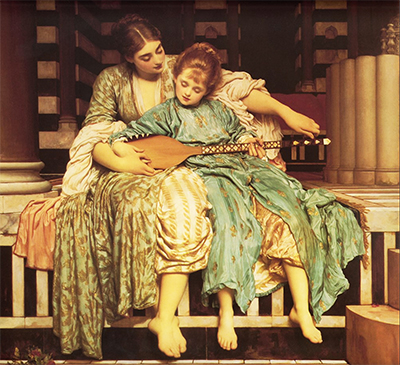
In The Music Lesson, the older figure adjusts the Turkish saz while she guides the child’s finger. It takes a moment to trace the separate arms where wrists and hands meet. The picture makes learning look like a physical act, carried from one person’s fingertips to another’s. In the catalogue for Victorians Decoded, Caroline Arscott connects that act to the pattern of the architecture, where the alternating bands of inlaid stone suggest a succession of notes. The two paintings can be experienced in sequence. Listen in imagination at the fountain, then follow the rhythm made by the alternating colours and overlapping bodies in the lesson. [13] [14] [15]
The City of London’s account traces the architecture in The Music Lesson to studies Leighton made in Damascus in 1873. It also identifies the young model as Connie Gilchrist. The picture brings a person from Leighton’s own artistic circle together with a Turkish instrument and details drawn from Syrian buildings. Treat the room as a studio invention assembled from observed elements. That helps explain how its striking patterns can feel so specific while they serve the painter’s arrangement of figures, colour and light. [14] [15]
The moment a myth becomes a painting
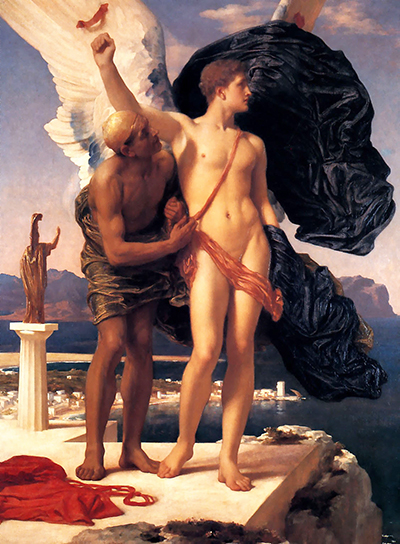
In Daedalus and Icarus, look for the father’s hands. Leighton places us at the fitting of the wings, before the flight. Our knowledge of the fall lends the practical work with feathers and fastenings a tenderness and urgency. The Faringdon Collection relates the sunlit setting to studies Leighton made on Rhodes. In the painting the brightness can be read both as the freedom the young man is about to enter and as a reminder of the heat that will undo his father’s work. The finished canvas, shown at the Royal Academy in 1869, is a separate object from the small colour sketch at Leighton House. [16]
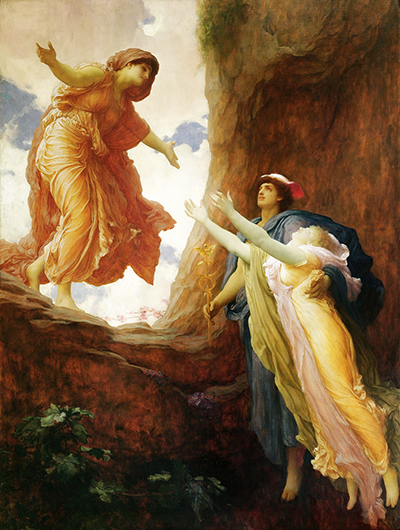
The Return of Persephone takes a different moment from its story. Persephone comes up from the underworld with Hermes and reaches for Demeter. The story turns on the daughter’s periodic return and its association with the seasons. The strongest direction in the painting comes from two bodies reaching across the space between them. The National Museum of Western Art in Tokyo preserves separate sheets in which Demeter’s arms reach down and Persephone’s reach up. In the Met’s oil study, only about 26 centimetres high, their gestures are already set within a whole picture, with the earth below and daylight above. The contrast in scale with the finished Leeds canvas helps explain what the different studies let Leighton work out, from the bearing of an arm to the effect of the entire reunion. [3] [17]
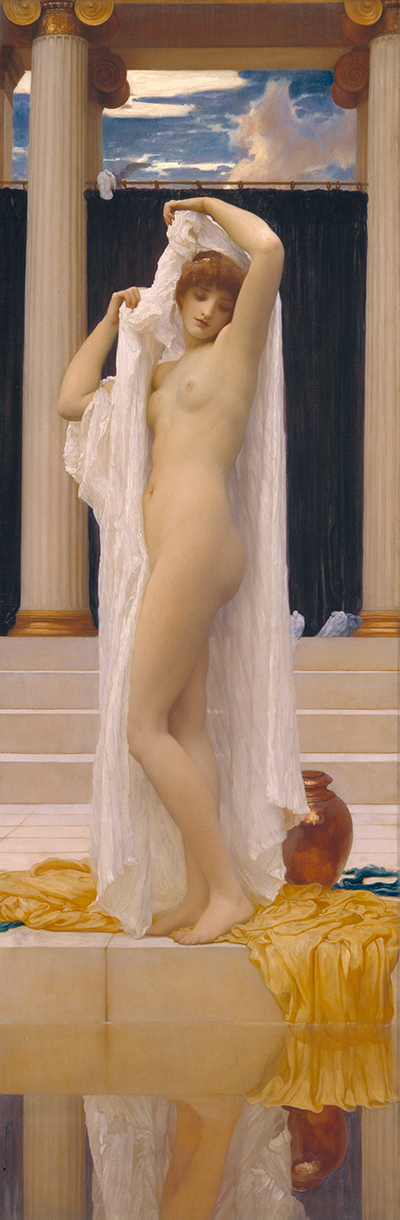
Other mythological paintings ask the eye to stay with a figure who seems to have time to herself. In Tate’s narrow The Bath of Psyche, the turn of a body and the fall of fabric have room to register slowly. Tate traces the bath pose to an ancient statue of Venus that Leighton saw in Naples. In the Lady Lever Art Gallery’s circular The Garden of the Hesperides, women recline under the spreading boughs of a fruit tree. The guardian Ladon winds around the trunk, and the coil of his body leads the eye back towards the figures. The museum explains the orchard through the myth of the golden apples. The painting gives that story the drowsy pace of a sheltered afternoon, with the sea visible through the foliage. [18] [19] [20]
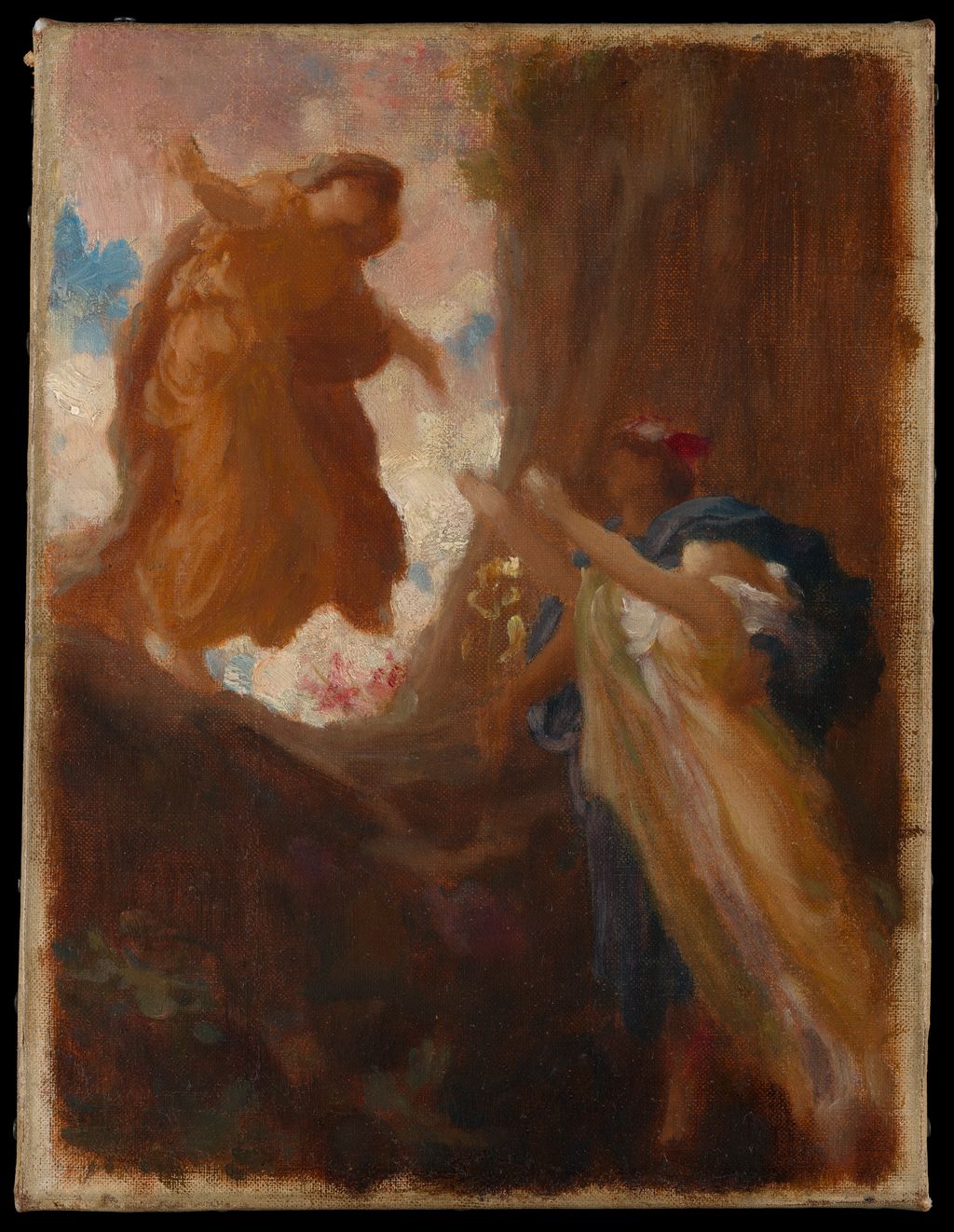
Frederic Leighton, The Return of Persephone, preparatory oil, Metropolitan Museum of Art. The Metropolitan Museum of Art. Image source. CC0 / Public domain. Resized to fit the article.
Three late figures and the shape of stillness
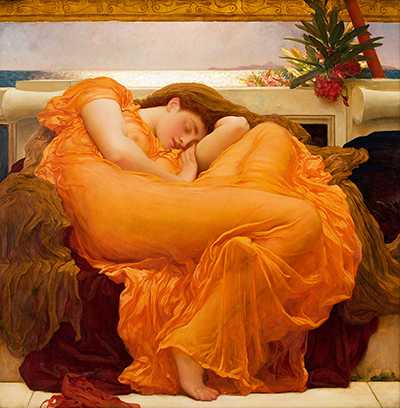
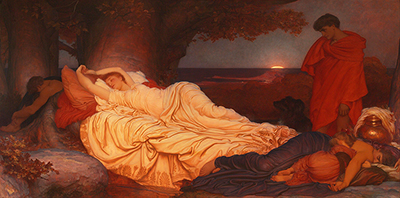
Flaming June and Lachrymae were both among Leighton’s submissions to the Academy in 1895. One uses a square, the other a canvas nearly two and a half times as high as it is wide. The sleeper in Flaming June folds inward, the high knee and the bowed head making a rounded shape against the horizontal bands of sea and stone. Leighton House’s colour sketch shows that he had introduced the glowing orange and the bright reflection on the water at a small scale. He dropped a small island from the horizon in the final picture. With less to catch the eye in the distance, that strip of sea gives the sleeper a sense of exposure to light without disturbing her seclusion. The Museo de Arte de Ponce also draws attention to how at ease the sleeper seems despite the complexity of her pose. For Leighton, the observed and imagined Mediterranean could overlap. Pola Durajska relates the strip of water to an earlier study of a bay on Rhodes. The sight of open water in strong light carries over from an outdoor sketch to a meticulously arranged figure painting. [2] [21] [22] [23]
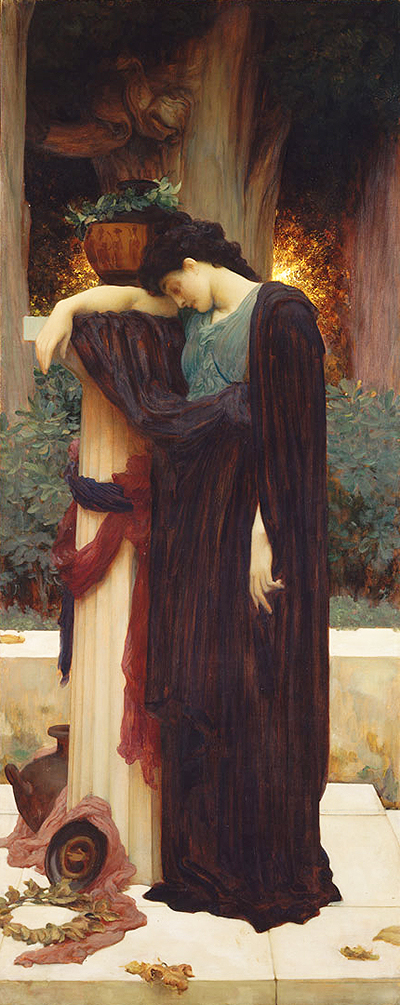
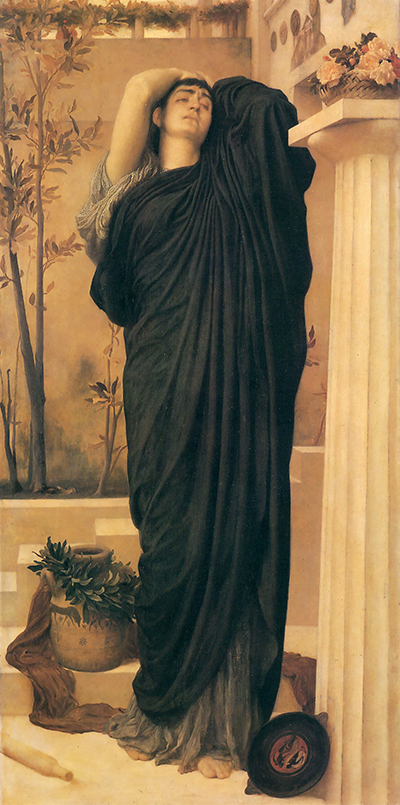
The figure in Lachrymae leans against a memorial. Close by are a cypress and a withered wreath. The verticals of tree, monument and robe are prolonged by the tall frame Leighton designed. The Met allows two readings of the orange light behind the tree, as a sunset or the glow of a funeral fire. It is a small uncertainty with a large effect. A sunset might make the scene feel like the end of a long vigil, while the fire would bring a ritual briefly into view. Held beside Flaming June, the painting shows how a glimpse of light beyond a figure can set the emotional temperature of a whole canvas. [2] [22] [24]
The unfinished Clytie lets us watch Leighton work out that relationship again. In Ovid’s story, the nymph follows the sun with her gaze after the sun god abandons her. Leighton showed one version in 1892, with the figure small beneath an expansive sky. In the later canvas, he brought the kneeling woman forward and wrapped her in dark cloth over a white blouse. Her upturned face and outstretched arms take the eye from the shadows towards the clouds and the last light of day. In a chalk study of Dorothy Dene, who modelled for this figure, Leighton had already separated the dark contour of the face and throat from touches of white. The painter was still considering details around the figure, including a statue whose feet he intended to show above the offering of fruit. [25]
Under the Academy’s rules for recently deceased members, Clytie was the sole Leighton in the 1896 Summer Exhibition. It hung prominently in Gallery III. As Anne Helmreich shows, reviewers for The Times and The Athenaeum praised its handling, and The Times recalled Captive Andromache and The Garden of the Hesperides in the same position in earlier years. Regular visitors could see echoes of canvases that were absent from the room. The broad landscape of one Clytie and the yearning pose of the other still reward that kind of comparison. [25]
Using the paintings catalogue
Start with a pair that shares a subject or a format. Compare Burton with Psyche to see what happens when Leighton places the emphasis on a face or on the whole body. Put the broad Daphnephoria alongside the round Garden of the Hesperides and follow the different paths traced by the figures. For works with familiar titles, look for the collection, medium and size. A chalk figure study, a palm-sized oil and a canvas designed to carry across a large exhibition room each give you a different view of the painter’s decisions. A print adds another distinction. The Met’s Andromache in Captivity, published in 1889, is a photogravure after the painting in Manchester. [5] [12] [17] [18] [20] [26]
Dates merit the same attention. Ernest Rhys’s early survey lists Royal Academy and Grosvenor Gallery appearances and gives a way to reconstruct which pictures a nineteenth-century visitor could have seen together. A date in an exhibition list tells you when a work was shown. The object record can take you back to the separate dates of study, execution or completion. Use the catalogue below to find individual paintings, then follow the museum records to see which object and which part of its history you are looking at. [1] [12] [27]
Browse Frederic Leighton’s artworks
Explore paintings, drawings, sculptures and prints, with separate rows for identified preparatory works, reproductions and casts.
| Name | Date | Medium |
|---|---|---|
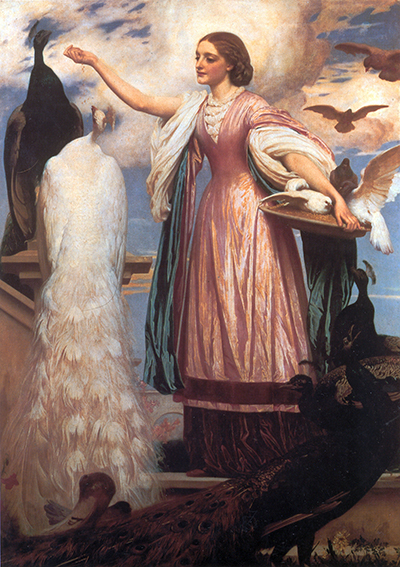
| A Girl Feeding Peacocks | Exhibited 1863 | Painting Catalogue. |
| A Recognition from ‘Romola’, engraved by Swain (Tate N04054) | published 1862 | Print Catalogue. |
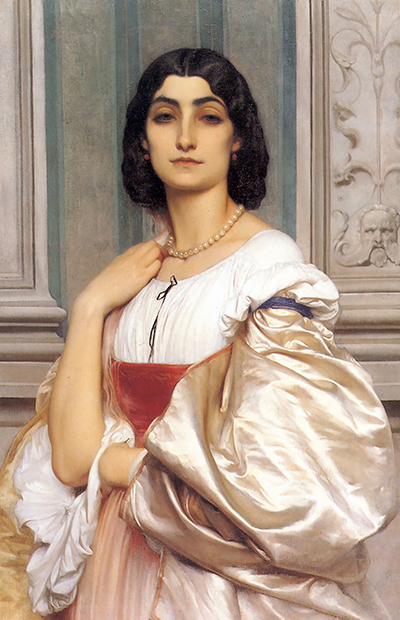
| A Roman Lady | 1859 | Painting Catalogue. |
| Abram and the Angel (Tate A00733) | published 1881 | Print Catalogue. |
| Acme and Septimius | Exhibited 1868 | Painting Catalogue. |
| An Athlete Wrestling with a Python (Tate exhibition bronze) | 1877 | Sculpture Catalogue. |
| And the Sea Gave Up the Dead Which Were in It (Tate N01511) | 1891–92 | Painting Catalogue. |
| Andromache in Captivity (photogravure after Leighton) | 1889 | Print Catalogue. |
| Athlete Wrestling with a Python (Anglesey Abbey cast) | model 1877; cast 1905 | Sculpture Catalogue. |
| Athlete Wrestling with a Python (Hood reduced cast) | 1877 (inscribed model date) | Sculpture Catalogue. |
| Athlete Wrestling with a Python (Saint Louis reduced cast) | 1877 (museum date) | Sculpture Catalogue. |
| Cain and Abel (Tate A00731) | published 1881 | Print Catalogue. |
| Captive Andromache | 1888 | Painting Catalogue. |
| Cimabue's Celebrated Madonna | 1853–55 | Painting Catalogue. |
| Cimon and Iphigenia, with Many Smaller Subjects (Tate T09061) | date not known | Drawing Catalogue. |
| Crenaia, the Nymph of the Dargle | Exhibited 1880 | Painting Catalogue. |
| Cymon and Iphigenia | 1884 | Painting Catalogue. |
| Daedalus and Icarus | 1869 | Painting Catalogue. |
| Dante in Exile | 1864 | Painting Catalogue. |
| Death of the First Born (Tate A00737) | published 1881 | Print Catalogue. |
| Electra at the Tomb of Agamemnon | c. 1869 | Painting Catalogue. |
| Eliezer and Rebekah (Tate A00735) | published 1881 | Print Catalogue. |
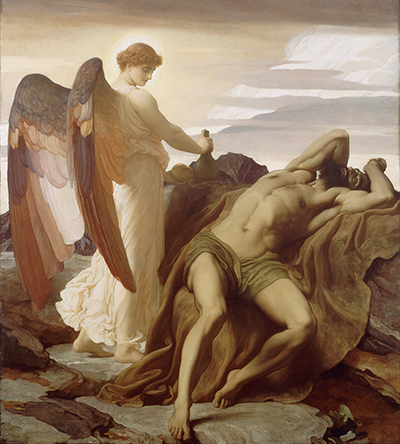
| Elijah in the Wilderness | 1877–78 | Painting Catalogue. |
| Fanny Kemble: A Study for ‘Jezebel and Ahab’ (Tate T08208) | c.1862 | Drawing Catalogue. |
| Figure Studies | Date not recorded | Drawing Catalogue. |
| Flaming June | 1895 | Painting Catalogue. |
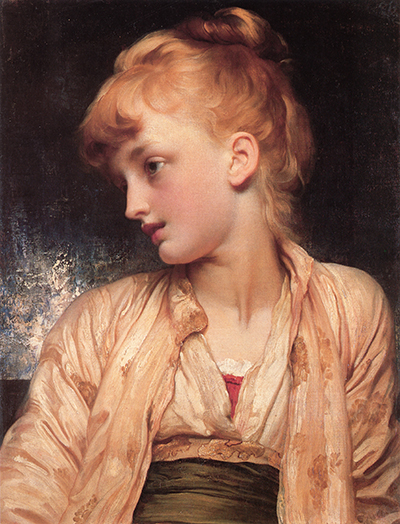
| Gulnihal | Exhibited 1886 | Painting Catalogue. |
| Helios and Rhodes (Tate N03015) | date not known | Painting Catalogue. |
| Hercules Wrestling with Death for the Body of Alcestis | c. 1869–71 | Painting Catalogue. |
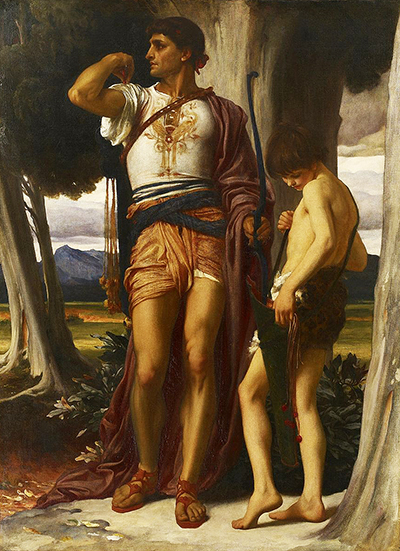
| Jonathan's Token to David | c. 1868 | Painting Catalogue. |
| Lachrymae | 1894–95 | Painting Catalogue. |
| Lieder ohne Worte | Exhibited 1861 | Painting Catalogue. |
| Light of the Harem | Exhibited 1880 | Painting Catalogue. |
| Moses Views the Promised Land (Tate A00736) | published 1881 | Print Catalogue. |
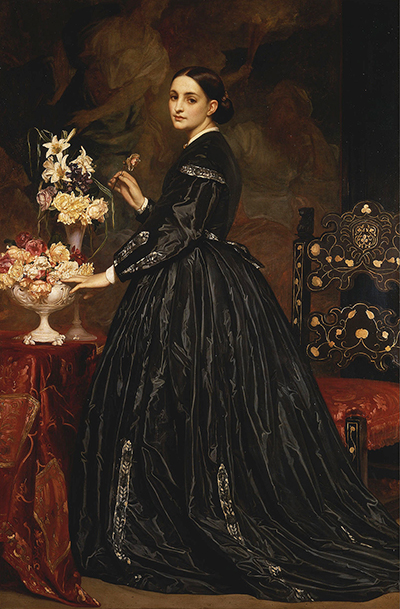
| Mrs James Guthrie | 1865 | Painting Catalogue. |
| Mrs John Hanson Walker (Tate N04731) | 1867 | Painting Catalogue. |
| Music Lesson | 1877 | Painting Catalogue. |
| Needless Alarms (Met cast) | modelled 1886; cast nineteenth century | Sculpture Catalogue. |
| Needless Alarms (Tate N05120) | 1886 | Sculpture Catalogue. |
| Pavonia | c. 1859 | Painting Catalogue. |
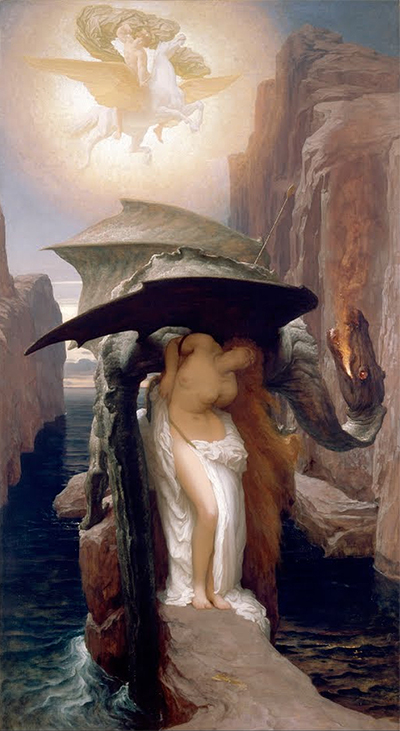
| Perseus and Andromeda | 1891 | Painting Catalogue. |
| Portrait of May Sartoris | c. 1860 | Painting Catalogue. |
| Preparing for a Festa, Florence (Tate T09062) | date not known | Drawing Catalogue. |
| Puerta de los Vientos, near Ronda, Spain (Tate N04006) | c.1886–9 | Painting Catalogue. |
| Samson and the Lions (Tate A00732) | published 1881 | Print Catalogue. |
| Samson at the Mill (Tate A00734) | published 1881 | Print Catalogue. |
| Samson Carrying the Gate (Tate A00738) | published 1881 | Print Catalogue. |
| Sketch for ‘An Athlete Wrestling with a Python’ (Tate N01761) | c.1877 | Sculpture Catalogue. |
| Sketches for Cimon and Iphigenia (Tate T09060) | date not known | Drawing Catalogue. |
| Study for The Return of Persephone (Demeter) | c. 1890–91 | Drawing Catalogue. |
| Study for The Return of Persephone (Persephone) | c. 1890–91 | Drawing Catalogue. |
| Study for ‘Needless Alarms’ (Tate N02945) | 1886 | Sculpture Catalogue. |
| Study for ‘The Discovery of Juliet Apparently Lifeless’ (Tate N01806) | c.1858 | Painting Catalogue. |
| The Bath of Psyche | Exhibited 1890 | Painting Catalogue. |
| The Daphnephoria | 1874–76 | Painting Catalogue. |
| The Death of Brunelleschi | 1852 | Painting Catalogue. |
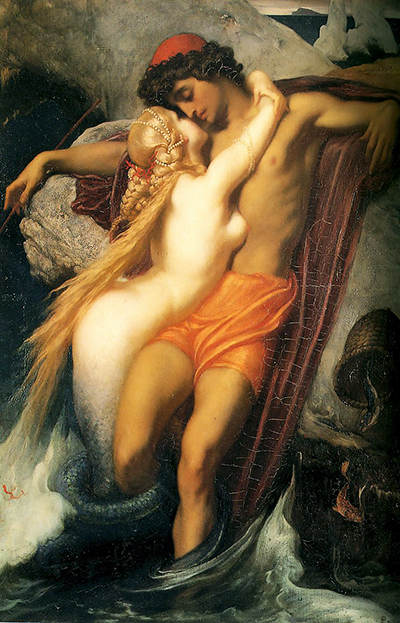
| The Fisherman and the Siren | Exhibited 1858 | Painting Catalogue. |
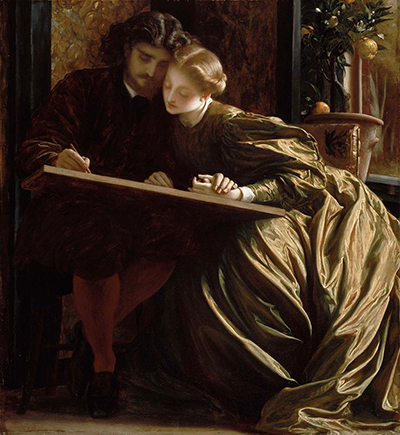
| The Painter's Honeymoon | c. 1864 | Painting Catalogue. |
| The Return of Persephone | 1891 | Painting Leeds painting identified in the Met study record. |
| The Return of Persephone (preparatory oil) | c. 1890–91 | Painting Catalogue. |
| The Sluggard (Anglesey Abbey cast) | probably 1890–about 1906 | Sculpture Catalogue. |
| The Sluggard (Met cast) | modelled 1886; cast possibly before 1896 | Sculpture Catalogue. |
| The Sluggard (Museum Wales) | 1882–85 (museum date) | Sculpture Catalogue. |
| The Sluggard (Tate N01752) | 1885 | Sculpture Catalogue. |
| The Spies Escape (Tate A00730) | published 1881 | Print Catalogue. |
| Various Subjects (Tate T09063) | date not known | Drawing Catalogue. |
| View in Capri | Possibly 1859 | Painting Catalogue. |
| Wedded | 1882 | Painting Catalogue. |
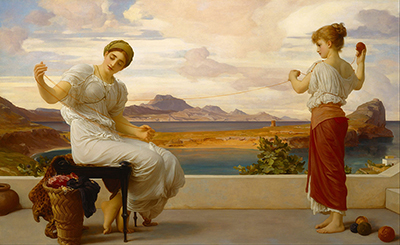
| Winding the Skein | c. 1878 | Painting Catalogue. |
Discussion
Look again at the images and ideas explored in Frederic Leighton Paintings. These editorial prompts invite your observations.
Reader Insights
Where does the rhythm of the crowd change when you compare Cimabue’s procession with Andromache at the well?
What do the materials and scale of a preparatory study tell you that its title alone cannot?
Join the Conversation
Share a detail, comparison or question about Frederic Leighton Paintings below.
References
- National Gallery, London. Cimabue’s Celebrated Madonna, L275. View source.
- Museo de Arte de Ponce. Flaming June, 63.0406. View source.
- Metropolitan Museum of Art. The Return of Persephone, preparatory oil, 2021.10.1. View source.
- Daniela Parenti, Gallerie degli Uffizi. Madonna col Bambino in trono e angeli (detta Madonna Rucellai). View source.
- Jonathan Law and Mary Roberts. “The Atmospherics of Leighton House”, British Art Studies 9, 2018, LL 3632, fig. 29 and discussion of the 1876 exhibition. View source.
- Claude Calame. Choruses of Young Women, chapter 2, discussion of the Daphnephoria. View source.
- National Gallery of Victoria. Studies for Daphnephoria. View source.
- Manchester Art Gallery. “Tales from the Archives: A Brush with the Law, Part 4”, discussion and reproduction of Captive Andromache (Manchester 1889.2, see [26]). View source.
- Musée d’Orsay. Étude pour Andromaque ; reprises, RF 39663, recto, held at the Louvre’s Département des Arts Graphiques. View source.
- Madeline Boden. A Relief from Classicism: Frederic Leighton in the Near East, 1857–1895, University of York doctoral thesis, 2019, figs. 10–11. View source.
- Kimbell Art Museum. Portrait of May Sartoris, ACF 1964.03. View source.
- National Portrait Gallery, London. Sir Richard Francis Burton, extended catalogue entry, NPG 1070. View source.
- Tate. Lieder ohne Worte, collection record via Google Arts & Culture. View source.
- Caroline Arscott. “The Music Lesson, 1877”, Victorians Decoded, entry T4, pp. 127–128. View source.
- City of London Corporation. Music Lesson, Guildhall Art Gallery collection record via Google Arts & Culture (Guildhall 1039, see [26]). View source.
- Faringdon Collection. Daedalus and Icarus, catalogue no. 80. View source.
- National Museum of Western Art, Tokyo. Study for ‘The Return of Persephone’, D.2017-0089, with catalogue discussion of D.2017-0092 in Japanese. View source.
- Tate. The Bath of Psyche, N01574, collection record via Google Arts & Culture. View source.
- National Museums Liverpool. Myths and Legends, teachers’ notes, p. 5, The Garden of Hesperides. View source.
- Pola Durajska. Nature, Science, and Myth in the Landscape Art of Frederic Leighton, vol. II, University of York doctoral thesis, 2021, fig. 146. View source.
- Museo de Arte de Ponce. Sol ardiente de junio, Spanish collection interpretation. View source.
- Leighton House, Royal Borough of Kensington and Chelsea. “Frederic Leighton’s Flaming June: The Making of an Icon”. View source.
- Pola Durajska. Nature, Science, and Myth in the Landscape Art of Frederic Leighton, vol. I, University of York doctoral thesis, 2021, pp. 195–196. View source.
- Metropolitan Museum of Art. Lachrymae, 96.28. View source.
- Anne Helmreich. “1896: Leighton’s Farewell”, The Royal Academy Summer Exhibition: A Chronicle, 1769–2018, figs. 1–2 and notes 1–9. View source.
- Metropolitan Museum of Art. Andromache in Captivity, 2015.653.1, photogravure after Frederic Leighton. View source.
- Ernest Rhys. Frederic Lord Leighton: An Illustrated Record of His Life and Work, revised edition, 1900, chapters IV–V and appendix I. View source.