 by Tom Gurney
Tom Gurney BSc (Hons) is an art history expert with over 20 years experience
Published on June 19, 2020 / Updated on November 29, 2026
Email: tomgurney1@gmail.com / Phone: +44 7429 011000
The Fisherman and the Siren: Introduction
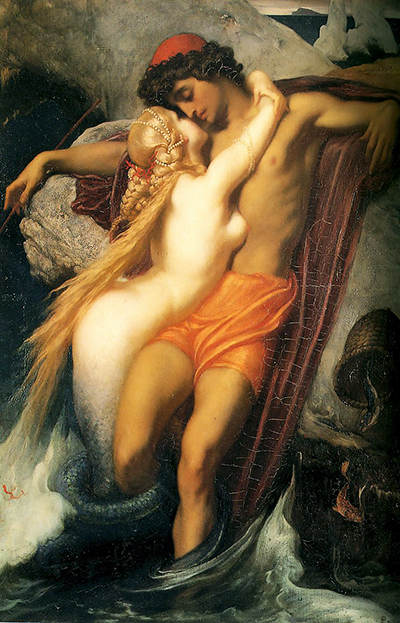
The fisherman is already slipping into the water when Frederic Leighton lets us see what is holding him there. One of the siren's arms curves around his neck, while her blue-green tail loops across his leg. His hands hang loose against the rock and his head tips towards hers. The embrace looks tender until the foam at their feet shows how little ground he has left. Bristol Museum & Art Gallery calls the painting The Fisherman and the Syren, using the spelling of its 1858 exhibition title. The oil on canvas, painted about 1856–58, measures 66.4 cm high by 48.9 cm wide and is catalogued as K1401. [1] [2] [3]
At a Glance
- Historical titleThe Fisherman and the Syren
- MediumOil on canvas
- CollectionBristol Museum & Art Gallery, K1401
- Royal AcademyExhibited in 1858 as no. 501
This work across Frederic Leighton’s career
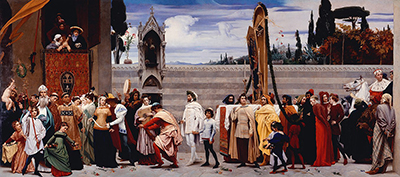
Cimabue’s Celebrated Madonna
1853–55The Fisherman and the Siren (current article)
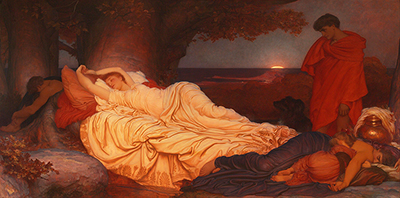
Exhibited 1858 [1]Lachrymae
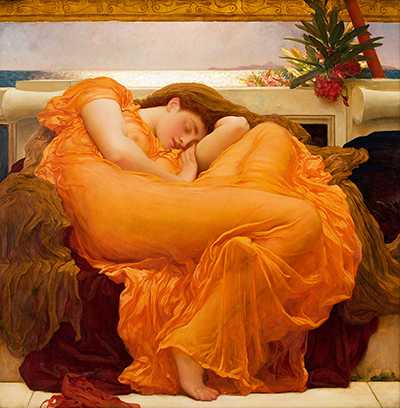
1894–95Flaming June
c. 1895Contents
- The embrace at the waterline
- What Goethe's fisherman hears
- A siren with a mermaid's tail
- From the Royal Academy to Bristol
- Annotated details
The embrace at the waterline
Leighton sets the two figures almost upright within a narrow canvas. The fisherman leans across a rock with an arm on either side of him, his dark head and scarlet cap just below the upper edge. His body has the strong shoulders of someone who could haul himself up. The languor of his hands and the tilt of his head suggest an utterly different state of mind. The siren presses upwards, her face all but hidden against his cheek. We see the encounter from close enough to follow the contact between her hand and his neck, yet the painting gives us remarkably little of their expressions. Art historian Jennifer Bates Ehlert draws attention to the part played by the bodies themselves. The curve of the siren's back and the weight of the fisherman against the rock convey what an exchange of looks might have told us in another picture. [1] [4]
Light guides the eye down her back and along the loose sweep of her golden hair. A few pearls catch the light closer to her head. The hair streams across the rock in one continuous fall, while the orange cloth at the fisherman's waist creases sharply where his legs bend. Behind him a long piece of purple fabric slips down towards the water. The tail is half lost in the dark tide, and the foam beside it carries the movement around the lower part of the canvas. Tracing those lines brings the eye back to his feet. The pale skin first catches the eye, then the movement of water and cloth reveals what the embrace is doing. [1] [5]
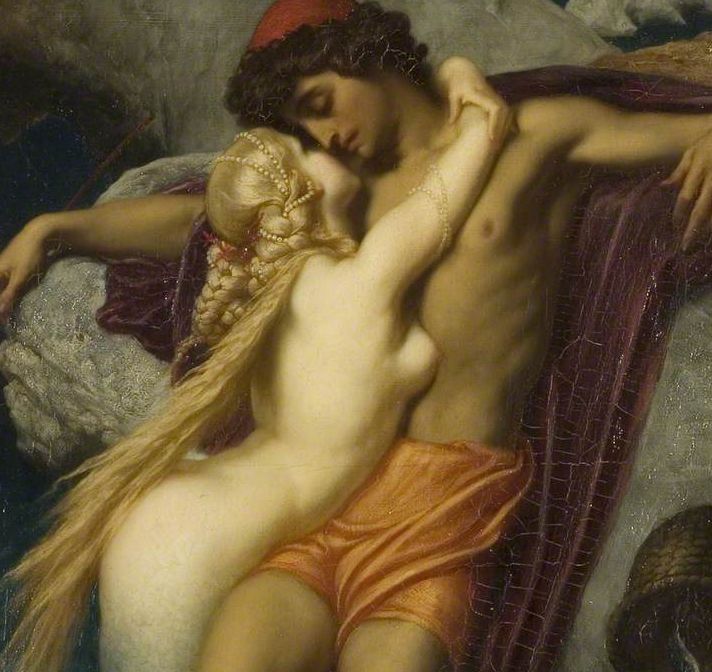
Detail of Leighton’s The Fisherman and the Syren. The joined arms hold the two figures together above the water. Image source. Public domain. Detail cropped from the documented Bristol reproduction.
Annotated Details from The Fisherman and the Siren
The numbered points identify visible features discussed in this article. Return from each detail to the numbered overview. Frederic Leighton, The Fisherman and the Syren, exhibited 1858. Bristol Museum & Art Gallery. Image source. Public domain. Resized without changing the composition.
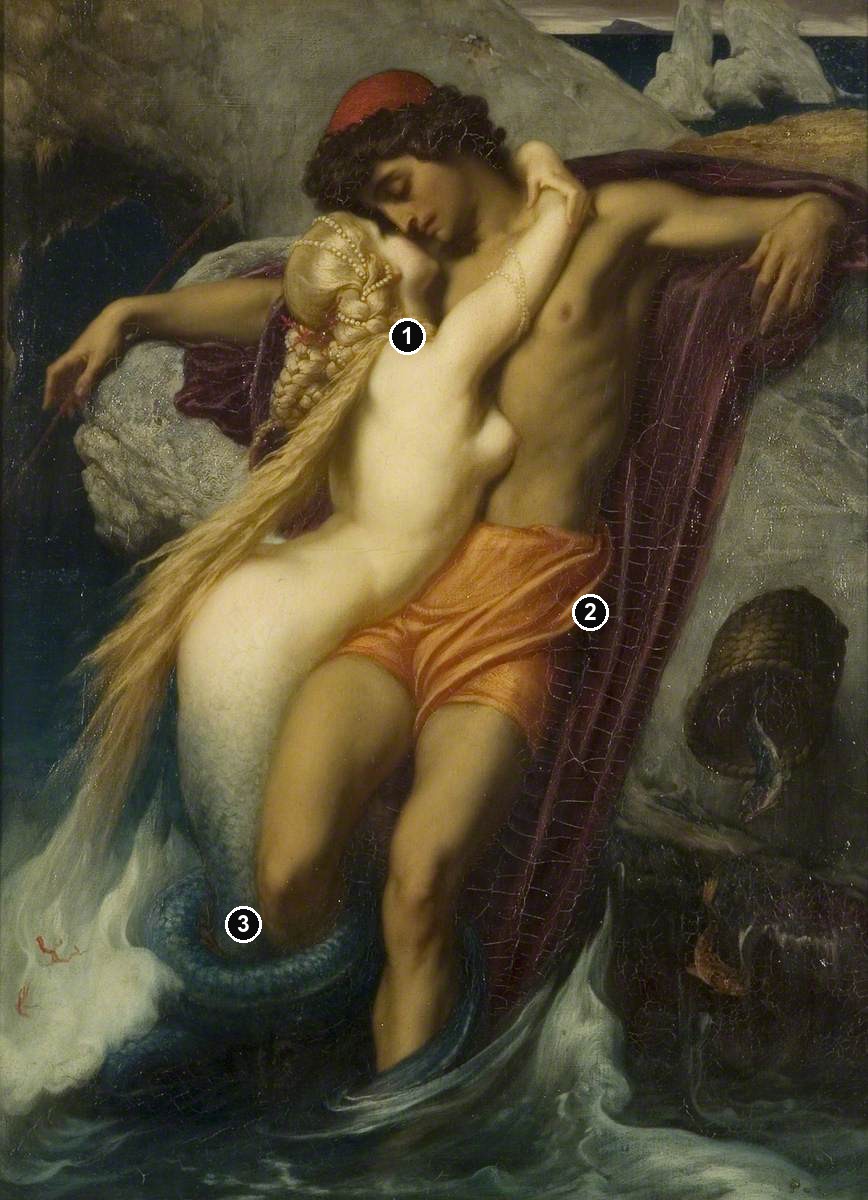
Details from THE FISHERMAN AND THE SIREN
Compare the cropped details with the source images above. Notice how their colours, shapes and positions contribute to the larger compositions.
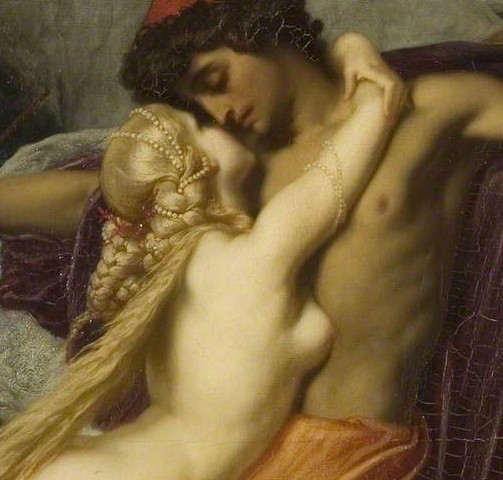
The faces and joined arms
The two heads incline towards one another. Her raised arm and his leaning shoulder hold their faces together in a small space above the rock.
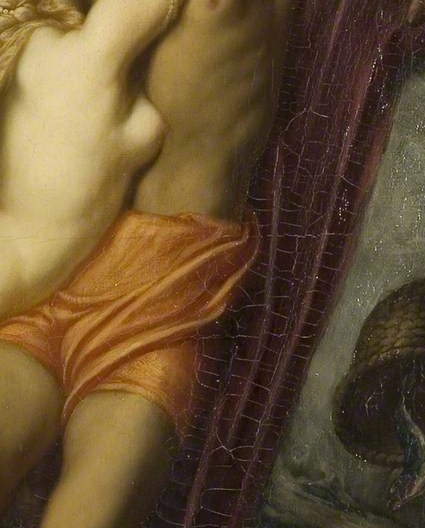
The fabric against the rock
The fisherman’s cloth turns orange across his hips. Against the neighbouring dark red fabric and stone it helps the eye follow the figure’s diagonal.
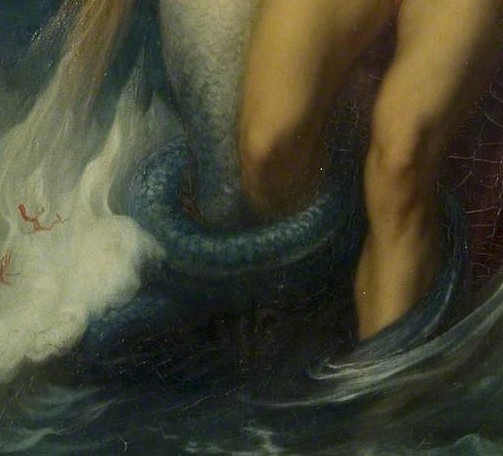
The tail and the waves
The syren’s body darkens where it curves into the water. Leighton uses the turning waves to link the foot of the rock to the two figures.
What Goethe's fisherman hears
In Johann Wolfgang von Goethe's Der Fischer, the fisherman begins at ease, watching his hook. The noise of the swelling water opens the ballad and returns near the end, when it reaches his bare foot. Between those two moments a woman rises from the water to ask why he uses his wits to lure her young up to die. She describes the depths as the place where the fish feel at home. She then asks whether the sun and moon seem more beautiful when reflected in the water and whether his own face draws him down. The fisherman, whose living depends on making something come to the surface, hears his own invitation turned back on him. [6]
The woman speaks and sings. Literary scholar Deva Kemmis places listening at the centre of the ballad, where its recurrence of sound makes the reader attend to the same things the fisherman hears. When Johann Gottfried Herder included the poem in his Volkslieder in 1779, he understood it as a model for German poetry drawing on the expressive power of folk song. Leighton had a different medium at his disposal. In the canvas the pair are so close that the siren could be murmuring into his ear, while the white water breaks across the blue in short bursts. Art historian Marte Stinis reads the painting as an early instance of Leighton making the pull of music visible. The fisherman has fallen still amid so much movement that we have time to imagine what has captivated him. [6] [7] [8]
Goethe divides the last action between the two figures. In the lines printed for Leighton's exhibition, she draws him and he sinks. Italian critic Benedetto Croce noticed how much depends on that balance when he criticised Andrea Maffei's translation for making the man's disappearance seem inevitable. In Vasily Zhukovsky's Russian rendering, the two figures move towards each other before the fisherman vanishes. Leighton gives the siren a firm hold and puts the fisherman's hand within reach of dry rock. The curve of his body leaves room for his own longing and for the danger her invitation presents. [3] [6] [9] [10]
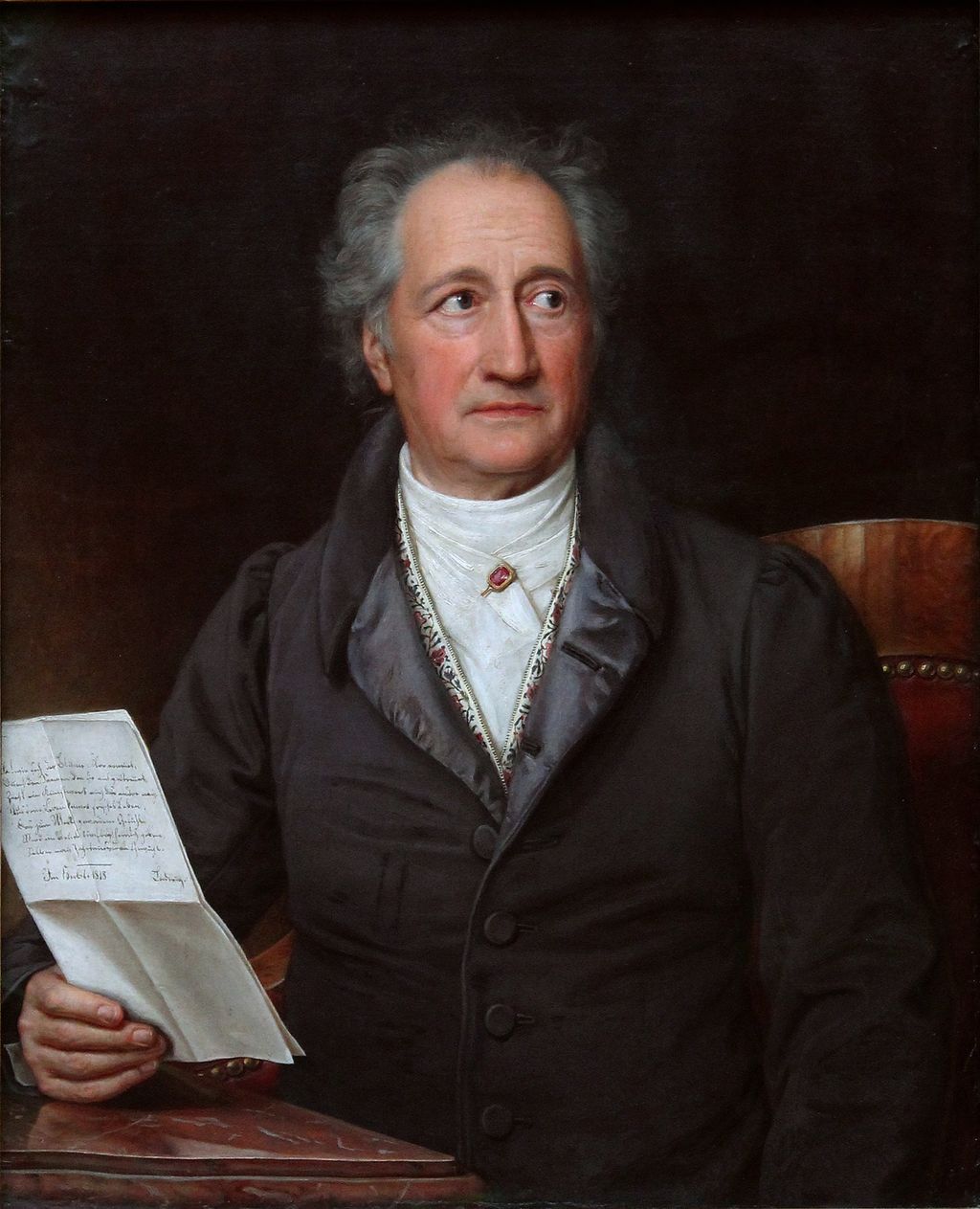
Joseph Karl Stieler, Johann Wolfgang von Goethe, 1828. Bayerische Staatsgemäldesammlungen. Image source. Public domain. Resized without changing the composition.
A siren with a mermaid's tail
An archaic Greek terracotta siren in the Metropolitan Museum of Art has a woman's head and a bird's body. Leighton's figure has a fish's tail instead. Goethe calls the being who rises from the waves a woman and leaves her shape below the water to the imagination. The tail lets Leighton show how easily she can move in the element that is becoming deadly to the fisherman. Its green and blue also make it easy to miss on a first look, especially beside the much warmer colours of the two figures. [1] [5] [6] [11]
Looking for pictorial precedents, the Japanese art historian Toyoshima draws a comparison with Francesco Furini's Hylas and the Nymphs in the Palazzo Pitti. In that painting, two nymphs wind their arms around the young Hylas's neck to carry him into the water. The subject comes from the voyage of the Argonauts. The comparison gives Leighton's gesture a history in painting while leaving Goethe's ballad as his named literary source. Toyoshima also connects the embrace with images of doomed lovers, including Leighton's earlier Shakespearean composition The Reconciliation of the Montagues and the Capulets and Ary Scheffer's Francesca da Rimini and Paolo Malatesta. In each, the closeness of the figures makes danger or grief more affecting. The shape of the siren's arms can carry some of that tenderness even as the tail draws the fisherman down. [12] [13] [14] [15]
The story also reached sculpture. In 1883 the Prussian sculptor Max Unger made a bronze Der Fischer that stands near the house at Huis Doorn in the Netherlands. The Dutch government’s survey identifies Goethe’s poem and Leighton’s painting as possible sources for the bronze. Unger’s three-dimensional group concentrates the story in the encounter of two bodies. Leighton could also use the colour of the tail, the slip of drapery and the foam around the bare legs to show what each figure is doing. [16]
From the Royal Academy to Bristol
At the Royal Academy in 1858 the picture hung in the West Room as number 501. The catalogue named Goethe's ballad in the subtitle and printed an English rendering of its last lines. Leighton's other exhibit was the Shakespearean picture now in Adelaide as The Feigned Death of Juliet. There, several figures gather around a woman they believe to be dead. The Juliet stretches nearly 1.8 metres across, while the fisherman and siren have less than half a metre of canvas between the sides of their rocky shore. [17] [18] [19]
The Daily Telegraph review of 3 May 1858, reprinted by Leighton's biographer Russell Barrington, praised the graceful drawing on both sides of the encounter. The writer read the fisherman as overcome by his affection and found the young painter's handling of the human figure worthy of the Italian masters. In 1861, Leighton himself brought up the painting in a letter to his father while discussing Lieder ohne Worte. He described the earlier picture as “as little naturalistic as anything could be”. His remark helps explain how the rock, the water and the skin can look so tangible even as the lines of the bodies seem deliberately arranged. The contours that impressed his reviewer were a means of making an invented encounter feel physically convincing. [20]
The Royal Academy brought the painting back in its 1897 winter exhibition. The catalogue records that Mrs Watney lent it under the title The Mermaid and explicitly gives the original title with its reference to Goethe. The Honourable Mrs Charles Lyell gave the canvas to Bristol in 1938. Visitors can encounter the same painted embrace under both titles in the exhibition record. [1] [3] [21]
Browse Frederic Leighton’s artworks
Explore paintings, drawings, sculptures and prints, with separate rows for identified preparatory works, reproductions and casts.
| Name | Date | Medium |
|---|---|---|
| A Girl Feeding Peacocks | Exhibited 1863 | Painting Catalogue. |
| A Recognition from ‘Romola’, engraved by Swain (Tate N04054) | published 1862 | Print Catalogue. |
| A Roman Lady | 1859 | Painting Catalogue. |
| Abram and the Angel (Tate A00733) | published 1881 | Print Catalogue. |
| Acme and Septimius | Exhibited 1868 | Painting Catalogue. |
| An Athlete Wrestling with a Python (Tate exhibition bronze) | 1877 | Sculpture Catalogue. |
| And the Sea Gave Up the Dead Which Were in It (Tate N01511) | 1891–92 | Painting Catalogue. |
| Andromache in Captivity (photogravure after Leighton) | 1889 | Print Catalogue. |
| Athlete Wrestling with a Python (Anglesey Abbey cast) | model 1877; cast 1905 | Sculpture Catalogue. |
| Athlete Wrestling with a Python (Hood reduced cast) | 1877 (inscribed model date) | Sculpture Catalogue. |
| Athlete Wrestling with a Python (Saint Louis reduced cast) | 1877 (museum date) | Sculpture Catalogue. |
| Cain and Abel (Tate A00731) | published 1881 | Print Catalogue. |
| Captive Andromache | 1888 | Painting Catalogue. |
| Cimabue's Celebrated Madonna | 1853–55 | Painting Catalogue. |
| Cimon and Iphigenia, with Many Smaller Subjects (Tate T09061) | date not known | Drawing Catalogue. |
| Crenaia, the Nymph of the Dargle | Exhibited 1880 | Painting Catalogue. |
| Cymon and Iphigenia | 1884 | Painting Catalogue. |
| Daedalus and Icarus | 1869 | Painting Catalogue. |
| Dante in Exile | 1864 | Painting Catalogue. |
| Death of the First Born (Tate A00737) | published 1881 | Print Catalogue. |
| Electra at the Tomb of Agamemnon | c. 1869 | Painting Catalogue. |
| Eliezer and Rebekah (Tate A00735) | published 1881 | Print Catalogue. |
| Elijah in the Wilderness | 1877–78 | Painting Catalogue. |
| Fanny Kemble: A Study for ‘Jezebel and Ahab’ (Tate T08208) | c.1862 | Drawing Catalogue. |
| Figure Studies | Date not recorded | Drawing Catalogue. |
| Flaming June | 1895 | Painting Catalogue. |
| Gulnihal | Exhibited 1886 | Painting Catalogue. |
| Helios and Rhodes (Tate N03015) | date not known | Painting Catalogue. |
| Hercules Wrestling with Death for the Body of Alcestis | c. 1869–71 | Painting Catalogue. |
| Jonathan's Token to David | c. 1868 | Painting Catalogue. |
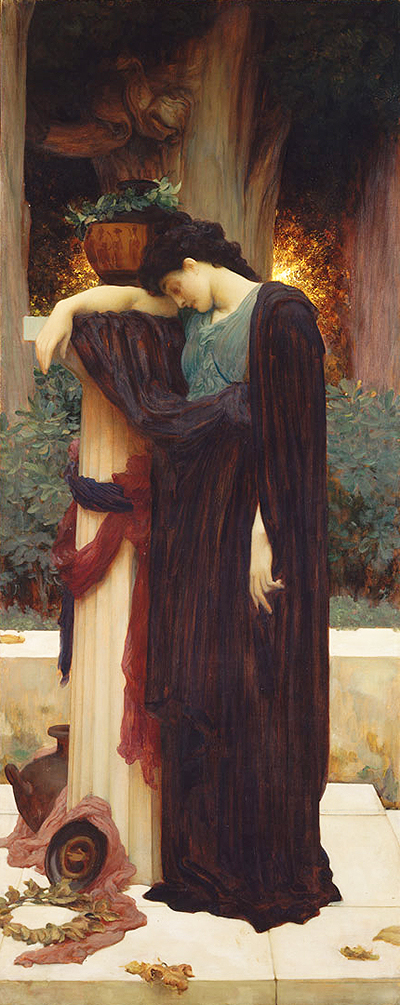
| Lachrymae | 1894–95 | Painting Catalogue. |
| Lieder ohne Worte | Exhibited 1861 | Painting Catalogue. |
| Light of the Harem | Exhibited 1880 | Painting Catalogue. |
| Moses Views the Promised Land (Tate A00736) | published 1881 | Print Catalogue. |
| Mrs James Guthrie | 1865 | Painting Catalogue. |
| Mrs John Hanson Walker (Tate N04731) | 1867 | Painting Catalogue. |
| Music Lesson | 1877 | Painting Catalogue. |
| Needless Alarms (Met cast) | modelled 1886; cast nineteenth century | Sculpture Catalogue. |
| Needless Alarms (Tate N05120) | 1886 | Sculpture Catalogue. |
| Pavonia | c. 1859 | Painting Catalogue. |
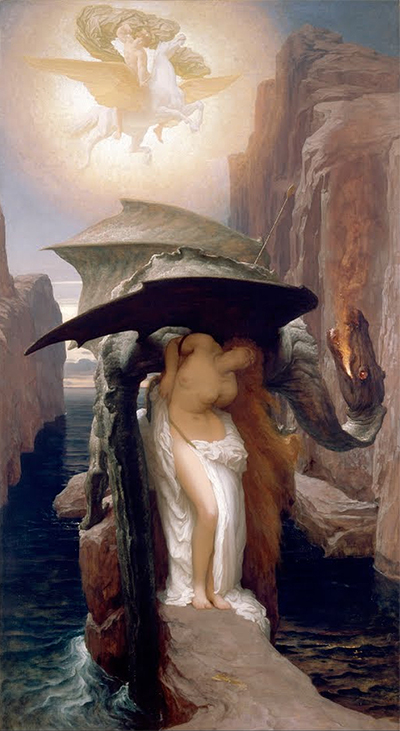
| Perseus and Andromeda | 1891 | Painting Catalogue. |
| Portrait of May Sartoris | c. 1860 | Painting Catalogue. |
| Preparing for a Festa, Florence (Tate T09062) | date not known | Drawing Catalogue. |
| Puerta de los Vientos, near Ronda, Spain (Tate N04006) | c.1886–9 | Painting Catalogue. |
| Samson and the Lions (Tate A00732) | published 1881 | Print Catalogue. |
| Samson at the Mill (Tate A00734) | published 1881 | Print Catalogue. |
| Samson Carrying the Gate (Tate A00738) | published 1881 | Print Catalogue. |
| Sketch for ‘An Athlete Wrestling with a Python’ (Tate N01761) | c.1877 | Sculpture Catalogue. |
| Sketches for Cimon and Iphigenia (Tate T09060) | date not known | Drawing Catalogue. |
| Study for The Return of Persephone (Demeter) | c. 1890–91 | Drawing Catalogue. |
| Study for The Return of Persephone (Persephone) | c. 1890–91 | Drawing Catalogue. |
| Study for ‘Needless Alarms’ (Tate N02945) | 1886 | Sculpture Catalogue. |
| Study for ‘The Discovery of Juliet Apparently Lifeless’ (Tate N01806) | c.1858 | Painting Catalogue. |
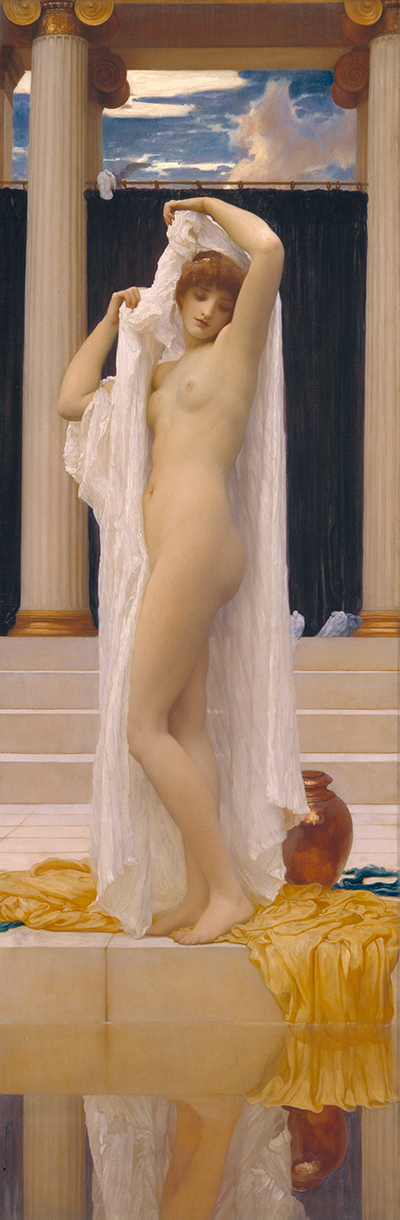
| The Bath of Psyche | Exhibited 1890 | Painting Catalogue. |
| The Daphnephoria | 1874–76 | Painting Catalogue. |
| The Death of Brunelleschi | 1852 | Painting Catalogue. |
| The Fisherman and the Siren | Exhibited 1858 | Painting Catalogue. |
| The Painter's Honeymoon | c. 1864 | Painting Catalogue. |
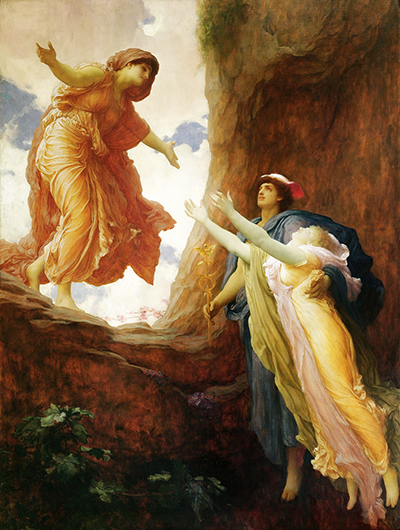
| The Return of Persephone | 1891 | Painting Leeds painting identified in the Met study record. |
| The Return of Persephone (preparatory oil) | c. 1890–91 | Painting Catalogue. |
| The Sluggard (Anglesey Abbey cast) | probably 1890–about 1906 | Sculpture Catalogue. |
| The Sluggard (Met cast) | modelled 1886; cast possibly before 1896 | Sculpture Catalogue. |
| The Sluggard (Museum Wales) | 1882–85 (museum date) | Sculpture Catalogue. |
| The Sluggard (Tate N01752) | 1885 | Sculpture Catalogue. |
| The Spies Escape (Tate A00730) | published 1881 | Print Catalogue. |
| Various Subjects (Tate T09063) | date not known | Drawing Catalogue. |
| View in Capri | Possibly 1859 | Painting Catalogue. |
| Wedded | 1882 | Painting Catalogue. |
| Winding the Skein | c. 1878 | Painting Catalogue. |
Discussion
Look again at the images and ideas explored in The Fisherman and the Siren. These editorial prompts invite your observations.
Reader Insights
Where does the picture leave the fisherman’s actions open to interpretation?
Which part of Goethe’s ballad does the silent meeting of the painted figures bring to mind?
Join the Conversation
Share a detail, comparison or question about The Fisherman and the Siren below.
References
- Bristol Museums, The Fisherman and the Syren, collection record and reproduction. View source.
- Madeline Boden, A Relief from Classicism: Frederic Leighton in the Near East, 1857–1895, University of York doctoral thesis, 2019, fig. 97, object K1401. View source.
- Royal Academy of Arts, Exhibition of Works by the Late Lord Leighton of Stretton, Winter Exhibition, 1897, p. 11, catalogue no. 26. View source.
- Jennifer Bates Ehlert, “Hylas and the Matinée Girl: John William Waterhouse and the Female Gaze,” Athanor 36, fig. 3 and discussion. View source.
- Bristol Museum & Art Gallery, “In Search of Sea Monsters,” collection discussion and dating. View source.
- Johann Wolfgang von Goethe, “Der Fischer,” Goethes Schriften, vol. 8, Leipzig, 1789, pp. 155–56. View source.
- Deva Kemmis, “Becoming the Listener: Goethe's ‘Der Fischer’,” Goethe Yearbook 25, 2018. View source.
- Marte Stinis, Music as Aesthetic Paradigm: Frederic Leighton, Albert Moore, and James McNeill Whistler, University of York doctoral thesis, 2021, fig. 17 and discussion. View source.
- Benedetto Croce, “Intorno a un’antologia di traduzioni italiane,” La Critica 37, 1939, p. 63. View source.
- Vasily Zhukovsky, “Рыбак,” Russian translation of Goethe, 1818, from the 1959 collected works, vol. 2. View source.
- The Metropolitan Museum of Art, Terracotta statuette of a siren, ca. 550–500 BCE. View source.
- Toyoshima (豊嶋乃女), “19世紀後半のセイレーン図像―フレデリック・レイトン《漁夫とセイレーン》を中心に―,” 67th annual meeting of the Japan Art History Society, 18 May 2014, conference abstract and Kobe University presentation notice. View source.
- Anna Bisceglia, Gallerie degli Uffizi, Ila e le ninfe, Galleria Palatina, inv. 1890 no. 3562. View source.
- Aix-Marseille Université, Utpictura18, Reconciliation of the Montagues and Capulets (Romeo and Juliet), record 17131. View source.
- Musée du Louvre, Les ombres de Francesca da Rimini et de Paolo Malatesta apparaissent à Dante et à Virgile, RF 1217. View source.
- Wevers & Van Luipen, Rijksvastgoedbedrijf, Parkobjecten Huis Doorn te Doorn, pp. 111–13, figs. 146–49. View source.
- Royal Academy of Arts, The Exhibition of the Royal Academy of Arts, the Ninetieth, 1858, p. 23, West Room, no. 501. View source.
- Royal Academy of Arts, The Exhibition of the Royal Academy of Arts, the Ninetieth, 1858, p. 27, no. 598. View source.
- Art Gallery of South Australia, The Feigned Death of Juliet, accession 0.160. View source.
- Russell Barrington, The Life, Letters and Work of Frederic Leighton, vol. 2, 1906, ch. 1. Includes the Daily Telegraph review of 3 May 1858 and Leighton's 1861 letter to his father. View source.
- Bristol Museums, Galleries & Archives, gift credit for The Fisherman and the Syren, Bridgeman record BAG46218. View source.