 by Tom Gurney
Tom Gurney BSc (Hons) is an art history expert with over 20 years experience
Published on June 19, 2020 / Updated on November 29, 2026
Email: tomgurney1@gmail.com / Phone: +44 7429 011000
Cymon and Iphigenia: Introduction
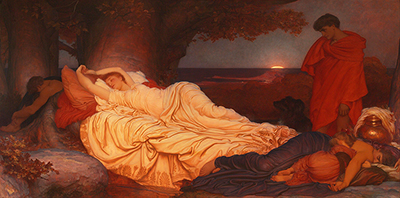
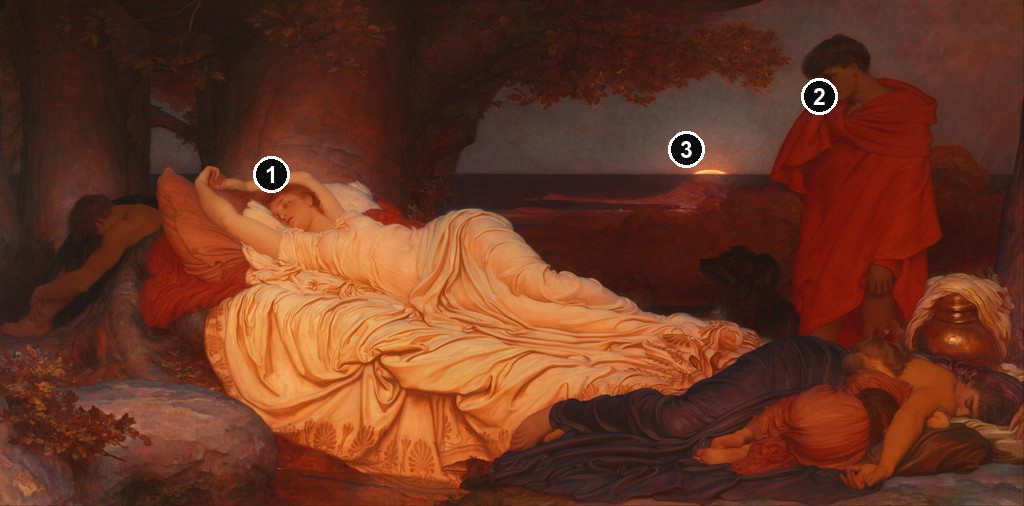
Iphigenia sleeps in a clearing by the sea. Cymon has stopped at the right, his head inclined towards her, while his black dog stands just ahead of him. Behind them a thin glow edges the horizon. It takes a moment to realise that the bright sliver is the rising moon. Frederic Leighton sets the discovery at the point when daylight still colours the sky and the woods are already dark. Iphigenia's dress, lit almost to gold, holds the eye as surely as it holds Cymon's. [1] [2]
Leighton exhibited Cymon and Iphigenia at the Royal Academy in 1884, while he was its president. The finished oil on canvas, now in the Art Gallery of New South Wales in Sydney, measures 163 by 328 centimetres within the frame. Its breadth gives Leighton room to show what is happening in the landscape as well as between the figures. A youth stands in shadow. The bright horizon marks a change taking place beyond the quiet of the encounter. [1] [3] [4]
At a Glance
- Date1884
- MediumOil on canvas
- CollectionArt Gallery of New South Wales, 210.1976
- SubjectThe first tale of the fifth day of Boccaccio’s Decameron
This work across Frederic Leighton’s career
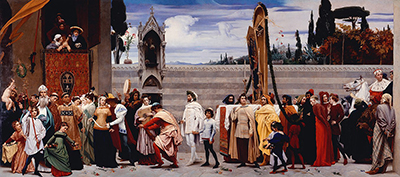
Cimabue’s Celebrated Madonna
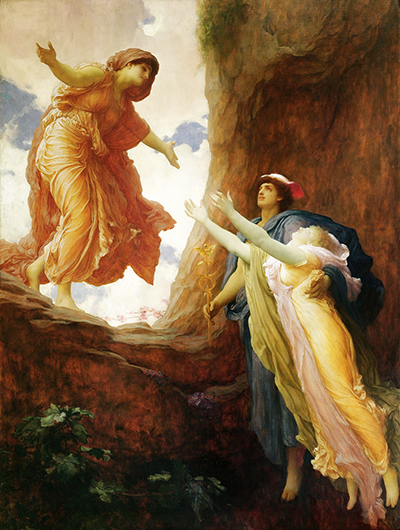
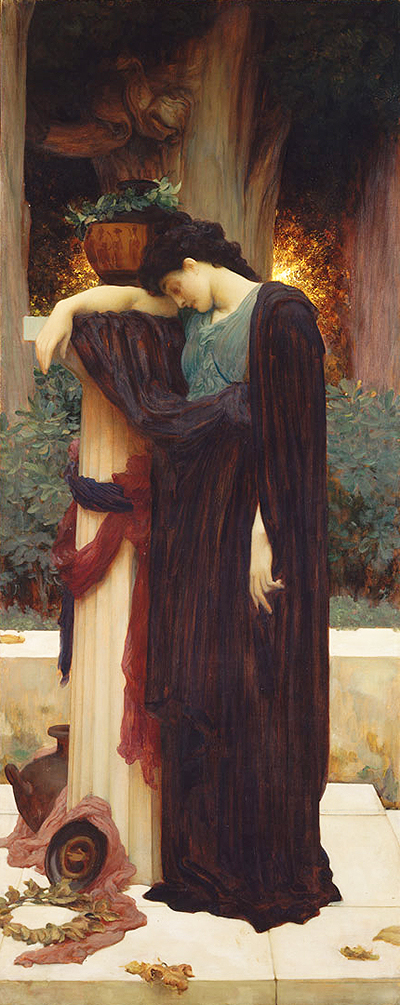
1853–55Lachrymae
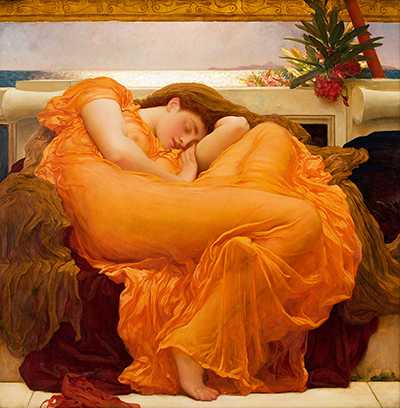
1894–95Flaming June
c. 1895Contents
- Boccaccio's tale at the edge of night
- How colour and drapery direct the eye
- From chalk and clay to the finished canvas
- Other painters and the first exhibitions
- Annotated details
Boccaccio's tale at the edge of night
The story comes from the first tale of the fifth day of Giovanni Boccaccio's Decameron. It begins on Cyprus with Galeso, a rich man's son whose family despairs of educating him. Known as Cimone in the Italian text, he is sent to live on a country estate. One afternoon in May, as he walks between properties, he finds a fountain in a leafy grove. Efigenia is asleep on the grass beside it. Her company consists of two women and a man, all her servants and all asleep. The youth leans on his staff and looks long enough to begin distinguishing and admiring her features. Boccaccio gives that scrutiny real consequences. Within four years, Cimone changes his speech and manners, learns music and takes up the pursuits expected of a young nobleman. [5]
Iphigenia wakes in the tale and immediately questions him. She is afraid as he follows her and tries to persuade him to leave. Later, after her father refuses to break her engagement to a man from Rhodes, Cymon takes her by force at sea. She condemns his conduct when a storm threatens them. What begins as a story about a man's education in beauty can feel different when read from her position. Leighton keeps the painting within the few moments when she is still asleep. The picture makes Cymon's attentive stillness persuasive while allowing that stillness to feel intrusive. [1] [5]
Leighton retains the grove, the sleeper and the staff. The shore, the child and the black dog give that scene a different setting and cast. The most consequential change is the hour. Boccaccio specifies that midday has passed on a day in May. Leighton told his biographer, Emilie Barrington, that he wanted the first edge of the moon to appear above the sea while the last glow of the sun lingered. The sky is dark enough for the moon to show, yet the pale dress retains the warmth of the fading daylight. Where Boccaccio can follow an education over years, Leighton uses a change that the eye can register in a single evening. [1] [2] [6] [5]
How colour and drapery direct the eye
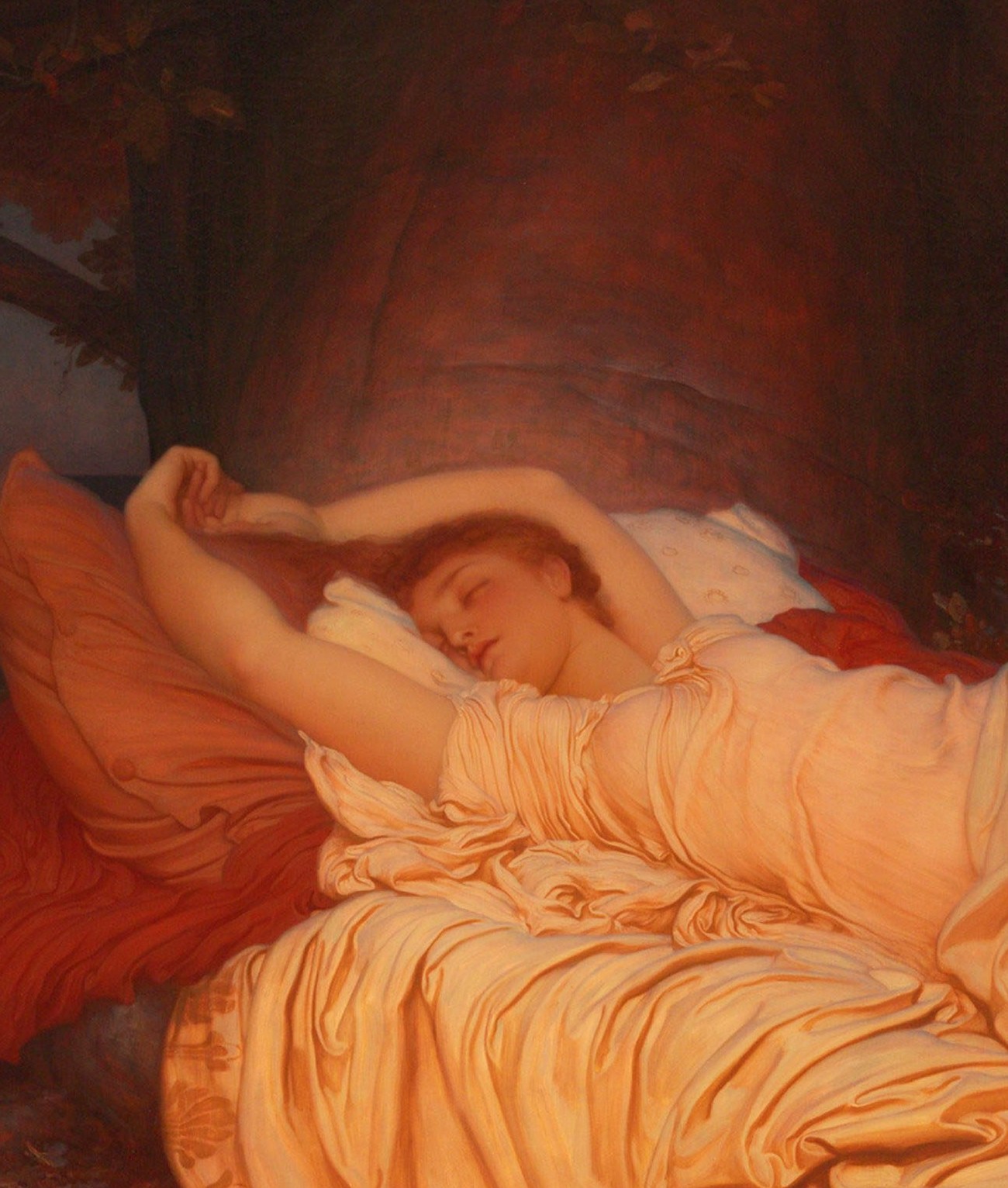
The main group lies low under the trees. A heavy trunk rises behind Iphigenia's red pillows and foliage encloses the upper edge. As her body stretches across the painting, her bent knee lifts the dress into a high ridge before the fabric drops in a long sweep towards her feet. Near her hip the folds gather and turn down across the foreground. The expanse of white can look almost uniform at first. Look a little longer and it becomes a field of rose, pale yellow and warmer orange, with narrow shadows turning the folds back into the body. The arms curve above the face and frame it against the pillow. Leighton lets the dress carry the eye a considerable distance from that face before the next figure claims it. [1] [3]
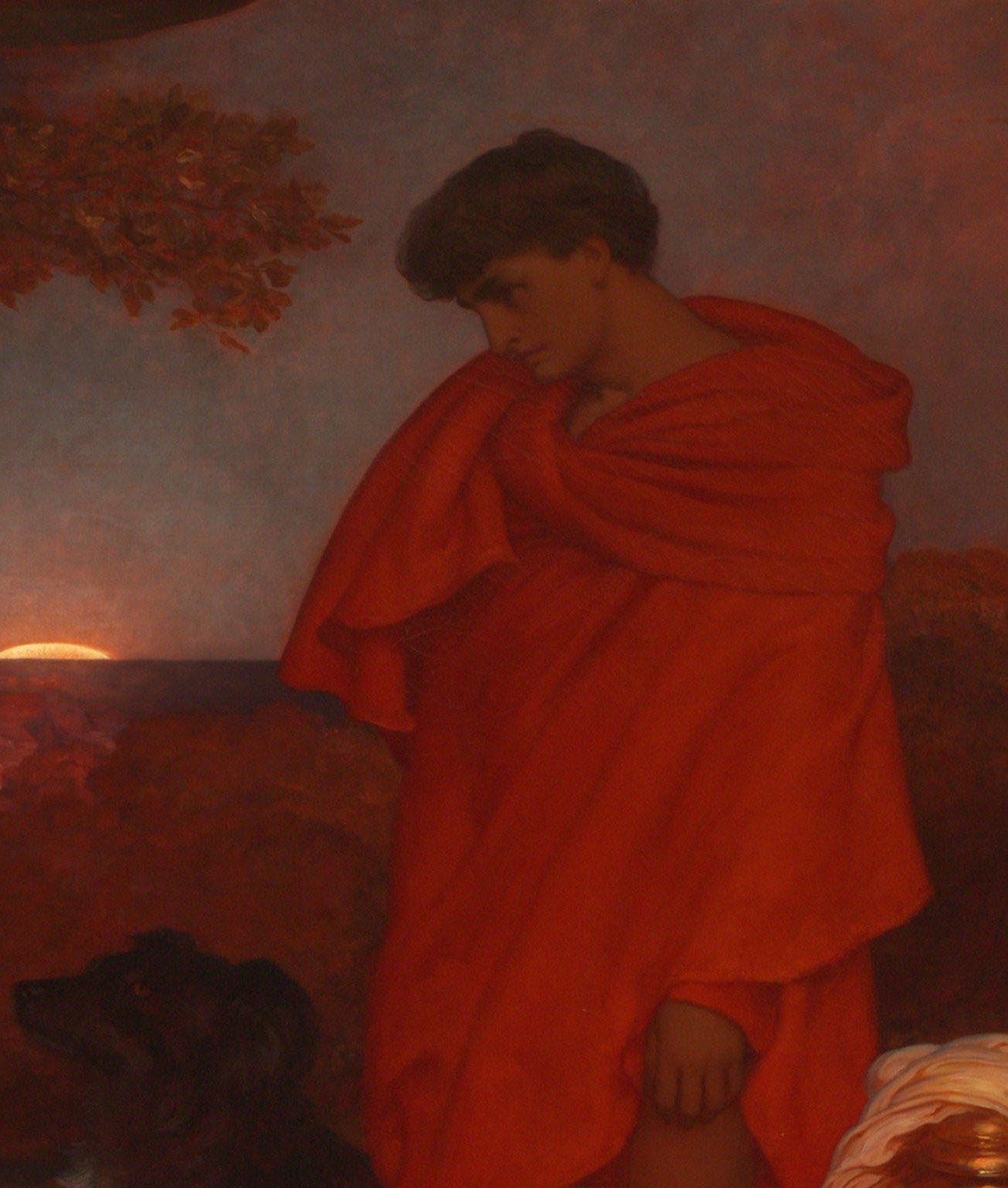
Cymon's red garment has a vertical weight against the pale horizontal figure. His face is shaded, yet the dip of his head directs the eye towards the brightest part of the painting. The red appears again in Iphigenia's pillows, linking two figures who never touch. At the right, the brass vessel catches a glow near the sleeping group, and darker blue cloth folds around the small foreground figure. The catalogue for Leighton's Kittens identifies the child in Cymon and Iphigenia as Lena Pullan, who also posed for Letty, another picture Leighton exhibited in 1884. The child contributes a compact, curled shape beside the great stretch of Iphigenia's body. [1] [3] [7]
In her review for The Art Journal in May 1884, Alice Meynell followed the way warm colours recur from the pillows to Cymon's clothing and the leaves. She treated the rendering of the white dress as an achievement in both line and colour. At the knee its folds describe a body underneath. Along the lip of the couch they form a pattern lively enough to draw attention in its own right. The art historian Keren Hammerschlag has since read that restlessness of fabric in the context of Victorian anxieties over the resemblance between sleep and death. The smooth modelling of Iphigenia's skin and the looser handling of the trees and ground, a contrast observed by the art historian Mary Roberts, make the passage from figure to setting feel like a change of texture as well as colour. [1] [3] [8] [9]
Annotated Details from Cymon and Iphigenia
The numbered points identify visible features discussed in this article. Return from each detail to the numbered overview. Each caption identifies the work shown.
Cymon and Iphigenia
Frederic Leighton, Cymon and Iphigenia, 1884. Art Gallery of New South Wales. Image source. Public domain. Resized without changing the composition.
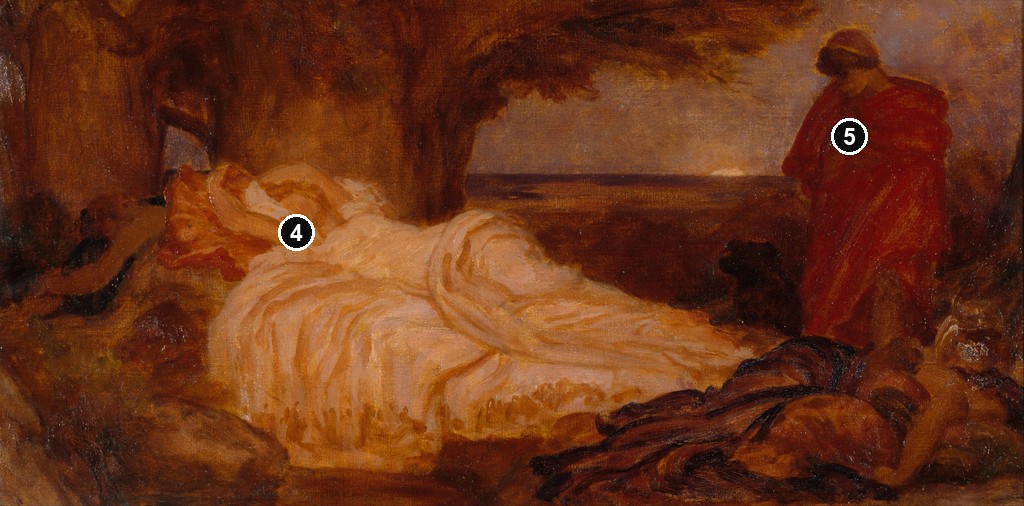
Colour study for Cymon and Iphigenia
Frederic Leighton, colour study for Cymon and Iphigenia, 1884. Art Gallery of New South Wales. Image source. Public domain. Resized without changing the composition.
Details from CYMON AND IPHIGENIA
Compare the cropped details with the source images above. Notice how their colours, shapes and positions contribute to the larger compositions.
Cymon and Iphigenia
Iphigenia’s reclining pose
The arm arcs over Iphigenia’s head, framing her face. The fabric gathers beneath the arm and carries the eye across the reclining body.
Cymon’s lowered gaze
Cymon’s upright figure interrupts the wide band of landscape. The turn of his head carries attention down and across to the sleeper.
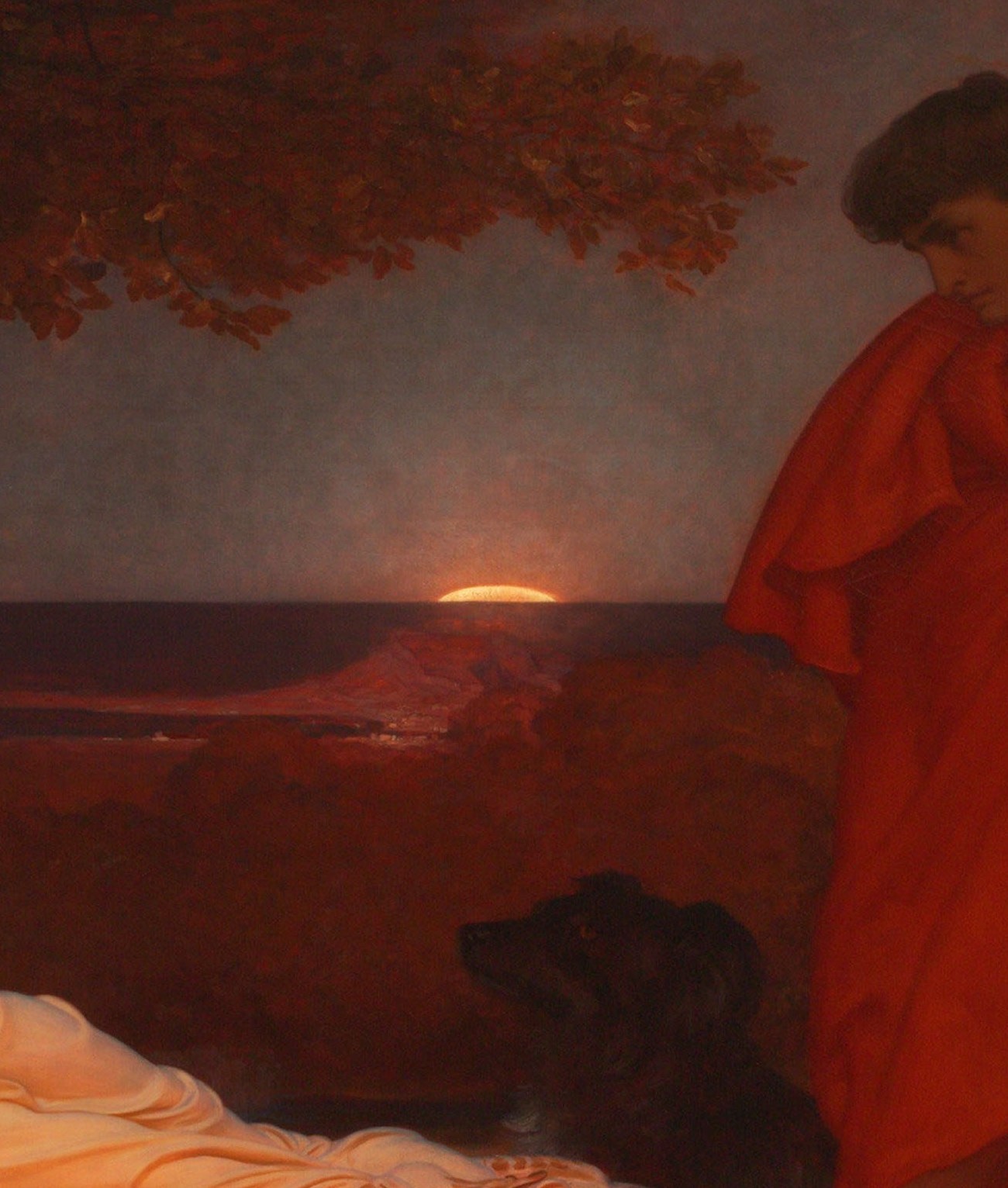
The narrow strip of light
Light on the horizon divides the muted distance into short horizontal bands. It echoes the long stretch of the figures nearer the viewer.
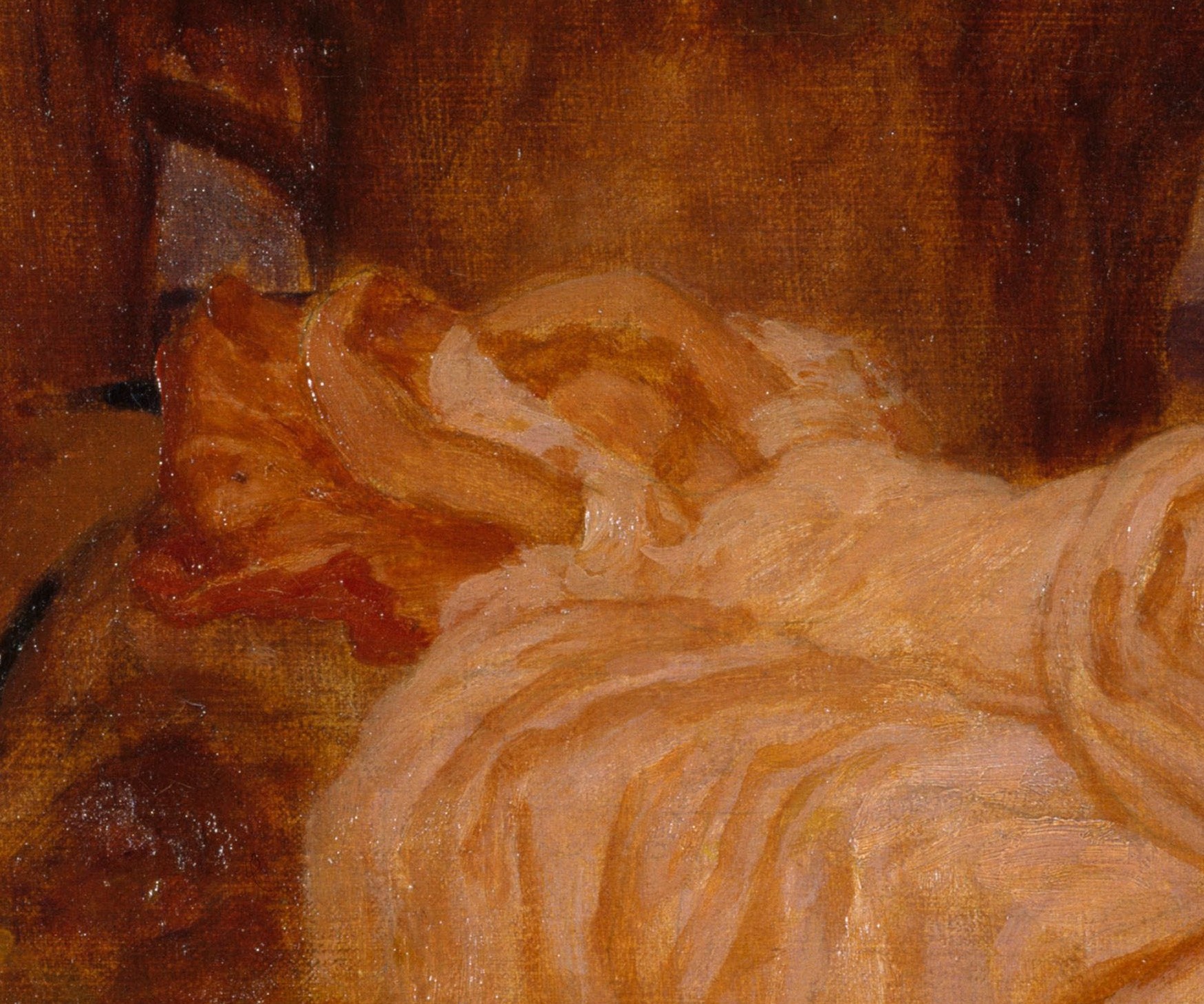
Colour study for Cymon and Iphigenia
The first arrangement of the sleeper
Warm streaks of paint gather across the sitter and her drapery. The oil sketch resolves the broad areas of light before the folds receive their definition in the large canvas.
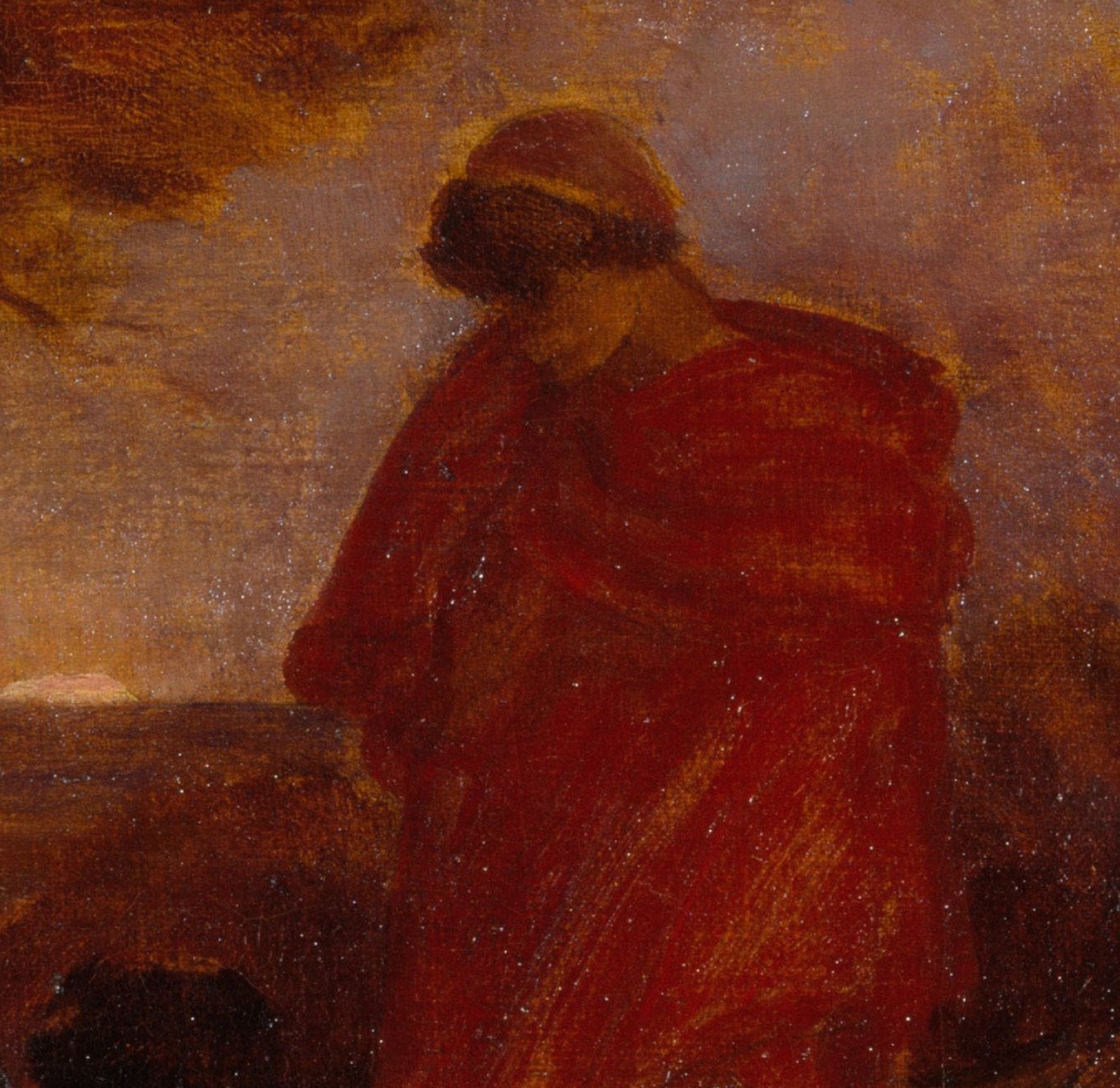
Cymon on the right
Cymon’s reddish shape rises against the shaded distance. The division between his head and the sky is softer in this study than in the exhibited painting.
From chalk and clay to the finished canvas
Sydney also holds the small oil Colour study for 'Cymon and Iphigenia', which measures 23.5 by 46.5 centimetres on its stretcher. It already has the broad scheme of the painting. Iphigenia makes a pale arc under the trees, red anchors the standing figure, and a light touches the sea horizon. In the study, the long sweep of her dress is laid in with broad strokes. In the canvas those strokes give way to distinct ridges, bunches and edges, especially where the dress turns down over the couch at the front. The water and sky also become more clearly legible as separate bands. The study establishes which parts of the scene will glow and which will sink into shadow. The finished canvas shows what Leighton could do within those broad divisions. [1] [2]
Two sheets at the National Gallery of Victoria in Melbourne offer a different view of the work. Both are in black and white chalk on brown paper and date to about 1884. On one, Leighton sets the huddle of sleepers beside separate experiments with a standing figure, a seated figure and a long, reclining silhouette. On the other, he tries the sleeping group twice on the same sheet. In the larger drawing the weight of one figure appears to bear down across another, and white chalk separates overlapping folds that would otherwise meld into a single mass. The arrangement already has the closeness of the group at the bottom of the oil painting. The studies let the tangled contours be seen in a way the dim foreground of the finished work only gradually allows. [10] [11]
An 1883 drawing in the National Gallery of Canada concentrates on Iphigenia's head and arms. Leighton uses the brown of the paper as a middle tone against the white chalk that catches the light on her bent arm. With little to tell us where she is sleeping, the turn of the face and the placement of the arms have to convey repose on their own. Meynell recorded that Leighton tried alternative positions for the head and arms and reproduced clay models for Cymon and for the attendant and child. The Royal Academy later exhibited bronze sketch models of Cymon and Iphigenia with the painting in its 1897 winter exhibition. The Academy's Cymon, a bronze cast of a sketch model, travelled to Forlì for an exhibition in 2024. When Leighton modelled a figure in the round, he could study where its weight fell from several sides before choosing the viewpoint he would paint. [3] [12] [13] [14] [15]
Meynell describes the preparation of a full-size drawing in sepia on brown paper, from which Leighton transferred the design to canvas. She also reproduces his studies of foliage. The work on the leaves is easy to overlook in a reproduction, since the canopy reads first as shade. Its studied edges make that deep mass porous in places, where small pockets of sky are still visible. The Royal Academy's technical questionnaires supply a separate detail about the painting process. Leighton recorded using Bell's medium as a vehicle in this painting. In a letter to the Academy's professor of chemistry, Arthur Church, he described the medium in terms of linseed oil, oil of spike and turpentine. [1] [6] [3] [16]
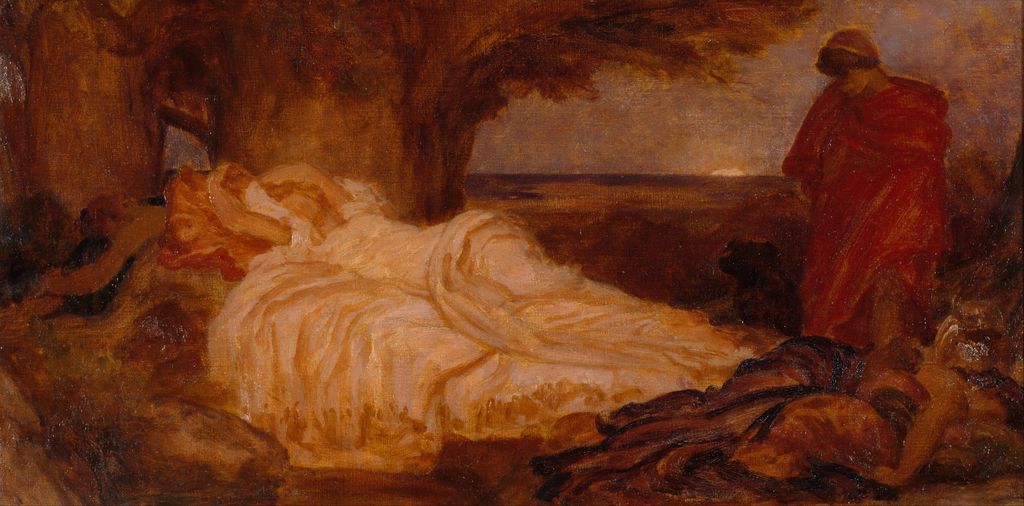
Frederic Leighton, colour study for Cymon and Iphigenia, 1884. Art Gallery of New South Wales. Image source. Public domain. Resized without changing the composition.
Other painters and the first exhibitions
The encounter had been a subject for British artists long before Leighton. In a drawing of about 1780 now at Princeton, George Romney put the watcher at the far left and brought the sleepers close to the viewer. The broad washes and abrupt reserves of bare paper make the sweep of limbs and cloth immediate. Leighton's wider interval between the watcher's face and the sleeper's, and the strip of sea behind them, give the act of looking a different pace. The viewer has time to notice the others lying nearby before returning to Iphigenia. [1] [17]
Meynell's readers had a more recent point of comparison. The previous winter the Grosvenor Gallery had shown Joshua Reynolds's Cymon and Iphigenia, originally exhibited at the Royal Academy in 1789 and now in the Royal Collection. Meynell admired the brilliance of the flesh in Reynolds's version, but she saw Leighton's treatment of the young man's expression and the extensive folds as central to the later painting. For her, the sight had to be worthy of the mental change it set in motion. Her comparison shows how quickly the picture's first viewers could move from the familiar incident to the specific choices of the painter. [3] [18] [19]
The survey English Art in 1884 printed a sketch of the composition under its Academy number, 278, and singled out the drawing and arrangement of drapery. The writer thought a photogravure would give readers a good idea of the design. By 1897, when Cuthbert Quilter lent the painting to the Guildhall Art Gallery after the Academy's winter exhibition, the Guildhall catalogue listed a photogravure published by the Fine Art Society. Readers could follow the sweep of Iphigenia's dress and the placement of the figures on paper. The balance of warm and cool colours was a reason to seek out the canvas itself. [3] [14] [4] [20]
Barrington records that Leighton chose the painting for the Berlin exhibition of 1885. She had seen it before it left the studio in 1884 and saw it in the same light again in 1901, when Quilter lent it for exhibition. She thought the tones had gained richness over seventeen years. In 1976 the Art Gallery of New South Wales bought the canvas at Christie's in London. It acquired the small oil separately ten years later. Seeing the two together makes it possible to trace one of Leighton's early decisions through both objects. His great area of pale colour lies in the recess of the grove, and the tiny point of light that answers it is out at sea. [1] [2] [6]
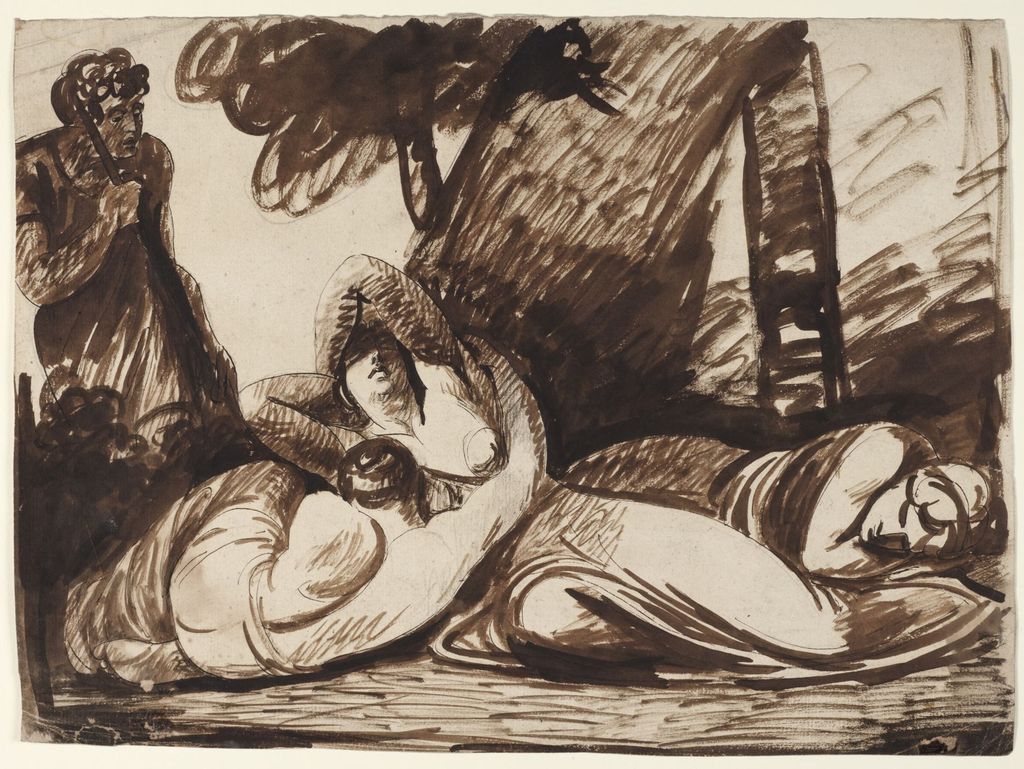
George Romney, Cimon and Iphigenia, c. 1780, recto. Princeton University Art Museum, gift of Frank Jewett Mather Jr. Image source. Public domain. Resized without changing the composition.
Browse Frederic Leighton’s artworks
Explore paintings, drawings, sculptures and prints, with separate rows for identified preparatory works, reproductions and casts.
| Name | Date | Medium |
|---|---|---|
| A Girl Feeding Peacocks | Exhibited 1863 | Painting Catalogue. |
| A Recognition from ‘Romola’, engraved by Swain (Tate N04054) | published 1862 | Print Catalogue. |
| A Roman Lady | 1859 | Painting Catalogue. |
| Abram and the Angel (Tate A00733) | published 1881 | Print Catalogue. |
| Acme and Septimius | Exhibited 1868 | Painting Catalogue. |
| An Athlete Wrestling with a Python (Tate exhibition bronze) | 1877 | Sculpture Catalogue. |
| And the Sea Gave Up the Dead Which Were in It (Tate N01511) | 1891–92 | Painting Catalogue. |
| Andromache in Captivity (photogravure after Leighton) | 1889 | Print Catalogue. |
| Athlete Wrestling with a Python (Anglesey Abbey cast) | model 1877; cast 1905 | Sculpture Catalogue. |
| Athlete Wrestling with a Python (Hood reduced cast) | 1877 (inscribed model date) | Sculpture Catalogue. |
| Athlete Wrestling with a Python (Saint Louis reduced cast) | 1877 (museum date) | Sculpture Catalogue. |
| Cain and Abel (Tate A00731) | published 1881 | Print Catalogue. |
| Captive Andromache | 1888 | Painting Catalogue. |
| Cimabue's Celebrated Madonna | 1853–55 | Painting Catalogue. |
| Cimon and Iphigenia, with Many Smaller Subjects (Tate T09061) | date not known | Drawing Catalogue. |
| Crenaia, the Nymph of the Dargle | Exhibited 1880 | Painting Catalogue. |
| Cymon and Iphigenia | 1884 | Painting Catalogue. |
| Daedalus and Icarus | 1869 | Painting Catalogue. |
| Dante in Exile | 1864 | Painting Catalogue. |
| Death of the First Born (Tate A00737) | published 1881 | Print Catalogue. |
| Electra at the Tomb of Agamemnon | c. 1869 | Painting Catalogue. |
| Eliezer and Rebekah (Tate A00735) | published 1881 | Print Catalogue. |
| Elijah in the Wilderness | 1877–78 | Painting Catalogue. |
| Fanny Kemble: A Study for ‘Jezebel and Ahab’ (Tate T08208) | c.1862 | Drawing Catalogue. |
| Figure Studies | Date not recorded | Drawing Catalogue. |
| Flaming June | 1895 | Painting Catalogue. |
| Gulnihal | Exhibited 1886 | Painting Catalogue. |
| Helios and Rhodes (Tate N03015) | date not known | Painting Catalogue. |
| Hercules Wrestling with Death for the Body of Alcestis | c. 1869–71 | Painting Catalogue. |
| Jonathan's Token to David | c. 1868 | Painting Catalogue. |
| Lachrymae | 1894–95 | Painting Catalogue. |
| Lieder ohne Worte | Exhibited 1861 | Painting Catalogue. |
| Light of the Harem | Exhibited 1880 | Painting Catalogue. |
| Moses Views the Promised Land (Tate A00736) | published 1881 | Print Catalogue. |
| Mrs James Guthrie | 1865 | Painting Catalogue. |
| Mrs John Hanson Walker (Tate N04731) | 1867 | Painting Catalogue. |
| Music Lesson | 1877 | Painting Catalogue. |
| Needless Alarms (Met cast) | modelled 1886; cast nineteenth century | Sculpture Catalogue. |
| Needless Alarms (Tate N05120) | 1886 | Sculpture Catalogue. |
| Pavonia | c. 1859 | Painting Catalogue. |
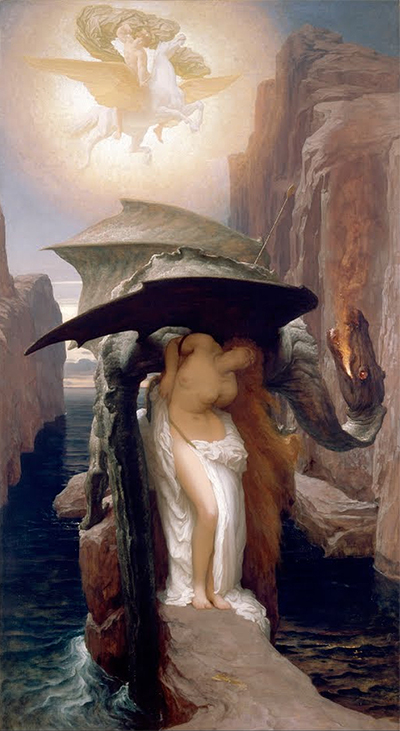
| Perseus and Andromeda | 1891 | Painting Catalogue. |
| Portrait of May Sartoris | c. 1860 | Painting Catalogue. |
| Preparing for a Festa, Florence (Tate T09062) | date not known | Drawing Catalogue. |
| Puerta de los Vientos, near Ronda, Spain (Tate N04006) | c.1886–9 | Painting Catalogue. |
| Samson and the Lions (Tate A00732) | published 1881 | Print Catalogue. |
| Samson at the Mill (Tate A00734) | published 1881 | Print Catalogue. |
| Samson Carrying the Gate (Tate A00738) | published 1881 | Print Catalogue. |
| Sketch for ‘An Athlete Wrestling with a Python’ (Tate N01761) | c.1877 | Sculpture Catalogue. |
| Sketches for Cimon and Iphigenia (Tate T09060) | date not known | Drawing Catalogue. |
| Study for The Return of Persephone (Demeter) | c. 1890–91 | Drawing Catalogue. |
| Study for The Return of Persephone (Persephone) | c. 1890–91 | Drawing Catalogue. |
| Study for ‘Needless Alarms’ (Tate N02945) | 1886 | Sculpture Catalogue. |
| Study for ‘The Discovery of Juliet Apparently Lifeless’ (Tate N01806) | c.1858 | Painting Catalogue. |
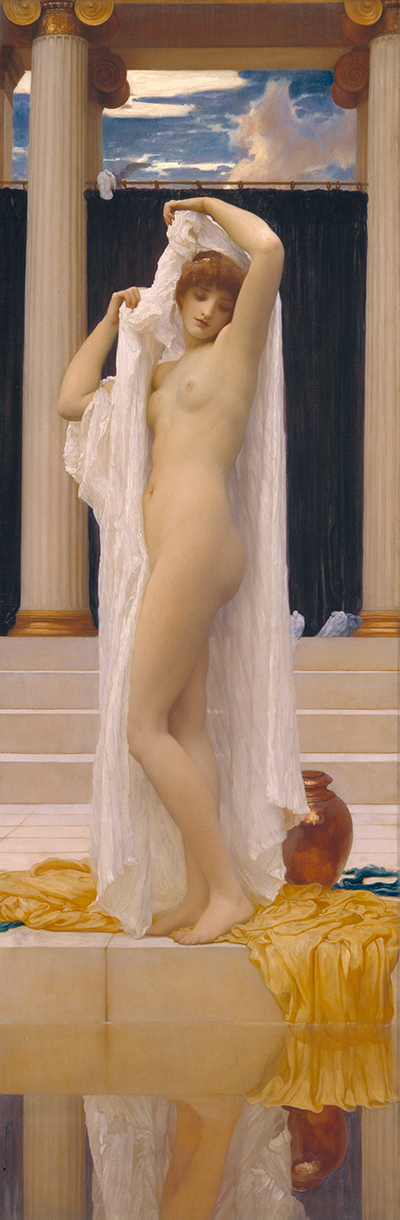
| The Bath of Psyche | Exhibited 1890 | Painting Catalogue. |
| The Daphnephoria | 1874–76 | Painting Catalogue. |
| The Death of Brunelleschi | 1852 | Painting Catalogue. |
| The Fisherman and the Siren | Exhibited 1858 | Painting Catalogue. |
| The Painter's Honeymoon | c. 1864 | Painting Catalogue. |
| The Return of Persephone | 1891 | Painting Leeds painting identified in the Met study record. |
| The Return of Persephone (preparatory oil) | c. 1890–91 | Painting Catalogue. |
| The Sluggard (Anglesey Abbey cast) | probably 1890–about 1906 | Sculpture Catalogue. |
| The Sluggard (Met cast) | modelled 1886; cast possibly before 1896 | Sculpture Catalogue. |
| The Sluggard (Museum Wales) | 1882–85 (museum date) | Sculpture Catalogue. |
| The Sluggard (Tate N01752) | 1885 | Sculpture Catalogue. |
| The Spies Escape (Tate A00730) | published 1881 | Print Catalogue. |
| Various Subjects (Tate T09063) | date not known | Drawing Catalogue. |
| View in Capri | Possibly 1859 | Painting Catalogue. |
| Wedded | 1882 | Painting Catalogue. |
| Winding the Skein | c. 1878 | Painting Catalogue. |
Discussion
Look again at the images and ideas explored in Cymon and Iphigenia. These editorial prompts invite your observations.
Reader Insights
What changes when Leighton moves the encounter from daytime to the edge of night?
Where did Leighton separate or combine forms between the colour study and the finished canvas?
Join the Conversation
Share a detail, comparison or question about Cymon and Iphigenia below.
References
- Art Gallery of New South Wales. Cymon and Iphigenia, 1884, oil on canvas, 210.1976. Collection data and reproduction, with text from the 1999 gallery handbook. Google Arts & Culture collection record. View source.
- Art Gallery of New South Wales. Colour study for 'Cymon and Iphigenia', 1884, oil on canvas, 274.1986. Google Arts & Culture collection record. View source.
- Meynell, Alice. “Cymon and Iphigenia.” The Art Journal 46 (May 1884), pp. 129–133. Getty Research Institute volume. View source.
- Blackburn, Henry, ed. English Art in 1884, Royal Academy section, no. 278. Digitised Cornell Library volume. View source.
- Boccaccio, Giovanni. Decameron, ed. Maurizio Fiorilla, day V, tale 1, especially paragraphs 3–23 and 25–39. Ente Nazionale Giovanni Boccaccio digital edition. View source.
- Barrington, Emilie (Mrs Russell Barrington). The Life, Letters and Work of Frederic Leighton, vol. II (1906), chapter V and the chapter VI catalogue entry for 1884. Project Gutenberg text. View source.
- Christie's. Kittens, catalogue essay, lot 963204. Lot record. View source.
- Hammerschlag, Keren. “The Deathly Sleep of Frederic Leighton's Painted Women.” Women 23, no. 2 (2012), pp. 201–215. Australian National University research record. View source.
- Roberts, Mary. “The Resistant Materiality of Frederic Leighton's Arab Hall.” British Art Studies 9 (2018), figures 3–4 and accompanying discussion. Article. View source.
- National Gallery of Victoria. Studies for sleeping group in Cymon and Iphigenia, and other figures, c. 1884, 292-2. Collection record. View source.
- National Gallery of Victoria. Studies for sleeping group in Cymon and Iphigenia, c. 1884, 293-2. Collection record. View source.
- National Gallery of Canada. Étude d’une tête et des bras d’Iphigénie pour « Cimon et Iphigénie », 1883, 48899. Rapport annuel 2019–2020, reproduction and acquisitions entry. French annual report. View source.
- Fondazione Cassa dei Risparmi di Forlì. “Cimone / Cymon.” Preraffaelliti. Rinascimento moderno, exhibition checklist (2024). Exhibition press materials. View source.
- Royal Academy of Arts. Exhibition of Works by the Old Masters, and by Deceased Masters of the British School, winter exhibition (1897), nos. 20, 314 and 315. Digitised exhibition catalogue. View source.
- Royal Academy of Arts. Annual Report 1 September 2023–31 August 2024, outward loans to Forlì, Cymon, 03/2436. Annual report. View source.
- National Portrait Gallery. “John Bell & Co.” British Artists' Suppliers, 1650–1950, section on Bell's medium, citing the Royal Academy's technical questionnaires. Suppliers directory. View source.
- Princeton University Art Museum. George Romney, Cimon and Iphigenia: Scene from Boccaccio's Decameron, c. 1780, x1942-117. Collection record. View source.
- Royal Collection Trust. Joshua Reynolds, Cymon and Iphigenia, RCIN 404695. Collection record. View source.
- Royal Academy of Arts. Summer Exhibition Catalogue, 1789, no. 143. Digitised exhibition catalogue. View source.
- Temple, A. G. Catalogue of the Loan Collection of Pictures by Painters of the British School Who Have Flourished During Her Majesty's Reign, Guildhall Art Gallery (1897), no. 20, p. 17. Digitised catalogue. View source.