 by Tom Gurney
Tom Gurney BSc (Hons) is an art history expert with over 20 years experience
Published on June 19, 2020 / Updated on November 29, 2026
Email: tomgurney1@gmail.com / Phone: +44 7429 011000
Winding the Skein: Introduction
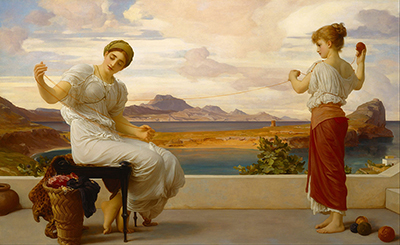
A thin strand of orange yarn crosses the bay in Frederic Leighton’s Winding the Skein. At one end a seated figure holds the loops apart. At the other, a younger girl raises the ball she is winding. The strand dips against the pale sky, and for a moment the distance between the girls matters more than the sweep of coast behind them. The oil on canvas measures 100.3 × 161.3 cm and belongs to the Art Gallery of New South Wales in Sydney, where it is accession 1.1974. The gallery dates the unsigned and undated canvas to circa 1878. Leighton exhibited it at the Royal Academy in 1878 as no. 302. [1] [2]
At a Glance
- PaintedAbout 1878
- MediumOil on canvas
- CollectionArt Gallery of New South Wales, 1.1974
- Royal Academy1878, no. 302
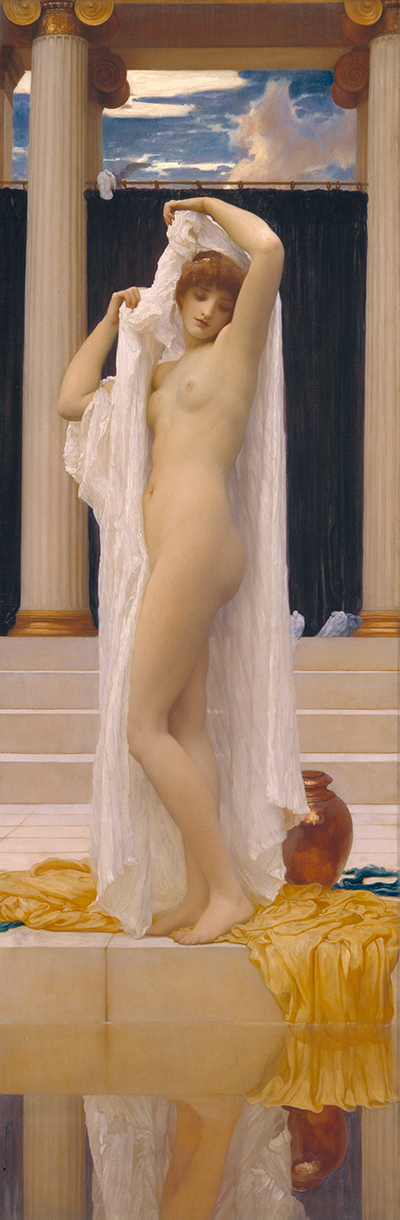
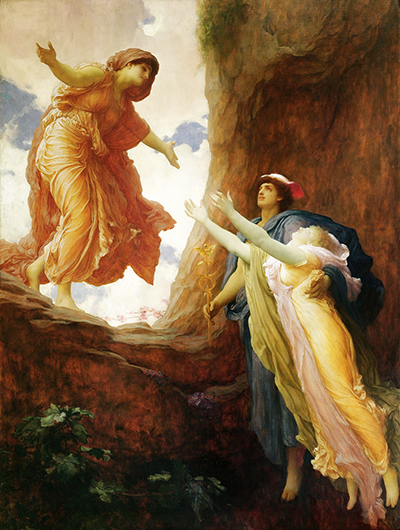
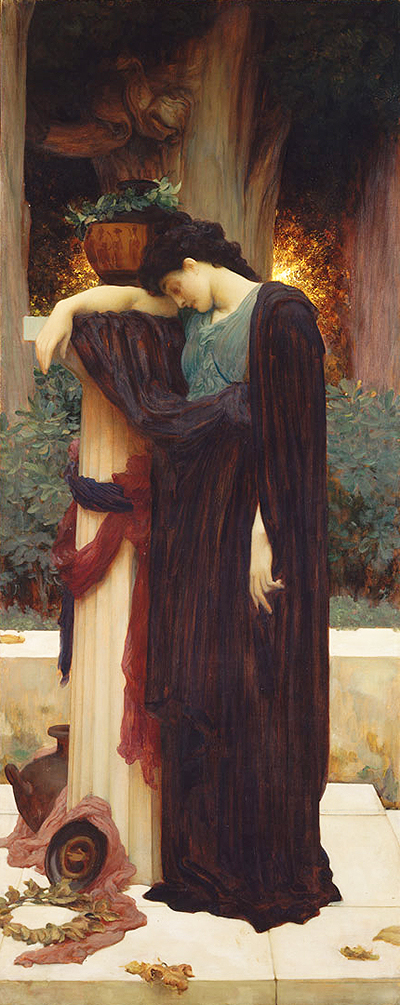
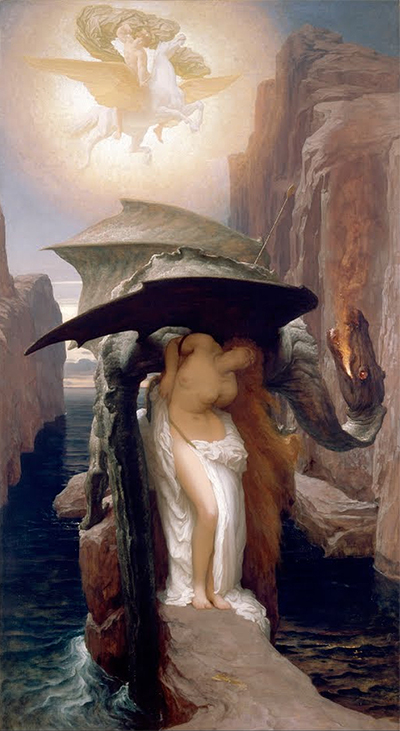
This work across Frederic Leighton’s career
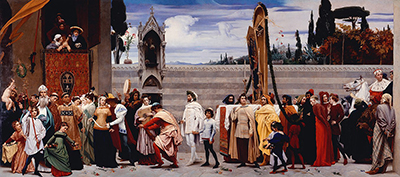
Cimabue’s Celebrated Madonna
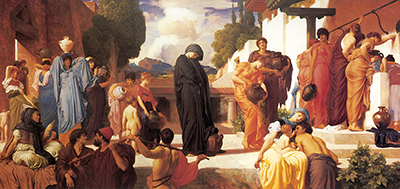
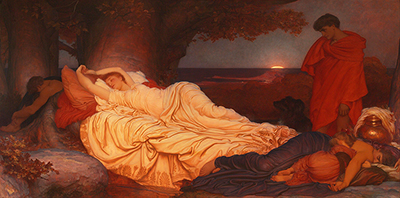
1853–55Lachrymae
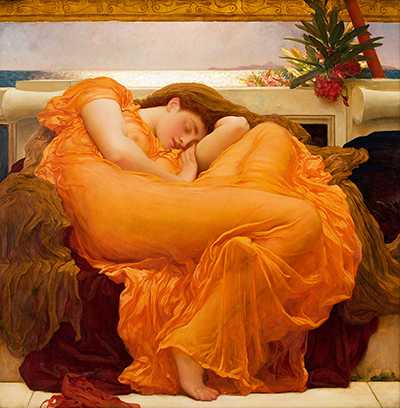
1894–95Flaming June
c. 1895Contents
- The work of two pairs of hands
- How Leighton built the view
- What Leighton brought back from Rhodes
- From the Royal Academy to Sydney
- Annotated details
The work of two pairs of hands
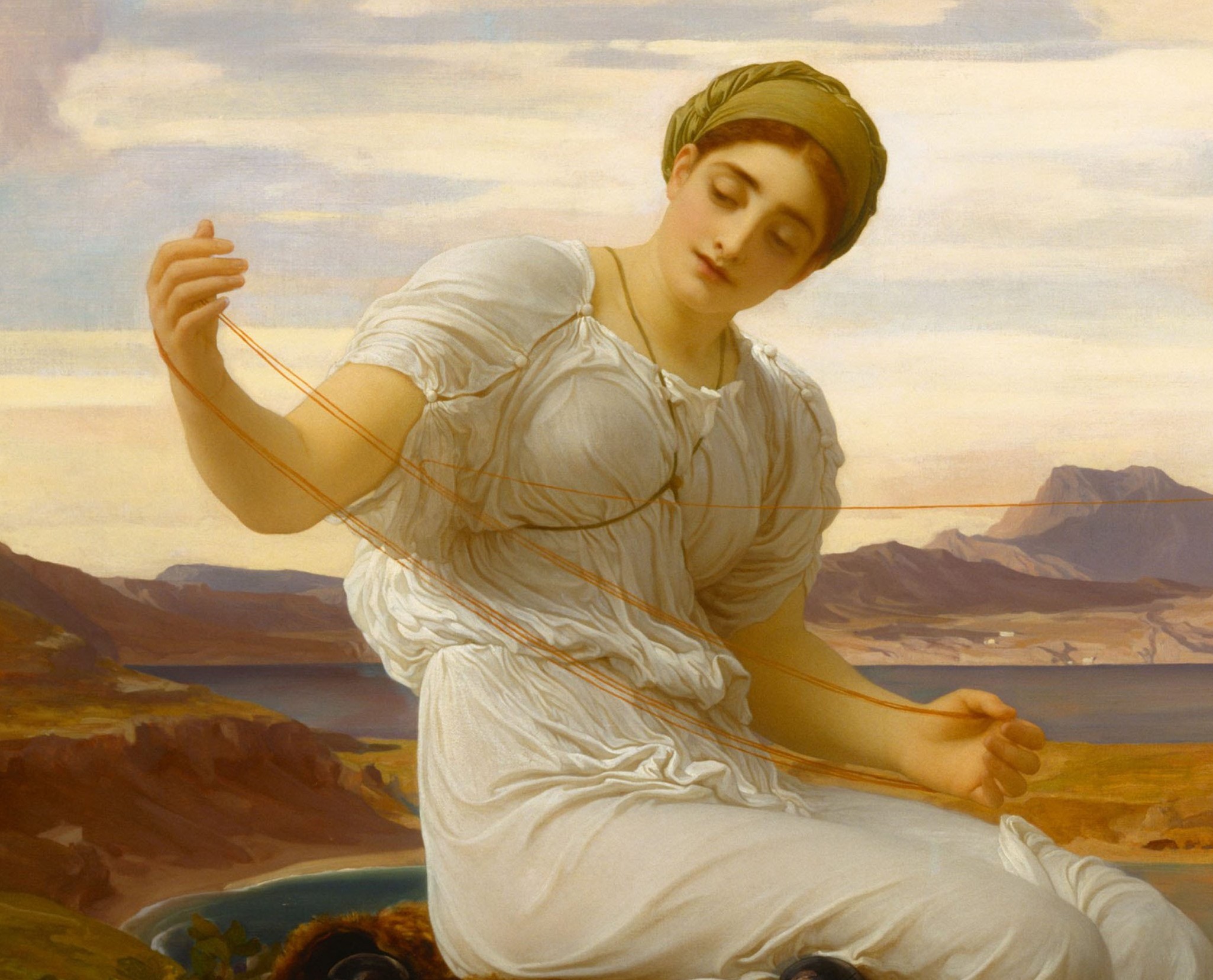
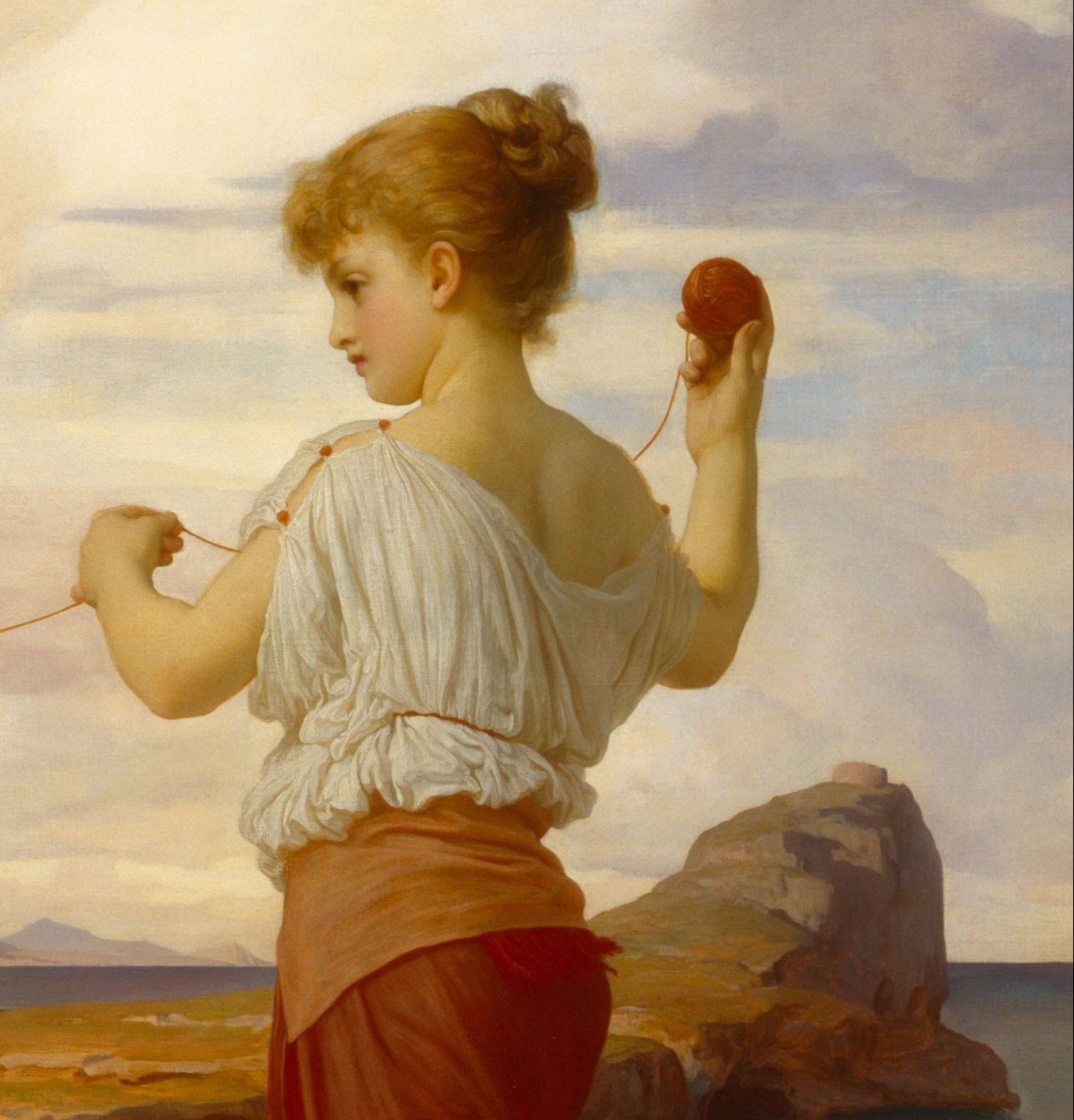
A skein is a length of yarn arranged in loops. The seated figure keeps those loops open with her hands apart, so the standing girl can draw off a strand and wind it into a ball. The standing girl looks down towards the thread passing through one hand while the other holds the ball by her shoulder. Look back across the picture and the loose loops around the seated figure’s arms resolve into several fine lines that converge on her hands. The 1897 Royal Academy catalogue describes both parts of the task, and Leighton’s own term for the yarn was worsted, a wool yarn. [1] [3] [4]
Eastman Johnson’s Winding Yarn (Interior of a Nantucket Kitchen) of 1872 offers another view of the job. In Johnson’s kitchen a man holds the coil and a woman seated across from him gathers the yarn. The Cleveland Museum of Art points out the humour a nineteenth-century audience could find in the arrangement, which turns the old association of winding yarn with courtship into a scene of a woman reeling in her suitor. Leighton makes use of the task’s dependence on two people in a different way. His figures frame an open view, and the yarn gives the viewer a reason to look between them. [1] [5]
Leighton gives each figure a different shape. The seated woman leans to the left as the gathered white cloth turns right across her lap and hangs down to her ankles. The girl stands nearly upright, with her head turned back to the left and her arms lifted to different heights. Pinched folds bunch across her shoulders where the fabric hangs loose, then a broad red wrap carries the eye down to the hem and the balls of wool on the floor. The rust-red ball nearest the corner picks up the colour of the one in her hand. Across the terrace, a sturdy woven basket stands beside the dark seat, and a spotted pelt hangs almost to the floor. Among so many worked surfaces, the thread is the one that the figures are still handling. [1]
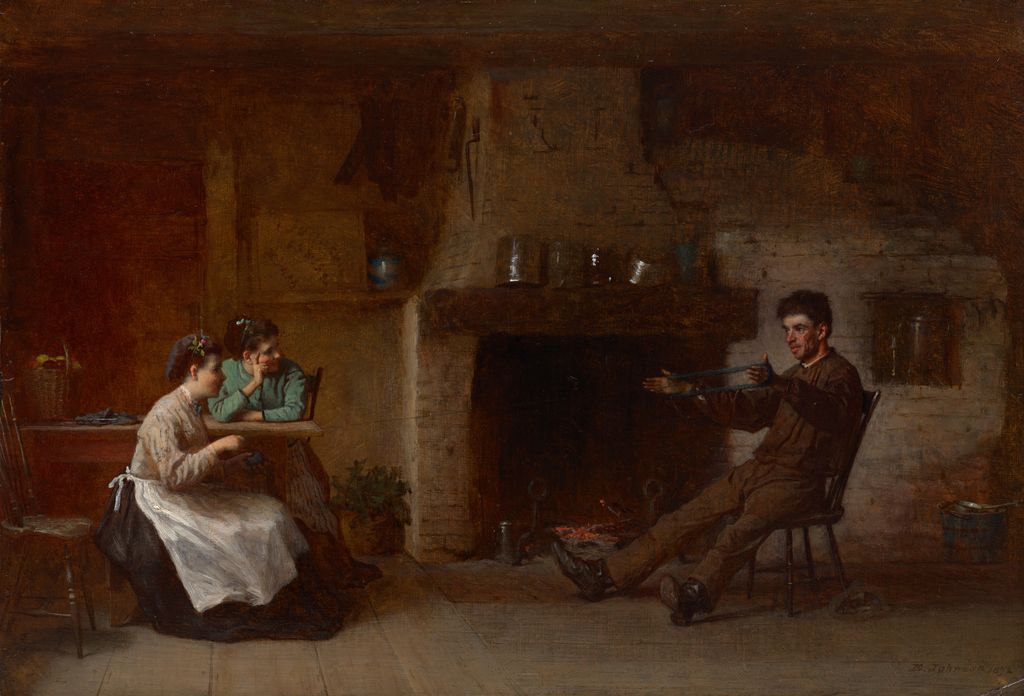
Eastman Johnson, Winding Yarn (Interior of a Nantucket Kitchen), 1872. The Cleveland Museum of Art. The Cleveland Museum of Art, Gift of the John Huntington Art and Polytechnic Trust. Image source. CC0 / Public domain. Resized proportionally.
How Leighton built the view
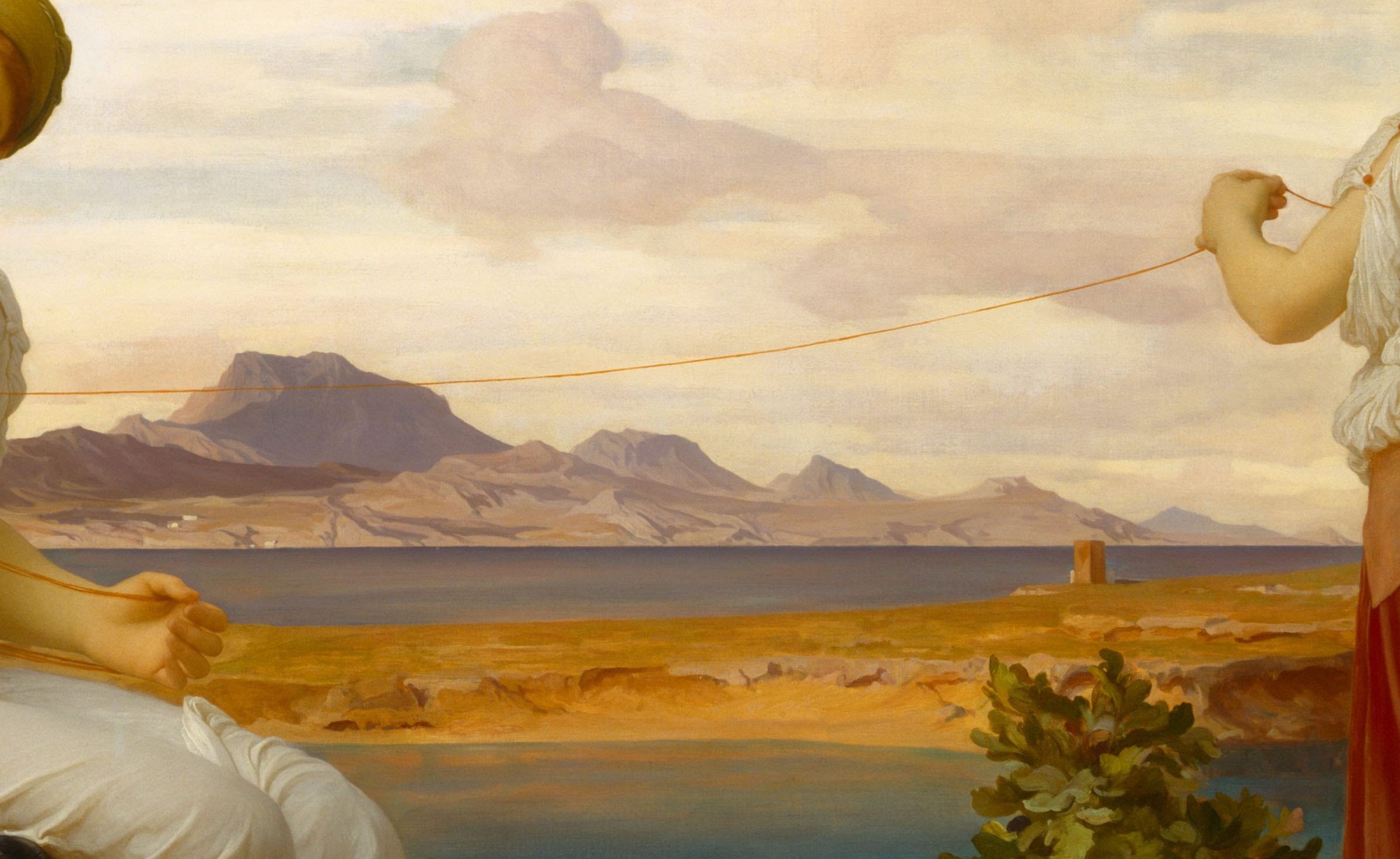
The parapet makes a straight edge behind the figures and establishes where the terrace ends. Its flat surface sits against strips of blue water and ochre land, with a step rising at the far right. The mountains run in a broken line just below the thread. Following that fine curve across the sky encourages a viewer to linger over a stretch of the canvas that might otherwise read as empty distance. At the same time, the strand passes in front of the distant blue and violet slopes without losing its place in the foreground. [1]
A study in black and white chalk on brown paper in the British Museum shows the seated and standing figures with a landscape behind them. Diagonal perspective lines remain visible on the sheet, and the museum records a related drawing at Leighton House that also gives unusual prominence to perspective. Such working lines help explain why the interval between the figures feels so deliberate in the oil. Their positions had to hold together as a pair while leaving room between them for a headland, open water and sky. The almost uninterrupted parapet in the canvas lets those distances read at once. [1] [6]
Anne-Florence Gillard-Estrada compares this arrangement to a classical frieze. The two heads and full-length bodies stand out like sculpted figures set along a horizontal strip. But the wool makes very particular demands on their poses. The seated figure’s shoulders and head turn towards her raised hand, and the younger girl’s elbow bends to keep the strand clear of her body. Leighton found the gestures for this classical composition in the practical motions of a household task. Gillard-Estrada also hears an echo of the three Fates, who in Greek mythology handle the thread of human life. The two girls and their ball of wool leave the connection to the viewer’s imagination. [1] [7]
What Leighton brought back from Rhodes
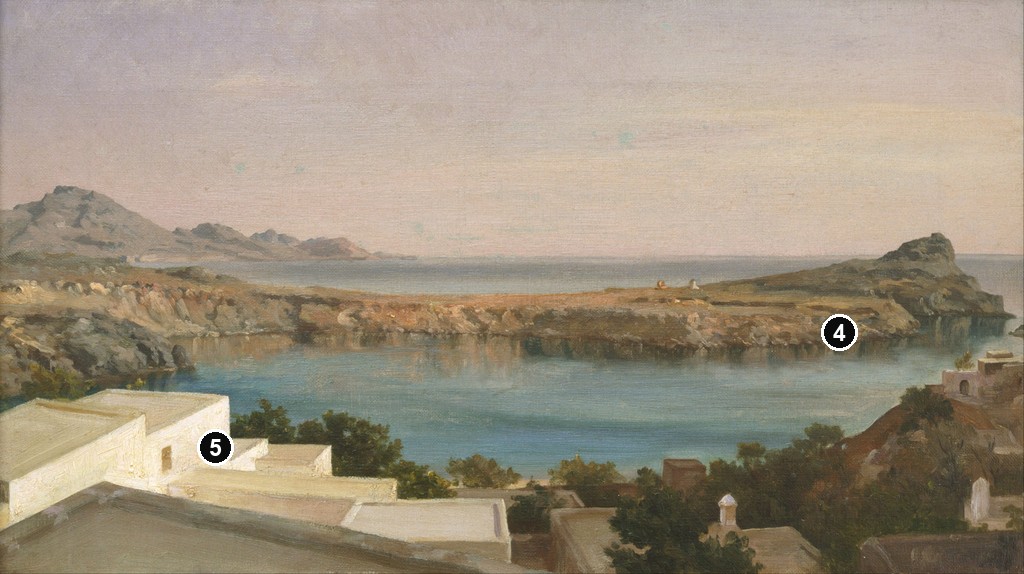
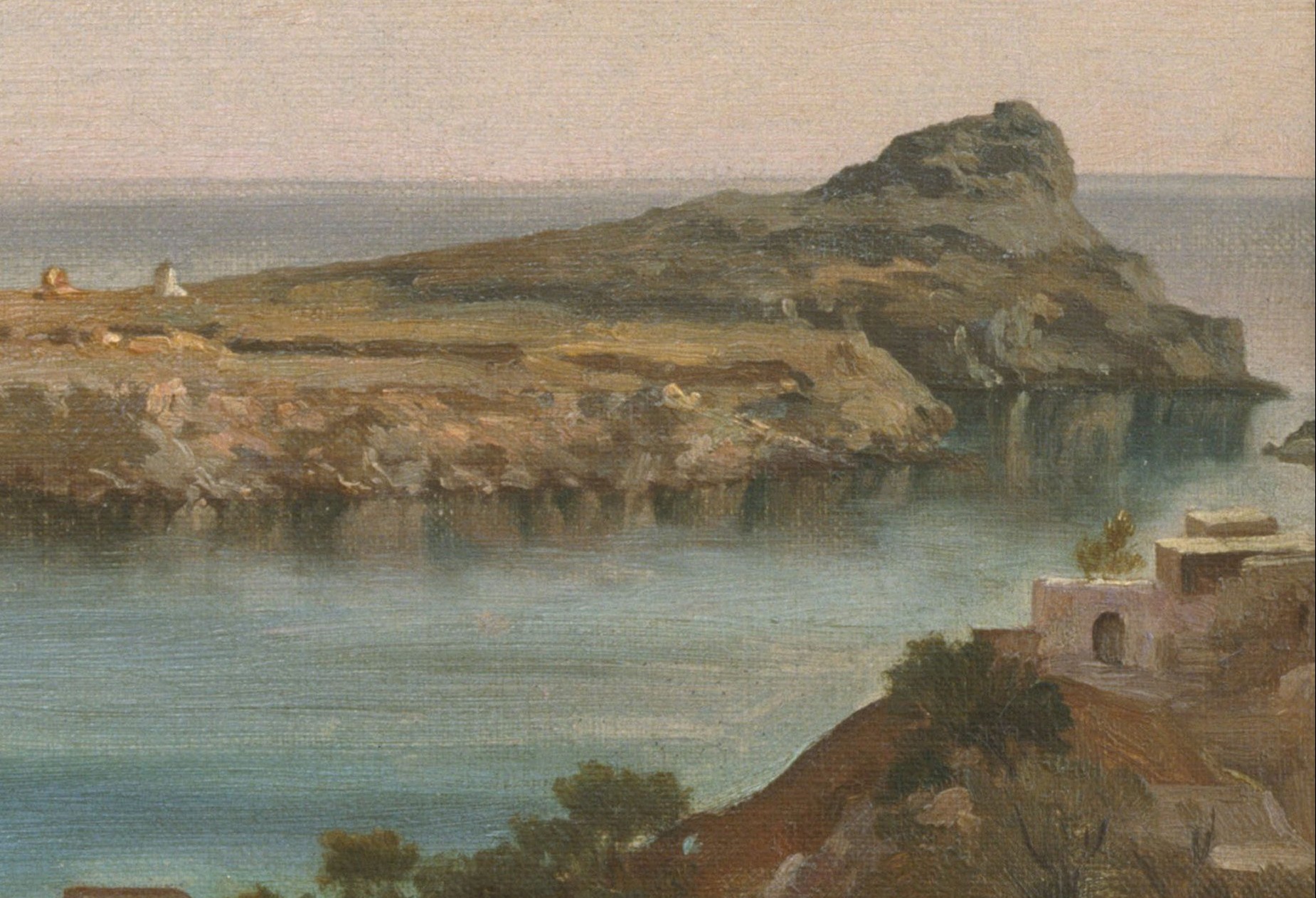
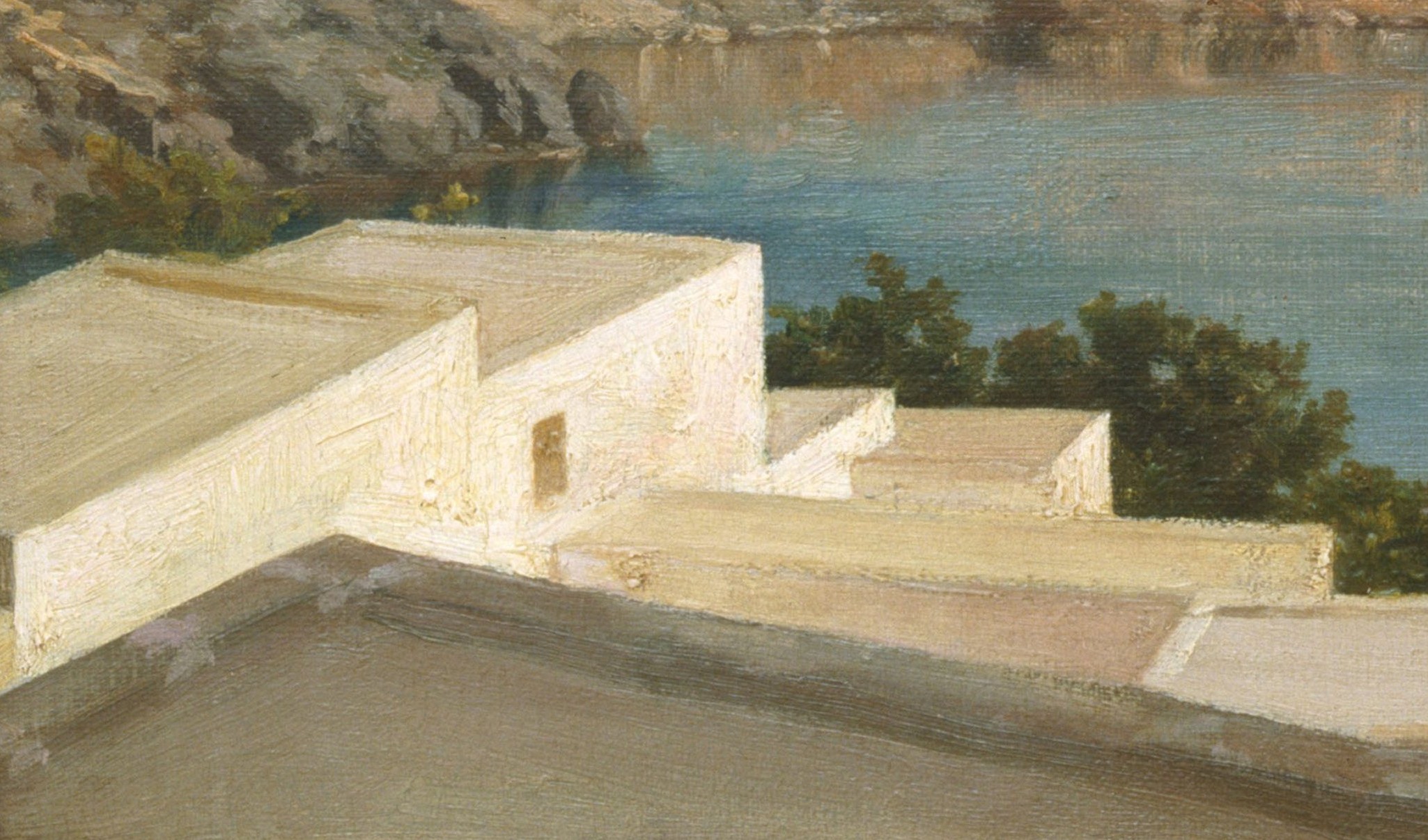
The Sydney gallery also owns Lindos, Rhodes, a 25.7 × 45.4 cm oil sketch from around 1867, when Leighton visited the island. Its small size puts it in the company of the landscape studies he made while travelling. Its foreground is a cluster of flat white rooftops overlooking turquoise water. Beyond them, an ochre shelf of land ends at the right in a rocky headland that casts a reflection into the bay. Art historian Pola Durajska traces that distinctive shape into the finished oil, where it rises behind the younger figure’s red clothing. The canvas changes the foreground into a shallow terrace and makes more of the distant mountains. The headland recalls a particular coast while the space around it has been worked out for the figures and their task. Angus Trumble, writing for the Art Gallery of South Australia, identifies the stone structure at the far end as the so-called Tomb of Cleobolus. He also identifies the younger girl as Connie Gilchrist, who posed for Leighton’s Music Lesson the previous year. [1] [8] [9] [10]
The sky had a separate history. Writing to his father from Granada on 19 October 1877, Leighton said that one purpose of his journey through southern Spain was to collect studies of sky effects, especially over the sea, for this picture. He had found none of the weather he wanted. In the finished painting, soft banks of rose-grey cloud and yellow light fill much more of the view than the quiet sky in the Rhodes sketch. The letter shows he was still planning this part of the painting a decade after his visit to Lindos. It leaves open exactly where he found the cloud forms he eventually used. [1] [4] [9]
That mixture of observed coast and imagined terrace gives the women a place that feels lived in even as their clothes and poses evoke classical art. In its exhibition on Leighton and the Mediterranean, the Museo de Arte de Ponce put the artist’s small landscapes alongside figure paintings and studies to explore how travel and ideas of antiquity met in his work. The pair of oils in Sydney make the connection tangible. The sketch notices how flat roofs catch the light above a bay. The exhibition canvas uses a related expanse of lit stone to set off the weight of a foot and the fall of a garment. [1] [8] [11]
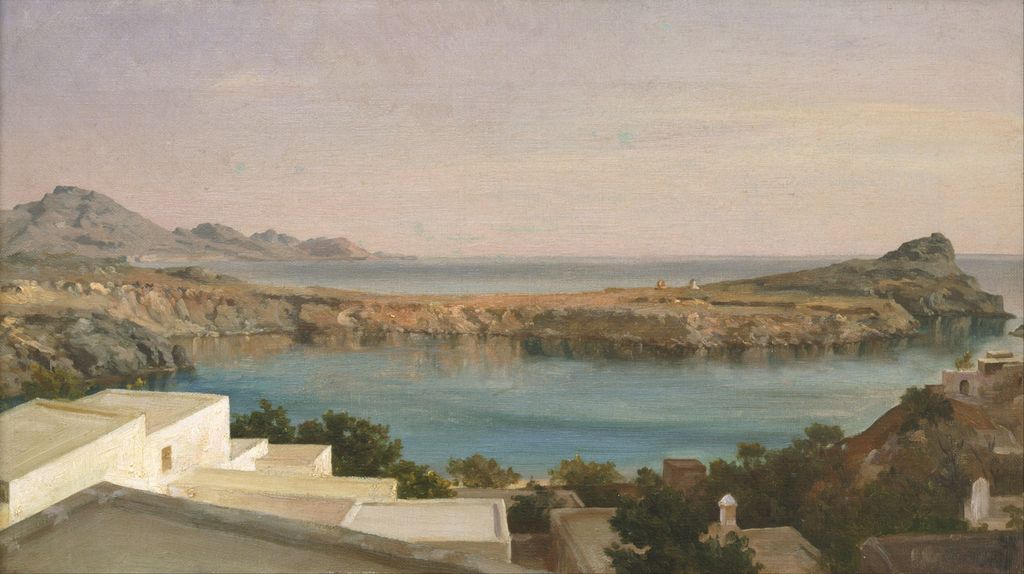
Frederic Leighton, Lindos, Rhodes, c. 1867. Art Gallery of New South Wales. Image source. Public domain. Resized without changing the composition.
Annotated Details from Winding the Skein
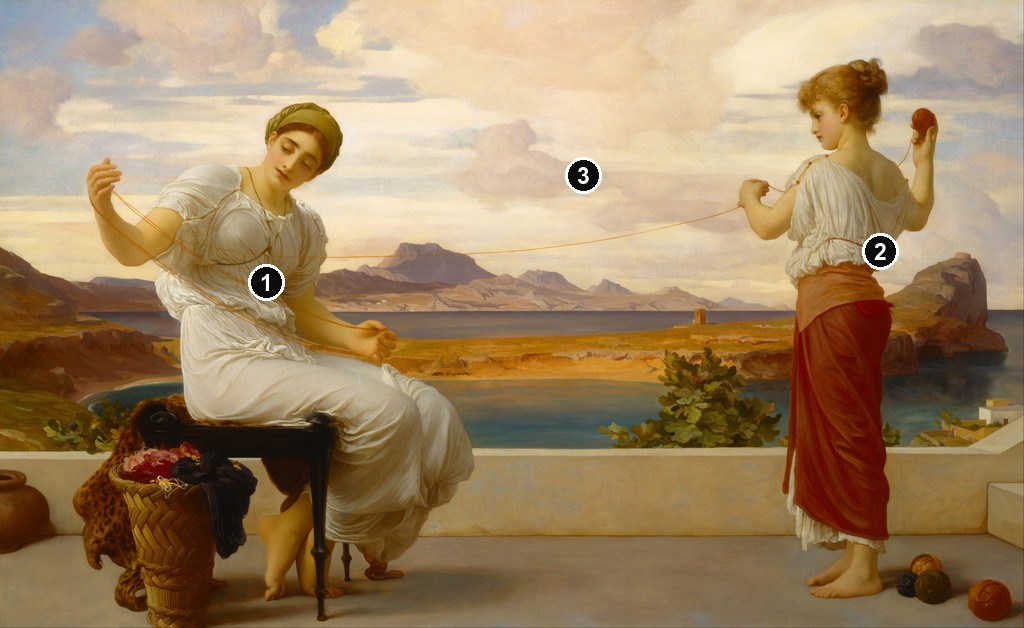
The numbered points identify visible features discussed in this article. Return from each detail to the numbered overview. Each caption identifies the work shown.
Winding the Skein
Frederic Leighton, Winding the Skein, c. 1878. Art Gallery of New South Wales. Image source. Public domain. Resized without changing the composition.
Lindos, Rhodes
Frederic Leighton, Lindos, Rhodes, c. 1867. Art Gallery of New South Wales. Image source. Public domain. Resized without changing the composition.
Details from WINDING THE SKEIN
Compare the cropped details with the source images above. Notice how their colours, shapes and positions contribute to the larger compositions.
Winding the Skein
Holding the skein open
The seated woman holds the wool in an open loop. Look for the loose threads against the lit folds of her sleeve.
Winding the ball
The younger figure lifts the small ball in one hand and guides the thread with the other. Her upright pose sets the movement apart from the seated figure’s.
Yarn across the bay
The fine strand crosses open air in front of the distant land. The mountains and water make it easier to register the space between the girls.
Lindos, Rhodes
The shape of the headland
The low ridge ends in a higher rocky form near the right edge. A similar landform appears behind the younger girl in the larger painting.
White roofs above the water
The blocks of the rooftops interrupt the irregular sweep of the coast. They are a different foreground from the continuous terrace in the finished figure painting.
From the Royal Academy to Sydney
The gallery quotes Henry James’s praise of the painting as the outstandingly beautiful work in the 1878 exhibition. Another Victorian critic, William Michael Rossetti, found the execution too smooth, as Ernest Rhys records in his illustrated book on Leighton. The two reactions draw attention to the painter’s surface. A fold in the white drapery can run from light to shadow so gradually that the change suggests fabric slipping over the knee, while the knuckles and fingers seem almost sharply modelled against the sky. The same control that made transitions look effortless could strike a viewer as excessive polish. A reviewer writing for The Magazine of Art in 1878 found the white drapery chilly and thought the heroic scale of the seated figure was at odds with the everyday subject. What troubled that reviewer is part of what makes the picture distinctive. A woman holding yarn has the presence of a figure in a history painting. [1] [12] [13]
F. H. Woodroffe lent the picture to the Royal Academy’s memorial exhibition in 1897, where it appeared as no. 79. Sydney’s provenance records a sale at Christie’s in London on 24 March 1906 and the gallery’s purchase from J. S. Maas & Co in 1974. The catalogue of the memorial exhibition describes a canvas 39½ inches high, large enough that the figures can sustain the broad shapes of the terrace and landscape while still rewarding a close look at what their fingers are doing. [1] [3]
The Sydney gallery’s 2012–13 annual report records funding from Friends of Conservation for treatment of the canvas. Conservators investigating the layers that Leighton laid down before painting found zinc white beneath the image. A later microscopy paper illustrates an area of the painting lit from the side. Small raised spots interrupt the surface where zinc in the paint has reacted with fatty acids from the oil to form compounds known as zinc soaps. A cross-section from an area of brown paint shows a deposit beneath the surface deforming the layers above it. The photograph shows how a change beginning deep in the paint can affect a quality that mattered to its first viewers. [14] [15] [16]
Browse Frederic Leighton’s artworks
Explore paintings, drawings, sculptures and prints, with separate rows for identified preparatory works, reproductions and casts.
| Name | Date | Medium |
|---|---|---|
| A Girl Feeding Peacocks | Exhibited 1863 | Painting Catalogue. |
| A Recognition from ‘Romola’, engraved by Swain (Tate N04054) | published 1862 | Print Catalogue. |
| A Roman Lady | 1859 | Painting Catalogue. |
| Abram and the Angel (Tate A00733) | published 1881 | Print Catalogue. |
| Acme and Septimius | Exhibited 1868 | Painting Catalogue. |
| An Athlete Wrestling with a Python (Tate exhibition bronze) | 1877 | Sculpture Catalogue. |
| And the Sea Gave Up the Dead Which Were in It (Tate N01511) | 1891–92 | Painting Catalogue. |
| Andromache in Captivity (photogravure after Leighton) | 1889 | Print Catalogue. |
| Athlete Wrestling with a Python (Anglesey Abbey cast) | model 1877; cast 1905 | Sculpture Catalogue. |
| Athlete Wrestling with a Python (Hood reduced cast) | 1877 (inscribed model date) | Sculpture Catalogue. |
| Athlete Wrestling with a Python (Saint Louis reduced cast) | 1877 (museum date) | Sculpture Catalogue. |
| Cain and Abel (Tate A00731) | published 1881 | Print Catalogue. |
| Captive Andromache | 1888 | Painting Catalogue. |
| Cimabue's Celebrated Madonna | 1853–55 | Painting Catalogue. |
| Cimon and Iphigenia, with Many Smaller Subjects (Tate T09061) | date not known | Drawing Catalogue. |
| Crenaia, the Nymph of the Dargle | Exhibited 1880 | Painting Catalogue. |
| Cymon and Iphigenia | 1884 | Painting Catalogue. |
| Daedalus and Icarus | 1869 | Painting Catalogue. |
| Dante in Exile | 1864 | Painting Catalogue. |
| Death of the First Born (Tate A00737) | published 1881 | Print Catalogue. |
| Electra at the Tomb of Agamemnon | c. 1869 | Painting Catalogue. |
| Eliezer and Rebekah (Tate A00735) | published 1881 | Print Catalogue. |
| Elijah in the Wilderness | 1877–78 | Painting Catalogue. |
| Fanny Kemble: A Study for ‘Jezebel and Ahab’ (Tate T08208) | c.1862 | Drawing Catalogue. |
| Figure Studies | Date not recorded | Drawing Catalogue. |
| Flaming June | 1895 | Painting Catalogue. |
| Gulnihal | Exhibited 1886 | Painting Catalogue. |
| Helios and Rhodes (Tate N03015) | date not known | Painting Catalogue. |
| Hercules Wrestling with Death for the Body of Alcestis | c. 1869–71 | Painting Catalogue. |
| Jonathan's Token to David | c. 1868 | Painting Catalogue. |
| Lachrymae | 1894–95 | Painting Catalogue. |
| Lieder ohne Worte | Exhibited 1861 | Painting Catalogue. |
| Light of the Harem | Exhibited 1880 | Painting Catalogue. |
| Moses Views the Promised Land (Tate A00736) | published 1881 | Print Catalogue. |
| Mrs James Guthrie | 1865 | Painting Catalogue. |
| Mrs John Hanson Walker (Tate N04731) | 1867 | Painting Catalogue. |
| Music Lesson | 1877 | Painting Catalogue. |
| Needless Alarms (Met cast) | modelled 1886; cast nineteenth century | Sculpture Catalogue. |
| Needless Alarms (Tate N05120) | 1886 | Sculpture Catalogue. |
| Pavonia | c. 1859 | Painting Catalogue. |
| Perseus and Andromeda | 1891 | Painting Catalogue. |
| Portrait of May Sartoris | c. 1860 | Painting Catalogue. |
| Preparing for a Festa, Florence (Tate T09062) | date not known | Drawing Catalogue. |
| Puerta de los Vientos, near Ronda, Spain (Tate N04006) | c.1886–9 | Painting Catalogue. |
| Samson and the Lions (Tate A00732) | published 1881 | Print Catalogue. |
| Samson at the Mill (Tate A00734) | published 1881 | Print Catalogue. |
| Samson Carrying the Gate (Tate A00738) | published 1881 | Print Catalogue. |
| Sketch for ‘An Athlete Wrestling with a Python’ (Tate N01761) | c.1877 | Sculpture Catalogue. |
| Sketches for Cimon and Iphigenia (Tate T09060) | date not known | Drawing Catalogue. |
| Study for The Return of Persephone (Demeter) | c. 1890–91 | Drawing Catalogue. |
| Study for The Return of Persephone (Persephone) | c. 1890–91 | Drawing Catalogue. |
| Study for ‘Needless Alarms’ (Tate N02945) | 1886 | Sculpture Catalogue. |
| Study for ‘The Discovery of Juliet Apparently Lifeless’ (Tate N01806) | c.1858 | Painting Catalogue. |
| The Bath of Psyche | Exhibited 1890 | Painting Catalogue. |
| The Daphnephoria | 1874–76 | Painting Catalogue. |
| The Death of Brunelleschi | 1852 | Painting Catalogue. |
| The Fisherman and the Siren | Exhibited 1858 | Painting Catalogue. |
| The Painter's Honeymoon | c. 1864 | Painting Catalogue. |
| The Return of Persephone | 1891 | Painting Leeds painting identified in the Met study record. |
| The Return of Persephone (preparatory oil) | c. 1890–91 | Painting Catalogue. |
| The Sluggard (Anglesey Abbey cast) | probably 1890–about 1906 | Sculpture Catalogue. |
| The Sluggard (Met cast) | modelled 1886; cast possibly before 1896 | Sculpture Catalogue. |
| The Sluggard (Museum Wales) | 1882–85 (museum date) | Sculpture Catalogue. |
| The Sluggard (Tate N01752) | 1885 | Sculpture Catalogue. |
| The Spies Escape (Tate A00730) | published 1881 | Print Catalogue. |
| Various Subjects (Tate T09063) | date not known | Drawing Catalogue. |
| View in Capri | Possibly 1859 | Painting Catalogue. |
| Wedded | 1882 | Painting Catalogue. |
| Winding the Skein | c. 1878 | Painting Catalogue. |
Discussion
Look again at the images and ideas explored in Winding the Skein. These editorial prompts invite your observations.
Reader Insights
What does the strand of yarn do to the apparent distance between the girls?
What changed when Leighton brought the headland in his Rhodes sketch into the larger composition?
Join the Conversation
Share a detail, comparison or question about Winding the Skein below.
References
- Art Gallery of New South Wales, Winding the skein, circa 1878, accession 1.1974, collection image, object details, interpretation and provenance via Google Arts & Culture. View source.
- Algernon Graves, The Royal Academy of Arts: A Complete Dictionary of Contributors and Their Work, vol. V (1905), p. 32, 1878 exhibition no. 302. View source.
- Royal Academy of Arts, winter exhibition catalogue (1897), Gallery III, p. 22, no. 79. View source.
- Emilie Barrington, The Life, Letters and Work of Frederic Leighton, vol. II (1906), pp. 211–12, Leighton to his father, 19 October 1877. View source.
- Cleveland Museum of Art, Eastman Johnson, Winding Yarn (Interior of a Nantucket Kitchen), 1872, accession 1915.682. View source.
- British Museum, composition study for Winding the Skein, 1955,0709.48, and curatorial note on the related Leighton House drawing. View source.
- Anne-Florence Gillard-Estrada, “Scènes de genre anecdotiques ou figurations fantasmatiques,” Représentations dans le monde anglophone (2021), pp. 51–53. View source.
- Art Gallery of New South Wales, Lindos, Rhodes, circa 1867, oil sketch, accession 1305.1990, collection image and details via Google Arts & Culture. View source.
- Pola Durajska, Nature, Science, and Myth in the Landscape Art of Frederic Leighton, vol. I (University of York, 2021), pp. 78–81 and figs. 49, 51–52. View source.
- Angus Trumble, catalogue entry for Winding the skein, Love and Death: Art in the Age of Queen Victoria, Art Gallery of South Australia, p. 196, reproduced by Victorian Web. View source.
- Museo de Arte de Ponce, Frederic Leighton y el Mediterráneo eterno, Spanish-language exhibition account. View source.
- Ernest Rhys, Frederic Lord Leighton: An Illustrated Record of His Life and Work, critical appendix, pp. 109–11. View source.
- The Magazine of Art, “The Royal Academy,” vol. I (1878), p. 43. View source.
- Art Gallery of New South Wales, Annual Report 2012–13, “Conservation,” p. 67. View source.
- Celine de Courlon and colleagues, “The Hidden Layers: The Preparatory Layers and Their Impact on the Conservation of Paintings,” Australian Institute for the Conservation of Cultural Material (2017). View source.
- Joen Hermans and colleagues, “Electron Microscopy Imaging of Zinc Soaps Nucleation in Oil Paint,” Microscopy and Microanalysis 24, no. 3 (2018), pp. 318–22, especially fig. 1. View source.