 by Tom Gurney
Tom Gurney BSc (Hons) is an art history expert with over 20 years experience
Published on June 19, 2020 / Updated on November 29, 2026
Email: tomgurney1@gmail.com / Phone: +44 7429 011000
Lieder ohne Worte: Introduction
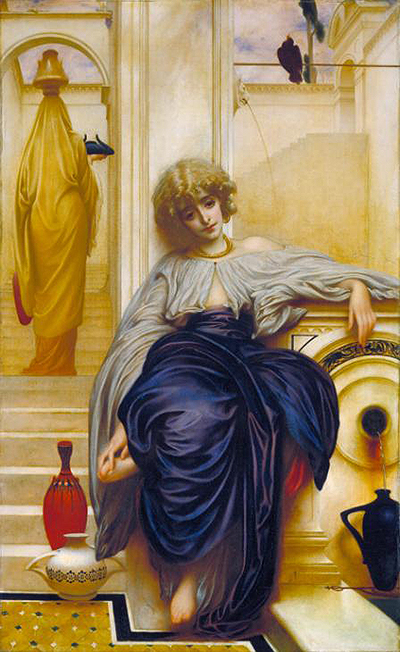
A girl leans against a fountain, one hand hanging over its carved rim. Above her, a blackbird perches on a slender bar. Water falls from the stonework beside her into the mouth of a dark pitcher. The girl’s eyes are lowered, and although both sounds are close by, her gaze follows neither of them. Frederic Leighton called this painting Lieder ohne Worte, German for Songs without Words. The oil on canvas measures 101.6 × 62.9 cm. Leighton exhibited it at the Royal Academy in 1861. Tate bought the painting in 1980 and catalogues it as T03053. [1]
At a Glance
- ExhibitedRoyal Academy, 1861, no. 550
- MediumOil on canvas
- CollectionTate, T03053
- English titleSongs without Words
This work across Frederic Leighton’s career
Cimabue’s Celebrated Madonna
1853–55Lieder ohne Worte (current article)
Exhibited 1861 [1]Lachrymae
1894–95Flaming June
c. 1895Contents
- A girl at a fountain
- Where the title came from
- What the studies reveal
- What visitors saw in 1861
- Annotated details
A girl at a fountain
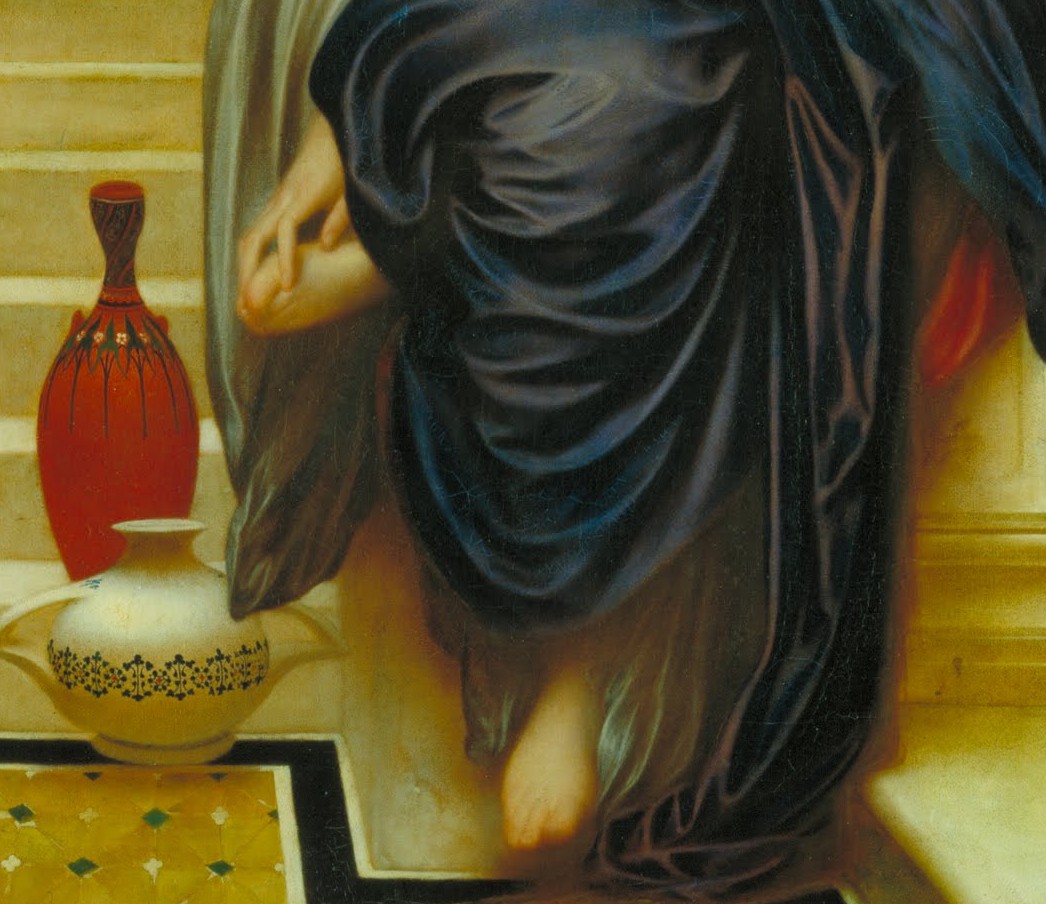
The blue drapery is the darkest broad shape in the painting. It gathers into rounded folds across the girl’s lap and falls almost to the angular black border of the tiled floor. She props one arm on the fountain while her other hand reaches down to the foot drawn up beside her. A necklace follows the line of her throat, and a tiny red fastening holds the pale top at the centre. There is a difference between how the folds convey her weight and how lightly her fingers hang. The pose looks comfortable enough for her to stay there a while. [1]
There is more movement at the edges. At left, a yellow-clad figure goes up the steps and away through an arch with a vessel balanced on her head. The shapes of the other vessels help trace a route between foreground and background. There is a pale patterned pot at the foot of the steps, a slender red one just above it, and a black pitcher on the ledge at the opposite side. From that pitcher, a thin stream leads the eye back up towards the girl’s loose hand. Higher still, a second jet arcs from a small carved spout. Once the eye reaches the blackbird, its dark shape is easy to find again among the pale walls and open sky. [1]
Colour mattered enough to Leighton that he wrote to his former teacher Edward von Steinle on 30 April 1861 to explain what a photograph of the picture got wrong. It made the girl’s clothing too light and the clothing of the figure going away too dark. It also dulled the girl’s dark blue eyes, changing her expression. Leighton told Steinle that his aim was to give the viewer, through colour and the run of the lines, something of the pleasure the girl heard in the water and the bird. Seen in that light, the little touches of red around the picture are worth following. The bright red vessel draws the eye away from the blue cloth, and the red below the fountain opening brings it back to the water. [1] [2]
Art historian Marte Stinis compares the recurring shapes and shifts in colour to effects that music can achieve through its own means. The arch over the stairs and the round face of the fountain echo one another across the figure. The edges of the stairs make their own sharp intervals behind the softer curves of the cloth. Suzanne Fagence Cooper also draws attention to the sense of touch in the picture. The girl’s fingers rest on stone at one side and on skin at the other. The sight of those surfaces has a physical immediacy that helps explain how a painted stream can summon the idea of a sound. [3] [4]
Annotated Details from Lieder ohne Worte
The numbered points identify visible features discussed in this article. Return from each detail to the numbered overview. Frederic Leighton, Lieder ohne Worte, 1861. Tate. Image source. Public domain. Resized without changing the composition.
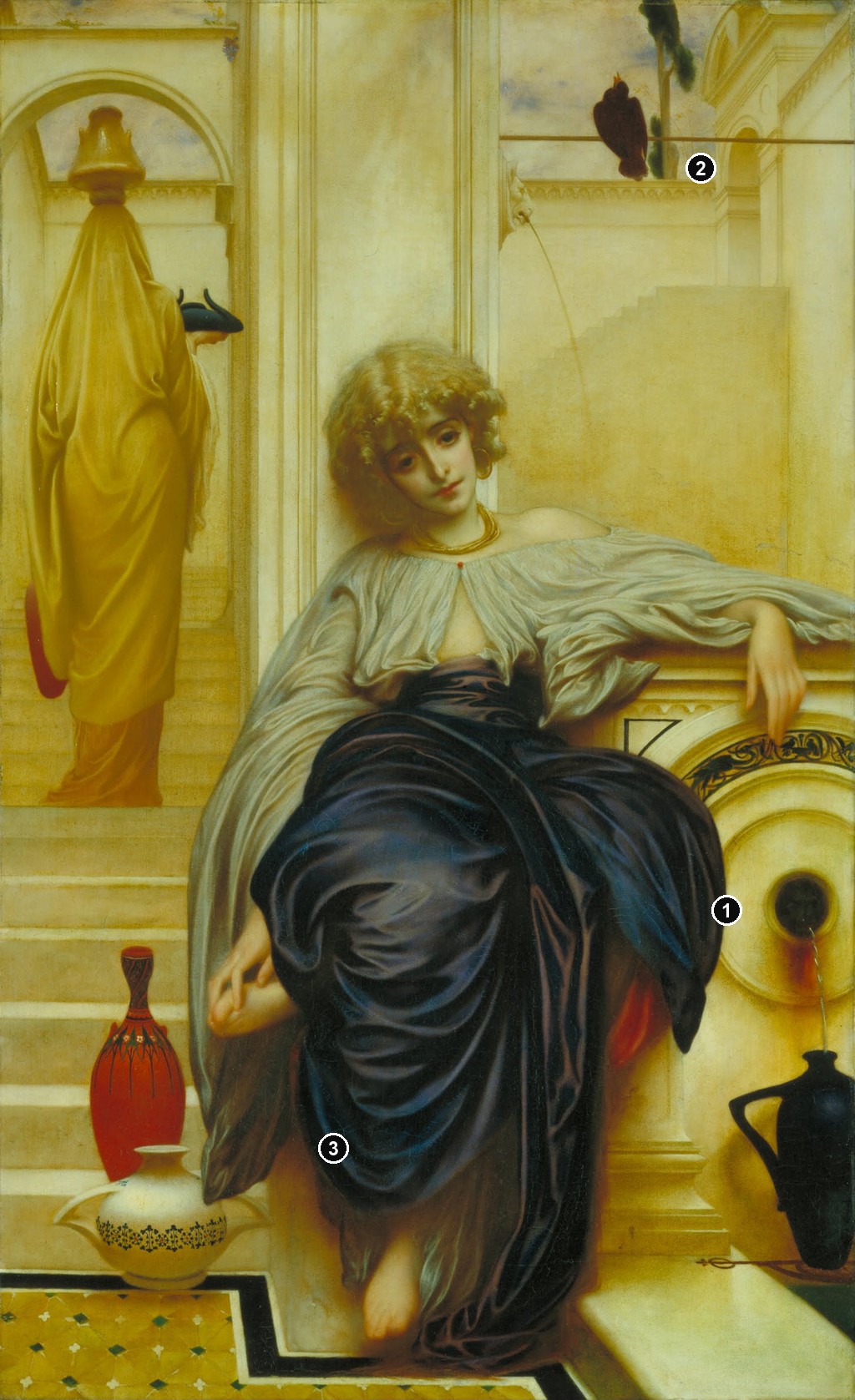
Details from LIEDER OHNE WORTE
Compare the cropped details with the source images above. Notice how their colours, shapes and positions contribute to the larger compositions.
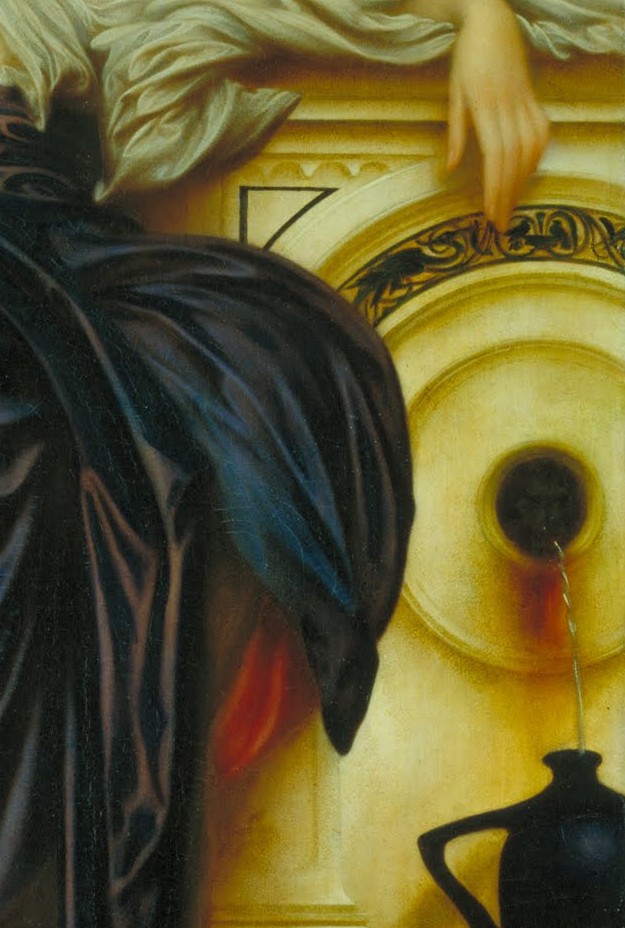
Hand and fountain
Her wrist rests against the rounded rim. The pale stone and the dark opening bring the light hand into the same small area as the falling water.
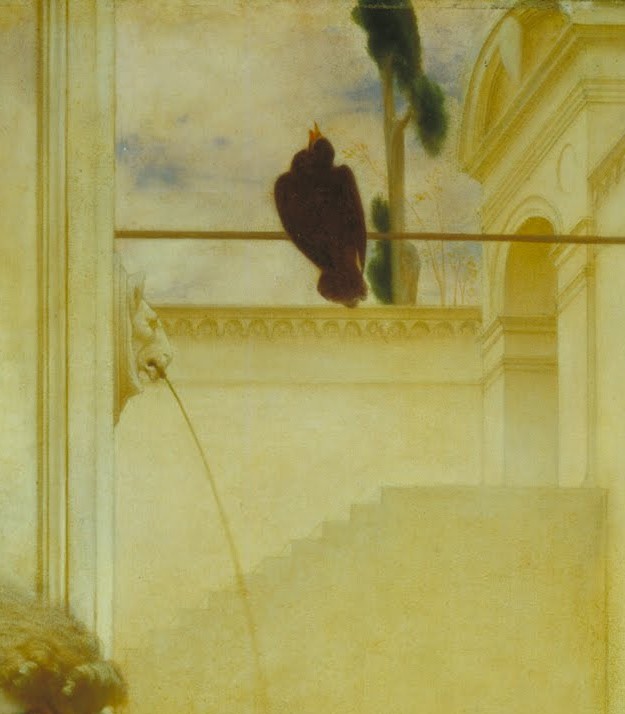
A bird in the pale court
A dark bird appears high beyond the sitter. Pale walls and architecture isolate it as a small but distinct shape.
Blue folds and red earthenware
The blue cloth gathers in the lower part of the picture, with a red vessel close by. Dark angular tiles keep the composition from dissolving into curves.
Where the title came from
Leighton had been calling the painting The Listener. The German title came from Mrs Ralph Benson. In a letter of 1 April 1861, her husband said he had considered a couplet about the splash of the fountain and the bird’s song after seeing the painting. His wife, hearing him describe it, suggested Lieder ohne Worte. Her title left viewers to discover what the girl was listening to for themselves. Leighton still used The Listener when mentioning the work to his mother on 1 May, even as he told her that he had adopted the new title. [2]
The expression already had a musical life of its own. Felix Mendelssohn had given the expressive character of song to short piano pieces. The first volume appeared in London in 1832 as Original Melodies for the Piano-Forte and in Paris around the same time as Six Romances sans paroles. The Bonn edition followed in 1833 under the German title. Subsequent London editions also printed the German words on their title pages. By Leighton’s exhibition, Tate notes, the pieces were popular in England. The chance that an Academy visitor would recognise the phrase was part of what made it effective. [5] [6] [7]
There is a parallel in the way the two artists explained their work. In 1842 Marc André Souchay tried to match pieces in several of Mendelssohn’s volumes to stories or sentiments. In his reply, Mendelssohn argued that the music expressed ideas more precisely than words could. Leighton’s account to Steinle likewise locates the girl’s experience in qualities that belong to painting. The sweep of a sleeve or the accumulation of dark blue can shape the mood in a way that a description of the scene alone leaves out. The bird and the running water supply the sounds Leighton imagined. Mendelssohn’s title gives the viewer a way to think about how those sounds are evoked. [2] [3] [5]
A surviving score shows how closely these pieces belonged to private life in Britain. In 1847 Mendelssohn sent Prince Albert a four-hand arrangement of one of his Songs without Words, knowing the royal couple liked to play them as duets. After the composer’s death that year, Queen Victoria recorded how strange it felt to play the music he had recently written out for them. In that instance the music acquired an association particular to its listeners. Leighton’s picture gives the girl a similarly private relation to what she hears, leaving her thoughts beyond the viewer’s reach. [1] [8]
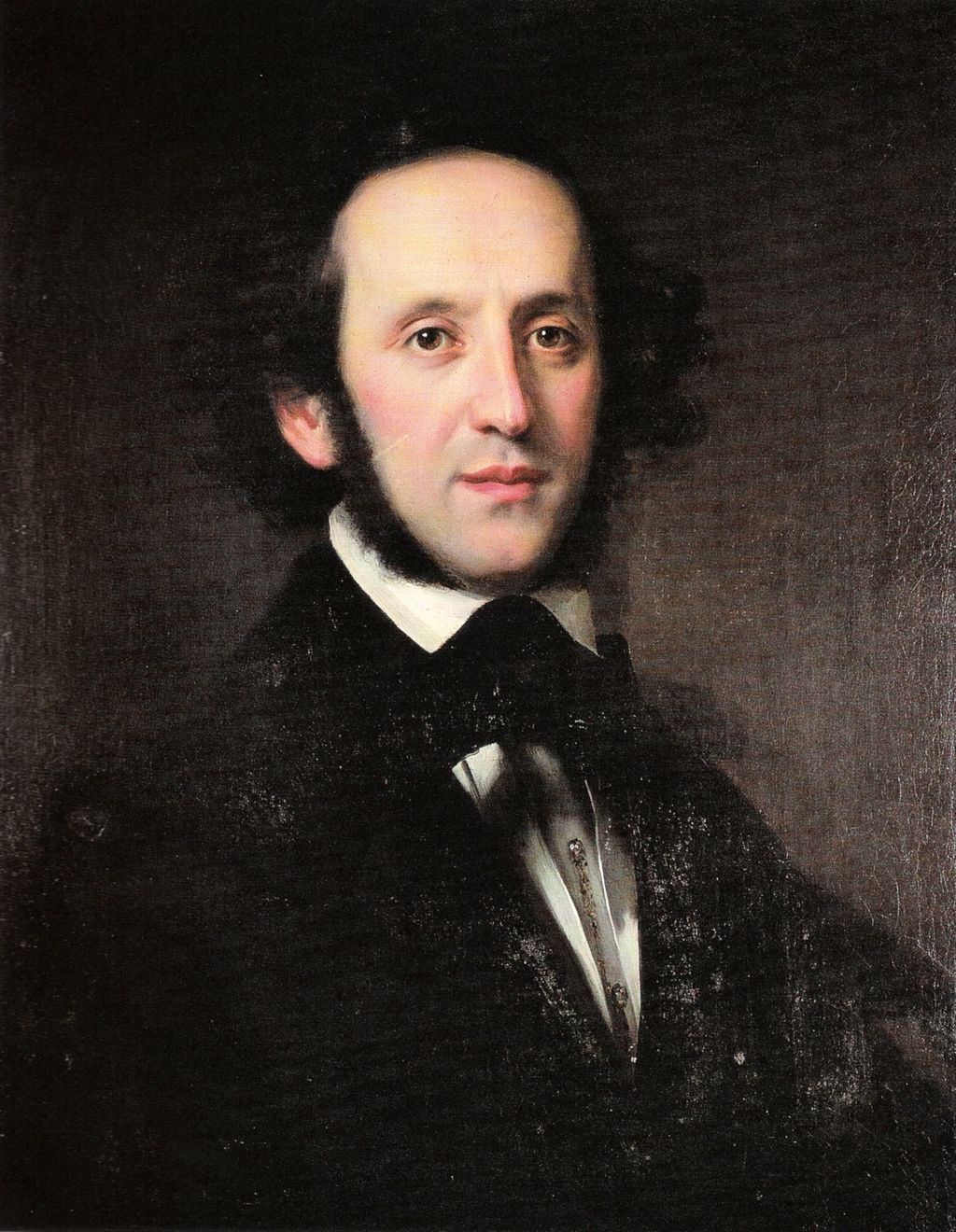
Eduard Magnus, Felix Mendelssohn Bartholdy, 1833. Image source. Public domain. Resized proportionally.
What the studies reveal
The line study in the Leighton House collection shows the artist working out the seated figure as a design. The arch, water bearer and jars are already in place around the listening girl. The dark hatching around her head and the finer outlines of the stonework pull her forward even in a drawing without colour. In the oil, the difference between the ochre figure in the doorway and the dark-blue folds in front gives that separation greater force. Hugh Witemeyer sets the drawing beside Leighton’s later Tessa at Home, an illustration for George Eliot’s Romola, and Summer Moon. These comparisons follow the pose into other settings, where the inclination of the head and the folds weighed down by a resting body do quite different work. [1] [3] [9]
Emilie Barrington reproduces a separate pencil drawing of John Hanson Walker as a boy and says Leighton used it as a head study for the painting. The study records an individual face framed by thick curls. In the finished picture these features belong to the girl, whose inclined head follows the angle of her shoulder. Taken together, the two drawings suggest different decisions at work. One helped Leighton find the form of the head, while the other considers how the whole body sits and settles against the architecture. [1] [9] [10]
What visitors saw in 1861
On 10 April, Leighton told his mother that the girl by the fountain had been among the favourites at his studio’s private view. George Frederic Watts and the singer Adelaide Sartoris preferred Paolo e Francesca, which was shown at the same Academy exhibition. The two paintings offered visitors quite different ways into a picture. The Academy catalogue gave the story of the lovers a line from Dante. Beside entry no. 550 it gave only the German title, with no verse to explain how the girl came to be there or what might happen to her next. [2] [11]
At the exhibition the picture hung high on the wall. On 1 May, after hearing where the Academy had placed his pictures, Leighton worried that visitors looking up from below would miss the finish on which they depended. On 10 May Dante Gabriel Rossetti wrote to William Allingham that he considered Lieder ohne Worte the best of Leighton’s submissions and found its placement conspicuously unfair. It is easy to see why the position mattered. The broad blue cloth is legible from a distance. The thin line of water above the pitcher is easier to lose. [1] [2] [12]
Reviewers who took the time to study it had trouble assigning the setting to a period. The Athenaeum tried several possibilities, from ancient Rome and Pompeii to architecture in the manner of Palladio. Macmillan’s Magazine made that uncertainty part of its praise, treating the place and costume as deliberately indefinite. Leighton told his father that he had abandoned his initial plan for a realistic treatment as soon as he began painting. The stairs, pots and flowing water are specific enough to give the girl a place to sit and something to hear. The place itself remains open to the imagination. [2] [3] [4]
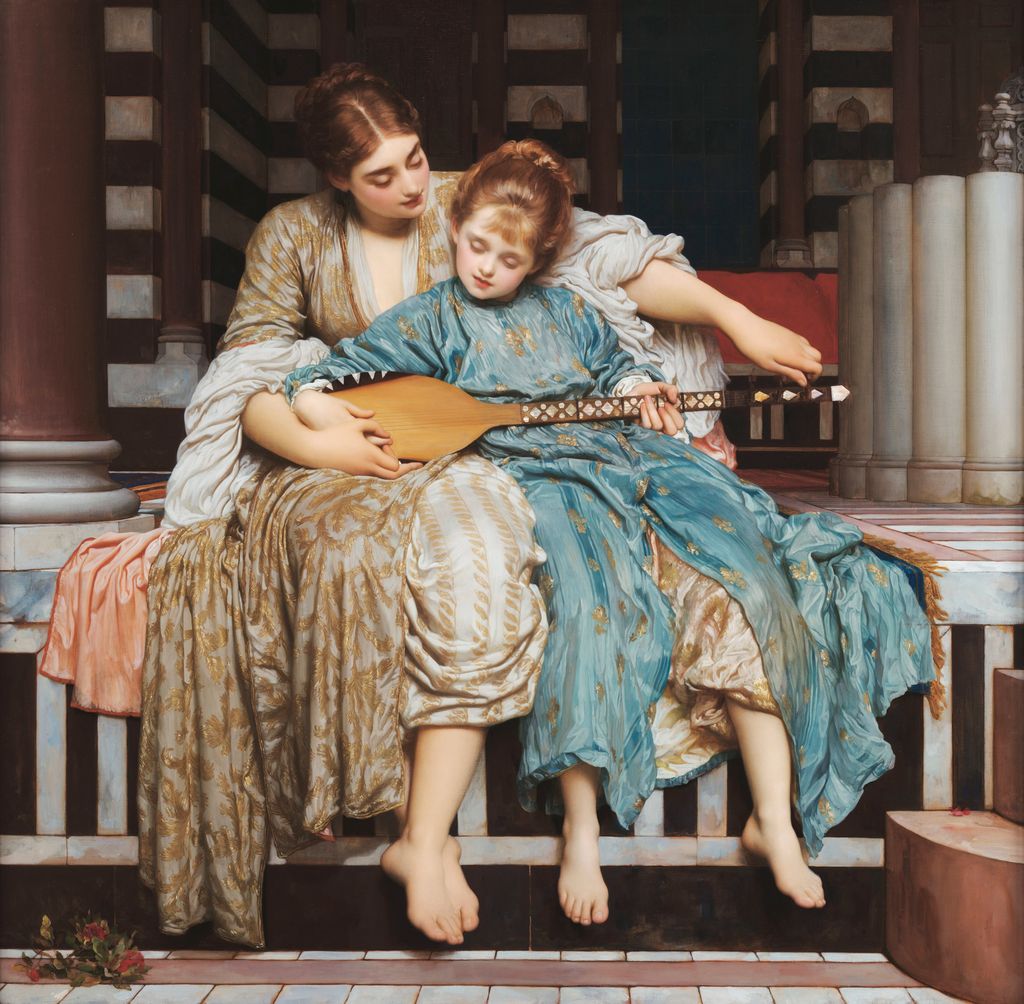
Frederic Leighton, The Music Lesson, 1877. Guildhall Art Gallery. Image source. Public domain. Resized without changing the composition.
Browse Frederic Leighton’s artworks
Explore paintings, drawings, sculptures and prints, with separate rows for identified preparatory works, reproductions and casts.
| Name | Date | Medium |
|---|---|---|
| A Girl Feeding Peacocks | Exhibited 1863 | Painting Catalogue. |
| A Recognition from ‘Romola’, engraved by Swain (Tate N04054) | published 1862 | Print Catalogue. |
| A Roman Lady | 1859 | Painting Catalogue. |
| Abram and the Angel (Tate A00733) | published 1881 | Print Catalogue. |
| Acme and Septimius | Exhibited 1868 | Painting Catalogue. |
| An Athlete Wrestling with a Python (Tate exhibition bronze) | 1877 | Sculpture Catalogue. |
| And the Sea Gave Up the Dead Which Were in It (Tate N01511) | 1891–92 | Painting Catalogue. |
| Andromache in Captivity (photogravure after Leighton) | 1889 | Print Catalogue. |
| Athlete Wrestling with a Python (Anglesey Abbey cast) | model 1877; cast 1905 | Sculpture Catalogue. |
| Athlete Wrestling with a Python (Hood reduced cast) | 1877 (inscribed model date) | Sculpture Catalogue. |
| Athlete Wrestling with a Python (Saint Louis reduced cast) | 1877 (museum date) | Sculpture Catalogue. |
| Cain and Abel (Tate A00731) | published 1881 | Print Catalogue. |
| Captive Andromache | 1888 | Painting Catalogue. |
| Cimabue's Celebrated Madonna | 1853–55 | Painting Catalogue. |
| Cimon and Iphigenia, with Many Smaller Subjects (Tate T09061) | date not known | Drawing Catalogue. |
| Crenaia, the Nymph of the Dargle | Exhibited 1880 | Painting Catalogue. |
| Cymon and Iphigenia | 1884 | Painting Catalogue. |
| Daedalus and Icarus | 1869 | Painting Catalogue. |
| Dante in Exile | 1864 | Painting Catalogue. |
| Death of the First Born (Tate A00737) | published 1881 | Print Catalogue. |
| Electra at the Tomb of Agamemnon | c. 1869 | Painting Catalogue. |
| Eliezer and Rebekah (Tate A00735) | published 1881 | Print Catalogue. |
| Elijah in the Wilderness | 1877–78 | Painting Catalogue. |
| Fanny Kemble: A Study for ‘Jezebel and Ahab’ (Tate T08208) | c.1862 | Drawing Catalogue. |
| Figure Studies | Date not recorded | Drawing Catalogue. |
| Flaming June | 1895 | Painting Catalogue. |
| Gulnihal | Exhibited 1886 | Painting Catalogue. |
| Helios and Rhodes (Tate N03015) | date not known | Painting Catalogue. |
| Hercules Wrestling with Death for the Body of Alcestis | c. 1869–71 | Painting Catalogue. |
| Jonathan's Token to David | c. 1868 | Painting Catalogue. |
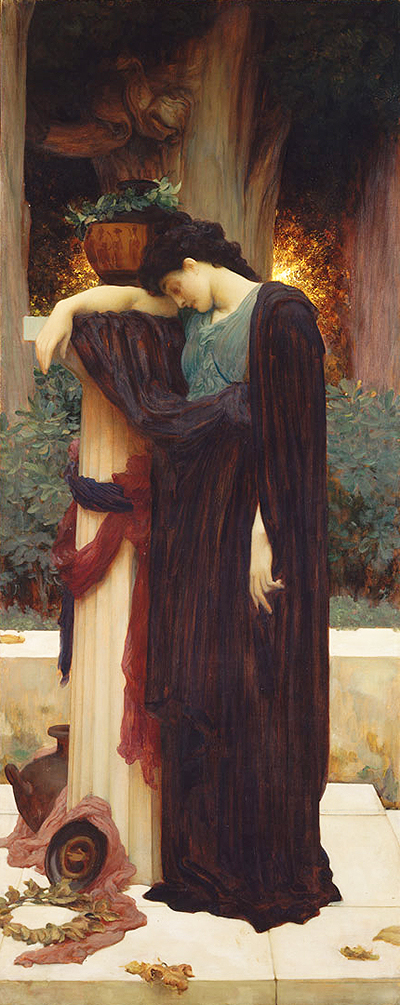
| Lachrymae | 1894–95 | Painting Catalogue. |
| Lieder ohne Worte | Exhibited 1861 | Painting Catalogue. |
| Light of the Harem | Exhibited 1880 | Painting Catalogue. |
| Moses Views the Promised Land (Tate A00736) | published 1881 | Print Catalogue. |
| Mrs James Guthrie | 1865 | Painting Catalogue. |
| Mrs John Hanson Walker (Tate N04731) | 1867 | Painting Catalogue. |
| Music Lesson | 1877 | Painting Catalogue. |
| Needless Alarms (Met cast) | modelled 1886; cast nineteenth century | Sculpture Catalogue. |
| Needless Alarms (Tate N05120) | 1886 | Sculpture Catalogue. |
| Pavonia | c. 1859 | Painting Catalogue. |
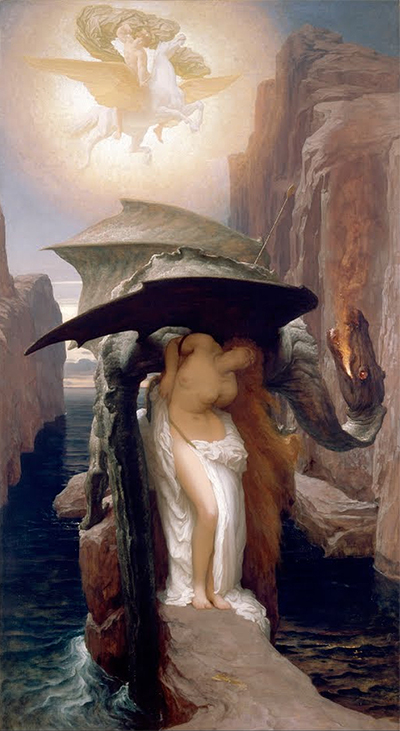
| Perseus and Andromeda | 1891 | Painting Catalogue. |
| Portrait of May Sartoris | c. 1860 | Painting Catalogue. |
| Preparing for a Festa, Florence (Tate T09062) | date not known | Drawing Catalogue. |
| Puerta de los Vientos, near Ronda, Spain (Tate N04006) | c.1886–9 | Painting Catalogue. |
| Samson and the Lions (Tate A00732) | published 1881 | Print Catalogue. |
| Samson at the Mill (Tate A00734) | published 1881 | Print Catalogue. |
| Samson Carrying the Gate (Tate A00738) | published 1881 | Print Catalogue. |
| Sketch for ‘An Athlete Wrestling with a Python’ (Tate N01761) | c.1877 | Sculpture Catalogue. |
| Sketches for Cimon and Iphigenia (Tate T09060) | date not known | Drawing Catalogue. |
| Study for The Return of Persephone (Demeter) | c. 1890–91 | Drawing Catalogue. |
| Study for The Return of Persephone (Persephone) | c. 1890–91 | Drawing Catalogue. |
| Study for ‘Needless Alarms’ (Tate N02945) | 1886 | Sculpture Catalogue. |
| Study for ‘The Discovery of Juliet Apparently Lifeless’ (Tate N01806) | c.1858 | Painting Catalogue. |
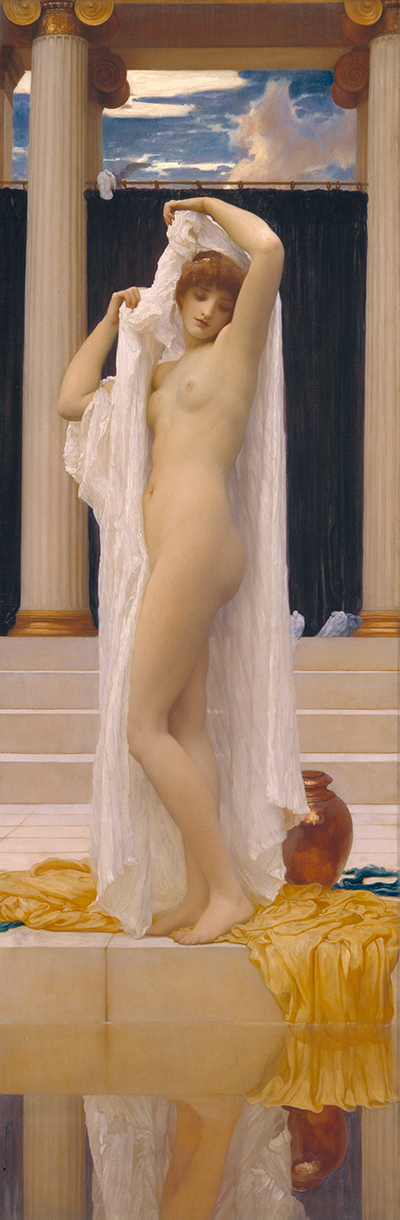
| The Bath of Psyche | Exhibited 1890 | Painting Catalogue. |
| The Daphnephoria | 1874–76 | Painting Catalogue. |
| The Death of Brunelleschi | 1852 | Painting Catalogue. |
| The Fisherman and the Siren | Exhibited 1858 | Painting Catalogue. |
| The Painter's Honeymoon | c. 1864 | Painting Catalogue. |
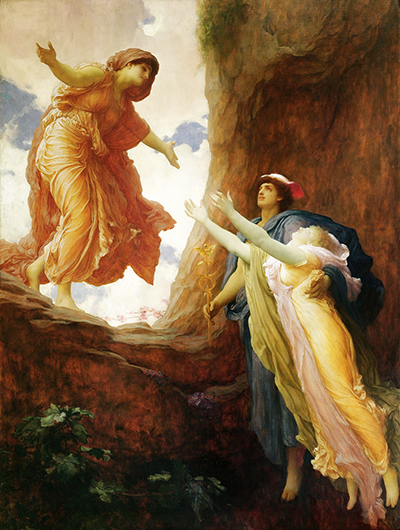
| The Return of Persephone | 1891 | Painting Leeds painting identified in the Met study record. |
| The Return of Persephone (preparatory oil) | c. 1890–91 | Painting Catalogue. |
| The Sluggard (Anglesey Abbey cast) | probably 1890–about 1906 | Sculpture Catalogue. |
| The Sluggard (Met cast) | modelled 1886; cast possibly before 1896 | Sculpture Catalogue. |
| The Sluggard (Museum Wales) | 1882–85 (museum date) | Sculpture Catalogue. |
| The Sluggard (Tate N01752) | 1885 | Sculpture Catalogue. |
| The Spies Escape (Tate A00730) | published 1881 | Print Catalogue. |
| Various Subjects (Tate T09063) | date not known | Drawing Catalogue. |
| View in Capri | Possibly 1859 | Painting Catalogue. |
| Wedded | 1882 | Painting Catalogue. |
| Winding the Skein | c. 1878 | Painting Catalogue. |
Discussion
Look again at the images and ideas explored in Lieder ohne Worte. These editorial prompts invite your observations.
Reader Insights
Which parts of the painting suggest a sound even without the title?
What differences do you notice between the line of the steps and the curved surfaces beside the girl?
Join the Conversation
Share a detail, comparison or question about Lieder ohne Worte below.
References
- Tate, collection data for Lieder ohne Worte, T03053, exhibited 1861. View source.
- Emilie Barrington, The Life, Letters and Work of Frederic Leighton, vol. II, pp. 57–64, including letters to and from Leighton, April–May 1861, and n. 19. View source.
- Marte Stinis, Music as Aesthetic Paradigm: Frederic Leighton, Albert Moore, and James McNeill Whistler, pp. 108–113. View source.
- Suzanne Fagence Cooper, “The Liquefaction of Desire: Music, Water and Femininity in Victorian Aestheticism,” Women: A Cultural Review 20, no. 2 (2009), pp. 186–201. View source.
- R. Larry Todd, bilingual preface to Mendelssohn’s Lieder ohne Worte (Bärenreiter), pp. V–VI and X–XI, including correspondence with Marc André Souchay and early publication history. View source.
- Tate Britain, Lieder ohne Worte, collection image and interpretation via Google Arts & Culture. View source.
- Morgan Library & Museum, Mendelssohn’s The Fourth Book of Original Melodies = 6 Lieder ohne Worte, London edition, catalogue no. 113782. View source.
- Royal Collection Trust, Mendelssohn’s Lied ohne Worte für das Piano vierhändig, 1847, RCIN 1047149. View source.
- Hugh Witemeyer, George Eliot and the Visual Arts, plate 29 and the Leighton House drawing, reproduced by Victorian Web. View source.
- Emilie Barrington, The Life, Letters and Work of Frederic Leighton, vol. I, illustration facing p. 251 and ch. V, n. 57. View source.
- Algernon Graves, The Royal Academy of Arts, vol. V, Leighton’s 1861 exhibitions, nos. 276 and 550. View source.
- Ernest Rhys, Frederic Lord Leighton, ch. III, letter from Dante Gabriel Rossetti to William Allingham, 10 May 1861. View source.