 by Tom Gurney
Tom Gurney BSc (Hons) is an art history expert with over 20 years experience
Published on June 19, 2020 / Updated on November 29, 2026
Email: tomgurney1@gmail.com / Phone: +44 7429 011000
Crenaia, the Nymph of the Dargle: Introduction
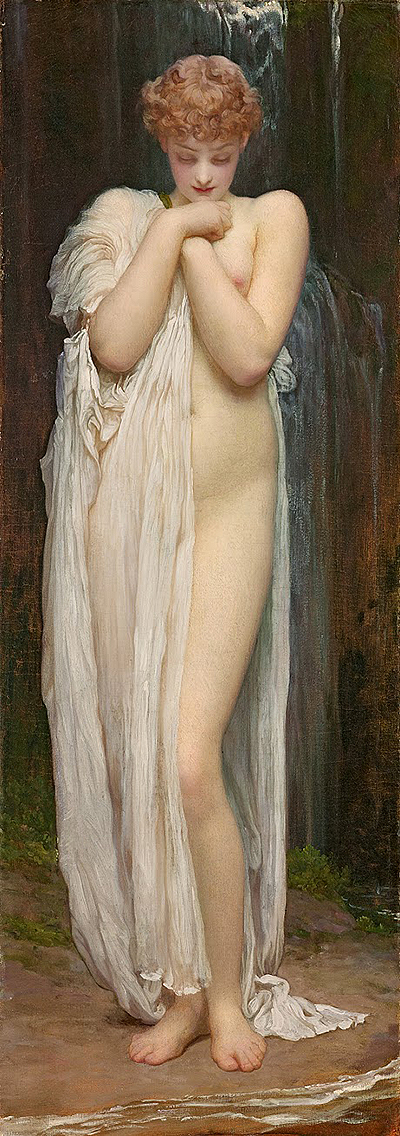
A woman stands at the edge of a stream, her eyes lowered and her hands gathered below her chin. A fall of white cloth covers one shoulder and hangs almost to her feet. Behind the other shoulder, water descends over dark rock in much the same folds. Frederic Leighton exhibited this narrow oil painting at the Royal Academy in 1880. The catalogue listed it in Gallery VII under a single name, Crenaia. [1]
At a Glance
- ExhibitedRoyal Academy, 1880, no. 655
- Exhibited titleCrenaia
- MediumOil on canvas
- CollectionPérez Simón Collection
This work across Frederic Leighton’s career
Cimabue’s Celebrated Madonna
1853–55Crenaia, the Nymph of the Dargle (current article)
Exhibited 1880 [1]Lachrymae
1894–95Flaming June
c. 1895Contents
- Drapery and falling water
- The Irish river in the title
- A model and a classical subject
- A small canvas on the exhibition wall
- Annotated details
Drapery and falling water
Leighton gives the figure very little room on either side. Her curls nearly touch the streak of light from the water above her head, and her bare feet are only a short distance from the painted stream at the bottom. The Spanish loan register gives the canvas as 76.8 by 27.2 centimetres, almost three times as tall as it is wide. The scale allows for a complete figure seen at close quarters. Even the shallow space behind her, where a dark near-vertical wall of rock takes the place of a distant view, keeps every part of the scene close to the surface. [2]
The pose holds the eye in the upper half of the canvas. One elbow projects to the left as we look, and the other points down, drawing a short diagonal across the longer lines of the figure. The head tips forward, still lit along the forehead and curls. Her shoulders turn just enough to make one side of the pose feel sheltered and the other exposed. Below, the fabric pulls away to disclose the line of one leg, then folds back into a small train on the ground. The feet have the warm colour of the bank around them, while the cool grey water behind the figure makes the skin seem more luminous.
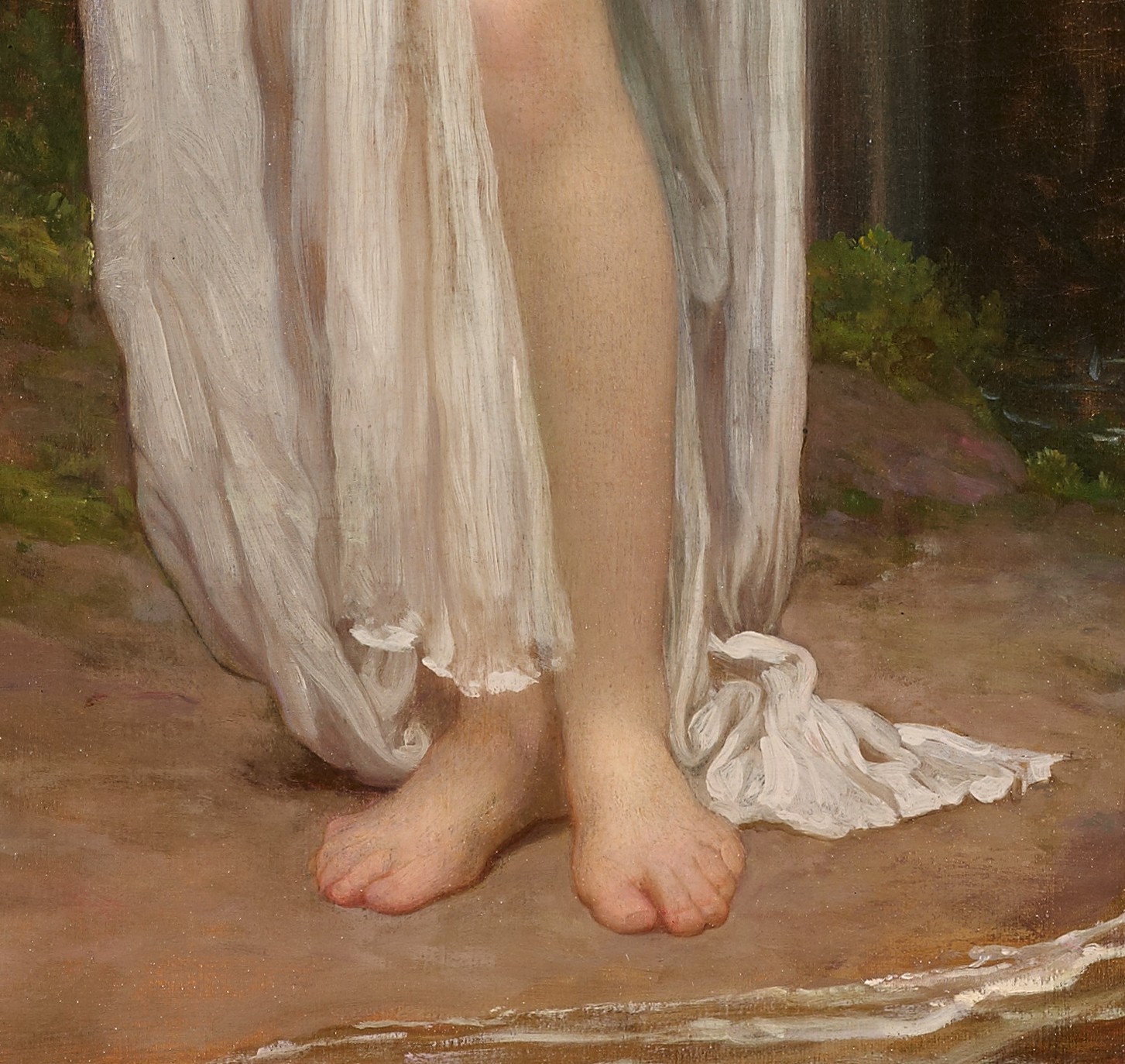
The French exhibition dossier for Désirs et volupté draws attention to the resemblance between the transparent folds and the cascade. The folds begin high on the shoulder and hang in fine, broken ridges. Behind the figure, the water divides into threads, interrupted by the unevenness of the rock. At her feet the two rhythms change. Fabric collects in a little heap and the stream passes across the foreground in thin, nearly horizontal bands. Leighton makes the nature of each material clearest where its direction changes. [3]
The critic writing in The Athenæum on 1 May 1880 noticed the gesture of gathering the cloth and thought it had been caught with spontaneity. The review praised the design and handling of the drapery and had reservations about the flesh tones, which it found too rosy or pale without a warm golden undertone. The distinction matters in a painting where the light fabric can come close to the colour of the body. The critic also understood the setting as a rocky recess beside a spring. The more specific connection to an Irish waterfall is recorded under the painting’s later title. [4]
Annotated Details from Crenaia, the Nymph of the Dargle
The numbered points identify visible features discussed in this article. Return from each detail to the numbered overview. Frederic Leighton, Crenaia, the Nymph of the Dargle, exhibited 1880. Image source. Public domain. Resized proportionally.
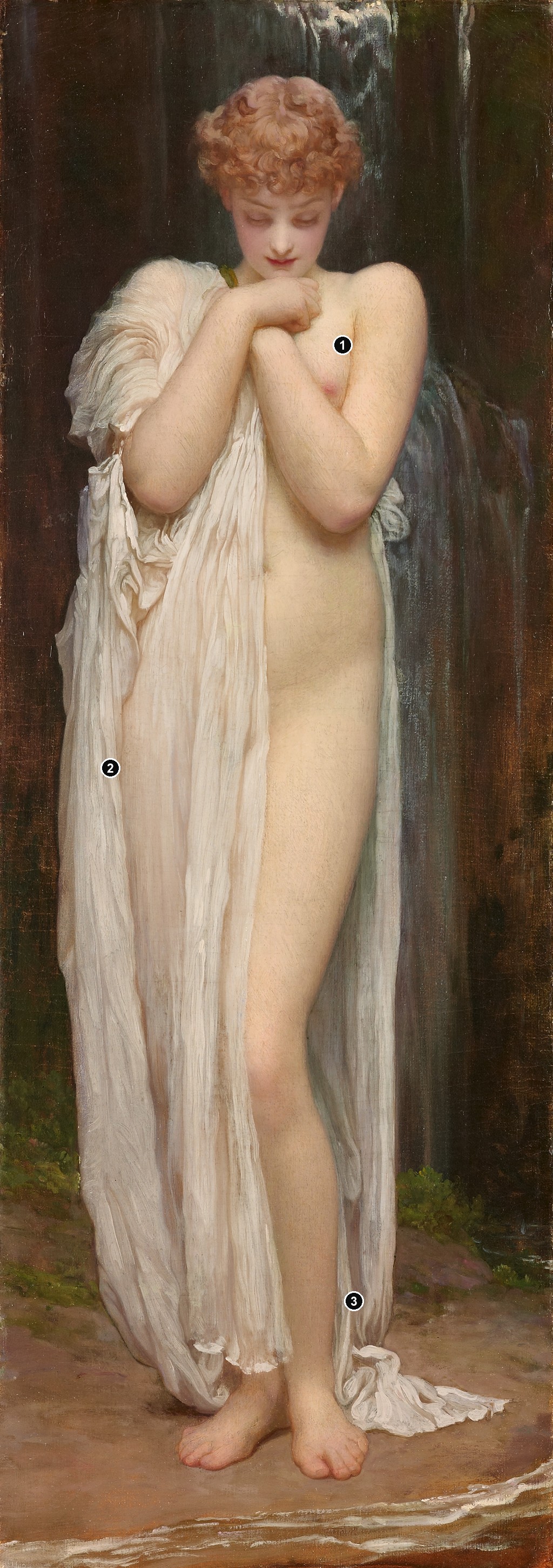
Details from CRENAIA, THE NYMPH OF THE DARGLE
Compare the cropped details with the source images above. Notice how their colours, shapes and positions contribute to the larger compositions.
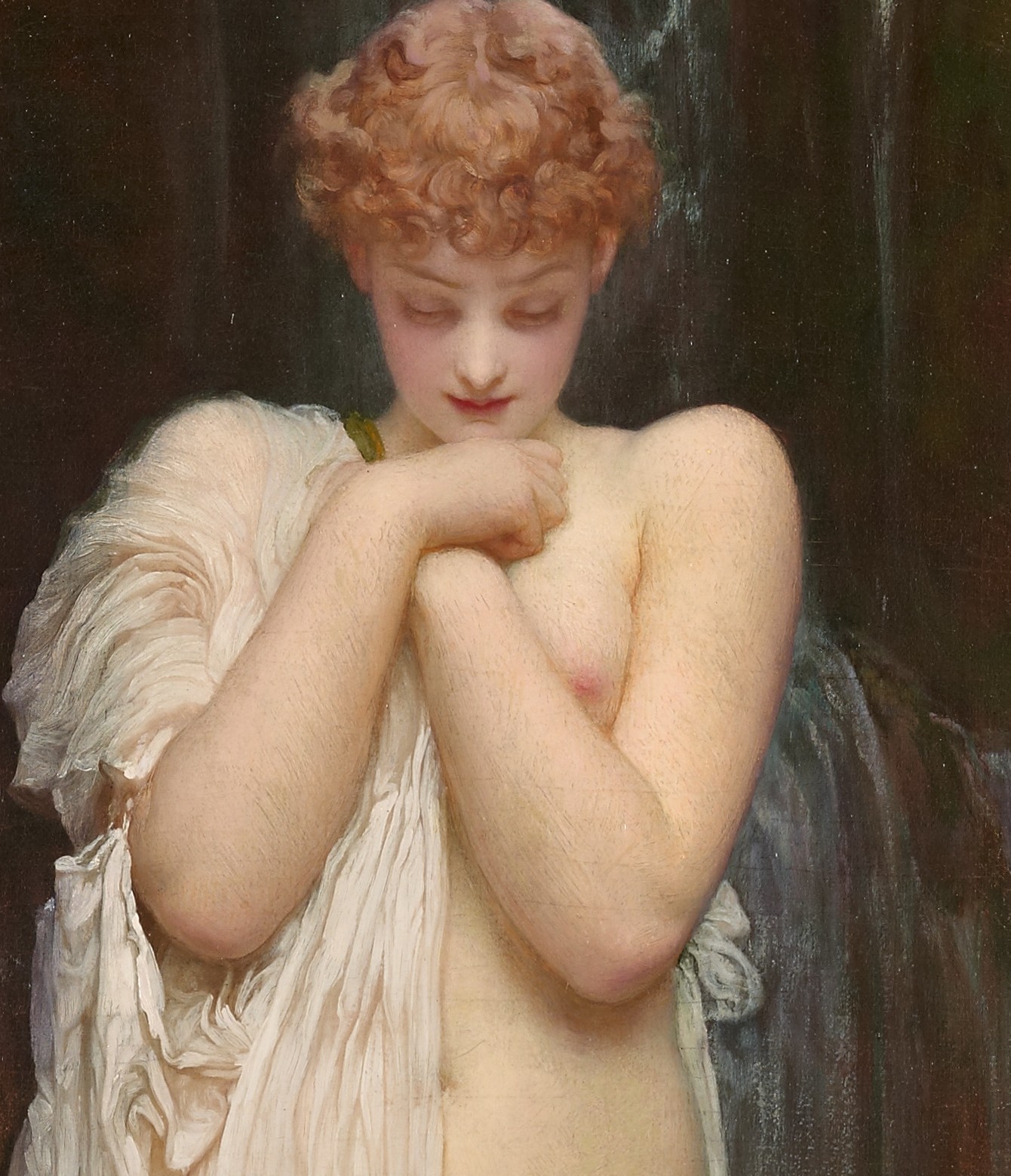
Closed gesture and lowered eyes
Her forearms meet in a small space below her chin. The turn of the head draws attention down to the cloth gathered against her.
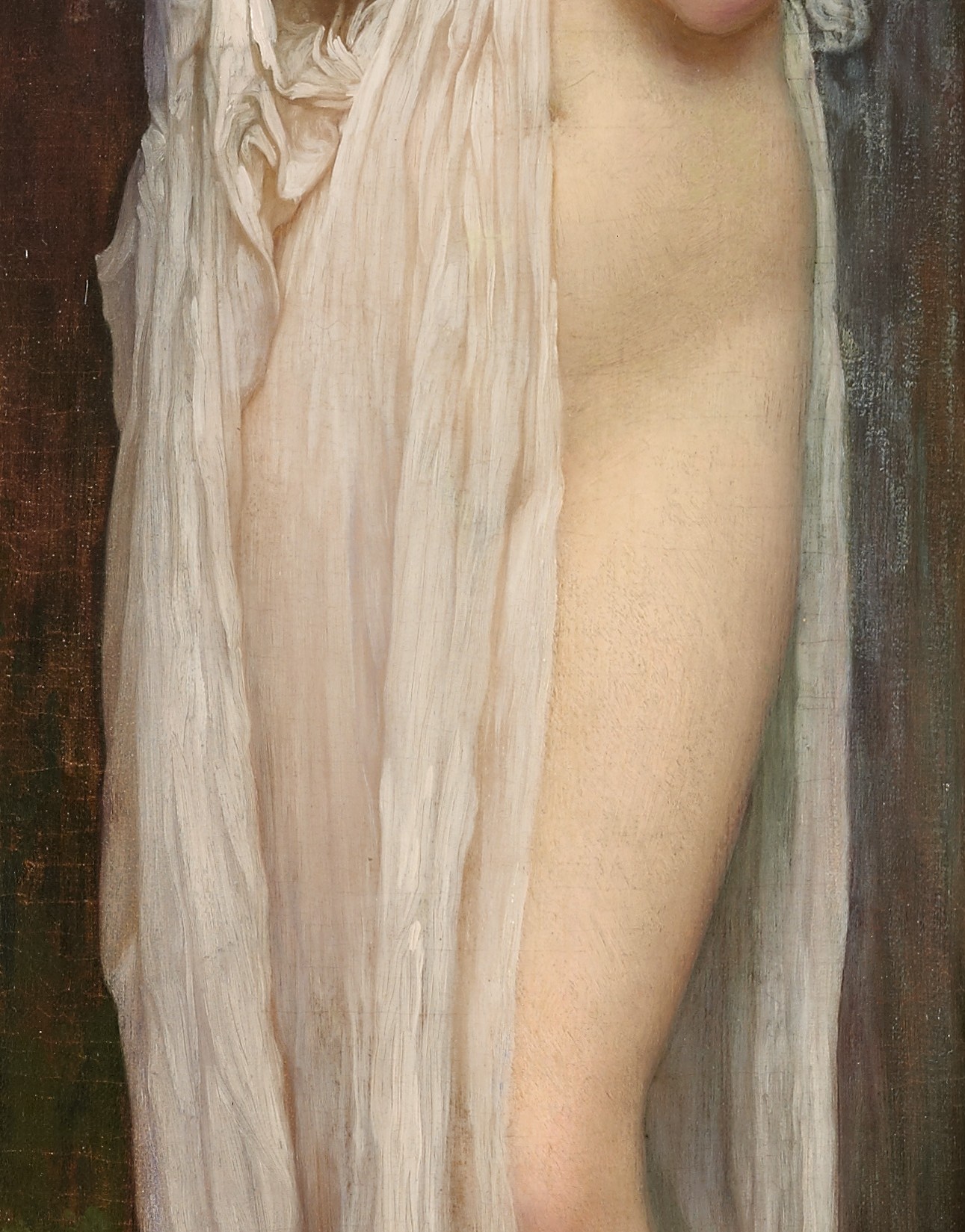
Water and hanging cloth
The fine vertical folds catch highlights against the dark fall. The cloth takes on the upright direction of the streaked water without sharing its colour.
An uneven place to stand
The drapery spreads beside the bare feet and turns sideways across the ground. That change of direction ends the long fall of folds from the shoulder.
The Irish river in the title
In the Royal Academy’s 1897 memorial exhibition, the canvas appeared as The Nymph of the Dargle, lent by Viscount Powerscourt. The catalogue identifies the earlier title and describes the background as the Powerscourt Waterfall. The Dargle really does fall over a steep rock face at Powerscourt, near Enniskerry in County Wicklow. The 1897 entry ties the work to that place and documents the loan. Its description leaves the circumstances of the painting’s commission and the exact viewpoint open. [5] [6]
The Dargle had already served as a subject for Irish landscape painting. James Arthur O’Connor’s A View of the Glen of the Dargle, signed and dated 1834, was purchased by the National Gallery of Ireland in 1873. Its horizontal format gives the landscape a breadth that Leighton’s compressed view cannot accommodate. O’Connor’s title identifies a view of the glen. Leighton’s later title identifies a figure through her relation to the river. The two paintings show different ways of giving an actual place a presence in a small canvas. [7]
The bare name Crenaia also has a classical resonance. The adjective krēnaios, from the ancient Greek word for a spring, describes fountain nymphs in the Odyssey. That makes a plausible association for a figure painted beside falling water. The 1880 catalogue offers the name alone, leaving its precise derivation open. Once the Dargle entered the title, a reader could locate this kind of water spirit in a particular landscape. [1] [8]
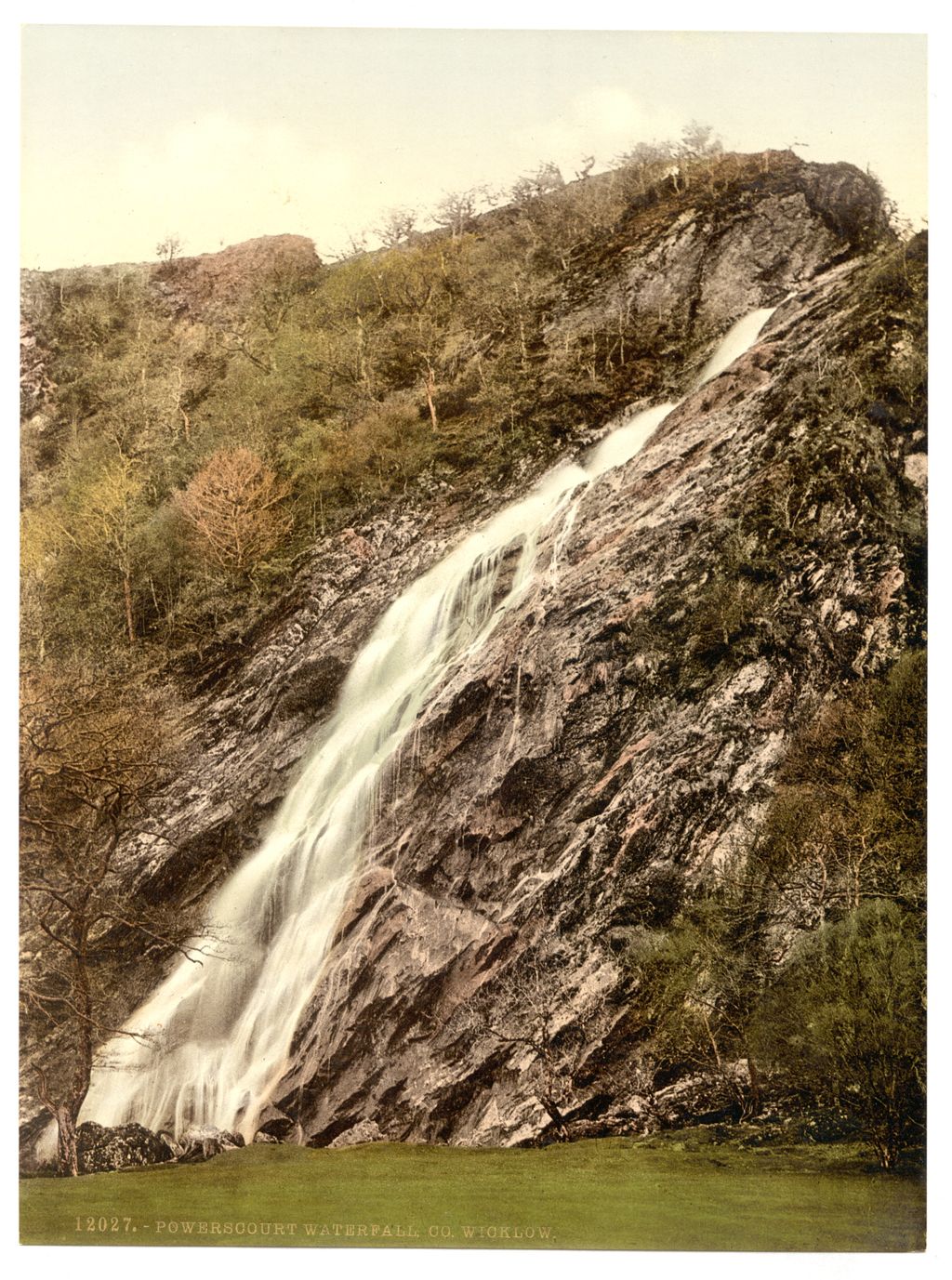
Powerscourt Waterfall, County Wicklow, in a photochrom print made around 1890–1900. Library of Congress. Image source. Public domain. Resized proportionally.
A model and a classical subject
The art historian Madeline Boden identifies Dorothy Dene in Crenaia and traces her appearance across Leighton’s five paintings at the 1880 exhibition. Dene became one of his principal models and pursued a career on the stage. One of her other subjects that year was Psamathe, shown in the same gallery as Crenaia. Ernest Rhys describes Psamathe seated face away from the viewer, looking out over the sea, with her drapery slipped down beside her. The stillness of that pose belongs to an open horizon. In Crenaia, Dene’s bowed head and the close frame of rock and water make the scene feel private even though the figure stands facing out. [9] [10] [11]
The Jacquemart-André dossier compares the painting to Jean-Auguste-Dominique Ingres’s La Source, completed in 1856. Ingres gives his standing figure a tilted vessel, a visible source for the stream spilling beside her. Raising the vessel lifts her arms and opens the front of the body to the viewer. Leighton brings his figure’s hands together in front of her, and lets the rock face carry the descending water. Ingres’s figure appears to pour out the stream. In Crenaia the water has its own course, and the fabrics seem to follow it. [3] [12]
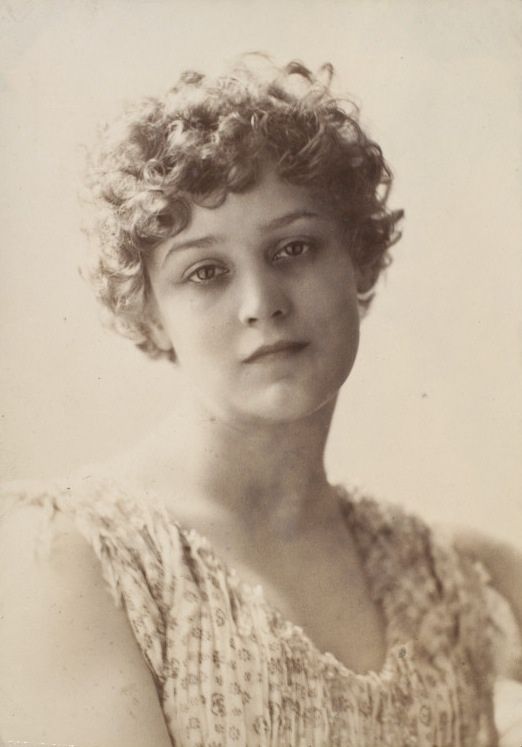
Dorothy Dene in a photograph by Henry Van der Weyde. Victoria and Albert Museum. Image source. Public domain. Resized proportionally.
A small canvas on the exhibition wall
A study of Leighton’s frames identifies the moulding on Crenaia as a variation on the classical design also seen on Psamathe. Its ornament repeats a pattern of stylised leaves. The fine ornament is low in relief and runs parallel to the edge of the canvas. On a painting this narrow, it gives the dark opening a distinct perimeter without competing with the much brighter folds of cloth. [13]
The Mexican Pérez Simón collection lent the painting to the exhibition that opened at the Musée Jacquemart-André in Paris in 2013. There it was discussed in a room devoted to the Victorian nude. The Chiostro del Bramante in Rome singled it out as a mythological subject when the exhibition travelled there in 2014. For the Madrid presentation at the Museo Thyssen-Bornemisza, Spain’s loan guarantee recorded the lender as Fundación JAPS of Mexico and listed the oil on canvas as inventory number 10513. Its measurement agrees with the Paris checklist, although the caption in the same French dossier gives 76.2 by 26.7 centimetres. The Paris dossier dates the painting to around 1880, the year it was shown at the Royal Academy. [2] [3] [14] [15]
The London leg brought the loan to Leighton’s former home in 2014–15. At Leighton House, the picture was hung inside the mouldings of a doorway. A reviewer for the Museums Association noticed how the tall opening repeated the proportions of the canvas. That choice recreated one of the picture’s effects on the scale of the room. The doorway drew a visitor’s eye into a small, shaded space, just as the canvas offers a glimpse of the nymph through an opening barely wider than her shoulders. [16] [17]
Browse Frederic Leighton’s artworks
Explore paintings, drawings, sculptures and prints, with separate rows for identified preparatory works, reproductions and casts.
| Name | Date | Medium |
|---|---|---|
| A Girl Feeding Peacocks | Exhibited 1863 | Painting Catalogue. |
| A Recognition from ‘Romola’, engraved by Swain (Tate N04054) | published 1862 | Print Catalogue. |
| A Roman Lady | 1859 | Painting Catalogue. |
| Abram and the Angel (Tate A00733) | published 1881 | Print Catalogue. |
| Acme and Septimius | Exhibited 1868 | Painting Catalogue. |
| An Athlete Wrestling with a Python (Tate exhibition bronze) | 1877 | Sculpture Catalogue. |
| And the Sea Gave Up the Dead Which Were in It (Tate N01511) | 1891–92 | Painting Catalogue. |
| Andromache in Captivity (photogravure after Leighton) | 1889 | Print Catalogue. |
| Athlete Wrestling with a Python (Anglesey Abbey cast) | model 1877; cast 1905 | Sculpture Catalogue. |
| Athlete Wrestling with a Python (Hood reduced cast) | 1877 (inscribed model date) | Sculpture Catalogue. |
| Athlete Wrestling with a Python (Saint Louis reduced cast) | 1877 (museum date) | Sculpture Catalogue. |
| Cain and Abel (Tate A00731) | published 1881 | Print Catalogue. |
| Captive Andromache | 1888 | Painting Catalogue. |
| Cimabue's Celebrated Madonna | 1853–55 | Painting Catalogue. |
| Cimon and Iphigenia, with Many Smaller Subjects (Tate T09061) | date not known | Drawing Catalogue. |
| Crenaia, the Nymph of the Dargle | Exhibited 1880 | Painting Catalogue. |
| Cymon and Iphigenia | 1884 | Painting Catalogue. |
| Daedalus and Icarus | 1869 | Painting Catalogue. |
| Dante in Exile | 1864 | Painting Catalogue. |
| Death of the First Born (Tate A00737) | published 1881 | Print Catalogue. |
| Electra at the Tomb of Agamemnon | c. 1869 | Painting Catalogue. |
| Eliezer and Rebekah (Tate A00735) | published 1881 | Print Catalogue. |
| Elijah in the Wilderness | 1877–78 | Painting Catalogue. |
| Fanny Kemble: A Study for ‘Jezebel and Ahab’ (Tate T08208) | c.1862 | Drawing Catalogue. |
| Figure Studies | Date not recorded | Drawing Catalogue. |
| Flaming June | 1895 | Painting Catalogue. |
| Gulnihal | Exhibited 1886 | Painting Catalogue. |
| Helios and Rhodes (Tate N03015) | date not known | Painting Catalogue. |
| Hercules Wrestling with Death for the Body of Alcestis | c. 1869–71 | Painting Catalogue. |
| Jonathan's Token to David | c. 1868 | Painting Catalogue. |
| Lachrymae | 1894–95 | Painting Catalogue. |
| Lieder ohne Worte | Exhibited 1861 | Painting Catalogue. |
| Light of the Harem | Exhibited 1880 | Painting Catalogue. |
| Moses Views the Promised Land (Tate A00736) | published 1881 | Print Catalogue. |
| Mrs James Guthrie | 1865 | Painting Catalogue. |
| Mrs John Hanson Walker (Tate N04731) | 1867 | Painting Catalogue. |
| Music Lesson | 1877 | Painting Catalogue. |
| Needless Alarms (Met cast) | modelled 1886; cast nineteenth century | Sculpture Catalogue. |
| Needless Alarms (Tate N05120) | 1886 | Sculpture Catalogue. |
| Pavonia | c. 1859 | Painting Catalogue. |
| Perseus and Andromeda | 1891 | Painting Catalogue. |
| Portrait of May Sartoris | c. 1860 | Painting Catalogue. |
| Preparing for a Festa, Florence (Tate T09062) | date not known | Drawing Catalogue. |
| Puerta de los Vientos, near Ronda, Spain (Tate N04006) | c.1886–9 | Painting Catalogue. |
| Samson and the Lions (Tate A00732) | published 1881 | Print Catalogue. |
| Samson at the Mill (Tate A00734) | published 1881 | Print Catalogue. |
| Samson Carrying the Gate (Tate A00738) | published 1881 | Print Catalogue. |
| Sketch for ‘An Athlete Wrestling with a Python’ (Tate N01761) | c.1877 | Sculpture Catalogue. |
| Sketches for Cimon and Iphigenia (Tate T09060) | date not known | Drawing Catalogue. |
| Study for The Return of Persephone (Demeter) | c. 1890–91 | Drawing Catalogue. |
| Study for The Return of Persephone (Persephone) | c. 1890–91 | Drawing Catalogue. |
| Study for ‘Needless Alarms’ (Tate N02945) | 1886 | Sculpture Catalogue. |
| Study for ‘The Discovery of Juliet Apparently Lifeless’ (Tate N01806) | c.1858 | Painting Catalogue. |
| The Bath of Psyche | Exhibited 1890 | Painting Catalogue. |
| The Daphnephoria | 1874–76 | Painting Catalogue. |
| The Death of Brunelleschi | 1852 | Painting Catalogue. |
| The Fisherman and the Siren | Exhibited 1858 | Painting Catalogue. |
| The Painter's Honeymoon | c. 1864 | Painting Catalogue. |
| The Return of Persephone | 1891 | Painting Leeds painting identified in the Met study record. |
| The Return of Persephone (preparatory oil) | c. 1890–91 | Painting Catalogue. |
| The Sluggard (Anglesey Abbey cast) | probably 1890–about 1906 | Sculpture Catalogue. |
| The Sluggard (Met cast) | modelled 1886; cast possibly before 1896 | Sculpture Catalogue. |
| The Sluggard (Museum Wales) | 1882–85 (museum date) | Sculpture Catalogue. |
| The Sluggard (Tate N01752) | 1885 | Sculpture Catalogue. |
| The Spies Escape (Tate A00730) | published 1881 | Print Catalogue. |
| Various Subjects (Tate T09063) | date not known | Drawing Catalogue. |
| View in Capri | Possibly 1859 | Painting Catalogue. |
| Wedded | 1882 | Painting Catalogue. |
| Winding the Skein | c. 1878 | Painting Catalogue. |
Discussion
Look again at the images and ideas explored in Crenaia, the Nymph of the Dargle. These editorial prompts invite your observations.
Reader Insights
Where do the hanging drapery and streaks of water look most alike?
What does knowing about the Dargle add to the narrow view behind the sitter?
Join the Conversation
Share a detail, comparison or question about Crenaia, the Nymph of the Dargle below.
References
- Royal Academy of Arts, The Exhibition of the Royal Academy of Arts, 1880, p. 28, Gallery VII, no. 655 View source.
- Boletín Oficial del Estado, Orden ECD/560/2014, annex, item 26 View source.
- Musée Jacquemart-André, Désirs et volupté à l’époque victorienne, teaching dossier, Room 7 and checklist View source.
- The Athenæum, “The Royal Academy. (First Notice.)”, 1 May 1880, p. 572 View source.
- Royal Academy of Arts, Winter Exhibition catalogue, 1897, p. 12, Gallery II, no. 30 View source.
- Geological Survey Ireland, County Geological Site Report, Powerscourt Waterfall View source.
- National Gallery of Ireland, James Arthur O’Connor, A View of the Glen of the Dargle, NGI.163 View source.
- Liddell–Scott–Jones, κρηναῖος, citing Odyssey 17.240, Perseus Digital Library View source.
- Madeline Stacey Boden, A Relief from Classicism, University of York doctoral thesis, pp. 157–58 View source.
- Leighton House Museum, The Women Who Made Us, Dorothy Dene View source.
- Ernest Rhys, Frederic Lord Leighton, pp. 41–42 View source.
- Musée du Louvre, Jean-Auguste-Dominique Ingres, La Source, RF 219 View source.
- The Frame Blog, “Olympian frames”, Classical Frames section View source.
- Centre André-Chastel, Désirs et volupté à l’époque victorienne, Paris exhibition record View source.
- Chiostro del Bramante, Alma-Tadema e i pittori dell’800 inglese, Rome exhibition record View source.
- Leighton House, past exhibitions, A Victorian Obsession, 2014–15 View source.
- Museums Association, A Victorian Obsession, review of the Leighton House installation, 2 February 2015 View source.