 by Tom Gurney
Tom Gurney BSc (Hons) is an art history expert with over 20 years experience
Published on June 19, 2020 / Updated on November 29, 2026
Email: tomgurney1@gmail.com / Phone: +44 7429 011000
The Music Lesson: Introduction
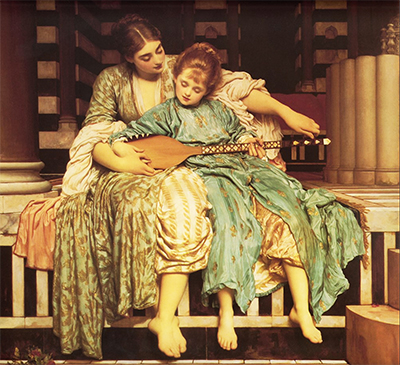
A girl in blue holds a long-necked lute across her lap. The woman beside her reaches for a tuning peg while steadying one of the girl’s fingers with her other hand. They sit so close that their sleeves overlap and the instrument stretches across both their bodies. Frederic Leighton painted The Music Lesson in 1877. The nearly square oil on canvas measures 93 by 95 centimetres and belongs to Guildhall Art Gallery in London. Leighton exhibited it at the Royal Academy that year as Music Lesson, catalogue number 209. [1] [2] [3]
At a Glance
- Painted1877
- MediumOil on canvas
- CollectionGuildhall Art Gallery, 1039
- Royal Academy1877, no. 209
This work across Frederic Leighton’s career
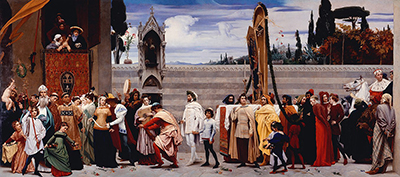
Cimabue’s Celebrated Madonna
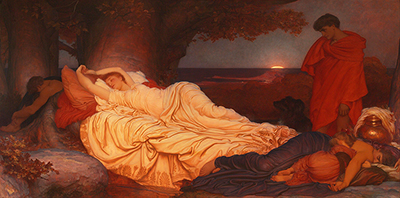
1853–55Lachrymae
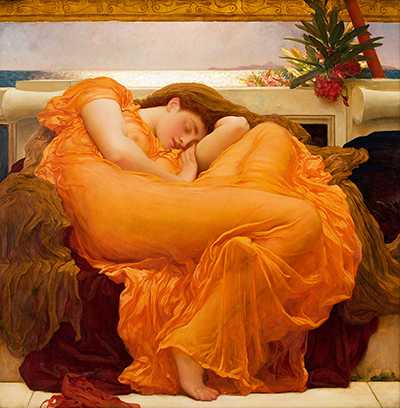
1894–95Flaming June
c. 1895Contents
- A lesson given by hand
- Damascus and the London studio
- An intimate scene on public view
- From the Royal Academy to Guildhall
- Annotated details
A lesson given by hand
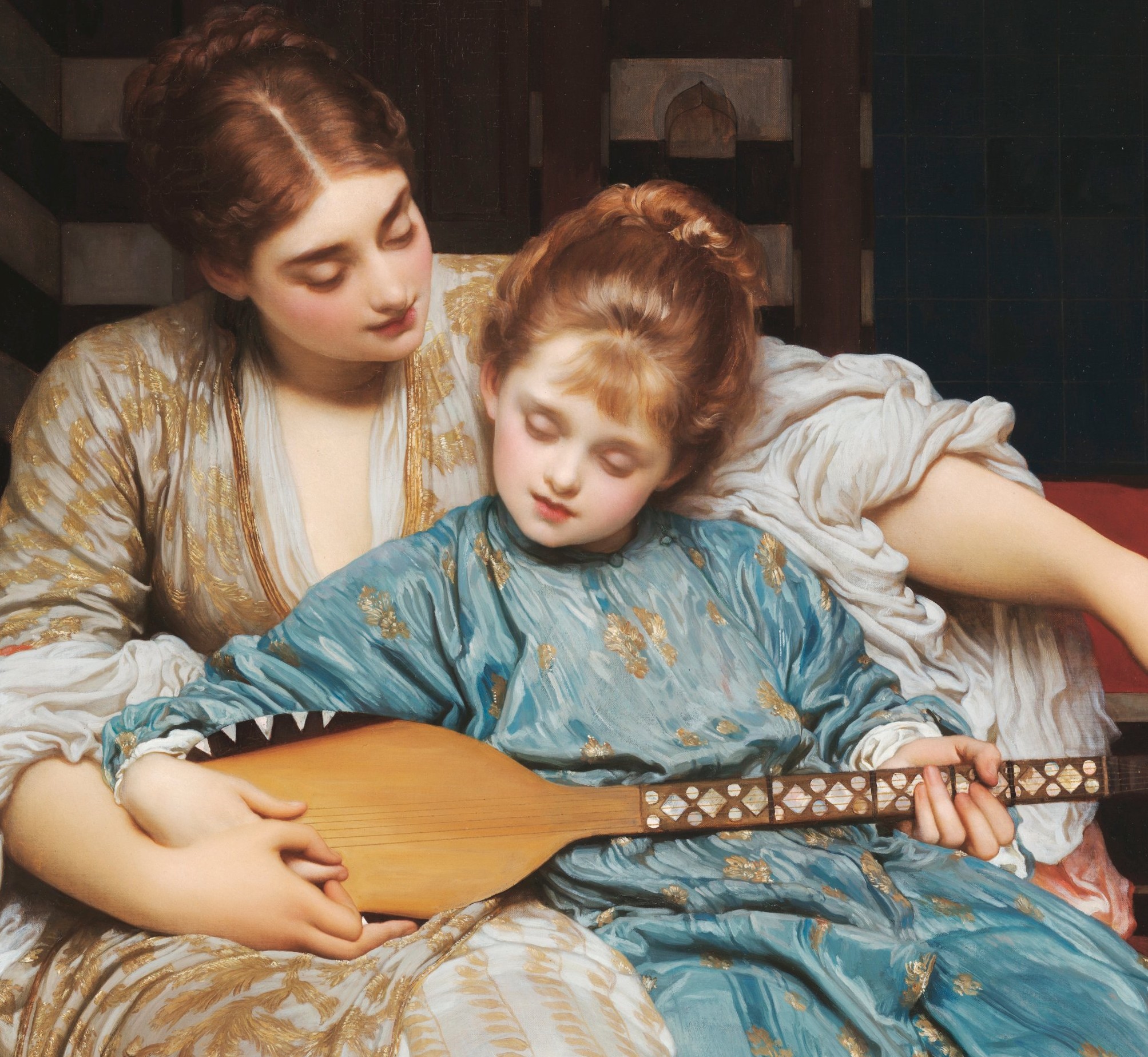
Follow the instrument from its amber body to the pale tuning pegs at the right. The girl’s left hand curls round the neck, while her right hand meets the older woman’s near the strings. The woman reaches across the picture to tune the lute even as she guides the girl’s touch. There is no sheet music in view. The girl watches the point where their fingers meet, and the woman watches the girl. In the catalogue for Victorians Decoded, Caroline Arscott draws attention to how nearly their arms appear to join into one. The loose white cloth around the woman’s arms helps create that effect. It bunches behind the girl’s head and reappears at the opposite side of the instrument, where their hands are hardest to disentangle. [1] [3]
Guildhall identifies the instrument as a Turkish saz and suggests that it probably belonged to Leighton. The term commonly refers to a family of plucked lutes with long, fretted necks. A late nineteenth-century example at the Metropolitan Museum of Art shows a similarly elongated neck, a pear-shaped body and decorative inlay. The Musée de la musique in Paris documents several sizes of saz, each with a name of its own. The girl’s instrument can be recognised by its general form, while its precise type and tuning remain uncertain. Leighton gives us enough detail to see why the lesson requires both pairs of hands. The girl can reach the strings and the neck, but the pegs are quite a stretch from where she sits. [1] [4] [5] [6]
The lute also gives the eye a path through the painting. Little pale shapes repeat down the dark neck, picking up the upright bands of marble beneath the ledge. Those bands can be followed across the picture, interrupted at irregular intervals by hanging cloth and bare feet. Arscott compares the sequence to notes spaced along a stave. There is a similar progression in the colour. Peach cloth spills over the ledge at the left, where a sprig of red blossom lies on the floor below. Gold threads through the woman’s pale robe and reappears in small patches on the girl’s blue garment. The red cushion behind the tuning hand brings a stronger note back in at the far side. [1] [3]
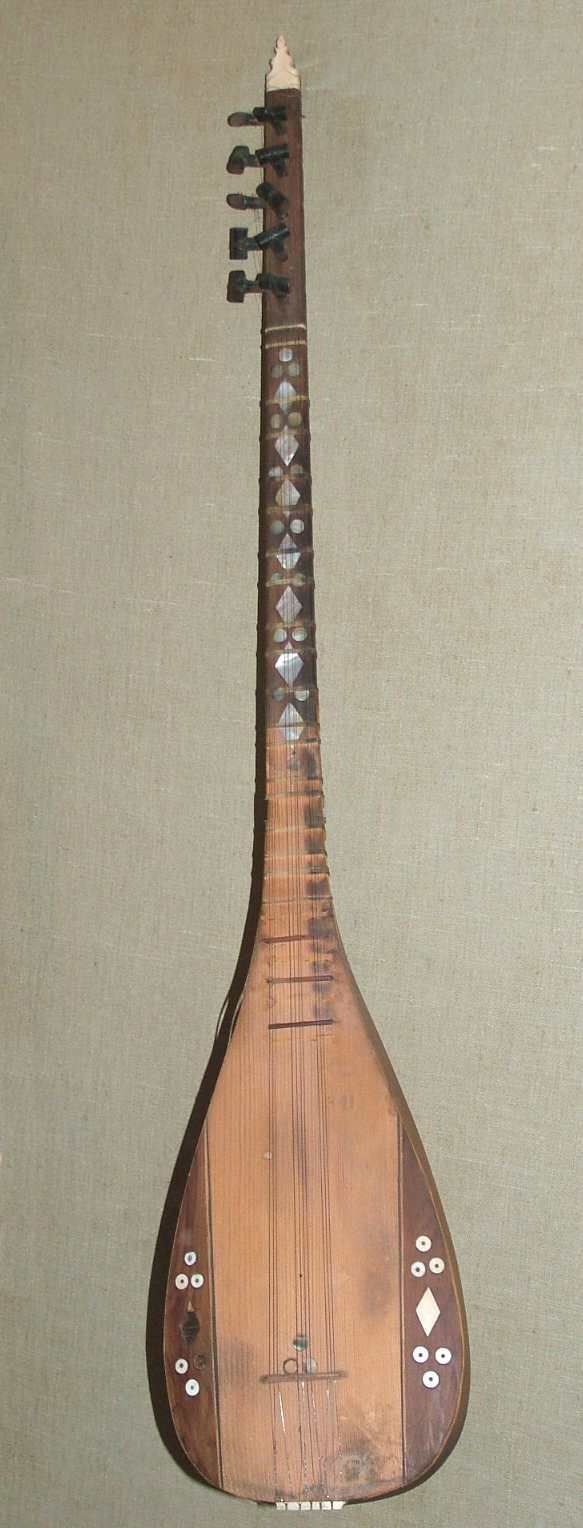
Turkish saz, late nineteenth century. A comparison for the instrument Leighton depicts. The Metropolitan Museum of Art. The Metropolitan Museum of Art, Crosby Brown Collection, 1889. Image source. CC0 / Public domain. Resized proportionally.
Annotated Details from The Music Lesson
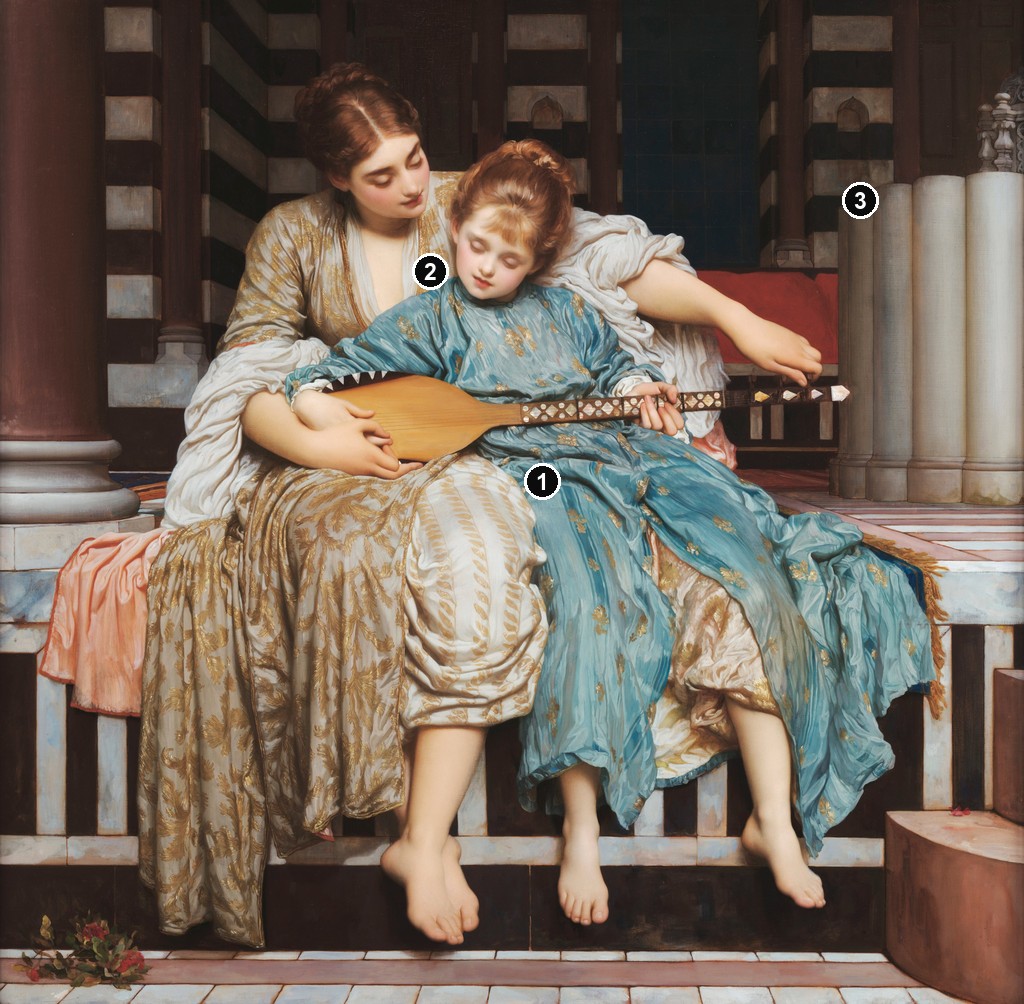
The numbered points identify visible features discussed in this article. Return from each detail to the numbered overview. Frederic Leighton, The Music Lesson, 1877. Guildhall Art Gallery. Image source. Public domain. Resized without changing the composition.
Details from THE MUSIC LESSON
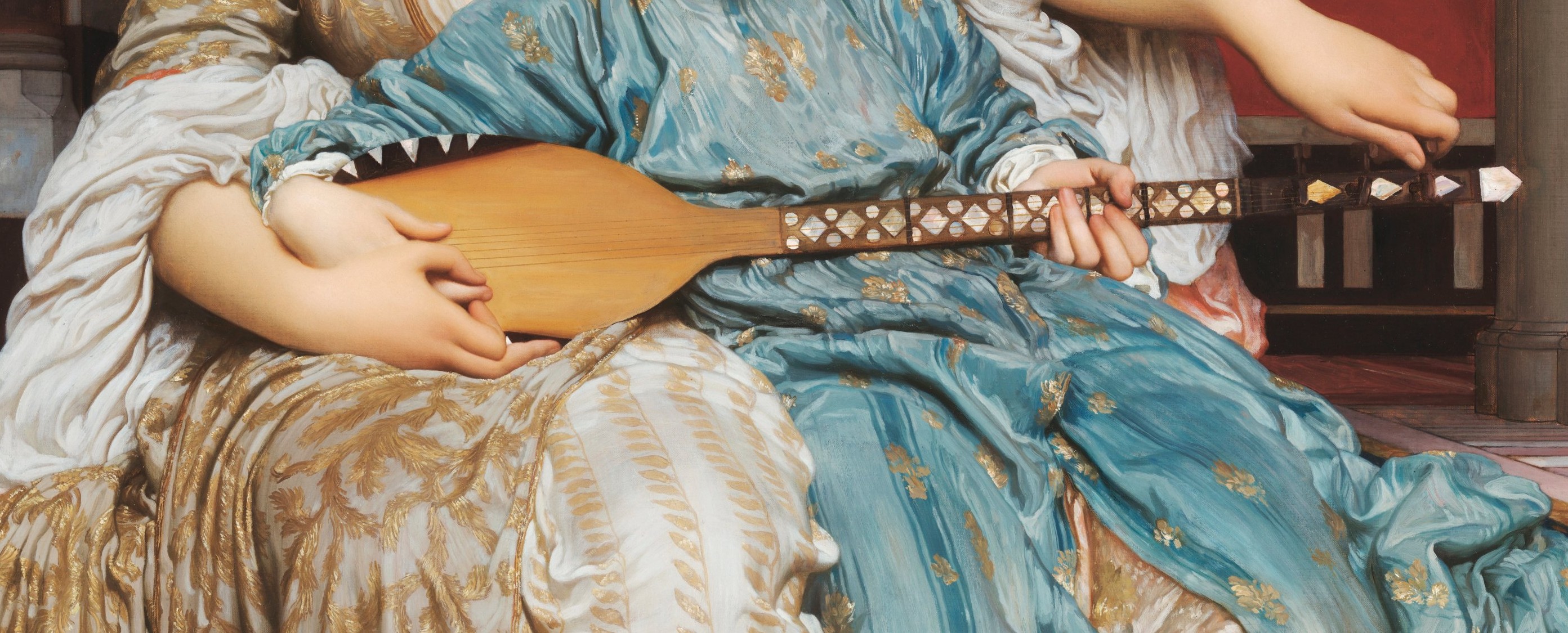
Compare the cropped details with the source images above. Notice how their colours, shapes and positions contribute to the larger compositions.
Hands along the saz
The adult reaches along the instrument while the child steadies it near the body. The spread of hands follows the long, inlaid neck.
The two faces and blue fabric
The heads tilt towards one another above the blue garment. Separate patterns on the fabrics help the eye distinguish their closely overlapping arms.
Stone stripes and columns
Alternating dark and pale courses lead into the recess. The pale columns repeat this rhythm at a different scale.
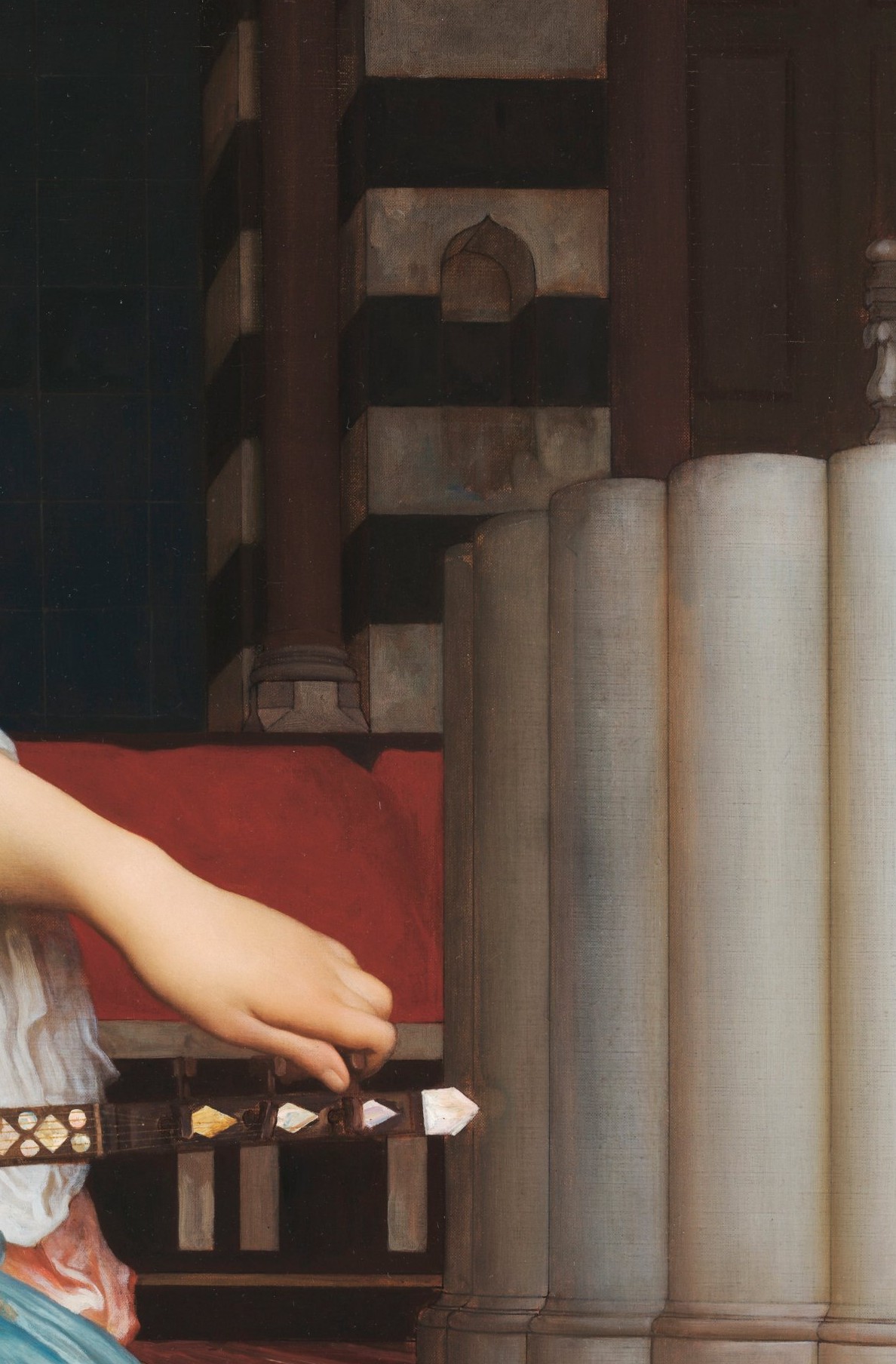
Damascus and the London studio
Guildhall traces the painted architecture to studies Leighton made during his journey to Damascus in 1873. The deep red upright at the left and the pale cluster of columns at the right frame a dark recess. Across the back, alternating courses of light and dark stone turn a corner and recede. On the floor and ledge those measured bands become a more intricate arrangement of coloured marble. The architectural details give the figures somewhere convincing to sit and make their closeness stand out against the space around them. Leighton House also identifies furniture and textiles from the artist’s travels among the objects that fed into the painting. Guildhall considers it likely that the lustrous fabrics used for the costumes came from the 1873 trip. [1] [4] [7]
In the same year that the picture went on show, work began on the Arab Hall at Leighton’s home in Holland Park. This was a separate use of his collection. The house museum identifies the 1884 Sun Gleam as the only painting he set in the hall itself. Two matching panels of grape-pattern tiles on the hall’s west wall, for example, were acquired in Damascus in 1877 by Caspar Purdon Clarke. In the canvas, Leighton uses the contrasting surfaces of his imagined interior to set off the figures. A cushion and dark stone silhouette the woman’s outstretched arm, while cloth falls across the face of the marble step in deep folds. [1] [4] [7]
The child was modelled by Connie Gilchrist, a Londoner who had first posed for Leighton at the age of six. She also sat for Study at a Reading Desk, exhibited alongside The Music Lesson in 1877. In that work, now at Sudley House in Liverpool, she leans over an open book propped up on an inlaid stand. In one picture she reads alone, while the lesson depends on two people attending to a single gesture. Lewis Carroll took Gilchrist to the Royal Academy exhibition and noted in his diary that she especially enjoyed seeing Leighton’s paintings of herself. Gilchrist’s stage work produced a different image again. Around the same time, James McNeill Whistler painted her standing with the skipping rope she used in her act. In Leighton’s painting there is no audience within the scene, and the girl has yet to master the instrument. [1] [8] [9]
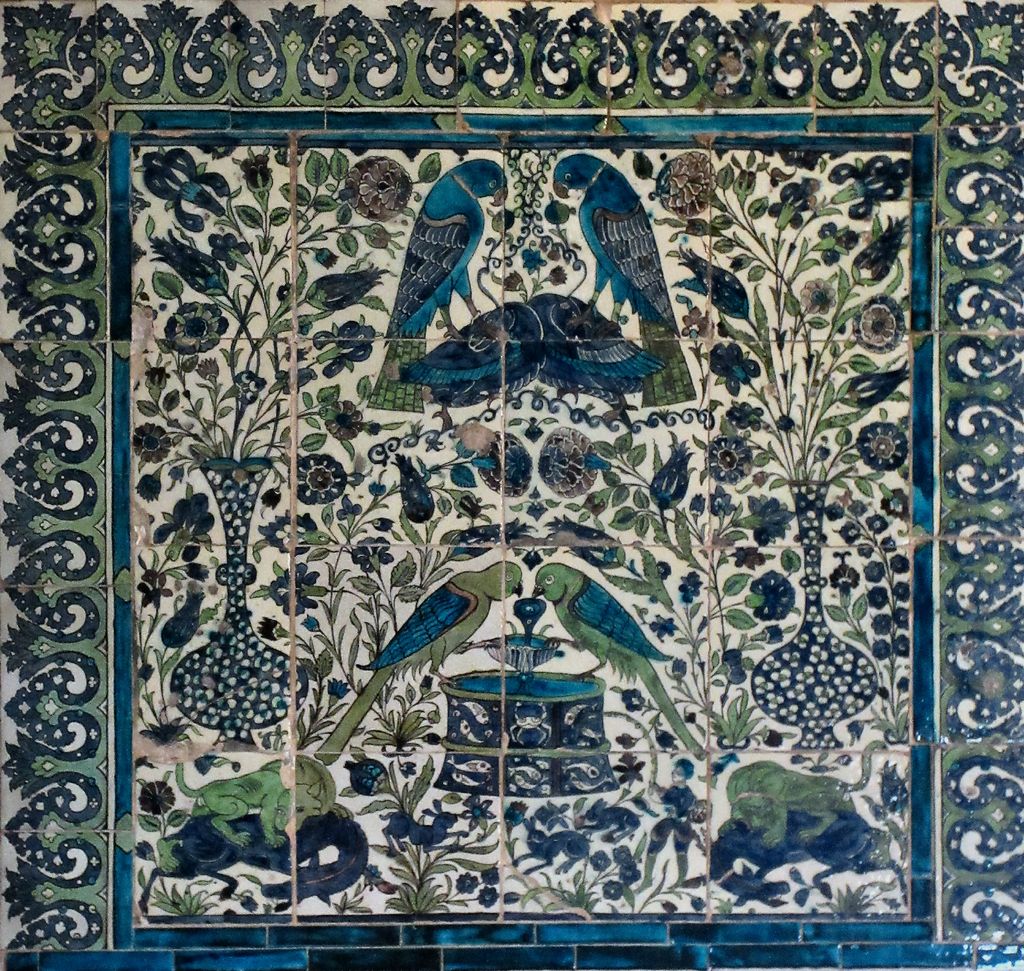
A tiled panel in the Arab Hall at Leighton House. AndyScott. Image source. CC0 / Public domain. Resized JPEG; photograph otherwise unaltered.
An intimate scene on public view
A reviewer for The Times described the lesson’s figures as “creatures of an Eastern ideal”. The phrase catches something about the painting’s appeal to a British audience in 1877. At that exhibition visitors could also see Edwin Long’s An Egyptian Feast and Frederick Goodall’s The Water Carriers: Egypt. Leighton chose a quieter subject in which even the relationship between the figures is left open. The pair might be a mother and daughter or sisters, and the older figure takes on the role of teacher. As the art historian Madeline Hewitson shows, Leighton repeatedly drew on the two Victorian tastes for pictures of children and pictures of the East. The very ordinary act of learning to play gave his Academy audience a way into a setting he had pieced together from travel studies, objects and a London model. [3] [4] [7] [8]
Leighton had painted music in a domestic setting before. The art historian Marte Stinis connects The Music Lesson with Golden Hours, a picture in which a woman leans towards a man at a piano as he plays. In the lesson, both figures are engaged in making a sound. A later comparison comes from the Ottoman painter Osman Hamdi Bey. His Two Musician Girls, painted in 1880 and now in the Pera Museum collection, places its players at different heights, one standing and the other seated. The standing figure plays a long-necked tambur while her companion holds a frame drum. Edhem Eldem notes the resemblance between the two paintings but found no firm evidence that Osman Hamdi saw Leighton’s work. Hamdi’s upright format opens a clear space between the heads of his players. Leighton’s square canvas lets the instrument stretch across both figures while their heads almost touch. [3] [10] [11] [12]
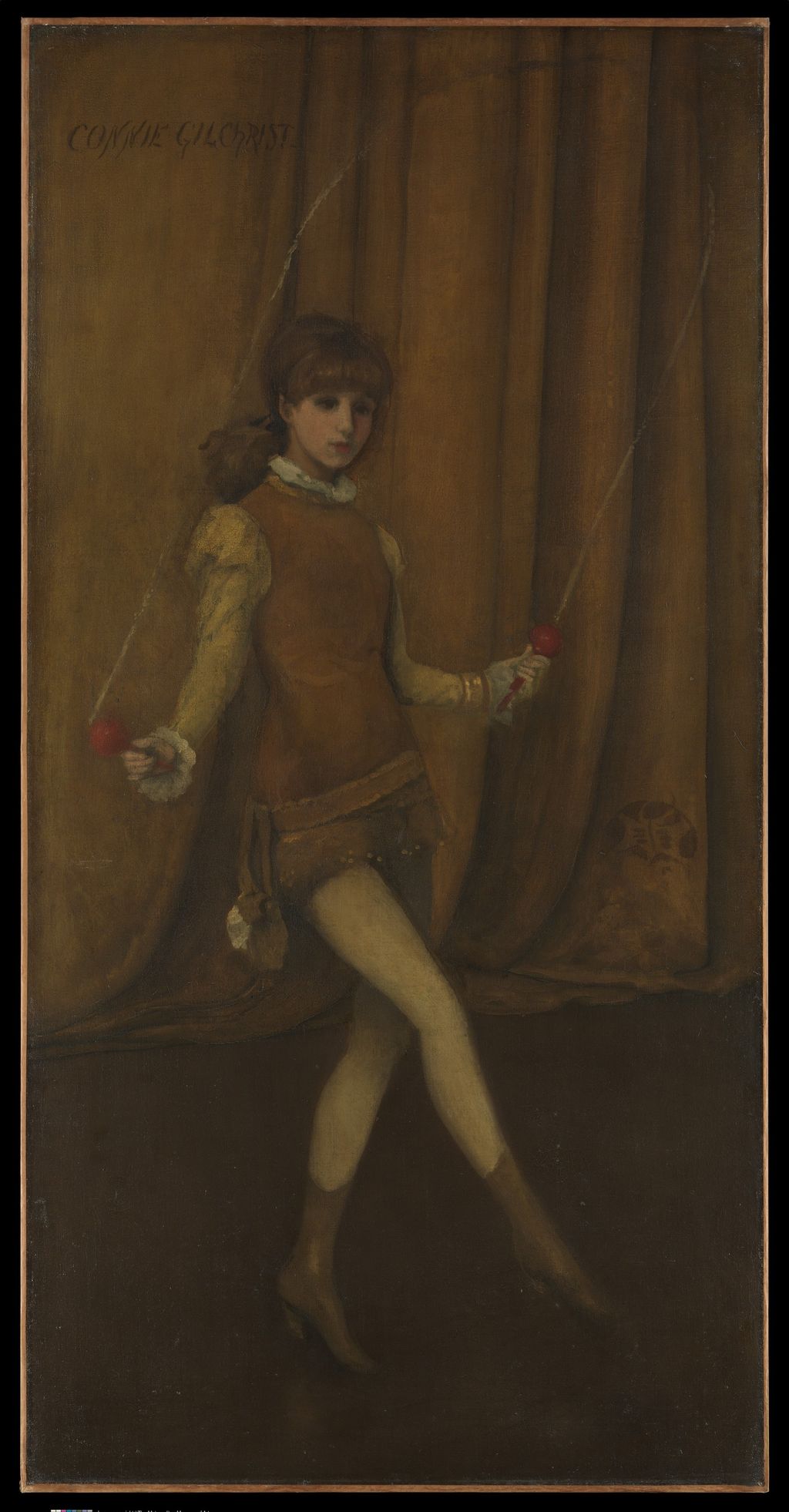
James McNeill Whistler, Harmony in Yellow and Gold: The Gold Girl—Connie Gilchrist, c. 1876–77. The Metropolitan Museum of Art. The Metropolitan Museum of Art, Gift of George A. Hearn, 1911. Image source. CC0 / Public domain. Resized proportionally.
From the Royal Academy to Guildhall
In 1878, the British fine art section of the Paris Universal Exposition showed The Music Lesson as number 136, lent by C. P. Matthews. The same catalogue lists Leighton’s Elijah and his portrait of Richard Francis Burton among the oils. The identification of the lender also places the picture in Charles Matthews’s collection well before his 1891 sale. It was with E. M. Denny by 1906. Another Leighton, Kittens, appears in both collections, and Christie’s has suggested that Denny may have bought the two works together. They eventually went to different owners. Lord Bearsted acquired The Music Lesson and presented it to Guildhall Art Gallery in 1925. [1] [13] [14]
Nearly a century after the gift, the canvas travelled to Forlì for the 2024 exhibition Preraffaelliti. Rinascimento moderno, where the Italian catalogue listed it as La lezione di musica. The early biographer Ernest Rhys urged readers to see the original because so much depended on its colour. It was already possible by 1906 to see the composition in Emilie Barrington’s illustrated life of Leighton. The monochrome plate brings out how the two sets of hands hold the whole picture together. In the oil painting there is also a change in colour right at that point. Against the gleam of the wood and the gold in the girl’s sleeve, Leighton makes the touch of the two hands easy to pick out from across the room. [1] [15] [16] [17]
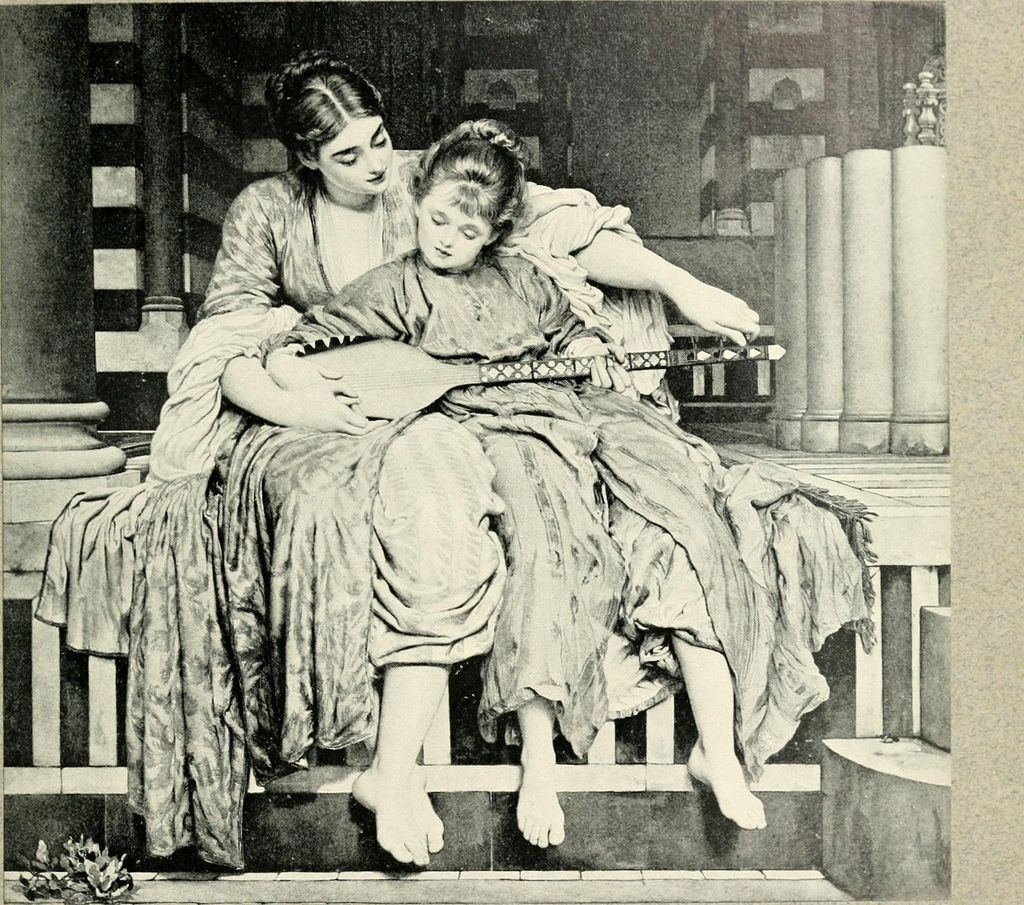
The Music Lesson as reproduced in Emilie Barrington’s life of Leighton, 1906. Image source. Public domain. Resized without changing the composition.
Browse Frederic Leighton’s artworks
Explore paintings, drawings, sculptures and prints, with separate rows for identified preparatory works, reproductions and casts.
| Name | Date | Medium |
|---|---|---|
| A Girl Feeding Peacocks | Exhibited 1863 | Painting Catalogue. |
| A Recognition from ‘Romola’, engraved by Swain (Tate N04054) | published 1862 | Print Catalogue. |
| A Roman Lady | 1859 | Painting Catalogue. |
| Abram and the Angel (Tate A00733) | published 1881 | Print Catalogue. |
| Acme and Septimius | Exhibited 1868 | Painting Catalogue. |
| An Athlete Wrestling with a Python (Tate exhibition bronze) | 1877 | Sculpture Catalogue. |
| And the Sea Gave Up the Dead Which Were in It (Tate N01511) | 1891–92 | Painting Catalogue. |
| Andromache in Captivity (photogravure after Leighton) | 1889 | Print Catalogue. |
| Athlete Wrestling with a Python (Anglesey Abbey cast) | model 1877; cast 1905 | Sculpture Catalogue. |
| Athlete Wrestling with a Python (Hood reduced cast) | 1877 (inscribed model date) | Sculpture Catalogue. |
| Athlete Wrestling with a Python (Saint Louis reduced cast) | 1877 (museum date) | Sculpture Catalogue. |
| Cain and Abel (Tate A00731) | published 1881 | Print Catalogue. |
| Captive Andromache | 1888 | Painting Catalogue. |
| Cimabue's Celebrated Madonna | 1853–55 | Painting Catalogue. |
| Cimon and Iphigenia, with Many Smaller Subjects (Tate T09061) | date not known | Drawing Catalogue. |
| Crenaia, the Nymph of the Dargle | Exhibited 1880 | Painting Catalogue. |
| Cymon and Iphigenia | 1884 | Painting Catalogue. |
| Daedalus and Icarus | 1869 | Painting Catalogue. |
| Dante in Exile | 1864 | Painting Catalogue. |
| Death of the First Born (Tate A00737) | published 1881 | Print Catalogue. |
| Electra at the Tomb of Agamemnon | c. 1869 | Painting Catalogue. |
| Eliezer and Rebekah (Tate A00735) | published 1881 | Print Catalogue. |
| Elijah in the Wilderness | 1877–78 | Painting Catalogue. |
| Fanny Kemble: A Study for ‘Jezebel and Ahab’ (Tate T08208) | c.1862 | Drawing Catalogue. |
| Figure Studies | Date not recorded | Drawing Catalogue. |
| Flaming June | 1895 | Painting Catalogue. |
| Gulnihal | Exhibited 1886 | Painting Catalogue. |
| Helios and Rhodes (Tate N03015) | date not known | Painting Catalogue. |
| Hercules Wrestling with Death for the Body of Alcestis | c. 1869–71 | Painting Catalogue. |
| Jonathan's Token to David | c. 1868 | Painting Catalogue. |
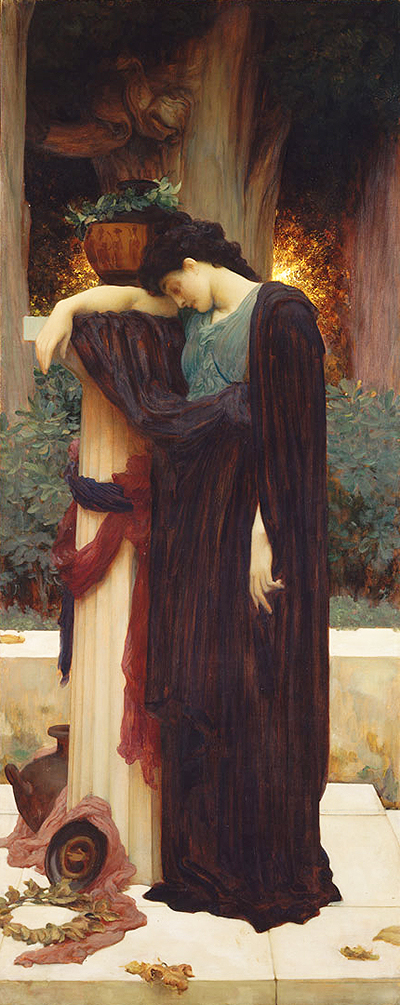
| Lachrymae | 1894–95 | Painting Catalogue. |
| Lieder ohne Worte | Exhibited 1861 | Painting Catalogue. |
| Light of the Harem | Exhibited 1880 | Painting Catalogue. |
| Moses Views the Promised Land (Tate A00736) | published 1881 | Print Catalogue. |
| Mrs James Guthrie | 1865 | Painting Catalogue. |
| Mrs John Hanson Walker (Tate N04731) | 1867 | Painting Catalogue. |
| Music Lesson | 1877 | Painting Catalogue. |
| Needless Alarms (Met cast) | modelled 1886; cast nineteenth century | Sculpture Catalogue. |
| Needless Alarms (Tate N05120) | 1886 | Sculpture Catalogue. |
| Pavonia | c. 1859 | Painting Catalogue. |
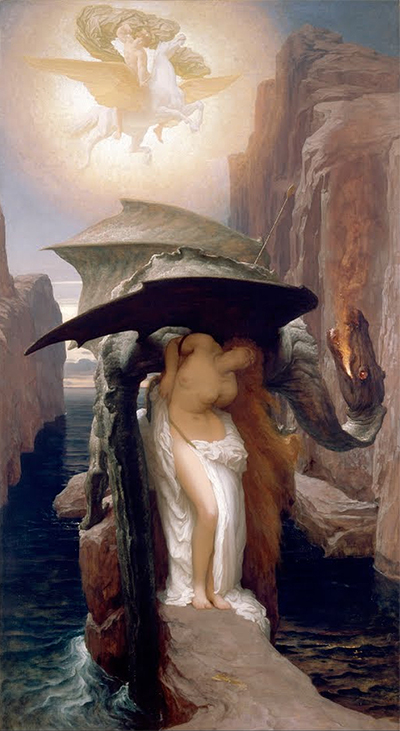
| Perseus and Andromeda | 1891 | Painting Catalogue. |
| Portrait of May Sartoris | c. 1860 | Painting Catalogue. |
| Preparing for a Festa, Florence (Tate T09062) | date not known | Drawing Catalogue. |
| Puerta de los Vientos, near Ronda, Spain (Tate N04006) | c.1886–9 | Painting Catalogue. |
| Samson and the Lions (Tate A00732) | published 1881 | Print Catalogue. |
| Samson at the Mill (Tate A00734) | published 1881 | Print Catalogue. |
| Samson Carrying the Gate (Tate A00738) | published 1881 | Print Catalogue. |
| Sketch for ‘An Athlete Wrestling with a Python’ (Tate N01761) | c.1877 | Sculpture Catalogue. |
| Sketches for Cimon and Iphigenia (Tate T09060) | date not known | Drawing Catalogue. |
| Study for The Return of Persephone (Demeter) | c. 1890–91 | Drawing Catalogue. |
| Study for The Return of Persephone (Persephone) | c. 1890–91 | Drawing Catalogue. |
| Study for ‘Needless Alarms’ (Tate N02945) | 1886 | Sculpture Catalogue. |
| Study for ‘The Discovery of Juliet Apparently Lifeless’ (Tate N01806) | c.1858 | Painting Catalogue. |
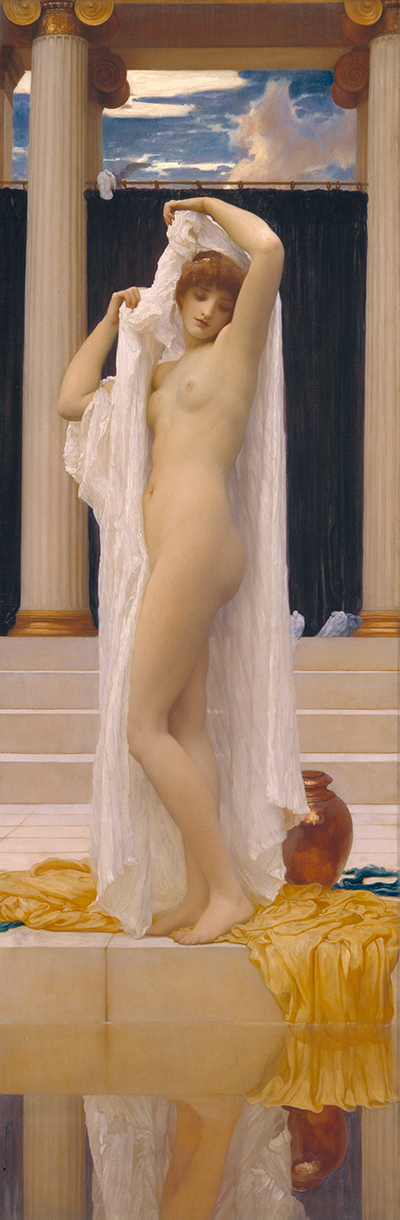
| The Bath of Psyche | Exhibited 1890 | Painting Catalogue. |
| The Daphnephoria | 1874–76 | Painting Catalogue. |
| The Death of Brunelleschi | 1852 | Painting Catalogue. |
| The Fisherman and the Siren | Exhibited 1858 | Painting Catalogue. |
| The Painter's Honeymoon | c. 1864 | Painting Catalogue. |
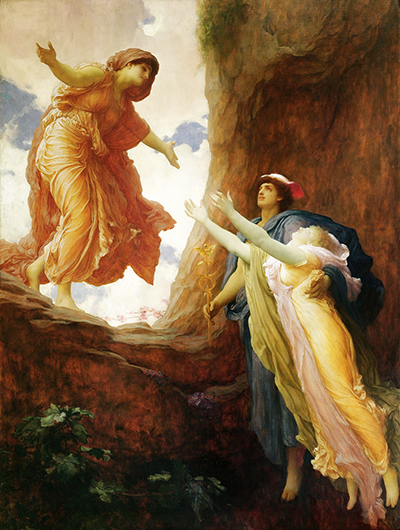
| The Return of Persephone | 1891 | Painting Leeds painting identified in the Met study record. |
| The Return of Persephone (preparatory oil) | c. 1890–91 | Painting Catalogue. |
| The Sluggard (Anglesey Abbey cast) | probably 1890–about 1906 | Sculpture Catalogue. |
| The Sluggard (Met cast) | modelled 1886; cast possibly before 1896 | Sculpture Catalogue. |
| The Sluggard (Museum Wales) | 1882–85 (museum date) | Sculpture Catalogue. |
| The Sluggard (Tate N01752) | 1885 | Sculpture Catalogue. |
| The Spies Escape (Tate A00730) | published 1881 | Print Catalogue. |
| Various Subjects (Tate T09063) | date not known | Drawing Catalogue. |
| View in Capri | Possibly 1859 | Painting Catalogue. |
| Wedded | 1882 | Painting Catalogue. |
| Winding the Skein | c. 1878 | Painting Catalogue. |
Discussion
Look again at the images and ideas explored in The Music Lesson. These editorial prompts invite your observations.
Reader Insights
Where does Leighton draw your eye along the saz?
How do the breadth of the steps and the pattern of the walls affect the small space the two figures share?
Join the Conversation
Share a detail, comparison or question about The Music Lesson below.
References
- Guildhall Art Gallery and London Picture Archive. The Music Lesson, 1877. Permanent collection accession 1039, medium, dimensions, reproduction and 1925 gift. View source.
- Algernon Graves. The Royal Academy of Arts: A Complete Dictionary of Contributors and Their Work, vol. V. 1906, p. 32, Royal Academy entries for 1877. View source.
- Caroline Arscott. The Music Lesson, in Victorians Decoded: Art and Telegraphy. 2016, catalogue entry T4, pp. 126–128. View source.
- Guildhall Art Gallery. Music Lesson. Partner collection interpretation on Google Arts & Culture. View source.
- Metropolitan Museum of Art. Saz, late 19th century. Turkish long-necked lute, accession 89.4.341. View source.
- Philharmonie de Paris, Musée de la musique. Le saz de Turquie. Instrument family and variation in size. View source.
- Melanie Gibson and Leighton House. Q&A: The Arab Hall at Leighton House. Construction, objects in the 1877 paintings, Sun Gleam and Damascus grape tiles. View source.
- Madeline Hewitson. The Little Girls of Orientalism: Frederic Leighton’s Study at a Reading Desk (1877). Journal of Victorian Culture 30, no. 2, 2025, pp. 193–210. Gilchrist, the two 1877 exhibits and London reception. View source.
- Metropolitan Museum of Art. James McNeill Whistler, Harmony in Yellow and Gold: The Gold Girl—Connie Gilchrist. Metropolitan Museum of Art accession 11.32. View source.
- Marte Stinis. Music as Aesthetic Paradigm: Frederic Leighton, Albert Moore, and James McNeill Whistler. University of York doctoral thesis, 2021, chapter 3, “Immersive Acoustic Spaces”, fig. 26 and discussion of Golden Hours. View source.
- Pera Museum. İki Müzisyen Kız. Turkish museum guide to Osman Hamdi Bey, including the 1880 painting. View source.
- Edhem Eldem. Crisscrossing between East and West: Osman Hamdi Bey. In Lucien de Guise, ed., Orientalist Paintings: Mirror or Mirage?, Islamic Arts Museum Malaysia, 2022. Comparison and limits of the evidence for direct influence. View source.
- Royal Commission for the Paris Exhibition. Paris Universal Exposition of 1878: Catalogue of the British Fine Art Section. Class I, no. 136, with C. P. Matthews as lender. View source.
- Christie’s. Frederic Leighton, Kittens. Lot essay, shared ownership history with The Music Lesson. View source.
- Fondazione Cassa dei Risparmi di Forlì. Preraffaelliti. Rinascimento moderno. 2024 exhibition press dossier and list of works, La lezione di musica. View source.
- Ernest Rhys. Frederic Lord Leighton: An Illustrated Record of His Life and Work. Chapter 5, account of the 1877 Royal Academy exhibition and the painting’s colour. View source.
- Emilie Barrington. The Life, Letters and Work of Frederic Leighton, vol. I. 1906, monochrome plate facing p. 214. View source.