 by Tom Gurney
Tom Gurney BSc (Hons) is an art history expert with over 20 years experience
Published on June 19, 2020 / Updated on November 29, 2026
Email: tomgurney1@gmail.com / Phone: +44 7429 011000
Perseus and Andromeda: Introduction
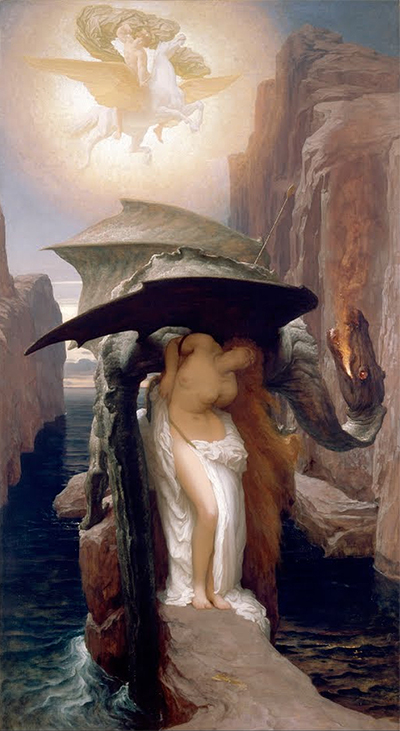
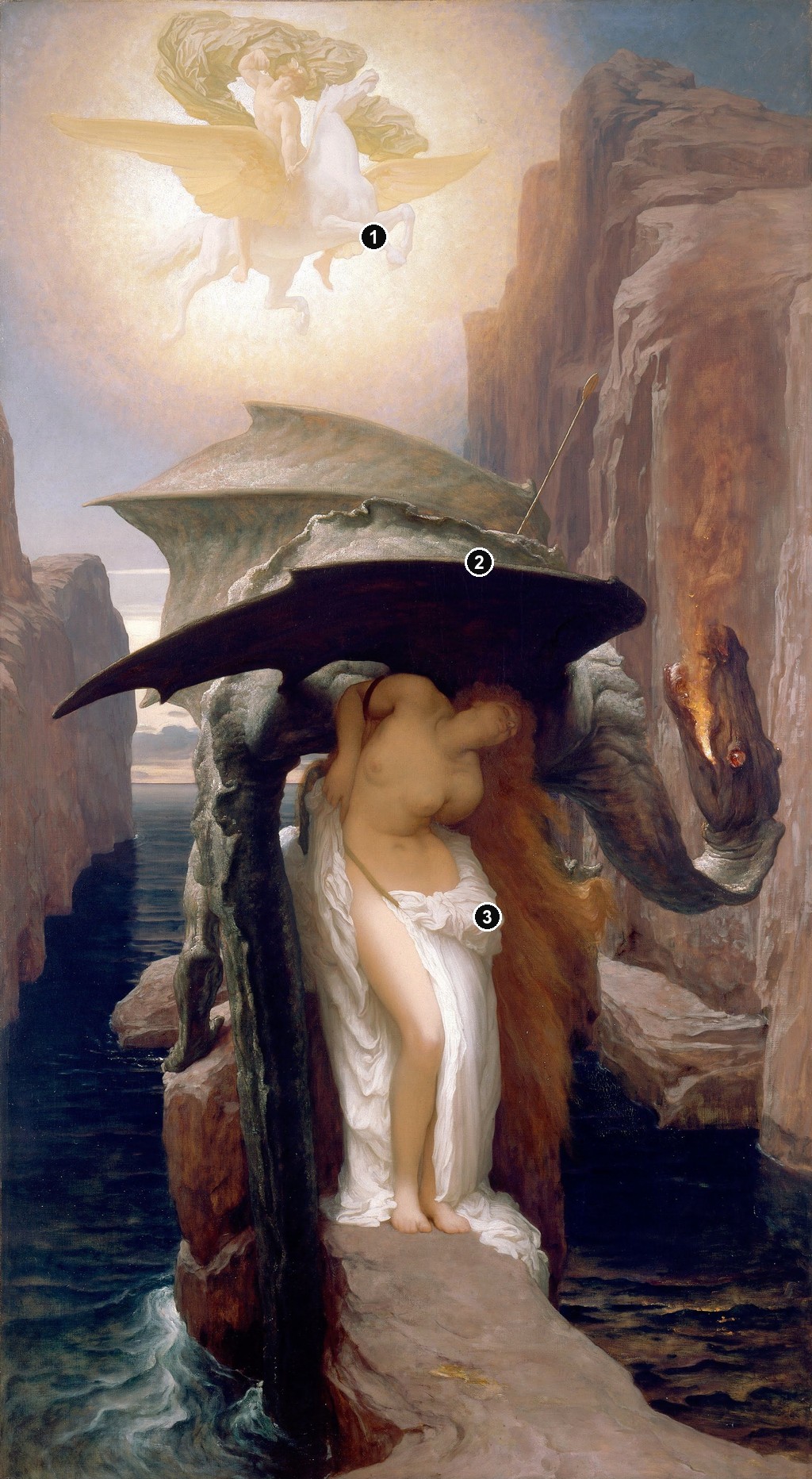
The arrow has already struck. High above the shore, Perseus rides a winged horse through a blaze of gold. Far below him, Andromeda twists against a rock as the wounded creature lifts its head towards its attacker. Frederic Leighton gives the rescuer the brightest light and the monster nearly all the foreground. We can see help coming and still feel how far away it is. Leighton exhibited the painting in 1891. The oil on canvas measures 235 cm high by 129.2 cm wide and belongs to the Walker Art Gallery in Liverpool, where it is catalogued as WAG 129. [1]
At a Glance
- Date1891
- MediumOil on canvas
- CollectionWalker Art Gallery, WAG 129
- Later comparisonPerseus on Pegasus, Leicester Museum and Art Gallery
This work across Frederic Leighton’s career
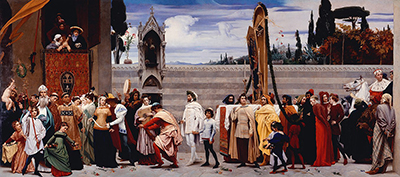
Cimabue’s Celebrated Madonna
1853–55Lachrymae
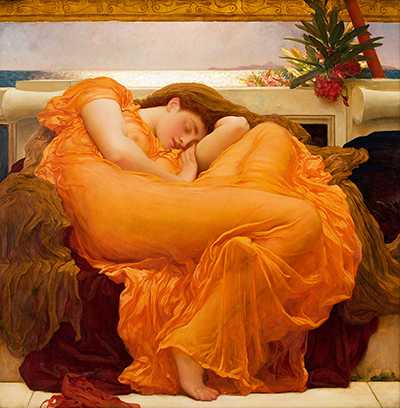
1894–95Flaming June
c. 1895Contents
- The instant after the arrow strikes
- The story Leighton changed
- Andromeda's body and the colour of her skin
- From the studio to the shore
- Perseus on Pegasus
- Exhibition and the journey to Liverpool
- Annotated details
The instant after the arrow strikes
At more than two metres tall, the picture gives the distance between the figures an almost physical presence. Andromeda's body cuts across the dark rocks in a long diagonal. The curve of her neck carries the eye towards the dragon, whose head then turns the gaze upwards towards Perseus. The gilded light around the rider draws the eye straight to the top, yet Andromeda herself looks around without seeing him. The creature still has her in its grip. The Walker identifies the slim shaft lodged in the dragon's body as the arrow Perseus has just fired. Its size in relation to the animal makes the extent of the injury hard to judge. [1] [2]
The wings tell much of the story. Pegasus has orderly ranks of feathers, sharpened by the light behind him. The dragon spreads a dark membrane over Andromeda, making the shadow above her seem almost as solid as the rock beneath her feet. Art historian Caitlin Silberman draws attention to the contrast between the birdlike wings above and the batlike wings below. The dragon looks anchored to the shore by the weight of its coils. Leighton's palette keeps the two halves in conversation. The brilliance around the rider has an answering flare at the dragon's mouth, and blue water shows through the rocks below the pale figure. [1] [2]
Annotated Details from Perseus and Andromeda
The numbered points identify visible features discussed in this article. Return from each detail to the numbered overview. Each caption identifies the work shown.
Perseus and Andromeda
Frederic Leighton, Perseus and Andromeda, 1891. Walker Art Gallery. Image source. Public domain. Resized without changing the composition.
Perseus on Pegasus
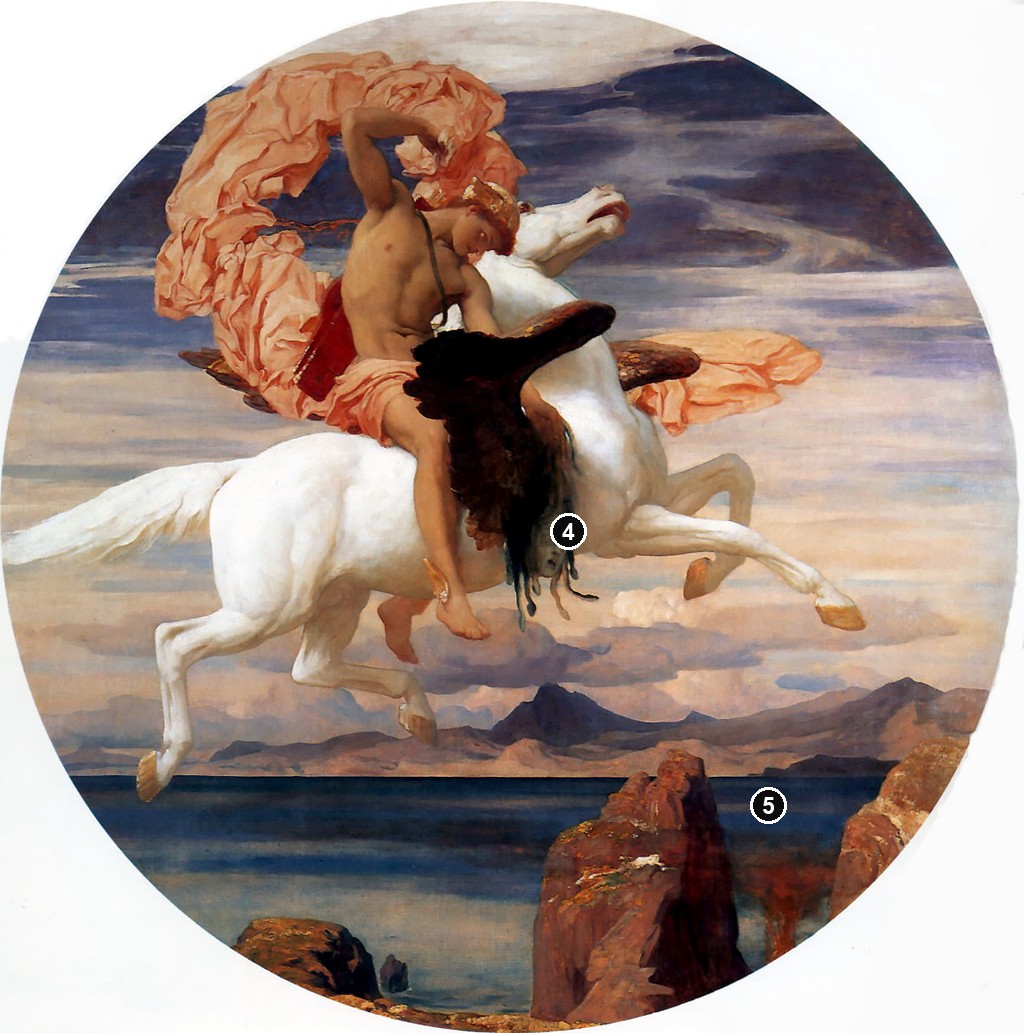
Frederic Leighton, Perseus, on Pegasus, Hastening to the Rescue of Andromeda, c. 1896. Leicester Museum and Art Gallery. Image source. Public domain. Resized without changing the composition.
Details from PERSEUS AND ANDROMEDA
Compare the cropped details with the source images above. Notice how their colours, shapes and positions contribute to the larger compositions.
Perseus and Andromeda
Perseus in the light
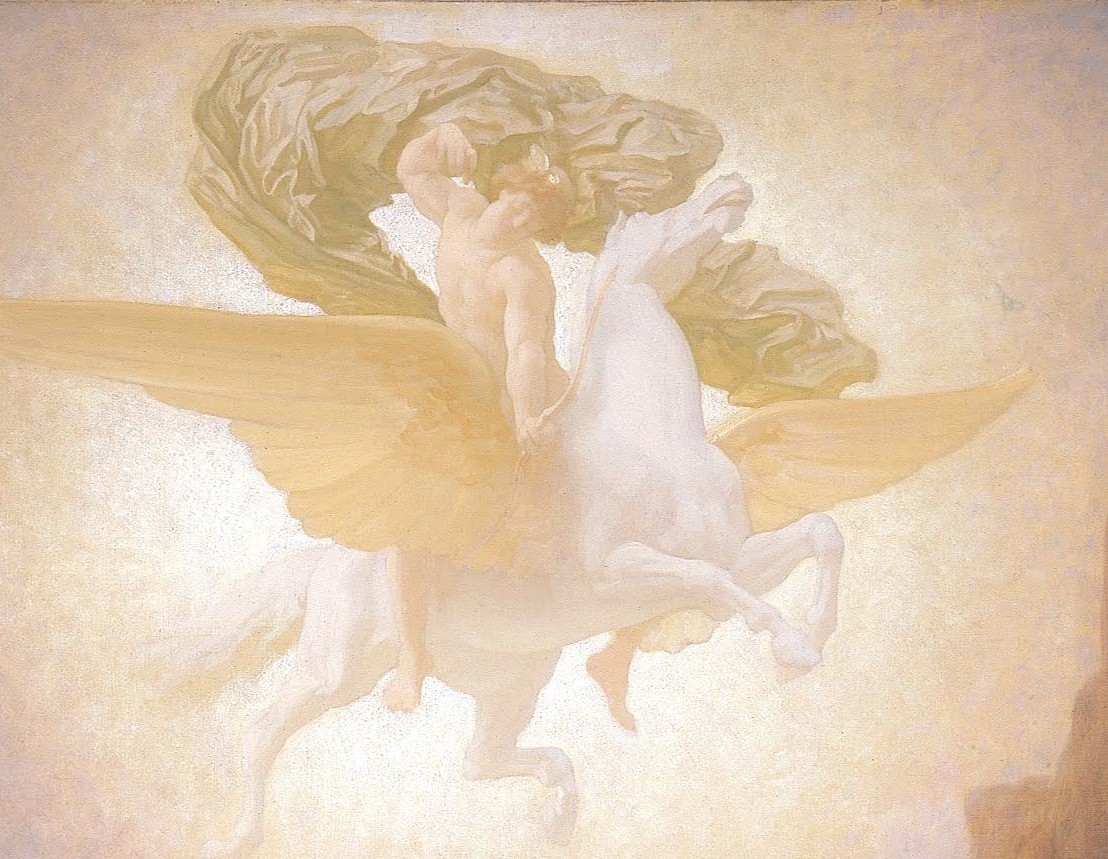
Perseus and his horse stand out against the brightness at the top of the canvas. The air and the steep drop beneath them emphasise their height.
The monster’s spread wings
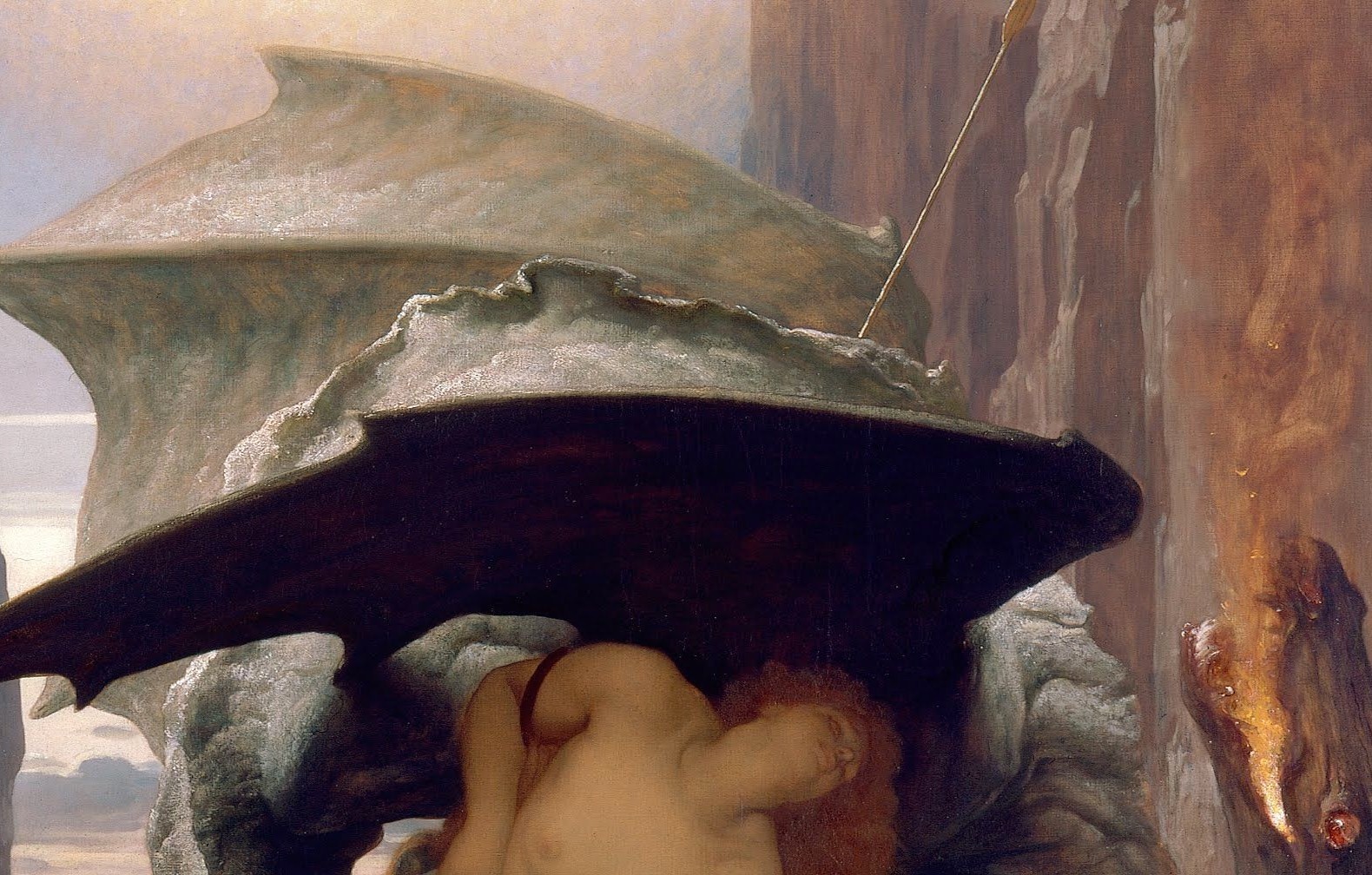
One dark wing stretches across the upper part of the rocky scene. Its shaded membrane contrasts with the feathers of the horse higher up.
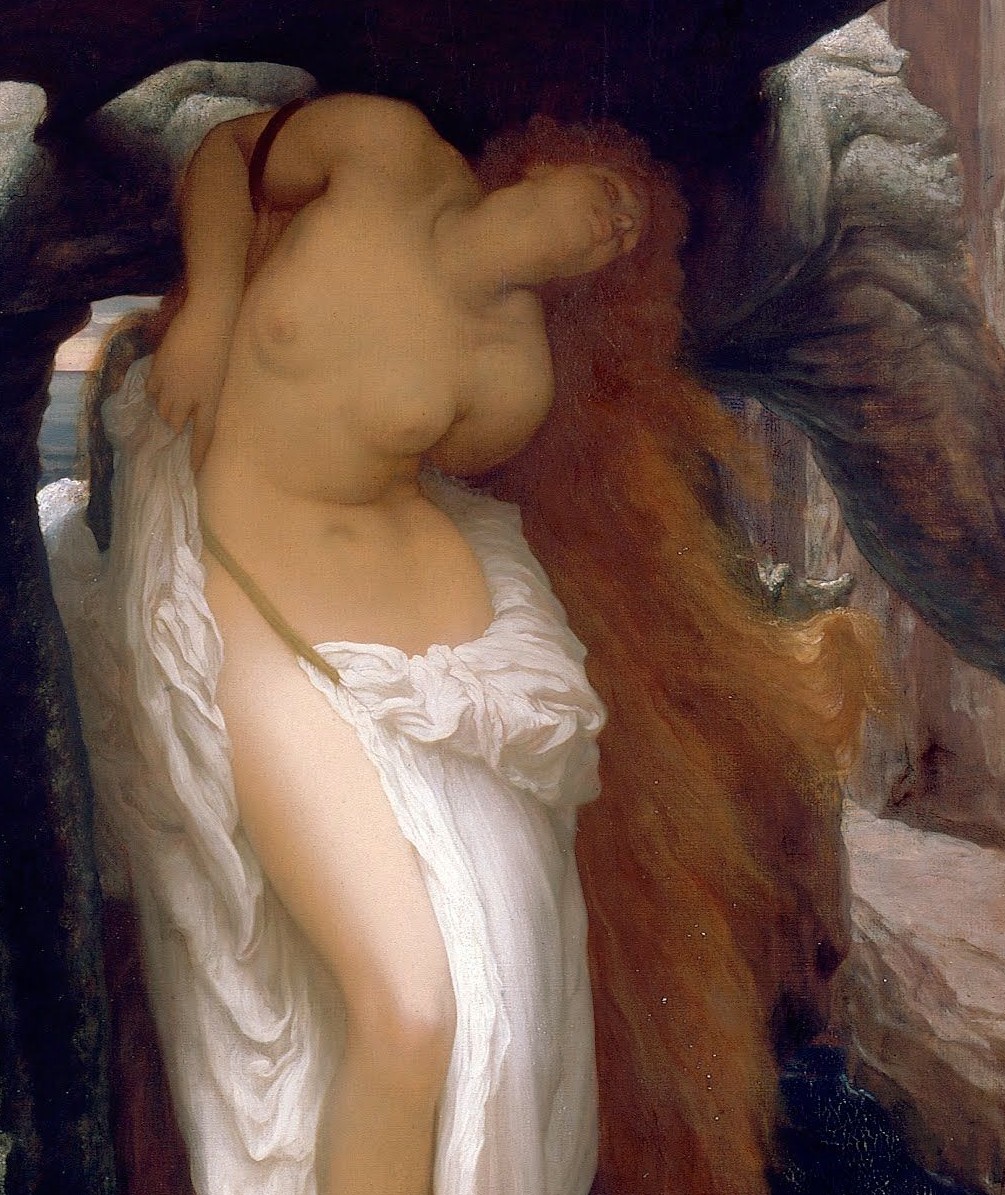
Andromeda below the wing
Andromeda turns beneath the dark wing. Her pale figure is framed on three sides by shadow, scales and rock.
Perseus on Pegasus
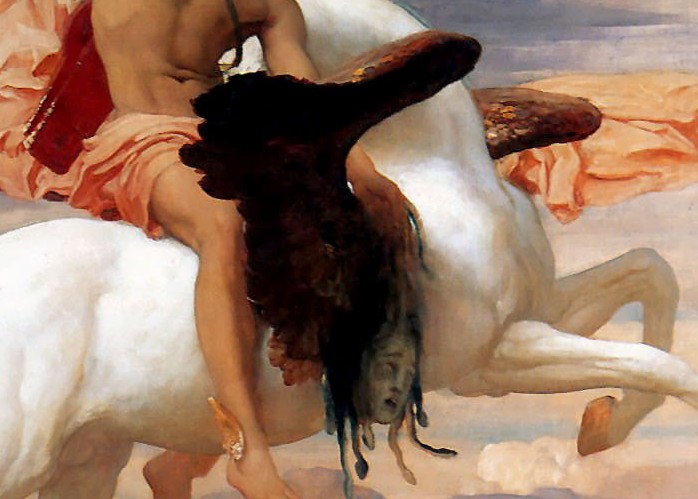
Head of Medusa
The large shape of Pegasus carries the rider across the picture. Medusa’s face and dark hanging hair are visible below his arm.
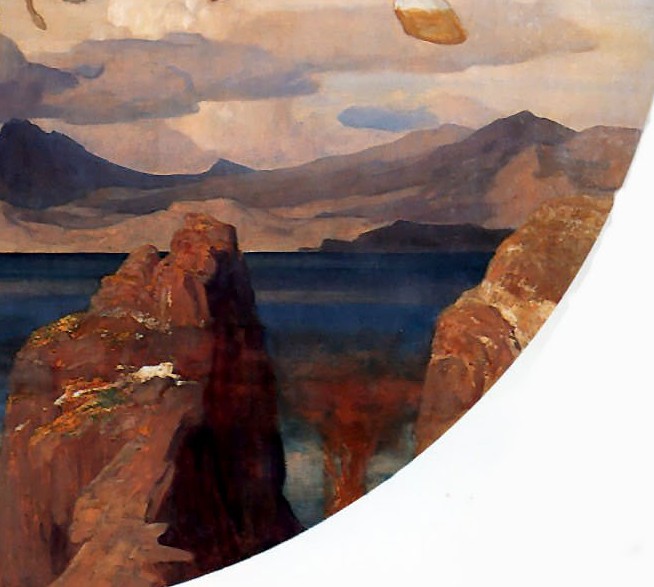
The sea and the rocks
The land and dark sea beneath the horse place its white legs against strong bands of colour. The rocks approach the edge of the painted circle.
The story Leighton changed
In the mythographer Apollodorus's Library, Andromeda’s mother, Cassiopeia, boasts that she surpasses the sea nymphs known as the Nereids in beauty. Poseidon answers their anger by sending a flood and a sea monster against the kingdom of Cepheus. An oracle says that the danger will end if Cepheus exposes his daughter Andromeda to the monster. Perseus finds her fastened to a rock on his way back from killing Medusa. He secures her father's promise of marriage before killing the creature and releasing her. Later, when her former betrothed Phineus plots against him, Perseus uses Medusa's head to turn the conspirators to stone. The Library leaves the method of killing the monster unspecified. [3]
Ovid's Metamorphoses gives the battle a different rhythm from Leighton's canvas. Perseus flies in winged sandals. He sees Andromeda and takes her for marble until her hair moves in the wind and he notices her tears. When the creature comes, he draws its attention with his shadow on the water, descends onto its back and strikes with a curved sword. As his wings grow heavy with spray and blood, he braces himself on a rock to finish the fight. The head of Medusa comes into play once more when he lays it on sea plants, which harden into coral. [4]
The winged horse was already familiar in art about the rescue. In Lorenzo Loli's seventeenth-century etching after Giovanni Andrea Sirani, now in the Rijksmuseum, Pegasus carries Perseus towards the chained figure and the monster. Leighton uses the horse to keep the hero airborne and gives him a bow, so the distance between the two combatants becomes part of the action. The Walker's catalogue describes Perseus as carrying Medusa's head. The embedded arrow supplies the visible sign of his intervention, while the beast's upturned head leaves the outcome in suspense. [1] [4] [5]
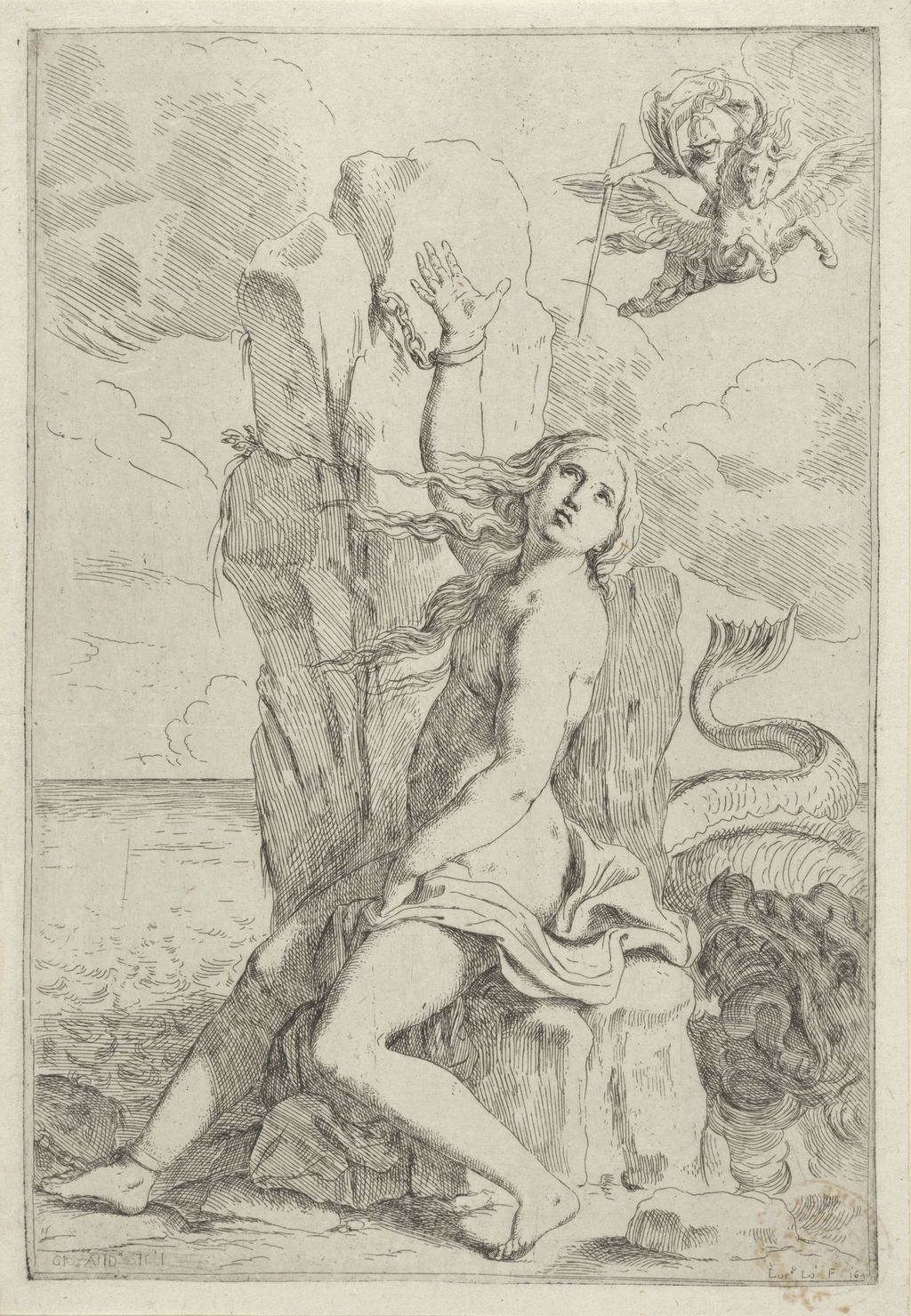
Lorenzo Loli, after Giovanni Andrea Sirani, Perseus and Andromeda, seventeenth century. Rijksmuseum. Image source. Public domain. Resized without changing the composition.
Andromeda's body and the colour of her skin
Ovid's momentary confusion between flesh and marble offers a way into Leighton's treatment of Andromeda. Her skin is pale against both the stone and the dragon's scales, but the twist of her torso and the fall of her hair give the figure a sense of strain. Keren Rosa Hammerschlag identifies Dorothy Dene as the model and reads the pose in relation to antique statues of Venus. The wings, folds and coils partly conceal Andromeda's bound arms, leaving her torso in view and making it easy to see why the figure has been compared to an armless marble. Hammerschlag also connects the woman's long, curling hair with the serpentine hair of Medusa in Leighton's later treatment of the story. [1] [4] [6]
There is another kind of distance between the picture and the classical texts. Both the Library and the Metamorphoses place Andromeda in ancient Aethiopia, a name whose historical usage extends beyond today's national borders. In the fifteenth letter of the Heroides, transmitted under Ovid's name, Sappho invokes Andromeda as a dark-complexioned woman whose beauty won Perseus. The artist and scholar Kimathi Donkor draws attention to the gap between that textual tradition and the fair skin given to Andromeda in many European paintings. Ovid signals life through hair and tears. Donkor asks readers to take the texts about her complexion just as seriously as the familiar image of the woman on the rock. [3] [4] [7] [8]
From the studio to the shore
The Russell-Cotes Art Gallery and Museum in Bournemouth holds Leighton's preparatory oil, Study for ‘Perseus and Andromeda’ (BORGM 01295). Its collection record distinguishes it from the Liverpool painting and records that Merton Russell-Cotes bought the study from Leighton at his studio home around 1892. An early biography by Emilie Barrington reproduces a separate study for Andromeda dated 1890 and an illustration from a clay sketch for Perseus dated 1891. The Royal Academy's posthumous exhibition of 1897 listed still more evidence of the work behind the canvas, including a chalk sheet with studies for three paintings and a bronze sketch model for the figures in Perseus and Andromeda. These records reach beyond the oil study to preparations concerned with a single body, a pose or a group in three dimensions. [9] [10] [11]
Leighton studied real coastlines for the imaginary scene. The catalogue of his 1896 studio sale identifies a work called Rocks, Malin Head, Donegal as a landscape study for Perseus and Andromeda. Art historian Pola Durajska likewise connects the Liverpool painting to Leighton's studies of the rocky Irish coast. The link gives the setting an origin without fixing the myth on a map. In the canvas, the rock serves at once as coastline, the place of sacrifice and the hard backing against which every twist of Andromeda's body reads. [1] [12] [13]
Perseus on Pegasus
The related painting in Leicester, Perseus, on Pegasus, Hastening to the Rescue of Andromeda, dates from around 1896 and takes up an earlier point in the action. Leicester Museums calls attention to Medusa's head in the rider's grasp, its snakes visible as he flies towards the scene. In Liverpool the eye has to travel past rocks, coils and wings to find the airborne figure. The rider and the head are large enough in the circular Leicester painting to make out the expression on Medusa’s face. When the Leicester canvas went on loan to the Musée des Beaux-Arts de Caen in 2023, both paintings appeared in Cécile Legrand’s illustrated study of Medusa, in sections on Pegasus and the aftermath of Medusa’s death. The Liverpool picture delays the relief of rescue. The later work lingers on the unsettling object the hero carries with him. [1] [6] [14] [15]
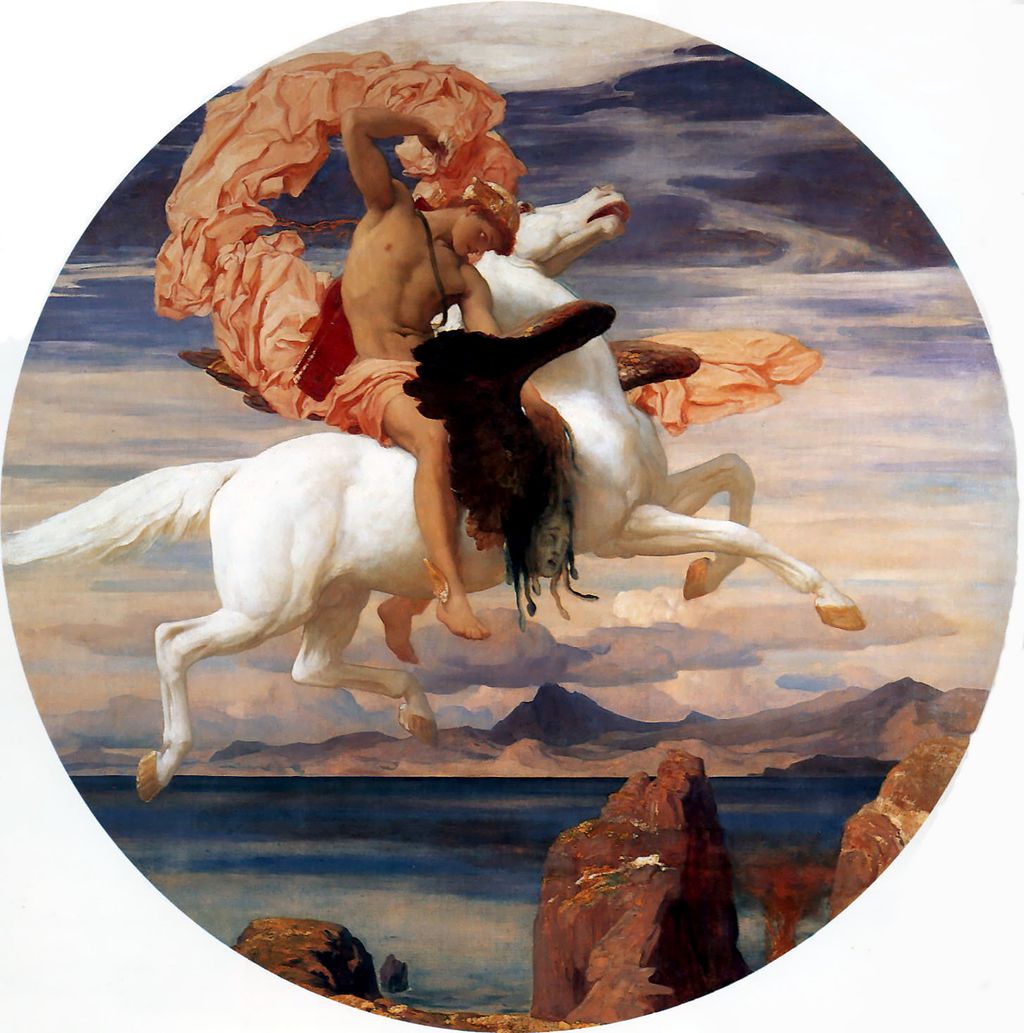
Frederic Leighton, Perseus, on Pegasus, Hastening to the Rescue of Andromeda, c. 1896. Leicester Museum and Art Gallery. Image source. Public domain. Resized without changing the composition.
Exhibition and the journey to Liverpool
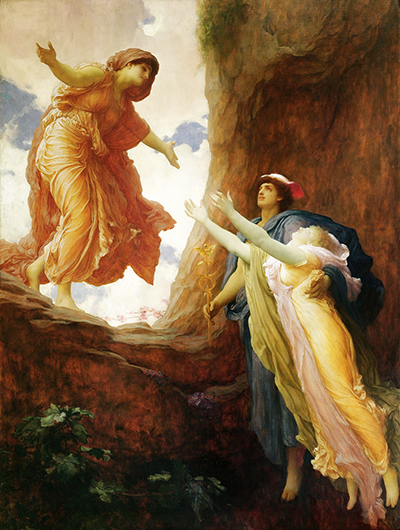
Leighton was president of the Royal Academy when he showed Perseus and Andromeda in 1891 alongside The Return of Persephone. The critic in The Theatre singled out the execution of the rescue scene as coarse by Leighton's standards and preferred Persephone. A few years later, Ernest Rhys remembered the brilliance of the rescue, especially its pool of deep blue water and the glow around the figures. The two accounts show how differently early viewers responded to the picture’s emphatic contrasts. [1] [11] [16] [17]
An 1892 photogravure issued by the Berlin Photographic Company carried the design into print. The canvas itself travelled to Chicago, where the 1893 World’s Columbian Exposition listed it in the British fine arts section. [18] [19] At Leighton's posthumous studio sale in July 1896, the two Perseus canvases appeared under separate lot numbers. The Walker records that Arthur Tooth & Sons acquired the 1891 painting at that sale. The firm lent it to the Academy's 1897 retrospective and to the St Louis exposition in 1904, where the later Leicester canvas appeared as a separate loan under a title that mentions Medusa's head. Liverpool dealers Grindley and Palmer subsequently sold the 1891 work to Sir William Pickles Hartley, who presented it to the Walker on 21 August 1909. [1] [11] [12] [20]
In 2015 the Walker lent the painting to Pre-Raphaelite and Romantic Painting at the Nagoya City Art Museum. The Japanese exhibition’s Bunkamura guide placed the rescue alongside the legend of Saint George, England’s patron saint, to explain the appeal of chivalric heroism to Victorian audiences. Leighton makes the hero visible from across the room, then gives the viewer a captive who has yet to see him. [1] [21] [22]
Browse Frederic Leighton’s artworks
Explore paintings, drawings, sculptures and prints, with separate rows for identified preparatory works, reproductions and casts.
| Name | Date | Medium |
|---|---|---|
| A Girl Feeding Peacocks | Exhibited 1863 | Painting Catalogue. |
| A Recognition from ‘Romola’, engraved by Swain (Tate N04054) | published 1862 | Print Catalogue. |
| A Roman Lady | 1859 | Painting Catalogue. |
| Abram and the Angel (Tate A00733) | published 1881 | Print Catalogue. |
| Acme and Septimius | Exhibited 1868 | Painting Catalogue. |
| An Athlete Wrestling with a Python (Tate exhibition bronze) | 1877 | Sculpture Catalogue. |
| And the Sea Gave Up the Dead Which Were in It (Tate N01511) | 1891–92 | Painting Catalogue. |
| Andromache in Captivity (photogravure after Leighton) | 1889 | Print Catalogue. |
| Athlete Wrestling with a Python (Anglesey Abbey cast) | model 1877; cast 1905 | Sculpture Catalogue. |
| Athlete Wrestling with a Python (Hood reduced cast) | 1877 (inscribed model date) | Sculpture Catalogue. |
| Athlete Wrestling with a Python (Saint Louis reduced cast) | 1877 (museum date) | Sculpture Catalogue. |
| Cain and Abel (Tate A00731) | published 1881 | Print Catalogue. |
| Captive Andromache | 1888 | Painting Catalogue. |
| Cimabue's Celebrated Madonna | 1853–55 | Painting Catalogue. |
| Cimon and Iphigenia, with Many Smaller Subjects (Tate T09061) | date not known | Drawing Catalogue. |
| Crenaia, the Nymph of the Dargle | Exhibited 1880 | Painting Catalogue. |
| Cymon and Iphigenia | 1884 | Painting Catalogue. |
| Daedalus and Icarus | 1869 | Painting Catalogue. |
| Dante in Exile | 1864 | Painting Catalogue. |
| Death of the First Born (Tate A00737) | published 1881 | Print Catalogue. |
| Electra at the Tomb of Agamemnon | c. 1869 | Painting Catalogue. |
| Eliezer and Rebekah (Tate A00735) | published 1881 | Print Catalogue. |
| Elijah in the Wilderness | 1877–78 | Painting Catalogue. |
| Fanny Kemble: A Study for ‘Jezebel and Ahab’ (Tate T08208) | c.1862 | Drawing Catalogue. |
| Figure Studies | Date not recorded | Drawing Catalogue. |
| Flaming June | 1895 | Painting Catalogue. |
| Gulnihal | Exhibited 1886 | Painting Catalogue. |
| Helios and Rhodes (Tate N03015) | date not known | Painting Catalogue. |
| Hercules Wrestling with Death for the Body of Alcestis | c. 1869–71 | Painting Catalogue. |
| Jonathan's Token to David | c. 1868 | Painting Catalogue. |
| Lachrymae | 1894–95 | Painting Catalogue. |
| Lieder ohne Worte | Exhibited 1861 | Painting Catalogue. |
| Light of the Harem | Exhibited 1880 | Painting Catalogue. |
| Moses Views the Promised Land (Tate A00736) | published 1881 | Print Catalogue. |
| Mrs James Guthrie | 1865 | Painting Catalogue. |
| Mrs John Hanson Walker (Tate N04731) | 1867 | Painting Catalogue. |
| Music Lesson | 1877 | Painting Catalogue. |
| Needless Alarms (Met cast) | modelled 1886; cast nineteenth century | Sculpture Catalogue. |
| Needless Alarms (Tate N05120) | 1886 | Sculpture Catalogue. |
| Pavonia | c. 1859 | Painting Catalogue. |
| Perseus and Andromeda | 1891 | Painting Catalogue. |
| Portrait of May Sartoris | c. 1860 | Painting Catalogue. |
| Preparing for a Festa, Florence (Tate T09062) | date not known | Drawing Catalogue. |
| Puerta de los Vientos, near Ronda, Spain (Tate N04006) | c.1886–9 | Painting Catalogue. |
| Samson and the Lions (Tate A00732) | published 1881 | Print Catalogue. |
| Samson at the Mill (Tate A00734) | published 1881 | Print Catalogue. |
| Samson Carrying the Gate (Tate A00738) | published 1881 | Print Catalogue. |
| Sketch for ‘An Athlete Wrestling with a Python’ (Tate N01761) | c.1877 | Sculpture Catalogue. |
| Sketches for Cimon and Iphigenia (Tate T09060) | date not known | Drawing Catalogue. |
| Study for The Return of Persephone (Demeter) | c. 1890–91 | Drawing Catalogue. |
| Study for The Return of Persephone (Persephone) | c. 1890–91 | Drawing Catalogue. |
| Study for ‘Needless Alarms’ (Tate N02945) | 1886 | Sculpture Catalogue. |
| Study for ‘The Discovery of Juliet Apparently Lifeless’ (Tate N01806) | c.1858 | Painting Catalogue. |
| The Bath of Psyche | Exhibited 1890 | Painting Catalogue. |
| The Daphnephoria | 1874–76 | Painting Catalogue. |
| The Death of Brunelleschi | 1852 | Painting Catalogue. |
| The Fisherman and the Siren | Exhibited 1858 | Painting Catalogue. |
| The Painter's Honeymoon | c. 1864 | Painting Catalogue. |
| The Return of Persephone | 1891 | Painting Leeds painting identified in the Met study record. |
| The Return of Persephone (preparatory oil) | c. 1890–91 | Painting Catalogue. |
| The Sluggard (Anglesey Abbey cast) | probably 1890–about 1906 | Sculpture Catalogue. |
| The Sluggard (Met cast) | modelled 1886; cast possibly before 1896 | Sculpture Catalogue. |
| The Sluggard (Museum Wales) | 1882–85 (museum date) | Sculpture Catalogue. |
| The Sluggard (Tate N01752) | 1885 | Sculpture Catalogue. |
| The Spies Escape (Tate A00730) | published 1881 | Print Catalogue. |
| Various Subjects (Tate T09063) | date not known | Drawing Catalogue. |
| View in Capri | Possibly 1859 | Painting Catalogue. |
| Wedded | 1882 | Painting Catalogue. |
| Winding the Skein | c. 1878 | Painting Catalogue. |
Discussion
Look again at the images and ideas explored in Perseus and Andromeda. These editorial prompts invite your observations.
Reader Insights
How do the two kinds of wings divide the action?
What does the later circular painting make easier to see?
Join the Conversation
Share a detail, comparison or question about Perseus and Andromeda below.
References
- National Museums Liverpool, Perseus and Andromeda, Walker Art Gallery, WAG 129. View source.
- Caitlin Silberman, Thinking with Birds in British Art and Visual Culture, 1840–1900, University of Wisconsin–Madison, 2017, pp. 28–30 and 81–82. View source.
- Pseudo-Apollodorus, The Library, 2.4.2–3, translated by James George Frazer. View source.
- Ovid, Metamorphoses, Book IV, lines 663–752, translated by Brookes More. View source.
- Rijksmuseum, Lorenzo Loli after Giovanni Andrea Sirani, Perseus en Andromeda, RP-P-OB-36.387. View source.
- Keren Rosa Hammerschlag, “Excavating Evidence from Frederic Leighton's Paintings of the Female Nude,” Victorian Studies 56, no. 3, 2014, pp. 452–456. View source.
- Ovid, attributed, Heroides, 15.35–38, Latin text edited by Rudolf Ehwald. View source.
- Kimathi Donkor, “Africana Andromeda: Contemporary Painting and the Classical Black Figure,” in Classicisms in the Black Atlantic, 2020, pp. 163–194. View source.
- Russell-Cotes Art Gallery and Museum, Study for ‘Perseus and Andromeda’, BORGM 01295. View source.
- Emilie Barrington, The Life, Letters and Work of Frederic Leighton, vol. II, 1906, illustrations 48–49. View source.
- Royal Academy of Arts, Exhibition of Works by the Late Lord Leighton of Stretton, 1897, nos. 32, 63, 250 and 322. View source.
- Christie, Manson & Woods, Catalogue of the Remaining Works and the Collection of Ancient & Modern Pictures and Water-Colour Drawings of the Late Right Honorable Lord Leighton of Stretton, P.R.A., July 1896, lots 87, 115 and 117. View source.
- Pola Durajska, Nature, Science, and Myth in the Landscape Art of Frederic Leighton, University of York, 2021, vol. I, p. 79. View source.
- Leicester Museums and Galleries, “Art Loan: Perseus, on Pegasus,” 21 April 2023. View source.
- Cécile Legrand, Méduse, ou le danger de la pétrification, Caen, 2023, illustrations 15 and 18. View source.
- The Theatre, “Art Notes: Royal Academy,” 1 July 1891, p. 41. View source.
- Ernest Rhys, Frederic Lord Leighton: An Illustrated Record of His Life and Work, 1898, pp. 58–60 and Appendix I. View source.
- Christie’s, Perseus and Andromeda, photogravure after Frederic Leighton, 1892, lot 72. View source.
- World's Columbian Exposition, Official Catalogue of Exhibits, Part X, Fine Arts, 1893, British section, no. 276. View source.
- Universal Exposition, St Louis, Official Catalogue of Exhibitors, 1904, British oil paintings, nos. 149–150. View source.
- Nagoya City Art Museum, annual report for fiscal 2015, Pre-Raphaelite and Romantic Painting, exhibition checklist, no. 27. View source.
- Bunkamura Museum of Art, Pre-Raphaelite and Romantic Painting, selected works guide, section two. View source.