 by Tom Gurney
Tom Gurney BSc (Hons) is an art history expert with over 20 years experience
Published on June 19, 2020 / Updated on November 29, 2026
Email: tomgurney1@gmail.com / Phone: +44 7429 011000
Light of the Harem: Introduction
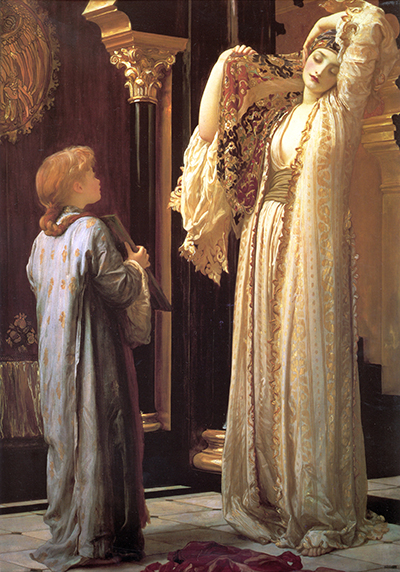
A woman raises a patterned scarf to her head while a girl steadies a mirror for her. The mirror turns towards the woman, leaving her reflection to her alone. Frederic Leighton builds a tall painting around that small difference in what each person can see. In 1880 the Royal Academy hung it in Gallery III at Burlington House as no. 256, The light of the hareem. The oil on canvas measures 152.4 by 83.8 centimetres and is recorded in a private collection. [1] [2] [3]
At a Glance
- ExhibitedRoyal Academy, 1880, no. 256
- Historical spellingThe light of the hareem
- MediumOil on canvas
- CollectionPrivate collection
This work across Frederic Leighton’s career
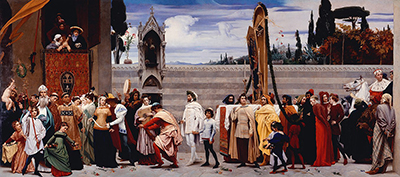
Cimabue’s Celebrated Madonna
1853–55Light of the Harem (current article)
Exhibited 1880 [1]Lachrymae
1894–95Flaming June
c. 1895Contents
- A room built around a gesture
- From a drawing to the wall at South Kensington
- The girl with the mirror
- What the title asks the viewer to imagine
- Leighton's studio and the painting's later record
- Annotated details
A room built around a gesture
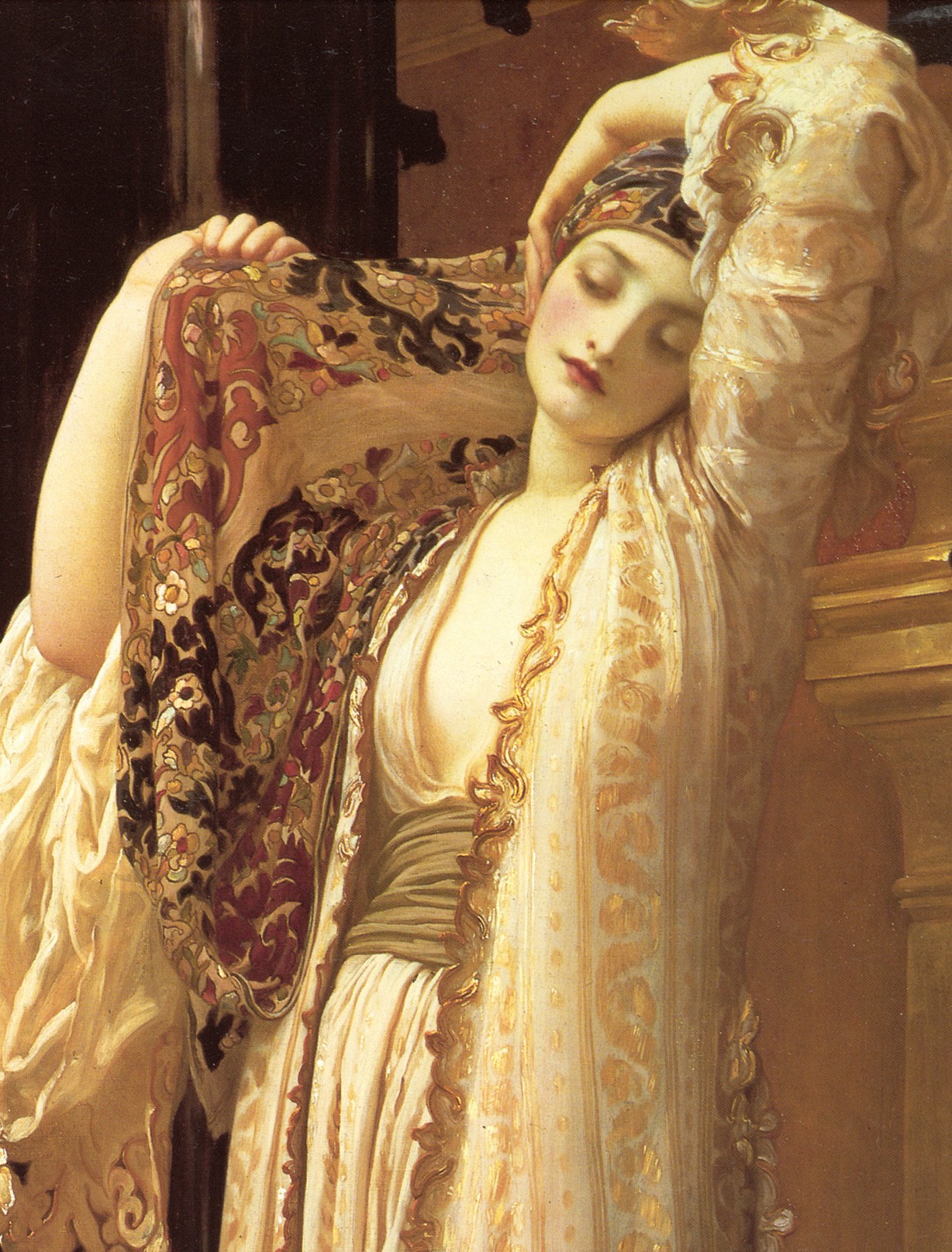
The woman seems to take up almost the entire height of the canvas. One sleeve balloons above her head as she adjusts the scarf, while the other falls from her lifted forearm in a mass of pale folds. The dark, patterned cloth stretches between her hands, its reds and golds coming forward against the shadow. Her face, tilted down into the light, sits between the curve of her arm and the heavy edge of the fabric. Follow the line from her head to her feet and the paint changes from smooth flesh to gleaming embroidery and finally to the crumpled cloth at floor level. There is enough weight in those folds to make the raised arms feel suspended for only a moment. [2]
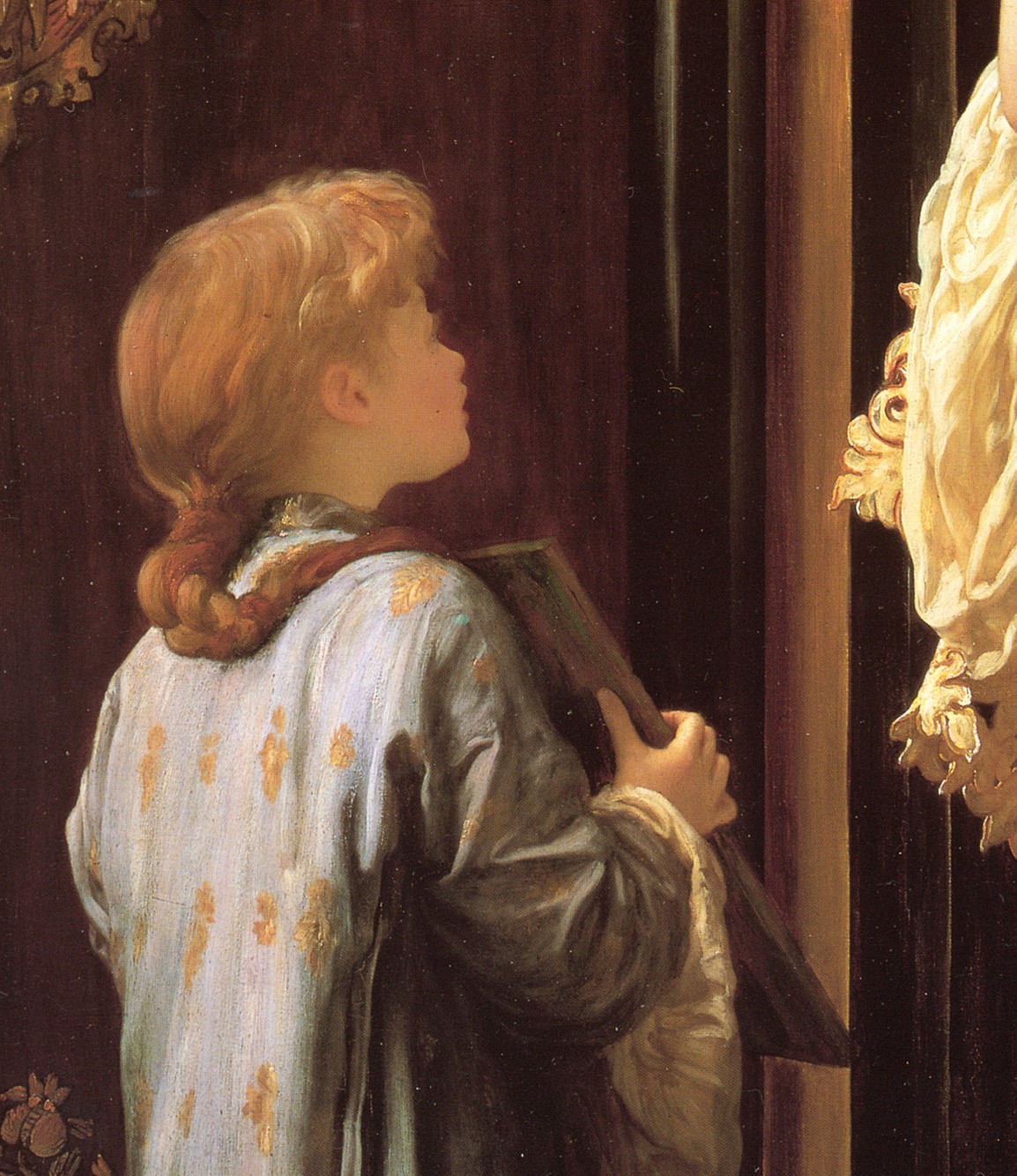
The girl's blue-grey coat is quieter, but its gold motifs answer the brighter gold opposite. Leighton turns her back towards the viewer so that her coat falls in a broad, unbroken surface. The turn of her cheek and the curve of her braid set off the heavier folds below. Her forearms draw in close to carry the mirror, whose dark diagonal is easy to miss. It makes a directional line from the girl's hands towards the woman, giving purpose to a pose that would otherwise look like simple admiration. The unequal height of the figures helps the eye climb from the girl to the raised scarf and descend again along the woman's gown. [2]
A slender dark column with a gold capital marks the gap between them. Its straight edge throws the curves of both bodies into relief. Near the bottom, the pale floor makes their feet legible, while a cropped piece of red fabric picks up the darker red in the scarf. Much of the architecture behind them recedes into brown and black. A glint on the column or a line along the moulding does enough to suggest costly fittings without lighting the whole room. In his account of English painting, the French critic Ernest Chesneau mentions La Lumière du Harem in a sequence of Leighton's gentler subjects, alongside the year’s Sister's Kiss and Psamathe. The image's scale and elaborate finish give weight to an action as ordinary as putting on a scarf. [1] [2] [4]
Annotated Details from Light of the Harem
The numbered points identify visible features discussed in this article. Return from each detail to the numbered overview. Frederic Leighton, Light of the Harem, exhibited 1880. Private collection. Image source. Public domain. Resized without changing the composition.
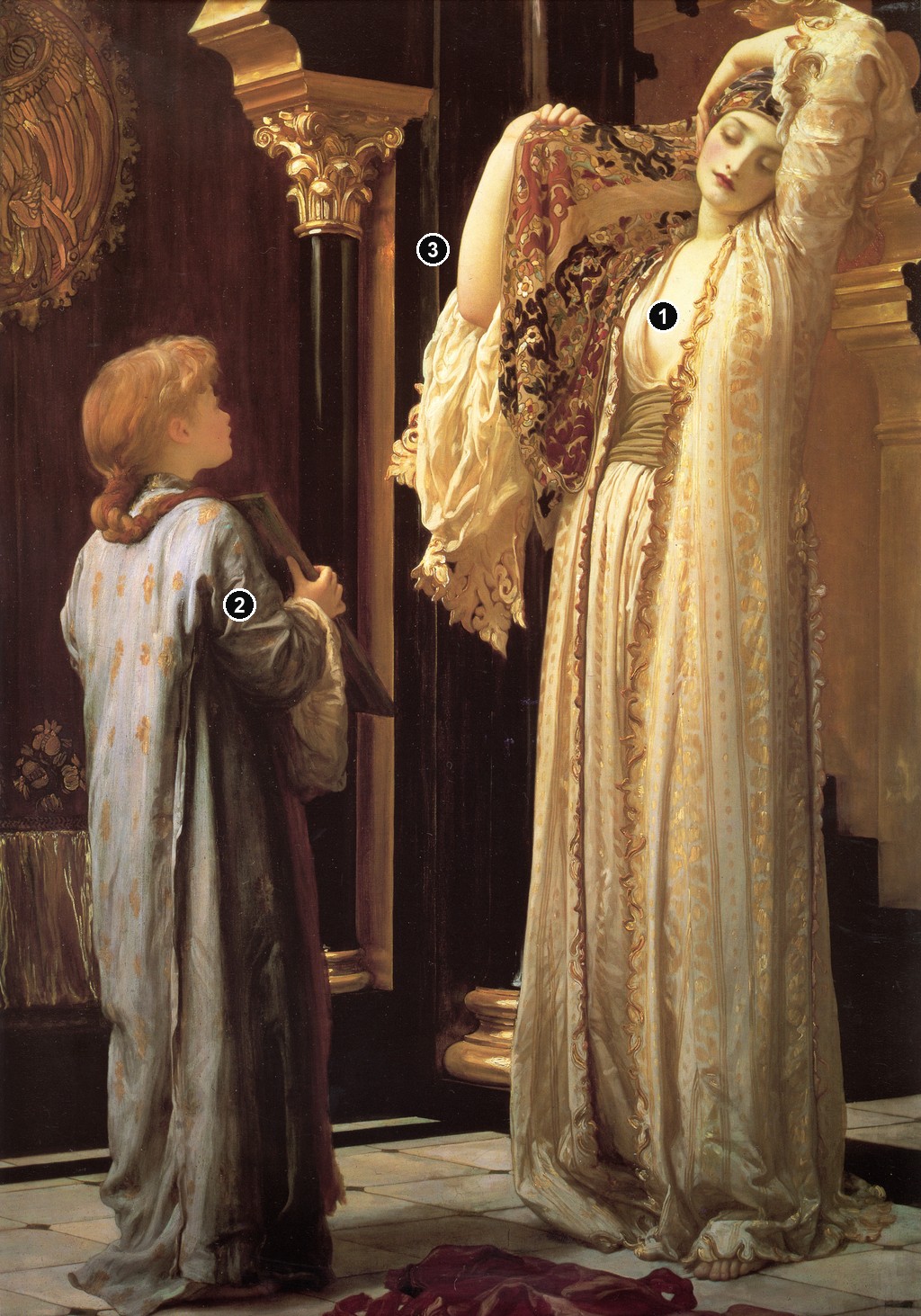
Details from LIGHT OF THE HAREM
Compare the cropped details with the source images above. Notice how their colours, shapes and positions contribute to the larger compositions.
Lifting the shawl
The standing woman holds the patterned cloth up near her head. The thick shawl and the long light robe catch the light in different ways.
A girl looks up
The younger figure lifts her face towards the standing woman. Her hands and the small mirror belong to the narrow space between them.
A lit capital at the doorway
The projecting top of the column catches the light at the edge of the recess. It helps separate the dark space behind the women from the lit cloth.
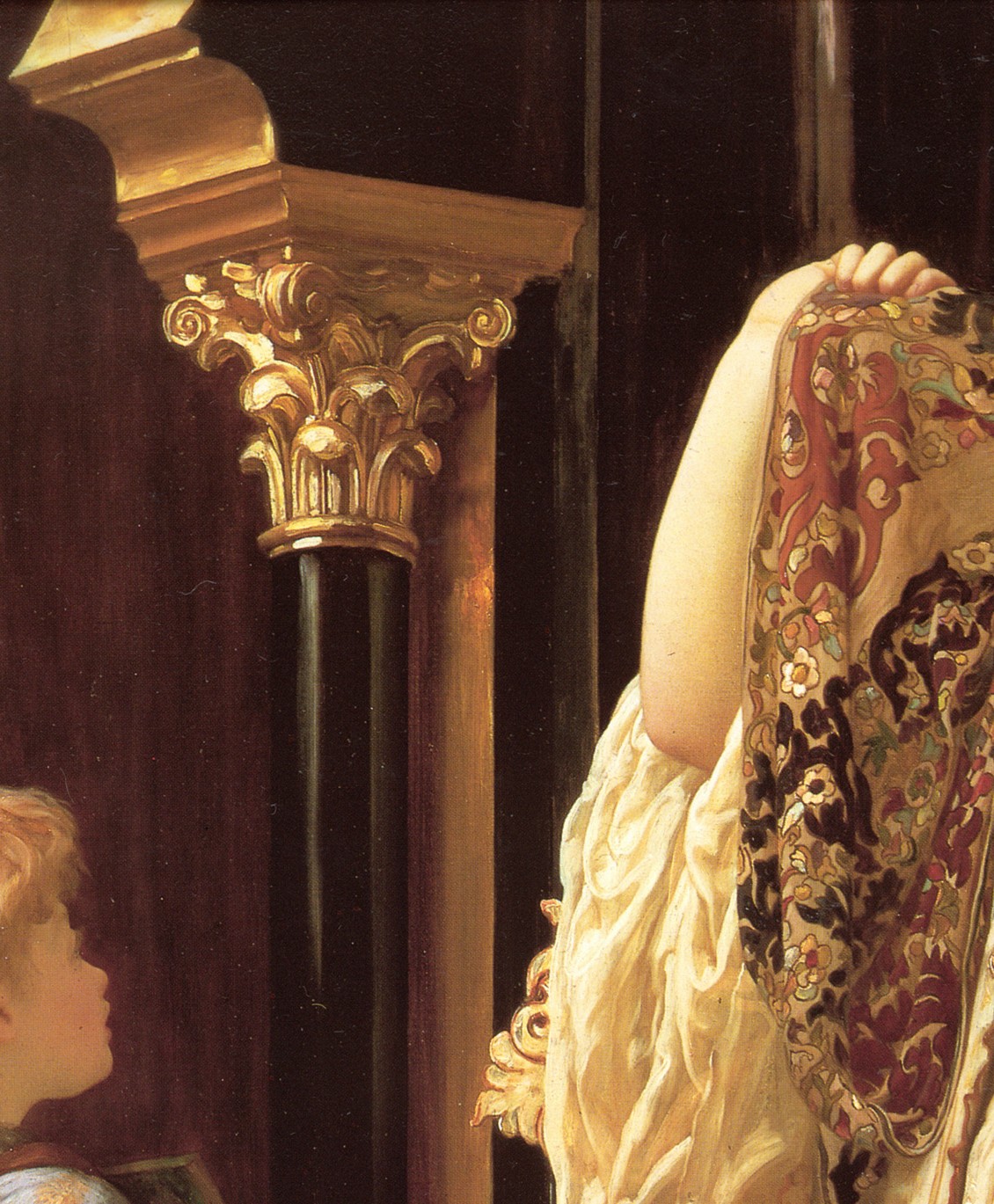
From a drawing to the wall at South Kensington
A drawing in black chalk on brown paper at the Victoria and Albert Museum gives the central figure room to stand on her own. The museum identifies her as a study for Light of the Harem. The raised elbow and the long fall of the garment already give the pose its outline. Faint lines running down the drapery give the figure the vertical lift that the columns reinforce in the painting. Leighton explores other poses on either side of her, including a seated figure at the right. The Academy's 1897 winter exhibition catalogue records a loan of chalk studies for the picture from Douglas Freshfield, evidence that drawings for the composition circulated after Leighton's death. [5] [6]
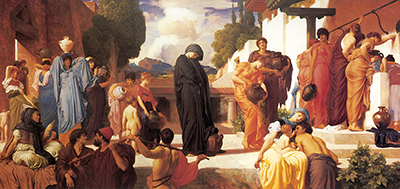
The gesture also connects the canvas to a commission on a much larger scale. Both Ernest Rhys and Emilie Barrington associated the easel painting with a group in Leighton's design for The Arts of Industry as Applied to Peace. The mural, completed in 1886, occupies a semicircular recess at what is now the Victoria and Albert Museum. Its setting is ancient Athens, where women dress with the assistance of attendants while labourers carry pottery and carpets ashore. At the right of the central group, a girl holds a mirror up for a woman. Amid the many figures and the sweep of the architecture, a viewer can pick out the same small act of assistance that occupies the whole canvas of Light of the Harem. [3] [7] [8] [9]
The surviving colour sketch for the mural dates to 1872–73. The full-size monochrome cartoon is dated 1883. The 1880 exhibition thus falls between early work for the South Court and the later stages of the mural. Thinking of the group as a design that Leighton could develop in more than one direction makes sense of the different settings. In the Athens scene, mirrors and fabrics belong to a public celebration of skilled workmanship. In the easel painting, they belong to a dressing scene with two figures so close to the front that their clothes almost fill the room. The repetition also shows how readily a pose that signalled beauty and luxury for Leighton could move from classical antiquity into a scene advertised to Victorian visitors as a harem. [1] [3] [7] [8] [9]
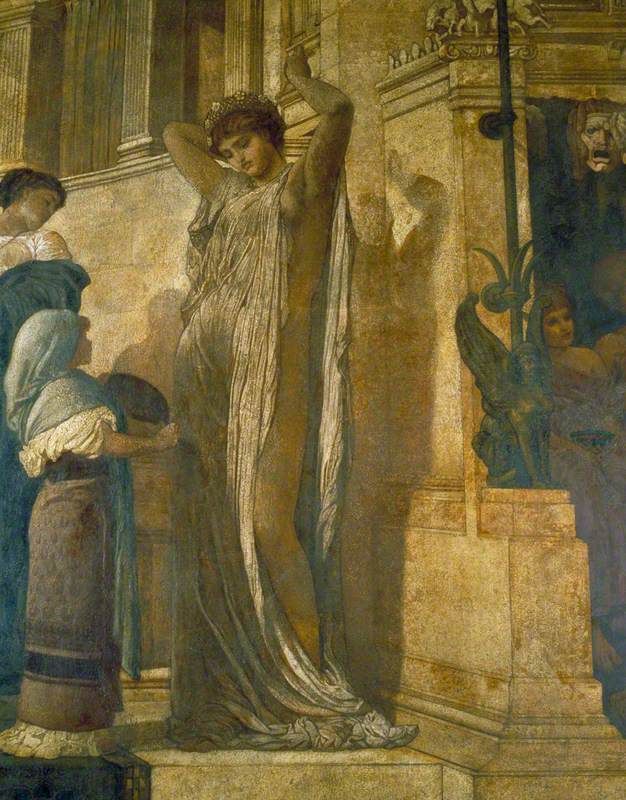
Frederic Leighton, colour sketch for The Arts of Industry as Applied to Peace, 1872–73. Victoria and Albert Museum. Image source. Public domain. Resized proportionally.
The girl with the mirror
The catalogue for Kittens identifies the girl as Lena Pullan, the youngest sister of the actress and model Dorothy Dene. The art historian Madeline Hewitson also names Lena in her study of Leighton's paintings of girls. She was born in 1873 and also posed for Sister's Kiss, shown at the same Academy exhibition, and later for the child in Cymon and Iphigenia. Hewitson has proposed Dorothy for the adult figure. That identification remains tentative. [1] [9] [10] [11]
Their relationship depends on how one reads the girl's act of assistance. Her attention can suggest the familiarity of a younger relative. She could equally be an attendant whose task is to hold the mirror. The woman attends to the work of dressing and never meets her companion's eye, so there is little to settle the question. Hewitson points to Leighton's recurring use of patterned garments and other studio props across paintings with different stories. Here the rich coat gives Lena a presence of her own, even while her pose directs the viewer back towards the standing woman. [2] [9] [11]
What the title asks the viewer to imagine
The Academy title invites a British audience to imagine looking into private quarters associated with an Ottoman household. That premise belongs to the Victorian genre of Orientalist painting. Mary Roberts has shown how differently nineteenth-century European artists, visitors and Ottoman patrons represented these interiors. Leighton's canvas offers a particularly narrow view. Two figures, a strip of floor and a few selected architectural elements leave a great deal for the title to supply. Fine details of embroidery give the scene physical conviction while revealing little about where it takes place or what the two figures' lives might be like. [1] [2] [12]
Roberts reads the mirror as part of the picture's appeal to the imagined male viewer. The woman is absorbed in her own appearance, and her young companion is absorbed in her. Those two lines of attention make the viewer's presence easy to forget, even though the bodies are carefully angled so that we can see the woman's face and the girl's profile. The angle that lets us admire the gown also blocks our view into the glass. The conceit offers the pleasure of entering a private room while drawing a limit to what we can see once inside. [2] [12]
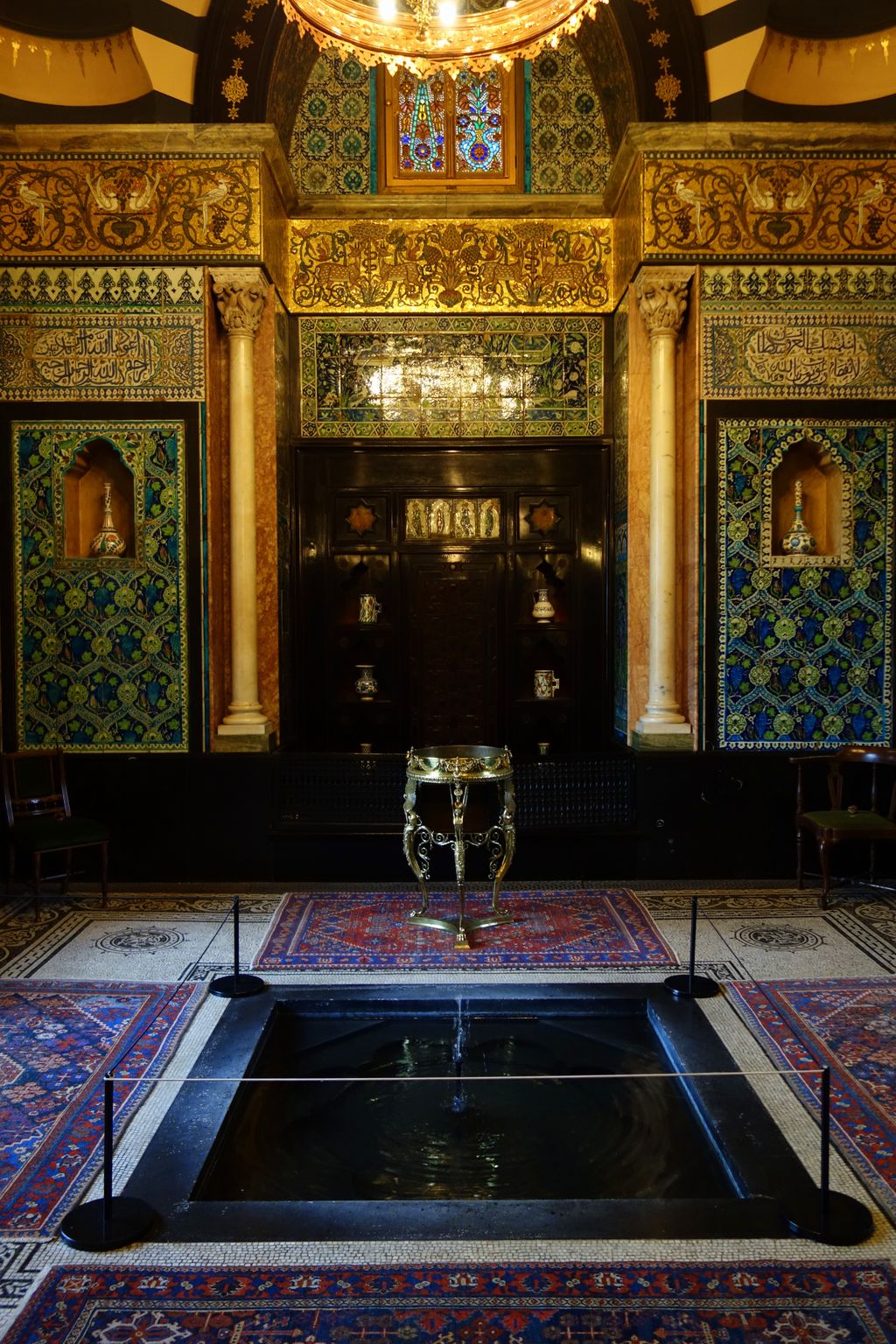
The Arab Hall viewed across its central pool. Daderot. Image source. CC0 / Public domain. Resized JPEG; photograph otherwise unaltered.
Leighton's studio and the painting's later record
Leighton had already begun the Arab Hall at his Kensington home, working with the architect George Aitchison on a room inspired in part by the Norman palace of La Zisa in Palermo. The palace's Fountain Room brings Islamic ornament and paired columns into a planned architectural ensemble. In London, Leighton and his collaborators used historic tiles from several places, including Damascus, and commissioned new work to fit them together. The historian of design Hitomi Kitamura connects the hall with Leighton's paintings of imagined places. In both, furnishings and surfaces evoke other times and places as seen through Victorian eyes. In Light of the Harem, the deep shadows between the columns leave plenty of room for that act of imagining. Roberts identifies Leighton's 1884 Sun Gleams (Arab Hall) as the painting in which he directly depicted the hall. [2] [13] [14] [15]
The American writer Julian Hawthorne remembered seeing the canvas on the easel and imagining a house suitable to hang it in. His suggestion that it might have ended up in an American millionaire's smoking room tells us about the kind of interior the painting evoked for him. A firmer trace is the reproduction in Barrington's 1906 biography, printed with the permission of the directors of the Leicester Gallery. The early plate shows the same column, raised scarf and red cloth on the floor visible in the modern colour photograph. The later publication records the canvas in a private collection. The intervening ownership remains uncertain. [2] [3]
Browse Frederic Leighton’s artworks
Explore paintings, drawings, sculptures and prints, with separate rows for identified preparatory works, reproductions and casts.
| Name | Date | Medium |
|---|---|---|
| A Girl Feeding Peacocks | Exhibited 1863 | Painting Catalogue. |
| A Recognition from ‘Romola’, engraved by Swain (Tate N04054) | published 1862 | Print Catalogue. |
| A Roman Lady | 1859 | Painting Catalogue. |
| Abram and the Angel (Tate A00733) | published 1881 | Print Catalogue. |
| Acme and Septimius | Exhibited 1868 | Painting Catalogue. |
| An Athlete Wrestling with a Python (Tate exhibition bronze) | 1877 | Sculpture Catalogue. |
| And the Sea Gave Up the Dead Which Were in It (Tate N01511) | 1891–92 | Painting Catalogue. |
| Andromache in Captivity (photogravure after Leighton) | 1889 | Print Catalogue. |
| Athlete Wrestling with a Python (Anglesey Abbey cast) | model 1877; cast 1905 | Sculpture Catalogue. |
| Athlete Wrestling with a Python (Hood reduced cast) | 1877 (inscribed model date) | Sculpture Catalogue. |
| Athlete Wrestling with a Python (Saint Louis reduced cast) | 1877 (museum date) | Sculpture Catalogue. |
| Cain and Abel (Tate A00731) | published 1881 | Print Catalogue. |
| Captive Andromache | 1888 | Painting Catalogue. |
| Cimabue's Celebrated Madonna | 1853–55 | Painting Catalogue. |
| Cimon and Iphigenia, with Many Smaller Subjects (Tate T09061) | date not known | Drawing Catalogue. |
| Crenaia, the Nymph of the Dargle | Exhibited 1880 | Painting Catalogue. |
| Cymon and Iphigenia | 1884 | Painting Catalogue. |
| Daedalus and Icarus | 1869 | Painting Catalogue. |
| Dante in Exile | 1864 | Painting Catalogue. |
| Death of the First Born (Tate A00737) | published 1881 | Print Catalogue. |
| Electra at the Tomb of Agamemnon | c. 1869 | Painting Catalogue. |
| Eliezer and Rebekah (Tate A00735) | published 1881 | Print Catalogue. |
| Elijah in the Wilderness | 1877–78 | Painting Catalogue. |
| Fanny Kemble: A Study for ‘Jezebel and Ahab’ (Tate T08208) | c.1862 | Drawing Catalogue. |
| Figure Studies | Date not recorded | Drawing Catalogue. |
| Flaming June | 1895 | Painting Catalogue. |
| Gulnihal | Exhibited 1886 | Painting Catalogue. |
| Helios and Rhodes (Tate N03015) | date not known | Painting Catalogue. |
| Hercules Wrestling with Death for the Body of Alcestis | c. 1869–71 | Painting Catalogue. |
| Jonathan's Token to David | c. 1868 | Painting Catalogue. |
| Lachrymae | 1894–95 | Painting Catalogue. |
| Lieder ohne Worte | Exhibited 1861 | Painting Catalogue. |
| Light of the Harem | Exhibited 1880 | Painting Catalogue. |
| Moses Views the Promised Land (Tate A00736) | published 1881 | Print Catalogue. |
| Mrs James Guthrie | 1865 | Painting Catalogue. |
| Mrs John Hanson Walker (Tate N04731) | 1867 | Painting Catalogue. |
| Music Lesson | 1877 | Painting Catalogue. |
| Needless Alarms (Met cast) | modelled 1886; cast nineteenth century | Sculpture Catalogue. |
| Needless Alarms (Tate N05120) | 1886 | Sculpture Catalogue. |
| Pavonia | c. 1859 | Painting Catalogue. |
| Perseus and Andromeda | 1891 | Painting Catalogue. |
| Portrait of May Sartoris | c. 1860 | Painting Catalogue. |
| Preparing for a Festa, Florence (Tate T09062) | date not known | Drawing Catalogue. |
| Puerta de los Vientos, near Ronda, Spain (Tate N04006) | c.1886–9 | Painting Catalogue. |
| Samson and the Lions (Tate A00732) | published 1881 | Print Catalogue. |
| Samson at the Mill (Tate A00734) | published 1881 | Print Catalogue. |
| Samson Carrying the Gate (Tate A00738) | published 1881 | Print Catalogue. |
| Sketch for ‘An Athlete Wrestling with a Python’ (Tate N01761) | c.1877 | Sculpture Catalogue. |
| Sketches for Cimon and Iphigenia (Tate T09060) | date not known | Drawing Catalogue. |
| Study for The Return of Persephone (Demeter) | c. 1890–91 | Drawing Catalogue. |
| Study for The Return of Persephone (Persephone) | c. 1890–91 | Drawing Catalogue. |
| Study for ‘Needless Alarms’ (Tate N02945) | 1886 | Sculpture Catalogue. |
| Study for ‘The Discovery of Juliet Apparently Lifeless’ (Tate N01806) | c.1858 | Painting Catalogue. |
| The Bath of Psyche | Exhibited 1890 | Painting Catalogue. |
| The Daphnephoria | 1874–76 | Painting Catalogue. |
| The Death of Brunelleschi | 1852 | Painting Catalogue. |
| The Fisherman and the Siren | Exhibited 1858 | Painting Catalogue. |
| The Painter's Honeymoon | c. 1864 | Painting Catalogue. |
| The Return of Persephone | 1891 | Painting Leeds painting identified in the Met study record. |
| The Return of Persephone (preparatory oil) | c. 1890–91 | Painting Catalogue. |
| The Sluggard (Anglesey Abbey cast) | probably 1890–about 1906 | Sculpture Catalogue. |
| The Sluggard (Met cast) | modelled 1886; cast possibly before 1896 | Sculpture Catalogue. |
| The Sluggard (Museum Wales) | 1882–85 (museum date) | Sculpture Catalogue. |
| The Sluggard (Tate N01752) | 1885 | Sculpture Catalogue. |
| The Spies Escape (Tate A00730) | published 1881 | Print Catalogue. |
| Various Subjects (Tate T09063) | date not known | Drawing Catalogue. |
| View in Capri | Possibly 1859 | Painting Catalogue. |
| Wedded | 1882 | Painting Catalogue. |
| Winding the Skein | c. 1878 | Painting Catalogue. |
Discussion
Look again at the images and ideas explored in Light of the Harem. These editorial prompts invite your observations.
Reader Insights
How do the mirror and shawl direct attention between the two figures?
What changes when a related figure group appears among the craftspeople in Leighton’s mural design?
Join the Conversation
Share a detail, comparison or question about Light of the Harem below.
References
- Royal Academy of Arts, The Exhibition of the Royal Academy of Arts, the One Hundred and Twelfth (1880), Gallery III, p. 14, no. 256, The light of the hareem. View source.
- Mary Roberts, “The Resistant Materiality of Frederic Leighton's Arab Hall,” British Art Studies 9 (2018), fig. 40 and accompanying discussion, including Julian Hawthorne's Shapes That Pass, p. 177. View source.
- Emilie Barrington, The Life, Letters and Work of Frederic Leighton, vol. II (1906), chs. V–VI, especially plate 45 facing p. 256 and the 1880 entry on p. 388. View source.
- Ernest Chesneau, “Sir Frederick Leighton, P.R.A.,” in Artistes anglais contemporains (1887), discussion of the works from 1877 to 1882. View source.
- Victoria and Albert Museum, Frederic Leighton, figure studies including a study for Light of the Harem, 1880, E.489-1931. View source.
- Royal Academy of Arts, Exhibition of Works by the Old Masters, and by Deceased Masters of the British School, Winter Exhibition (1897), p. 50, no. 293. View source.
- Ernest Rhys, Frederic Lord Leighton: An Illustrated Record of His Life and Work (1898 ed.), ch. V and appendix I, 1880 entries. View source.
- Victoria and Albert Museum, “The South Court and Leighton Frescos,” with the colour sketch 993-1873 and full-scale monochrome cartoon 993A-1873 for The Arts of Industry as Applied to Peace. View source.
- Madeline Boden (now Hewitson), A Relief from Classicism: Frederic Leighton in the Near East, 1857–1895, doctoral thesis (University of York, 2019), ch. 3, pp. 156–163 and fig. 100. View source.
- Christie's, Kittens, lot 963204, catalogue essay on the Pullan sisters. View source.
- Madeline Hewitson, “The Little Girls of Orientalism: Frederic Leighton's Study at a Reading Desk (1877),” Journal of Victorian Culture 30, no. 2 (2025), sections 3 and 6. View source.
- Mary Roberts, Intimate Outsiders: The Harem in Ottoman and Orientalist Art and Travel Literature (Duke University Press, 2007), pp. 89–90 and plate 19. View source.
- Leighton House, “Q&A: The Arab Hall at Leighton House,” interview with Melanie Gibson. View source.
- Comune di Palermo, “Palazzo della Zisa,” architectural account including the Sala della Fontana. View source.
- Hitomi Kitamura (北村仁美), “The Place of the Interior in Late Nineteenth-Century Britain” (「一九世紀後半の英国におけるインテリアの位置」), a+a 11 (2017), pp. 14–25, discussion of Leighton House and imagined interiors. View source.