 by Tom Gurney
Tom Gurney BSc (Hons) is an art history expert with over 20 years experience
Published on June 19, 2020 / Updated on November 29, 2026
Email: tomgurney1@gmail.com / Phone: +44 7429 011000
Captive Andromache: Introduction
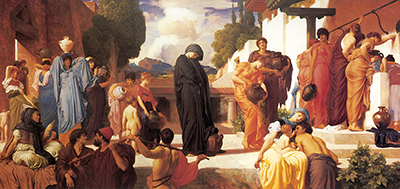
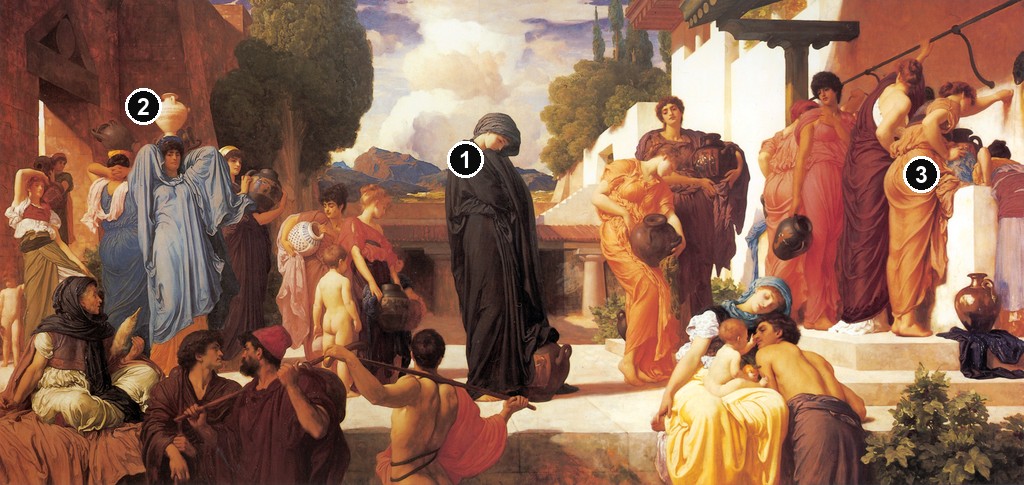
At the centre of Frederic Leighton’s Captive Andromache, a woman in a dark mantle lowers her head. A jar rests beside her hem. Around her, women raise and steady their water vessels, people talk, and a child reaches towards a man in the foreground. The woman is Andromache, Hector’s widow, imagined in captivity after the fall of Troy. Leighton makes her the still point in a scene full of small movements. The oil on canvas, completed around 1888, measures about 197 × 407 cm and belongs to Manchester Art Gallery, where it is catalogued as 1889.2. Its scale gives those everyday movements the room usually reserved for a great public event. [1] [2]
At a Glance
- Date1888
- MediumOil on canvas
- CollectionManchester Art Gallery, 1889.2
- First exhibitedRoyal Academy, 1888
This work across Frederic Leighton’s career
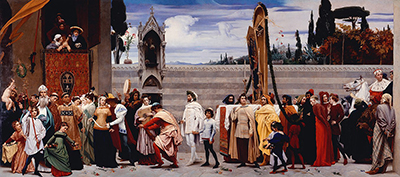
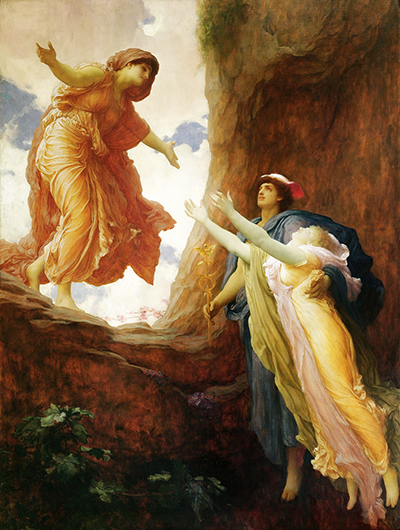
Cimabue’s Celebrated Madonna
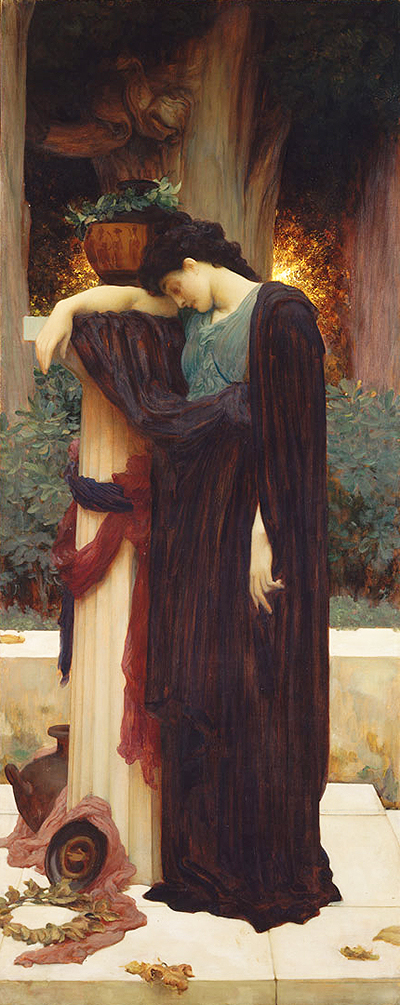
1853–55Lachrymae
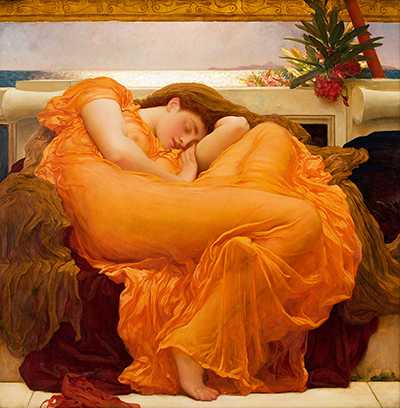
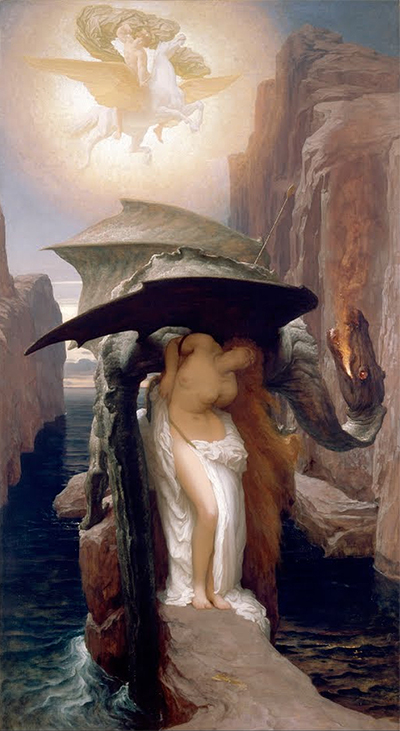
1894–95Flaming June
c. 1895Contents
- Hector imagines the well
- The people around her
- From sketchbook to canvas
- From the Royal Academy to Manchester
- Annotated details
Hector imagines the well
The scene begins with a conversation in Book VI of Homer’s Iliad. Andromache begs Hector to stay by the walls of Troy. He speaks of the city’s eventual defeat and of what he fears most for her: a Greek will take her away, and she will be made to work at another woman’s loom or fetch water from a spring. He imagines a stranger recognising her as the wife of the man who once led the Trojans in battle. Recognition, in Hector’s telling, is another injury. The stranger’s words will remind her in public of a life she can no longer return to. [3]
Leighton’s first Royal Academy audience had those words in mind. The 1888 exhibition entry for the painting, no. 227, carried lines from Elizabeth Barrett Browning’s verse rendering of the passage. Her version gives particular force to the bystander noticing Andromache’s tears. Leighton takes the captivity that Hector can only foresee and gives it the ordinary duration of a wait for water. The quiet of the figure also gives the viewer a choice about where to look. A man gestures in the foreground, but his words are left to the imagination. The exhibition guide edited by Henry Blackburn read the scene as a public humiliation at the Hyperian well. The Metropolitan Museum’s catalogue of a print after the painting places the scene in Epirus, where later tradition tells of Andromache’s captivity with Neoptolemus. The two readings approach the scene through different parts of her story. Leighton gives us the work of carrying water and the looks around the well, leaving the exact place to the imagination. [3] [4] [5] [6]
After this speech in Homer, Hector reaches for their son, Astyanax. The boy recoils from his helmet until Hector takes it off. The ease with which the adults lean towards the small child in the painting recalls that brief family intimacy. The comparison gains force from the amount of space Leighton leaves around the widow’s lowered face. Jacques-Louis David’s Andromache Mourning Hector of 1783, now at the Louvre, keeps the son at her side and his father’s body within reach. David cites Andromache’s lament from Book XXIV on the painted candelabrum. Leighton chooses a later point in the story, when the bodies of her husband and the child she held at Troy are absent and another household’s affection is visible to her. [1] [3] [7]
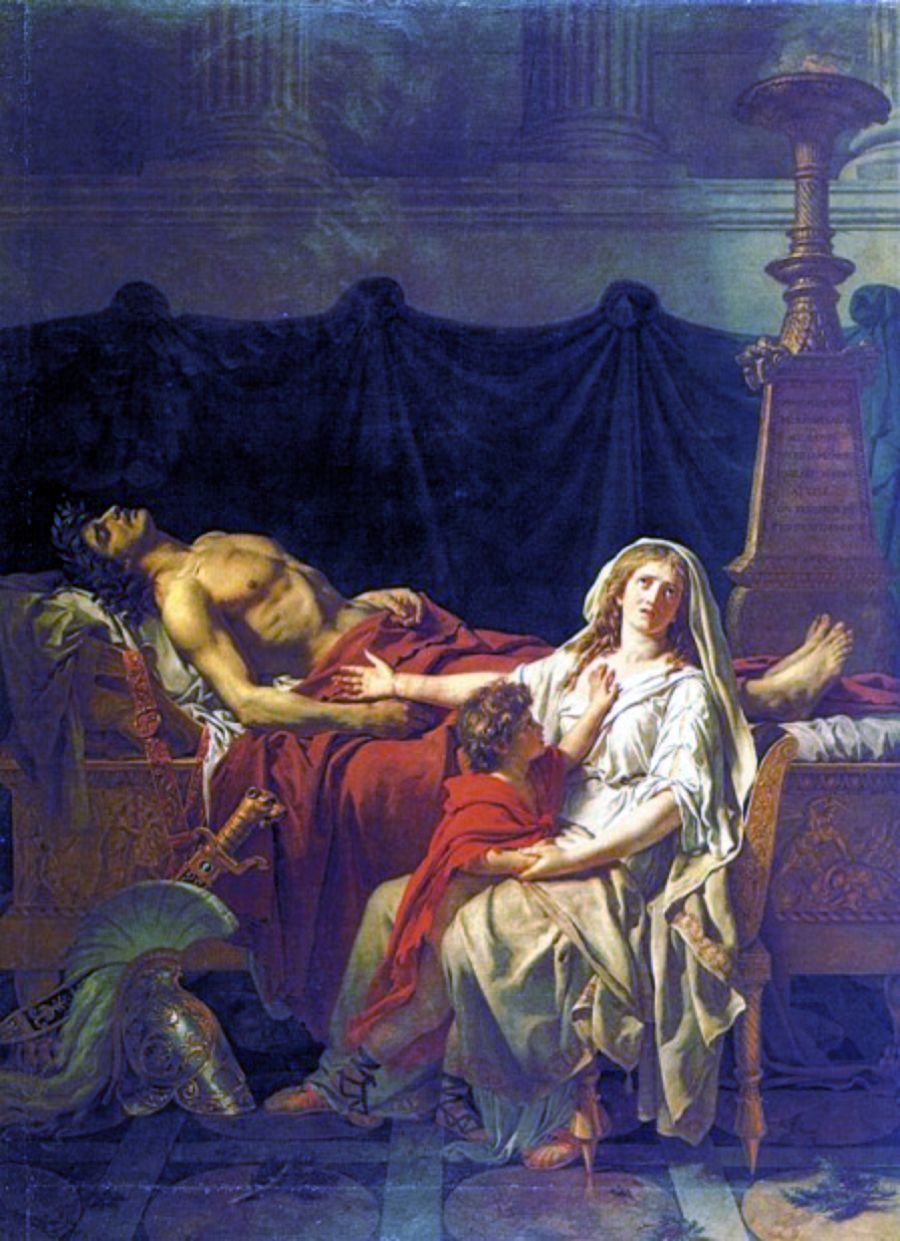
Jacques-Louis David, Andromache Mourning Hector, 1783. Musée du Louvre. Image source. Public domain. Resized without changing the composition.
The people around her
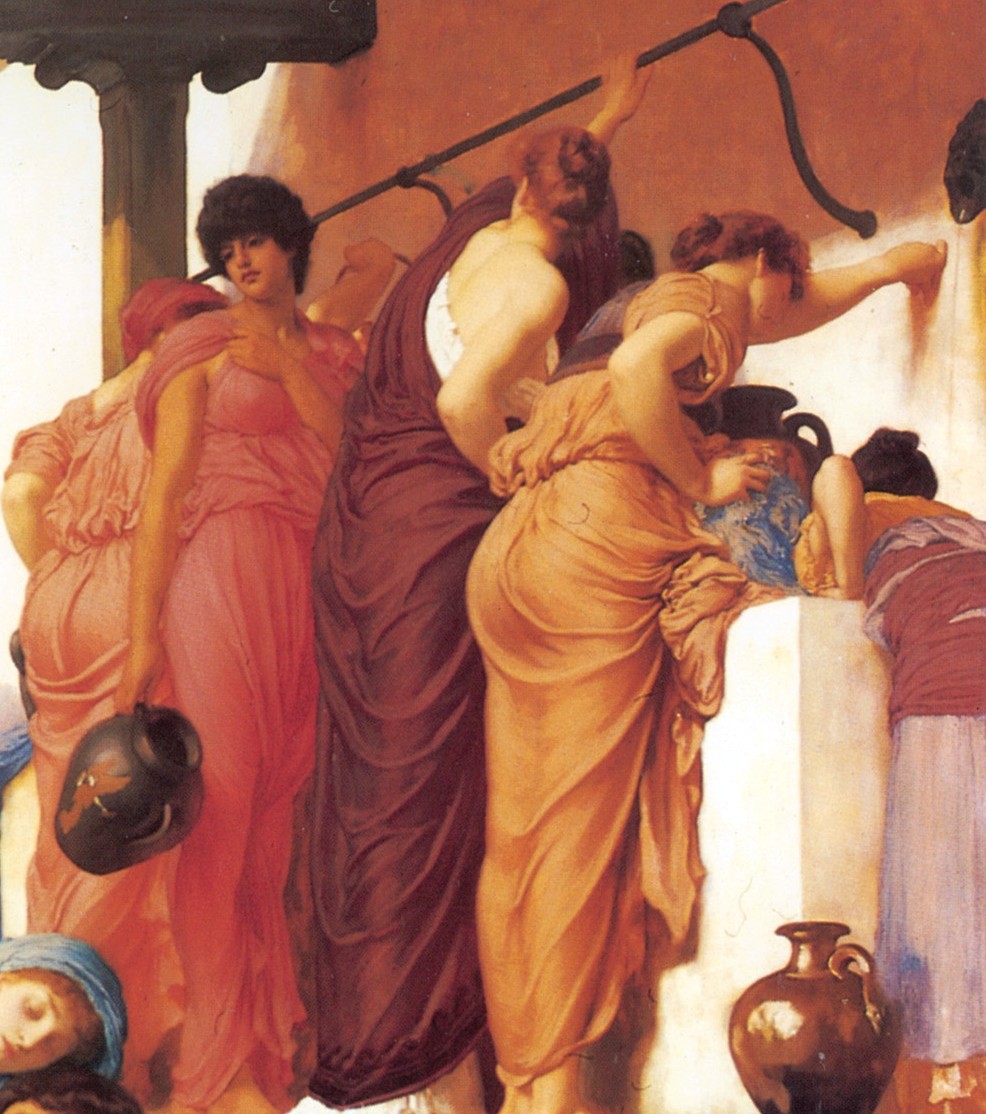
Follow the vessels from left to right. A woman in blue comes forward under a pale, round jar, the weight balanced above her head. A little farther in, a child stands between women in shadow. The figures on the right rise with the stone steps, their sleeves and draperies catching the sunlight against a pale wall. An orange-clad woman bends over a dark jar and props it against her raised thigh. Steps, ledges and rails give the group a series of places to pause. The woman in dark clothing stands almost straight between these different rhythms, her heavy garment drawing into long folds while the other figures turn and reach. [1] [2]
Look below the level of the well and there is another band of activity. The bare back and extended arm of the man just left of centre pull the eye across the foreground. On the right, yellow cloth pools around the seated woman with the child. Further back, trees and buildings make a narrow opening onto hills and cloud. The view through that opening gives the composition depth, while the shallow steps bring the people close. Leighton had long worked with frieze-like arrangements, including the Florentine procession in Cimabue’s Celebrated Madonna. Here he puts the broad sweep of a procession at the service of a woman who can only wait her turn. [1] [2] [8]
The vessels give each person a different task. Some can be held close to the body. Others have handles that determine how the carrier can lift or pour them. Ian Jenkins traced both angular-shouldered hydriai, Greek water jars with three handles, and the rounded type often called the kalpis. He also showed how freely Leighton combined the sources. On the jar beside Andromache, the folds conceal most of the decoration. Jenkins identified the surviving figure as a borrowing from an Attic vase whose scene probably includes Menelaus pursuing Helen. The painted pot changes both the vessel’s form and the figure’s colour treatment. On another jar Leighton includes part of an ancient vase painting of women drawing water, a small repetition of the action all around it. Jenkins also identified a nineteenth-century Egyptian water jar that served as a prop in the studies. The orange-clad woman held a jar of that shape in a drawing. In the canvas it has the rounded profile of a Greek kalpis. [9]
Annotated Details from Captive Andromache
The numbered points identify visible features discussed in this article. Return from each detail to the numbered overview. Frederic Leighton, Captive Andromache, 1888. Manchester Art Gallery. Image source. Public domain. Resized without changing the composition.
Details from CAPTIVE ANDROMACHE
Compare the cropped details with the source images above. Notice how their colours, shapes and positions contribute to the larger compositions.
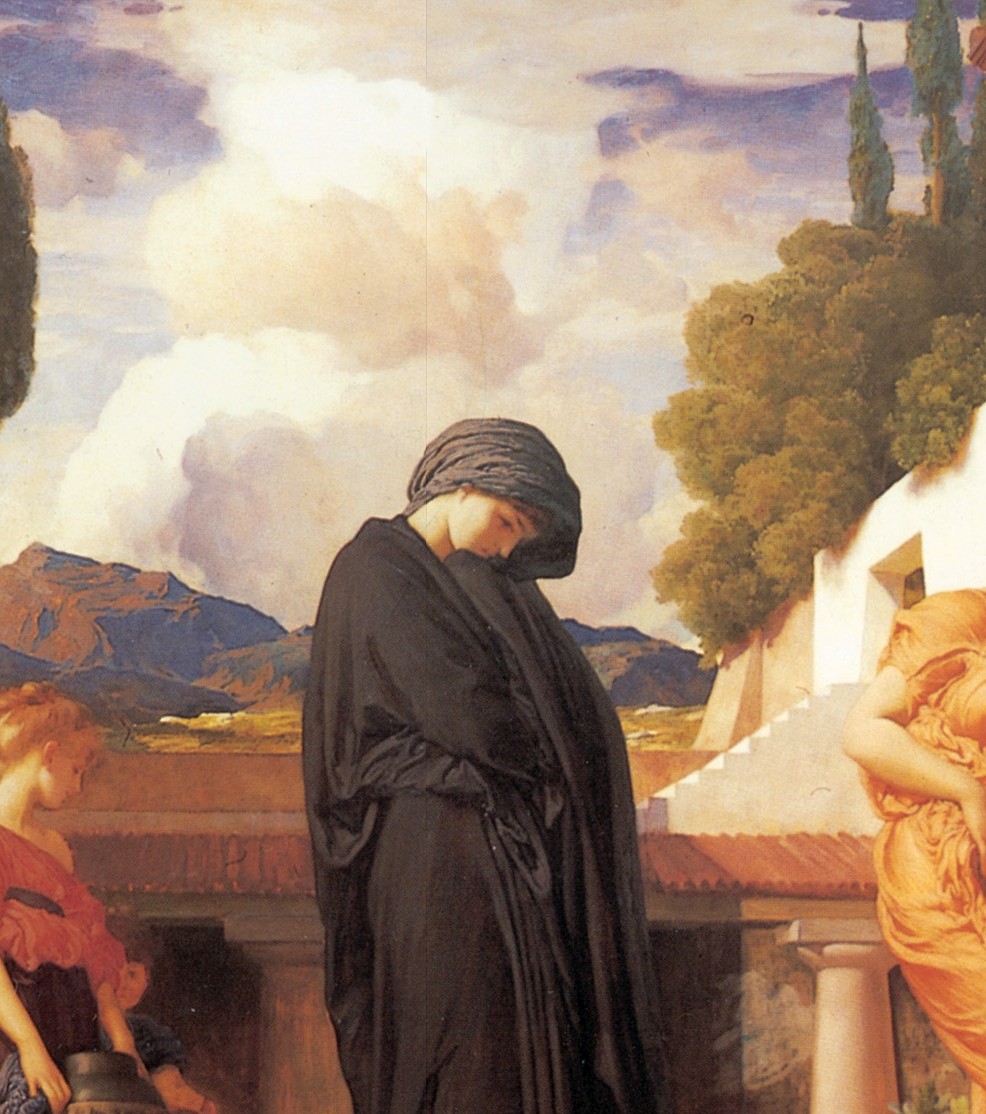
Andromache’s downturned head
Dark cloth draws Andromache into a nearly continuous silhouette. Her bowed head gives her an inward focus amid the other figures’ work at the well.
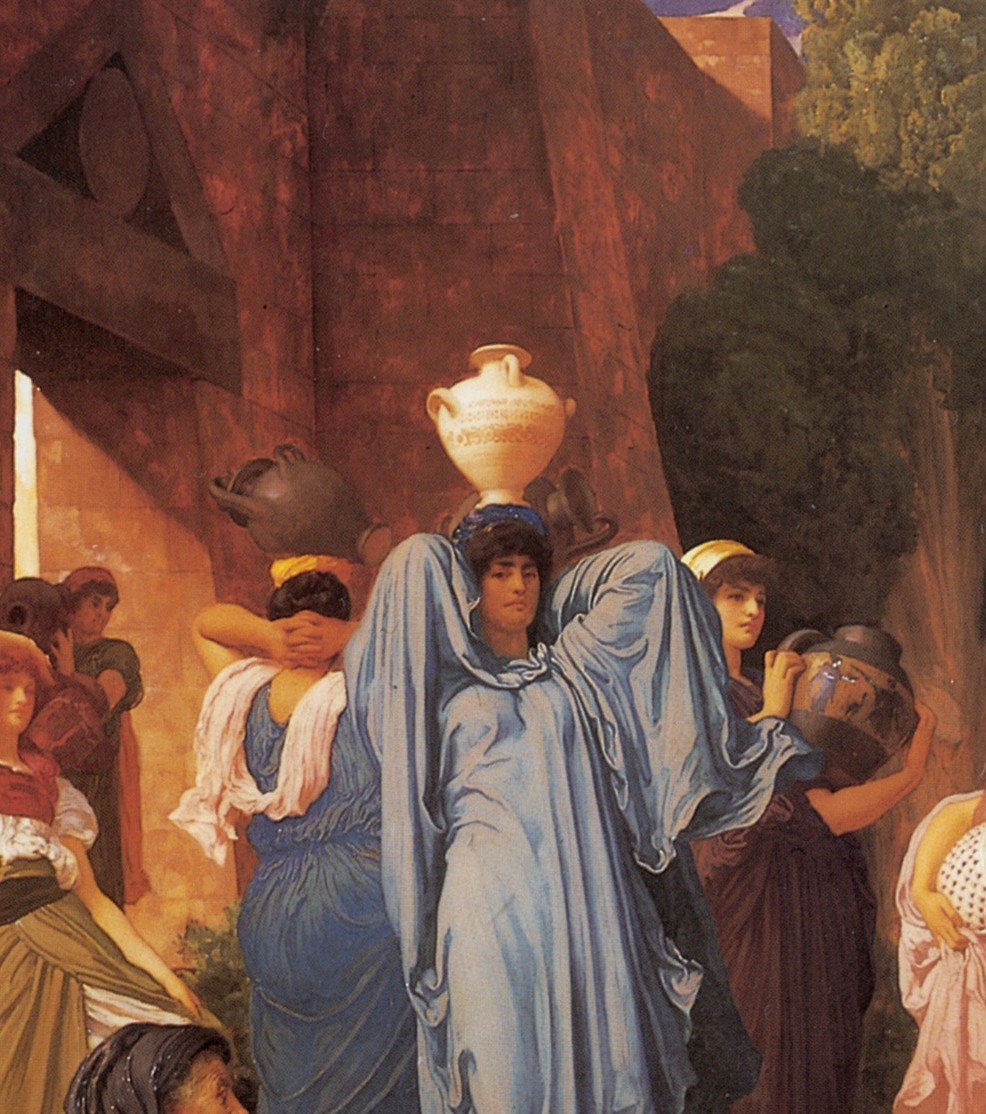
Carrying water
A figure balances a vessel amid the group at the left. The lifted shape introduces a counterpoint to the many figures bending or sitting.
The work at the well
Turning bodies and lifted arms concentrate activity at the right. The working group contrasts with the still figure near the centre.
From sketchbook to canvas
The setting took shape through revisions. Madeline Boden compares two surviving Royal Academy tracings, one with a walled city and recognisably Greek architectural features, the other with a more open landscape. Figures change position or disappear between the drawings and the oil. In her reading, the finished picture draws on a wider Mediterranean world than the tracings’ classical motifs might suggest. A gesture in the left group supplies a striking instance. In 1868 Leighton watched women fetch water from the Nile and noted how the angle of a pitcher changed when it was full. His travel sketches record women balancing vessels, and Boden connects those observations with the blue-clad carrier in the finished painting. The literary setting and the particular bodily effort of carrying water came from different experiences. [1]
The small oil panel at the Dahesh Museum of Art, Study for Captive Andromache (1996.26), is about 41 cm wide. The brush moves freely through the broad masses, bringing the principal tones together at a scale the eye can take in whole. Dahesh places this oil study after detailed drawings that established the arrangement. The richly differentiated surfaces of the final canvas grew from work at both scales. A report by the critic M. H. Spielmann, reprinted by Ernest Rhys, describes Leighton checking the weight and action of a model’s body before working out the fall of the clothes. The article takes The Sibyl as its immediate example, then points to the exceptional labour a crowd like Andromache’s entailed. [10] [11]
A compositional drawing now in the Victoria and Albert Museum brings the whole group down to 40 cm across in pencil, wash and touches of white. It travelled to Tokyo in 2014 for the Mitsubishi Ichigokan Museum’s exhibition on British Aestheticism. A sheet catalogued by the Musée d’Orsay as Étude pour Andromaque ; reprises uses black chalk and white highlights on brown paper. Leighton gave it to the French state in 1893, and it is kept in the Louvre’s Department of Prints and Drawings. The catalogue leaves the date of its making open. A small oil on board catalogued by Christie’s as a study of a head closely resembles the red-capped man low on the left. In its catalogue for Kittens, Christie’s identifies Lena Pullan as the younger figure just behind Andromache. Boden identifies Dorothy Dene, Lena’s older sister, as the model for the woman at the centre, an identification the Italian art historian Gian Luca Tusini treats as possible. During an 1892 interview, Leighton showed Harry How several studies on brown paper, including two for Andromache. A reader of The Strand Magazine could see on the page how much attention went into even a single figure. [1] [12] [13] [14] [15] [16] [17]
From the Royal Academy to Manchester
In 1888, Blackburn gave the painting a prominent place in his account of the Royal Academy exhibition. He traced the cooler blues and greys on the left against the yellows and oranges on the right, treating those colour groups as part of its decorative effect. The first notice in The Times admired the elaboration but questioned what feeling the picture was meant to arouse. That response gets at a tension visible in the work. The figures’ studied poses and measured intervals could seem remote from the urgency of Hector’s speech. They also give Andromache time and space to grieve while the rest of the scene goes on. [4] [18]
Manchester acquired the painting in 1889 for £4,000. It was shown that year at the Exposition Universelle in Paris, where Georges Lafenestre saw echoes of Florentine art in the outlines of the water carriers and likened the composition to a relief. Writing in Spanish, Ernesto García Ladevesse admired the grace and variety of four women drawing water but found the colour less successful. A. De Ticheler, writing in the Dutch-language Dietsche Warande, noted how little sympathy younger artists might have for Leighton’s classicism. The placement of a single, dark figure among all those studies of light and movement could prompt very different responses. [13] [19] [20] [21]
For a portfolio reproducing paintings at the Paris exhibition, George Barrie of Philadelphia published the 1889 photogravure Andromache in Captivity, now represented by an impression in the Metropolitan Museum of Art, accession 2015.653.1. In the print, the dark central silhouette and intervals of pale stone hold the scene together through tone. That November, a German Kunstchronik advertisement also listed a feature on Leighton’s Gefangene Andromache in a publication of Berlin’s Photographic Society. The canvas returned to the Royal Academy for the 1897 memorial exhibition as no. 57, with several related chalk studies listed separately in the catalogue. [6] [22] [23]
The painting’s life in Manchester has left marks beyond those of Leighton’s brush. The gallery records that campaigners for women’s suffrage broke its protective glass in April 1913. Its conservators later repaired a small puncture made in 2003 in the area of the standing child to Andromache’s left. The detail is easy to miss in a reproduction and the repair is hard to detect in front of the canvas. At full scale there is room for an eye to rest on such small incidents, then return to the woman at the well, still held at a distance from the other lives around her. [2] [24]
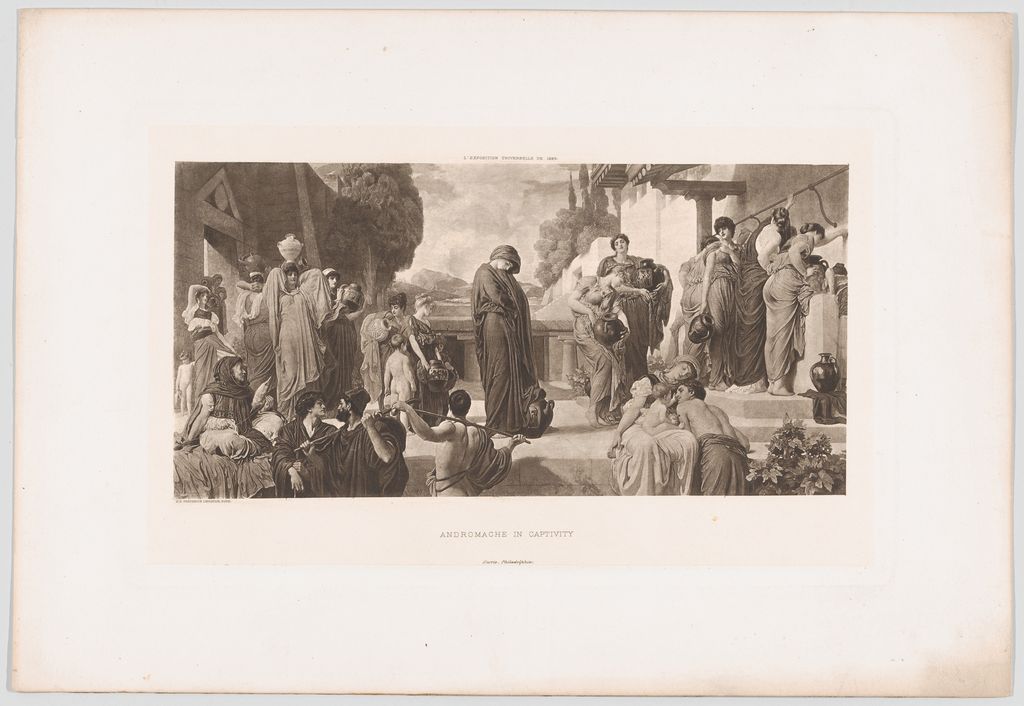
After Frederic Leighton, Andromache in Captivity, 1889. Photogravure published by George Barrie. The Metropolitan Museum of Art, gift of Donato Esposito, 2015. Image source. CC0 / Public domain. Resized without changing the composition.
Browse Frederic Leighton’s artworks
Explore paintings, drawings, sculptures and prints, with separate rows for identified preparatory works, reproductions and casts.
| Name | Date | Medium |
|---|---|---|
| A Girl Feeding Peacocks | Exhibited 1863 | Painting Catalogue. |
| A Recognition from ‘Romola’, engraved by Swain (Tate N04054) | published 1862 | Print Catalogue. |
| A Roman Lady | 1859 | Painting Catalogue. |
| Abram and the Angel (Tate A00733) | published 1881 | Print Catalogue. |
| Acme and Septimius | Exhibited 1868 | Painting Catalogue. |
| An Athlete Wrestling with a Python (Tate exhibition bronze) | 1877 | Sculpture Catalogue. |
| And the Sea Gave Up the Dead Which Were in It (Tate N01511) | 1891–92 | Painting Catalogue. |
| Andromache in Captivity (photogravure after Leighton) | 1889 | Print Catalogue. |
| Athlete Wrestling with a Python (Anglesey Abbey cast) | model 1877; cast 1905 | Sculpture Catalogue. |
| Athlete Wrestling with a Python (Hood reduced cast) | 1877 (inscribed model date) | Sculpture Catalogue. |
| Athlete Wrestling with a Python (Saint Louis reduced cast) | 1877 (museum date) | Sculpture Catalogue. |
| Cain and Abel (Tate A00731) | published 1881 | Print Catalogue. |
| Captive Andromache | 1888 | Painting Catalogue. |
| Cimabue's Celebrated Madonna | 1853–55 | Painting Catalogue. |
| Cimon and Iphigenia, with Many Smaller Subjects (Tate T09061) | date not known | Drawing Catalogue. |
| Crenaia, the Nymph of the Dargle | Exhibited 1880 | Painting Catalogue. |
| Cymon and Iphigenia | 1884 | Painting Catalogue. |
| Daedalus and Icarus | 1869 | Painting Catalogue. |
| Dante in Exile | 1864 | Painting Catalogue. |
| Death of the First Born (Tate A00737) | published 1881 | Print Catalogue. |
| Electra at the Tomb of Agamemnon | c. 1869 | Painting Catalogue. |
| Eliezer and Rebekah (Tate A00735) | published 1881 | Print Catalogue. |
| Elijah in the Wilderness | 1877–78 | Painting Catalogue. |
| Fanny Kemble: A Study for ‘Jezebel and Ahab’ (Tate T08208) | c.1862 | Drawing Catalogue. |
| Figure Studies | Date not recorded | Drawing Catalogue. |
| Flaming June | 1895 | Painting Catalogue. |
| Gulnihal | Exhibited 1886 | Painting Catalogue. |
| Helios and Rhodes (Tate N03015) | date not known | Painting Catalogue. |
| Hercules Wrestling with Death for the Body of Alcestis | c. 1869–71 | Painting Catalogue. |
| Jonathan's Token to David | c. 1868 | Painting Catalogue. |
| Lachrymae | 1894–95 | Painting Catalogue. |
| Lieder ohne Worte | Exhibited 1861 | Painting Catalogue. |
| Light of the Harem | Exhibited 1880 | Painting Catalogue. |
| Moses Views the Promised Land (Tate A00736) | published 1881 | Print Catalogue. |
| Mrs James Guthrie | 1865 | Painting Catalogue. |
| Mrs John Hanson Walker (Tate N04731) | 1867 | Painting Catalogue. |
| Music Lesson | 1877 | Painting Catalogue. |
| Needless Alarms (Met cast) | modelled 1886; cast nineteenth century | Sculpture Catalogue. |
| Needless Alarms (Tate N05120) | 1886 | Sculpture Catalogue. |
| Pavonia | c. 1859 | Painting Catalogue. |
| Perseus and Andromeda | 1891 | Painting Catalogue. |
| Portrait of May Sartoris | c. 1860 | Painting Catalogue. |
| Preparing for a Festa, Florence (Tate T09062) | date not known | Drawing Catalogue. |
| Puerta de los Vientos, near Ronda, Spain (Tate N04006) | c.1886–9 | Painting Catalogue. |
| Samson and the Lions (Tate A00732) | published 1881 | Print Catalogue. |
| Samson at the Mill (Tate A00734) | published 1881 | Print Catalogue. |
| Samson Carrying the Gate (Tate A00738) | published 1881 | Print Catalogue. |
| Sketch for ‘An Athlete Wrestling with a Python’ (Tate N01761) | c.1877 | Sculpture Catalogue. |
| Sketches for Cimon and Iphigenia (Tate T09060) | date not known | Drawing Catalogue. |
| Study for The Return of Persephone (Demeter) | c. 1890–91 | Drawing Catalogue. |
| Study for The Return of Persephone (Persephone) | c. 1890–91 | Drawing Catalogue. |
| Study for ‘Needless Alarms’ (Tate N02945) | 1886 | Sculpture Catalogue. |
| Study for ‘The Discovery of Juliet Apparently Lifeless’ (Tate N01806) | c.1858 | Painting Catalogue. |
| The Bath of Psyche | Exhibited 1890 | Painting Catalogue. |
| The Daphnephoria | 1874–76 | Painting Catalogue. |
| The Death of Brunelleschi | 1852 | Painting Catalogue. |
| The Fisherman and the Siren | Exhibited 1858 | Painting Catalogue. |
| The Painter's Honeymoon | c. 1864 | Painting Catalogue. |
| The Return of Persephone | 1891 | Painting Leeds painting identified in the Met study record. |
| The Return of Persephone (preparatory oil) | c. 1890–91 | Painting Catalogue. |
| The Sluggard (Anglesey Abbey cast) | probably 1890–about 1906 | Sculpture Catalogue. |
| The Sluggard (Met cast) | modelled 1886; cast possibly before 1896 | Sculpture Catalogue. |
| The Sluggard (Museum Wales) | 1882–85 (museum date) | Sculpture Catalogue. |
| The Sluggard (Tate N01752) | 1885 | Sculpture Catalogue. |
| The Spies Escape (Tate A00730) | published 1881 | Print Catalogue. |
| Various Subjects (Tate T09063) | date not known | Drawing Catalogue. |
| View in Capri | Possibly 1859 | Painting Catalogue. |
| Wedded | 1882 | Painting Catalogue. |
| Winding the Skein | c. 1878 | Painting Catalogue. |
Discussion
Look again at the images and ideas explored in Captive Andromache. These editorial prompts invite your observations.
Reader Insights
How does the activity at the well change the way you read Andromache’s stillness?
Which part of Homer’s account becomes most visible in Leighton’s choice of scene?
Join the Conversation
Share a detail, comparison or question about Captive Andromache below.
References
- Madeline Boden, A Relief from Classicism: Frederic Leighton in the Near East, 1857–1895, PhD thesis, University of York, 2019, chapter 4, pp. 169–70, 191–99 and fig. 11. View source.
- Manchester Art Gallery, “Tales from the Archives: A Brush with the Law, Part 4”, object reproduction and conservation history. View source.
- Homer, Iliad, Book VI, lines 390–502, trans. A. S. Kline. See also Elizabeth Barrett Browning, “Hector and Andromache”, in The Poetical Works of Elizabeth Barrett Browning, pp. 163–64. View source 1. View source 2.
- Henry Blackburn, ed., Academy Notes 1888, London, May 1888, description on p. 6 and illustration on p. 38. View source.
- Algernon Graves, The Royal Academy of Arts: A Complete Dictionary of Contributors and Their Work, vol. 5, p. 33, catalogue no. 227 for 1888. View source.
- Metropolitan Museum of Art, Andromache in Captivity, after Frederic Leighton, published by George Barrie, 1889, photogravure, accession 2015.653.1. View source.
- Musée du Louvre, Jacques-Louis David, La douleur et les regrets d’Andromaque sur le corps d’Hector, 1783, DL 1969 1, object and inscription record. View source.
- Leighton House, “Leighton’s Music and The Dance friezes”, “Classicism and Aestheticism.” View source.
- Ian Jenkins, “Frederic Lord Leighton and Greek Vases”, The Burlington Magazine 125, no. 967 (October 1983), pp. 596–603, 605, especially figs. 15–22. View source.
- Dahesh Museum of Art, Study for Captive Andromache, c. 1888, oil on panel, accession 1996.26. View source.
- Ernest Rhys, Frederic Lord Leighton: An Illustrated Record of His Life and Work, chapter VI, “His Method of Painting,” pp. 55–59, reproducing Marion H. Spielmann’s account. View source.
- Musée d’Orsay, Étude pour Andromaque ; reprises, RF 39663, recto, object details and provenance. View source.
- Christie’s, Study of a Head for ‘Captive Andromache’, lot 5025168, object and catalogue essay. View source.
- Christie’s, Kittens, lot 963204, catalogue essay on the Pullan sisters. View source.
- Harry How, “Illustrated Interviews: Sir Frederic Leighton, P.R.A.”, The Strand Magazine, vol. 4, no. 20 (August 1892), illustration p. 135. View source.
- Mitsubishi Ichigokan Museum, Annual Report 2014, p. 13, Art for Art’s Sake: The Aesthetic Movement 1860–1900 exhibition checklist, no. 42, V&A E.310–1954. View source.
- Gian Luca Tusini, “Eredità delle Troiane nell’arte contemporanea: macerie della postmodernità”, in Troiane classiche e contemporanee, ed. Francesco Citti, Alessandro Iannucci and Antonio Ziosi (Georg Olms, 2017), pp. 251–53. View source.
- “The Royal Academy: First Notice”, The Times, 5 May 1888, p. 14, excerpted in Keren Rosa Hammerschlag, Frederic Leighton: Death, Mortality, Resurrection, introduction, note 19. View source.
- Georges Lafenestre, “La Peinture étrangère à l’Exposition universelle”, Revue des Deux Mondes 96 (1889), pp. 138–72, discussion of the British section. View source.
- Ernesto García Ladevesse, “La Exposición de París: La pintura inglesa”, El Siglo Diez y Nueve, 21 August 1889, reprinted in Anales del Instituto de Investigaciones Estéticas, no. 61 (1990), document 8, pp. 169–70. View source.
- A. De Ticheler, “De Parijsche tentoonstelling. Na de wandeling”, Dietsche Warande, new series 2 (1889), p. 605. View source.
- Kunstchronik, 1889–90, col. 78, advertisement for the Kunstberichte über den Verlag der Photographischen Gesellschaft in Berlin. View source.
- Royal Academy of Arts, Exhibition of Works by the Old Masters, and by Deceased Masters of the British School … and a Collection of the Works of the Late Lord Leighton of Stretton, winter exhibition, 1897, nos. 57, 220, 227, 246, 249 and 258. View source.
- Manchester Art Gallery, “Tales from the Archives: A Brush with the Law, Part 1”, account of 3 April 1913. View source.