 by Tom Gurney
Tom Gurney BSc (Hons) is an art history expert with over 20 years experience
Email: tomgurney1@gmail.com / Phone: +44 7429 011000
The Women of Amphissa: Introduction
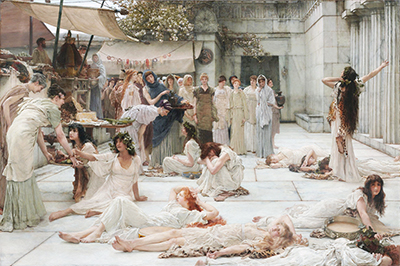
A woman in pale green bends towards a stranger on the pavement of a Greek marketplace. At the right, another woman gets to her feet and stretches, her dark hair hanging down her back. Others are still asleep on the stone. Lawrence Alma-Tadema set The Women of Amphissa at the moment when the townswomen who have stood watch can begin to help the women they have been guarding. The oil on canvas dates from 1887 and measures 122.5 by 184.2 centimetres. It is in the Clark Art Institute in Williamstown, Massachusetts, which acquired it in 1978 and catalogues it as 1978.12. The artist tucked his signature and the number Op. CCLXXVIII into a tambourine at the lower right. [1] [2]
At a Glance
- Date1887
- CollectionClark Art Institute, 1978.12
- SubjectThe women of Amphissa shelter the followers of Dionysus in the marketplace.
- Ancient sourcePlutarch, Virtues of Women
This work across Lawrence Alma-Tadema’s career
Contents
- What happened at Amphissa?
- How a marketplace becomes a place of shelter
- An imagined square and a heavily revised canvas
- From sleeping maenads to the women who protect them
- Exhibitions and responses
What happened at Amphissa?
The story comes from the Greek author Plutarch’s On the Bravery of Women, part of the Moralia. He sets the episode during the Sacred War, after rulers from Phocis seized Delphi and the Thebans took up arms against them. A group of women devoted to Dionysus, whom Plutarch calls the Thyiades, wandered at night in a state of religious frenzy. They reached Amphissa without realising where they were, sank down in different parts of the marketplace and fell asleep. Amphissa was allied with the Phocians in Plutarch’s account. The local women feared mistreatment of the strangers because soldiers serving the Phocian rulers were in town. Plutarch tells the episode centuries after the war, as an example of conduct worthy of remembrance. [5] [6] [7] [8]
The women of Amphissa ran to the market and stood around the sleepers in silence. They kept their distance until the visitors woke, then offered food and looked after them individually. Finally, after securing their husbands’ consent, they saw the strangers safely to the frontier. The painting brings two stages of the account together. Some residents are still waiting in the background while others bend towards women who are already awake. The danger belongs to the story and the escort will come later. On the canvas, the change from standing guard to offering help takes place in the space between a reaching hand and a woman still on the ground. [1] [6] [8]
How a marketplace becomes a place of shelter
At the left, the pale green woman inclines her whole body towards the nearest visitor. Behind her, two more townswomen bow to different heights. The successive angles of their torsos lead the eye down from the standing group to the people on the paving. Further back, neatly arranged mantles and covered or pinned hair make the residents easy to pick out. Their heads form a loose line across the middle of the canvas. Plutarch describes the women surrounding the sleepers. The classicist Guy Hedreen reads this line and its turn at the left as the visible part of that circle. The companion arc would be on our side of the picture, a position that invites us to watch with the residents. [1] [2] [6] [8]
The foreground has a different rhythm. A red-haired woman props herself up, her face catching the light while her legs are still stretched along the pavement. To her right a woman with dark hair pushes up on both hands. One body remains almost level with the lower edge of the picture. The standing woman farther back on the right, with her elbows at different heights and one hand behind her head, takes the motion further. All these poses fit within the same interval of waking. The viewer can follow that change across several bodies while the women nearest the stalls are already leaning in. [1] [2] [8]
The ivy, animal skins and tambourines identify the visitors through attributes familiar from ancient depictions of Dionysian worship. At the edge of the market, awnings shelter displays of produce and game. Those carefully arranged goods face the scattered drapery and instruments of the women on the ground. A stall’s wares are within reach of the place where the women are waking, which makes the offer of food in Plutarch’s account easy to picture. The setting remains recognisable as a public market. Its temporary use as a place of shelter depends on how the townswomen occupy it. [1] [5] [6] [8]
What the residents are thinking is open to interpretation. The Clark catalogue reads Alma-Tadema’s scene in relation to Victorian debates about women’s conduct, observing that women identified with domestic care carry out their work here in a public place. Hedreen gives greater weight to the uncertainty of the encounter. Ancient literature and art could present maenads as formidable figures, and that tradition makes the outcome feel less assured to a viewer who catches the allusions. The gestures in the painting establish who stands by and who approaches. The quiet faces allow room for more than one account of what it costs the residents to come forward. [1] [8]
An imagined square and a heavily revised canvas
The building on the right has a deep doorway and an extended run of columns. Above the entrance, the rectangular relief panels draw on carved metopes from Temple E at Selinus in Sicily. The Clark catalogue also notes that a fish plate in the British Museum furnished a design for the circular medallion on a pier. These borrowings give the square detail at two different scales. The larger architecture sets the direction of the scene while the market awnings interrupt its stonework. Small ancient objects and architectural fragments come together in a setting devised for Plutarch’s episode. [1] [8]
The Clark’s technical examination shows how much of that arrangement took shape on the canvas. Infrared inspection makes some of the perspective lines below the architecture visible. X-rays reveal figures replaced or removed, alongside fountains, tambourines and plates that disappeared as Alma-Tadema worked. The reclining figures in the foreground were reworked so extensively that the radiographs are particularly difficult to interpret there. The examination also records thicker applications of light paint and thinner glazing in the dark passages. In the finished picture, a crisp junction between two slabs of paving can sit a few inches from the softly lit face of a sleeper. The same marble that makes the architecture look imposing gives the women’s bodies a plain surface against which the smallest change of posture shows. [1]
From sleeping maenads to the women who protect them
Alma-Tadema had painted exhausted worshippers well before 1887. The Van Gogh Museum dates its unfinished Exhausted Maenads after the Dance to about 1875. On that low, wide canvas three recumbent figures occupy the scene, with features such as the ritual staff still only partly worked out. A separate, finished version, After the Dance, singles out one reclining woman. The writer Carel Vosmaer saw that picture at the Grosvenor Gallery in the winter of 1882–83 and recorded his admiration for the warmth of the flesh against the dark animal skin. J. F. Heijbroek also traces the unfinished picture through Vosmaer’s diary. Vosmaer drew it, recorded Alma-Tadema giving it to him, and connected its subject to Plutarch. In the 1887 canvas, the sleeping body that had occupied him in those earlier works becomes one part of a much wider encounter. [8] [9] [10]
Dionysian attributes could carry a different story elsewhere in Alma-Tadema’s work. In Between Venus and Bacchus, a watercolour of 1882, Hedreen identifies a boy with a ritual staff and a girl with ivy and a tambourine beside a fountain. He reads the encounter through the play between worship and attraction. The tambourines in The Women of Amphissa still give the visitors a history, but with their owners lying in the square, they lie quiet too. [8]
George Eliot’s Daniel Deronda adds a Victorian route into the story. In Book II, Chapter XVII, Daniel has rescued Mirah from drowning and is taking her to the Meyrick household. He thinks of the women in Plutarch standing watch, tending the strangers and seeing them safely to the border. The example gives him confidence in the welcome his friends will offer Mirah. At the 1889 Paris exhibition, Eliot’s novel was named as the source of the painting. The earlier maenad works and Vosmaer’s reference to the Moralia show the longer life of the subject in Alma-Tadema’s work. The exhibition citation makes Eliot’s treatment of hospitality especially pertinent to the version in which the women who offer help take the title. [1] [8] [10] [11]
Exhibitions and responses
The Royal Academy showed the canvas in 1887 as no. 305. The Academy catalogue supplied an unattributed account of the incident that named the worshippers “Chyades”. As the Clark records, that spelling prompted a question in the Illustrated London News and a correspondent suggested the intended word was Thyades. A critic in the same paper praised the attention paid to feeling in the waking women and their protectors. Reviewing the British contribution to the Paris Exposition Universelle, where the picture received a gold medal in 1889, Claude Phillips admired aspects of the conception and execution but found the treatment too composed for the dramatic possibilities of the story. The difference comes down to what each critic expected of the women's restraint. [1] [8] [12]
British critics had already disagreed over Alma-Tadema’s Bacchic subjects. The Vintage Festival, painted in two versions for the dealer Ernest Gambart, depicts a Roman procession. The National Gallery of Victoria holds the smaller 1871 version on wood in its original frame. In 1883 John Ruskin objected to the painter’s repeated attention to Bacchic frenzy and what he saw as Roman corruption. In 1889 Frederic George Stephens defended the religious character of the revels in a pamphlet accompanying A Dedication to Bacchus, the painting now in Hamburg. Those arguments concerned the wider subject in Alma-Tadema’s work. The particular tension in the Greek marketplace comes from the stillness of women whose instruments suggest movement and sound. [13] [14] [15]
Mrs Thwaites lent The Women of Amphissa to the 1897 Guildhall exhibition, where it was no. 38. Her daughter, Mrs Yerburgh, lent it to the Royal Academy’s memorial exhibition in 1913. The Clark records that the painting passed down in the family before its sale at Christie’s in 1975. Alma-Tadema kept a version of the scene close at hand in another medium. He commissioned William Reynolds-Stephens to make a copper frieze based on the composition for his Grove End Road studio, where the relief appears in period photographs. The Clark’s purchase of the oil in 1978 was the first major acquisition of David Brooke’s directorship. The institute’s finding aid records a dedicated file on the painting in his papers. [1] [16] [17] [18]
In 2018 the Clark lent the canvas to the Harvard Art Museums for Animal-Shaped Vessels from the Ancient World. The museum setting gave visitors a reason to look closely at the objects in the square, just as Victorian reviewers did. To follow the story, the eye must travel from those painted things to the women using the space around them. The stalls establish what the square is for on an ordinary day. The women gathered on the stone show what they can make it do for strangers. [1] [2] [19]
Further reading
The Women of Amphissa. Clark Art Institute, 1978.12
Explore the painting and the Clark’s account of its source in Plutarch. View source.
Lawrence Alma-Tadema artworks directory
Search by title or medium. The directory includes Alma-Tadema’s numbered compositions, separately catalogued fragments, and selected drawings and historic prints. Dates for unlinked works follow the catalogue’s year groupings. View the numbered opus catalogue
| Name | Date | Medium |
|---|---|---|
| Portrait of my sister Artje | 1851 | Painting |
| Selfportrait | 1852 | Painting |
| Portrait of my mother (oval) | 1852 | Painting |
| The alm | 1856 | Painting |
| The inundation of the Biesbosch in 1421 | 1857 | Painting |
| The destruction of Terdoest Abbey in 1571 | 1857 | Painting |
| Faust en Marguerite | 1857 | Watercolour |
| Clotilde at the tomb of her grandchildren | 1858 | Painting |
| Marius on the ruins of Carthage | 1858 | Watercolour |
| The sad father: the unfavourable oracle (Death of the first-born, first version) | 1859 | Painting |
| The death of Attila, 453 AD | 1859 | Watercolour |
| Triumphal return of Sir Willem van Saeftingen | 1860 | Painting |
| The death of Hippolyte | 1860 | Watercolour |
| The Education of the Children of Clovis | 1861 | Painting |
| Venantius Fortunatus reading his poems to Radagonda VI | 1862 | Painting |
| Gunthram Bose and his daughters, 572 AD: the Ambuscade | 1862 | Painting |
| A medieval Flemish interior | 1863 | Painting |
| Pastimes in Ancient Egypt: 3.000 years ago | 1863 | Painting |
| Interior of the Church San Clemente, Rome: a study | 1863 | Painting |
| Queen Fredegonda at the deathbed of Bishop Praetextatus (first version) | 1864 | Painting |
| Leaving Church in the fifteenth century | 1864 | Painting |
| Egyptian Chess Players (An Egyptian Game) | 1865 | Painting |
| Birthday presents in the sixteenth century | 1865 | Painting |
| Gallo-Roman women | 1865 | Painting |
| Entering Church in the fourteenth century | 1865 | Painting |
| An Egyptian at his doorway in Memphis | 1865 | Painting |
| Catallus ten huize van Lesbia | 1865 | Painting |
| The discourse | 1865 | Painting |
| A Roman scribe writing despatches | 1865 | Painting |
| A soldier of Marathon | 1865 | Painting |
| Home from market | 1865 | Painting |
| Death of Galeswinthe | 1865 | Painting |
| An Egyptian Game (preparatory drawing) | 1865 | Drawing |
| Making wreaths for festivities in a Pompeian house | 1866 | Painting |
| Vespasian hearing of the taking of Jerusalem by Titus | 1866 | Painting |
| Entrance to a Roman theatre | 1866 | Painting |
| In the peristyle | 1866 | Painting |
| Agrippina visiting the ashes of Germanicus | 1866 | Painting |
| Tibullus at Delia's | 1866 | Painting |
| A Roman dance | 1866 | Painting |
| Lesbia weeping over a sparrow | 1866 | Painting |
| The armourer's shop in ancient Rome | 1866 | Painting |
| The Education of the Children of Clovis (Rennefeld print after Alma-Tadema) | 1866 | |
| The mummy: Roman period: Egyptians lamenting their dead | 1867 | Painting |
| The honeymoon | 1867 | Painting |
| Cuckoo | 1867 | Painting |
| The aesthetic view: Madame Dumoulin, Pauline, and Laurence | 1867 | Painting |
| Glaucus and Nydia | 1867 | Painting |
| Portrait of Mr A. Bonnefoy | 1867 | Painting |
| Proclaiming Claudius Emperor | 1867 | Painting |
| A sculpture gallery in Rome at the time of Augustus | 1867 | Painting |
| A collector of pictures at the time of Augustus | 1867 | Painting |
| Tarquinius Superbus before Galba | 1867 | Painting |
| A Roman family | 1867 | Painting |
| Italian women | 1867 | Painting |
| Portrait of Madame Bonnefoy and Mr Puttemans | 1867 | Painting |
| The siësta (first version) | 1868 | Drawing |
| The embarkation | 1868 | Painting |
| The siësta (second version) | 1868 | Painting |
| A Roman art lover | 1868 | Painting |
| Woman and flowers | 1868 | Painting |
| Phidias and the Parthenon, Athens | 1868 | Painting |
| The flower girl | 1868 | Painting |
| A Roman flower market: Pompeii | 1868 | Painting |
| Egyptian game | 1868 | Watercolour |
| Education of the children of Clovis | 1868 | Painting |
| A Roman art lover: silver statue | 1868 | Painting |
| Egyptian dancing girls | 1868 | Watercolour |
| Catalina | 1869 | Painting |
| The visit: Sunday morning before churching (first version): a birth chamber, seventeenth century | 1869 | Painting |
| The Pyrrhic dance | 1869 | Painting |
| The Grand Chamberlain of Sesostris the Great | 1869 | Painting |
| The convalescent | 1869 | Painting |
| Confidences | 1869 | Painting |
| A Greek Woman | 1869 | Painting |
| At the wine shop | 1869 | Painting |
| An Exedra (first version) | 1869 | Painting |
| Portrait of Master Ernest Angely | 1870 | Painting |
| A juggler | 1870 | Painting |
| A nurse, seventeenth century: Sunday morning (second version) | 1870 | Watercolour |
| Roman art lover (the runner ) | 1870 | Painting |
| Anacreon reading his poems at Lesbia's house | 1870 | Painting |
| The vintage festival (first version) | 1870 | Painting |
| The first whisper of love | 1870 | Painting |
| The letter: from an absent one (first version) | 1870 | Painting |
| A staircase (first version) | 1870 | Painting |
| Hush, she sleeps | 1870 | Painting |
| The letter: from an absent one (second version) | 1871 | Watercolour |
| The vintage festival (second version) | 1871 | Painting |
| A Roman Emperor (second version) | 1871 | Painting |
| In the temple (first version) | 1871 | Painting |
| Portrait of Miss Laura Theresa Epps | 1871 | Painting |
| A Bacchic dance | 1871 | Painting |
| Fredegonda and Praetextatus (second version) | 1871 | Painting |
| Portrait study for Mrs H.W. Mesdag | 1871 | Painting |
| Greek potters | 1871 | Painting |
| An exedra (second version) | 1871 | Watercolour |
| Sunday morning: the two sisters (third version) | 1871 | Painting |
| In the temple (second version) | 1872 | Watercolour |
| The first reproach | 1872 | Painting |
| An Egyptian widow | 1872 | Painting |
| Improvisatore | 1872 | Painting |
| A halt (first version) | 1872 | Painting |
| The last roses | 1872 | Painting |
| Death of the first-born (second version) | 1872 | Painting |
| Portrait of Dr Franz and Mrs Catherine Hueffer 'When I am dead, oh dearest sing' | 1872 | Painting |
| The nurse | 1872 | Painting |
| Greek wine (first version) | 1872 | Painting |
| Goldfish (first version) | 1872 | Painting |
| On a Roman staircase (second version) | 1872 | Watercolour |
| Hercules | 1872 | Painting |
| Portrait of Miss Kate Thompson | 1873 | Painting |
| The dinner (first version) | 1873 | Painting |
| The siësta (third version) | 1873 | Painting |
| A visit to the studio (second version) | 1873 | Watercolour |
| Cherries | 1873 | Painting |
| Greek wine (second version) | 1873 | Watercolour |
| This is our corner | 1873 | Painting |
| A picture gallery (third version) | 1873 | Painting |
| The last roses (second version) | 1873 | Watercolour |
| Fishing (first version) | 1873 | Painting |
| Music has charms | 1873 | Watercolour |
| Counting the passers-by | 1873 | Watercolour |
| Portrait of Mrs Frederick George Stephens | 1873 | Painting |
| Two heads from 'The Picture Gallery': A visit to the studio by Charles W. Deschamps and his wife (first version) | 1874 | Watercolour |
| Joseph, overseer of Pharaoh's granaries | 1874 | Painting |
| A sculpturegallery (first version) | 1874 | Painting |
| A picture gallery in Rome at the time of Augustus (fourth version) | 1874 | Painting |
| Portrait of Charles W. Deschamps and his wife (second version) | 1874 | Painting |
| Autumn | 1874 | Watercolour |
| Reflections: fishing (second version) | 1874 | Painting |
| A Roman artist | 1874 | Watercolour |
| Good friends | 1874 | Watercolour |
| On the steps of the Capitol (first version) | 1874 | Painting |
| Water pets: goldfish (second version) | 1874 | Painting |
| Münster Cathedral | 1874 | Painting |
| Landscape near Münster | 1874 | Painting |
| Antistius Labeon, 75 AD: A Roman amateur artist | 1874 | Painting |
| Sunny days | 1874 | Painting |
| Spring flowers: garland seller on the steps of the Capitol (second version) | 1874 | Watercolour |
| Through an archway | 1874 | Painting |
| (A, B) Decoration for my piano: 'Serious and merry music' | 1874 | Painting |
| Rêverie | 1874 | Painting |
| The Roman architect | 1874 | Painting |
| Sunflowers | 1874 | Painting |
| Landscape: carriage drive by the outskirts of a wood, Penhill Castle | 1875 | Painting |
| A peep through the trees | 1875 | Painting |
| Cleopatra (first version) | 1875 | Painting |
| (a, b, c) The tragedy of an honest wife | 1875 | Watercolour |
| The architect of the Coliseum | 1875 | Watercolour |
| Fishing | 1875 | Watercolour |
| Cherry blossom | 1875 | Painting |
| Water pets: goldfish (third version) | 1875 | Painting |
| 'There he is!' | 1875 | Painting |
| Play Garden | 1875 | Painting |
| Portrait of Miss Thackeray's 'Elisabeth' | 1875 | Painting |
| A nymphaeum from the Villa Aldobrandini in Rome | 1875 | Painting |
| Haystacks | 1875 | Painting |
| A sculpture gallery (second version) | 1875 | Painting |
| After the dance: a bacchanal | 1875 | Painting |
| Landscape: a breezy day in August near Innsbruck | 1875 | Painting |
| The service | 1875 | Painting |
| An audience at Agrippa's (first version) | 1875 | Painting |
| Kriemhild’s Tryste | 1875 | |
| Portrait of my wife | 1876 | Painting |
| Between hope and fear | 1876 | Painting |
| 94 Degrees in the Shade | 1876 | Painting |
| An antique custom | 1876 | Painting |
| Portrait of Jules Dalou, his wife and his daughter | 1876 | Painting |
| Pleading (first version) | 1876 | Painting |
| Hide and seek | 1876 | Painting |
| Balneatrix | 1876 | Watercolour |
| A mirror | 1877 | Painting |
| An interesting scroll | 1877 | Watercolour |
| Winter | 1877 | Painting |
| Autumn-vintage festival | 1877 | Painting |
| Summer | 1877 | Painting |
| Spring in the gardens of the Villa Borghese (first version) | 1877 | Painting |
| A balneator | 1877 | Watercolour |
| Painting in Ancient Rome | 1877 | Painting |
| A balneatrix | 1877 | Painting |
| The sculptor's model (Venus Esquilina) | 1877 | Painting |
| The sculptor's studio in ancient Rome | 1877 | Painting |
| Architecture in ancient Rome | 1877 | Painting |
| Cleopatra (second version) | 1877 | Painting |
| Spring in the gardens of the Villa Borghese (second version) | 1877 | Painting |
| Panel for H. W. Mesdag's studio door: Spring in the gardens of the Villa Borghese (third version) | 1877 | Painting |
| The question: Pleading (second version) | 1877 | Painting |
| A kitchen garden | 1877 | Painting |
| Flora: Spring in the gardens of the Villa Borghese (fourth version) | 1877 | Watercolour |
| A silent counsellor | 1878 | Watercolour |
| A sollicitation | 1878 | Watercolour |
| A hearty welcome | 1878 | Painting |
| A landscape | 1878 | Painting |
| In the time of Constantine | 1878 | Painting |
| A love missile | 1878 | Painting |
| Fredegonda en Galswintha, 566 AD | 1878 | Painting |
| A safe confidant | 1878 | Painting |
| After the audience (second version) | 1879 | Painting |
| Strigils andsponges | 1879 | Watercolour |
| E festival in Pomona | 1879 | Painting |
| Prose | 1879 | Painting |
| Going down to the river | 1879 | Painting |
| The Roman wine tasters | 1879 | Watercolour |
| Portrait of th singer George Henschel Esq. at the piano | 1879 | Painting |
| Poetry | 1879 | Painting |
| A well-protected slumber | 1879 | Painting |
| A garden altar | 1879 | Painting |
| Beauties | 1879 | Painting |
| Portrait of Thekla Friedländer | 1879 | Unspecified |
| On the road to the Temple of Ceres: A springfestival | 1879 | Painting |
| Autumn (third version) | 1879 | Drawing |
| 'Not at home' | 1879 | Painting |
| An old bachelor after the bath | 1879 | Watercolour |
| Spring (Blanchard print after Alma-Tadema’s 1877 painting) | 1879 | |
| The first course: the dinner | 1880 | Painting |
| Interrupted | 1880 | Painting |
| Grapes | 1880 | Watercolour |
| A pastoral | 1880 | Painting |
| A portrait of Dr Felix and Mrs August Redeker Semon | 1880 | Painting |
| Ave Caesar! Io Saturnalia! (third version) | 1880 | Painting |
| A prize for the artist's corps | 1880 | Painting |
| The departure (first version) | 1880 | Painting |
| A harvest festival | 1880 | Painting |
| 'Your carriage stops the way' | 1880 | Painting |
| Autumn (Scene in a Roman Garden) | c.1880 | Drawing |
| The torch dance | 1881 | Painting |
| Sappho and Alcaeus | 1881 | Painting |
| A kiss | 1881 | Watercolour |
| A Bacchante dancing before the thymele | 1881 | Watercolour |
| An audience | 1881 | Painting |
| Portrait of Dr Hans Richter | 1881 | Painting |
| Pandora | 1881 | Watercolour |
| The Tepidarium | 1881 | Painting |
| Quiet pets | 1881 | Painting |
| A priestess of Apollo | 1881 | Watercolour |
| A difficult line from Horace (first version) | 1881 | Painting |
| A stranger in my studio (one of a pair) | 1881 | Painting |
| Amo te ama me | 1881 | Painting |
| The First Course–The Dinner (Löwenstam print after Alma-Tadema) | 1881 | |
| Young affections | 1882 | Painting |
| A difficult line from Horace (second version) | 1882 | Drawing |
| Portrait of John F. Whichcord Esq., PRIBA, FSA | 1882 | Painting |
| Portrait of Ludwig Barnay as Marcus Antonius | 1882 | Painting |
| The way to the temple | 1882 | Painting |
| A parting kiss | 1882 | Painting |
| Reflections | 1882 | Painting |
| Between Venus and Bacchus | 1882 | Watercolour |
| Dolce far niente (first version) | 1882 | Watercolour |
| Dolce far niente (second version) | 1882 | Painting |
| An Oleander | 1882 | Painting |
| The meeting of Antony and Cleopatra | 1883 | Painting |
| Portrait of Catherine, Duchess of Cleveland | 1883 | Painting |
| Portrait of my daughter Anna Alma-Tadema | 1883 | Painting |
| Shy | 1883 | Painting |
| Portrait of His Excellency the Duke of Bylandt | 1883 | Painting |
| Una Carita: The three graces: Laura, Laurence, and Anna | 1883 | Painting |
| Portrait of Leopold Lowenstam, the engraver | 1883 | Painting |
| Portrait of Lady Thompson | 1883 | Painting |
| Portrait of Professor Giovanni Battista Amendola | 1883 | Painting |
| 'Der alte Menander ist doch nicht gestorben!' Paulus and Hermas | 1883 | Drawing |
| A street altar | 1883 | Watercolour |
| Welcome Footsteps (The Well-Known Footsteps) | 1883 | Painting |
| A declaration: an old, old story | 1883 | Watercolour |
| Xanthe and Phaon | 1883 | Watercolour |
| Selfportrait | 1883 | Painting |
| Hadrian in England: visiting a Roman-British Pottery (original, later divided) | 1884 | Painting |
| A Roman-British pottery | 1884 | Painting |
| Emperor Hadrian's visit to a British pottery | 1884 | Painting |
| A Roman-British potter | 1884 | Painting |
| Portrait of Miss Alice Lewis | 1884 | Painting |
| Who is it? | 1884 | Painting |
| Portrait of Moses Ezekiel | 1884 | Painting |
| Portrait of Sir Francis Powell | 1884 | Painting |
| Egyptien à l’entrée de sa demeure (Ramus print after Alma-Tadema) | 1884 | |
| Expectations | 1885 | Painting |
| A Reading from Homer | 1885 | Painting |
| Portrait of Dr Wahington Napoleon Epps: my docter | 1885 | Painting |
| The triumph of Titus: the Flavians | 1885 | Painting |
| Ariadne | 1885 | Painting |
| Portrait of Mrs W. M. Baker | 1885 | Painting |
| Rose of all roses | 1885 | Painting |
| A foregone conclusion | 1885 | Painting |
| A apodyterium | 1886 | Painting |
| Portrait of James Reld Esq. | 1886 | Painting |
| Portrait of Mrs Frank D. Millet | 1886 | Painting |
| A secret | 1887 | Painting |
| The Women of Amphissa | 1887 | Painting |
| A new dress | 1887 | Watercolour |
| 'He loves me, he loves me not' | 1887 | Painting |
| Illuminated letter 'W' for the Royal Academy address to Queen Victoria | 1887 | Watercolour |
| Portia | 1887 | Painting |
| The Roses of Heliogabalus | 1888 | Painting |
| Fair tresses: a sketch | 1888 | Painting |
| Midday slumbers | 1888 | Watercolour |
| Portrait of the honourable Adama van Scheltema | 1888 | Painting |
| Venus and Mars | 1888 | Painting |
| Portrait of Jules de Soria | 1888 | Painting |
| At the shrine of Venus | 1888 | Painting |
| The Favourite Poet | 1888 | Painting |
| The Favourite Poet (Löwenstam print after Alma-Tadema) | c.1888 | |
| Sisters | 1889 | Painting |
| Cloaked in yellow | 1889 | Painting |
| A dedication to Bacchus (first version) | 1889 | Painting |
| A dedication to Bacchus (second version) | 1889 | Painting |
| Portrait of Mrs Ralph Sneyd | 1889 | Painting |
| Portrait of Miss MacWhirter (Mrs Charles Sims) | 1889 | Painting |
| Portrait of young gentleman John Parsons Millet | 1889 | Painting |
| In a rose garden | 1889 | Painting |
| A Silent Greeting | 1889 | Painting |
| Portrait of Sir Ernest A. Waterlow, Esq., RA | 1889 | Painting |
| Eloquent silence | 1890 | Painting |
| The Frigidarium | 1890 | Painting |
| Promise of Spring | 1890 | Painting |
| Portrait of Miss Agnes Marks | 1890 | Painting |
| Rêverie: a sketch | 1890 | Painting |
| Portrait of the Right Hon. Arthur James Balfour | 1891 | Painting |
| An earthly paradise | 1891 | Painting |
| Love's votaries; Love in idleness | 1891 | Painting |
| Portrait of the Honourable Archdean Watkins of Durham, DD | 1891 | Painting |
| Portrait of Alfred Waterhouse Esq. RA | 1891 | Painting |
| Portrait of Ignacy Jan Paderewski | 1891 | Painting |
| The kiss | 1891 | Painting |
| Calling the worshippers | 1892 | Watercolour |
| The poet Gallus dreaming | 1892 | Painting |
| Courtship | 1892 | Painting |
| Comparisons | 1892 | Painting |
| The inner sanctuary | 1892 | Painting |
| Portrait of Dr Joseph Joachim | 1893 | Painting |
| In the corner of my studio | 1893 | Painting |
| Portrait of Mrs Charles Wyllie | 1893 | Painting |
| Unconscious Rivals | 1893 | Painting |
| Godspeed | 1893 | Painting |
| Portrait of Mrs Theyre Smith | 1893 | Painting |
| At the close of a joyful day | 1894 | Painting |
| The benediction | 1894 | Painting |
| Spring | 1894 | Painting |
| Past and present generations | 1894 | Painting |
| God Speed (Löwenstam print after Alma-Tadema) | 1894 | |
| Love's jewelled fetter | 1895 | Painting |
| Fortune's favourite | 1895 | Painting |
| Portrait of Mrs Roland Hill and her children | 1895 | Painting |
| Portrait of George Simmonds and family | 1895 | Painting |
| Unwelcome confidence | 1895 | Painting |
| A Coign of Vantage | 1895 | Painting |
| Portrait of Mrs Marcus Stone | 1895 | Painting |
| Whispering Noon | 1896 | Painting |
| The Coliseum | 1896 | Painting |
| Familygroup | 1896 | Painting |
| Portrait of Miss Onslow Ford | 1896 | Painting |
| A Difference of Opinion | 1896 | Painting |
| Portrait of Maurice Sons Esq. playing the violin in Alma-Tadema's studio | 1896 | Painting |
| Selfportrait | 1896 | Painting |
| 'Nobody asked you sir!' she said | 1896 | Watercolour |
| Portrait of J. M. Zarifi Esq. | 1897 | Painting |
| Watching and waiting | 1897 | Painting |
| 'Her eyes are with her thoughts, and they are far away' | 1897 | Painting |
| Wandering thoughts | 1897 | Painting |
| Melody on a Mediterranean terrace | 1897 | Painting |
| Roses, love's delight | 1897 | Painting |
| A Difference of Opinion (Boulard print after Alma-Tadema) | 1897 | |
| Portrait of Lady Sydney (Margaret) Waterlow | 1898 | Painting |
| The conversion of Paula by St. Jerome | 1898 | Painting |
| Portrait of Tine Son-Maris | 1898 | Painting |
| Hero | 1898 | Painting |
| Portrait of Mrs George Lewis and her daughter Elisabeth | 1899 | Painting |
| The listeners | 1899 | Painting |
| Attracted: watchers | 1899 | Watercolour |
| The Baths of Caracalla (Thermae Antoninianae) | 1899 | Painting |
| Bluebells | 1899 | Painting |
| Study for Thermaie Antoniniane | 1899 | Drawing |
| A flag of truce | 1900 | Painting |
| Goldfish (fourth version) | 1900 | Painting |
| Portrait of Mrs Armour from Princeton | 1900 | Painting |
| Portrait of George Aitchison, PRIBA, RA | 1900 | Painting |
| Vain courtship | 1900 | Painting |
| Under the roof of blue Ionian weather | 1901 | Painting |
| Death of the first born (third version) | 1901 | Drawing |
| A priestess of Hymen | 1901 | Watercolour |
| Fair tresses | 1901 | Painting |
| Impatient | 1901 | Watercolour |
| Portrait of Sir Max Waechter High Sheriff of Sussex | 1901 | Painting |
| The year's at the spring, all's right with the world | 1902 | Painting |
| Caracalla | 1902 | Painting |
| A crown | 1902 | Watercolour |
| Amongst the ruins | 1902 | Painting |
| Silver Favourites | 1903 | Painting |
| A peaceful wooing | 1903 | Painting |
| The ever-new horizon | 1903 | Painting |
| Thalia's homage to Aesculapius | 1904 | Drawing |
| The Finding of Moses | 1904 | Painting |
| A world of their own | 1905 | Painting |
| Ask Me No More | 1906 | Painting |
| Entering the Coliseum (first version) | 1907 | Watercolour |
| Geta and his sister | 1907 | Drawing |
| Caracalla and Geta | 1907 | Painting |
| Orante (oval, one of a pair) | 1907 | Painting |
| Bacchante (oval, one of a pair) | 1907 | Painting |
| Melodie del mare e dell'amore | 1907 | Watercolour |
| Youth | 1907 | Watercolour |
| Portrait of myself for the R. Accademia Romana di San Luca | 1907 | Painting |
| The golden hour | 1907 | Painting |
| At Aphrodite’s Cradle | 1908 | Painting |
| A message of love | 1909 | Painting |
| A Favourite Custom | 1909 | Painting |
| Splashing | 1909 | Drawing |
| Portrait of Mrs Washington Epps | 1909 | Drawing |
| Hopeful | 1909 | Painting |
| Portrait of Dr J. M. W. van der Poorten-Schwartz (Maarten Maartens) | 1909 | Drawing |
| Portrait of Ilona Eibenschutz | 1909 | Painting |
| The voice of spring | 1910 | Painting |
| Principal figure of 'The voice of spring' | 1910 | Drawing |
| A border for the King's letter to the nation | 1910 | Drawing |
| Heading: the Royal Academy address to H.M. King George on his accession to the throne | 1910 | Watercolour |
| Title unknown | 1910 | Unspecified |
| When flowers return (one of a pair) | 1911 | Painting |
| Summer Offering | 1911 | Painting |
| Title unknown | 1911 | Unspecified |
| Entering the Coliseum (second version) | 1911 | Painting |
| Portrait of William Whitaker Thompson Esq. | 1911 | Painting |
| Portrait of myself for the R. Accademia Romana di San Luca | 1912 | Painting |
| Preparations in the Coliseum | 1912 | Painting |
Discussion
Look again at the images and ideas explored in The Women of Amphissa. These editorial prompts invite your observations.
Reader Insights
Where do the standing women begin to form a protective group?
What parts of Plutarch’s account can you see most clearly in the painting?
Join the Conversation
Share a detail, comparison or question about The Women of Amphissa below.
References
- Elizabeth A. Pergam and Sandra L. Webber, Nineteenth-Century European Paintings at the Sterling and Francine Clark Art Institute, vol. I, entry 3 and technical report, pp. 7–11. View source.
- Clark Art Institute, Clark SIX, The Women of Amphissa, object interpretation and image. View source.
- Walters Art Museum, Sappho and Alcaeus. View source.
- Philadelphia Museum of Art, A Reading from Homer. View source.
- Plutarch, Mulierum virtutes, Greek text, section XIII, 249E–F. View source.
- Plutarch, On the Bravery of Women, section XIII, 249E–F, translated by Frank Cole Babbitt, Loeb Classical Library, 1931. View source.
- Warburg Institute, Iconographic Database, Alma-Tadema, The Women of Amphissa, WPC-WID-ARSD. View source.
- Guy Hedreen, ‘Sir Lawrence Alma-Tadema’s “Women of Amphissa”’, The Journal of the Walters Art Gallery 52/53, 1994–95, pp. 79–92. View source.
- Van Gogh Museum, Catalogue of Acquisitions, Van Gogh Museum Journal 1996, pp. 193–94, entry s 458 S/1996. View source.
- J. F. Heijbroek, ‘The Exhausted Maenads’, Van Gogh Museum Journal 1996, pp. 166–70, figs. 4–9. View source.
- George Eliot, Daniel Deronda, Book II, Chapter XVII, closing paragraphs. View source.
- Algernon Graves, The Royal Academy of Arts, vol. I, p. 29, 1887 exhibition, no. 305. View source.
- National Gallery of Victoria, The Vintage Festival, object record p.312.7-1, inscription, provenance and frame. View source.
- Michelle Bonollo, ‘From old world to new’, National Gallery of Victoria, Art Journal 39, discussion of the two versions and nn. 57–59. View source.
- Hamburger Kunsthalle, Sculptural, object entry for Eine Weihung an Bacchus, 1889. View source.
- A. G. Temple, Descriptive Catalogue of the Loan Collection of Pictures, Guildhall Art Gallery, 1897, gallery I, no. 38. View source.
- Clark Archives, The Records and Papers of David Brooke, Director, 1977–1996, CAI ARC 2007.06, Scope and Content. View source.
- Clark Archives, ‘Alma-Tadema Women of Amphissa’, CAI ARC 2007.06, box 4, folder 13. View source.
- Clark Art Institute, Annual Report FY2019, p. 12, Loans, Harvard Art Museums, 2018–19. View source.