 by Tom Gurney
Tom Gurney BSc (Hons) is an art history expert with over 20 years experience
Email: tomgurney1@gmail.com / Phone: +44 7429 011000
Sappho and Alcaeus: Introduction
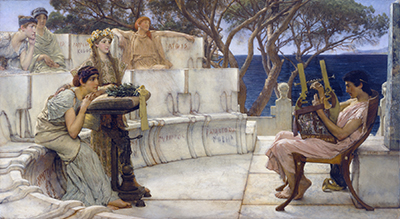
Sappho sits low on a marble bench, leaning towards the musician across the paved space. Behind her, a young woman in a flower wreath rests a hand on her shoulder. Further back, another stretches both arms along the stone and looks towards the sea. In Lawrence Alma-Tadema’s Sappho and Alcaeus, the poet who is playing has an audience of his own, but the picture keeps drawing us back to the poet who listens. The Walters Art Museum in Baltimore holds the 1881 painting, an oil on panel measuring 66 × 122 cm. It records Alma-Tadema’s signature and the inscription Op CCXXIII at the lower right. [1]
At a Glance
- Date1881 [1]
- MediumOil on panel, 66 × 122 cm [1]
- CollectionThe Walters Art Museum, 37.159 [1]
- OpusCCXXIII [1]
This work across Lawrence Alma-Tadema’s career
Contents
- How the painting makes us listen
- How Athens became Lesbos
- From ancient verse to a painted performance
- From the Royal Academy to Baltimore
How the painting makes us listen
Alcaeus sits at the right on a reddish wooden chair, looking down towards the instrument the Walters identifies as a kithara. Its upright arms and fine strings interrupt the horizontal band of blue water. His pale rose clothing hangs in loose folds around his legs, and his bare feet meet the stone just inside the space bounded by the chair legs. Sappho leans in from the opposite side. Her hands come together at the edge of a cushion on a dark stand. A glossy wreath with a yellow ribbon lies on it, its leaves catching the light against the marble. Each poet is seen in profile, but their eyes follow different paths. Sappho watches Alcaeus, while his attention appears to stay with the strings. [1]
The width of the panel gives the performance room. A wide stretch of pavement runs between the two figures. The empty stone lets us register how far Sappho leans forward and how little Alcaeus moves in response. Further back, the partly obscured steps mark a way down behind the seating. Trunks and branches divide the open sea into irregular intervals, and a distant strip of shore lies behind the musician. The dark water and grey-green foliage also give the pale seats definition, making every joint, patch of yellow-brown discolouration and faint vein easier to see. [1] [4]
The women on the left vary the rhythm. One props her chin on her hand and turns sharply towards the performance. Another sits upright under a dark headband. The woman nearest Sappho keeps her hand on the poet’s shoulder even as Sappho leans away from her. Movement then opens outward in the red-haired woman’s pose. The Saturday Review, in a notice preserved in the 1915 Walters collection catalogue, remarked on this spread of attentive and apparently indifferent listeners and imagined someone waiting for the red-haired woman across the water. The distant lover belonged to the reviewer’s story. The figure’s turned face and spread arms supply enough of a change in attention on their own. [1] [4]
How Athens became Lesbos
The setting evokes the island of Lesbos, the home of the two poets in the late seventh and early sixth centuries BCE. The seating has a different origin. The Walters identifies the Theatre of Dionysos in Athens as Alma-Tadema’s model. Its front row had places of honour reserved for priests, officials and other distinguished spectators. Surviving inscriptions identify those entitlements. One Athenian seat, for example, carries inscriptions from two occasions, the later one assigning it to the priest of Antinoos. The comparison shows what the lettering did in an actual theatre. A carved label gave a spectator a formally recognised place. [1] [5] [6]
Alma-Tadema gave the same kind of prominence to names connected with Sappho’s poetry. Follow the curve of the seats and the names appear on different surfaces, partly lost behind a body or a piece of furniture. Atthis is visible by the outstretched arm on the upper tier, while the letters associated with Anaktoria and Gyrinno appear on the lower fronts. The positions help make the names look as though they belong to the furniture. Anaktoria is the absent woman whom the speaker remembers in fragment 16. On the terrace her name contributes to the gathering without identifying the nearest figure. The artist’s choice also puts the intimate world of the songs into architectural forms associated with public honour. [1] [6] [7]
Oscar Wilde advised on the Greek. His surviving reply, placed in late 1880 or early 1881, explains that the earliest Aeolic coinage he knew was several decades later than the date he assigned to Sappho and that he lacked inscriptions contemporary with her. He used the coin as a starting point for the letter forms and recommended Mnasidika in place of the Mnasidion proposed in the correspondence. He also suggested Gyrinnos, describing it as an Aeolic form of Gyrinna. María S. Sergueeva identifies the form more specifically as a genitive, which makes good sense on a seat where a name can mean ‘of Gyrinno’. [7] [8]
Wilde offered a further possibility. The marble might carry the opening of Sappho’s fragment 31, the poem in which the speaker watches a man sitting close to the person she desires. The suggestion followed a conversation about Catullus, whose poem 51 reworked Sappho’s lines in Latin. Wilde’s Greek used a digamma, an old letter resembling an F, in a variant preserved by an ancient grammarian. The openings of songs could be as difficult to reconstruct as the shapes of letters. In the finished painting, the names are the literary clues that remain visible. [7] [8]
From ancient verse to a painted performance
Sappho and Alcaeus belonged to the lyric tradition of Lesbos. The Walters connects Alma-Tadema’s scene with Hermesianax, a Hellenistic poet writing centuries after them. Athenaeus quotes the passage in book 13 of the Deipnosophistae, at 598b. In it Hermesianax describes Alcaeus playing his lyre in the grip of desire for Sappho and brings in Anacreon as a rival. Elsewhere in the same discussion Athenaeus questions the chronology that would make Sappho and Anacreon contemporaries. The poem belongs to an ancient tradition of inventing love stories about earlier poets. The marble auditorium and its attentive gathering are Alma-Tadema’s way of giving one such story a setting. [1] [5] [9]
Aristotle preserves a different encounter in the Rhetoric (1.1367a). He quotes lines in which Alcaeus hesitates to say something and Sappho replies that honourable words would give him no reason for shame. Scholars have disputed whether the passage was composed by Sappho alone, whether the lines belong to different poets and how an exchange like this might have been performed. The metre resembles one Alcaeus used, a clue Gregory Nagy takes as grounds to consider Alcaeus the composer of both voices. The two roles could be performed together even if one poet wrote the whole exchange. The fragment offers a repartee between poetic voices. The painting, with one musician playing and the other held in a listening pose, chooses a different point in the imagined exchange. [5] [9]
The two had already been pictured together in antiquity. On a red-figure vessel of about 470 BCE now in Munich, each holds a stringed instrument. Small circles emerge from Alcaeus’s mouth to indicate song. Sappho turns towards him with an instrument of her own, which gives the scene the possibility of a reply. Another useful comparison is an Attic flask of about 420 BCE at the Metropolitan Museum of Art. Apollo plays the lyre for Urania and another Muse. The flask supplies an ancient parallel for a player facing an audience, while the museum’s identification of the kithara in Alma-Tadema’s picture comes from its own catalogue. [1] [5] [10] [11]
A Victorian parallel is Albert Moore’s A Quartet of 1868. Moore placed modern bowed instruments among figures in classical dress, and used the play of colours and contours to suggest musical harmony. In Alma-Tadema’s panel it is just as rewarding to follow the rhythm of repeated lines, from the rims of the marble seats to the spaced trunks and the strings. The carved names and the particular posture of Sappho, however, keep the experience tied to these two poets and this imagined occasion. [1] [12]
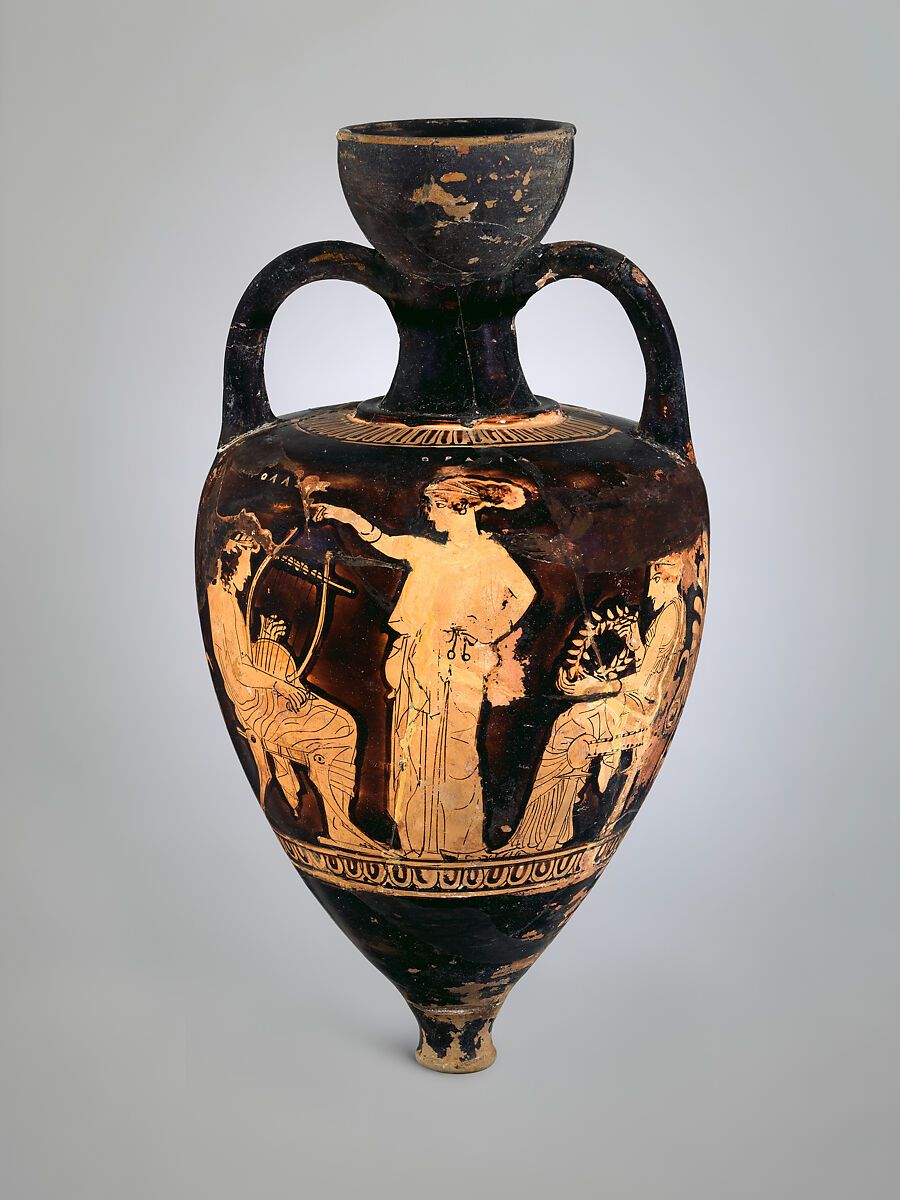
Apollo plays the lyre for Urania and another Muse. Attic red-figure flask, c. 420 BCE. Metropolitan Museum of Art, 19.192.44. Image source. CC0 / Public domain.
From the Royal Academy to Baltimore
The Royal Academy exhibited the painting as Sappho in 1881, catalogue number 269. The Athenaeum review of 30 April, reprinted in the Walters catalogue, imagined that Alcaeus was trying to win Sappho’s support for a political cause. William Powell Frith offered a rather different record of the show in Private View at the Royal Academy, 1881, painted in 1883. At the far right of Frith’s crowded gallery John Everett Millais looks closely at the Alma-Tadema. Once again, a work about the character of an audience has become the object of someone’s absorbed attention. [4] [13] [14]
Simon Goldhill has drawn attention to a second drama in the picture, in the interval between Sappho and Alcaeus and in the physical contact between Sappho and the woman beside her. That touch is easy to miss when the painting is reduced to the story of a man singing to a woman. Trace the flower-crowned woman’s arm as it reaches down to Sappho’s shoulder and another kind of intimacy enters the scene, closer and quieter than the music crossing the open floor. The historic title is a useful prompt to follow these relationships back to the woman at their centre. [1] [13] [15]
The Royal Society displayed the work in its Council Room at Burlington House on 21 June 1882. Its account calls the picture a highlight of the soirée, part of a series of gatherings that made room for art alongside scientific instruments, specimens and demonstrations. William T. Walters purchased the panel through Deschamps at a date the museum gives only as after 1881. Henry Walters inherited it in 1894 and it passed to the museum by his bequest in 1931. The museum’s later records include a 1993 surface cleaning and coating, as well as examinations connected with possible loans in 1990, 1996 and 2007. The panel travelled to Amsterdam and several American museums for the 1991–92 exhibition Empires Restored, Elysium Revisited. [1] [16]
The image also travelled in smaller forms. Henry Thornton Wharton records an etching by C. O. Murray and photographs in various sizes from the Berlin Photographic Company. For Wharton’s own edition of the poems, J. C. Webb engraved a frontispiece medallion from the painted head of Sappho. The close crop gave readers a portrait they could carry away from the scene. A Dutch catalogue records a hand-coloured impression of Murray’s etching from The Art Journal. [17] [18]
The composition reached Lesbos in another form. In a 1928 mural for a coffee shop in Skopelos, the Greek painter Theofilos Hadjimichael retained the encounter across the stand, with a woman beside Sappho and Alcaeus seated opposite. He moved the encounter into a patterned seaside enclosure, adding a cat on the floor and a ship on the water. A second version, shown at the Theocharakis Foundation in 2021–22, kept closer to the open-air arrangement. Alma-Tadema’s assembly of ancient words and objects had itself become something a later painter could take apart and reassemble. The particular reproduction available to Theofilos remains uncertain. [19] [20] [21]
At a distance the work offers the contrast between the bright stone and the dark water that reviewers noticed in its first years. At closer range the painted letters ask the eye to slow down, just as the varying poses ask us to reconsider who is listening, and to whom. Sappho is the still centre of that activity. By placing Sappho where the curve of the benches meets the open floor, Alma-Tadema lets us watch the performance reach her. [1] [4] [15]
Lawrence Alma-Tadema artworks directory
Search by title or medium. The directory includes Alma-Tadema’s numbered compositions, separately catalogued fragments, and selected drawings and historic prints. Dates for unlinked works follow the catalogue’s year groupings. View the numbered opus catalogue
| Name | Date | Medium |
|---|---|---|
| Portrait of my sister Artje | 1851 | Painting |
| Selfportrait | 1852 | Painting |
| Portrait of my mother (oval) | 1852 | Painting |
| The alm | 1856 | Painting |
| The inundation of the Biesbosch in 1421 | 1857 | Painting |
| The destruction of Terdoest Abbey in 1571 | 1857 | Painting |
| Faust en Marguerite | 1857 | Watercolour |
| Clotilde at the tomb of her grandchildren | 1858 | Painting |
| Marius on the ruins of Carthage | 1858 | Watercolour |
| The sad father: the unfavourable oracle (Death of the first-born, first version) | 1859 | Painting |
| The death of Attila, 453 AD | 1859 | Watercolour |
| Triumphal return of Sir Willem van Saeftingen | 1860 | Painting |
| The death of Hippolyte | 1860 | Watercolour |
| The Education of the Children of Clovis | 1861 | Painting |
| Venantius Fortunatus reading his poems to Radagonda VI | 1862 | Painting |
| Gunthram Bose and his daughters, 572 AD: the Ambuscade | 1862 | Painting |
| A medieval Flemish interior | 1863 | Painting |
| Pastimes in Ancient Egypt: 3.000 years ago | 1863 | Painting |
| Interior of the Church San Clemente, Rome: a study | 1863 | Painting |
| Queen Fredegonda at the deathbed of Bishop Praetextatus (first version) | 1864 | Painting |
| Leaving Church in the fifteenth century | 1864 | Painting |
| Egyptian Chess Players (An Egyptian Game) | 1865 | Painting |
| Birthday presents in the sixteenth century | 1865 | Painting |
| Gallo-Roman women | 1865 | Painting |
| Entering Church in the fourteenth century | 1865 | Painting |
| An Egyptian at his doorway in Memphis | 1865 | Painting |
| Catallus ten huize van Lesbia | 1865 | Painting |
| The discourse | 1865 | Painting |
| A Roman scribe writing despatches | 1865 | Painting |
| A soldier of Marathon | 1865 | Painting |
| Home from market | 1865 | Painting |
| Death of Galeswinthe | 1865 | Painting |
| An Egyptian Game (preparatory drawing) | 1865 | Drawing |
| Making wreaths for festivities in a Pompeian house | 1866 | Painting |
| Vespasian hearing of the taking of Jerusalem by Titus | 1866 | Painting |
| Entrance to a Roman theatre | 1866 | Painting |
| In the peristyle | 1866 | Painting |
| Agrippina visiting the ashes of Germanicus | 1866 | Painting |
| Tibullus at Delia's | 1866 | Painting |
| A Roman dance | 1866 | Painting |
| Lesbia weeping over a sparrow | 1866 | Painting |
| The armourer's shop in ancient Rome | 1866 | Painting |
| The Education of the Children of Clovis (Rennefeld print after Alma-Tadema) | 1866 | |
| The mummy: Roman period: Egyptians lamenting their dead | 1867 | Painting |
| The honeymoon | 1867 | Painting |
| Cuckoo | 1867 | Painting |
| The aesthetic view: Madame Dumoulin, Pauline, and Laurence | 1867 | Painting |
| Glaucus and Nydia | 1867 | Painting |
| Portrait of Mr A. Bonnefoy | 1867 | Painting |
| Proclaiming Claudius Emperor | 1867 | Painting |
| A sculpture gallery in Rome at the time of Augustus | 1867 | Painting |
| A collector of pictures at the time of Augustus | 1867 | Painting |
| Tarquinius Superbus before Galba | 1867 | Painting |
| A Roman family | 1867 | Painting |
| Italian women | 1867 | Painting |
| Portrait of Madame Bonnefoy and Mr Puttemans | 1867 | Painting |
| The siësta (first version) | 1868 | Drawing |
| The embarkation | 1868 | Painting |
| The siësta (second version) | 1868 | Painting |
| A Roman art lover | 1868 | Painting |
| Woman and flowers | 1868 | Painting |
| Phidias and the Parthenon, Athens | 1868 | Painting |
| The flower girl | 1868 | Painting |
| A Roman flower market: Pompeii | 1868 | Painting |
| Egyptian game | 1868 | Watercolour |
| Education of the children of Clovis | 1868 | Painting |
| A Roman art lover: silver statue | 1868 | Painting |
| Egyptian dancing girls | 1868 | Watercolour |
| Catalina | 1869 | Painting |
| The visit: Sunday morning before churching (first version): a birth chamber, seventeenth century | 1869 | Painting |
| The Pyrrhic dance | 1869 | Painting |
| The Grand Chamberlain of Sesostris the Great | 1869 | Painting |
| The convalescent | 1869 | Painting |
| Confidences | 1869 | Painting |
| A Greek Woman | 1869 | Painting |
| At the wine shop | 1869 | Painting |
| An Exedra (first version) | 1869 | Painting |
| Portrait of Master Ernest Angely | 1870 | Painting |
| A juggler | 1870 | Painting |
| A nurse, seventeenth century: Sunday morning (second version) | 1870 | Watercolour |
| Roman art lover (the runner ) | 1870 | Painting |
| Anacreon reading his poems at Lesbia's house | 1870 | Painting |
| The vintage festival (first version) | 1870 | Painting |
| The first whisper of love | 1870 | Painting |
| The letter: from an absent one (first version) | 1870 | Painting |
| A staircase (first version) | 1870 | Painting |
| Hush, she sleeps | 1870 | Painting |
| The letter: from an absent one (second version) | 1871 | Watercolour |
| The vintage festival (second version) | 1871 | Painting |
| A Roman Emperor (second version) | 1871 | Painting |
| In the temple (first version) | 1871 | Painting |
| Portrait of Miss Laura Theresa Epps | 1871 | Painting |
| A Bacchic dance | 1871 | Painting |
| Fredegonda and Praetextatus (second version) | 1871 | Painting |
| Portrait study for Mrs H.W. Mesdag | 1871 | Painting |
| Greek potters | 1871 | Painting |
| An exedra (second version) | 1871 | Watercolour |
| Sunday morning: the two sisters (third version) | 1871 | Painting |
| In the temple (second version) | 1872 | Watercolour |
| The first reproach | 1872 | Painting |
| An Egyptian widow | 1872 | Painting |
| Improvisatore | 1872 | Painting |
| A halt (first version) | 1872 | Painting |
| The last roses | 1872 | Painting |
| Death of the first-born (second version) | 1872 | Painting |
| Portrait of Dr Franz and Mrs Catherine Hueffer 'When I am dead, oh dearest sing' | 1872 | Painting |
| The nurse | 1872 | Painting |
| Greek wine (first version) | 1872 | Painting |
| Goldfish (first version) | 1872 | Painting |
| On a Roman staircase (second version) | 1872 | Watercolour |
| Hercules | 1872 | Painting |
| Portrait of Miss Kate Thompson | 1873 | Painting |
| The dinner (first version) | 1873 | Painting |
| The siësta (third version) | 1873 | Painting |
| A visit to the studio (second version) | 1873 | Watercolour |
| Cherries | 1873 | Painting |
| Greek wine (second version) | 1873 | Watercolour |
| This is our corner | 1873 | Painting |
| A picture gallery (third version) | 1873 | Painting |
| The last roses (second version) | 1873 | Watercolour |
| Fishing (first version) | 1873 | Painting |
| Music has charms | 1873 | Watercolour |
| Counting the passers-by | 1873 | Watercolour |
| Portrait of Mrs Frederick George Stephens | 1873 | Painting |
| Two heads from 'The Picture Gallery': A visit to the studio by Charles W. Deschamps and his wife (first version) | 1874 | Watercolour |
| Joseph, overseer of Pharaoh's granaries | 1874 | Painting |
| A sculpturegallery (first version) | 1874 | Painting |
| A picture gallery in Rome at the time of Augustus (fourth version) | 1874 | Painting |
| Portrait of Charles W. Deschamps and his wife (second version) | 1874 | Painting |
| Autumn | 1874 | Watercolour |
| Reflections: fishing (second version) | 1874 | Painting |
| A Roman artist | 1874 | Watercolour |
| Good friends | 1874 | Watercolour |
| On the steps of the Capitol (first version) | 1874 | Painting |
| Water pets: goldfish (second version) | 1874 | Painting |
| Münster Cathedral | 1874 | Painting |
| Landscape near Münster | 1874 | Painting |
| Antistius Labeon, 75 AD: A Roman amateur artist | 1874 | Painting |
| Sunny days | 1874 | Painting |
| Spring flowers: garland seller on the steps of the Capitol (second version) | 1874 | Watercolour |
| Through an archway | 1874 | Painting |
| (A, B) Decoration for my piano: 'Serious and merry music' | 1874 | Painting |
| Rêverie | 1874 | Painting |
| The Roman architect | 1874 | Painting |
| Sunflowers | 1874 | Painting |
| Landscape: carriage drive by the outskirts of a wood, Penhill Castle | 1875 | Painting |
| A peep through the trees | 1875 | Painting |
| Cleopatra (first version) | 1875 | Painting |
| (a, b, c) The tragedy of an honest wife | 1875 | Watercolour |
| The architect of the Coliseum | 1875 | Watercolour |
| Fishing | 1875 | Watercolour |
| Cherry blossom | 1875 | Painting |
| Water pets: goldfish (third version) | 1875 | Painting |
| 'There he is!' | 1875 | Painting |
| Play Garden | 1875 | Painting |
| Portrait of Miss Thackeray's 'Elisabeth' | 1875 | Painting |
| A nymphaeum from the Villa Aldobrandini in Rome | 1875 | Painting |
| Haystacks | 1875 | Painting |
| A sculpture gallery (second version) | 1875 | Painting |
| After the dance: a bacchanal | 1875 | Painting |
| Landscape: a breezy day in August near Innsbruck | 1875 | Painting |
| The service | 1875 | Painting |
| An audience at Agrippa's (first version) | 1875 | Painting |
| Kriemhild’s Tryste | 1875 | |
| Portrait of my wife | 1876 | Painting |
| Between hope and fear | 1876 | Painting |
| 94 Degrees in the Shade | 1876 | Painting |
| An antique custom | 1876 | Painting |
| Portrait of Jules Dalou, his wife and his daughter | 1876 | Painting |
| Pleading (first version) | 1876 | Painting |
| Hide and seek | 1876 | Painting |
| Balneatrix | 1876 | Watercolour |
| A mirror | 1877 | Painting |
| An interesting scroll | 1877 | Watercolour |
| Winter | 1877 | Painting |
| Autumn-vintage festival | 1877 | Painting |
| Summer | 1877 | Painting |
| Spring in the gardens of the Villa Borghese (first version) | 1877 | Painting |
| A balneator | 1877 | Watercolour |
| Painting in Ancient Rome | 1877 | Painting |
| A balneatrix | 1877 | Painting |
| The sculptor's model (Venus Esquilina) | 1877 | Painting |
| The sculptor's studio in ancient Rome | 1877 | Painting |
| Architecture in ancient Rome | 1877 | Painting |
| Cleopatra (second version) | 1877 | Painting |
| Spring in the gardens of the Villa Borghese (second version) | 1877 | Painting |
| Panel for H. W. Mesdag's studio door: Spring in the gardens of the Villa Borghese (third version) | 1877 | Painting |
| The question: Pleading (second version) | 1877 | Painting |
| A kitchen garden | 1877 | Painting |
| Flora: Spring in the gardens of the Villa Borghese (fourth version) | 1877 | Watercolour |
| A silent counsellor | 1878 | Watercolour |
| A sollicitation | 1878 | Watercolour |
| A hearty welcome | 1878 | Painting |
| A landscape | 1878 | Painting |
| In the time of Constantine | 1878 | Painting |
| A love missile | 1878 | Painting |
| Fredegonda en Galswintha, 566 AD | 1878 | Painting |
| A safe confidant | 1878 | Painting |
| After the audience (second version) | 1879 | Painting |
| Strigils andsponges | 1879 | Watercolour |
| E festival in Pomona | 1879 | Painting |
| Prose | 1879 | Painting |
| Going down to the river | 1879 | Painting |
| The Roman wine tasters | 1879 | Watercolour |
| Portrait of th singer George Henschel Esq. at the piano | 1879 | Painting |
| Poetry | 1879 | Painting |
| A well-protected slumber | 1879 | Painting |
| A garden altar | 1879 | Painting |
| Beauties | 1879 | Painting |
| Portrait of Thekla Friedländer | 1879 | Unspecified |
| On the road to the Temple of Ceres: A springfestival | 1879 | Painting |
| Autumn (third version) | 1879 | Drawing |
| 'Not at home' | 1879 | Painting |
| An old bachelor after the bath | 1879 | Watercolour |
| Spring (Blanchard print after Alma-Tadema’s 1877 painting) | 1879 | |
| The first course: the dinner | 1880 | Painting |
| Interrupted | 1880 | Painting |
| Grapes | 1880 | Watercolour |
| A pastoral | 1880 | Painting |
| A portrait of Dr Felix and Mrs August Redeker Semon | 1880 | Painting |
| Ave Caesar! Io Saturnalia! (third version) | 1880 | Painting |
| A prize for the artist's corps | 1880 | Painting |
| The departure (first version) | 1880 | Painting |
| A harvest festival | 1880 | Painting |
| 'Your carriage stops the way' | 1880 | Painting |
| Autumn (Scene in a Roman Garden) | c.1880 | Drawing |
| The torch dance | 1881 | Painting |
| Sappho and Alcaeus | 1881 | Painting |
| A kiss | 1881 | Watercolour |
| A Bacchante dancing before the thymele | 1881 | Watercolour |
| An audience | 1881 | Painting |
| Portrait of Dr Hans Richter | 1881 | Painting |
| Pandora | 1881 | Watercolour |
| The Tepidarium | 1881 | Painting |
| Quiet pets | 1881 | Painting |
| A priestess of Apollo | 1881 | Watercolour |
| A difficult line from Horace (first version) | 1881 | Painting |
| A stranger in my studio (one of a pair) | 1881 | Painting |
| Amo te ama me | 1881 | Painting |
| The First Course–The Dinner (Löwenstam print after Alma-Tadema) | 1881 | |
| Young affections | 1882 | Painting |
| A difficult line from Horace (second version) | 1882 | Drawing |
| Portrait of John F. Whichcord Esq., PRIBA, FSA | 1882 | Painting |
| Portrait of Ludwig Barnay as Marcus Antonius | 1882 | Painting |
| The way to the temple | 1882 | Painting |
| A parting kiss | 1882 | Painting |
| Reflections | 1882 | Painting |
| Between Venus and Bacchus | 1882 | Watercolour |
| Dolce far niente (first version) | 1882 | Watercolour |
| Dolce far niente (second version) | 1882 | Painting |
| An Oleander | 1882 | Painting |
| The meeting of Antony and Cleopatra | 1883 | Painting |
| Portrait of Catherine, Duchess of Cleveland | 1883 | Painting |
| Portrait of my daughter Anna Alma-Tadema | 1883 | Painting |
| Shy | 1883 | Painting |
| Portrait of His Excellency the Duke of Bylandt | 1883 | Painting |
| Una Carita: The three graces: Laura, Laurence, and Anna | 1883 | Painting |
| Portrait of Leopold Lowenstam, the engraver | 1883 | Painting |
| Portrait of Lady Thompson | 1883 | Painting |
| Portrait of Professor Giovanni Battista Amendola | 1883 | Painting |
| 'Der alte Menander ist doch nicht gestorben!' Paulus and Hermas | 1883 | Drawing |
| A street altar | 1883 | Watercolour |
| Welcome Footsteps (The Well-Known Footsteps) | 1883 | Painting |
| A declaration: an old, old story | 1883 | Watercolour |
| Xanthe and Phaon | 1883 | Watercolour |
| Selfportrait | 1883 | Painting |
| Hadrian in England: visiting a Roman-British Pottery (original, later divided) | 1884 | Painting |
| A Roman-British pottery | 1884 | Painting |
| Emperor Hadrian's visit to a British pottery | 1884 | Painting |
| A Roman-British potter | 1884 | Painting |
| Portrait of Miss Alice Lewis | 1884 | Painting |
| Who is it? | 1884 | Painting |
| Portrait of Moses Ezekiel | 1884 | Painting |
| Portrait of Sir Francis Powell | 1884 | Painting |
| Egyptien à l’entrée de sa demeure (Ramus print after Alma-Tadema) | 1884 | |
| Expectations | 1885 | Painting |
| A Reading from Homer | 1885 | Painting |
| Portrait of Dr Wahington Napoleon Epps: my docter | 1885 | Painting |
| The triumph of Titus: the Flavians | 1885 | Painting |
| Ariadne | 1885 | Painting |
| Portrait of Mrs W. M. Baker | 1885 | Painting |
| Rose of all roses | 1885 | Painting |
| A foregone conclusion | 1885 | Painting |
| A apodyterium | 1886 | Painting |
| Portrait of James Reld Esq. | 1886 | Painting |
| Portrait of Mrs Frank D. Millet | 1886 | Painting |
| A secret | 1887 | Painting |
| The Women of Amphissa | 1887 | Painting |
| A new dress | 1887 | Watercolour |
| 'He loves me, he loves me not' | 1887 | Painting |
| Illuminated letter 'W' for the Royal Academy address to Queen Victoria | 1887 | Watercolour |
| Portia | 1887 | Painting |
| The Roses of Heliogabalus | 1888 | Painting |
| Fair tresses: a sketch | 1888 | Painting |
| Midday slumbers | 1888 | Watercolour |
| Portrait of the honourable Adama van Scheltema | 1888 | Painting |
| Venus and Mars | 1888 | Painting |
| Portrait of Jules de Soria | 1888 | Painting |
| At the shrine of Venus | 1888 | Painting |
| The Favourite Poet | 1888 | Painting |
| The Favourite Poet (Löwenstam print after Alma-Tadema) | c.1888 | |
| Sisters | 1889 | Painting |
| Cloaked in yellow | 1889 | Painting |
| A dedication to Bacchus (first version) | 1889 | Painting |
| A dedication to Bacchus (second version) | 1889 | Painting |
| Portrait of Mrs Ralph Sneyd | 1889 | Painting |
| Portrait of Miss MacWhirter (Mrs Charles Sims) | 1889 | Painting |
| Portrait of young gentleman John Parsons Millet | 1889 | Painting |
| In a rose garden | 1889 | Painting |
| A Silent Greeting | 1889 | Painting |
| Portrait of Sir Ernest A. Waterlow, Esq., RA | 1889 | Painting |
| Eloquent silence | 1890 | Painting |
| The Frigidarium | 1890 | Painting |
| Promise of Spring | 1890 | Painting |
| Portrait of Miss Agnes Marks | 1890 | Painting |
| Rêverie: a sketch | 1890 | Painting |
| Portrait of the Right Hon. Arthur James Balfour | 1891 | Painting |
| An earthly paradise | 1891 | Painting |
| Love's votaries; Love in idleness | 1891 | Painting |
| Portrait of the Honourable Archdean Watkins of Durham, DD | 1891 | Painting |
| Portrait of Alfred Waterhouse Esq. RA | 1891 | Painting |
| Portrait of Ignacy Jan Paderewski | 1891 | Painting |
| The kiss | 1891 | Painting |
| Calling the worshippers | 1892 | Watercolour |
| The poet Gallus dreaming | 1892 | Painting |
| Courtship | 1892 | Painting |
| Comparisons | 1892 | Painting |
| The inner sanctuary | 1892 | Painting |
| Portrait of Dr Joseph Joachim | 1893 | Painting |
| In the corner of my studio | 1893 | Painting |
| Portrait of Mrs Charles Wyllie | 1893 | Painting |
| Unconscious Rivals | 1893 | Painting |
| Godspeed | 1893 | Painting |
| Portrait of Mrs Theyre Smith | 1893 | Painting |
| At the close of a joyful day | 1894 | Painting |
| The benediction | 1894 | Painting |
| Spring | 1894 | Painting |
| Past and present generations | 1894 | Painting |
| God Speed (Löwenstam print after Alma-Tadema) | 1894 | |
| Love's jewelled fetter | 1895 | Painting |
| Fortune's favourite | 1895 | Painting |
| Portrait of Mrs Roland Hill and her children | 1895 | Painting |
| Portrait of George Simmonds and family | 1895 | Painting |
| Unwelcome confidence | 1895 | Painting |
| A Coign of Vantage | 1895 | Painting |
| Portrait of Mrs Marcus Stone | 1895 | Painting |
| Whispering Noon | 1896 | Painting |
| The Coliseum | 1896 | Painting |
| Familygroup | 1896 | Painting |
| Portrait of Miss Onslow Ford | 1896 | Painting |
| A Difference of Opinion | 1896 | Painting |
| Portrait of Maurice Sons Esq. playing the violin in Alma-Tadema's studio | 1896 | Painting |
| Selfportrait | 1896 | Painting |
| 'Nobody asked you sir!' she said | 1896 | Watercolour |
| Portrait of J. M. Zarifi Esq. | 1897 | Painting |
| Watching and waiting | 1897 | Painting |
| 'Her eyes are with her thoughts, and they are far away' | 1897 | Painting |
| Wandering thoughts | 1897 | Painting |
| Melody on a Mediterranean terrace | 1897 | Painting |
| Roses, love's delight | 1897 | Painting |
| A Difference of Opinion (Boulard print after Alma-Tadema) | 1897 | |
| Portrait of Lady Sydney (Margaret) Waterlow | 1898 | Painting |
| The conversion of Paula by St. Jerome | 1898 | Painting |
| Portrait of Tine Son-Maris | 1898 | Painting |
| Hero | 1898 | Painting |
| Portrait of Mrs George Lewis and her daughter Elisabeth | 1899 | Painting |
| The listeners | 1899 | Painting |
| Attracted: watchers | 1899 | Watercolour |
| The Baths of Caracalla (Thermae Antoninianae) | 1899 | Painting |
| Bluebells | 1899 | Painting |
| Study for Thermaie Antoniniane | 1899 | Drawing |
| A flag of truce | 1900 | Painting |
| Goldfish (fourth version) | 1900 | Painting |
| Portrait of Mrs Armour from Princeton | 1900 | Painting |
| Portrait of George Aitchison, PRIBA, RA | 1900 | Painting |
| Vain courtship | 1900 | Painting |
| Under the roof of blue Ionian weather | 1901 | Painting |
| Death of the first born (third version) | 1901 | Drawing |
| A priestess of Hymen | 1901 | Watercolour |
| Fair tresses | 1901 | Painting |
| Impatient | 1901 | Watercolour |
| Portrait of Sir Max Waechter High Sheriff of Sussex | 1901 | Painting |
| The year's at the spring, all's right with the world | 1902 | Painting |
| Caracalla | 1902 | Painting |
| A crown | 1902 | Watercolour |
| Amongst the ruins | 1902 | Painting |
| Silver Favourites | 1903 | Painting |
| A peaceful wooing | 1903 | Painting |
| The ever-new horizon | 1903 | Painting |
| Thalia's homage to Aesculapius | 1904 | Drawing |
| The Finding of Moses | 1904 | Painting |
| A world of their own | 1905 | Painting |
| Ask Me No More | 1906 | Painting |
| Entering the Coliseum (first version) | 1907 | Watercolour |
| Geta and his sister | 1907 | Drawing |
| Caracalla and Geta | 1907 | Painting |
| Orante (oval, one of a pair) | 1907 | Painting |
| Bacchante (oval, one of a pair) | 1907 | Painting |
| Melodie del mare e dell'amore | 1907 | Watercolour |
| Youth | 1907 | Watercolour |
| Portrait of myself for the R. Accademia Romana di San Luca | 1907 | Painting |
| The golden hour | 1907 | Painting |
| At Aphrodite’s Cradle | 1908 | Painting |
| A message of love | 1909 | Painting |
| A Favourite Custom | 1909 | Painting |
| Splashing | 1909 | Drawing |
| Portrait of Mrs Washington Epps | 1909 | Drawing |
| Hopeful | 1909 | Painting |
| Portrait of Dr J. M. W. van der Poorten-Schwartz (Maarten Maartens) | 1909 | Drawing |
| Portrait of Ilona Eibenschutz | 1909 | Painting |
| The voice of spring | 1910 | Painting |
| Principal figure of 'The voice of spring' | 1910 | Drawing |
| A border for the King's letter to the nation | 1910 | Drawing |
| Heading: the Royal Academy address to H.M. King George on his accession to the throne | 1910 | Watercolour |
| Title unknown | 1910 | Unspecified |
| When flowers return (one of a pair) | 1911 | Painting |
| Summer Offering | 1911 | Painting |
| Title unknown | 1911 | Unspecified |
| Entering the Coliseum (second version) | 1911 | Painting |
| Portrait of William Whitaker Thompson Esq. | 1911 | Painting |
| Portrait of myself for the R. Accademia Romana di San Luca | 1912 | Painting |
| Preparations in the Coliseum | 1912 | Painting |
Discussion
Look again at the images and ideas explored in Sappho and Alcaeus. These editorial prompts invite your observations.
Reader Insights
How do the women’s poses give Alcaeus different kinds of attention?
What do the names on the seats add once you notice them?
Join the Conversation
Share a detail, comparison or question about Sappho and Alcaeus below.
References
- The Walters Art Museum, Sappho and Alcaeus, accession 37.159, object image, description, inscription, measurements, provenance and conservation. View source.
- Philadelphia Museum of Art, A Reading from Homer. View source.
- Clark Art Institute, The Women of Amphissa. View source.
- Walters collection catalogue, The Walters Collection (1915), no. 159, pp. 51–53, including the notices from the Saturday Review and the London Athenaeum (30 April 1881). View source.
- Dimitrios Yatromanolakis, ‘Alcaeus and Sappho’, The Cambridge Companion to Greek Lyric, pp. 204–226, opening summary. View source.
- Attic Inscriptions Online, IG II³ 4, 1901, ‘Seat of the priest of Antinoos in the theatre of Dionysos at Athens’, inscription and note 1. View source.
- María S. Sergueeva, ‘The letter of Oscar Wilde to Alma-Tadema regarding the writing of some Greek names in his painting “Sappho and Alcaeus”’ (2024), pp. 1–5, transcription, reading of the painted names and discussion of fragment 31. View source.
- Syracuse University Libraries, Oscar Wilde Letters, archival description of Wilde’s letter to Alma-Tadema, with a note on Ian Small’s edition in The Courier. View source.
- Gregory Nagy, ‘Did Sappho and Alcaeus Ever Meet?’, discussion of Aristotle, Rhetoric 1.1367a and Hermesianax F 7 via Athenaeus 13.598b–c. View source.
- Perseus Art and Archaeology Browser, Munich 2416, side A, ‘Alcaeus and Sappho’. View source.
- The Metropolitan Museum of Art, Terracotta amphoriskos (flask), accession 19.192.44, obverse. View source.
- Marte Stinis, ‘“Ultra sign of the times”: Albert Moore’s Musical Pictures of the 1860s’, British Association for Victorian Studies, discussion of A Quartet. View source.
- Ariel Kline, ‘Is the Painting a Grave? John Everett Millais and the Queer Refusals of Victorian Art’, British Art Studies 24 (2024), opening analysis of Frith, figs. 1–3 and note 2. View source.
- Algernon Graves, The Royal Academy of Arts: A Complete Dictionary of Contributors and Their Work (1905), vol. I, p. 29, 1881 entry no. 269. View source.
- Simon Goldhill, ‘The Touch of Sappho’, Victorian Culture and Classical Antiquity (2011), chapter abstract. View source.
- The Royal Society, ‘The Royal Society Soirées’, Highlights from the Summer Science Exhibition, entry for 21 June 1882. View source.
- Henry Thornton Wharton, Sappho: Memoir, Text, Selected Renderings and a Literal Translation (1907 edition), p. 30, note on reproductions and the frontispiece. View source.
- Alma-Tadema en de Klassieke Oudheid, catalogue no. 18, hand-coloured impression of Charles Murray’s Sappho and Alceus. View source.
- Bonhams, The Greek Sale (2016), lot 48, Theofilos Hadjimichael, Sappho and Alcaeus, 1928, illustrated catalogue entry and provenance. View source.
- B. & M. Theocharakis Foundation, Theofilos exhibition (2021–22), Greek checklist of featured work. View source.
- Maria Giannikou-Liontou, ‘Alma-Tadema’s Sappho inspires folk artist Theophilos’, comparison of the two Theofilos compositions and discussion of transmission. View source.