 by Tom Gurney
Tom Gurney BSc (Hons) is an art history expert with over 20 years experience
Email: tomgurney1@gmail.com / Phone: +44 7429 011000
The Frigidarium: Introduction
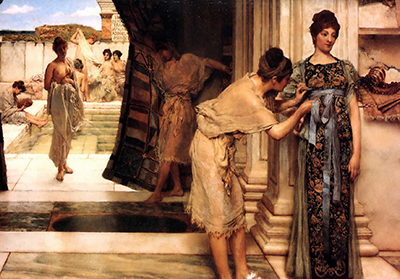
In Lawrence Alma-Tadema’s The Frigidarium (1890), a woman stands barefoot while an attendant fastens a blue sash over her embroidered dress. Another attendant holds back a heavy curtain, revealing a green pool and a group of women still occupied with bathing. Alma-Tadema gives the dressing scene as much room as the bath itself. The work is an oil on canvas measuring 45 × 59.7 cm, catalogued by Sotheby’s in 2023. It bears the artist’s signature and the inscription Op. CCCII on the upper right. It was shown at the Royal Academy in London in 1890 as no. 324. [1] [2]
At a Glance
- Date1890 [1]
- MediumOil on canvas, 45 × 59.7 cm [1]
- OpusCCCII [1]
- ExhibitionRoyal Academy, 1890, no. 324 [2]
This work across Lawrence Alma-Tadema’s career
Contents
- Looking through the curtain
- A Roman cold bath, assembled in paint
- Max Waechter and the Academy exhibition
- Other baths in Alma-Tadema’s paintings
- Annotated details
Looking through the curtain
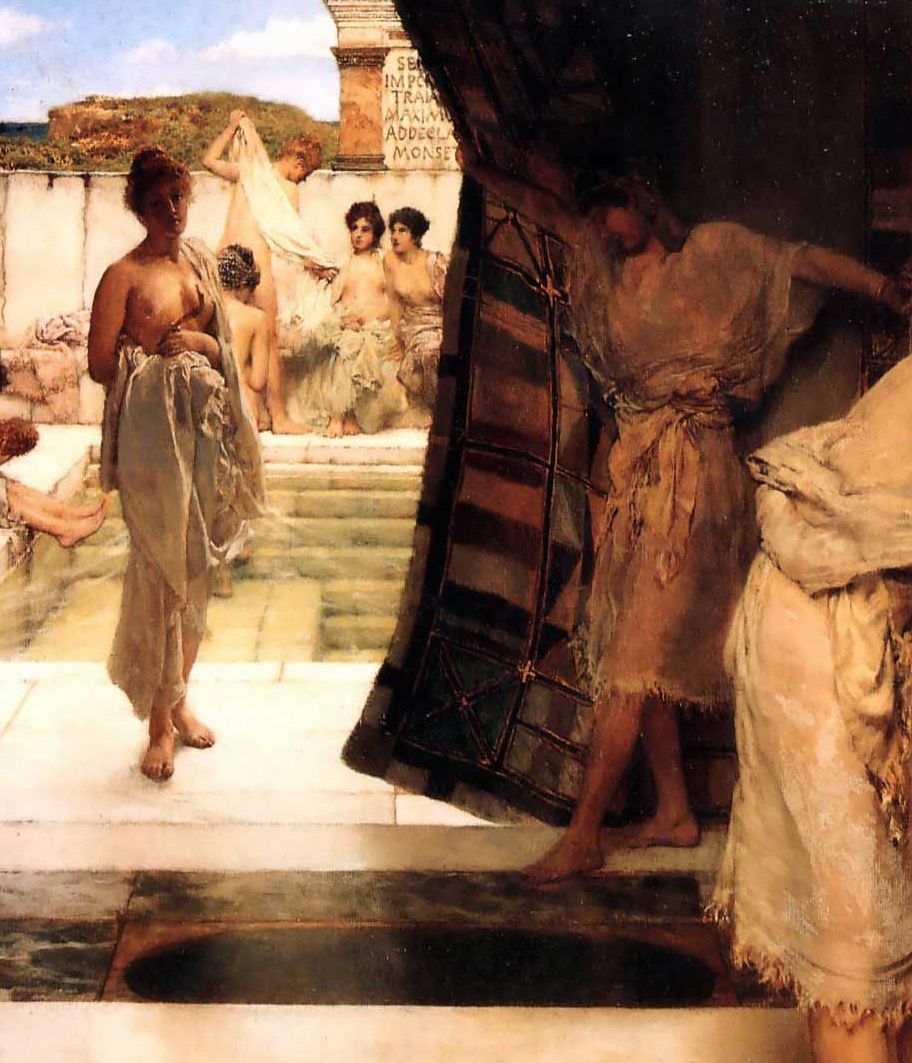
The woman with the blue sash and the attendant beside her stand within reach of one another, but their attention runs in different directions. The attendant bends and looks closely at her hands. The dressed woman looks beyond her, apparently content to wait. The sash crosses a dense pattern of gold-coloured embroidery, and its long ends hang loose almost to the hem. Below them the creases of discarded cloth interrupt the smooth expanse of marble. To the right, metal coils and reddish beads catch the light on a shelf above a fringed textile. Henry Blackburn’s Academy Notes identified the beads as amber and described the attendant as adjusting a girdle. His account confirms that details as small as the jewellery registered with viewers at the exhibition. [1] [6]
The painting offers several moments in the same routine. Nearest the viewer, the richly dressed woman is almost ready to leave. Beyond her, a woman carrying a cloth approaches the threshold. Around the pool, some figures sit or lean while another lifts a length of fabric above her head. The diverging poses make the bath feel inhabited beyond the immediate business of the foreground. They also distribute the work involved in the visit. One woman receives help to dress, another holds the curtain, and behind them women gather and arrange their cloths. Everything turns on actions small enough to escape notice in a larger history painting. [1] [6]
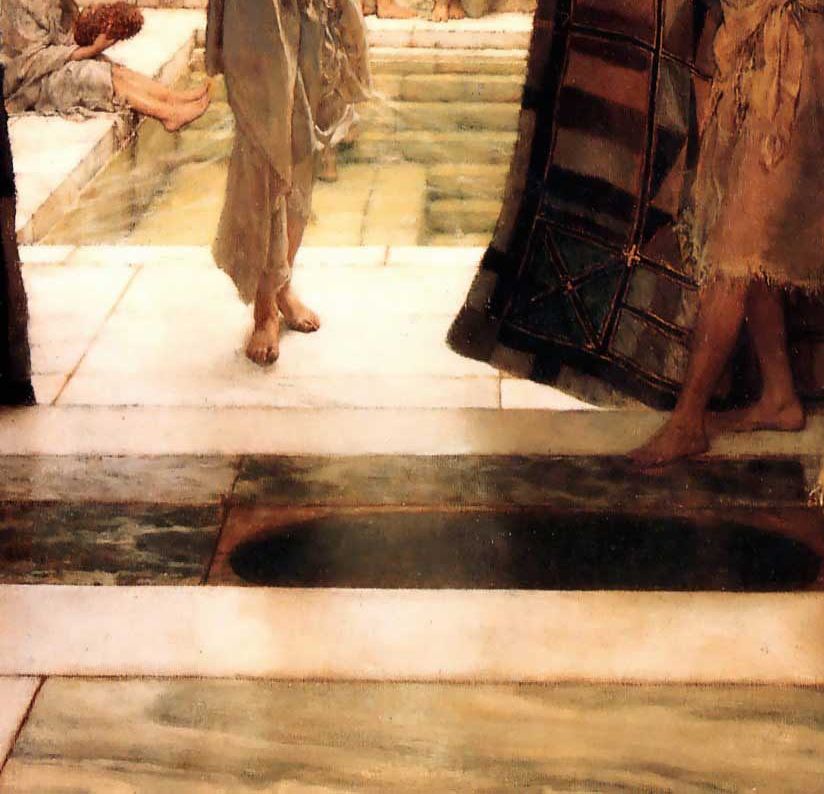
The principal compositional break follows the edge of the curtain. Its dark diagonal partially screens the bath and crosses the upright lines of the architecture. Past its edge the bands of the marble floor give way to the horizontal rim and submerged steps of the pool. Blackburn described bright light falling through an opening in the roof. In the painting the strip of blue sky, greenery beyond the wall and brightness of the water make the pool feel exposed, while the curtain and column shelter the changing area. Our view of the bath depends on a person holding that curtain back. [1] [6]
A Roman cold bath, assembled in paint
A frigidarium was the cool or unheated part of a Roman bathing complex, often with a cold plunge pool. A tepidarium was a warm room, a caldarium a hot room, and an apodyterium a changing room. A bather might pass through rooms of increasing warmth before returning to cold water. Layouts differed, and one room could serve several purposes. At Pompeii’s Stabian Baths, for instance, the excavators distinguish an indoor cold pool in the men’s frigidarium from an open swimming pool by the exercise court. In the women’s suite they identify a cold pool fitted into the changing room. Those arrangements show how much could vary even within one establishment. [7] [8]
The Spanish historian of bathing María Ángeles Ceballos-Hernansanz points out that the open setting in Alma-Tadema’s scene also recalls a natatio, an outdoor swimming pool. Blackburn’s description suggests a viewer could read the same strip of sky as a roof opening. The painting gives the pool an apparent edge but keeps much of it out of sight. The title names the cold bath, while the picture explores the passage from bathing to dressing. The architectural details leave room for more than one reading of the space. [1] [6] [8] [9]
Two small details suggest how Alma-Tadema gave his setting the appearance of historical specificity. On a stone beyond the pool, six lines of lettering disappear behind the curtain. The line openings, including TRAI…, MAXI…, AD DECL… and MONS ET…, appear in that order on the pedestal of Trajan’s Column in Rome. They belong to a dedication that names the emperor and commemorates the earth removed for his forum. The match suggests a quotation from the monument, whether Alma-Tadema worked from it directly or through a reproduction. The curtain hides most of the text and the scene gives the lettering a new architectural setting. [1] [10]
The jewellery offers a different path into the studio. The jewellers Wartski identify the gold coil on the shelf as an armlet Alma-Tadema gave to his wife Laura. Made by the Victorian firm J. S. and A. B. Wyon, it wraps four times around the arm and bears Laura’s name in Greek lettering. Wartski compares it with an ancient armlet from Cumae, now in the British Museum, whose snake and horse heads provide a close parallel. Wartski also identifies Laura as the model for the dressed woman. The armlet links an ancient design to Victorian metalwork and then to a tiny painted still life. [1] [11] [12]
The archaeology scholar Stephanie Moser describes the portfolios of photographs and drawings, books, and studio objects that Alma-Tadema brought together for his work. Frederick Dolman’s 1899 visit for The Strand Magazine gives a glimpse of the environment in which those resources sat. Its prose describes a library adjoining the studio that the painter called his atrium, with an onyx window and a fountain falling into a marble basin. On the same page the magazine printed a monochrome reproduction of The Frigidarium, crediting the painting to Alma-Tadema and the permission to reproduce it to Stephen T. Gooden. The picture and the room described around it show two ways he used antiquity, to organise an imaginary bath and to furnish his own working surroundings. Earlier in the interview, Dolman asked Alma-Tadema about the demand for pictures with blue skies and white marble. The painter spoke of the pressure to find fresh subjects and technical challenges within the manner that had made his reputation. The alternation between sunlight and sheltered marble in The Frigidarium shows how much he could make of that familiar palette. [1] [13] [14]
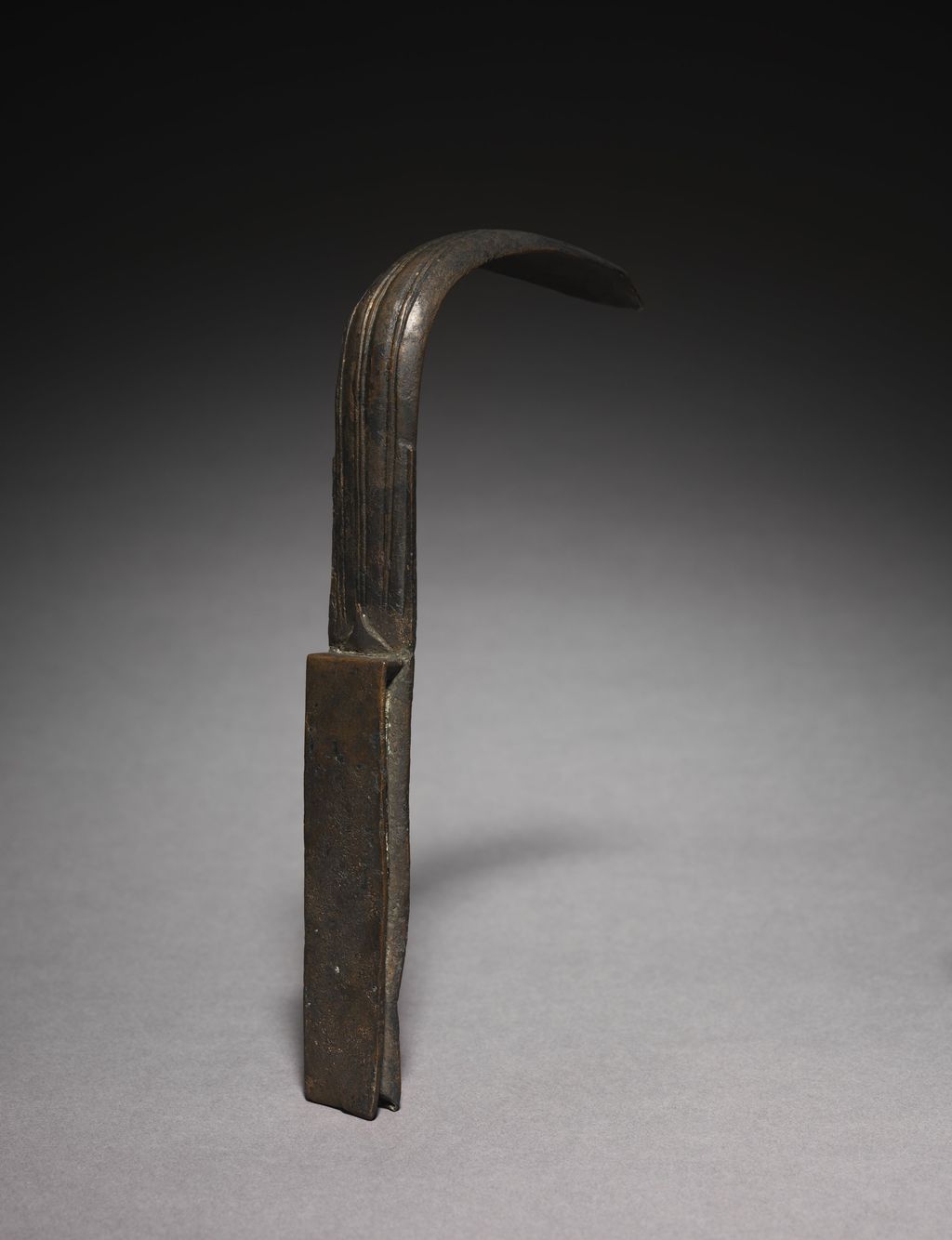
A Roman bronze strigil, dated 324–476. Cleveland Museum of Art, 1916.91. Image source. CC0 / Public domain.
Annotated Details from The Frigidarium
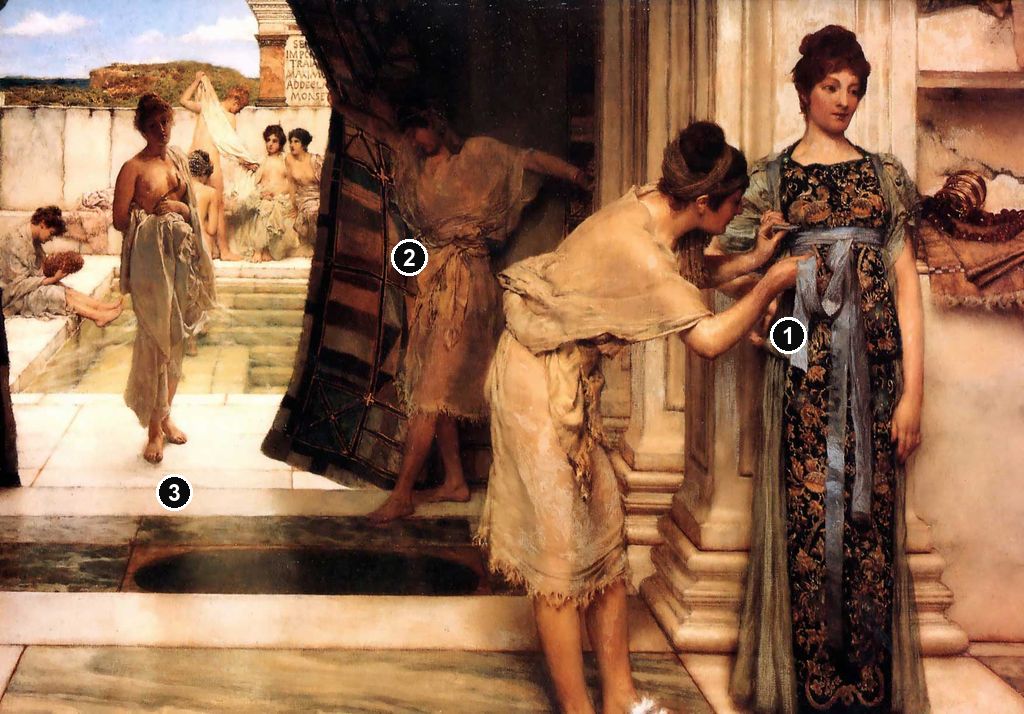
The numbered points mark details in The Frigidarium. Catalogue record. Public domain.
Details from THE FRIGIDARIUM
Select a numbered point or use the details below to examine a part of the painting.
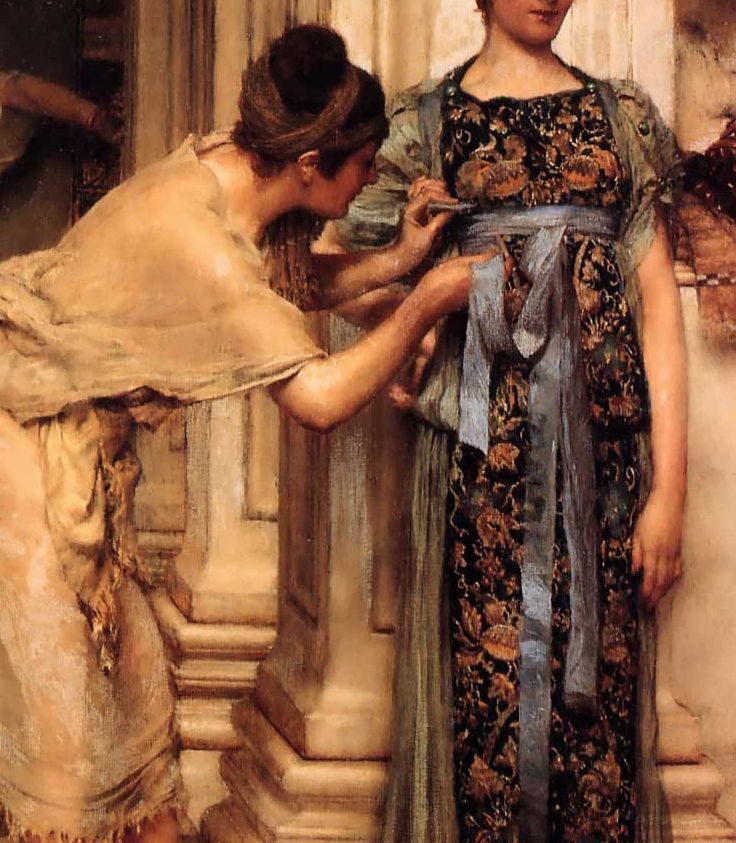
Hands at the blue sash
The attendant pulls a blue sash across the dress. The length of fabric falls over the busy embroidery and separates her hands from the standing figure’s skirt.
The lifted curtain and approaching figure
The attendant draws back the dark curtain. Look through the opening to the lighter pavement and the bather walking towards the viewer.
Steps and the cold pool
Pale steps and patches of green water cut across the opening. The contrast between outdoor light and the shadow at the curtain gives the narrow view considerable depth.
Max Waechter and the Academy exhibition
Max Waechter of Terrace House, Richmond, commissioned The Frigidarium. Sotheby’s reports that a receipt from Alma-Tadema to Waechter for £2,200, dated 15 April 1890, was formerly attached to the back of the painting. In his 1905 account, P. C. Standing independently names Waechter as the patron and records a second painting made for him the following year, A Kiss. The 2023 lot identifies the support as canvas. A Dutch opus index lists the same number and dimensions but describes a panel, so the material here follows the auctioneer’s record of the object it handled. [1] [15] [16]
The 1890 Academy showing brought the privately commissioned work before a much wider audience. Blackburn recorded the interplay of coloured marble, figured cloth, jewellery and roof light. An Academy correspondent whose account appeared in New Zealand’s Otago Daily Times on 3 July 1890 marvelled at the painter’s ability but withheld admiration for the picture. The brief notice leaves the reason open. The work also circulated through reproductions. Sotheby’s lists an illustration in the Pall Mall Gazette’s Pictures of the Year for 1890 and another in the New York magazine Munsey’s in 1896. The Dutch dealer Inter-Antiquariaat catalogues a photogravure dated 1891 after Op. CCCII, signed by Alma-Tadema in pencil and coloured by hand at a later date. [1] [2] [6] [17] [18]
The canvas was shown in Birmingham in 1890, at Liverpool’s Walker Art Gallery in 1907 and at the Royal Academy’s winter memorial exhibition in 1913. Its later provenance includes Allen Funt, who bought it in 1967. During his ownership it appeared as no. 25 in Victorians in Togas at New York’s Metropolitan Museum of Art, which ran from 9 March to 29 April 1973. It was shown in Leeuwarden in 1974. The painting’s exhibition history thus spans its original audience and a later one encountering Alma-Tadema as an artist whose antiquity belonged to the Victorian imagination. [1] [19]
Other baths in Alma-Tadema’s paintings
In The Tepidarium (1881), at the Lady Lever Art Gallery, a reclining woman holds a strigil, an implement for scraping the skin after oiling. The small panel puts her near the picture plane, across a fur, with the warm room reduced to the fittings immediately around her. An Apodyterium (1886) puts dressing and undressing at the centre of a crowded changing room. Its title, date and Op. CCLXXIV identify a separate oil on panel. In the 1890 picture the foreground routine is seen alongside a column, a curtain and the pool behind it. The distance between the two groups lets Alma-Tadema show how a woman moves from one part of the baths to the next. [1] [20] [21]
In A Favourite Custom (1909), Alma-Tadema returned to the cold plunge and moved it to the foreground, where one woman playfully splashes another. Tate traces that composition to photographs of the Stabian Baths and identifies the marble floor and walls as embellishments. That documentation applies to the later picture. Seen together, the two works reveal how much Alma-Tadema could change by moving the pool. The later painting puts a game in the water at the centre of attention. In The Frigidarium, the pool lies beyond the curtain and the central action is a woman tying a sash. [1] [22]
The curtain also helps explain the painting’s appeal to filmmakers. Film historian Maria Wyke reads Ione’s bath scene in Eleuterio Rodolfi’s 1913 The Last Days of Pompeii as a quotation from The Frigidarium. She points to the attendant’s activity, the partial glimpse of bathers through a deeper opening and the use of the curtain. On screen the curtain can close and end the view. Alma-Tadema holds it open, keeping both the brightly lit pool and the quiet work in the dressing room visible in a single moment. [1] [23]
Lawrence Alma-Tadema artworks directory
Search by title or medium. The directory includes Alma-Tadema’s numbered compositions, separately catalogued fragments, and selected drawings and historic prints. Dates for unlinked works follow the catalogue’s year groupings. View the numbered opus catalogue
| Name | Date | Medium |
|---|---|---|
| Portrait of my sister Artje | 1851 | Painting |
| Selfportrait | 1852 | Painting |
| Portrait of my mother (oval) | 1852 | Painting |
| The alm | 1856 | Painting |
| The inundation of the Biesbosch in 1421 | 1857 | Painting |
| The destruction of Terdoest Abbey in 1571 | 1857 | Painting |
| Faust en Marguerite | 1857 | Watercolour |
| Clotilde at the tomb of her grandchildren | 1858 | Painting |
| Marius on the ruins of Carthage | 1858 | Watercolour |
| The sad father: the unfavourable oracle (Death of the first-born, first version) | 1859 | Painting |
| The death of Attila, 453 AD | 1859 | Watercolour |
| Triumphal return of Sir Willem van Saeftingen | 1860 | Painting |
| The death of Hippolyte | 1860 | Watercolour |
| The Education of the Children of Clovis | 1861 | Painting |
| Venantius Fortunatus reading his poems to Radagonda VI | 1862 | Painting |
| Gunthram Bose and his daughters, 572 AD: the Ambuscade | 1862 | Painting |
| A medieval Flemish interior | 1863 | Painting |
| Pastimes in Ancient Egypt: 3.000 years ago | 1863 | Painting |
| Interior of the Church San Clemente, Rome: a study | 1863 | Painting |
| Queen Fredegonda at the deathbed of Bishop Praetextatus (first version) | 1864 | Painting |
| Leaving Church in the fifteenth century | 1864 | Painting |
| Egyptian Chess Players (An Egyptian Game) | 1865 | Painting |
| Birthday presents in the sixteenth century | 1865 | Painting |
| Gallo-Roman women | 1865 | Painting |
| Entering Church in the fourteenth century | 1865 | Painting |
| An Egyptian at his doorway in Memphis | 1865 | Painting |
| Catallus ten huize van Lesbia | 1865 | Painting |
| The discourse | 1865 | Painting |
| A Roman scribe writing despatches | 1865 | Painting |
| A soldier of Marathon | 1865 | Painting |
| Home from market | 1865 | Painting |
| Death of Galeswinthe | 1865 | Painting |
| An Egyptian Game (preparatory drawing) | 1865 | Drawing |
| Making wreaths for festivities in a Pompeian house | 1866 | Painting |
| Vespasian hearing of the taking of Jerusalem by Titus | 1866 | Painting |
| Entrance to a Roman theatre | 1866 | Painting |
| In the peristyle | 1866 | Painting |
| Agrippina visiting the ashes of Germanicus | 1866 | Painting |
| Tibullus at Delia's | 1866 | Painting |
| A Roman dance | 1866 | Painting |
| Lesbia weeping over a sparrow | 1866 | Painting |
| The armourer's shop in ancient Rome | 1866 | Painting |
| The Education of the Children of Clovis (Rennefeld print after Alma-Tadema) | 1866 | |
| The mummy: Roman period: Egyptians lamenting their dead | 1867 | Painting |
| The honeymoon | 1867 | Painting |
| Cuckoo | 1867 | Painting |
| The aesthetic view: Madame Dumoulin, Pauline, and Laurence | 1867 | Painting |
| Glaucus and Nydia | 1867 | Painting |
| Portrait of Mr A. Bonnefoy | 1867 | Painting |
| Proclaiming Claudius Emperor | 1867 | Painting |
| A sculpture gallery in Rome at the time of Augustus | 1867 | Painting |
| A collector of pictures at the time of Augustus | 1867 | Painting |
| Tarquinius Superbus before Galba | 1867 | Painting |
| A Roman family | 1867 | Painting |
| Italian women | 1867 | Painting |
| Portrait of Madame Bonnefoy and Mr Puttemans | 1867 | Painting |
| The siësta (first version) | 1868 | Drawing |
| The embarkation | 1868 | Painting |
| The siësta (second version) | 1868 | Painting |
| A Roman art lover | 1868 | Painting |
| Woman and flowers | 1868 | Painting |
| Phidias and the Parthenon, Athens | 1868 | Painting |
| The flower girl | 1868 | Painting |
| A Roman flower market: Pompeii | 1868 | Painting |
| Egyptian game | 1868 | Watercolour |
| Education of the children of Clovis | 1868 | Painting |
| A Roman art lover: silver statue | 1868 | Painting |
| Egyptian dancing girls | 1868 | Watercolour |
| Catalina | 1869 | Painting |
| The visit: Sunday morning before churching (first version): a birth chamber, seventeenth century | 1869 | Painting |
| The Pyrrhic dance | 1869 | Painting |
| The Grand Chamberlain of Sesostris the Great | 1869 | Painting |
| The convalescent | 1869 | Painting |
| Confidences | 1869 | Painting |
| A Greek Woman | 1869 | Painting |
| At the wine shop | 1869 | Painting |
| An Exedra (first version) | 1869 | Painting |
| Portrait of Master Ernest Angely | 1870 | Painting |
| A juggler | 1870 | Painting |
| A nurse, seventeenth century: Sunday morning (second version) | 1870 | Watercolour |
| Roman art lover (the runner ) | 1870 | Painting |
| Anacreon reading his poems at Lesbia's house | 1870 | Painting |
| The vintage festival (first version) | 1870 | Painting |
| The first whisper of love | 1870 | Painting |
| The letter: from an absent one (first version) | 1870 | Painting |
| A staircase (first version) | 1870 | Painting |
| Hush, she sleeps | 1870 | Painting |
| The letter: from an absent one (second version) | 1871 | Watercolour |
| The vintage festival (second version) | 1871 | Painting |
| A Roman Emperor (second version) | 1871 | Painting |
| In the temple (first version) | 1871 | Painting |
| Portrait of Miss Laura Theresa Epps | 1871 | Painting |
| A Bacchic dance | 1871 | Painting |
| Fredegonda and Praetextatus (second version) | 1871 | Painting |
| Portrait study for Mrs H.W. Mesdag | 1871 | Painting |
| Greek potters | 1871 | Painting |
| An exedra (second version) | 1871 | Watercolour |
| Sunday morning: the two sisters (third version) | 1871 | Painting |
| In the temple (second version) | 1872 | Watercolour |
| The first reproach | 1872 | Painting |
| An Egyptian widow | 1872 | Painting |
| Improvisatore | 1872 | Painting |
| A halt (first version) | 1872 | Painting |
| The last roses | 1872 | Painting |
| Death of the first-born (second version) | 1872 | Painting |
| Portrait of Dr Franz and Mrs Catherine Hueffer 'When I am dead, oh dearest sing' | 1872 | Painting |
| The nurse | 1872 | Painting |
| Greek wine (first version) | 1872 | Painting |
| Goldfish (first version) | 1872 | Painting |
| On a Roman staircase (second version) | 1872 | Watercolour |
| Hercules | 1872 | Painting |
| Portrait of Miss Kate Thompson | 1873 | Painting |
| The dinner (first version) | 1873 | Painting |
| The siësta (third version) | 1873 | Painting |
| A visit to the studio (second version) | 1873 | Watercolour |
| Cherries | 1873 | Painting |
| Greek wine (second version) | 1873 | Watercolour |
| This is our corner | 1873 | Painting |
| A picture gallery (third version) | 1873 | Painting |
| The last roses (second version) | 1873 | Watercolour |
| Fishing (first version) | 1873 | Painting |
| Music has charms | 1873 | Watercolour |
| Counting the passers-by | 1873 | Watercolour |
| Portrait of Mrs Frederick George Stephens | 1873 | Painting |
| Two heads from 'The Picture Gallery': A visit to the studio by Charles W. Deschamps and his wife (first version) | 1874 | Watercolour |
| Joseph, overseer of Pharaoh's granaries | 1874 | Painting |
| A sculpturegallery (first version) | 1874 | Painting |
| A picture gallery in Rome at the time of Augustus (fourth version) | 1874 | Painting |
| Portrait of Charles W. Deschamps and his wife (second version) | 1874 | Painting |
| Autumn | 1874 | Watercolour |
| Reflections: fishing (second version) | 1874 | Painting |
| A Roman artist | 1874 | Watercolour |
| Good friends | 1874 | Watercolour |
| On the steps of the Capitol (first version) | 1874 | Painting |
| Water pets: goldfish (second version) | 1874 | Painting |
| Münster Cathedral | 1874 | Painting |
| Landscape near Münster | 1874 | Painting |
| Antistius Labeon, 75 AD: A Roman amateur artist | 1874 | Painting |
| Sunny days | 1874 | Painting |
| Spring flowers: garland seller on the steps of the Capitol (second version) | 1874 | Watercolour |
| Through an archway | 1874 | Painting |
| (A, B) Decoration for my piano: 'Serious and merry music' | 1874 | Painting |
| Rêverie | 1874 | Painting |
| The Roman architect | 1874 | Painting |
| Sunflowers | 1874 | Painting |
| Landscape: carriage drive by the outskirts of a wood, Penhill Castle | 1875 | Painting |
| A peep through the trees | 1875 | Painting |
| Cleopatra (first version) | 1875 | Painting |
| (a, b, c) The tragedy of an honest wife | 1875 | Watercolour |
| The architect of the Coliseum | 1875 | Watercolour |
| Fishing | 1875 | Watercolour |
| Cherry blossom | 1875 | Painting |
| Water pets: goldfish (third version) | 1875 | Painting |
| 'There he is!' | 1875 | Painting |
| Play Garden | 1875 | Painting |
| Portrait of Miss Thackeray's 'Elisabeth' | 1875 | Painting |
| A nymphaeum from the Villa Aldobrandini in Rome | 1875 | Painting |
| Haystacks | 1875 | Painting |
| A sculpture gallery (second version) | 1875 | Painting |
| After the dance: a bacchanal | 1875 | Painting |
| Landscape: a breezy day in August near Innsbruck | 1875 | Painting |
| The service | 1875 | Painting |
| An audience at Agrippa's (first version) | 1875 | Painting |
| Kriemhild’s Tryste | 1875 | |
| Portrait of my wife | 1876 | Painting |
| Between hope and fear | 1876 | Painting |
| 94 Degrees in the Shade | 1876 | Painting |
| An antique custom | 1876 | Painting |
| Portrait of Jules Dalou, his wife and his daughter | 1876 | Painting |
| Pleading (first version) | 1876 | Painting |
| Hide and seek | 1876 | Painting |
| Balneatrix | 1876 | Watercolour |
| A mirror | 1877 | Painting |
| An interesting scroll | 1877 | Watercolour |
| Winter | 1877 | Painting |
| Autumn-vintage festival | 1877 | Painting |
| Summer | 1877 | Painting |
| Spring in the gardens of the Villa Borghese (first version) | 1877 | Painting |
| A balneator | 1877 | Watercolour |
| Painting in Ancient Rome | 1877 | Painting |
| A balneatrix | 1877 | Painting |
| The sculptor's model (Venus Esquilina) | 1877 | Painting |
| The sculptor's studio in ancient Rome | 1877 | Painting |
| Architecture in ancient Rome | 1877 | Painting |
| Cleopatra (second version) | 1877 | Painting |
| Spring in the gardens of the Villa Borghese (second version) | 1877 | Painting |
| Panel for H. W. Mesdag's studio door: Spring in the gardens of the Villa Borghese (third version) | 1877 | Painting |
| The question: Pleading (second version) | 1877 | Painting |
| A kitchen garden | 1877 | Painting |
| Flora: Spring in the gardens of the Villa Borghese (fourth version) | 1877 | Watercolour |
| A silent counsellor | 1878 | Watercolour |
| A sollicitation | 1878 | Watercolour |
| A hearty welcome | 1878 | Painting |
| A landscape | 1878 | Painting |
| In the time of Constantine | 1878 | Painting |
| A love missile | 1878 | Painting |
| Fredegonda en Galswintha, 566 AD | 1878 | Painting |
| A safe confidant | 1878 | Painting |
| After the audience (second version) | 1879 | Painting |
| Strigils andsponges | 1879 | Watercolour |
| E festival in Pomona | 1879 | Painting |
| Prose | 1879 | Painting |
| Going down to the river | 1879 | Painting |
| The Roman wine tasters | 1879 | Watercolour |
| Portrait of th singer George Henschel Esq. at the piano | 1879 | Painting |
| Poetry | 1879 | Painting |
| A well-protected slumber | 1879 | Painting |
| A garden altar | 1879 | Painting |
| Beauties | 1879 | Painting |
| Portrait of Thekla Friedländer | 1879 | Unspecified |
| On the road to the Temple of Ceres: A springfestival | 1879 | Painting |
| Autumn (third version) | 1879 | Drawing |
| 'Not at home' | 1879 | Painting |
| An old bachelor after the bath | 1879 | Watercolour |
| Spring (Blanchard print after Alma-Tadema’s 1877 painting) | 1879 | |
| The first course: the dinner | 1880 | Painting |
| Interrupted | 1880 | Painting |
| Grapes | 1880 | Watercolour |
| A pastoral | 1880 | Painting |
| A portrait of Dr Felix and Mrs August Redeker Semon | 1880 | Painting |
| Ave Caesar! Io Saturnalia! (third version) | 1880 | Painting |
| A prize for the artist's corps | 1880 | Painting |
| The departure (first version) | 1880 | Painting |
| A harvest festival | 1880 | Painting |
| 'Your carriage stops the way' | 1880 | Painting |
| Autumn (Scene in a Roman Garden) | c.1880 | Drawing |
| The torch dance | 1881 | Painting |
| Sappho and Alcaeus | 1881 | Painting |
| A kiss | 1881 | Watercolour |
| A Bacchante dancing before the thymele | 1881 | Watercolour |
| An audience | 1881 | Painting |
| Portrait of Dr Hans Richter | 1881 | Painting |
| Pandora | 1881 | Watercolour |
| The Tepidarium | 1881 | Painting |
| Quiet pets | 1881 | Painting |
| A priestess of Apollo | 1881 | Watercolour |
| A difficult line from Horace (first version) | 1881 | Painting |
| A stranger in my studio (one of a pair) | 1881 | Painting |
| Amo te ama me | 1881 | Painting |
| The First Course–The Dinner (Löwenstam print after Alma-Tadema) | 1881 | |
| Young affections | 1882 | Painting |
| A difficult line from Horace (second version) | 1882 | Drawing |
| Portrait of John F. Whichcord Esq., PRIBA, FSA | 1882 | Painting |
| Portrait of Ludwig Barnay as Marcus Antonius | 1882 | Painting |
| The way to the temple | 1882 | Painting |
| A parting kiss | 1882 | Painting |
| Reflections | 1882 | Painting |
| Between Venus and Bacchus | 1882 | Watercolour |
| Dolce far niente (first version) | 1882 | Watercolour |
| Dolce far niente (second version) | 1882 | Painting |
| An Oleander | 1882 | Painting |
| The meeting of Antony and Cleopatra | 1883 | Painting |
| Portrait of Catherine, Duchess of Cleveland | 1883 | Painting |
| Portrait of my daughter Anna Alma-Tadema | 1883 | Painting |
| Shy | 1883 | Painting |
| Portrait of His Excellency the Duke of Bylandt | 1883 | Painting |
| Una Carita: The three graces: Laura, Laurence, and Anna | 1883 | Painting |
| Portrait of Leopold Lowenstam, the engraver | 1883 | Painting |
| Portrait of Lady Thompson | 1883 | Painting |
| Portrait of Professor Giovanni Battista Amendola | 1883 | Painting |
| 'Der alte Menander ist doch nicht gestorben!' Paulus and Hermas | 1883 | Drawing |
| A street altar | 1883 | Watercolour |
| Welcome Footsteps (The Well-Known Footsteps) | 1883 | Painting |
| A declaration: an old, old story | 1883 | Watercolour |
| Xanthe and Phaon | 1883 | Watercolour |
| Selfportrait | 1883 | Painting |
| Hadrian in England: visiting a Roman-British Pottery (original, later divided) | 1884 | Painting |
| A Roman-British pottery | 1884 | Painting |
| Emperor Hadrian's visit to a British pottery | 1884 | Painting |
| A Roman-British potter | 1884 | Painting |
| Portrait of Miss Alice Lewis | 1884 | Painting |
| Who is it? | 1884 | Painting |
| Portrait of Moses Ezekiel | 1884 | Painting |
| Portrait of Sir Francis Powell | 1884 | Painting |
| Egyptien à l’entrée de sa demeure (Ramus print after Alma-Tadema) | 1884 | |
| Expectations | 1885 | Painting |
| A Reading from Homer | 1885 | Painting |
| Portrait of Dr Wahington Napoleon Epps: my docter | 1885 | Painting |
| The triumph of Titus: the Flavians | 1885 | Painting |
| Ariadne | 1885 | Painting |
| Portrait of Mrs W. M. Baker | 1885 | Painting |
| Rose of all roses | 1885 | Painting |
| A foregone conclusion | 1885 | Painting |
| A apodyterium | 1886 | Painting |
| Portrait of James Reld Esq. | 1886 | Painting |
| Portrait of Mrs Frank D. Millet | 1886 | Painting |
| A secret | 1887 | Painting |
| The Women of Amphissa | 1887 | Painting |
| A new dress | 1887 | Watercolour |
| 'He loves me, he loves me not' | 1887 | Painting |
| Illuminated letter 'W' for the Royal Academy address to Queen Victoria | 1887 | Watercolour |
| Portia | 1887 | Painting |
| The Roses of Heliogabalus | 1888 | Painting |
| Fair tresses: a sketch | 1888 | Painting |
| Midday slumbers | 1888 | Watercolour |
| Portrait of the honourable Adama van Scheltema | 1888 | Painting |
| Venus and Mars | 1888 | Painting |
| Portrait of Jules de Soria | 1888 | Painting |
| At the shrine of Venus | 1888 | Painting |
| The Favourite Poet | 1888 | Painting |
| The Favourite Poet (Löwenstam print after Alma-Tadema) | c.1888 | |
| Sisters | 1889 | Painting |
| Cloaked in yellow | 1889 | Painting |
| A dedication to Bacchus (first version) | 1889 | Painting |
| A dedication to Bacchus (second version) | 1889 | Painting |
| Portrait of Mrs Ralph Sneyd | 1889 | Painting |
| Portrait of Miss MacWhirter (Mrs Charles Sims) | 1889 | Painting |
| Portrait of young gentleman John Parsons Millet | 1889 | Painting |
| In a rose garden | 1889 | Painting |
| A Silent Greeting | 1889 | Painting |
| Portrait of Sir Ernest A. Waterlow, Esq., RA | 1889 | Painting |
| Eloquent silence | 1890 | Painting |
| The Frigidarium | 1890 | Painting |
| Promise of Spring | 1890 | Painting |
| Portrait of Miss Agnes Marks | 1890 | Painting |
| Rêverie: a sketch | 1890 | Painting |
| Portrait of the Right Hon. Arthur James Balfour | 1891 | Painting |
| An earthly paradise | 1891 | Painting |
| Love's votaries; Love in idleness | 1891 | Painting |
| Portrait of the Honourable Archdean Watkins of Durham, DD | 1891 | Painting |
| Portrait of Alfred Waterhouse Esq. RA | 1891 | Painting |
| Portrait of Ignacy Jan Paderewski | 1891 | Painting |
| The kiss | 1891 | Painting |
| Calling the worshippers | 1892 | Watercolour |
| The poet Gallus dreaming | 1892 | Painting |
| Courtship | 1892 | Painting |
| Comparisons | 1892 | Painting |
| The inner sanctuary | 1892 | Painting |
| Portrait of Dr Joseph Joachim | 1893 | Painting |
| In the corner of my studio | 1893 | Painting |
| Portrait of Mrs Charles Wyllie | 1893 | Painting |
| Unconscious Rivals | 1893 | Painting |
| Godspeed | 1893 | Painting |
| Portrait of Mrs Theyre Smith | 1893 | Painting |
| At the close of a joyful day | 1894 | Painting |
| The benediction | 1894 | Painting |
| Spring | 1894 | Painting |
| Past and present generations | 1894 | Painting |
| God Speed (Löwenstam print after Alma-Tadema) | 1894 | |
| Love's jewelled fetter | 1895 | Painting |
| Fortune's favourite | 1895 | Painting |
| Portrait of Mrs Roland Hill and her children | 1895 | Painting |
| Portrait of George Simmonds and family | 1895 | Painting |
| Unwelcome confidence | 1895 | Painting |
| A Coign of Vantage | 1895 | Painting |
| Portrait of Mrs Marcus Stone | 1895 | Painting |
| Whispering Noon | 1896 | Painting |
| The Coliseum | 1896 | Painting |
| Familygroup | 1896 | Painting |
| Portrait of Miss Onslow Ford | 1896 | Painting |
| A Difference of Opinion | 1896 | Painting |
| Portrait of Maurice Sons Esq. playing the violin in Alma-Tadema's studio | 1896 | Painting |
| Selfportrait | 1896 | Painting |
| 'Nobody asked you sir!' she said | 1896 | Watercolour |
| Portrait of J. M. Zarifi Esq. | 1897 | Painting |
| Watching and waiting | 1897 | Painting |
| 'Her eyes are with her thoughts, and they are far away' | 1897 | Painting |
| Wandering thoughts | 1897 | Painting |
| Melody on a Mediterranean terrace | 1897 | Painting |
| Roses, love's delight | 1897 | Painting |
| A Difference of Opinion (Boulard print after Alma-Tadema) | 1897 | |
| Portrait of Lady Sydney (Margaret) Waterlow | 1898 | Painting |
| The conversion of Paula by St. Jerome | 1898 | Painting |
| Portrait of Tine Son-Maris | 1898 | Painting |
| Hero | 1898 | Painting |
| Portrait of Mrs George Lewis and her daughter Elisabeth | 1899 | Painting |
| The listeners | 1899 | Painting |
| Attracted: watchers | 1899 | Watercolour |
| The Baths of Caracalla (Thermae Antoninianae) | 1899 | Painting |
| Bluebells | 1899 | Painting |
| Study for Thermaie Antoniniane | 1899 | Drawing |
| A flag of truce | 1900 | Painting |
| Goldfish (fourth version) | 1900 | Painting |
| Portrait of Mrs Armour from Princeton | 1900 | Painting |
| Portrait of George Aitchison, PRIBA, RA | 1900 | Painting |
| Vain courtship | 1900 | Painting |
| Under the roof of blue Ionian weather | 1901 | Painting |
| Death of the first born (third version) | 1901 | Drawing |
| A priestess of Hymen | 1901 | Watercolour |
| Fair tresses | 1901 | Painting |
| Impatient | 1901 | Watercolour |
| Portrait of Sir Max Waechter High Sheriff of Sussex | 1901 | Painting |
| The year's at the spring, all's right with the world | 1902 | Painting |
| Caracalla | 1902 | Painting |
| A crown | 1902 | Watercolour |
| Amongst the ruins | 1902 | Painting |
| Silver Favourites | 1903 | Painting |
| A peaceful wooing | 1903 | Painting |
| The ever-new horizon | 1903 | Painting |
| Thalia's homage to Aesculapius | 1904 | Drawing |
| The Finding of Moses | 1904 | Painting |
| A world of their own | 1905 | Painting |
| Ask Me No More | 1906 | Painting |
| Entering the Coliseum (first version) | 1907 | Watercolour |
| Geta and his sister | 1907 | Drawing |
| Caracalla and Geta | 1907 | Painting |
| Orante (oval, one of a pair) | 1907 | Painting |
| Bacchante (oval, one of a pair) | 1907 | Painting |
| Melodie del mare e dell'amore | 1907 | Watercolour |
| Youth | 1907 | Watercolour |
| Portrait of myself for the R. Accademia Romana di San Luca | 1907 | Painting |
| The golden hour | 1907 | Painting |
| At Aphrodite’s Cradle | 1908 | Painting |
| A message of love | 1909 | Painting |
| A Favourite Custom | 1909 | Painting |
| Splashing | 1909 | Drawing |
| Portrait of Mrs Washington Epps | 1909 | Drawing |
| Hopeful | 1909 | Painting |
| Portrait of Dr J. M. W. van der Poorten-Schwartz (Maarten Maartens) | 1909 | Drawing |
| Portrait of Ilona Eibenschutz | 1909 | Painting |
| The voice of spring | 1910 | Painting |
| Principal figure of 'The voice of spring' | 1910 | Drawing |
| A border for the King's letter to the nation | 1910 | Drawing |
| Heading: the Royal Academy address to H.M. King George on his accession to the throne | 1910 | Watercolour |
| Title unknown | 1910 | Unspecified |
| When flowers return (one of a pair) | 1911 | Painting |
| Summer Offering | 1911 | Painting |
| Title unknown | 1911 | Unspecified |
| Entering the Coliseum (second version) | 1911 | Painting |
| Portrait of William Whitaker Thompson Esq. | 1911 | Painting |
| Portrait of myself for the R. Accademia Romana di San Luca | 1912 | Painting |
| Preparations in the Coliseum | 1912 | Painting |
Discussion
Look again at the images and ideas explored in The Frigidarium. These editorial prompts invite your observations.
Reader Insights
What do you notice first through the opening in the curtain?
How does the blue sash help you follow the two attendants’ separate tasks?
Join the Conversation
Share a detail, comparison or question about The Frigidarium below.
References
- Sotheby’s, The Frigidarium, European & British Paintings Day Auction, lot 10, 7 December 2023, including object photograph, description, provenance, exhibition history and bibliography. View source.
- Algernon Graves, The Royal Academy of Arts, vol. I (1905), p. 29, entry no. 324 for 1890. View source.
- J. Paul Getty Museum, Spring. View source.
- American Art Association, The Baths of Caracalla, New York sale catalogue, 1907. View source.
- Tate, A Favourite Custom. View source.
- Henry Blackburn, Academy Notes (1890), p. 12, no. 324. View source.
- English Heritage, “Baths and Bathing in Roman Britain”, bathing sequence and heat. View source.
- Archaeological Park of Pompeii, “Public Saunas in the Stabian Baths – A Privilege of Men”, findings on the two sections of the Stabian Baths. View source.
- María Ángeles Ceballos-Hernansanz, “Visión de las termas romanas a través de la obra pictórica de Lawrence Alma Tadema”, Boletín de la Sociedad Española de Hidrología Médica 31.1 (2016), pp. 25–26, fig. 11. View source.
- Trajan’s Column in Rome research project, “The Dedicatory Inscription of the Column”, photograph and transcription of CIL VI.960. View source.
- Wartski, “The Alma-Tadema Armlet”, catalogue of Laura Alma-Tadema’s armlet and its appearance in the painting. View source.
- British Museum, armlet from Cumae, museum no. 1872,0604.686. View source.
- Stephanie Moser, “An Aura of Antiquity: Archaeology and the Ancient World in Alma-Tadema’s Studio-Homes”, British Art Studies 9 (2018). View source.
- Frederick Dolman, “Illustrated Interviews. LXVIII. Sir Lawrence Alma-Tadema, R.A.”, The Strand Magazine 18.108 (December 1899), pp. 604–605 and 611. View source.
- P. C. Standing, Sir Lawrence Alma-Tadema, O.M., R.A. (1905), pp. 74 and 99, reproduction and patronage. View source.
- MpaginaE, “Lourens Alma Tadema: opus 1–408”, entry 302-CCCII. View source.
- Otago Daily Times, “Academy Sketches”, 3 July 1890, p. 1, supplement. View source.
- Inter-Antiquariaat, The Frigidarium – Lawrence Alma-Tadema, 1891, illustrated photogravure catalogue entry. View source.
- Metropolitan Museum of Art, exhibition chronology, p. 91, Victorians in Togas: Paintings by Sir Lawrence Alma-Tadema. View source.
- National Inventory of Continental European Paintings, The Tepidarium, Lady Lever Art Gallery, LL 3130. View source.
- Christie’s, An Apodyterium, lot 728, 11 November 2023, illustrated object record and provenance. View source.
- Tate Britain, A Favourite Custom (1909), collection interpretation on Google Arts & Culture. View source.
- Maria Wyke, “Mobilising Pompeii for Italian Silent Cinema”, Classical Receptions Journal 11.4 (2019), pp. 453–475, author manuscript p. 15. View source.