 by Tom Gurney
Tom Gurney BSc (Hons) is an art history expert with over 20 years experience
Email: tomgurney1@gmail.com / Phone: +44 7429 011000
A Silent Greeting: Introduction
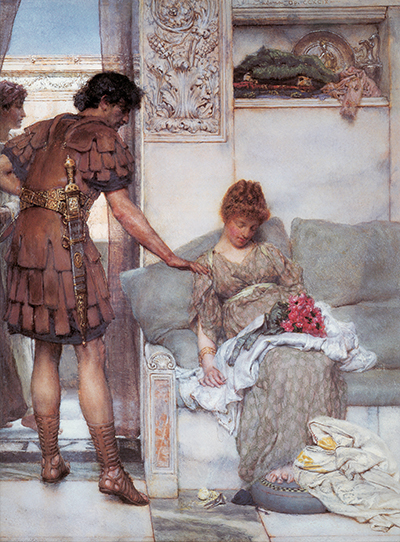
A Roman soldier has left red roses in the lap of a sleeping woman. He bends towards her, one hand extended close to her shoulder, while a second woman watches from the doorway. The sleeping woman’s chin has dropped and her hand rests loosely on the cloth across her knees. She will see the flowers when she wakes. Lawrence Alma-Tadema painted A Silent Greeting in oil on a wooden panel just 30.5 centimetres high and 22.9 wide. Tate dates it to 1889 and records it as a gift from Sir Henry Tate in 1894. [1] [2]
At a Glance
- Date1889 [1]
- MediumOil on wood panel [1]
- CollectionTate, N01523 [1]
- AcquisitionGift of Henry Tate, 1894 [1]
This work across Lawrence Alma-Tadema’s career
Contents
- A glimpse from the doorway
- What the panel rewards at close range
- Goethe and the companion picture
- From Henry Tate’s collection to the gallery
A glimpse from the doorway
The opening to the left shows a narrow strip of brilliant blue sky above a sunlit wall. The soldier fills most of the doorway, with a foot close to the couch and the other farther back by the threshold. His back is partly turned to us. We see the layered flaps of his armour and the glints of gold on his belt and sword fittings before we pick out the expression on his shaded face. Behind his shoulder the second woman’s face appears in profile, just inside the edge of the picture. Edward T. Cook’s 1898 handbook to the Tate Gallery reads her as an enslaved attendant holding the curtain aside. Her position lets us see over the soldier’s shoulder into the sunlight and gives the encounter a witness. [2] [6]
Our own view takes in more than any of the figures appear to see. The soldier looks down into the shaded room. The attendant must look past him from the doorway. The recipient sleeps through the whole exchange, her face tipped towards the very place where the flowers lie. At first glance, the soldier’s outstretched arm draws the eye straight to her lowered head. Follow it as far as his fingertips and the small gap between the hand and the roses becomes apparent. His hand comes up near her upper arm. The bouquet already rests on the folds of white cloth. Cook describes him placing it in her lap. The position of his fingertips makes the moment more suspenseful. A touch at the shoulder might still wake her. [2] [6]
Colour keeps the room legible at the scale of the little panel. The sky is the strongest blue and fixes the position of the farthest visible space. The roses make a much smaller but equally concentrated patch of colour in the foreground, set off by the silvery folds and blue-grey cushions. Between those patches are quieter transitions. The soldier’s arm begins against the warm brown of his armour, crosses the cool upright of the doorway and ends against the woman’s grey-green dress. Cook remarked on the sensation of coolness within and heat outside. That change of light also helps establish just how far the visitor has stepped into the room. [2] [6]
What the panel rewards at close range
Moving closer brings a second scale of activity into view. A scroll at the head of the couch arm catches a pale edge of light. High on the wall, a shallow round dish and a jug rise behind a pile of textiles. One loose end spills over the shelf. At floor level, what looks like a small ball of pale thread lies by the couch, close to the cushion beneath the sleeper’s foot. The things above and below her suggest a room in use, and the cloth across her lap gives the roses a clear place to land. A closer look at the upper shelf reveals Alma-Tadema’s signature and the number Op. CCXCIX along the narrow stone band. He places the inscription where it reads almost like lettering on the architecture itself. [2] [6]
There is a label on the reverse of the actual panel as well. The National Portrait Gallery’s survey of artists’ suppliers illustrates the Winsor & Newton label on A Silent Greeting. It identifies the wooden support as a prepared panel from the London colourmen, a piece of the artist’s own working world behind the imagined Roman interior. The relatively fine changes of edge are visible on the front. Compare the crisp incised decoration on the arm of the couch with the soft boundary between the woman’s hair and the cushion. Those shifts let the stone, the furnishing and the sleeper occupy distinct places within a span of a few centimetres. [2] [7]
Goethe and the companion picture
In a letter published by The Strand Magazine in 1907, Alma-Tadema recalled that a literary friend had suggested using Goethe’s lines for the title. In Der Besuch (The Visit), the speaker opens a locked door with a key from his pocket and eventually finds his beloved asleep on a sofa. He sits beside her, considers waking her and decides to go quietly, leaving two oranges and two roses on a little table. In the painting the gifts take the form of a bunch of roses, laid where the woman will feel or see them when she stirs. The attendant at the curtain makes the visitor’s entry visible. The Roman armour and sword give the visitor a public identity, while the delicacy of his hand shows how carefully he moves in this private room. [2] [8] [9]
The same letter says Alma-Tadema painted the work for Henry Tate in 1889, repainted it in 1891 and made it, at Tate’s request, as a companion to A Foregone Conclusion. The earlier picture, an oil on wood of almost exactly the same size, dates from 1885. It belonged to Tate’s wife Amy and came to the gallery through her bequest in 1920. In it, a man on the stairs studies an engagement ring as two women look down from above. The sea and sky open out behind them. In A Silent Greeting, the painter gives us a much narrower view outdoors, and the woman who is to receive the gift has her eyes closed. Both pictures make a small object central to the drama. The ring is poised to set an encounter in motion, while the flowers allow an encounter to continue after the visitor has left. [2] [8] [10]
From Henry Tate’s collection to the gallery
Cook’s handbook places A Silent Greeting at the New Gallery in 1892. That is the year after the repainting Alma-Tadema remembered and the year of a separate etching after the panel by Leopold Löwenstam. Robert Verhoogt records an impression measuring 15¾ by 12 inches, larger than the oil itself. A separate auction catalogue describes an impression with an ivy-leaf motif in the margin and signatures by both artist and etcher beneath the image. A collector could encounter the scene as a signed print in its own right. With the image carried into print, the positions of the three figures and the slope of the soldier’s arm can tell the story through line and shading. The panel gives the blue of the sky and red of the roses their own work to do. [2] [6] [8] [11] [12]
The painting entered the national collection in Henry Tate’s 1894 gift, three years before the Millbank gallery opened as the National Gallery of British Art. The gallery’s illustrated catalogue of 1908 lists it as no. 1523 in the Tate Gift and reproduces it in black and white at the head of the catalogue entries. Cook had already guided gallery visitors towards the temperature of the light and the arrangement of the room. In the catalogue illustration, the blue sky and red flowers become shades of grey. The sunlit wall behind the soldier still defines the opening, while the white cloth lifts the bouquet into view as a dark mass. The gesture carries into print because so much depends on the few inches that separate the soldier’s hand, the woman’s shoulder and the gift. [1] [2] [6] [13]
Further reading
A Popular Handbook to the Tate Gallery. Edward T. Cook, 1898, entry 1523 and Appendix II
Find the early description of the painting and the record of its New Gallery exhibition. View source.
Lawrence Alma-Tadema artworks directory
Search by title or medium. The directory includes Alma-Tadema’s numbered compositions, separately catalogued fragments, and selected drawings and historic prints. Dates for unlinked works follow the catalogue’s year groupings. View the numbered opus catalogue
| Name | Date | Medium |
|---|---|---|
| Portrait of my sister Artje | 1851 | Painting |
| Selfportrait | 1852 | Painting |
| Portrait of my mother (oval) | 1852 | Painting |
| The alm | 1856 | Painting |
| The inundation of the Biesbosch in 1421 | 1857 | Painting |
| The destruction of Terdoest Abbey in 1571 | 1857 | Painting |
| Faust en Marguerite | 1857 | Watercolour |
| Clotilde at the tomb of her grandchildren | 1858 | Painting |
| Marius on the ruins of Carthage | 1858 | Watercolour |
| The sad father: the unfavourable oracle (Death of the first-born, first version) | 1859 | Painting |
| The death of Attila, 453 AD | 1859 | Watercolour |
| Triumphal return of Sir Willem van Saeftingen | 1860 | Painting |
| The death of Hippolyte | 1860 | Watercolour |
| The Education of the Children of Clovis | 1861 | Painting |
| Venantius Fortunatus reading his poems to Radagonda VI | 1862 | Painting |
| Gunthram Bose and his daughters, 572 AD: the Ambuscade | 1862 | Painting |
| A medieval Flemish interior | 1863 | Painting |
| Pastimes in Ancient Egypt: 3.000 years ago | 1863 | Painting |
| Interior of the Church San Clemente, Rome: a study | 1863 | Painting |
| Queen Fredegonda at the deathbed of Bishop Praetextatus (first version) | 1864 | Painting |
| Leaving Church in the fifteenth century | 1864 | Painting |
| Egyptian Chess Players (An Egyptian Game) | 1865 | Painting |
| Birthday presents in the sixteenth century | 1865 | Painting |
| Gallo-Roman women | 1865 | Painting |
| Entering Church in the fourteenth century | 1865 | Painting |
| An Egyptian at his doorway in Memphis | 1865 | Painting |
| Catallus ten huize van Lesbia | 1865 | Painting |
| The discourse | 1865 | Painting |
| A Roman scribe writing despatches | 1865 | Painting |
| A soldier of Marathon | 1865 | Painting |
| Home from market | 1865 | Painting |
| Death of Galeswinthe | 1865 | Painting |
| An Egyptian Game (preparatory drawing) | 1865 | Drawing |
| Making wreaths for festivities in a Pompeian house | 1866 | Painting |
| Vespasian hearing of the taking of Jerusalem by Titus | 1866 | Painting |
| Entrance to a Roman theatre | 1866 | Painting |
| In the peristyle | 1866 | Painting |
| Agrippina visiting the ashes of Germanicus | 1866 | Painting |
| Tibullus at Delia's | 1866 | Painting |
| A Roman dance | 1866 | Painting |
| Lesbia weeping over a sparrow | 1866 | Painting |
| The armourer's shop in ancient Rome | 1866 | Painting |
| The Education of the Children of Clovis (Rennefeld print after Alma-Tadema) | 1866 | |
| The mummy: Roman period: Egyptians lamenting their dead | 1867 | Painting |
| The honeymoon | 1867 | Painting |
| Cuckoo | 1867 | Painting |
| The aesthetic view: Madame Dumoulin, Pauline, and Laurence | 1867 | Painting |
| Glaucus and Nydia | 1867 | Painting |
| Portrait of Mr A. Bonnefoy | 1867 | Painting |
| Proclaiming Claudius Emperor | 1867 | Painting |
| A sculpture gallery in Rome at the time of Augustus | 1867 | Painting |
| A collector of pictures at the time of Augustus | 1867 | Painting |
| Tarquinius Superbus before Galba | 1867 | Painting |
| A Roman family | 1867 | Painting |
| Italian women | 1867 | Painting |
| Portrait of Madame Bonnefoy and Mr Puttemans | 1867 | Painting |
| The siësta (first version) | 1868 | Drawing |
| The embarkation | 1868 | Painting |
| The siësta (second version) | 1868 | Painting |
| A Roman art lover | 1868 | Painting |
| Woman and flowers | 1868 | Painting |
| Phidias and the Parthenon, Athens | 1868 | Painting |
| The flower girl | 1868 | Painting |
| A Roman flower market: Pompeii | 1868 | Painting |
| Egyptian game | 1868 | Watercolour |
| Education of the children of Clovis | 1868 | Painting |
| A Roman art lover: silver statue | 1868 | Painting |
| Egyptian dancing girls | 1868 | Watercolour |
| Catalina | 1869 | Painting |
| The visit: Sunday morning before churching (first version): a birth chamber, seventeenth century | 1869 | Painting |
| The Pyrrhic dance | 1869 | Painting |
| The Grand Chamberlain of Sesostris the Great | 1869 | Painting |
| The convalescent | 1869 | Painting |
| Confidences | 1869 | Painting |
| A Greek Woman | 1869 | Painting |
| At the wine shop | 1869 | Painting |
| An Exedra (first version) | 1869 | Painting |
| Portrait of Master Ernest Angely | 1870 | Painting |
| A juggler | 1870 | Painting |
| A nurse, seventeenth century: Sunday morning (second version) | 1870 | Watercolour |
| Roman art lover (the runner ) | 1870 | Painting |
| Anacreon reading his poems at Lesbia's house | 1870 | Painting |
| The vintage festival (first version) | 1870 | Painting |
| The first whisper of love | 1870 | Painting |
| The letter: from an absent one (first version) | 1870 | Painting |
| A staircase (first version) | 1870 | Painting |
| Hush, she sleeps | 1870 | Painting |
| The letter: from an absent one (second version) | 1871 | Watercolour |
| The vintage festival (second version) | 1871 | Painting |
| A Roman Emperor (second version) | 1871 | Painting |
| In the temple (first version) | 1871 | Painting |
| Portrait of Miss Laura Theresa Epps | 1871 | Painting |
| A Bacchic dance | 1871 | Painting |
| Fredegonda and Praetextatus (second version) | 1871 | Painting |
| Portrait study for Mrs H.W. Mesdag | 1871 | Painting |
| Greek potters | 1871 | Painting |
| An exedra (second version) | 1871 | Watercolour |
| Sunday morning: the two sisters (third version) | 1871 | Painting |
| In the temple (second version) | 1872 | Watercolour |
| The first reproach | 1872 | Painting |
| An Egyptian widow | 1872 | Painting |
| Improvisatore | 1872 | Painting |
| A halt (first version) | 1872 | Painting |
| The last roses | 1872 | Painting |
| Death of the first-born (second version) | 1872 | Painting |
| Portrait of Dr Franz and Mrs Catherine Hueffer 'When I am dead, oh dearest sing' | 1872 | Painting |
| The nurse | 1872 | Painting |
| Greek wine (first version) | 1872 | Painting |
| Goldfish (first version) | 1872 | Painting |
| On a Roman staircase (second version) | 1872 | Watercolour |
| Hercules | 1872 | Painting |
| Portrait of Miss Kate Thompson | 1873 | Painting |
| The dinner (first version) | 1873 | Painting |
| The siësta (third version) | 1873 | Painting |
| A visit to the studio (second version) | 1873 | Watercolour |
| Cherries | 1873 | Painting |
| Greek wine (second version) | 1873 | Watercolour |
| This is our corner | 1873 | Painting |
| A picture gallery (third version) | 1873 | Painting |
| The last roses (second version) | 1873 | Watercolour |
| Fishing (first version) | 1873 | Painting |
| Music has charms | 1873 | Watercolour |
| Counting the passers-by | 1873 | Watercolour |
| Portrait of Mrs Frederick George Stephens | 1873 | Painting |
| Two heads from 'The Picture Gallery': A visit to the studio by Charles W. Deschamps and his wife (first version) | 1874 | Watercolour |
| Joseph, overseer of Pharaoh's granaries | 1874 | Painting |
| A sculpturegallery (first version) | 1874 | Painting |
| A picture gallery in Rome at the time of Augustus (fourth version) | 1874 | Painting |
| Portrait of Charles W. Deschamps and his wife (second version) | 1874 | Painting |
| Autumn | 1874 | Watercolour |
| Reflections: fishing (second version) | 1874 | Painting |
| A Roman artist | 1874 | Watercolour |
| Good friends | 1874 | Watercolour |
| On the steps of the Capitol (first version) | 1874 | Painting |
| Water pets: goldfish (second version) | 1874 | Painting |
| Münster Cathedral | 1874 | Painting |
| Landscape near Münster | 1874 | Painting |
| Antistius Labeon, 75 AD: A Roman amateur artist | 1874 | Painting |
| Sunny days | 1874 | Painting |
| Spring flowers: garland seller on the steps of the Capitol (second version) | 1874 | Watercolour |
| Through an archway | 1874 | Painting |
| (A, B) Decoration for my piano: 'Serious and merry music' | 1874 | Painting |
| Rêverie | 1874 | Painting |
| The Roman architect | 1874 | Painting |
| Sunflowers | 1874 | Painting |
| Landscape: carriage drive by the outskirts of a wood, Penhill Castle | 1875 | Painting |
| A peep through the trees | 1875 | Painting |
| Cleopatra (first version) | 1875 | Painting |
| (a, b, c) The tragedy of an honest wife | 1875 | Watercolour |
| The architect of the Coliseum | 1875 | Watercolour |
| Fishing | 1875 | Watercolour |
| Cherry blossom | 1875 | Painting |
| Water pets: goldfish (third version) | 1875 | Painting |
| 'There he is!' | 1875 | Painting |
| Play Garden | 1875 | Painting |
| Portrait of Miss Thackeray's 'Elisabeth' | 1875 | Painting |
| A nymphaeum from the Villa Aldobrandini in Rome | 1875 | Painting |
| Haystacks | 1875 | Painting |
| A sculpture gallery (second version) | 1875 | Painting |
| After the dance: a bacchanal | 1875 | Painting |
| Landscape: a breezy day in August near Innsbruck | 1875 | Painting |
| The service | 1875 | Painting |
| An audience at Agrippa's (first version) | 1875 | Painting |
| Kriemhild’s Tryste | 1875 | |
| Portrait of my wife | 1876 | Painting |
| Between hope and fear | 1876 | Painting |
| 94 Degrees in the Shade | 1876 | Painting |
| An antique custom | 1876 | Painting |
| Portrait of Jules Dalou, his wife and his daughter | 1876 | Painting |
| Pleading (first version) | 1876 | Painting |
| Hide and seek | 1876 | Painting |
| Balneatrix | 1876 | Watercolour |
| A mirror | 1877 | Painting |
| An interesting scroll | 1877 | Watercolour |
| Winter | 1877 | Painting |
| Autumn-vintage festival | 1877 | Painting |
| Summer | 1877 | Painting |
| Spring in the gardens of the Villa Borghese (first version) | 1877 | Painting |
| A balneator | 1877 | Watercolour |
| Painting in Ancient Rome | 1877 | Painting |
| A balneatrix | 1877 | Painting |
| The sculptor's model (Venus Esquilina) | 1877 | Painting |
| The sculptor's studio in ancient Rome | 1877 | Painting |
| Architecture in ancient Rome | 1877 | Painting |
| Cleopatra (second version) | 1877 | Painting |
| Spring in the gardens of the Villa Borghese (second version) | 1877 | Painting |
| Panel for H. W. Mesdag's studio door: Spring in the gardens of the Villa Borghese (third version) | 1877 | Painting |
| The question: Pleading (second version) | 1877 | Painting |
| A kitchen garden | 1877 | Painting |
| Flora: Spring in the gardens of the Villa Borghese (fourth version) | 1877 | Watercolour |
| A silent counsellor | 1878 | Watercolour |
| A sollicitation | 1878 | Watercolour |
| A hearty welcome | 1878 | Painting |
| A landscape | 1878 | Painting |
| In the time of Constantine | 1878 | Painting |
| A love missile | 1878 | Painting |
| Fredegonda en Galswintha, 566 AD | 1878 | Painting |
| A safe confidant | 1878 | Painting |
| After the audience (second version) | 1879 | Painting |
| Strigils andsponges | 1879 | Watercolour |
| E festival in Pomona | 1879 | Painting |
| Prose | 1879 | Painting |
| Going down to the river | 1879 | Painting |
| The Roman wine tasters | 1879 | Watercolour |
| Portrait of th singer George Henschel Esq. at the piano | 1879 | Painting |
| Poetry | 1879 | Painting |
| A well-protected slumber | 1879 | Painting |
| A garden altar | 1879 | Painting |
| Beauties | 1879 | Painting |
| Portrait of Thekla Friedländer | 1879 | Unspecified |
| On the road to the Temple of Ceres: A springfestival | 1879 | Painting |
| Autumn (third version) | 1879 | Drawing |
| 'Not at home' | 1879 | Painting |
| An old bachelor after the bath | 1879 | Watercolour |
| Spring (Blanchard print after Alma-Tadema’s 1877 painting) | 1879 | |
| The first course: the dinner | 1880 | Painting |
| Interrupted | 1880 | Painting |
| Grapes | 1880 | Watercolour |
| A pastoral | 1880 | Painting |
| A portrait of Dr Felix and Mrs August Redeker Semon | 1880 | Painting |
| Ave Caesar! Io Saturnalia! (third version) | 1880 | Painting |
| A prize for the artist's corps | 1880 | Painting |
| The departure (first version) | 1880 | Painting |
| A harvest festival | 1880 | Painting |
| 'Your carriage stops the way' | 1880 | Painting |
| Autumn (Scene in a Roman Garden) | c.1880 | Drawing |
| The torch dance | 1881 | Painting |
| Sappho and Alcaeus | 1881 | Painting |
| A kiss | 1881 | Watercolour |
| A Bacchante dancing before the thymele | 1881 | Watercolour |
| An audience | 1881 | Painting |
| Portrait of Dr Hans Richter | 1881 | Painting |
| Pandora | 1881 | Watercolour |
| The Tepidarium | 1881 | Painting |
| Quiet pets | 1881 | Painting |
| A priestess of Apollo | 1881 | Watercolour |
| A difficult line from Horace (first version) | 1881 | Painting |
| A stranger in my studio (one of a pair) | 1881 | Painting |
| Amo te ama me | 1881 | Painting |
| The First Course–The Dinner (Löwenstam print after Alma-Tadema) | 1881 | |
| Young affections | 1882 | Painting |
| A difficult line from Horace (second version) | 1882 | Drawing |
| Portrait of John F. Whichcord Esq., PRIBA, FSA | 1882 | Painting |
| Portrait of Ludwig Barnay as Marcus Antonius | 1882 | Painting |
| The way to the temple | 1882 | Painting |
| A parting kiss | 1882 | Painting |
| Reflections | 1882 | Painting |
| Between Venus and Bacchus | 1882 | Watercolour |
| Dolce far niente (first version) | 1882 | Watercolour |
| Dolce far niente (second version) | 1882 | Painting |
| An Oleander | 1882 | Painting |
| The meeting of Antony and Cleopatra | 1883 | Painting |
| Portrait of Catherine, Duchess of Cleveland | 1883 | Painting |
| Portrait of my daughter Anna Alma-Tadema | 1883 | Painting |
| Shy | 1883 | Painting |
| Portrait of His Excellency the Duke of Bylandt | 1883 | Painting |
| Una Carita: The three graces: Laura, Laurence, and Anna | 1883 | Painting |
| Portrait of Leopold Lowenstam, the engraver | 1883 | Painting |
| Portrait of Lady Thompson | 1883 | Painting |
| Portrait of Professor Giovanni Battista Amendola | 1883 | Painting |
| 'Der alte Menander ist doch nicht gestorben!' Paulus and Hermas | 1883 | Drawing |
| A street altar | 1883 | Watercolour |
| Welcome Footsteps (The Well-Known Footsteps) | 1883 | Painting |
| A declaration: an old, old story | 1883 | Watercolour |
| Xanthe and Phaon | 1883 | Watercolour |
| Selfportrait | 1883 | Painting |
| Hadrian in England: visiting a Roman-British Pottery (original, later divided) | 1884 | Painting |
| A Roman-British pottery | 1884 | Painting |
| Emperor Hadrian's visit to a British pottery | 1884 | Painting |
| A Roman-British potter | 1884 | Painting |
| Portrait of Miss Alice Lewis | 1884 | Painting |
| Who is it? | 1884 | Painting |
| Portrait of Moses Ezekiel | 1884 | Painting |
| Portrait of Sir Francis Powell | 1884 | Painting |
| Egyptien à l’entrée de sa demeure (Ramus print after Alma-Tadema) | 1884 | |
| Expectations | 1885 | Painting |
| A Reading from Homer | 1885 | Painting |
| Portrait of Dr Wahington Napoleon Epps: my docter | 1885 | Painting |
| The triumph of Titus: the Flavians | 1885 | Painting |
| Ariadne | 1885 | Painting |
| Portrait of Mrs W. M. Baker | 1885 | Painting |
| Rose of all roses | 1885 | Painting |
| A foregone conclusion | 1885 | Painting |
| A apodyterium | 1886 | Painting |
| Portrait of James Reld Esq. | 1886 | Painting |
| Portrait of Mrs Frank D. Millet | 1886 | Painting |
| A secret | 1887 | Painting |
| The Women of Amphissa | 1887 | Painting |
| A new dress | 1887 | Watercolour |
| 'He loves me, he loves me not' | 1887 | Painting |
| Illuminated letter 'W' for the Royal Academy address to Queen Victoria | 1887 | Watercolour |
| Portia | 1887 | Painting |
| The Roses of Heliogabalus | 1888 | Painting |
| Fair tresses: a sketch | 1888 | Painting |
| Midday slumbers | 1888 | Watercolour |
| Portrait of the honourable Adama van Scheltema | 1888 | Painting |
| Venus and Mars | 1888 | Painting |
| Portrait of Jules de Soria | 1888 | Painting |
| At the shrine of Venus | 1888 | Painting |
| The Favourite Poet | 1888 | Painting |
| The Favourite Poet (Löwenstam print after Alma-Tadema) | c.1888 | |
| Sisters | 1889 | Painting |
| Cloaked in yellow | 1889 | Painting |
| A dedication to Bacchus (first version) | 1889 | Painting |
| A dedication to Bacchus (second version) | 1889 | Painting |
| Portrait of Mrs Ralph Sneyd | 1889 | Painting |
| Portrait of Miss MacWhirter (Mrs Charles Sims) | 1889 | Painting |
| Portrait of young gentleman John Parsons Millet | 1889 | Painting |
| In a rose garden | 1889 | Painting |
| A Silent Greeting | 1889 | Painting |
| Portrait of Sir Ernest A. Waterlow, Esq., RA | 1889 | Painting |
| Eloquent silence | 1890 | Painting |
| The Frigidarium | 1890 | Painting |
| Promise of Spring | 1890 | Painting |
| Portrait of Miss Agnes Marks | 1890 | Painting |
| Rêverie: a sketch | 1890 | Painting |
| Portrait of the Right Hon. Arthur James Balfour | 1891 | Painting |
| An earthly paradise | 1891 | Painting |
| Love's votaries; Love in idleness | 1891 | Painting |
| Portrait of the Honourable Archdean Watkins of Durham, DD | 1891 | Painting |
| Portrait of Alfred Waterhouse Esq. RA | 1891 | Painting |
| Portrait of Ignacy Jan Paderewski | 1891 | Painting |
| The kiss | 1891 | Painting |
| Calling the worshippers | 1892 | Watercolour |
| The poet Gallus dreaming | 1892 | Painting |
| Courtship | 1892 | Painting |
| Comparisons | 1892 | Painting |
| The inner sanctuary | 1892 | Painting |
| Portrait of Dr Joseph Joachim | 1893 | Painting |
| In the corner of my studio | 1893 | Painting |
| Portrait of Mrs Charles Wyllie | 1893 | Painting |
| Unconscious Rivals | 1893 | Painting |
| Godspeed | 1893 | Painting |
| Portrait of Mrs Theyre Smith | 1893 | Painting |
| At the close of a joyful day | 1894 | Painting |
| The benediction | 1894 | Painting |
| Spring | 1894 | Painting |
| Past and present generations | 1894 | Painting |
| God Speed (Löwenstam print after Alma-Tadema) | 1894 | |
| Love's jewelled fetter | 1895 | Painting |
| Fortune's favourite | 1895 | Painting |
| Portrait of Mrs Roland Hill and her children | 1895 | Painting |
| Portrait of George Simmonds and family | 1895 | Painting |
| Unwelcome confidence | 1895 | Painting |
| A Coign of Vantage | 1895 | Painting |
| Portrait of Mrs Marcus Stone | 1895 | Painting |
| Whispering Noon | 1896 | Painting |
| The Coliseum | 1896 | Painting |
| Familygroup | 1896 | Painting |
| Portrait of Miss Onslow Ford | 1896 | Painting |
| A Difference of Opinion | 1896 | Painting |
| Portrait of Maurice Sons Esq. playing the violin in Alma-Tadema's studio | 1896 | Painting |
| Selfportrait | 1896 | Painting |
| 'Nobody asked you sir!' she said | 1896 | Watercolour |
| Portrait of J. M. Zarifi Esq. | 1897 | Painting |
| Watching and waiting | 1897 | Painting |
| 'Her eyes are with her thoughts, and they are far away' | 1897 | Painting |
| Wandering thoughts | 1897 | Painting |
| Melody on a Mediterranean terrace | 1897 | Painting |
| Roses, love's delight | 1897 | Painting |
| A Difference of Opinion (Boulard print after Alma-Tadema) | 1897 | |
| Portrait of Lady Sydney (Margaret) Waterlow | 1898 | Painting |
| The conversion of Paula by St. Jerome | 1898 | Painting |
| Portrait of Tine Son-Maris | 1898 | Painting |
| Hero | 1898 | Painting |
| Portrait of Mrs George Lewis and her daughter Elisabeth | 1899 | Painting |
| The listeners | 1899 | Painting |
| Attracted: watchers | 1899 | Watercolour |
| The Baths of Caracalla (Thermae Antoninianae) | 1899 | Painting |
| Bluebells | 1899 | Painting |
| Study for Thermaie Antoniniane | 1899 | Drawing |
| A flag of truce | 1900 | Painting |
| Goldfish (fourth version) | 1900 | Painting |
| Portrait of Mrs Armour from Princeton | 1900 | Painting |
| Portrait of George Aitchison, PRIBA, RA | 1900 | Painting |
| Vain courtship | 1900 | Painting |
| Under the roof of blue Ionian weather | 1901 | Painting |
| Death of the first born (third version) | 1901 | Drawing |
| A priestess of Hymen | 1901 | Watercolour |
| Fair tresses | 1901 | Painting |
| Impatient | 1901 | Watercolour |
| Portrait of Sir Max Waechter High Sheriff of Sussex | 1901 | Painting |
| The year's at the spring, all's right with the world | 1902 | Painting |
| Caracalla | 1902 | Painting |
| A crown | 1902 | Watercolour |
| Amongst the ruins | 1902 | Painting |
| Silver Favourites | 1903 | Painting |
| A peaceful wooing | 1903 | Painting |
| The ever-new horizon | 1903 | Painting |
| Thalia's homage to Aesculapius | 1904 | Drawing |
| The Finding of Moses | 1904 | Painting |
| A world of their own | 1905 | Painting |
| Ask Me No More | 1906 | Painting |
| Entering the Coliseum (first version) | 1907 | Watercolour |
| Geta and his sister | 1907 | Drawing |
| Caracalla and Geta | 1907 | Painting |
| Orante (oval, one of a pair) | 1907 | Painting |
| Bacchante (oval, one of a pair) | 1907 | Painting |
| Melodie del mare e dell'amore | 1907 | Watercolour |
| Youth | 1907 | Watercolour |
| Portrait of myself for the R. Accademia Romana di San Luca | 1907 | Painting |
| The golden hour | 1907 | Painting |
| At Aphrodite’s Cradle | 1908 | Painting |
| A message of love | 1909 | Painting |
| A Favourite Custom | 1909 | Painting |
| Splashing | 1909 | Drawing |
| Portrait of Mrs Washington Epps | 1909 | Drawing |
| Hopeful | 1909 | Painting |
| Portrait of Dr J. M. W. van der Poorten-Schwartz (Maarten Maartens) | 1909 | Drawing |
| Portrait of Ilona Eibenschutz | 1909 | Painting |
| The voice of spring | 1910 | Painting |
| Principal figure of 'The voice of spring' | 1910 | Drawing |
| A border for the King's letter to the nation | 1910 | Drawing |
| Heading: the Royal Academy address to H.M. King George on his accession to the throne | 1910 | Watercolour |
| Title unknown | 1910 | Unspecified |
| When flowers return (one of a pair) | 1911 | Painting |
| Summer Offering | 1911 | Painting |
| Title unknown | 1911 | Unspecified |
| Entering the Coliseum (second version) | 1911 | Painting |
| Portrait of William Whitaker Thompson Esq. | 1911 | Painting |
| Portrait of myself for the R. Accademia Romana di San Luca | 1912 | Painting |
| Preparations in the Coliseum | 1912 | Painting |
Discussion
Look again at the images and ideas explored in A Silent Greeting. These editorial prompts invite your observations.
Reader Insights
What does the doorway reveal before you notice the woman further inside?
Which painted edges make the small panel feel deep?
Join the Conversation
Share a detail, comparison or question about A Silent Greeting below.
References
- Tate, A Silent Greeting, collection record N01523, archived collection data with medium, dimensions, date and credit line. View source.
- Tate, A Silent Greeting, collection photograph of panel N01523. View source.
- Walters Art Museum, Sappho and Alcaeus. View source.
- Christie’s, The Roses of Heliogabalus. View source.
- Tate, A Favourite Custom. View source.
- Edward T. Cook, A Popular Handbook to the Tate Gallery, National Gallery of British Art (1898), introduction, entry 1523 (pp. 151–154) and Appendix II (p. 293), listing the New Gallery exhibition of 1892. View source.
- National Portrait Gallery, British Canvas, Stretcher and Panel Suppliers’ Marks, Part 11, Winsor & Newton panels, section 7 and photograph of the label on A Silent Greeting. View source.
- Lawrence Alma-Tadema, letter excerpt in “Seven Famous Paintings”, The Strand Magazine, vol. 33, no. 193 (February 1907), opening section on A Silent Greeting. View source.
- Johann Wolfgang von Goethe, “Der Besuch”, in Gedichte. Ausgabe letzter Hand, chapter 183, German text. View source.
- Tate Britain, A Foregone Conclusion (1885), collection image, interpretation and bequest record. View source.
- Robert Verhoogt, Kunst in reproductie (University of Amsterdam, 2004), list of illustrations, fig. 110, entry for Löwenstam’s 1892 etching. View source.
- Dominic Winter Auctions, catalogue lot 499, signed 1892 etching of A Silent Greeting with an ivy-leaf remarque. View source.
- National Gallery of British Art, Illustrated Catalogue (1908), Edward J. Poynter’s introduction, and no. 1523 illustration and Tate Gift entry on PDF page 9. View source.