


 by Tom Gurney
Tom Gurney BSc (Hons) is an art history expert with over 20 years experience
Published on June 19, 2020 / Updated on September 27, 2026
Email: tomgurney1@gmail.com / Phone: +44 7429 011000
Flowering Tree: abstraction with reference to growth
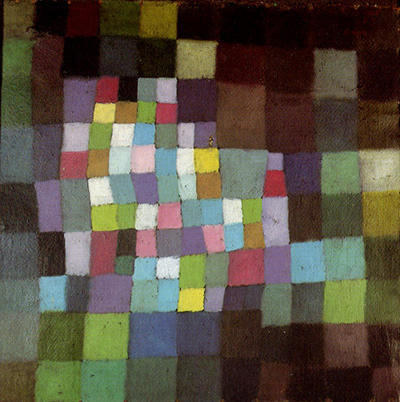
Paul Klee's small, nearly square painting of 1925 is usually identified in English as Abstraction with Reference to a Flowering Tree. The German title and qualification need a little more care. Japanese scholar Atsushi Yamamoto transcribes Blühender Baum (“Flowering Tree”) and reports Klee's own accompanying note in his handwritten work list, Abstract mit Bezug auf einen blühenden Baum (“Abstract with reference to a flowering tree”). Klee numbered the work 1925, 119. The printed Catalogue raisonné Paul Klee number 3800 is supplied by Yamamoto's study; that volume has not been directly consulted here. The painting is oil on carton, 39.3 × 39.1 cm, in the National Museum of Modern Art, Tokyo.[1][2][3]
No trunk, branches or flowers are clearly drawn. Instead, small coloured blocks gather toward the centre of a dark field. They are tightly packed, bright and varied, while larger and generally darker blocks occupy the outside. The eye can move inward as if discovering light, or outward as if watching colour spread. Klee's reference to a flowering tree guides that movement without turning the marks into a botanical diagram. The picture can be looked at as an arrangement of squares and as an image of a process of growth.[2][3][4]
A tree without an outline
The Tokyo museum's Japanese catalogue text describes small squares shimmering against a dim ground. It places the painting among Klee's “magic square” works, compositions built from adjoining quadrilateral colour fields. It also connects their formal clarity to his search for a theory of colour and form while teaching at the Bauhaus. The curator's reading is that the painting's poetic sense of flowering arises through that deliberate structure. Structure and imaginative response are both part of the work.[2]
The Fondation Beyeler's German account calls the image wholly nonrepresentational: only the title directs a viewer toward a tree. It describes a luminous, vibrating coloured formation emerging from darkness. That does not mean the title is arbitrary. It changes how one experiences the field. The central brightness may feel like flowers opening; the expansion from small to large units may suggest growth. Yet one can also follow the colours, proportions and intervals without assigning any patch to a leaf or petal.[4]
Yamamoto's detailed study of this exact object gives a useful way to look. The smallest nearly square units cluster around the centre; intermediate rectangles are roughly twice their area; and large outer fields are roughly four times the smallest. The study describes an approximate outer grid of nine units vertically and ten horizontally. These are proportions discerned through close analysis, not evidence that every painted cell was measured mechanically. The pieces are individually irregular, and the apparent lines sway. The near-square overall format makes those small departures from strict geometry more noticeable.[3]
The colour progression is similarly ordered and varied. Dark purple and green dominate much of the margin, but they are not flat, identical border pieces. Moving inward, the units become smaller and often lighter: blues, pinks, yellows, whites and fresh greens gather near the middle. The centre is not one painted flower. It is a concentration of differences. Yamamoto compares the adjacent units to cells in an organism, a metaphor that explains why the composition can feel alive despite its block-like elements. A viewer's gaze repeatedly assembles and reassembles them into waves, a glow or a flowering event.[3]
What the title adds
The phrase “with reference to” preserves a distance between subject and form. The painted object is not a tree seen through geometric simplification in the way that a landscape might be reduced to squares. In Yamamoto's reading of Wolfgang Kersten's scholarship, Klee begins from subjective experience and lets painting call up a memory or sensation of a flowering tree. The scholar contrasts that procedure with the progressive abstraction of a visibly observed tree. This is an account of Klee's artistic process, not a recovered preparatory sketch proving every step he took for this canvas.[3]
Yamamoto links that process to Klee's wider interest in genesis, the coming-into-being of a form. The argument is that an abstract painting can evoke the activity of growth rather than reproduce a final botanical appearance. A cluster of colour becomes brighter, smaller and denser; a pattern radiates or seems to condense. In either direction, the composition invites movement across the surface. The title gives that movement a possible natural analogue: flowering.[3]
Klee's famous distinction between reproducing the visible and making something visible is often quoted too broadly. Here it has an object-specific application when joined to the observable colour pattern and to his own title note. The painting allows a viewer to experience a sequence of visual changes, even though its pigment remains still. The claim that the sequence is precisely what Klee intended remains interpretive; the title and his teaching do not supply a written, work-by-work decoding key.[3]
Squares, irregularity and Bauhaus teaching
Klee painted Blühender Baum during his Bauhaus years. The German exhibition account published by Art in Words places the work amid tensions between rational construction and intuition in his teaching and painting. It notes the oil-painted carton nailed to a stretcher and original painted frame strips, giving a more specific physical description than the Tokyo collection's brief “oil on carton.” A little image online cannot verify those construction details; the exhibition caption is the source for them.[1][5]
Yamamoto draws a more specific connection to Klee's Bauhaus lectures of 1921–23. He studied how elements could combine into an organic whole and warned that a rule followed for its own sake would produce a scheme in place of a work. Yamamoto’s discussion of his 1922 colour-course text sets his reservations beside the strongly geometric ideas circulating around De Stijl. It would be too simple to declare the painting a direct argument against that movement. It is better to see the freely varied blocks as an example of how Klee could use a repeatable structure while allowing each element to shift.[3][5]
This difference is visible at the centre and edges. A rigid checkerboard would make every square the same size and hold each colour inside a perfect grid. Here the blocks change scale, shape and temperature. Their boundaries make a rhythm, but the irregularities keep it from settling into a machine pattern. Klee's discipline does not erase the feeling of contingency. The apparent organic movement comes from the tension between plan and variation.[2][3][4]
Yamamoto also proposes a musical analogy. Repeated units and gradations of colour can be followed in a sequence, just as musical tones are organized in time. This does not mean Klee painted a transcription of a specific score. It is one way to explain why a still image seems to unfold as the eye moves. The painting offers successive changes in brightness and scale, and the viewer supplies a duration to their encounter with them.[3]
Material, exhibition and later echo
Japan's Agency for Cultural Affairs record gives oil on carton and the 39.3 × 39.1 cm dimensions; it notes a signature, date and inscription at the upper right. Its exhibition history places the work in a 1927 Renoir–Klee show at Galerie Flechtheim in Düsseldorf, under the shorter title Flowering Tree. The Art Platform Japan collection record identifies Tokyo accession O01020 and a 15 November 1993 purchase. These records document the work's location and two points in its public history. They do not give a continuous provenance from Klee to Tokyo.[1][2]
The picture remained important enough for Klee to revisit. Yamamoto discusses Blühendes (“Blooming”), 1934, 199, now at Kunstmuseum Winterthur, as a larger work closely related to the 1925 composition. The comparison finds a broadly similar distribution of colour fields, turned approximately ninety degrees and worked in a different material and scale. Yamamoto treats it as a reworking, not the same object or a literal enlargement. That later echo strengthens the case for looking at Flowering Tree as a developed formal idea, while the specific reason Klee returned to it remains open.[3]
The Tokyo museum has repeatedly shown the work in collection presentations, including recent exhibition lists. An exhibition list proves display on its specified dates, not perpetual hanging. The painting's larger significance does not depend on it being visible in a gallery at every moment. In reproductions and in person, it asks viewers to test how far a title can direct recognition and how colour can suggest a living process without drawing the living thing.[1][3][4]
Flowering Tree keeps abstraction and nature in conversation. Its blocks are clearly made, counted and coloured. Their uneven sequence also seems to grow, flare and change. The tree is a reference; the act of looking through this moving pattern is the painting's subject.[2][3][4]
Related artworks
Explore eight other Klee works from the researched artwork cluster.
Ancient Harmony
1925
Fish Magic
1925
The Goldfish
1925
Actor's Mask
1924
Around the Fish
1926
Flora on Sand
1927
Sinbad the Sailor
1923
Castle and Sun
1928
References
- Art Platform Japan, Abstraction with Reference to a Flowering Tree, collection record, Japanese/English, data supplied by the National Museum of Modern Art, Tokyo: accession O01020, oil on carton, dimensions, upper-right inscription and 1993 purchase. Its image notice does not permit downloading or republication of that specific file, View source.
- Agency for Cultural Affairs, 花ひらく木をめぐる抽象, Japanese: object details, 1927 Düsseldorf exhibition and interpretation of the small squares against a dark ground. MOMAT bilingual 2019 exhibition list confirms English title, 1925 date, oil on carton and measurements.
- Atsushi Yamamoto, “Imagined plants, the creation of plants: on Paul Klee's Flowering Tree”, Dokkyo Universität Germanistische Forschungsbeiträge 79 (2021), pp. 159–190, Japanese; full 32-page PDF directly consulted: Klee's annual number and title note, indirectly cited catalogue raisonné no. 3800, composition, Kersten's interpretation, Bauhaus lectures, growth, music and 1934 related work. PDF.
- Fondation Beyeler, “ Blühender Baum, 1925, 119”, German, curator Anna Szech's 2017 exhibition account: square-picture context, dark surroundings, bright central formation and title as guide to the subject, View source.
- Art in Words, “Paul Klee: Konstruktion des Geheimnisses in München”, German, exhibition review and object caption: carton nailed to stretcher, original painted frame strips, 1925, 119, and a contextual reading of Bauhaus construction and intuition. The physical description is taken from its caption, not independently verified through conservation inspection, View source.