


 by Tom Gurney
Tom Gurney BSc (Hons) is an art history expert with over 20 years experience
Published on June 19, 2020 / Updated on September 27, 2026
Email: tomgurney1@gmail.com / Phone: +44 7429 011000
Cathedrals: architecture made from repeated signs
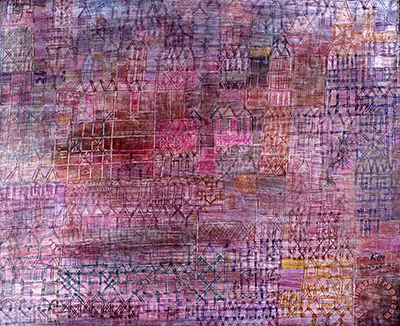
The image on this page corresponds to Paul Klee's Kathedralen (Cathedrals), 1925, work no. 65, as described by art historian K. Porter Aichele. Her study gives its material as watercolour on paper with an oil ground, mounted on cardboard, with an original frame, 27.3 × 32 cm, and records it in a private collection in Japan at the time of publication. The inherited site photograph and a separately published reproduction titled Cathedrals show the same dense arrangement of fine architectural signs. This is a strong visual and textual identification, although the research has not located a current owner's image or independently inspected the printed catalogue raisonné entry.[1][4]
The painting is a field of small lines. Pointed tops suggest roofs or spires; paired upright strokes and small arcs can become windows and arches. Many units repeat, but their spacing and colour shift. Reds, pinks, violet, ochre and cool blue-grey appear beneath or around the dark tracery. No single building is isolated against a sky. Instead, possible buildings overlap, recede and reform across nearly the whole surface. Klee makes looking at a city feel like reading a densely marked page.[1][4]
A plural title and several possible buildings
The German title Kathedralen is plural. Aichele proposes that the work could show several views of one cathedral or three or four different structures, each gathered around a quadrant. She also leaves open a wider meaning: the plural could refer to Klee's earlier cathedral images and remembered places as much as to a count of buildings. That uncertainty fits the painting. The eye picks out groups of gables and arches, loses them in the cross-lines, and then finds another possible façade nearby.[1]
A strong horizontal rhythm runs through the image, especially where rows of short verticals and pointed marks accumulate. At the same time, stacked signs invite a vertical reading as towers. One can move across the painting as across a score or climb through it as through clustered buildings. Aichele argues that this tension between horizontal pattern and vertical architectural image is central to the work. It lets the marks operate as both an abstract rhythm and signs of a place.[1]
The forms are not a survey of a specific cathedral. Their arches and peaks are generic enough to trigger architectural recognition without making an identifiable façade. Aichele connects this to the artist's practice of turning visual memory and written language into condensed signs. In her interpretation, the work's repeated linear units acquire a poetic structure. This is a scholarly reading, not documentary proof that the pictured marks record a named church or a measured plan.[1]
Some traces are difficult to assign even to architecture. A short diagonal may be a roof, a brace, a cross or only an accent in a sequence. A pale rectangle can act as a wall or a pause in the pattern. This ambiguity is productive: the title draws attention to cathedrals, while the image continually moves between building and ornament. The colour is not merely a backdrop. Warm and cool passages create local emphases that help clusters come forward, then let them sink back into the overall web.[1][4]
Watercolour, oil ground and scale
Aichele's figure caption describes watercolour on paper with an oil ground, mounted on cardboard. That account is more precise than the inherited page's unsupported statement that Klee first drew “in pen and ink” and added oil and watercolours later. The present sources do not establish such a step-by-step sequence, so it should not be repeated as fact. The documented oil ground and overlying colour are enough to make material layering relevant without pretending to reconstruct every action in the studio.[1]
At 27.3 × 32 cm, this is a compact work. The dense signs reward close attention; enlarging a small reproduction can make the strokes seem coarser and the colours more saturated than in a sound photograph. The local 400 × 326 px image is a small inherited copy with no recorded source. Its pattern matches the separate Cathedrals reproduction, but it is not evidence for exact colour, condition or the state of the original frame. Aichele's material and measurement record provides the firmer object description.[1][4]
The distinction matters because Klee made other cathedral works. The Phillips Collection owns a singular Cathedral dated 1924, measuring 11¾ × 13⅞ inches (about 29.8 × 35.2 cm). Its collection photograph shows a reddish, framed architectural field with light linear symbols; it is visibly different from the pink-violet lattice inherited here. The old text on this site copied the Phillips dimensions while calling the image Cathedrals and dating it about 1914. Those figures belong to the 1924 Phillips object, not to the 1925 work discussed on this page.[2]
There is also a Kathedralen, II. The Museum of Modern Art's 1930 exhibition catalogue lists it as 1925, “oil on canvas on board.” That contemporaneous catalogue entry proves that the title family contains at least one further 1925 object. It does not identify the image here as Kathedralen, II. The site image, Aichele's title and materials, and the secondary visual comparison instead point to Kathedralen, 1925/65. The close names make precision about the medium and dimensions essential.[1][3][4]
Reading the painting without inventing a monument
Aichele relates the 1925 work to Klee's longer interest in architectural signs and to his Bauhaus teaching on structural rhythms. She considers the possibility that a remembered night view of Cologne, which Klee wrote about in 1916, contributed to the painting's poetic structure. She does not present it as a literal view of Cologne Cathedral. Her analysis stresses that Klee removes markers that would tie the pattern securely to one building. The result is architecture as a visual language, rather than a tourist view.[1]
That interpretation sharpens a simple observation of the image. If each gable-like mark is read separately, the work can seem crowded and fragmented. If the marks are read in groups, larger masses start to appear. The painting alternates between these scales. Its apparent intricacy comes from limited components varied in orientation, spacing and colour. Klee can therefore suggest monumental buildings through signs small enough to fit into a hand-held sheet.[1][4]
The plural title keeps the image open. A viewer can find several cathedrals, repeated views of one, or the idea of cathedral architecture passing through memory and drawing. What the sources securely establish is the 1925 Kathedralen identification in Aichele's scholarship, the distinct 1924 Cathedral in Washington, and the further 1925 Kathedralen, II in the MoMA exhibition list. Keeping those objects apart lets the inherited image be read on its own terms: a small, layered surface where repeated lines become buildings and buildings return to pattern.[1][2][3]
Related artworks
Explore eight other Klee works from the researched artwork cluster.
Ancient Harmony
1925
Fish Magic
1925
The Goldfish
1925
Actor's Mask
1924
Around the Fish
1926
Flora on Sand
1927
Sinbad the Sailor
1923
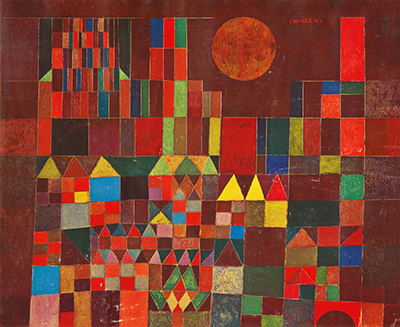
Castle and Sun
1928
References
- K. Porter Aichele, Paul Klee, Poet/Painter, Camden House, 2006, fig. 34 and pp. 130–35; searchable text consulted. The scholarly study identifies Kathedralen as 1925/65, gives its medium, size and then recorded location, and offers the attributed analysis of repeated signs, multiple possible structures and poetic rhythm. The ebook text omits the work's figure; the printed catalogue raisonné was not directly inspected.
- The Phillips Collection, Cathedral, owner record and object image: distinct singular work, 1924, watercolour and oil on paper mounted on cardboard and wood panel, 11¾ × 13⅞ inches, View source.
- The Museum of Modern Art, Paul Klee, March 13–April 2, 1930, catalogue, item 10, p. 13: distinct Cathedrals, II (Kathedralen, II), 1925, oil on canvas on board. The catalogue notes that some of its medium descriptions were uncertain, View source.
- Pg-Plaisio, Cathedrals reproduction listing, used only to compare the image pattern with the inherited 400 px JPEG; this retailer is not relied on for date, medium, dimensions, ownership or catalogue number, View source.