


 by Tom Gurney
Tom Gurney BSc (Hons) is an art history expert with over 20 years experience
Published on June 19, 2020 / Updated on September 27, 2026
Email: tomgurney1@gmail.com / Phone: +44 7429 011000
A face made of lines
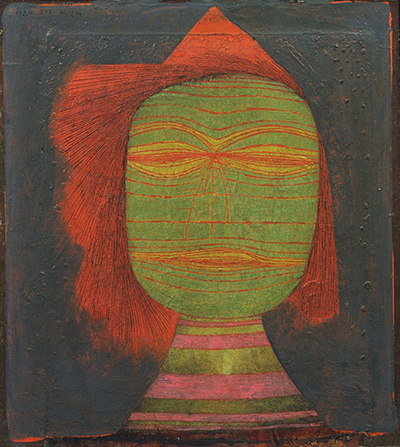
A green oval face emerges from a dark blue-grey ground. Close red-orange lines cross it, bunching into eye-like curves, narrowing towards a possible nose and spreading again around a closed-looking mouth. Red gathers at the sides like hair or a headdress, while a pointed red top and a striped neck give the figure a theatrical silhouette. Paul Klee’s Actor’s Mask is recognisably a face, yet its most expressive features are not simply eyes and lips. They are the paths the lines take across a painted surface.[1][2]
The work belongs to Klee’s 1924 Bauhaus years. Its original German title is usually printed Schauspieler=Maske: literally “actor = mask.” The equals sign is striking. The familiar English Actor’s Mask makes a mask something an actor has; the German formula can suggest a more unsettling closeness between the performer and the face presented to the public. That is a prompt for looking, not a recovered declaration that Klee intended one precise philosophical equation.[1][3]
Contents
- Which Actor’s Mask is this?
- How is the face constructed?
- Is the actor wearing a mask, or becoming one?
- What does the Bauhaus theatre context explain?
- How did early critics read the work?
- From Klee’s studio to MoMA
- Looking again
Which Actor’s Mask is this?
The Museum of Modern Art in New York owns the painting as 616.1967, part of The Sidney and Harriet Janis Collection. Its present record gives 1924, oil on canvas mounted on board, and 36.7 × 33.8 cm. The 2008 Berlin Das Universum Klee checklist identifies Klee’s own annual number 1924, 252 and the printed catalogue raisonné’s continuous number 3624. The former distinguishes it within his work for that year; the latter locates it in the modern scholarly catalogue. Neither is MoMA’s accession number.[1][3]
The Berlin checklist describes the support more fully in German: oil paint on canvas on cardboard on wood. MoMA’s shorter “canvas mounted on board” does not make the Berlin wording false, but the visible online records do not establish exactly how every backing layer is joined. A conservator’s file would be needed for a confident account of the mount or the order of the coloured layers. A small reproduction shows an uneven, worked surface; it cannot identify whether every hairline is scratched, painted or the result of an earlier layer showing through.[1][2][3]
The English title has remained stable in MoMA’s current record, while German versions have varied. Berlin’s checklist and a 2019 MoMA exhibition checklist print Schauspieler=Maske. MoMA says a 1929 Flechtheim catalogue listed Schauspielermaske without the equals sign. The announced title of a 2016 French object essay adds Jugendlicher, or “young,” in parentheses. Without the artist’s handwritten work catalogue or the printed raisonné entry directly in view, the expanded form should be treated as a title lead, not silently promoted to Klee’s definitive original wording. The page uses the well-attested short German form and keeps the variation in the historical record.[1][3][4]
The date has also changed in the museum’s publications. MoMA’s 1930 Klee exhibition catalogue listed no. 12, Actor’s Mask, as 1925, with “oil on canvas on fibre-board.” A 1941 MoMA catalogue again said 1925 and simplified the medium to “oil on wood.” A subsequent 1949 MoMA Klee catalogue listed the Janis-owned painting as 1924, although it retained “oil on wood.” MoMA’s present object record, Berlin’s 2008 list and MoMA’s 2019 checklist also give 1924. These are successive descriptions of the same Janis painting, not evidence for an otherwise unknown second Actor’s Mask. The current owner and catalogue-based 1924 identification governs this page’s caption.[1][3][5][6]
A larger reproduction sourced to MoMA shows a small inscription at the painting's upper left that can be read as 1924, 252 beside Klee's name. It gives a visual reason to check the earlier catalogue dates against the object, though a photograph alone cannot establish the inscription's authorship or the precise date it was placed there. Its numerals agree with the annual number in the Berlin checklist. The reproduction is used here for research, not added to the page as a new image.[2][3]
How is the face constructed?
The green central form is nearly symmetrical at first glance, but its sides are not identical. Its left and right boundaries curve differently against the red areas. A sharp peak above it seems to join the face to a hat or triangular headdress. Beneath it, a narrow banded neck widens into a stepped base. These stacked shapes stabilise the frontal figure, while the fine lines across the face keep it from becoming a flat emblem.[2]
The lines are most concentrated at eye level. Several arc outward from the centre, turn back and meet their partners across the face. The repeated curves can be read as eyelids, brows or an ornamental band over the eyes. Because they cross where a gaze would normally meet ours, they make looking back at this “actor” strangely uncertain. The face has no plainly open pair of pupils. It appears present and withheld at once.[2]
Fine reddish strokes run almost horizontally across the forehead and cheeks. Near the middle, some bend down to suggest a nose. Lower curves settle around a mouth-like opening or a closed set of lips. None behaves quite like anatomical contour alone. A line that first helps make a feature continues across the green surface as an independent graphic mark. The mask seems to be generated by drawing rather than merely covered with decoration.[2]
The red at the sides is uneven. On the left it spreads in a broader, rougher mass; on the right it lies closer to the green oval. Calling both sides “hair” is convenient but not certain. They may suggest costume, a head covering or a dramatic background halo. The striped lower section is equally ambiguous: it can be a collar, a pedestal-like continuation of the face, or part of a theatrical garment. No identified object or culture supports treating those bands as an ethnographic neck ornament.[1][2]
Around the figure, blue-grey paint carries visible variation and small irregular marks. Its darkness increases the force of the green and red, but it is not empty space. The figure reaches close to the rectangle’s top and bottom, leaving little room for a stage, audience or other characters. That compression helps turn an “actor” into an encounter with one frontal image. A photographic reproduction can preserve the broad relations of face, line and ground; it cannot replace looking at MoMA’s object for surface depth, true hue or condition.[1][2]
Is the actor wearing a mask, or becoming one?
The English possessive title can lead us to imagine a person behind a removable object. The painting itself supplies no visible edge where a physical mask lifts away to reveal a second face. The features we see are the lines of the green oval. The German equals sign gives a useful counter-pressure: performance and presented face are held together in the title. The image does not resolve whether it is showing a concealed individual, a public role, or simply the formal construction of a face.[2][3]
Marie Kakinuma, studying Klee’s 1919 self-portrait series in the German-language specialist journal Zwitscher-Maschine, traces an earlier thought by Klee about a mask. His diary notes of 1903 and 1905 concern the etching Komiker (Comedian): in that context he compared the mask with art and the person behind it with the human maker. A shorter formulation appeared in a 1920 publication. This is unusually relevant artist-authored thinking, but its date and subject must stay attached to it. Klee did not write those words as a label for the 1924 canvas. The earlier distinction between mask and human being gives us a question to bring to Actor’s Mask, not a verified answer about the figure’s identity.[7]
Kakinuma argues that a 1919 work titled Maske can be considered within an allegory of the artist. Her formal comparison concerns that group of self-portraits, not this later MoMA painting. One might extend her question: if lines across a face can be routes for analysing an artwork, what do the eye-level curves and mouth bands do here? They reveal how an image is made while making an ordinary psychological reading of the face more difficult. The analogy remains ours unless a dated Klee source connects it to this precise object.[2][7]
A 2016 Centre Pompidou exhibition caption in French offered a stronger view: it proposed a possible self-portrait of Klee in the guise of a masked actor, using the earlier mask remark to frame art as staging itself. That is a coherent curatorial interpretation, and the word “possible” is important. No likeness, self-portrait title or artist inscription in the accessible MoMA record identifies the green face as Klee. The French reading can enrich the page without turning the painting into a documented portrait of its maker.[1][8]
English-language critic Dena Shottenkirk, writing in 2006, likewise understood the work through the divide between an external role and an inner self. She noticed the contrast between delicate lines and a rougher painted surface. Her psychological account and the Pompidou’s self-reflexive one are later responses to the same difficulty: the face looks direct, while its visible features do not disclose a particular person behind it. Their differences are useful because they keep the painting from becoming a single solved metaphor.[2][8][9]
What does the Bauhaus theatre context explain?
Klee taught at the Bauhaus in Weimar when he made the painting, and theatre was part of the school’s experimental life. MoMA’s current children’s label introduces his interest in theatre, while the 2008 Berlin exhibition placed Schauspieler=Maske in a thematic section on Theater. These institutional choices support a discussion of performance and role. They do not identify a particular production, performer, costume or stage mask that Klee copied for this painting.[1][3]
Klee also made puppets for his son Felix, and other works in the Berlin theatre group depict actors, tightrope walkers and theatrical situations. Such breadth makes the topic more than an isolated word in one title. Still, connecting Actor’s Mask to a specific Bauhaus costume resembling a fencer’s mask would require a dated photograph, letter or other work-specific comparison; none is established in the consulted object sources. The green frontal face, pointed top and striped base deserve to be studied as this work’s forms before they are assigned to a production history.[2][3]
The unusual title may be the most compact theatrical device. It withholds a conventional plot and collapses two nouns into a visual equation. An actor ordinarily performs several roles; a mask can give one role a face. In Klee’s picture the two concepts are locked together, while the actual appearance remains unsteady: eye band, hair-like passages and collar-like base each shift between portrait and costume. The actor is therefore present through a role, but no biography of that actor is supplied.[2][3]
How did early critics read the work?
MoMA’s 1930 catalogue supplies an unusually early American reception. Its essay by Alfred H. Barr Jr. compared the effect of Actor’s Mask with Melanesian ceremonial masks and said Klee had studied masks in theatrical and ethnographic museums. This is a historically situated analogy and a claim about Klee’s studies, not itself a letter or diary entry recording his encounter with any particular mask. The catalogue does not identify a specific Melanesian object that served as a model. It would be misleading to turn Barr’s comparison into an established “tribal influence” or to imply that unnamed cultures form one decorative category.[5]
Barr was trying to convey the image’s startling psychological force to a New York audience. The analogy belongs to the story of how the painting was introduced there. Klee’s 1903–05 mask thought, the Weimar theatre setting and the painting’s own formal features offer different kinds of evidence: an artist’s earlier reflection, a general historical setting and the physical image. They need not all be made to say the same thing.[2][5][7]
The early catalogue’s 1925 date and older medium wording show a further reason to distinguish reception from object documentation. A work can be admired and interpreted while its cataloguing is still being refined. MoMA’s present 1924, canvas-on-board record and Berlin’s numbered 1924 entry make the modern identification stronger, but the earlier errors remain part of the work’s exhibition history. They also caution against using a historical critic’s material description as a technical report.[1][3][5][6]
From Klee’s studio to MoMA
MoMA’s provenance project records the painting on consignment from Klee to Rudolf Probst’s Galerie Neue Kunst Fides in Dresden in 1928, and also to Galerie Alfred Flechtheim in Berlin from February 1928. The entries overlap in the published summary; without the dealer records, there is no reason to invent an exact route between them. “On consignment” means the dealers handled the work on the artist’s behalf; it is not evidence that they bought it from him.[1]
The painting appeared as no. 54 in Flechtheim’s Berlin Klee exhibition of 20 October–15 November 1929. It was then lent to MoMA’s first Klee exhibition, 13 March–2 April 1930, as no. 12. The 1930 catalogue states that paintings without another named owner belonged to the artist and were shown through his representatives. In 1931, the work was sold through J. B. Neumann in New York to Sidney Janis. The Janis collection gave it to MoMA in 1967. That sequence shows how a small Weimar-period painting travelled through German dealers into American private and then museum ownership, with different roles for consignment, loan, sale and gift.[1][5]
MoMA’s 1941 Klee catalogue listed the painting while it was with Janis. A 2019 MoMA checklist and recent installation history document its later life within the institution; the work is currently marked “not on view” on the museum page, a display status that can change. These records should not be collapsed into a claim that it stayed on a wall continuously. The stable ownership fact is the 1967 Janis gift, recorded under MoMA’s accession number.[1][4][6]
Looking again
The green oval holds its place against the dark field, but the red lines refuse to become a simple expression. They make a face, hide part of its gaze and keep announcing themselves as lines. The title says “actor = mask”; the painting asks how much of a person can be read from an image designed for performance. Later scholars have called it self-portrait, role play or a division between public and private selves. Each reading begins with something visible or historically relevant, and each needs its qualification.[1][2][3][7][8][9]
Look again at the narrow centre where the eye-level lines meet. The face is not blank, but neither does it meet us with an unambiguous gaze. Klee made a mask that can feel vivid without revealing its wearer. The painting’s force lies in that formal balance between a boldly coloured frontal figure and the thin, persistent lines that keep its identity open.[2]
For related reading, explore Klee’s Bauhaus years, his materials and techniques, and the distinct later painting Mask of Fear. That 1932 work has a different scale, support and historical setting; a shared word in the titles does not make the two objects interchangeable.
Explore selected works from Klee’s much larger oeuvre. Titles without a link have an authenticated catalogue identity but no reviewed article yet.
Artworks directory
| Name | Date | Medium |
|---|---|---|
| A Gate | 1939 | Painting and mixed media |
| A Woman for Gods | 1938 | Watercolour and mixed media |
| Ab Ovo | 1917 | Watercolour and mixed media |
| Above Mountain Summit | 1917 | Drawing and mixed media |
| Abstract Trio | 1923 | Drawing and mixed media |
| Acrobats | 1915 | Watercolour and mixed media |
| Actor's Mask | 1924 | Painting and mixed media |
| Ad Marginem | 1930 | Drawing and mixed media |
| Ad Parnassum | 1932 | Painting and mixed media |
| Adventurer Ship | 1927 | Drawing and mixed media |
| Affected Place | 1922 | Drawing and mixed media |
| After a Sketch from Zurich | 1914 | Watercolour and mixed media |
| After Drawing | 1919 | |
| After The Floods | 1936 | Watercolour and mixed media |
| All Souls' Picture | 1921 | |
| Ancient Harmony | 1925 | Painting and mixed media |
| Angel Applicant | 1939 | Drawing and mixed media |
| Angel Serves the Desired | 1920 | |
| Angel, Still Female | 1939 | Painting and mixed media |
| Angelus Novus | 1920 | Drawing and mixed media |
| Animal Terror | 1926 | Painting and mixed media |
| Arab Song | 1932 | Painting and mixed media |
| Archangel | 1938 | Painting and mixed media |
| Architecture | 1923 | Painting and mixed media |
| Architecture of the Plain | 1923 | Drawing and mixed media |
| Around the Fish | 1926 | Painting and mixed media |
| Arrival of the Air Steamer | 1921 | Drawing and mixed media |
| Asiatic God | 1924 | Painting and mixed media |
| Astrological Fantasy Portrait | 1924 | Drawing and mixed media |
| Athlete's Head | 1932 | Watercolour and mixed media |
| Aufgehender Stern | 1931 | Painting and mixed media |
| Autumn Flower | 1922 | Painting and mixed media |
| Bad Band | 1920 | Drawing and mixed media |
| Baroque Centaur | 1939 | Painting and mixed media |
| Before the Blitz | 1923 | Drawing and mixed media |
| Before the Snow | 1929 | Drawing and mixed media |
| Besessenes Madchen | 1924 | Watercolour and mixed media |
| Bird Garden | 1924 | |
| Bird Wandering Off | 1926 | Watercolour and mixed media |
| Blossoms in the Night | 1930 | Watercolour and mixed media |
| Blue-Bird-Pumpkin | 1939 | Painting and mixed media |
| Boats in the Flood | 1937 | Painting and mixed media |
| Botanical Theatre | 1934 | Drawing and mixed media |
| Boy in Fancy Dress | 1931 | Watercolour and mixed media |
| Broken Key | 1938 | |
| Brother and Sister | 1930 | Watercolour and mixed media |
| But the Red Roof | 1935 | Painting and mixed media |
| C - C = Fisch | 1931 | Watercolour and mixed media |
| Cacti | 1912 | Painting and mixed media |
| Camel (in Rhythmic Landscape with Trees) | 1920 | Drawing and mixed media |
| Captive Pierrot | 1923 | Drawing and mixed media |
| Castle and Sun | 1928 | Drawing and mixed media |
| Cat and Bird | 1928 | Drawing and mixed media |
| Cathedrals | 1925 | Watercolour and mixed media |
| Chalice of the Heart | 1937 | Painting and mixed media |
| Characters in Yellow | 1937 | Painting and mixed media |
| Chosen Site | 1927 | Mixed media |
| Christmas Picture | 1923 | Drawing and mixed media |
| City of Towers | 1916 | Painting and mixed media |
| Clarification | 1932 | Painting and mixed media |
| Collection of Figurines | 1926 | Painting and mixed media |
| Colorful Architecture | 1917 | Painting and mixed media |
| Comedians' Handbill | 1938 | |
| Comic Opera Singer | 1927 | Painting and mixed media |
| Composition | 1939 | Painting and mixed media |
| Composition with Figures | 1915 | Drawing and mixed media |
| Composition with the Yellow Half-Moon and the Y | 1918 | Watercolour and mixed media |
| Conch–Still Life II | 1939 | Watercolour and mixed media |
| Cosmic Composition | 1919 | Painting and mixed media |
| Crystal Gradation | 1921 | Drawing and mixed media |
| Dance of the Grieving Child | 1922 | Painting and mixed media |
| Dancing Girl | 1940 | Painting and mixed media |
| Das Licht und Etliches | 1931 | Mixed media |
| Death and Fire | 1940 | Painting and mixed media |
| Death for the Idea | 1915 | |
| Demon as Pirate | 1926 | Watercolour and mixed media |
| Diana | 1931 | Painting and mixed media |
| Diavolo Player | 1923 | Drawing and mixed media |
| Die Kapelle | 1917 | Watercolour and mixed media |
| Die Vase | 1938 | Painting and mixed media |
| Doctor | 1930 | Drawing and mixed media |
| Dredger and Sailboat | 1931 | Watercolour and mixed media |
| Ein Tor | 1939 | Painting and mixed media |
| Ein Weib fur Gotter | 1938 | Mixed media |
| Embrace | 1939 | Watercolour and mixed media |
| Episode before an Arab Town | 1923 | |
| Equals Infinity | 1932 | Painting and mixed media |
| Eros | 1923 | Drawing and mixed media |
| Error on Green | 1930 | Watercolour and mixed media |
| Evening Figure | 1935 | Drawing and mixed media |
| Falling Bird | 1919 | |
| Fermata | 1932 | Watercolour and mixed media |
| Fire Clown | 1921 | Watercolour and mixed media |
| Fire Full Moon | 1933 | Watercolour and mixed media |
| Fire in the Evening | 1929 | Painting and mixed media |
| Fish in the Harbour | 1916 | Watercolour and mixed media |
| Fish Magic | 1925 | Watercolour and mixed media |
| Flock of Birds | 1917 | Drawing and mixed media |
| Flora on Sand | 1927 | Watercolour and mixed media |
| Flower Myth | 1918 | |
| Flower Stand with Watering Can and Bucket | 1910 | Watercolour and mixed media |
| Flowering Tree (Abstraction with Reference to a Flowering Tree) | 1925 | Painting and mixed media |
| Flowers in Pots | 1923 | |
| Flowers in Stone | 1939 | Painting and mixed media |
| Forest Witch | 1938 | Painting and mixed media |
| Fright of a Girl | 1922 | Drawing and mixed media |
| Fruits on Red | 1930 | Drawing and mixed media |
| Full Moon | 1919 | Mixed media |
| Föhn Wind in Franz Marc's Garden | 1915 | Watercolour and mixed media |
| Garden in St Germain, The European Quarter near Tunis | 1914 | Watercolour and mixed media |
| Ghost Chamber with the Tall Door (New Version) | 1925 | |
| Ghost of a Genius | 1922 | Drawing and mixed media |
| Girl in Mourning | 1939 | Painting and mixed media |
| Glance of a Landscape | 1926 | Watercolour and mixed media |
| Gluht Nach | 1939 | Drawing and mixed media |
| Golden Fish | 1925 | Watercolour and mixed media |
| Goldfish Wife | 1921 | Watercolour and mixed media |
| Green Plant, Blood, Louse | 1924 | Drawing and mixed media |
| Hafenbild | 1918 | Mixed media |
| Hammamet with Mosque | 1914 | Watercolour and mixed media |
| Harbour with Sailing Ships | 1937 | Painting and mixed media |
| Hauptweg und Nebenwege | 1929 | Painting and mixed media |
| Heavenly and Earthly Time | 1927 | Drawing and mixed media |
| Heroic Fiddling | 1938 | Painting and mixed media |
| Heroic Roses | 1938 | Painting and mixed media |
| Heroic Strokes of the Bow | — | Mixed media |
| Highway and Byways | 1929 | Drawing and mixed media |
| Houses near the Gravel Pit | 1913 | Watercolour and mixed media |
| Howling Dog | 1928 | Painting and mixed media |
| In the Current Six Thresholds | 1929 | Painting and mixed media |
| In the Style of Kairouan | 1914 | Drawing and mixed media |
| Individualized Altimetry of Stripes | 1930 | Painting and mixed media |
| Insula Dulcamara | 1938 | |
| Interior with the Clock | 1913 | Watercolour and mixed media |
| Irma Rossa the Animal Tamer | 1918 | Drawing and mixed media |
| Journey in Corsica | 1927 | Drawing and mixed media |
| Landscape with Bluebirds | 1919 | Watercolour and mixed media |
| Legend of the Nile | 1937 | Painting and mixed media |
| Lemon Harvest | 1937 | Watercolour and mixed media |
| Likeness in the Bower | 1930 | Watercolour and mixed media |
| Limits of Reason | 1927 | Painting and mixed media |
| Little Hope | 1938 | Watercolour and mixed media |
| Magdalena before the Conversion | 1938 | Drawing and mixed media |
| Mask of Fear | 1932 | Painting and mixed media |
| May Picture | 1925 | Painting and mixed media |
| Monument in a Cemetery | 1922 | Watercolour and mixed media |
| Monuments at G | 1929 | Watercolour and mixed media |
| Municipal Jewel | 1917 | Watercolour and mixed media |
| Mural from the Temple of Longing Thither | 1922 | |
| Nach der Uberschwemmung | 1936 | Watercolour and mixed media |
| New Harmony | 1936 | Painting and mixed media |
| New House in the Suburbs | — | Mixed media |
| Old Steamboat | 1922 | Drawing and mixed media |
| On the Edge | 1930 | Drawing and mixed media |
| Once Emerged from the Gray of Night | 1918 | Drawing and mixed media |
| One Who Understands | 1934 | Painting and mixed media |
| Oriental Pleasure Garden | 1925 | Painting and mixed media |
| Park of Idols | 1939 | Watercolour and mixed media |
| Passing by Red Pillars | 1928 | Watercolour and mixed media |
| Persian Nightingales | 1917 | Drawing and mixed media |
| Popular Wall Painting | 1922 | Painting and mixed media |
| Prestidigitator | 1927 | Watercolour and mixed media |
| Rainy Day | 1931 | Watercolour and mixed media |
| Red and White Domes | 1914 | Watercolour and mixed media |
| Red Balloon | 1922 | Drawing and mixed media |
| Redgreen and Violet-Yellow Rhythms | 1920 | Drawing and mixed media |
| Refuge | 1930 | Watercolour and mixed media |
| Rhythmic Rythmical | 1930 | Painting and mixed media |
| Saint of the Inner Light | 1921 | |
| Scaffolding of a New Building | 1930 | Painting and mixed media |
| Scholar in Dealing with Stars | 1926 | Watercolour and mixed media |
| Seated Woman | 1930 | Drawing and mixed media |
| Senecio | 1922 | Painting and mixed media |
| Separation in the Evening | 1922 | Drawing and mixed media |
| Sinbad the Sailor | 1923 | Drawing and mixed media |
| Skeptically Smiling | — | Mixed media |
| Small House in the Garden City | 1928 | Watercolour and mixed media |
| Small Portrait of a Girl in Yellow | 1925 | Painting and mixed media |
| Southern Gardens | 1919 | Watercolour and mixed media |
| Static-Dynamic Gradation | 1923 | Drawing and mixed media |
| Still Life | 1927 | Painting and mixed media |
| Still Life with Gladioli | 1932 | Watercolour and mixed media |
| Strange Garden | 1923 | Drawing and mixed media |
| Stricken City | 1936 | Painting and mixed media |
| Strong Dream | 1929 | Watercolour and mixed media |
| Struck from the List | 1933 | Drawing and mixed media |
| Structural I | 1924 | Drawing and mixed media |
| Sumpflegende | 1919 | Painting and mixed media |
| Temple Gardens | 1920 | Drawing and mixed media |
| The Arrow before the Target | 1921 | Drawing and mixed media |
| The Barbed Noose with the Mice | 1923 | Watercolour and mixed media |
| The Flora of the Heath | 1925 | Watercolour and mixed media |
| The Goldfish | 1925 | Watercolour and mixed media |
| The Hour Before One Night | 1940 | Painting and mixed media |
| The Man in Love | 1923 | |
| The Mask with the Flag | 1925 | Mixed media |
| The Pathos of Fertility | 1921 | |
| The Rhine at Duisburg | 1937 | Painting and mixed media |
| The Way to the Citadel | 1937 | Painting and mixed media |
| Three Houses and a Bridge | 1922 | Watercolour and mixed media |
| Tightrope Walker | 1923 | |
| Tomb in Three Parts | 1923 | Watercolour and mixed media |
| Tomcat's Turf | 1919 | Watercolour and mixed media |
| Tower in Orange and Green | 1922 | Drawing and mixed media |
| Tree and Architecture - Rhythms I | 1920 | Watercolour and mixed media |
| Tree and Architecture - Rhythms II | 1920 | Painting and mixed media |
| Tropical Dawn with the Owl | 1921 | Mixed media |
| Tropische Dammerung | 1921 | Painting and mixed media |
| Twittering Machine | 1922 | Drawing and mixed media |
| Variations (Progressive Motif) | 1927 | Watercolour and mixed media |
| Ventriloquist and Crier in the Moor | 1923 | |
| Viaducts Break Ranks | 1937 | Drawing and mixed media |
| Villa R | 1919 | Painting and mixed media |
| Village Carnival | 1926 | Painting and mixed media |
| Vor dem Blitz | 1923 | Drawing and mixed media |
| Wald-Hexen | 1938 | Painting and mixed media |
| Young Forest | 1925 | Drawing and mixed media |
Related artworks
Explore eight other Klee works, beginning with works close in date to this one.
Ancient Harmony
1925
Fish Magic
1925
Sinbad the Sailor
1923
The Goldfish
1925
Around the Fish
1926
Red Balloon
1922
Senecio
1922
Twittering Machine
1922
Discussion
Klee's green face is made by fine red lines that both form and interrupt its features.
The German title links actor and mask; later scholars disagree on what that identity suggests.
Reader Insights
Where do the red lines make an eye or mouth, and where do they keep moving as marks?
Does the striped lower form read as costume, collar or part of the face's design?
How does the German equals sign affect your reading of the English title?
Join the Conversation
Share the detail or source behind your reading.
References
- Museum of Modern Art, Actor’s Mask object and provenance record, current 1924 date, medium, dimensions, inv. 616.1967, Janis credit, exhibition history, licensing notice and detailed 1928–67 consignment/sale/gift chain. MoMA labels provenance research ongoing, View source.
- Artwork reproductions: the inherited 400 × 447 px image on this page, visually matched to MoMA’s object in reference 1; and an exact 1838 × 2000 px Commons copy sourced to MoMA, inspected at native scale for broad visual details and the upper-left inscription. Commons marks its copy public domain, while MoMA's current rights notice differs; it is not republished here as an enlarged image, View source.
- Staatliche Museen zu Berlin, Das Universum Klee checklist (2008), Klee 1924,252, raisonné no. 3624, Schauspieler=Maske, 36.7 × 33.8 cm, layered German material wording, “Theater” grouping, View source.
- Museum of Modern Art, Lincoln Kirstein’s Modern press checklist (2019), current 1924 date and short German title; Clara Pacquet, 2016 publication list, attests a work-specific essay with expanded parenthetical title. Its full text was not available for this manuscript.
- Museum of Modern Art, Paul Klee, 13 March–2 April 1930 exhibition catalogue, especially no. 12 and Alfred H. Barr Jr.’s essay, PDF pp. 12 and 16: early 1925 date, fibre-board description, mask comparison and artist-ownership convention. Barr’s analogy is reception, not proof of a particular ethnographic source, View source.
- Museum of Modern Art, Paul Klee 1941 travelling exhibition catalogue, no. 32: earlier 1925 date, oil-on-wood description and Janis loan; and MoMA’s Paintings, Drawings, and Prints by Paul Klee catalogue (1949), no. 31, which dates the Janis work to 1924 while retaining “oil on wood.” These older descriptions are historical cataloguing rather than present technical authority.
- Marie Kakinuma, “Die Serie der ‘Selbstbildnisse’ im Jahr 1919 von Paul Klee”, Zwitscher-Maschine (German), discussion of Klee diary entries 517 (1903) and 618 (1905), Komiker and the 1920 Zahn formulation. Her analysis concerns the earlier works; Klee’s critical diary edition and Zahn source remain to read directly before exact quotation, View source.
- Le Monde, 2016 Centre Pompidou exhibition image caption, French, caption to “Masque = comédien, 1924”: possible self-portrait and staged-art interpretation, explicitly a later curatorial reading, View source.
- Dena Shottenkirk, “Klee in America” (2006), English review: attributed role/inner-self and line/surface reading, not an artist statement, View source.
