


 by Tom Gurney
Tom Gurney BSc (Hons) is an art history expert with over 20 years experience
Published on June 19, 2020 / Updated on September 27, 2026
Email: tomgurney1@gmail.com / Phone: +44 7429 011000
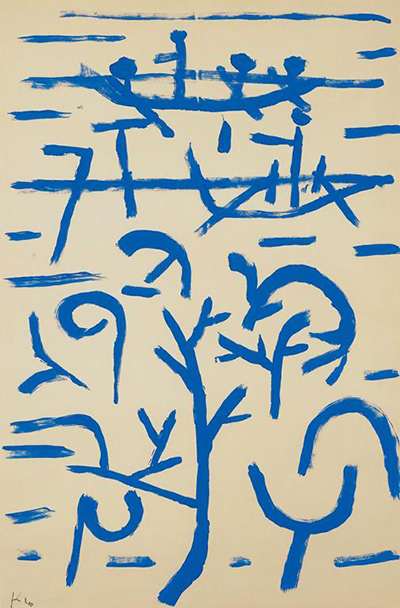
Boats in the Flood: the white of the page becomes water
Paul Klee made Boats in the Flood in 1937, giving it the original German title boote in der Überflutung. The Fondation Beyeler, which owns the work, records it as 1937, 222 (V 2) and describes coloured paste on wrapping paper mounted on cardboard, measuring 49.5 × 32.5 cm. Its collection number is Inv. 59.4. The artist signed, dated and numbered the lower left, and wrote the title at the lower right. The familiar English title on this site is shorter than the museum's exhibition translation, Boats in the Flood Waters; both refer to this one work.[1][2]
The sheet is nearly monochrome. Blue marks cross a pale paper ground, from long horizontal strokes near the top to curlier, branching movements below. Boats and rowers appear in the upper portion. Farther down, the lines can be read as trees thrusting up through water, and their curved strokes suggest eddies. Klee used very little colour to establish a scene in motion. The Fondation Beyeler's German, French and English guides make the crucial observation: much of the flood is made by the unpainted light paper between the blue marks. The support becomes an active part of the image rather than an empty background.[2][3][4]
Reading the flood from bottom to top
Near the lower edge, several blue strokes bend, fork and spiral. Their branches rise from vertical trunks or trunk-like lines. They are recognisable as trees, yet their twisting contours also look like the water circling around those trees. Klee does not draw a separate outline for every wave. One stroke can help us imagine a tree, a current and the turbulence produced where the two meet. The picture therefore moves between things and forces: what stands still and what flows past it.[2]
Higher up, a tight band of vertical and horizontal blue marks cuts across the sheet. Some strokes belong to the boats and the figures aboard them; others extend into the water. The figures are small, reduced almost to signs. This compression matters. At first glance the upper band can look like another set of wave marks. Only after looking longer do boats and rowers become distinct. Klee lets recognition emerge gradually from a spare arrangement of lines.[2][3]
The broad pale intervals remain visible everywhere. They separate one blue gesture from another, but they also connect them as a continuous expanse of water. This is why calling the work simply “a blue painting of a flood” misses its main device. The eye supplies water across the spaces Klee leaves open. The museum's guide describes the upper part as calmer, with the boats seeming to have reached relative safety. Its wording is cautious: the appearance of safety is a reading of the marks, not a documented narrative supplied by Klee.[2][4]
Small horizontal strokes at both side edges look like possible water-level marks. Near the boats, a blue line runs more continuously across the picture; one more long line sits near the top. The guide offers several ways to read that final mark: a wave crest, a horizon, or a distant shore. None is forced by the picture. The uncertainty is productive because the same line can suggest both the continuing flood and a route beyond it.[2][3][4]
What “coloured paste” means here
The owner's current object record specifies coloured paste on wrapping paper mounted on cardboard. A 2017 English press caption calls the support simply paper, while the German and French captions also use the broader word for paper. These exhibition captions are useful for identification and dimensions, but the fuller current object record is the better source for the material description. The work is not an oil painting on canvas, despite generic labels sometimes attached to Klee images online.[1][5]
The Zentrum Paul Klee's technique guide explains that Klee experimented with paste as a binder and mixed it with other painting materials; in later work he could apply thick paste colour with a brush. That guide is a general account of his practice, not a technical examination of this particular sheet. It helps explain why “coloured paste” is a meaningful material label, but it does not justify guessing the exact recipe or tool used for every blue stroke here.[6]
Wrapping paper was a deliberate and workable support for Klee's late experiments. In this image, its light surface does more than carry the paint. The museum's interpretation turns attention to the sheet itself: the unpainted ground creates the volume of the flood while the blue marks give it direction, rhythm and scale. The mounted cardboard supplies physical support, but the painting is seen on the paper face. A small screen reproduction can convey the composition while showing little about surface texture or the relationship between the two layers.[1][2][6]
A precise identity in Klee's late work
The 1937, 222 (V 2) notation should be read carefully. The owner shows the designation in its title and also transcribes Klee's lower-left inscription as Klee // 1937. V 2. The collection page separately cites the printed nine-volume Paul Klee. Catalogue raisonné, volume 7, where this work appears as no. 7158 on page 313. Those are different numbering systems: the artist's annual sequence and the later catalogue entry. This article relies on the owner's bibliographic record for the latter; it does not claim direct inspection of the printed volume.[1]
The Fondation Beyeler places the work within a long exhibition history. It records a 1948 presentation at Curt Valentin's Buchholz Gallery in New York; a 1953 Institute of Contemporary Art, London, exhibition of drawings from Valentin's collection; and the 1953 Paul Klee: Drawings 1908–1940 exhibition at the Museum of Modern Art and the Minneapolis Institute of Art. Later listings include the Beyeler's 2003 exhibition on Klee's late work and its 2017–18 retrospective. An exhibition-list entry records participation or publication in that context; it does not tell us that the work is on view today.[1]
The provenance is unusually clear in the owner's record. The work remained with Klee until 1940, then passed to Lily Klee in Bern, to the Klee-Gesellschaft in 1946, and to the Buchholz/Curt Valentin gallery network in New York from 1948. G. David Thompson of Pittsburgh owned it after the early 1950s; it entered the Beyeler collection in 1959 and the Beyeler Foundation in 1991. The record does not give a date for every transfer, so the intervals should not be made more exact than the source allows.[1]
Klee's 1936 After the Floods is a separate work, also held by the Fondation Beyeler. The similar English titles make confusion easy. Here the date 1937, the original title, the 222 (V 2) notation and the blue-on-light vertical composition anchor the identity of Boats in the Flood. The image is memorable because its blank areas do so much work: the flood is present wherever the paper stays open, while a few emphatic blue marks let boats, people and trees briefly hold their shape within it.[1][2]
Related artworks
Explore eight other Klee works from the researched artwork cluster.
Viaducts Break Ranks
1937
Insula Dulcamara
1938
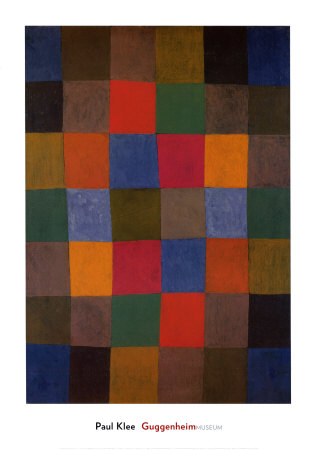
New Harmony
1936
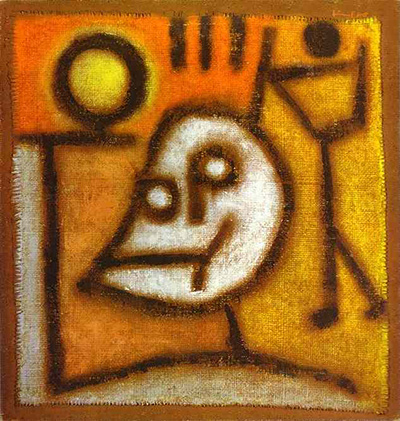
Death and Fire
1940
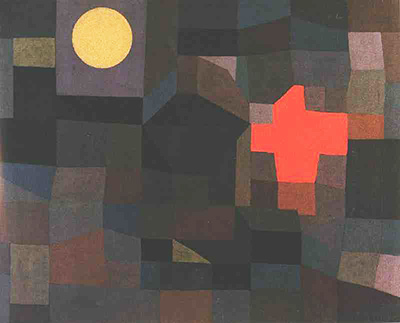
Fire Full Moon
1933
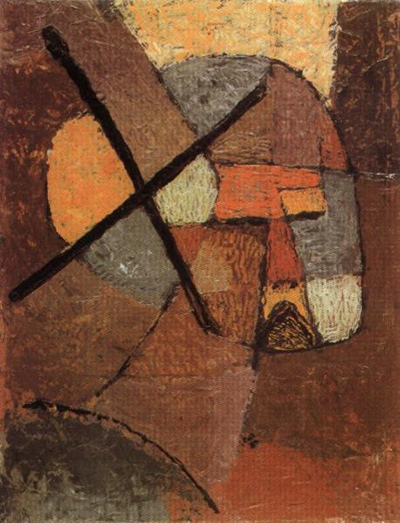
Struck from the List
1933
Ad Parnassum
1932
References
- Fondation Beyeler, boote in der Überflutung collection record: title, annual notation, medium, dimensions, inscription, inventory, provenance, exhibition history and catalogue raisonné bibliographic entry, View source.
- Fondation Beyeler, Paul Klee exhibition room guide, German, 2017–18, room 5: owner interpretation of the flood, trees, boats, white ground and open-ended final line, View source.
- Fondation Beyeler, Paul Klee exhibition room guide, French, 2017–18, room 5: French translation Barques dans l’inondation and parallel interpretation, View source.
- Fondation Beyeler, Paul Klee exhibition room guide, English, 2017–18, room 5: English translation Boats in the Flood Waters and parallel interpretation, View source.
- Fondation Beyeler, Paul Klee press kit, 2017, image caption 16: object date, medium, dimensions and photo credit; its shorter support description is compared with the current collection record, View source.
- Zentrum Paul Klee, exhibition guide on Klee's materials and techniques, German, section “Kleisterfarbe”: general account of paste colour and its late application, not an object-specific technical report, View source.