


 by Tom Gurney
Tom Gurney BSc (Hons) is an art history expert with over 20 years experience
Published on June 19, 2020 / Updated on September 27, 2026
Email: tomgurney1@gmail.com / Phone: +44 7429 011000
A mountain built from colour and time
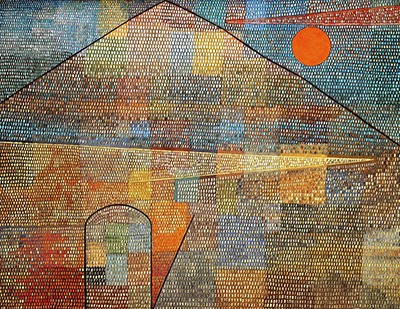
From a distance Paul Klee’s Ad Parnassum appears to offer a simple structure: a broad triangle rising above an arch, with an orange circle near the upper right. Move closer and the apparently solid mountain becomes a field of small colour units. Beneath them lie larger square divisions and bands; dark slanting lines give the triangle its roof-like edge. The arch feels like an entrance, yet it does not open onto an ordinary building. Klee made recognition and abstraction work together, allowing a viewer to see a mountain, pyramid or constructed form while still seeing the many decisions that built it.[1][2]
The painting is unusually revealing because Klee left a technical account of its making. He described a sequence from casein-painted squares on unprimed canvas through white oil subdivision and coloured glaze to the warm circle and oil lines. Conservators later examined the original and explained the immense labour behind the small marks. These sources allow a closer account than the common label “pointillist painting,” while also showing why a summary or reproduction cannot answer every question about the object.[2][3]
Contents
- The work in Bern
- What Klee said he did
- A mountain, pyramid and title
- Points and polyphony
- How the work entered the Bern collection
- Why a six-minute journey mattered
- Looking again
The work in Bern
Klee made Ad Parnassum in 1932, during his Düsseldorf Academy years. His annual number is 1932,274; a specialist sale catalogue cites the later catalogue raisonné number 5970. Kunstmuseum Bern’s current detailed checklist gives a size of 100 × 126 cm, inventory G 1427, and an original painted wooden frame. The owner credit belongs to the Verein der Freunde, the museum’s Friends association. The picture has been on long-term loan to Kunstmuseum Bern since 1935. These numbers and relationships serve different purposes: 1932,274 locates the work in Klee’s own annual sequence, 5970 in the later catalogue raisonné, and G 1427 in the museum’s inventory. The museum is its home, while the Friends association is credited as owner.[1][2][3][4]
The checklist describes oil paint, white points subsequently painted over, casein paint on canvas on a stretcher, stamped lines and the original frame. This is a mixed-medium work, not simply oil on canvas. The casein layer, oil touches and glazes are integral to the appearance of the triangle. A derivative description that omits them makes the image seem simpler than its construction. Nor is the frame merely a later presentation accessory: Bern’s record identifies it as original and painted, although its exact role in Klee’s intended colour experience still deserves closer technical study.[1]
The size matters too. At a metre high and more than a metre wide, the work asks for movement: at one distance the apex and orange circle organise the whole; nearer the surface, the many small units separate and the square structure becomes easier to see. A 400-pixel reproduction can show the overall arrangement but cannot faithfully communicate the brushwork, translucency, frame or condition. The painting’s scale and layers are part of why it has remained a central object for both art historians and conservators.[1][3]
What Klee said he did
Zentrum Paul Klee transcribes Klee’s five-part “Attest des Künstlers.” He began with a square division in casein colour on unprimed canvas. He then made a finer subdivision with white oil paint and glazed that division with oil colours thinned using turpentine and some painting medium. The warm circle was added in oil, and finally the line in oil. This source is unusually close to the artist’s own process. The published museum text is a transcription, however, rather than a facsimile of the original attestation inspected for this article. It establishes the sequence Klee reported; it does not by itself show every tool stroke.[2]
Conservators Nathalie Bäschlin and Michael Baumgartner wrote a fuller, examination-based account for the work’s special 2007 presentation. They date Klee’s explanation to 1936. They describe the casein as thin enough for the canvas weave to remain visible, and they identify a linear underdrawing beneath the later colour. According to them, Klee applied more than 15,000 small white-oil touches with a fine flat brush, then glazed each separately. He made the oil lines by dipping the edge of small spatulas or plates into paint and stamping them onto the surface. The exact count and method are their technical report, not something a reader could verify by counting marks in a small web image.[3]
This close account also exposes a source difference. Bern’s concise 2026 checklist says the points were initially stamped in white and then painted over; Bäschlin and Baumgartner say the white touches were applied with a fine flat brush, while the lines were stamped with tool edges. Those statements should not be silently turned into one unqualified recipe. They may refer to different types of marks or reflect compressed checklist language. The original technical photographs and full conservation proceedings are needed to reconcile the wording. For the visitor, the secure point is that Klee combined a square-painted foundation, thousands of oil touches and glaze, then a small number of forceful structural marks.[1][3]
The order changes how the finished picture can be read. The first square division remains beneath the later small touches; it gives the surface a larger rhythm even where the eye is drawn to tiny colour units. White touches create places for translucent colour to modulate. The warm circle and dark line do not merely sit beside the little marks; they were late decisions that sharpened the whole. Because the final shapes emerge through successive layers, “dots make a mountain” understates what Klee did. Surface, large geometry and later contour all participate.[2][3]
A mountain, pyramid and title
The triangle is clear, but what kind of triangle? The apex and sloping sides invite a mountain; the regularity also evokes a pyramid or roof. A dark horizontal divides upper and lower areas, while the arch at lower left resembles a gate. The orange circle may suggest sun, moon or another source of warmth, but the painting does not document its astronomical identity or a particular time of day. The forms are specific enough to be followed with the eye and open enough for several places or ideas to overlap.[1][2]
The Latin title Ad Parnassum means roughly “to” or “toward Parnassus.” In Greek mythology Parnassus was associated with Apollo and the Muses. Zentrum Paul Klee describes Klee’s recurring mountain and pyramid motifs and reads this painting as a possible image of artistic striving, travel and contact with other cultures. Such associations help explain why a mountain need not be only a landscape here. They remain curatorial interpretations rather than a literal map to the Greek mountain or a statement written by Klee about every shape.[2]
Nina Zimmer, writing in German, proposes that the Swiss Niesen, with its almost pyramidal outline when seen from Lake Thun, is probably in view. She also sees an Egyptian-pyramid association and asks whether the title could express Klee’s sense of having reached a summit in his own work. Her words “probably” and “perhaps” matter. No Niesen study or Egyptian sketch has been tied to this exact composition in the accessible object records. The picture can join a Swiss mountain, an ancient pyramid and a mythic seat of the arts in the viewer’s mind without becoming a topographical view of all three.[5]
The arch complicates a single mountain reading. It puts a human-scale opening below the immense triangle, as though the viewer might enter the image’s structure. Its curved top contrasts with the sloping sides and the orange circle. The arch has no fully described depth, passage or destination, however; the small squares continue around it. It may be a gate, part of a building or a compositional counter-shape. Calling it an “entrance” describes an invitation in the form, not a proven narrative in which Klee or a pilgrim climbs toward artistic achievement.[1]
Points and polyphony
Ad Parnassum belongs to a larger group of roughly seventy so-called point pictures Klee made while teaching in Düsseldorf in 1931–32, according to Zimmer. She compares their small touches with the divisionist experiments of Georges Seurat and Paul Signac but stresses that Klee used the principle more freely. The word “pointillist” can therefore orient a new reader, but it should not imply that Klee copied Seurat’s optical programme or joined a nineteenth-century movement. His casein squares, white-oil touches, glaze and stamped lines make a distinctive layered procedure.[5][2][3]
Zimmer calls this complexity “polyphonic.” In music, polyphony allows distinct voices to sound together. In the painting, one can attend to the square ground, the small touches, the changing colours, the triangle, the arch and the orange circle without reducing any of them to a single supporting part. Oskar Bätschmann’s book on Ad Parnassum is expressly devoted to Klee’s polyphonic painting, colour and the rhythm of points; its publisher synopsis establishes the book’s subject, but the book itself has not yet been read for this page. Thus polyphony is a useful historical and curatorial analogy here, not a claim that each coloured touch corresponds to a note in a score.[5][6]
Klee’s other works of the Düsseldorf period likewise experiment with layered colour and musical language. The comparison is useful because it shows a sustained problem rather than a single painting produced in isolation. It does not make the pictures a documented triptych or establish an exact day-by-day production order. The title Ad Parnassum may also call to mind musical exercises that use Parnassus as a metaphor for ascent, but a specific influence from a named treatise or composition needs documentary evidence beyond a shared phrase.[5][6]
A report from the 2006 Bern colloquium proposed a dialogue between the painting and Swiss composer Albert Möschinger’s Clementi-Hütte, dated 1940, and suggested that Klee might have had Muzio Clementi’s Gradus ad Parnassum in mind. The first is necessarily a retrospective comparison: a 1940 composition could not have shaped Klee’s painting in 1932. The second is a hypothesis, not a documented quotation from Klee. Both can enrich a history of reception, but they should not become a confident account of what Klee heard while making the painting.[7]
How the work entered the Bern collection
Klee showed a large group of his own works at Kunsthalle Bern in 1935, after returning from Düsseldorf to Switzerland. The ZPK-sponsored report on the 2006 colloquium says that the Friends association bought Ad Parnassum directly from him that year and placed it on long-term loan with Kunstmuseum Bern. The association’s current museum page confirms that it acquired the painting, and ZPK confirms the loan from 1935. This matters because accounts that simply call it a museum purchase erase the role of the private supporters who acted for the museum at a time when modern art still met scepticism locally.[7][8][2]
Art historian Michael Baumgartner’s study of Kunsthalle director Max Huggler gives the purchase a more precise setting. He reports that Ad Parnassum was the largest painting in the 1935 Bern exhibition and that the Friends paid 4,000 Swiss francs for it, roughly the annual wage of the Kunsthalle’s caretaker. Baumgartner describes that price as relatively modest for a Klee painting, while also showing why it could look extravagant in Bern’s public debate. He cites sceptical contemporary responses to Klee’s art and to the prices charged for it. That tension helps explain the Friends’ importance: the purchase committed private supporters to a work whose later stature was not yet assured locally.[9]
Baumgartner relays earlier scholar Samuel Vitali’s suggestion that the painting’s comparatively approachable subject or price may have eased the purchase. These are proposed explanations for the choice, not stated motives in a purchase document. The sale, sum and exhibition context are more secure than a claim about what every Friend or curator thought. Baumgartner also traces Huggler’s initial uncertainty about Klee through correspondence and his later change of view; this story makes the acquisition part of a developing local encounter with modern art, rather than a simple tale of unanimous recognition.[9]
The directly quoted artist attestation may belong to the history of the sale or later documentation, but the accessible ZPK transcription does not itself provide the original sheet, recipient or full date. Bäschlin and Baumgartner call Klee’s process account a 1936 document, a year after the Friends’ purchase. It should therefore not be represented as a note he necessarily handed to the buyers in 1935. The original document and the full Bern archival study would help settle its purpose and path.[2][3]
The 2006 account links the acquisition to the Bern Kunsthalle retrospective and notes Hanni Bürgi’s support for that show. A later museum interview with Zimmer identifies Max Huggler’s proposal to buy Ad Parnassum and says the Friends made the purchase possible. These are useful institutional memories; the original sale correspondence and complete 1935 catalogue remain a priority for a fully documented acquisition account. The simpler facts are already strong: an object Klee still owned was sold into a local support network, became an enduring loan to the museum and retains the Friends’ ownership credit.[7][8][2]
Why a six-minute journey mattered
The painting’s fragility is not an abstract warning attached to all old art. Bäschlin and Baumgartner describe a canvas whose tension had slackened and a weakly bound, relatively inelastic paint layer with tiny cracks and losses at points where the weave crosses. Movement, vibration and shifts in humidity could stress the layers. The ZPK’s 2007–08 exhibition account likewise links brittleness and uncertain adhesion to Klee’s unusual combination of casein and oil. These are conservation observations from that period; they do not prove the picture’s precise condition or loan policy in 2026.[3][2]
The work had not left Kunstmuseum Bern for fourteen years when ZPK sought to include it in its 2007 presentation. The short distance did not automatically make travel safe. The conservators made a test painting of comparable size and weight, with related support properties, and equipped a climate crate with instruments to record temperature, relative humidity and shocks. An accelerometer on the stretcher measured vibration during an approximately six-minute drive between the institutions. The 2006 colloquium report notes that packing, unpacking or rehanging could subject an object to more jolts than a carefully controlled short ride.[2][3][7]
The controlled transfer was approved for the ZPK exhibition, but the conservators warned against repeated trips because damage risk accumulates; the long-distance loan restriction remained in place at that time. This is a story about careful measurement changing a decision, not about declaring the painting safe to travel generally. Klee’s experimental making gave the picture its visual richness and produced a surface requiring special stewardship. The physical work and the image it offers cannot be separated.[3]
Looking again
Start at the orange circle and follow the small marks into the triangular field. Watch how the larger square divisions persist beneath the finer touches. Then trace the dark sloping edge to the apex and down the other side; it gives the mountain or roof a certainty that the interior texture does not. Return to the arch and ask whether it seems cut into the triangle, placed in front of it or built from the same field. The painting allows these relations to shift as one moves between whole and detail.[1][2]
The title offers Parnassus, the picture offers a triangle and gate, and Klee’s documented procedure offers successive physical layers. Bern’s ownership and conservation records add another history: a 1935 direct sale into the Friends’ collection and a carefully tested short loan decades later. What remains uncertain is equally worth keeping clear: the precise source of the mountain, the status of musical allusions beyond curatorial analogy, the technical wording conflict between checklist and conservators, and the painting’s present condition. These open questions need fuller archives and the dedicated monograph, not a simpler story imposed on the thousands of marks.[1][2][3][5]
Explore Klee’s materials and techniques for more about his varied supports, his colour studies for the wider context, and the paintings overview for other works from the Düsseldorf and Bern years.
Explore selected works from Klee’s much larger oeuvre. Titles without a link have an authenticated catalogue identity but no reviewed article yet.
Artworks directory
| Name | Date | Medium |
|---|---|---|
| A Gate | 1939 | Painting and mixed media |
| A Woman for Gods | 1938 | Watercolour and mixed media |
| Ab Ovo | 1917 | Watercolour and mixed media |
| Above Mountain Summit | 1917 | Drawing and mixed media |
| Abstract Trio | 1923 | Drawing and mixed media |
| Acrobats | 1915 | Watercolour and mixed media |
| Actor's Mask | 1924 | Painting and mixed media |
| Ad Marginem | 1930 | Drawing and mixed media |
| Ad Parnassum | 1932 | Painting and mixed media |
| Adventurer Ship | 1927 | Drawing and mixed media |
| Affected Place | 1922 | Drawing and mixed media |
| After a Sketch from Zurich | 1914 | Watercolour and mixed media |
| After Drawing | 1919 | |
| After The Floods | 1936 | Watercolour and mixed media |
| All Souls' Picture | 1921 | |
| Ancient Harmony | 1925 | Painting and mixed media |
| Angel Applicant | 1939 | Drawing and mixed media |
| Angel Serves the Desired | 1920 | |
| Angel, Still Female | 1939 | Painting and mixed media |
| Angelus Novus | 1920 | Drawing and mixed media |
| Animal Terror | 1926 | Painting and mixed media |
| Arab Song | 1932 | Painting and mixed media |
| Archangel | 1938 | Painting and mixed media |
| Architecture | 1923 | Painting and mixed media |
| Architecture of the Plain | 1923 | Drawing and mixed media |
| Around the Fish | 1926 | Painting and mixed media |
| Arrival of the Air Steamer | 1921 | Drawing and mixed media |
| Asiatic God | 1924 | Painting and mixed media |
| Astrological Fantasy Portrait | 1924 | Drawing and mixed media |
| Athlete's Head | 1932 | Watercolour and mixed media |
| Aufgehender Stern | 1931 | Painting and mixed media |
| Autumn Flower | 1922 | Painting and mixed media |
| Bad Band | 1920 | Drawing and mixed media |
| Baroque Centaur | 1939 | Painting and mixed media |
| Before the Blitz | 1923 | Drawing and mixed media |
| Before the Snow | 1929 | Drawing and mixed media |
| Besessenes Madchen | 1924 | Watercolour and mixed media |
| Bird Garden | 1924 | |
| Bird Wandering Off | 1926 | Watercolour and mixed media |
| Blossoms in the Night | 1930 | Watercolour and mixed media |
| Blue-Bird-Pumpkin | 1939 | Painting and mixed media |
| Boats in the Flood | 1937 | Painting and mixed media |
| Botanical Theatre | 1934 | Drawing and mixed media |
| Boy in Fancy Dress | 1931 | Watercolour and mixed media |
| Broken Key | 1938 | |
| Brother and Sister | 1930 | Watercolour and mixed media |
| But the Red Roof | 1935 | Painting and mixed media |
| C - C = Fisch | 1931 | Watercolour and mixed media |
| Cacti | 1912 | Painting and mixed media |
| Camel (in Rhythmic Landscape with Trees) | 1920 | Drawing and mixed media |
| Captive Pierrot | 1923 | Drawing and mixed media |
| Castle and Sun | 1928 | Drawing and mixed media |
| Cat and Bird | 1928 | Drawing and mixed media |
| Cathedrals | 1925 | Watercolour and mixed media |
| Chalice of the Heart | 1937 | Painting and mixed media |
| Characters in Yellow | 1937 | Painting and mixed media |
| Chosen Site | 1927 | Mixed media |
| Christmas Picture | 1923 | Drawing and mixed media |
| City of Towers | 1916 | Painting and mixed media |
| Clarification | 1932 | Painting and mixed media |
| Collection of Figurines | 1926 | Painting and mixed media |
| Colorful Architecture | 1917 | Painting and mixed media |
| Comedians' Handbill | 1938 | |
| Comic Opera Singer | 1927 | Painting and mixed media |
| Composition | 1939 | Painting and mixed media |
| Composition with Figures | 1915 | Drawing and mixed media |
| Composition with the Yellow Half-Moon and the Y | 1918 | Watercolour and mixed media |
| Conch–Still Life II | 1939 | Watercolour and mixed media |
| Cosmic Composition | 1919 | Painting and mixed media |
| Crystal Gradation | 1921 | Drawing and mixed media |
| Dance of the Grieving Child | 1922 | Painting and mixed media |
| Dancing Girl | 1940 | Painting and mixed media |
| Das Licht und Etliches | 1931 | Mixed media |
| Death and Fire | 1940 | Painting and mixed media |
| Death for the Idea | 1915 | |
| Demon as Pirate | 1926 | Watercolour and mixed media |
| Diana | 1931 | Painting and mixed media |
| Diavolo Player | 1923 | Drawing and mixed media |
| Die Kapelle | 1917 | Watercolour and mixed media |
| Die Vase | 1938 | Painting and mixed media |
| Doctor | 1930 | Drawing and mixed media |
| Dredger and Sailboat | 1931 | Watercolour and mixed media |
| Ein Tor | 1939 | Painting and mixed media |
| Ein Weib fur Gotter | 1938 | Mixed media |
| Embrace | 1939 | Watercolour and mixed media |
| Episode before an Arab Town | 1923 | |
| Equals Infinity | 1932 | Painting and mixed media |
| Eros | 1923 | Drawing and mixed media |
| Error on Green | 1930 | Watercolour and mixed media |
| Evening Figure | 1935 | Drawing and mixed media |
| Falling Bird | 1919 | |
| Fermata | 1932 | Watercolour and mixed media |
| Fire Clown | 1921 | Watercolour and mixed media |
| Fire Full Moon | 1933 | Watercolour and mixed media |
| Fire in the Evening | 1929 | Painting and mixed media |
| Fish in the Harbour | 1916 | Watercolour and mixed media |
| Fish Magic | 1925 | Watercolour and mixed media |
| Flock of Birds | 1917 | Drawing and mixed media |
| Flora on Sand | 1927 | Watercolour and mixed media |
| Flower Myth | 1918 | |
| Flower Stand with Watering Can and Bucket | 1910 | Watercolour and mixed media |
| Flowering Tree (Abstraction with Reference to a Flowering Tree) | 1925 | Painting and mixed media |
| Flowers in Pots | 1923 | |
| Flowers in Stone | 1939 | Painting and mixed media |
| Forest Witch | 1938 | Painting and mixed media |
| Fright of a Girl | 1922 | Drawing and mixed media |
| Fruits on Red | 1930 | Drawing and mixed media |
| Full Moon | 1919 | Mixed media |
| Föhn Wind in Franz Marc's Garden | 1915 | Watercolour and mixed media |
| Garden in St Germain, The European Quarter near Tunis | 1914 | Watercolour and mixed media |
| Ghost Chamber with the Tall Door (New Version) | 1925 | |
| Ghost of a Genius | 1922 | Drawing and mixed media |
| Girl in Mourning | 1939 | Painting and mixed media |
| Glance of a Landscape | 1926 | Watercolour and mixed media |
| Gluht Nach | 1939 | Drawing and mixed media |
| Golden Fish | 1925 | Watercolour and mixed media |
| Goldfish Wife | 1921 | Watercolour and mixed media |
| Green Plant, Blood, Louse | 1924 | Drawing and mixed media |
| Hafenbild | 1918 | Mixed media |
| Hammamet with Mosque | 1914 | Watercolour and mixed media |
| Harbour with Sailing Ships | 1937 | Painting and mixed media |
| Hauptweg und Nebenwege | 1929 | Painting and mixed media |
| Heavenly and Earthly Time | 1927 | Drawing and mixed media |
| Heroic Fiddling | 1938 | Painting and mixed media |
| Heroic Roses | 1938 | Painting and mixed media |
| Heroic Strokes of the Bow | — | Mixed media |
| Highway and Byways | 1929 | Drawing and mixed media |
| Houses near the Gravel Pit | 1913 | Watercolour and mixed media |
| Howling Dog | 1928 | Painting and mixed media |
| In the Current Six Thresholds | 1929 | Painting and mixed media |
| In the Style of Kairouan | 1914 | Drawing and mixed media |
| Individualized Altimetry of Stripes | 1930 | Painting and mixed media |
| Insula Dulcamara | 1938 | |
| Interior with the Clock | 1913 | Watercolour and mixed media |
| Irma Rossa the Animal Tamer | 1918 | Drawing and mixed media |
| Journey in Corsica | 1927 | Drawing and mixed media |
| Landscape with Bluebirds | 1919 | Watercolour and mixed media |
| Legend of the Nile | 1937 | Painting and mixed media |
| Lemon Harvest | 1937 | Watercolour and mixed media |
| Likeness in the Bower | 1930 | Watercolour and mixed media |
| Limits of Reason | 1927 | Painting and mixed media |
| Little Hope | 1938 | Watercolour and mixed media |
| Magdalena before the Conversion | 1938 | Drawing and mixed media |
| Mask of Fear | 1932 | Painting and mixed media |
| May Picture | 1925 | Painting and mixed media |
| Monument in a Cemetery | 1922 | Watercolour and mixed media |
| Monuments at G | 1929 | Watercolour and mixed media |
| Municipal Jewel | 1917 | Watercolour and mixed media |
| Mural from the Temple of Longing Thither | 1922 | |
| Nach der Uberschwemmung | 1936 | Watercolour and mixed media |
| New Harmony | 1936 | Painting and mixed media |
| New House in the Suburbs | — | Mixed media |
| Old Steamboat | 1922 | Drawing and mixed media |
| On the Edge | 1930 | Drawing and mixed media |
| Once Emerged from the Gray of Night | 1918 | Drawing and mixed media |
| One Who Understands | 1934 | Painting and mixed media |
| Oriental Pleasure Garden | 1925 | Painting and mixed media |
| Park of Idols | 1939 | Watercolour and mixed media |
| Passing by Red Pillars | 1928 | Watercolour and mixed media |
| Persian Nightingales | 1917 | Drawing and mixed media |
| Popular Wall Painting | 1922 | Painting and mixed media |
| Prestidigitator | 1927 | Watercolour and mixed media |
| Rainy Day | 1931 | Watercolour and mixed media |
| Red and White Domes | 1914 | Watercolour and mixed media |
| Red Balloon | 1922 | Drawing and mixed media |
| Redgreen and Violet-Yellow Rhythms | 1920 | Drawing and mixed media |
| Refuge | 1930 | Watercolour and mixed media |
| Rhythmic Rythmical | 1930 | Painting and mixed media |
| Saint of the Inner Light | 1921 | |
| Scaffolding of a New Building | 1930 | Painting and mixed media |
| Scholar in Dealing with Stars | 1926 | Watercolour and mixed media |
| Seated Woman | 1930 | Drawing and mixed media |
| Senecio | 1922 | Painting and mixed media |
| Separation in the Evening | 1922 | Drawing and mixed media |
| Sinbad the Sailor | 1923 | Drawing and mixed media |
| Skeptically Smiling | — | Mixed media |
| Small House in the Garden City | 1928 | Watercolour and mixed media |
| Small Portrait of a Girl in Yellow | 1925 | Painting and mixed media |
| Southern Gardens | 1919 | Watercolour and mixed media |
| Static-Dynamic Gradation | 1923 | Drawing and mixed media |
| Still Life | 1927 | Painting and mixed media |
| Still Life with Gladioli | 1932 | Watercolour and mixed media |
| Strange Garden | 1923 | Drawing and mixed media |
| Stricken City | 1936 | Painting and mixed media |
| Strong Dream | 1929 | Watercolour and mixed media |
| Struck from the List | 1933 | Drawing and mixed media |
| Structural I | 1924 | Drawing and mixed media |
| Sumpflegende | 1919 | Painting and mixed media |
| Temple Gardens | 1920 | Drawing and mixed media |
| The Arrow before the Target | 1921 | Drawing and mixed media |
| The Barbed Noose with the Mice | 1923 | Watercolour and mixed media |
| The Flora of the Heath | 1925 | Watercolour and mixed media |
| The Goldfish | 1925 | Watercolour and mixed media |
| The Hour Before One Night | 1940 | Painting and mixed media |
| The Man in Love | 1923 | |
| The Mask with the Flag | 1925 | Mixed media |
| The Pathos of Fertility | 1921 | |
| The Rhine at Duisburg | 1937 | Painting and mixed media |
| The Way to the Citadel | 1937 | Painting and mixed media |
| Three Houses and a Bridge | 1922 | Watercolour and mixed media |
| Tightrope Walker | 1923 | |
| Tomb in Three Parts | 1923 | Watercolour and mixed media |
| Tomcat's Turf | 1919 | Watercolour and mixed media |
| Tower in Orange and Green | 1922 | Drawing and mixed media |
| Tree and Architecture - Rhythms I | 1920 | Watercolour and mixed media |
| Tree and Architecture - Rhythms II | 1920 | Painting and mixed media |
| Tropical Dawn with the Owl | 1921 | Mixed media |
| Tropische Dammerung | 1921 | Painting and mixed media |
| Twittering Machine | 1922 | Drawing and mixed media |
| Variations (Progressive Motif) | 1927 | Watercolour and mixed media |
| Ventriloquist and Crier in the Moor | 1923 | |
| Viaducts Break Ranks | 1937 | Drawing and mixed media |
| Villa R | 1919 | Painting and mixed media |
| Village Carnival | 1926 | Painting and mixed media |
| Vor dem Blitz | 1923 | Drawing and mixed media |
| Wald-Hexen | 1938 | Painting and mixed media |
| Young Forest | 1925 | Drawing and mixed media |
Related artworks
Explore eight other Klee works, beginning with works close in date to this one.
Mask of Fear
1932
Fire Full Moon
1933
Struck from the List
1933
Ad Marginem
1930
Error on Green
1930
Fire in the Evening
1929
Highway and Byways
1929
Discussion
The mountain, gate, circle and many colour touches reward looking at both the whole and the surface.
The conservators' records also show how Klee's experiment affected the painting's later care.
Reader Insights
Do you see the triangle first as a mountain, pyramid or roof?
Where do the larger squares remain visible beneath the small touches?
What would the original technical photographs clarify about the white points?
Join the Conversation
Share an observation about the painting or a source that helps explain it.
References
- Kunstmuseum Bern, June 2026 collection display checklist, entry for Ad Parnassum, p. 10 (German), View source.
- Zentrum Paul Klee, “Sammlungspräsentation: Ad Parnassum,” 2007–08 exhibition account, including Klee’s transcribed “Attest des Künstlers” and conservation/loan summary (German), View source.
- Nathalie Bäschlin and Michael Baumgartner, “Das Meisterwerk «Ad Parnassum» zu Besuch im Zentrum Paul Klee,” ensuite 54/55 (German, June 2007), p. 69; authored conservation and exhibition account, View source.
- Galerie Kornfeld, 2024 specialist sale catalogue, lot 172, citing Catalogue raisonné Paul Klee vol. 6, no. 5970 for Ad Parnassum (German; catalogue raisonné itself still to be checked), View source.
- Nina Zimmer, “Nina Zimmer über Paul Klee,” Parnass (German, 12 September 2017); essay on the point-picture group, Niesen and the title, View source.
- University of Chicago Press / Scheidegger & Spiess, description of Oskar Bätschmann, Paul Klee—Ad Parnassum (English publisher synopsis, 2021/22); cited only for the book’s scope, View source.
- Zentrum Paul Klee-sponsored report, “Auf dem Prüfstand,” ensuite 47 (German, November 2006), p. 31; contemporaneous colloquium report printed as a promotional page, View source.
- Kunstmuseum Bern / Verein der Freunde, “Freundeswerke,” association acquisition note (French-language museum site), View source.
- Michael Baumgartner, “Max Huggler und Paul Klee: Spuren einer Begegnung,” Zwitscher-Maschine 11 (2022), pp. 109–21, especially pp. 111–13 and note 9; German specialist study, View source.