


 by Tom Gurney
Tom Gurney BSc (Hons) is an art history expert with over 20 years experience
Published on June 19, 2020 / Updated on September 27, 2026
Email: tomgurney1@gmail.com / Phone: +44 7429 011000
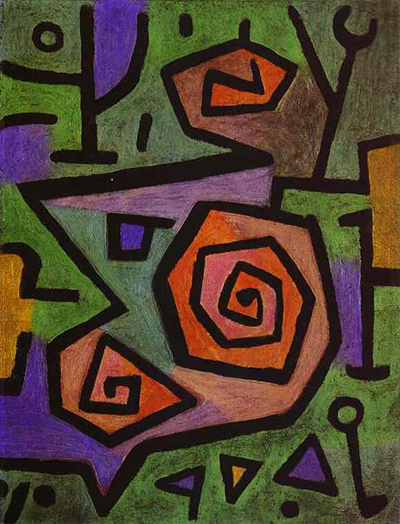
Heroic Roses: three spirals on jute
Paul Klee’s Heroische Rosen (Heroic Roses) is dated 1938,139 (J 19) in the record of the Kunstsammlung Nordrhein-Westfalen, Düsseldorf. The museum identifies it as oil on jute on a stretcher, measuring 68 × 52 cm. Its inventory number is 0046 and its published catalogue raisonné number is 7341. Klee signed the upper left; the stretcher bears the date, letter-number designation and German title. These object details are firmer than the inherited page’s description of oil on canvas. The museum currently lists the picture as on view at K20.[1][2]
Three angular, reddish spirals make the title legible. The largest is slightly below the centre, while one sits above it and a smaller one occupies the lower left. Broad black lines mark their paths, branching through the green, violet, blue and ochre field. The shapes are recognisable as roses partly because Klee named them so; without the title, the same image might first appear as a network of signs, stems and geometric compartments. “Heroic” adds a second question that the image leaves open: what, precisely, is being overcome or sustained?[1][3][4]
Flowers built from turns and barriers
Each bloom begins as a turn inward. In the central rose, an orange-pink band encloses a dark spiral; the outer edge has the irregular profile of a flower seen from above. The upper bloom is smaller and more compressed. The lower-left form opens at one corner and meets a strong diagonal black line. These are not botanical portraits with accurately rendered petals. A few turns of line and patches of warm colour are enough for Klee to propose roses.[1][4]
The black marks also do more than outline flowers. One line stretches across the picture at mid-height, another rises at the right, and several short bars, hooks and triangular forms interrupt the field. They can suggest stalks, supports, tools or boundaries without settling into a single labelled diagram. The picture asks the eye to travel along those paths and then to return to the spirals. Its forms remain compact but the routes between them are varied.[1][3]
The colour is more complex than the older page’s “three red roses on a muted green and blue background.” Pink, orange and violet run through the blooms; purple and yellow blocks sit at the edges; green changes temperature across the ground. Dark lines join patches that might otherwise separate into a flat mosaic. The jute support matters too: the museum identifies a coarse woven material beneath the oil. A small reproduction shows colour and shape more readily than the exact weave, but the cloth is part of the painting’s physical construction, not a generic canvas substitute.[1][2]
Philosopher Gabriel Almeida Assumpção uses Heroic Roses as an example in a Portuguese-language study of Klee, Kandinsky and the idea of nature as a productive force. He observes that the spirals and reddish colour allow the viewer to recognise roses only after looking more closely. For him, the picture transforms natural forms rather than reproducing the appearance of flowers in a conventional still life. This is a useful account of what the title and simplified marks do together. The article calls the support stained canvas, but the owning museum’s current object record specifies jute.[1][4]
How “heroic” has been read
In a German programme essay for the Bavarian Radio Symphony Orchestra, writer Renate Ulm reads the three spirals as protected spaces within a grid of heavy marks. She associates the dark side bands and the work’s 1938 date with the threatening political setting around Klee in Switzerland. Her reading gives the adjective “heroic” a forceful historical meaning: the roses continue to bloom within a constraining environment. She also compares the drawing’s bars with keys, flags, walls and tools. These are her visual and historical associations, not symbols identified as such by the museum or recorded by Klee in the sources consulted here.[3]
Ulm further invokes Klee’s writings on spirals and interprets their tightening turns psychologically. Her essay is valuable because it follows particular shapes rather than treating late Klee as automatically tragic. Yet its claim that Klee drew all the black lines before the coloured areas is a statement about working order that the present museum record does not establish. The visible painting allows a reader to examine how dark edges and coloured sections interact; determining the actual sequence would require technical study or a directly documented account of Klee’s process.[1][3]
The title permits a more restrained reading as well. A rose is a fragile flower; in this picture its petals become angular, enclosed turns supported by emphatic black marks. That contrast can make “heroic” feel apt without turning every bar into a wall or every colour into a political code. The viewer can recognise persistence in the forms while leaving open how Klee intended the adjective to work.[1][3][4]
A picture that crossed borders
The museum’s unusually detailed provenance gives a concrete history alongside interpretation. Klee retained ownership when he sent the work in 1938 on consignment to Daniel-Henry Kahnweiler’s Galerie Simon in Paris. By September 1938 it had reached Karl Nierendorf’s New York gallery, where records trace it into 1941. After Klee’s death in 1940, ownership passed to his wife Lily. The museum treats the subsequent Nierendorf sale to Mr and Mrs Henry Clifford as probable by 1941 and certain by 1944, rather than giving an unqualified single sale date.[1][2]
In 1953, Curt Valentin held the painting on consignment for Henry Clifford and offered it to G. David Thompson. Thompson bought it that year and kept it until its sale to Galerie Beyeler in Basel in 1960. The state of North Rhine-Westphalia then acquired it from Beyeler with 87 other Klee works. That group became the foundation of the Düsseldorf Kunstsammlung, established in 1961. The museum’s accession 0046 places Heroische Rosen among the works on which the collection’s identity was built.[1][2][5]
This trajectory also clarifies what it means to say the work was “in Paris” or “in New York.” Those places name dealers holding it on consignment, not necessarily a change in ownership at every move. Klee’s title and numbering on the stretcher, the records of sale and the museum’s accession number link the material object across those transactions. They matter when a widely reproduced image is labelled loosely as oil on canvas or given an English title alone.[1][2]
The collection describes its 1960 acquisition of 88 Klee works as both a tribute and a response to the injustice of Klee’s dismissal from the Düsseldorf Academy under the Nazi regime. The painter had left Germany for Switzerland in late 1933. That institutional context belongs to the work’s later reception in Düsseldorf; it is distinct from proving that Klee designed each black bar in Heroische Rosen as a sign of a particular border or regime.[3][5]
Looking again
The image works at two scales. From a distance the three warm spirals organise the field. Up close, smaller black notches, circles and blocks break the paths into episodes; the coloured areas differ in size and direction; and the material support becomes part of the surface. The German title names the flowers but does not explain away those interruptions. Klee made the roses by compressing growth into turns of line, then gave them a word—“heroic”—that invites interpretation without fixing it.[1][3][4]
The museum record establishes the object, its jute support, its inscription and its route into the Düsseldorf collection. Ulm and Assumpção offer two different ways of looking: one presses the historical and psychological resonance of enclosing lines; the other follows the transformation of nature into abstract form. Neither account needs to be presented as Klee’s own stated explanation. Together with close attention to the image, they make the work more precise and more open than the old description of three merely decorative roses.[1][3][4]
Related artworks
Explore eight other Klee works from the researched artwork cluster.
Insula Dulcamara
1938
Viaducts Break Ranks
1937
Death and Fire
1940
New Harmony
1936
Fire Full Moon
1933
Struck from the List
1933
Ad Parnassum
1932
References
- Kunstsammlung Nordrhein-Westfalen, Heroische Rosen, object 0046 (English): current owner record for date, annual number, materials, measurements, inscription, catalogue raisonné number, collection status and provenance, View source.
- Kunstsammlung Nordrhein-Westfalen, Heroische Rosen, German object and provenance record (German): original-language title, detailed ownership timeline and technical terminology. The printed catalogue raisonné entry itself was not directly consulted, View source.
- Renate Ulm, “Musik & Bild: Paul Klee, Heroische Rosen (1938),” Bavarian Radio Symphony Orchestra programme (German, 2020), pp. 10–11: attributed reading of spirals, black marks and historical setting; its short medium caption differs from the current museum record, View source.
- Gabriel Almeida Assumpção, “A pintura abstrata e Schelling: atravessar a ‘pele da natureza’,” Princípios 24, no. 45 (2017) (Portuguese), pp. 72–74: scholarly account of how Klee’s spirals and colour transform natural rose forms; its material caption differs from the owner record, View source.
- Kunstsammlung Nordrhein-Westfalen, “Paul Klee – The Heart of the Collection” (English): institutional account of the 1960 group acquisition and Klee’s dismissal from the Düsseldorf Academy, View source.