


 by Tom Gurney
Tom Gurney BSc (Hons) is an art history expert with over 20 years experience
Published on June 19, 2020 / Updated on September 27, 2026
Email: tomgurney1@gmail.com / Phone: +44 7429 011000
A staged battle in line and colour
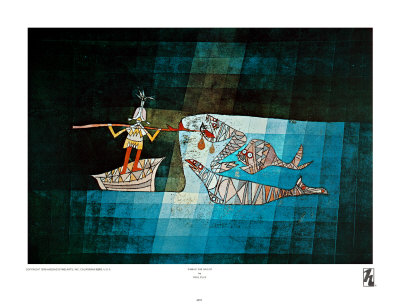
A small sailor stands upright in a patterned boat and drives a long red lance toward a cluster of improbable sea creatures. The encounter takes place on a blue field divided into rectangles, with a pale band opening through the darkness. It is easy to understand why this Paul Klee picture became known in English as Sinbad the Sailor. Its museum title, however, is more specific and more curious: Kampfscene aus der komisch-phantastischen Oper “der Seefahrer”, or a battle scene from the comic-fantastic opera “The Seafarer.” The title makes us look at an encounter that might be staged, sung or invented; it does not itself document an opera that was performed in 1923.[1][2]
Klee registered the sheet as 1923,123. The current Kunstmuseum Basel record places it in the museum's collection under inventory 1986.500, with the gift of Trix Dürst-Haass. It measures 34.5 × 50 cm as a sheet. A Berlin museum exhibition checklist independently gives the same year-number, collection, dimensions and group of materials. This is an object made from oil transfer, pencil, watercolour and gouache on paper, with an additional lower border strip, then mounted on cardboard. Calling it simply a painting or an uncomplicated watercolour misses much of its construction.[1][2]
Explore the details of Opera battle scene
Select a numbered area to examine its detail at high resolution.
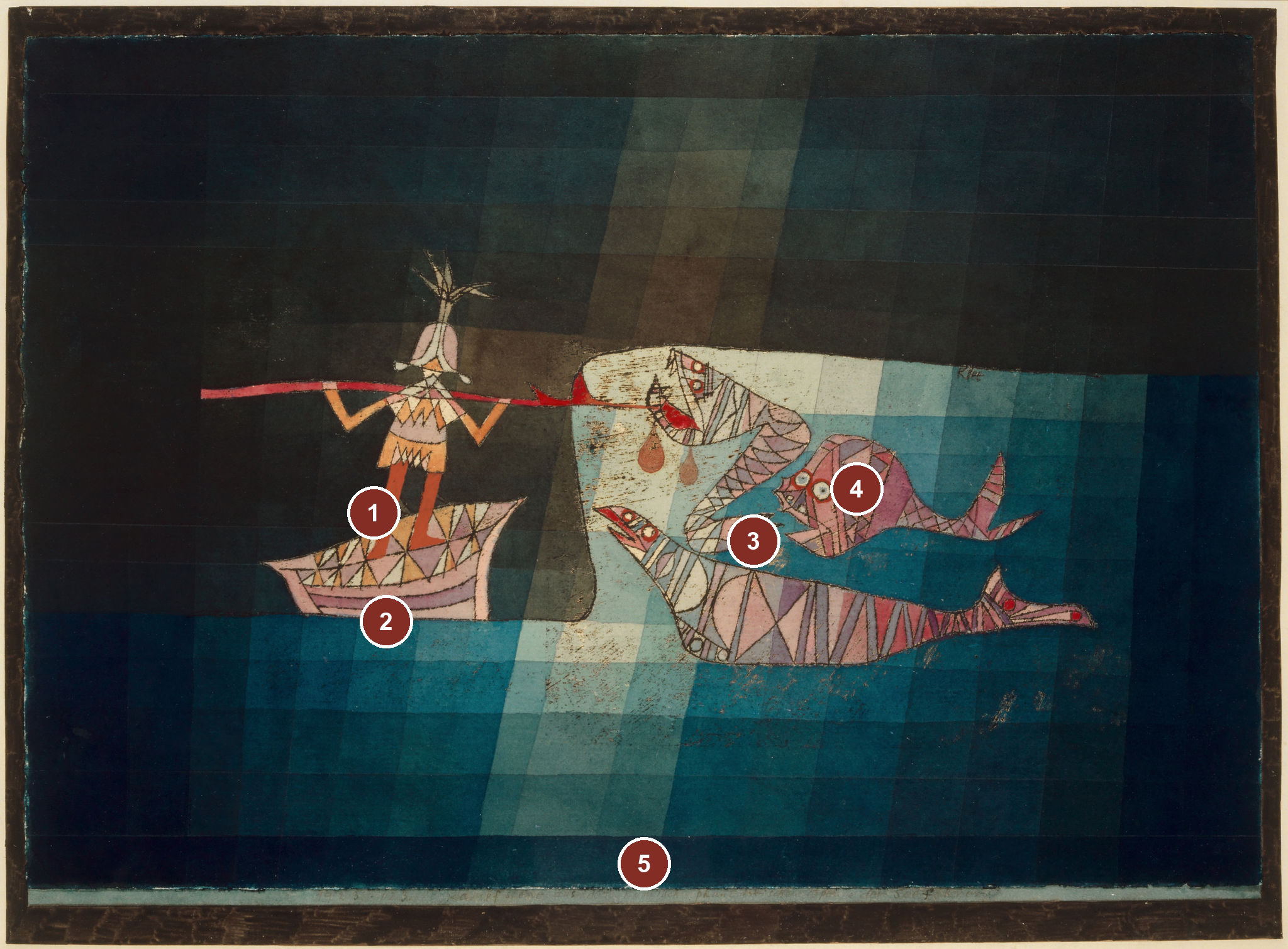
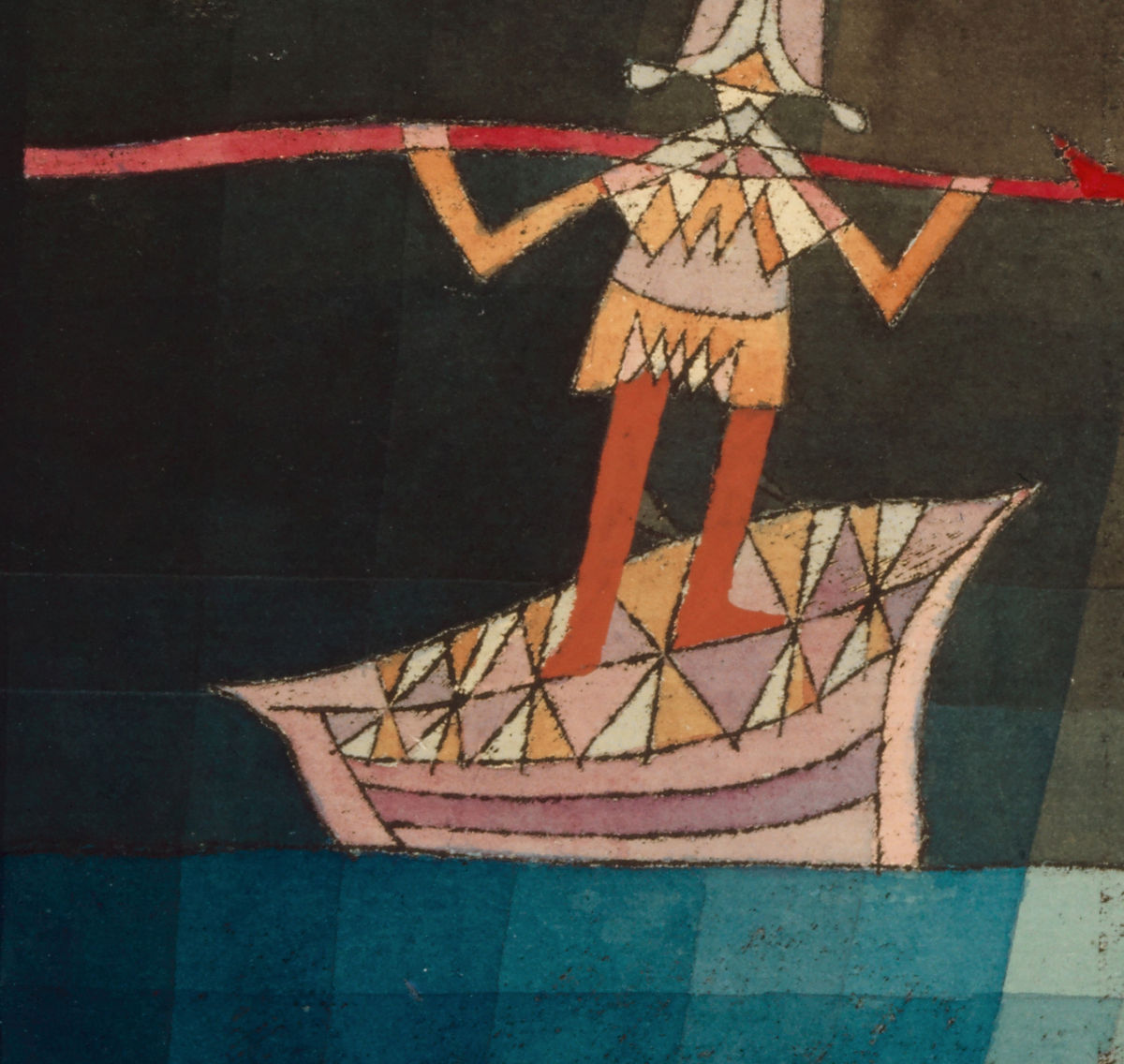
Small figure at left
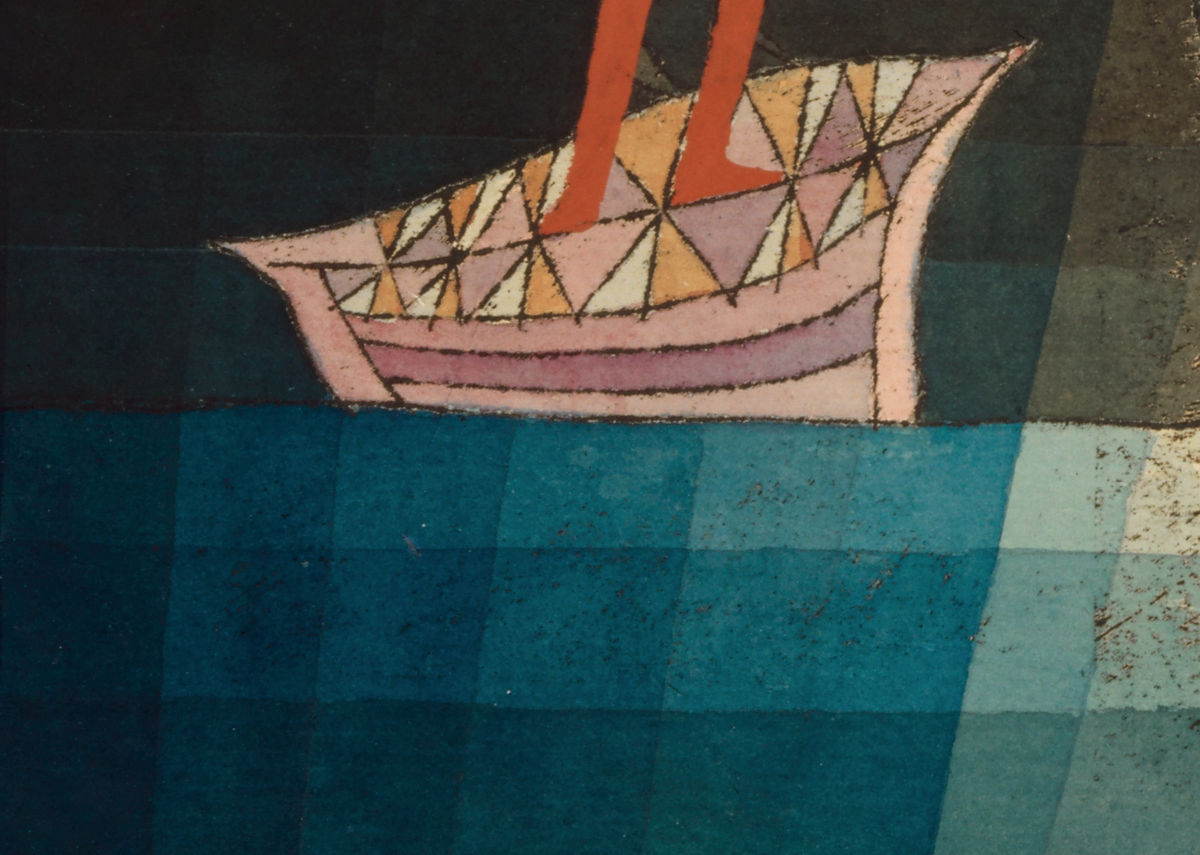
Left-hand boat
Large fish-like figure
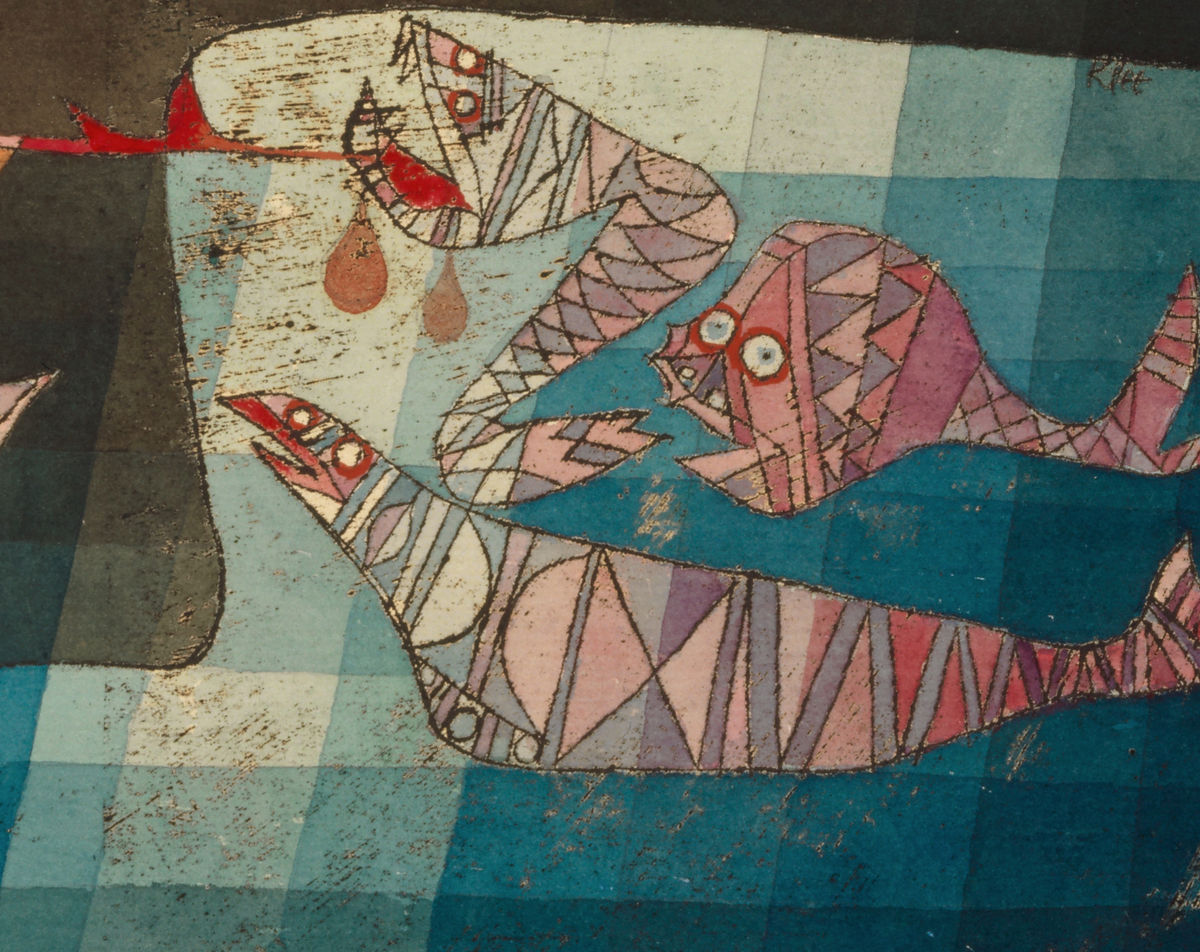
Blue-green grid
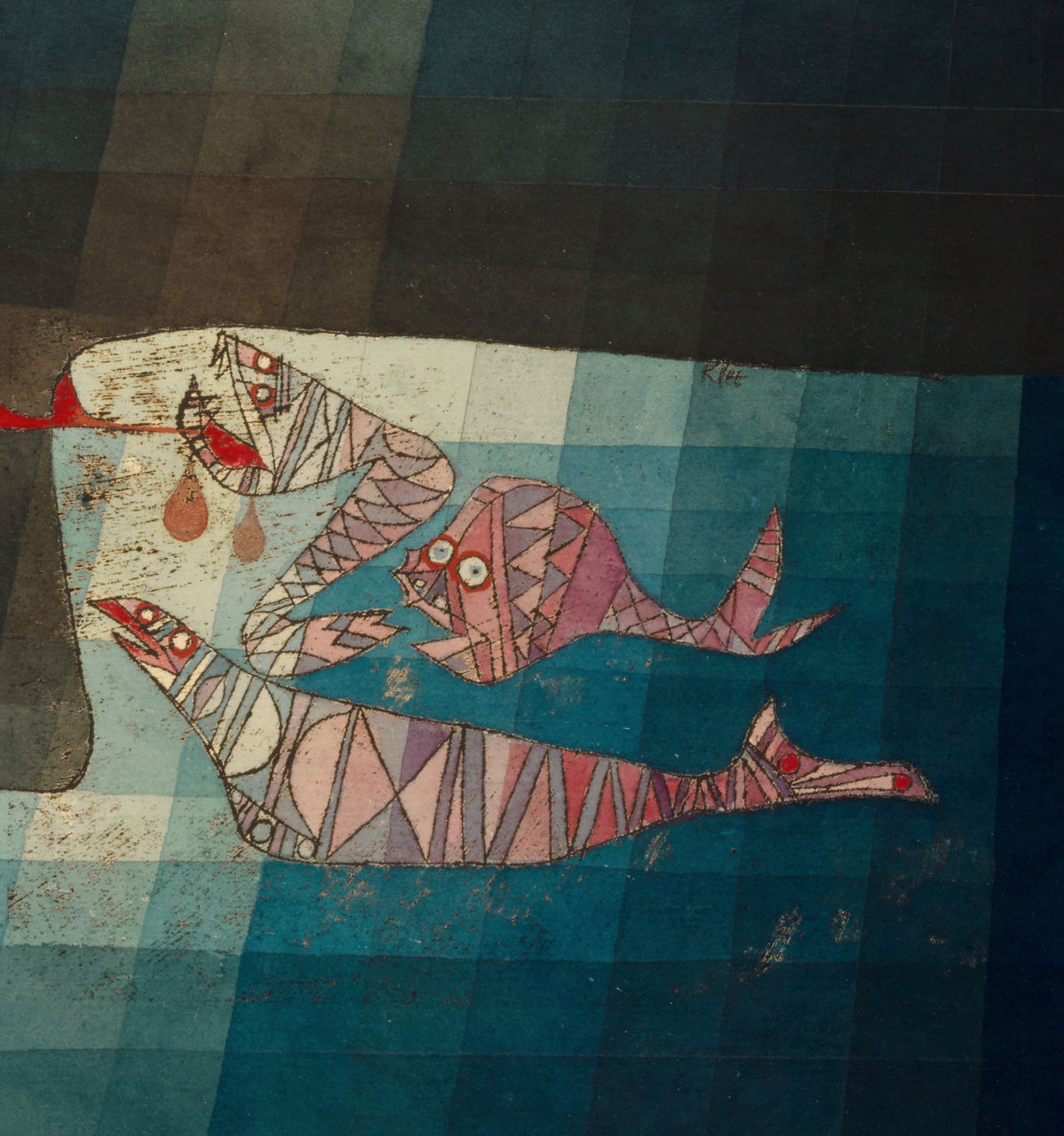
Painted border and mounting

Contents
- Which work is this?
- What happens on the blue field?
- Is the opera real?
- How was the sheet made?
- What do we know about a related drawing?
- Why does the sailor become Sinbad?
- How did another artist read it?
- Look again
Which work is this?
The number 1923,123 is the strongest short way to identify the work. Berlin's 2008 checklist also gives it the continuous catalogue number 3217. Its entry appears in the checklist's theatre section alongside other Klee images of performers, masks, puppets and staged action. These numbers identify this sheet, rather than a textile made after it, a print using a similar title, or an otherwise related drawing. They also help control translation: the Basel title says “the Seafarer,” without the name Sinbad or Sindbad. The familiar English shorthand should be read as a later way of identifying the figure, not as a word Klee demonstrably wrote in the original title.[1][2][3]
Two German spellings circulate. Basel transcribes the opening as Kampfscene, while the Berlin checklist modernises it to Kampfszene. The difference does not create two objects. Likewise, Berlin capitalises the quoted Der Seefahrer while Basel's current caption prints “der Seefahrer”. When discussing the source, it is better to preserve the spelling of the record being cited than to silently normalise one into the other. Neither caption supplies the score, libretto, cast list or performance history of a separate opera.[1][2]
The site's image shows the same composition as a Basel-sourced full-sheet reproduction: the black bordering, small boat at left, red lance, three creatures at right, blue grid and pale vertical band all agree. A public-domain high-resolution file has permitted the detail views below to show the small figure, patterned boat, creatures, grid and worked border more clearly. This image is a reproduction of the completed Basel sheet, not proof that every visible line has been assigned to a particular technical layer. A more detailed study of the physical object would be needed for that.[1][4]
What happens on the blue field?
At left, a narrow-legged figure stands on the prow of a boat that looks as if it has been folded from pointed, coloured panels. The torso and pointed head are built from similarly angular units. The arms hold a horizontal red line that runs nearly from the left edge of the image to the mouth of the highest creature. Its role as a lance is suggested by the figure's pose and the apparent collision. Yet the line also works as a bold compositional stroke: it binds the sailor to his opponents and carries the eye across a large dark area that might otherwise separate them.[4]
At right, one long, hinged creature rises toward the spear. A rounder form with a large eye hangs behind it, while a lower elongated creature points back toward the boat. Pink, lilac and brown patterned surfaces bring them forward from the turquoise ground. A few red drops hang below the upper form. We may read them as part of a wound, but that is a visual inference, not a conservation finding or a key to a fixed narrative. The Berlin title establishes a “battle scene”; it does not identify each animal as a particular sea species, nor does the Basel material record do so.[1][2][4]
Rectangles of blue and near-black grade across the background. Many are not level, and their edges do not simply describe a natural sea horizon. The lighter vertical band cuts through the field just to the right of the boat, meeting a pale area behind the creatures. It could make the middle feel like an illuminated performance space, a current or an opening in darkness. None of those readings needs to be treated as a literal piece of scenery. The gridded field gives the invented combat a measured visual order while the figures and creatures seem free to violate it.[4]
The outer black margin is also visible. It contains the action like a framed stage, while the blue rectangles and pale band complicate any stable distinction between deep water, backdrop and light. A spectator can see a sailor confronting monsters and simultaneously see pointed shapes, coloured planes and transferred line. The scene is legible without being optically naturalistic. Klee's humour is strongest in this friction: a fierce battle has the visual delicacy of a paper theatre, while the sailor's conspicuous spear and the creatures' pointed mouths prevent it from becoming only decorative.[4][5]
Is the opera real?
Klee's title calls the scene part of a comic-fantastic opera. A named opera in an artwork title is not, by itself, evidence that a composer wrote it or a company performed it. Neither the Basel object record nor the Berlin exhibition checklist identifies a score or a historical staging. The safe conclusion from those sources is that Klee gave the picture a theatrical fiction, or at least framed it in operatic terms; whether any further, externally performed work existed remains unverified. The former site article turned “1923” into the date of an opera. In the reliable object records, it is the date of Klee's sheet.[1][2]
The fiction can still matter fully. Imagine the sailor as a heroic tenor and the three creatures as an opposing trio: the encounter begins to sound like a scene in which different voices answer one another. An account of Klee's 1992 Weimar exhibition uses just such terms for a related drawing. That is a curator's interpretive description of figures, stage and action, not a recovered libretto. A Portuguese musicology conference paper more cautiously places this picture among works with explicit musical and theatrical subjects, distinct from images argued to resemble musical structures through abstract organisation. The opera title gives a strong basis for the first category. It gives no basis for claiming that each blue rectangle corresponds to a bar of music or that the composition is a transcription of a specific score.[5][6]
This distinction helps the reader see why the picture can be both playful and exact. Klee did not need to illustrate a known opera to use the conventions of theatre. The standing protagonist, the faced-off creatures, their visual separation, the framed field and the title's declared genre provide enough stagecraft. The “comic” part tempers the violence; the “fantastic” part permits impossible opponents and an unstable setting. Those words belong to the artist's title as recorded by the museum. A claim about real-world performance would require additional theatre documentation that has not been found.[1][2][5]
How was the sheet made?
Basel's medium line is unusually important here. It lists oil transfer, pencil, watercolour and gouache on paper; a lower border strip bears pen and watercolour; pen and gouache frame the image; the sheet is mounted on card. The year-number is inscribed on the lower mount strip. Thus the visible scene, its boundary and its mounting are parts of one constructed object. A simple “watercolour on paper” caption would erase the transferred drawing and the separate edge treatment that help give the combat its graphic bite.[1]
Klee developed a means of drawing through a prepared intermediary sheet. MoMA's historical account, attributed to curator Howardena Pindell, describes a drawing placed over paper coated with printer's ink or oil paint, with another sheet underneath to receive the pressure of a needle. The trace could carry the older line into a new work, while hand pressure left unwanted or deliberately accepted patches and textures. MoMA's discussion of Twittering Machine explains the same principle for another oil-transfer work: a traced line and later colour need not behave like one continuous brush stroke. This is a general account of Klee's process, not an X-ray of the Basel sheet.[7][8]
Bethielle Amaral Kupstaitis's Portuguese study reads the transfer process as more than a way to make copies. In her account, the artist could preserve, reverse and rework a drawing; the friction and pressure of the operation leave physical traces, while reused motifs acquire new time and meaning. She compares the practice with memory and Freud's Wunderblock. Her examples include other Klee works, especially Ghost of a Genius and Moon Play. Her interpretation offers a way to think about the present scene's combination of transferred line and coloured completion, but it cannot prove Klee's conscious motive in making 1923,123. Its value here is to keep transfer from being mistaken for an impersonal mechanical reproduction.[9]
The material record cannot tell us which exact dark stroke was made by the oil transfer, which was reinforced with pencil, or in what order every watercolour and gouache patch was applied. A present conservation study could answer such questions. The different media do explain why this page should describe the work as a layered drawing and painted construction. In the light and dark areas, fine edges and smudged textures can cooperate: the monsters and sailor are shaped by lines, but the blue and pale bands give them a field in which to act.[1][4][7][9]
What do we know about a related drawing?
MoMA's 1949 exhibition catalogue lists a separate, 1923 pencil-and-pen object as Drawing for “The Combat of the Sea-farers”, German Zeichnung zur Kampfszene der Seefahrer. Its catalogue entry gives 9⅜ × 13⅞ inches, about 23.8 × 35.2 cm. That is a smaller object with a different medium from Basel's 34.5 × 50 cm mixed-media sheet. The 1949 catalogue title calls it a drawing for the combat scene, strong historical evidence of a working relationship. It does not reproduce in that entry the technical side-by-side evidence needed to say that this precise drawing was put over the oil sheet and traced without alteration.[1][10]
This difference matters especially for oil transfer. Klee's method often began with an existing drawing, so the existence of a drawing with a matching subject is an attractive explanation. But titles, historic catalogue wording and close chronology should not be made to do the work of direct comparison. The drawing's current catalogue number and location still need verification. Until its image and current record are consulted, its exact relation to the red lance, monsters and gridded field can be described as a documented preparatory relationship rather than a demonstrated transfer matrix.[7][9][10]
The Berlin checklist offers a second safeguard against conflation. It places several 1923 theatre works near 1923,123: Bauchredner und Rufer im Moor is 1923,103, Mondspiel is 1923,153, and Loewen, man beachte sie! is 1923,155. Each has its own number and materials. These nearby entries support a theatre-related cluster of Klee's making and exhibition, but none can donate its provenance or technical observations to the Basel combat sheet. Nor does the existence of a staged looking picture prove that Klee made scenery for a performed opera with this name.[2]
Why does the sailor become Sinbad?
The original recorded title says only der Seefahrer. English labels and later reproductions have commonly used Sinbad or Sindbad, a name that gives readers an immediate adventure story. That familiar name can be helpful as a route into the image. It can also conceal the difference between an identification made by viewers and the wording preserved in Klee's museum record. No cited object-specific source identifies an episode from One Thousand and One Nights that the painting depicts. The picture gives us a boat, a combat and fantastic sea life; those signs invite a story without specifying a particular voyage.[1][3][4]
A later embroidered textile shows how such names travel. A 2019 auction catalogue describes a large tapestry titled Sindbad der Seefahrer as made after Klee's Basel work. Its measurements, wool medium and stitched surface belong to the textile, not to the 1923 sheet. The catalogue is useful evidence that the Sindbad label has had a life in reproduction and reception; it is not a second original Klee painting and cannot be used as the owner record for 1923,123.[3]
Historic captions also conflict on seemingly factual points. The front matter of a 1994 German book reproducing the picture on its cover calls it 37.5 × 51 cm and gives a private collection. That differs from Basel's current 34.5 × 50 cm sheet and its 1986 accession. The older caption may refer to another component, repeat outdated information or simply be mistaken; the accessible source does not resolve which. It should be cited as a conflicting historic caption, not silently averaged with Basel's measurement or treated as proof of a later sale out of the museum.[1][11]
How did another artist read it?
Sylvia Plath wrote a poem titled “Battle-Scene from the Comic Operatic Fantasy The Seafarer” in response to Klee's picture. Indiana University's manuscript inventory lists a signed typescript with handwritten changes under a draft label, “Bathtub Battle Scene,” carrying the fuller title. Its archive description does not date that typescript. This is firm evidence of Plath's later encounter with the image and of an evolving poetic response; claims about a precise first publication or composition day require a separate bibliographic check.[12]
Plath's poem calls the protagonist “Sindbad” and makes much of the playful contradiction between a dangerous battle and a toy-like aquatic world. Those are Plath's interpretive choices. They show how readily a reader could connect Klee's seafarer with a famous adventurer and with children's imaginative play; they do not retroactively insert that name into Klee's original title. The painting's pink and turquoise, its small boat and its monstrously pointed forms invite the turn between delight and threat that Plath explores. A later poem is a rich part of the image's reception precisely because it answers the painting rather than serving as a catalogue label for it.[4][12]
The poem also makes the picture's staged quality more visible. A reader can use words to extend Klee's frame into an imagined action, assigning voices or suspense to silent forms. But the painted sheet does something that prose and verse cannot reproduce exactly: it presents the whole confrontation at once while the eye moves between lance, boat, heads, grid and light. Reading Plath after looking at Klee may sharpen the difference between an unfolding story and a single visual field. It need not settle which creatures they are or whether they “win.”[4][12]
Look again
Start at the sailor's feet and follow the pointed boat. Trace the red lance until it meets the upper creature, then notice the two other forms below and behind. Ask how the pale vertical band changes your sense of water or stage space. Finally, look at the border and the grid: where does the supposed sea end and a deliberately constructed picture begin? Those questions are answerable from the visible scene without pretending to know the missing libretto or the exact order of every medium.[1][4]
The work's durable tension lies between a named battle and its making. Klee's original title conjures a comic-fantastic opera; his coloured, transferred and mounted sheet supplies a stage for it. The reliable records anchor 1923,123, the Basel collection, the size and materials. The historical catalogue preserves a related drawing, and later viewers, including Plath, show how the sailor acquired further names and stories. The actual status of an opera, the transfer drawing's present identity and some older caption discrepancies remain open. Keeping those questions open leaves the work itself clearer: a spirited fight imagined across a surface of line, colour and theatrical possibility.[1][2][10][12]
Related artworks
Explore eight other Klee works, beginning with works close in date to this one.
Actor's Mask
1924
Red Balloon
1922
Senecio
1922
Twittering Machine
1922
Ancient Harmony
1925
Crystal Gradation
1921
Fish Magic
1925
The Goldfish
1925
Discussion
The picture makes a battle look like a scene on an invented stage.
Its original title, mixed media and related drawing leave distinct questions for viewers.
Reader Insights
Where does the blue grid feel like water, and where like a backdrop?
How does the long red lance organise the encounter?
Which interpretation needs the original object or a theatre record to test?
Join the Conversation
Share the detail and source behind your reading.
References
- Kunstmuseum Basel, collection record for Kampfscene aus der komisch-phantastischen Oper “der Seefahrer” (German), 1923,123, inv. 1986.500, gift of Trix Dürst-Haass; medium, support, lower strip, inscription and 34.5 × 50 cm sheet. Current object anchor; the browser-readable database may present its fields through a dynamic interface, View source.
- Staatliche Museen zu Berlin, Das Universum Klee work checklist (2008; German/English), theatre section, continuous no. 3217, 1923,123, Basel credit, media and dimensions, with distinct adjacent theatre works, View source.
- Auktionshaus Schops Turowski, November 2019 auction catalogue, lot 468 (German), embroidered tapestry Sindbad der Seefahrer explicitly catalogued after Klee's Basel original. Evidence for later naming/reproduction only, View source.
- Kunstmuseum Basel image and image rights: Rawpixel source item 7728486 labels its Basel-sourced 6,849 × 5,046 px / 300 dpi image public domain / CC0, free for personal and business use; Wikimedia Commons full-sheet file credits Kunstmuseum Basel / Martin P. Bü and Public Domain Mark 1.0. Both were visually checked against the site's splash. Visual descriptions are observations from reproductions, not a conservation examination.
- ACC Galerie Weimar, 1992 Klee exhibition account (German), describes the related seafarer drawing as a sailor/heroic tenor facing a trio of monsters. Exhibition interpretation, not a performance record, View source.
- Clayton Vetromilla, “Paul Klee: vida musical”, XXVI Congresso da Associação Nacional de Pesquisa e Pós-Graduação em Música (2016), p. 2 (Portuguese), distinguishes overt music/theatre subjects from structural analogies in Klee's work. No claim of a performed opera, View source.
- The Museum of Modern Art, 1978 press release on Klee's prints and transfer drawings, pp. 1–2 (English), attributes a general oil-transfer process description and 1919 development date to curator Howardena Pindell, View source.
- The Museum of Modern Art, Twittering Machine collection essay (English), explains a drawing, prepared oil layer, needle tracing, smudges and later colour in another Klee oil-transfer work. Comparative process source, not a Basel examination, View source.
- Bethielle Amaral Kupstaitis, “Transferências de óleo na obra de Paul Klee: estratégia reprodutiva e memória”, Revista da FUNDARTE 47 (2021) (Portuguese), full 13-page journal PDF read directly; technical and interpretive account of Klee's transfer practice, with examples other than the Basel scene.
- The Museum of Modern Art, Paintings, Drawings, and Prints by Paul Klee (1949), PDF p. 67, item 146, Drawing for “The Combat of the Sea-farers”, 1923, pencil and pen, 9⅜ × 13⅞ in. Historic preparatory-drawing record; current object location and catalogue number not verified, View source.
- Deutsche Nationalbibliothek, digitised front matter of Bernhard Rank, ed., Erfahrungen mit Phantasie (1994) (German), cover-image caption with 37.5 × 51 cm and private collection. Conflicts with Basel's current caption; reason unknown, View source.
- Indiana University, Lilly Library, Sylvia Plath manuscript inventory (English), Box 7a, folder 8, signed typescript with handwritten changes listed as “Bathtub Battle Scene” carrying “Battle-Scene from the Comic Operatic Fantasy The Seafarer”; draft date n.d. The Fu Jen Catholic University English literature teaching resource prints and discusses the poem, including the single-word “Sindbad” identification used here. First publication remains to verify.
