


 by Tom Gurney
Tom Gurney BSc (Hons) is an art history expert with over 20 years experience
Published on June 19, 2020 / Updated on September 27, 2026
Email: tomgurney1@gmail.com / Phone: +44 7429 011000
A red circle over an uncertain town
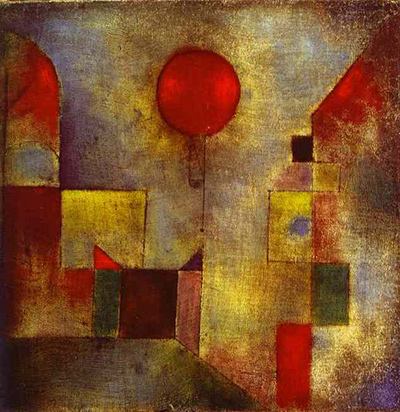
A red circle hovers over a group of buildings. At first the picture seems almost effortless to read: Paul Klee has given it the title Roter Ballon (Red Balloon), and the thin lines descending from the circle encourage us to supply a suspended basket or tether. Look longer, however, and the supposed town becomes less certain. A curved wall may be an arch, a blue patch may be an opening, and coloured panels meet without resolving into one street or one perspective. The painting lets a familiar object emerge from an arrangement that remains partly abstract.[1][2]
This small oil painting, made in 1922, belongs to the Solomon R. Guggenheim Museum in New York. Its title, material support and route into the museum are documented more securely than any single symbolic meaning. That distinction matters: the balloon can invite thoughts of flight and escape, but neither the title nor the picture makes a private allegory by Klee recoverable on its own.[1][3]
Explore the details of Red Balloon
Select a numbered area to examine its detail at high resolution.
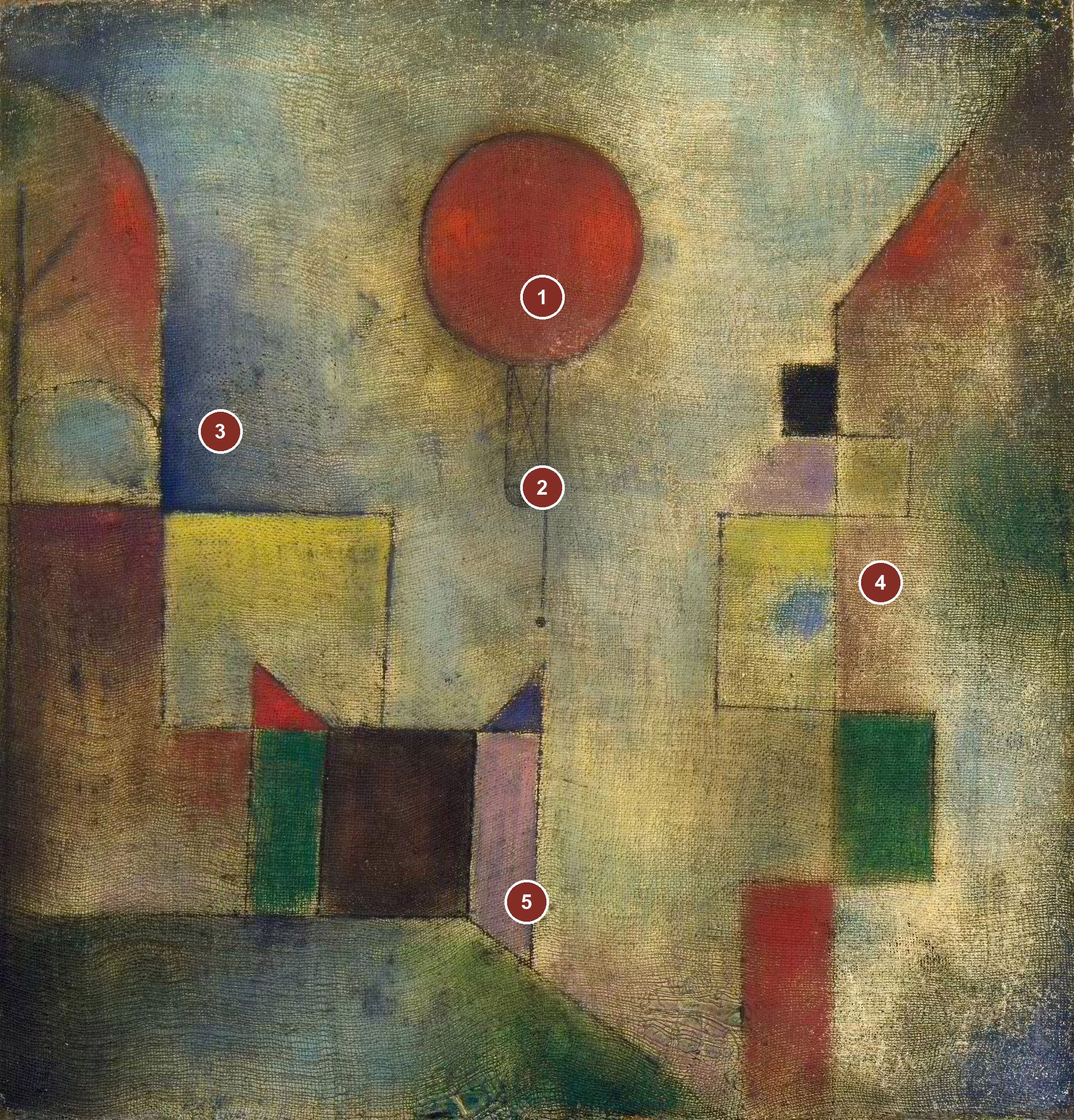
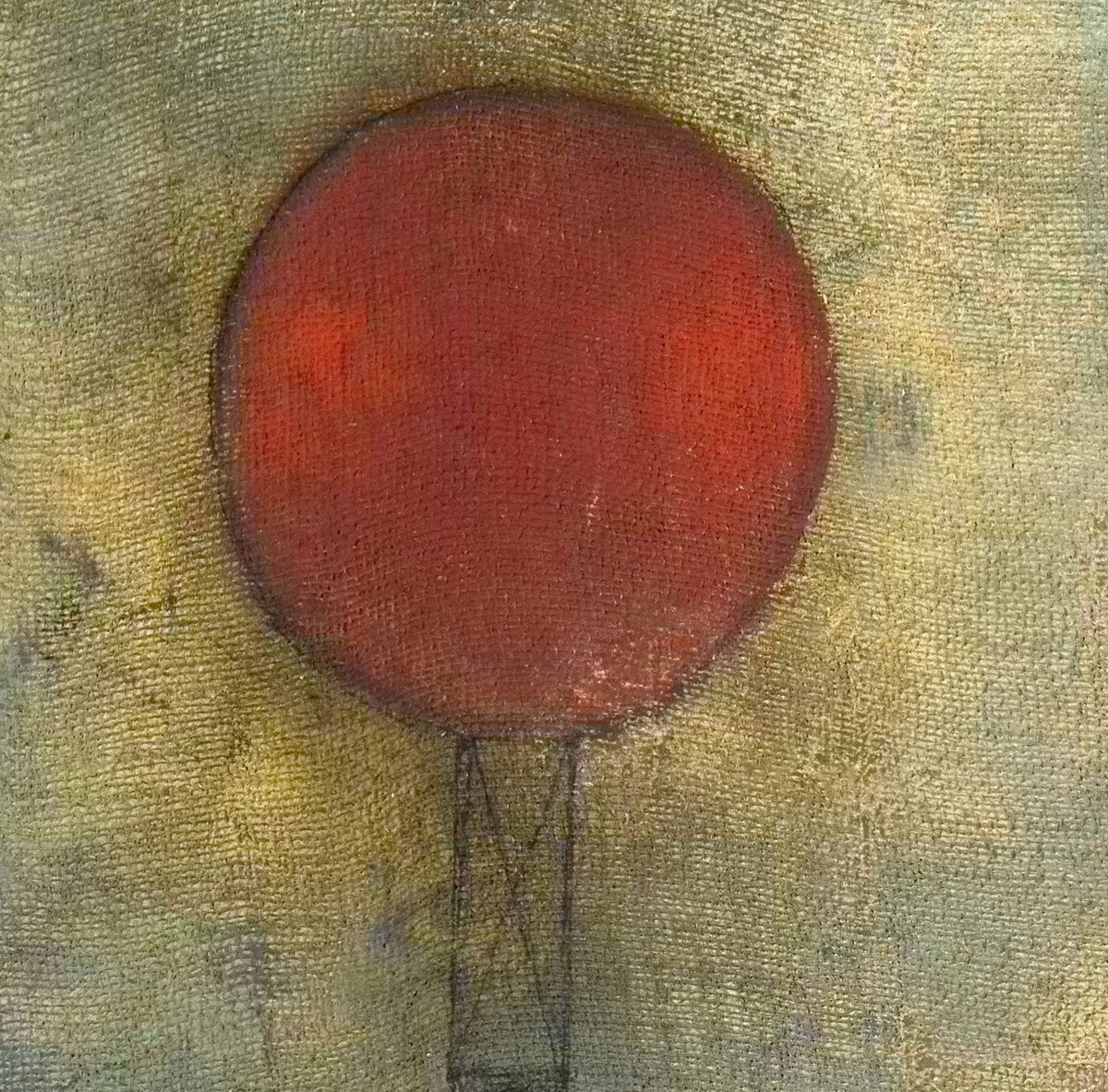
Red balloon
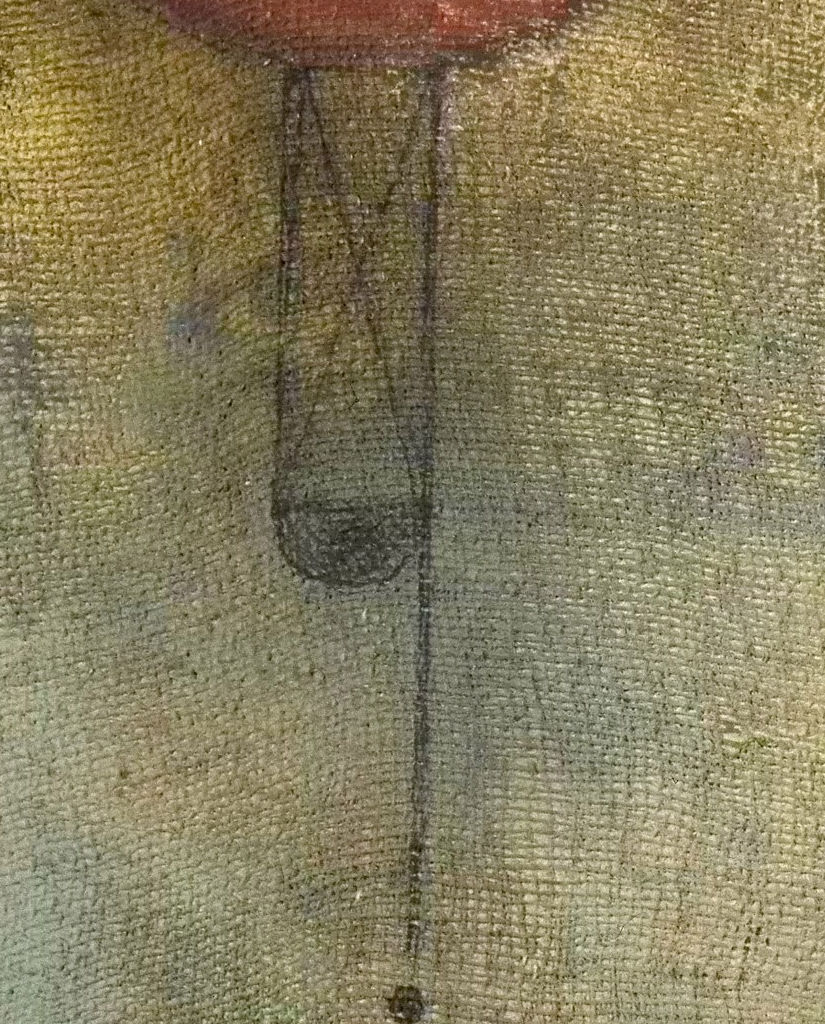
Thin line beneath the balloon
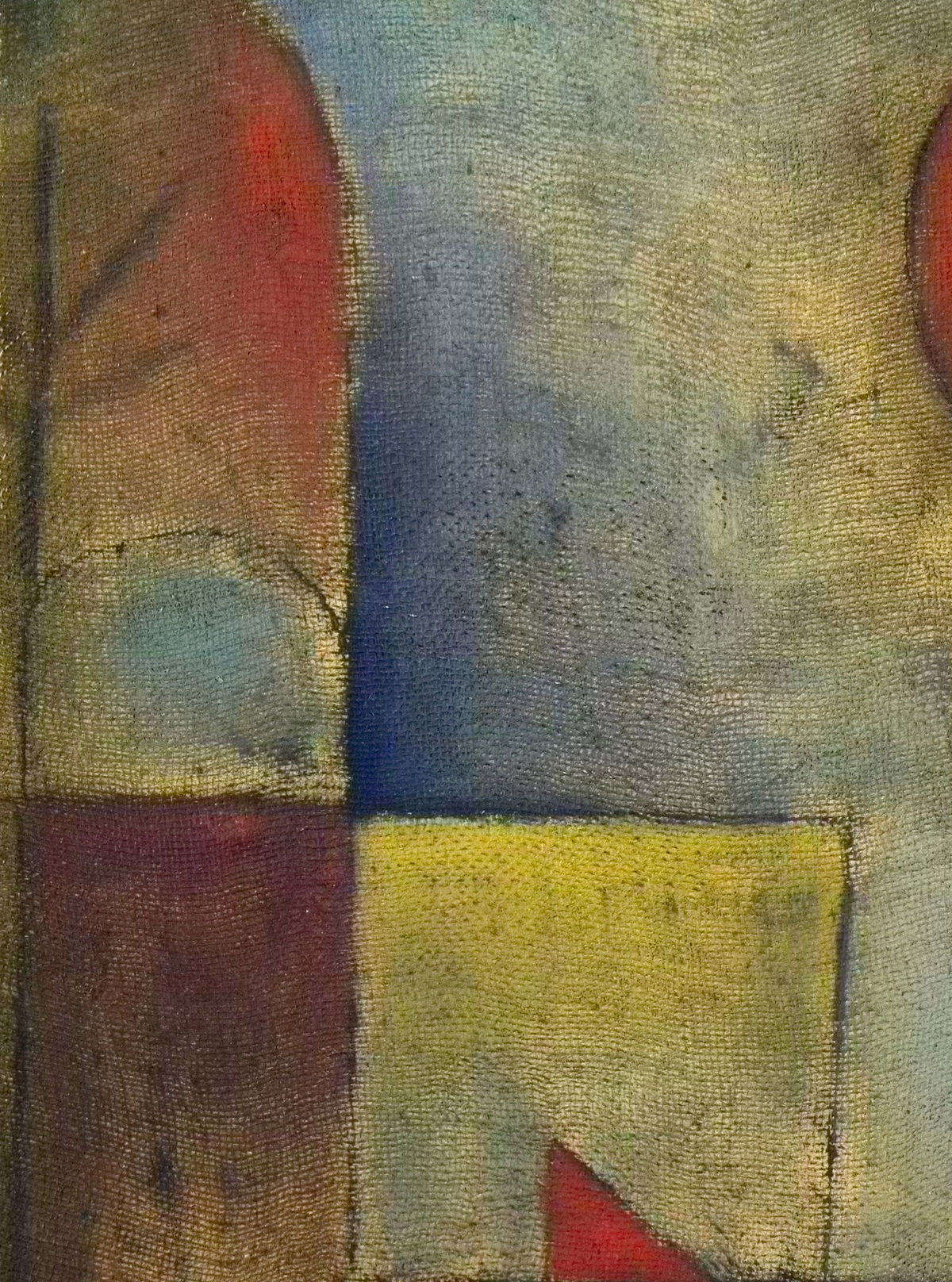
Left-hand arch and roof
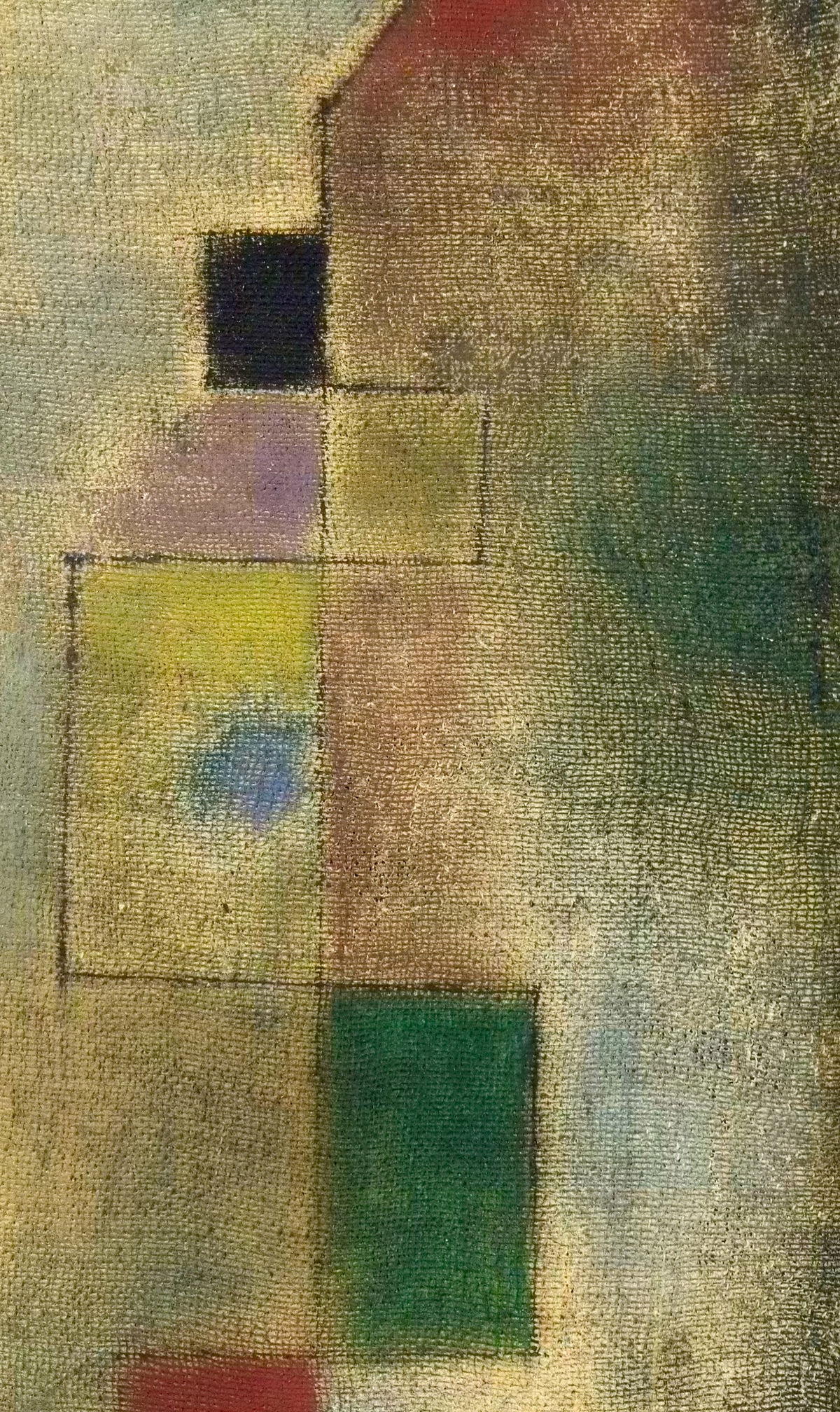
Right-hand roof and wall
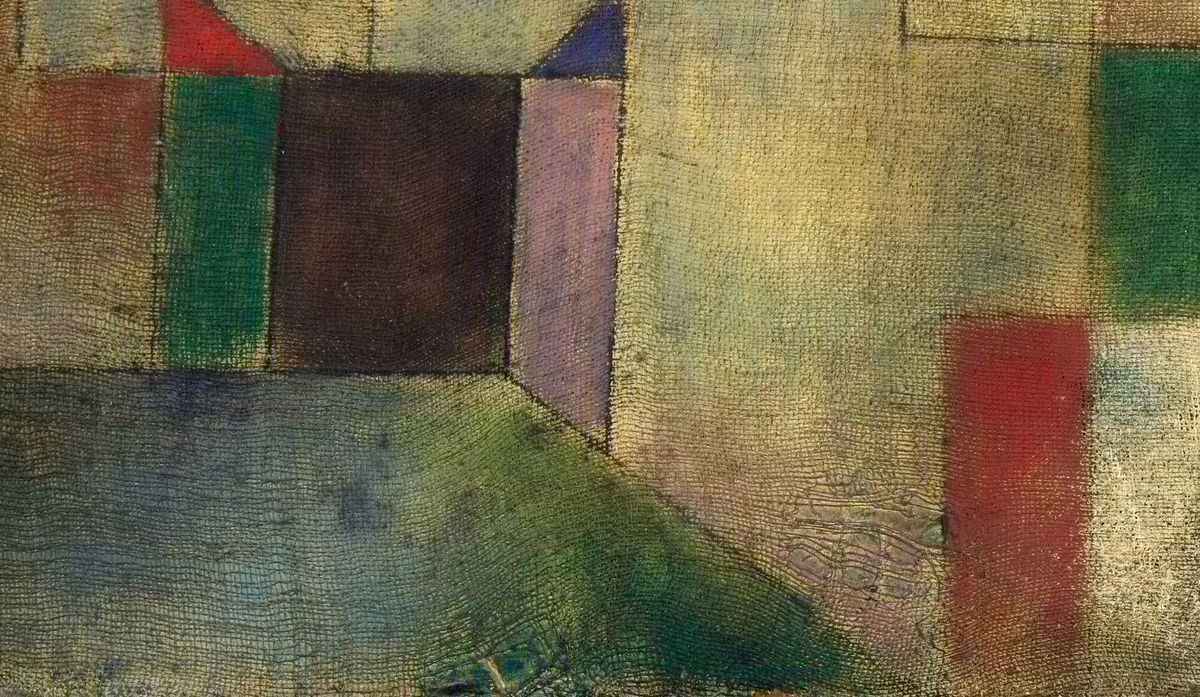
Lower geometric blocks
Contents
- Which painting is Red Balloon?
- Look from the balloon to the buildings
- What the title does
- Oil paint on a prepared textile
- A painting from Klee's Weimar Bauhaus years
- Balloons elsewhere in Klee's work
- From earlier owners to the Guggenheim
Which painting is Red Balloon?
The original German title is Roter Ballon. Klee recorded the work as 1922, 179, the number within his annual list of works. The Guggenheim's inventory number is 48.1172.524. These two numbers serve different purposes: one belongs to Klee's own chronological system, the other to the museum's collection. An older Guggenheim handbook reproduces a short description from Klee's work record, while a German-language book caption independently prints the title and annual number. The printed nine-volume Catalogue raisonné Paul Klee has not been directly consulted for this page; its entry should not be mistaken for an inspected source here.[1][3][4]
The museum measures the painted object at 31.7 × 31.1 cm, almost square. Its 2017 catalogue caption describes oil, with a possible oil-transfer drawing, on chalk-primed gauze mounted on board. The museum actually places a question mark after the transfer-drawing suggestion. It is responsible to preserve that uncertainty rather than rename the work an established oil-transfer painting. Likewise, “chalk-primed” describes the preparation under the paint. It does not demonstrate that Klee drew the visible scene with loose chalk. German Nesselstoff and the handbook's “linen gauze” describe the fabric support in historically related but not technically identical terms; the precise fibre and construction would require the owner's technical file.[1][3][4]
The object record does establish an unusual combination for a painting of this scale: a prepared, visibly woven textile fixed to a stiff board. Even in a reproduction the weave shows through the colour, most strongly in the pale field and dark corners. The surface makes the red circle, open sky and apparent masonry share one physical texture. That is an observation about what the image shows, not a laboratory conclusion about pigment, binder, transfer paper or the order of Klee's strokes. The museum's qualified wording leaves those finer questions open.[1][2]
Look from the balloon to the buildings
Start near the upper middle. The red disc is the most compact, saturated form in the picture. Its edge is dark enough to hold its roundness against a field of grey-blue, yellow and green. Directly below, a few fine dark lines form a narrow hanging structure. A small loop-like element and an even finer line continue downward. From the title it is natural to read these as balloon equipment, yet the precise basket, string and connection are not depicted like an engineering diagram. The sparseness of the lines leaves the disc poised between a recognisable object and an autonomous red circle.[1][2]
The immediate surroundings resist the easy idea of an empty sky. Dark passages press in from the upper corners. On the left, a tall warm shape curves over a pale-blue circular or arched area; a strong blue upright narrows the space beside it. On the right, a pointed red-brown roof sits above an almost black square and a sequence of green, yellow and pink blocks. Near the lower edge, steep triangles and tall rectangles lead to a broad blue-green band. One can find walls, windows, roofs and perhaps an opening between buildings, but no building needs to be mapped to a real town.[2]
Klee makes those architectural signs just sufficient. A sloping line becomes a roof once a wall-like plane sits below it; a dark square may be a window when framed by a facade. The same shapes could also be read as colour units. The Guggenheim's later educational guide places the work at the boundary of abstraction, landscape and representation. The museum's 1984 handbook calls the city both imaginable and intelligible and points to Klee's reduction of house details. These are museum interpretations of a visible tension, not records of a specific street or proof that every rectangle stands for masonry.[1][3]
The distribution of colour reinforces that tension. The balloon's red is emphatic, but smaller red accents repeat at a left roof, a lower triangle and the right-hand wall. Green appears near the centre bottom and along the right side. The pale yellow middle lets a darker blue upright on the left and the roof on the right seem to project forward. The work gives the eye routes across its surface without supplying a single realistic light source. It is possible to see the upper disc as floating high above a town, then to see the whole image as a close arrangement of coloured planes. Neither view cancels the other.[2]
The existing five detail images below let the reader test these descriptions against the full painting. Their crops isolate the circle, the thin structure below it, the left arch, the right roof and the lower blocks. A close-up is useful for seeing the texture and a line's change of direction, but it removes the neighbouring colours that give the shape its place. The detail should always be compared with the uncropped image above.[2]
What the title does
The title provides a concrete noun for the red disc. Without Roter Ballon, some viewers might first see a sun, a circle or a red planet. The narrow lines below make “balloon” plausible; the name makes it immediately available. The lower forms then become a possible town below it, even though the composition never supplies a continuous horizon or a conventional street view. This is a way to describe the relation between image and title, rather than to guess the exact moment when Klee decided on the title.[1][2]
Art historian Stephen Bann used this painting in a 1985 discussion of how names interact with modern images. A later University of Jyväskylä dissertation reports his argument: the relatively definite circle meets the title while the surrounding architectural forms remain more open, and a title can direct attention without exhausting a picture. Bann's original page has not been directly read for this project, so his exact wording and larger semiotic argument remain a research lead. A more recent article in the specialist journal Zwitscher-Maschine likewise treats Klee's titles as parts of an evolving artistic practice; it addresses other works, not this painting directly. The securely visible point here is narrower: the named red form helps organise an image whose other signs stay provisional.[5][6]
That balance makes quick symbolism tempting. Red may feel warm or urgent; flight may suggest freedom, escape, play or distance. Those are possible responses, and a reader can explain which painted details support one of them. They should not be converted into a claim that Klee “meant” the balloon to be the soul, childhood or a political event. Neither the museum's object label nor Klee's short recorded description supplies that key. The painting remains stronger when its title opens a reading without closing all other questions.[1][3]
An Italian-language educational publication offers a revealing example of later use. In a lesson about geometry, teachers invite pupils to move between fanciful identifications of buildings, balconies, roofs or a balloon and a more abstract inventory of circles, triangles and quadrilaterals. It is a lesson plan rather than historical evidence about Klee's intention, but it shows why this particular image works so well for looking: the same form can be approached as an object or as a relation of edges and colour.[7]
Oil paint on a prepared textile
The fabric is no mere hidden backing. In the high-resolution image, a regular weave is legible within the balloon, pale centre and colour blocks. Some painted zones seem dense, especially the red circle and very dark square at right; elsewhere lighter colour lets more of the woven grid remain visible. This does not tell us how many passes of paint Klee laid down. It does show that the physical support participates in the appearance of softness and depth. The older Guggenheim handbook specifically connects the weave and the paint's absorption with the work's hazy pictorial space.[2][3]
The older German work-list phrase, as transcribed by that handbook, calls the picture a small-format oil painting on Nesselstoff glued to card and prepared with a chalk ground. That is useful evidence of how the work was classified in Klee's record. The surviving online scan merges two printed columns and contains recognisable OCR mistakes, however, so its detailed transcription of inscriptions and framing instructions should be checked against the printed page or museum file before quotation. What can safely be said now is that the older museum account and the 2017 museum caption agree on a prepared textile mounted on a firm support; the later caption explicitly leaves oil transfer uncertain.[1][3][4]
Calling the picture simply “oil and chalk on muslin,” as the older local text did, obscures the distinction between a ground and a drawing medium. Calling it “oil on canvas” loses the gauze's particular visual role. And the presence of fabric in a painting made during Klee's Bauhaus years does not establish that it was produced in the Bauhaus weaving workshop. The support is an object fact; a link to a named workshop would need a separate document.[1][8]
A painting from Klee's Weimar Bauhaus years
Klee was teaching at the Bauhaus in Weimar when he made Red Balloon. The Bauhaus-Archiv describes how his instruction in form and colour belonged to a curriculum joining studio experiments with workshop practice. The Guggenheim guide sees colour, geometry and landscape converging in the painting. Those contexts help ask what the work is doing, but they do not make it an illustration of one lesson sheet or a mechanically applied colour rule. The actual object remains a small, distinctive painting with a coarse visible support and an elusive town.[1][8]
Klee's later writings and lectures can illuminate the possibilities of a circle, line and moving eye, provided their dates are kept straight. His 1925 Pedagogical Sketchbook, for instance, was published after this 1922 painting. A study by K. Porter Aichele notes a Bauhaus lecture on pictorial mechanics given in February 1924, in which Klee discussed flight and movement. That later lecture shows the motif could belong to his thinking about pictorial movement; it cannot be cited as Klee's explanation for the already completed Red Balloon. Aichele also follows images and diary language of flight across Klee's earlier and later work, rather than reducing the 1922 painting to one timeless sign.[8][9]
The date also guards against a common shortcut. The painting should not be made to stand for every movement Klee encountered. Its compressed town and unstable planes may recall aspects of Cubism, but saying that a single “Cubist technique” makes the balloon leap forward tells little about the prepared surface, the limited architectural clues or the work's actual colour relations. Description of those particular choices is more useful than an inherited list of movements and adjectives.[1][2]
Balloons elsewhere in Klee's work
The balloon was a recurring, changing image for Klee. Aichele identifies balloon motifs in 1918 landscapes and names Der Luftballon of 1926 as another example after Roter Ballon. She relates the motif to Klee's wider language of flight, including an illustration in a Gymnasium physics book associated with him and later Bauhaus teaching. Her suggestion that Klee was interested more in the symbolic possibilities of flight than in the historical detail of ballooning is an interpretation of the group, not a surviving statement about this painting alone.[9]
This comparison is valuable because the 1922 disc is stripped of most identifying machinery. A viewer does not need a detailed envelope, basket, ropes, burner, crew or mapped landscape to recognise a balloon once the title and minimal lines are in place. The economy of signs permits the red form to operate both as an object in a scene and as the principal colour event. It is also why a different balloon picture must be kept distinct. Der Ballon im Fenster, a separately catalogued 1929 work, has its own image, support and ownership history; its details cannot be transferred to the Guggenheim painting.[2][9][10]
The 1984 handbook offers another formal comparison with the 1922 Little Fir-Tree Painting in Basel and suggests that the schematic building forms anticipate later compositions of coloured rectangles. That is the handbook author's developmental reading. The original Basel object, and the specific later pictures intended, have not yet been compared directly for this page, so the analogy should remain attributed rather than becoming an asserted line of influence. What the two readings share is a helpful question: how can Klee reduce a recognisable scene towards geometry while keeping a trace of the scene available?[3]
From earlier owners to the Guggenheim
The Guggenheim acquired Red Balloon in 1948, when the Solomon R. Guggenheim Foundation purchased the estate of the dealer Karl Nierendorf. This was an estate acquisition, not a purchase directly from Klee. The museum explains that Nierendorf had represented Klee in the United States from February 1938, had continued collecting his work after the artist's death and died in 1947. Its educational guide says his estate contained more than 120 Klee works. The museum's shorter collection-history account describes more than fifty Klee paintings and works on paper brought into the collection by the estate purchase; those statements use different scopes and should not be forced into one precise number of objects still held today.[1][11]
The older museum handbook gives an earlier chain that includes the collector Hermann Lange in Krefeld and Nierendorf in New York. The online OCR loses part of Lange's date and mixes neighbouring catalogue columns, so the exact dates and any intervening dealer step need verification from the printed entry and provenance file. The name remains a worthwhile lead because the 1948 acquisition is the end of an ownership history, not its beginning. It should not be turned into an invented continuous chain from Klee's studio to New York.[3]
Exhibitions help trace the painting's public life. The handbook lists a 1931 Düsseldorf Klee exhibition before the Guggenheim acquisition, then a 1957 Guggenheim loan exhibition that travelled from London through The Hague, Helsinki, Rome, Cologne and Paris. It records display in the museum's inaugural selection in 1959–60 and the 1967 Klee retrospective, which also travelled to Basel. These details come from an older museum catalogue whose exhibition column is legible but OCR-interleaved; they are best read as a documented exhibition trail pending original catalogue cross-checks. They demonstrate that the picture had a public history long before the 2017 teacher resource made it a classroom example.[3]
The painting's later familiarity should not flatten its questions. Its almost square scale asks close viewing; its woven surface holds colour differently from a smooth paper; its title names one form while the architecture remains suspended between place and pattern. The red disc first promises a simple story of a balloon over a town. Klee's painting rewards a slower account of how little is needed to make that story possible, and how much remains open after we have told it.[1][2][3]
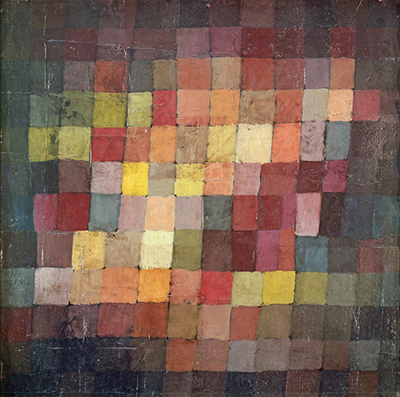
Explore Klee's Bauhaus years for the teaching context and the materials and techniques guide for the difference between a prepared support and a drawing medium. Castle and Sun offers another invented town, while Ancient Harmony shows a later way of arranging coloured units.
Explore selected works from Klee’s much larger oeuvre. Titles without a link have an authenticated catalogue identity but no reviewed article yet.
Artworks directory
| Name | Date | Medium |
|---|---|---|
| A Gate | 1939 | Painting and mixed media |
| A Woman for Gods | 1938 | Watercolour and mixed media |
| Ab Ovo | 1917 | Watercolour and mixed media |
| Above Mountain Summit | 1917 | Drawing and mixed media |
| Abstract Trio | 1923 | Drawing and mixed media |
| Acrobats | 1915 | Watercolour and mixed media |
| Actor's Mask | 1924 | Painting and mixed media |
| Ad Marginem | 1930 | Drawing and mixed media |
| Ad Parnassum | 1932 | Painting and mixed media |
| Adventurer Ship | 1927 | Drawing and mixed media |
| Affected Place | 1922 | Drawing and mixed media |
| After a Sketch from Zurich | 1914 | Watercolour and mixed media |
| After Drawing | 1919 | |
| After The Floods | 1936 | Watercolour and mixed media |
| All Souls' Picture | 1921 | |
| Ancient Harmony | 1925 | Painting and mixed media |
| Angel Applicant | 1939 | Drawing and mixed media |
| Angel Serves the Desired | 1920 | |
| Angel, Still Female | 1939 | Painting and mixed media |
| Angelus Novus | 1920 | Drawing and mixed media |
| Animal Terror | 1926 | Painting and mixed media |
| Arab Song | 1932 | Painting and mixed media |
| Archangel | 1938 | Painting and mixed media |
| Architecture | 1923 | Painting and mixed media |
| Architecture of the Plain | 1923 | Drawing and mixed media |
| Around the Fish | 1926 | Painting and mixed media |
| Arrival of the Air Steamer | 1921 | Drawing and mixed media |
| Asiatic God | 1924 | Painting and mixed media |
| Astrological Fantasy Portrait | 1924 | Drawing and mixed media |
| Athlete's Head | 1932 | Watercolour and mixed media |
| Aufgehender Stern | 1931 | Painting and mixed media |
| Autumn Flower | 1922 | Painting and mixed media |
| Bad Band | 1920 | Drawing and mixed media |
| Baroque Centaur | 1939 | Painting and mixed media |
| Before the Blitz | 1923 | Drawing and mixed media |
| Before the Snow | 1929 | Drawing and mixed media |
| Besessenes Madchen | 1924 | Watercolour and mixed media |
| Bird Garden | 1924 | |
| Bird Wandering Off | 1926 | Watercolour and mixed media |
| Blossoms in the Night | 1930 | Watercolour and mixed media |
| Blue-Bird-Pumpkin | 1939 | Painting and mixed media |
| Boats in the Flood | 1937 | Painting and mixed media |
| Botanical Theatre | 1934 | Drawing and mixed media |
| Boy in Fancy Dress | 1931 | Watercolour and mixed media |
| Broken Key | 1938 | |
| Brother and Sister | 1930 | Watercolour and mixed media |
| But the Red Roof | 1935 | Painting and mixed media |
| C - C = Fisch | 1931 | Watercolour and mixed media |
| Cacti | 1912 | Painting and mixed media |
| Camel (in Rhythmic Landscape with Trees) | 1920 | Drawing and mixed media |
| Captive Pierrot | 1923 | Drawing and mixed media |
| Castle and Sun | 1928 | Drawing and mixed media |
| Cat and Bird | 1928 | Drawing and mixed media |
| Cathedrals | 1925 | Watercolour and mixed media |
| Chalice of the Heart | 1937 | Painting and mixed media |
| Characters in Yellow | 1937 | Painting and mixed media |
| Chosen Site | 1927 | Mixed media |
| Christmas Picture | 1923 | Drawing and mixed media |
| City of Towers | 1916 | Painting and mixed media |
| Clarification | 1932 | Painting and mixed media |
| Collection of Figurines | 1926 | Painting and mixed media |
| Colorful Architecture | 1917 | Painting and mixed media |
| Comedians' Handbill | 1938 | |
| Comic Opera Singer | 1927 | Painting and mixed media |
| Composition | 1939 | Painting and mixed media |
| Composition with Figures | 1915 | Drawing and mixed media |
| Composition with the Yellow Half-Moon and the Y | 1918 | Watercolour and mixed media |
| Conch–Still Life II | 1939 | Watercolour and mixed media |
| Cosmic Composition | 1919 | Painting and mixed media |
| Crystal Gradation | 1921 | Drawing and mixed media |
| Dance of the Grieving Child | 1922 | Painting and mixed media |
| Dancing Girl | 1940 | Painting and mixed media |
| Das Licht und Etliches | 1931 | Mixed media |
| Death and Fire | 1940 | Painting and mixed media |
| Death for the Idea | 1915 | |
| Demon as Pirate | 1926 | Watercolour and mixed media |
| Diana | 1931 | Painting and mixed media |
| Diavolo Player | 1923 | Drawing and mixed media |
| Die Kapelle | 1917 | Watercolour and mixed media |
| Die Vase | 1938 | Painting and mixed media |
| Doctor | 1930 | Drawing and mixed media |
| Dredger and Sailboat | 1931 | Watercolour and mixed media |
| Ein Tor | 1939 | Painting and mixed media |
| Ein Weib fur Gotter | 1938 | Mixed media |
| Embrace | 1939 | Watercolour and mixed media |
| Episode before an Arab Town | 1923 | |
| Equals Infinity | 1932 | Painting and mixed media |
| Eros | 1923 | Drawing and mixed media |
| Error on Green | 1930 | Watercolour and mixed media |
| Evening Figure | 1935 | Drawing and mixed media |
| Falling Bird | 1919 | |
| Fermata | 1932 | Watercolour and mixed media |
| Fire Clown | 1921 | Watercolour and mixed media |
| Fire Full Moon | 1933 | Watercolour and mixed media |
| Fire in the Evening | 1929 | Painting and mixed media |
| Fish in the Harbour | 1916 | Watercolour and mixed media |
| Fish Magic | 1925 | Watercolour and mixed media |
| Flock of Birds | 1917 | Drawing and mixed media |
| Flora on Sand | 1927 | Watercolour and mixed media |
| Flower Myth | 1918 | |
| Flower Stand with Watering Can and Bucket | 1910 | Watercolour and mixed media |
| Flowering Tree (Abstraction with Reference to a Flowering Tree) | 1925 | Painting and mixed media |
| Flowers in Pots | 1923 | |
| Flowers in Stone | 1939 | Painting and mixed media |
| Forest Witch | 1938 | Painting and mixed media |
| Fright of a Girl | 1922 | Drawing and mixed media |
| Fruits on Red | 1930 | Drawing and mixed media |
| Full Moon | 1919 | Mixed media |
| Föhn Wind in Franz Marc's Garden | 1915 | Watercolour and mixed media |
| Garden in St Germain, The European Quarter near Tunis | 1914 | Watercolour and mixed media |
| Ghost Chamber with the Tall Door (New Version) | 1925 | |
| Ghost of a Genius | 1922 | Drawing and mixed media |
| Girl in Mourning | 1939 | Painting and mixed media |
| Glance of a Landscape | 1926 | Watercolour and mixed media |
| Gluht Nach | 1939 | Drawing and mixed media |
| Golden Fish | 1925 | Watercolour and mixed media |
| Goldfish Wife | 1921 | Watercolour and mixed media |
| Green Plant, Blood, Louse | 1924 | Drawing and mixed media |
| Hafenbild | 1918 | Mixed media |
| Hammamet with Mosque | 1914 | Watercolour and mixed media |
| Harbour with Sailing Ships | 1937 | Painting and mixed media |
| Hauptweg und Nebenwege | 1929 | Painting and mixed media |
| Heavenly and Earthly Time | 1927 | Drawing and mixed media |
| Heroic Fiddling | 1938 | Painting and mixed media |
| Heroic Roses | 1938 | Painting and mixed media |
| Heroic Strokes of the Bow | — | Mixed media |
| Highway and Byways | 1929 | Drawing and mixed media |
| Houses near the Gravel Pit | 1913 | Watercolour and mixed media |
| Howling Dog | 1928 | Painting and mixed media |
| In the Current Six Thresholds | 1929 | Painting and mixed media |
| In the Style of Kairouan | 1914 | Drawing and mixed media |
| Individualized Altimetry of Stripes | 1930 | Painting and mixed media |
| Insula Dulcamara | 1938 | |
| Interior with the Clock | 1913 | Watercolour and mixed media |
| Irma Rossa the Animal Tamer | 1918 | Drawing and mixed media |
| Journey in Corsica | 1927 | Drawing and mixed media |
| Landscape with Bluebirds | 1919 | Watercolour and mixed media |
| Legend of the Nile | 1937 | Painting and mixed media |
| Lemon Harvest | 1937 | Watercolour and mixed media |
| Likeness in the Bower | 1930 | Watercolour and mixed media |
| Limits of Reason | 1927 | Painting and mixed media |
| Little Hope | 1938 | Watercolour and mixed media |
| Magdalena before the Conversion | 1938 | Drawing and mixed media |
| Mask of Fear | 1932 | Painting and mixed media |
| May Picture | 1925 | Painting and mixed media |
| Monument in a Cemetery | 1922 | Watercolour and mixed media |
| Monuments at G | 1929 | Watercolour and mixed media |
| Municipal Jewel | 1917 | Watercolour and mixed media |
| Mural from the Temple of Longing Thither | 1922 | |
| Nach der Uberschwemmung | 1936 | Watercolour and mixed media |
| New Harmony | 1936 | Painting and mixed media |
| New House in the Suburbs | — | Mixed media |
| Old Steamboat | 1922 | Drawing and mixed media |
| On the Edge | 1930 | Drawing and mixed media |
| Once Emerged from the Gray of Night | 1918 | Drawing and mixed media |
| One Who Understands | 1934 | Painting and mixed media |
| Oriental Pleasure Garden | 1925 | Painting and mixed media |
| Park of Idols | 1939 | Watercolour and mixed media |
| Passing by Red Pillars | 1928 | Watercolour and mixed media |
| Persian Nightingales | 1917 | Drawing and mixed media |
| Popular Wall Painting | 1922 | Painting and mixed media |
| Prestidigitator | 1927 | Watercolour and mixed media |
| Rainy Day | 1931 | Watercolour and mixed media |
| Red and White Domes | 1914 | Watercolour and mixed media |
| Red Balloon | 1922 | Drawing and mixed media |
| Redgreen and Violet-Yellow Rhythms | 1920 | Drawing and mixed media |
| Refuge | 1930 | Watercolour and mixed media |
| Rhythmic Rythmical | 1930 | Painting and mixed media |
| Saint of the Inner Light | 1921 | |
| Scaffolding of a New Building | 1930 | Painting and mixed media |
| Scholar in Dealing with Stars | 1926 | Watercolour and mixed media |
| Seated Woman | 1930 | Drawing and mixed media |
| Senecio | 1922 | Painting and mixed media |
| Separation in the Evening | 1922 | Drawing and mixed media |
| Sinbad the Sailor | 1923 | Drawing and mixed media |
| Skeptically Smiling | — | Mixed media |
| Small House in the Garden City | 1928 | Watercolour and mixed media |
| Small Portrait of a Girl in Yellow | 1925 | Painting and mixed media |
| Southern Gardens | 1919 | Watercolour and mixed media |
| Static-Dynamic Gradation | 1923 | Drawing and mixed media |
| Still Life | 1927 | Painting and mixed media |
| Still Life with Gladioli | 1932 | Watercolour and mixed media |
| Strange Garden | 1923 | Drawing and mixed media |
| Stricken City | 1936 | Painting and mixed media |
| Strong Dream | 1929 | Watercolour and mixed media |
| Struck from the List | 1933 | Drawing and mixed media |
| Structural I | 1924 | Drawing and mixed media |
| Sumpflegende | 1919 | Painting and mixed media |
| Temple Gardens | 1920 | Drawing and mixed media |
| The Arrow before the Target | 1921 | Drawing and mixed media |
| The Barbed Noose with the Mice | 1923 | Watercolour and mixed media |
| The Flora of the Heath | 1925 | Watercolour and mixed media |
| The Goldfish | 1925 | Watercolour and mixed media |
| The Hour Before One Night | 1940 | Painting and mixed media |
| The Man in Love | 1923 | |
| The Mask with the Flag | 1925 | Mixed media |
| The Pathos of Fertility | 1921 | |
| The Rhine at Duisburg | 1937 | Painting and mixed media |
| The Way to the Citadel | 1937 | Painting and mixed media |
| Three Houses and a Bridge | 1922 | Watercolour and mixed media |
| Tightrope Walker | 1923 | |
| Tomb in Three Parts | 1923 | Watercolour and mixed media |
| Tomcat's Turf | 1919 | Watercolour and mixed media |
| Tower in Orange and Green | 1922 | Drawing and mixed media |
| Tree and Architecture - Rhythms I | 1920 | Watercolour and mixed media |
| Tree and Architecture - Rhythms II | 1920 | Painting and mixed media |
| Tropical Dawn with the Owl | 1921 | Mixed media |
| Tropische Dammerung | 1921 | Painting and mixed media |
| Twittering Machine | 1922 | Drawing and mixed media |
| Variations (Progressive Motif) | 1927 | Watercolour and mixed media |
| Ventriloquist and Crier in the Moor | 1923 | |
| Viaducts Break Ranks | 1937 | Drawing and mixed media |
| Villa R | 1919 | Painting and mixed media |
| Village Carnival | 1926 | Painting and mixed media |
| Vor dem Blitz | 1923 | Drawing and mixed media |
| Wald-Hexen | 1938 | Painting and mixed media |
| Young Forest | 1925 | Drawing and mixed media |
Related artworks
Explore eight other Klee works, beginning with works close in date to this one.
Senecio
1922
Twittering Machine
1922
Crystal Gradation
1921
Sinbad the Sailor
1923
Actor's Mask
1924
Angelus Novus
1920
Ancient Harmony
1925
Fish Magic
1925
Discussion
The title identifies a balloon, while the surrounding town remains open to interpretation.
Visible details, museum records and later readings answer different questions.
Reader Insights
Which lines below the red circle make it look like a balloon?
Where do you see a building, and where only a colour block?
How does the visible fabric weave change the apparent sky or walls?
Join the Conversation
Share the visual detail or source behind your reading.
References
- Solomon R. Guggenheim Museum, Visionaries: Creating a Modern Guggenheim, teacher resource (2017), pp. 11–12. Museum caption, qualified oil-transfer possibility, 31.7 × 31.1 cm, accession 48.1172.524, and institutional interpretation and Nierendorf acquisition history, View source.
- Rawpixel, exact-match Red Balloon item 22631867, item-level CC0 high-resolution image. Visual observations were checked against the unenhanced 3929 × 4096 px, natively 300 dpi master saved in the project; this is an image source rather than a technical examination of the artwork, View source.
- Vivian Endicott Barnett, Handbook: The Guggenheim Museum Collection 1900–1980 (New York: Solomon R. Guggenheim Foundation, 1984), no. 78, printed pp. 174–75, Open Library edition record and searchable digitised transcription. The online text was read; its two-column OCR is damaged. Precise inscription, early provenance and exhibition details require comparison with the printed page.
- Mark W. Rectanus, ed., Über Gegenwartsliteratur / About Contemporary Literature (Bielefeld: Aisthesis, 2008), publisher-hosted preview, p. 2, German cover caption: Roter Ballon, 1922,179, oil on prepared Nesseltuch on card. The cover caption corroborates identity and broad support, not a work-specific analysis, View source.
- Stephen Bann, “The Mythical Conception Is the Name: Titles and Names in Modern and Post-Modern Painting” (1985), bibliographic abstract, and the University of Jyväskylä dissertation discussing Bann and Red Balloon. Bann's original p. 184 remains unread; the work-specific summary is mediated through the dissertation and is accordingly qualified.
- Annabelle B. Berghof, “Name Games: Paul Klee's Self-Referential Titling”, Zwitscher-Maschine: Journal on Paul Klee (2024), journal abstract and free-PDF link. General title-practice context; its focal examples are not Red Balloon, View source.
- Luca Crivelli and Vanessa Hena, In arte… Matematica!, Italian-language educational preview, p. 41. A later lesson using Palloncino rosso to move between imagined town details and elementary geometric forms; evidence of pedagogical reception, not artist intent, View source.
- Bauhaus-Archiv, “Unterricht” (German), account of Weimar teaching in form and colour; Pedagogical Sketchbook publication note (English), 1925 publication context. Neither source identifies Red Balloon as a workshop product or illustrates a direct preparatory exercise.
- K. Porter Aichele, Paul Klee, Poet/Painter (Rochester, NY: Camden House, 2006), printed pp. 80–82 and 91 n. 49–54, searchable third-party transcription. Read relevant chapter and notes directly in the transcription; original printed pagination and quotations should be verified in an authorised edition before close quotation. Her flight and balloon argument is attributed, not treated as a note Klee wrote about this object, View source.
- Christie's, Der Ballon im Fenster catalogue entry, 1929. Source for the identity of a separate balloon-themed work; its medium and provenance are not transferred to Roter Ballon, View source.
- Solomon R. Guggenheim Museum, “About the Collection”, Nierendorf estate and the more-than-fifty Klee works described as an accession group; read with the wider estate count in reference 1, View source.