


 by Tom Gurney
Tom Gurney BSc (Hons) is an art history expert with over 20 years experience
Published on June 19, 2020 / Updated on September 27, 2026
Email: tomgurney1@gmail.com / Phone: +44 7429 011000
Collection of Birds: Klee’s varied 1917 gathering
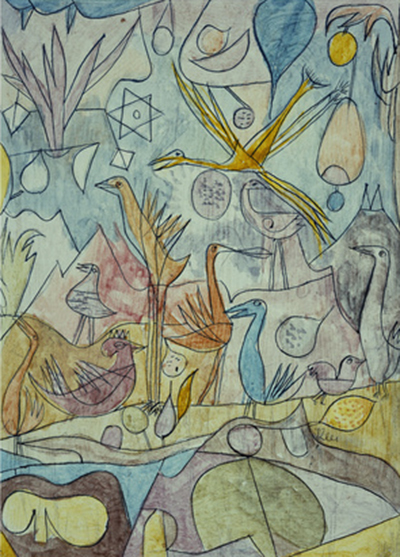
Paul Klee's Vogelsammlung was made in 1917. The German title is usually rendered Collection of Birds; some reproductions call it Flock of Birds. The distinction is useful. A flock suggests birds moving together, while the sheet gathers birds of different shapes and colours among plants, suspended forms and delicate lines. A Christie's Images listing identifies watercolour, ink and pencil, while a Bridgeman listing describes pen, ink and pencil on paper mounted on board. Bridgeman places the work in a private collection. Their differing medium descriptions should be kept visible until an original object or auction catalogue is consulted.[1][2]
The inherited reproduction on this page shows a tall, narrow composition with a pale blue-green ground. At least several birds can be picked out: a rose-coloured bird at lower left, an orange-brown upright bird near the centre, a blue bird at lower right of centre, a grey bird at the right, and a long-beaked yellow form cutting diagonally across the upper half. Small ovals, circles, pointed leaves and branching or reed-like lines occupy the intervals. The image is too small to settle every shape or technical detail, but it is sufficient to show that the birds do not simply fly in one direction as a single group.[1][2]
A gathering rather than a flock
The birds are neither arranged like specimens in a natural-history cabinet nor assembled into a realistic landscape. Some appear to stand; another stretches across the sheet on a diagonal; others are partially joined to the surrounding vegetation. Their outlines are economical. A beak, rounded body, eye or fan of strokes is often enough to suggest a creature. Those graphic cues invite recognition, yet the bodies vary so much that a species-by-species reading would be speculative. The title names a collection, not a list of identifiable species.[1][2]
Looking from top to bottom, the image has a loose vertical rhythm. Long stems at the left are answered by the narrow orange and yellow diagonals above centre. Round and droplet forms recur at different heights. Below, a broad curved division brings the eye toward the larger forms at the foot of the sheet. The repetition creates connections among otherwise separate figures. It can also make a bird seem to emerge from a plant or a plant from a bird's tail. These are observations about the visible composition, not evidence that Klee meant a precise transformation story.[1][2]
There is no stable horizon and no measured depth. The pale ground can suggest air, water, foliage or simply the exposed support. Blue, rose, ochre and soft yellow are distributed in small areas rather than assigned consistently to foreground and background. Fine dark contours remain readable across the washes. Because the available archive captions differ over the full medium, it is safer to describe what the reproduction shows—transparent-looking colour crossed by drawing—than to state a particular order in which Klee applied each material.[1][2]
The English name Flock of Birds may lead a viewer to search for collective flight. A few forms do imply movement, especially the strong diagonal above the centre, but the lower birds appear more nearly settled. Collection of Birds better preserves the possibility of a deliberately varied assembly. Klee can present birds as individual inventions while making their beaks, eyes, stems and little geometric signs participate in one pictorial field. Neither English title proves the artist's intention; the German Vogelsammlung is the most secure title available in the image listings.[1][2]
Birds and nature in Klee's work
The Zentrum Paul Klee has devoted an exhibition to the artist's animal subjects. Its account says that animals interested him throughout his career and that birds and fish held a particular place because their movement through air and water suggested freedoms unavailable to people bound to the earth. The exhibition text also stresses his observation of natural things and his imaginative reversal of human and animal traits. This is a sound framework for looking at the motif in Vogelsammlung, but it is general context: the museum text does not interpret this specific private-collection sheet.[3]
That distinction matters because birds in Klee's art do not carry one fixed meaning. A museum-held work from the same year, Persische Nachtigallen (Persian Nightingales, 1917), brings three birds together with letters, a rose, celestial forms and a literary allusion. The National Gallery of Art explains those particular birds through the poetry of Hafiz and the Persian miniature tradition. Those readings are grounded in that work's inscriptions and imagery. They cannot simply be transferred to Vogelsammlung, which has a different arrangement and no comparable literary source identified in the accessible record.[4]
The National Gallery's object entry nevertheless offers a useful visual comparison. It identifies watercolour and drawing on paper mounted on cardboard, and shows how Klee could make birds coexist with signs and thin washes in 1917. Vogelsammlung is more crowded with varied bird forms and vegetation. The comparison places it within Klee's period of experimentation without treating the two sheets as variants or claiming that one led to the other.[1][2][4]
The year 1917
Klee made Vogelsammlung during the First World War. The Zentrum Paul Klee's German exhibition account records that he had been drafted in March 1916, worked chiefly at military airfields rather than at the front, and from January 1917 served as a clerk in the accounts office of the flying school at Gersthofen. It describes 1916–18 as productive years in which he continued developing abstraction, symbols and subjects drawn from nature. Such documented circumstances establish the setting of the year; they do not establish where this sheet was made or whether its birds directly represent military aircraft.[5]
The same museum account describes other works in which flying birds and planes combine or fall, and it links those works to Klee's airfield experience. Vogelsammlung should remain separate from that identified group unless an object-specific source makes the connection. No plane is clearly legible in the inherited image. Its birds can be read in the broader context of Klee's interest in flight, but a wartime allegory for this exact work would go beyond the evidence presently available.[5]
The centre's discussion of wartime watercolours is also relevant in a narrower way. It says that Klee invented landscapes in which animals, plants and celestial bodies could be principal elements. Here, plant-like shapes and birds share a field that does not resemble a recorded place. This resemblance supports a contextual comparison, not a claim that Vogelsammlung illustrates a particular diary entry, battlefield event or personal memory.[5]
Object identity and open questions
A private work index gives Vogelsammlung the annual number 1917, 28 and lists both Collection of Birds and Flock of Birds as English names. This crosswalk is helpful for distinguishing the work from other Klee bird images, but the number has not been checked here against Klee's handwritten register or the printed Catalogue raisonné. The two image archives differ on whether watercolour belongs in the medium summary. Without the primary catalogue or a current owner record, exact dimensions, mounting and full provenance remain provisional.[1][2][6]
The available small reproduction conveys the birds and broad washes, but cannot settle fine drawn signs, surface texture or inscriptions.[1][2]
What can be seen now is already rich. The sheet turns a group of differently formed birds into an intricate network of eyes, beaks, colour patches, stems and floating marks. Its old English label invites the image of a flock, while its German title asks us to see an assortment. The experience moves between recognising birds one by one and following the visual links that make them a collection.[1][2]
Related artworks
Explore eight other Klee works from the researched artwork cluster.
Flower Myth
1918
Angelus Novus
1920
Hammamet with Mosque
1914
Crystal Gradation
1921
Red Balloon
1922
References
- Bridgeman Images, “Flock of Birds, 1917,” CH376708: image archive title, date, pen/ink/pencil description, paper mounted on board and private-collection attribution. The photograph is credited to Christie's Images / Bridgeman Images, View source.
- SuperStock / Christie's Images Ltd., “Collection of Birds (Vogelsammlung),” image 1100-397: image supplier record for German and English title, 1917 date, watercolour/ink/pencil description and licensed high-resolution image context. Its medium wording differs from Bridgeman's, View source.
- Zentrum Paul Klee, “Paul Klee. Tierisches” (German exhibition text served on an Italian-language route): institutional account of Klee's animal subjects, observation of nature and the special place of birds and fish. It does not identify this sheet, View source.
- National Gallery of Art, Persische Nachtigallen (Persian Nightingales): owner object record and interpretation of a distinct 1917 bird watercolour, including medium, inscriptions and literary imagery. Comparison only, View source.
- Zentrum Paul Klee, “Klee im Krieg” (German exhibition text): institutional account of Klee's wartime duties, 1917 production, invented nature imagery and other bird/plane works. It does not link Vogelsammlung to a particular military episode, View source.
- PaulKlee.fr, 1917 work index (French/German private derivative index): proposes Vogelsammlung as 1917, 28 with English aliases. The original register and printed catalogue entry have not been directly checked, View source.