


 by Tom Gurney
Tom Gurney BSc (Hons) is an art history expert with over 20 years experience
Published on June 19, 2020 / Updated on September 27, 2026
Email: tomgurney1@gmail.com / Phone: +44 7429 011000
A city transposed
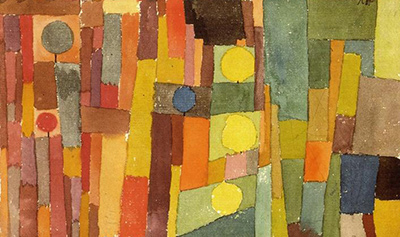
A line of coloured bands fills the small watercolour. Rectangles rise, overlap and change direction; circles punctuate them. The title names Kairouan, yet there is no single gate, mosque or street that a visitor can confidently pick out. Paul Klee called the work “(im Stil v Kairouan, ins gemässigte übertragen)”: in the Kairouan style, transposed into the moderate. The word transposed matters. This is a picture made from an encounter with a place, then worked into relations of colour and form, rather than a diagram from which the original view can be recovered.[1][2][3]
The watercolour shown above is Klee’s 1914,211, now at the Zentrum Paul Klee in Bern. Another 1914 work bears the same German title. That second version, 1914,210, belongs to the Los Angeles County Museum of Art. The two cannot share a single object record: their compositions, dimensions, supports, ownership histories and published interpretations differ. This page follows the Bern picture while using the Los Angeles version only as a clearly identified comparison.[1][2][4][5]
Contents
- Which Kairouan work is shown here?
- What did Klee see in Tunisia?
- What happens across the watercolour?
- How does it relate to Klee’s Kairouan views?
- Does “transposed into the moderate” refer to music?
- Was this Klee’s first truly abstract work?
- Where is the Bern work now, and what remains uncertain?
Which Kairouan work is shown here?
The Zentrum Paul Klee gives the Bern work as 1914,211, watercolour and pencil on paper mounted on cardboard, 12.3 × 19.5 cm. The catalogue for the 2019 Paul Klee: Equilíbrio Instável exhibition at the Centro Cultural Banco do Brasil repeats those details beside its illustration 16. The Fondation Beyeler’s 2017 Klee exhibition checklist records the same work and also describes a lower marginal stripe drawn in pen. The published material available here does not establish whether that stripe is part of the painted sheet, its mount, or the boundary between them, so it is best treated as a catalogue description rather than a feature to identify in this small reproduction.[1][2][3]
Los Angeles County Museum of Art identifies its separate 1914,210 as In the Kairouan Style, Transposed in a Moderate Way, accession M.2005.70.51. It measures 14.5 × 21.5 cm and is described as watercolour and pencil on paper on bristol board. Its image is more open and lighter: broad pale areas and a conspicuous orange circle low on the right differ from the narrower, more densely packed bands and several yellow circles in the Bern version. LACMA’s provenance and account of a Japanese ink wash technique concern no. 210. They cannot be copied into the caption for no. 211.[4][5]
Klee’s own annual numbers help more than a translated title. Spelling varies across catalogues: Kairuan and Kairouan, gemässigte and Gemässigte, and English versions including “In the Style of Kairouan” and “In the Kairouan Style, Transposed into the Moderate.” The longer German wording is not a separate work when the number, size and holder still match. Nor does the fact that 210 and 211 are adjacent numbers prove which was conceived first or that one is a sketch for the other. The complete catalogue raisonné entries and the Bern object file would be needed to test those questions.[1][2][4][6]
What did Klee see in Tunisia?
Klee travelled in April 1914 with the painters August Macke and Louis Moilliet. Their route took them through Tunis and other towns before Kairouan. He drew and painted during the journey, but the trip was also followed by sorting, cutting, mounting and new picture making. A work dated 1914 and named for Kairouan is therefore not automatically an uninterrupted outdoor watercolour completed at a particular gate on a particular day.[1][2][7]
The Bern Zentrum’s German Mapping Klee account puts architecture alongside colour. It cites Klee’s interest in how a town’s built arrangement could become an architecture of the picture. White cubic buildings, rectilinear edges and shifting spaces supplied possibilities for pictorial organisation. The account says he wanted to return to his Munich studio to put new ideas to work. Its interpretive framework is apt for no. 211: the title retains an encounter with Kairouan while the watercolour builds a new field of strips, rectangles and discs. A diary statement about city architecture helps frame the process; it does not prove that a particular line in this sheet corresponds to a named wall.[1]
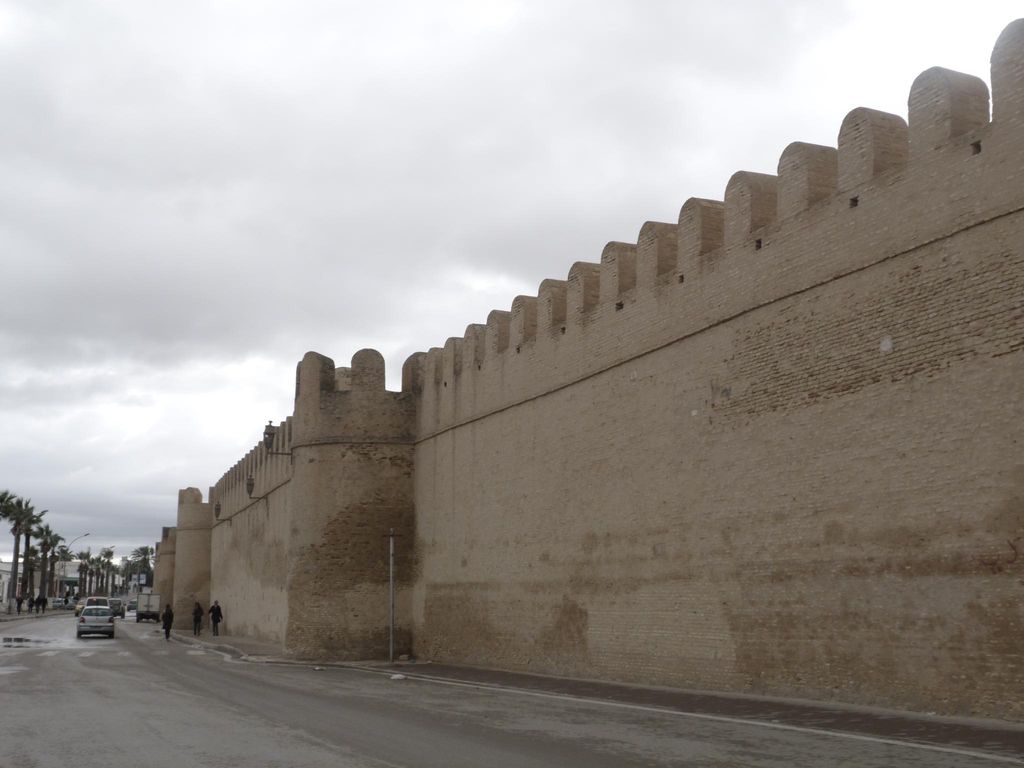
Kairouan was and remains more than an artist’s stimulus. The Tunisian Institut National du Patrimoine describes a living medina enclosed by roughly three kilometres of walls, with a north–south route through the souks, tightly connected streets and low houses, and the domes and minarets of long standing religious buildings. The Great Mosque and the Mosque of the Three Gates belong to the city’s architectural history. The three painters encountered this urban world while Tunisia was under French colonial rule. None of these facts makes the Bern watercolour a map of the medina or tells us which Kairouan monument, if any, one of its coloured blocks represents.[4][8]
The local context also has voices beyond Klee. Tunisian aesthetician Rachida Triki, introducing a 2014 Tunis colloquium, relates his pictorial construction to medina architecture, domes, ornament, light and colour. Tunisian artist and filmmaker Nacer Khemir writes from a different direction: reproductions of Klee encountered in childhood helped him attend to signs in mosque facades, homes, textiles and other parts of his own environment. Khemir is describing the later effect of Klee’s work on his perception, not testifying that Klee copied one specific Tunisian motif. Their different perspectives keep the encounter from being told entirely as a solitary European revelation.[7]
Writing in the same colloquium, the Tunisia-based artist and researcher Olga Malakhova asks what happened after Klee. Her study of modern Tunisian landscape painting calls his approach to pictorial structure and colour a possible creative catalyst, but warns against imagining that Tunisian painters simply followed a uniform Klee-derived school. She also names other artistic influences and describes artists working between local traditions and international exchange. This is a later reception argument, not evidence that the Bern watercolour directly quotes a particular carpet, building or maker.[7]
What happens across the watercolour?
The Bern image is unusually horizontal for a picture that invites architectural language. Slender vertical passages begin and end at different heights. Horizontal crossbars interrupt them; red, blue, green, brown, ochre and yellow fields do not settle into a single ordered row. Several circles, especially yellow ones toward the centre and right, stop the eye as the strips carry it along. At left, smaller coloured roundels balance the larger interruptions elsewhere. These observations concern broad forms visible in the existing modest reproduction. Exact pigment, paper structure, sequence of washes and small pencil lines require an authorised high-resolution image or direct object study.[1][2]
The Zentrum emphasises the contrast of circles and rectangles and differences of colour value and hue. Those are useful starting points because they can be tested against the image. Where a strong yellow circle sits among darker blocks, it seems to advance; where a pale rectangle meets a dense band, the rhythm slows. Klee did not give the viewer a conventional horizon or a vanishing point. The strips can suggest built space without resolving into a street. What becomes “architectural” here is the arrangement of adjacent parts and intervals, not an illustration of a single building.[1]
The image also resists a simple code. The circles might evoke suns, openings or accents, but the visible evidence does not identify any one of them as a particular object. It is tempting to turn every vertical into a minaret or every square into a house. That would make the picture easier to narrate while obscuring Klee’s actual departure from a decipherable town view. His title still lets the city accompany the image; the forms do not compel a literal translation back.[1][8]
How does it relate to Klee’s Kairouan views?
The bilingual 2019 exhibition catalogue distinguishes watercolours made during the Tunisian journey from later reworking and remodelling. It points to works associated with Kairouan, including Before the Gates of Kairuan, 1914,216, and the Bern 1914,211. Its argument is that Klee sometimes cut watercolours and made other works whose vocabulary leaned toward abstract forms and colour fields after returning. It does not say that this particular Bern sheet was cut in two, or give a construction chronology for every part of it. Those material claims need object-specific evidence.[2]
French writer Alain Nadaud, in the 2014 Tunis colloquium, proposes a sequence from recognisable Kairouan gate and town views to the two similarly titled works numbered 210 and 211. In his reading, squares, rectangles and circles take over until the original scene cannot be plainly seen. This is a useful comparison of a group of pictures, especially because he names both variants. It should not be mistaken for evidence that the numbers are a day-by-day diary or that each pictured form derives from one identifiable street. The publication’s account of the 1914 journey is itself part of a later debate about how a famous artistic turning point came to be told.[7]
The travel watercolours make the change more tangible. In the Kairouan gate pictures, wall, opening and sky remain legible even as washes and simplified blocks strain against conventional perspective. In 1914,211, the place is present chiefly through the title and the logic of constructed adjacency. The move from one to the other is neither a sudden invention of colour nor the irreversible end of subject matter. The 2019 catalogue explicitly notes that architectural and botanical themes continue to appear in Klee’s later work.[2][7]
Does “transposed into the moderate” refer to music?
Klee was a musician, and the title’s verb naturally invites comparison with musical transposition. Nadaud goes further, suggesting that gemässigte might recall the idea of a tempered register and that the ordered variation of colour could be heard as a kind of pictorial improvisation. His essay presents this as an interpretation of both Kairouan variants. It offers a way of thinking about rhythm but does not supply a score, pitch sequence or note-to-colour key written by Klee for the Bern sheet.[7]
The older text on this site treated the coloured rectangles as musical notes. That claim is too exact for the evidence. One can describe recurrence and variation without pretending that a rectangle has a fixed musical value. Here the eye moves between long and short bands, pauses at circles, then finds related shapes changed in colour or size. Such visual rhythm can support a musical analogy, provided it remains an analogy. The German title also carries a less specialised sense of transformation: experience of Kairouan is moved into a newly regulated or moderated pictorial field. The published translations differ, and no single English phrase settles every nuance.[1][2][7]
Nadaud’s essay also compares geometric relationships in Klee’s work with Tunisian carpets and kilims. This is an interesting question about exchange between media and cultures. He acknowledges, however, that a direct carpet influence on the 1914 pictures is not authenticated by Klee’s diary. Formal resemblance does not establish that Klee examined a particular textile or borrowed its pattern for this work. It would also diminish Tunisian makers to describe their textiles as merely steps towards a European painter’s abstraction. The comparison is most useful when both art forms retain their own histories and materials.[7][8]
Was this Klee’s first truly abstract work?
LACMA’s curatorial note calls its no. 210 one of Klee’s first fully abstract watercolours. That statement belongs to the Los Angeles object. The Bern no. 211 likewise has no readily identifiable townscape in its visible composition, and the Beyeler placed it in a major exhibition about Klee and abstraction. Still, the evidence does not justify calling it the first abstract picture or implying that Klee ceased making figurative art thereafter. In 2019 the bilingual catalogue stressed the continuity of architecture and botanical motifs. The Zentrum describes a practice in which abstract grids and structures developed while memories of things remained available.[1][2][3][4]
The famous diary declaration about colour in Tunisia has often become the whole story. In the Tunis colloquium, Michael Baumgartner of the Zentrum Paul Klee notes that Klee had already made technically and formally adventurous coloured watercolours before travelling. The 2019 catalogue likewise traces earlier experiments in reduction, monochrome watercolour and colour, including his engagement with Robert Delaunay before 1914. The journey mattered, but it intensified a developing practice and gave Klee new material to think through. A dramatic single moment of conversion is an inadequate explanation of the Bern sheet.[2][7]
There is another chronology to keep in mind: the diary as readers know it was shaped retrospectively. The Berlin museum’s account of a different Tunisia watercolour records Klee’s editing of the travel text around 1921. That does not make the journey fictitious; it means the published declaration should be read as part of Klee’s later account of his own development. The watercolour, the day of travel, later remodelling and the subsequent story told about the trip are related but separate sources.[2][10]
Where is the Bern work now, and what remains uncertain?
The current holder is the Zentrum Paul Klee, Bern. That is more precise than the former page’s loose statement that the work was in the Kunstmuseum Bern. The accessible institutional and exhibition sources establish the annual number, medium, dimensions and current holder. They do not provide the full Bern accession history, a conservation account of the mounted sheet, or the detailed entry for 1914,211 in the nine-volume Catalogue raisonné Paul Klee. The Zentrum says its continually updated research database can be consulted on site by arrangement. A complete ownership chain or technical reconstruction would require that record and the printed entries for 210 and 211; no such chain is inferred here.[1][2][3][11]
The small reproduction conveys the broad pattern, but cannot establish precise pigment edges or support close analysis of the surface.[1][3]
Look again from the edges inward. The city in the title is historical and real; the picture is small, constructed and resistant to any simple key. Klee held both together by naming a source and visibly altering its terms. The two same-title works remind us that this result was a field of experiment rather than a single reproducible formula.[1][2][4][7]
Explore the wider Tunisia journey, compare Hammamet with Its Mosque, and read about Klee’s materials and techniques.
Explore selected works from Klee’s much larger oeuvre. Titles without a link have an authenticated catalogue identity but no reviewed article yet.
Artworks directory
| Name | Date | Medium |
|---|---|---|
| A Gate | 1939 | Painting and mixed media |
| A Woman for Gods | 1938 | Watercolour and mixed media |
| Ab Ovo | 1917 | Watercolour and mixed media |
| Above Mountain Summit | 1917 | Drawing and mixed media |
| Abstract Trio | 1923 | Drawing and mixed media |
| Acrobats | 1915 | Watercolour and mixed media |
| Actor's Mask | 1924 | Painting and mixed media |
| Ad Marginem | 1930 | Drawing and mixed media |
| Ad Parnassum | 1932 | Painting and mixed media |
| Adventurer Ship | 1927 | Drawing and mixed media |
| Affected Place | 1922 | Drawing and mixed media |
| After a Sketch from Zurich | 1914 | Watercolour and mixed media |
| After Drawing | 1919 | |
| After The Floods | 1936 | Watercolour and mixed media |
| All Souls' Picture | 1921 | |
| Ancient Harmony | 1925 | Painting and mixed media |
| Angel Applicant | 1939 | Drawing and mixed media |
| Angel Serves the Desired | 1920 | |
| Angel, Still Female | 1939 | Painting and mixed media |
| Angelus Novus | 1920 | Drawing and mixed media |
| Animal Terror | 1926 | Painting and mixed media |
| Arab Song | 1932 | Painting and mixed media |
| Archangel | 1938 | Painting and mixed media |
| Architecture | 1923 | Painting and mixed media |
| Architecture of the Plain | 1923 | Drawing and mixed media |
| Around the Fish | 1926 | Painting and mixed media |
| Arrival of the Air Steamer | 1921 | Drawing and mixed media |
| Asiatic God | 1924 | Painting and mixed media |
| Astrological Fantasy Portrait | 1924 | Drawing and mixed media |
| Athlete's Head | 1932 | Watercolour and mixed media |
| Aufgehender Stern | 1931 | Painting and mixed media |
| Autumn Flower | 1922 | Painting and mixed media |
| Bad Band | 1920 | Drawing and mixed media |
| Baroque Centaur | 1939 | Painting and mixed media |
| Before the Blitz | 1923 | Drawing and mixed media |
| Before the Snow | 1929 | Drawing and mixed media |
| Besessenes Madchen | 1924 | Watercolour and mixed media |
| Bird Garden | 1924 | |
| Bird Wandering Off | 1926 | Watercolour and mixed media |
| Blossoms in the Night | 1930 | Watercolour and mixed media |
| Blue-Bird-Pumpkin | 1939 | Painting and mixed media |
| Boats in the Flood | 1937 | Painting and mixed media |
| Botanical Theatre | 1934 | Drawing and mixed media |
| Boy in Fancy Dress | 1931 | Watercolour and mixed media |
| Broken Key | 1938 | |
| Brother and Sister | 1930 | Watercolour and mixed media |
| But the Red Roof | 1935 | Painting and mixed media |
| C - C = Fisch | 1931 | Watercolour and mixed media |
| Cacti | 1912 | Painting and mixed media |
| Camel (in Rhythmic Landscape with Trees) | 1920 | Drawing and mixed media |
| Captive Pierrot | 1923 | Drawing and mixed media |
| Castle and Sun | 1928 | Drawing and mixed media |
| Cat and Bird | 1928 | Drawing and mixed media |
| Cathedrals | 1925 | Watercolour and mixed media |
| Chalice of the Heart | 1937 | Painting and mixed media |
| Characters in Yellow | 1937 | Painting and mixed media |
| Chosen Site | 1927 | Mixed media |
| Christmas Picture | 1923 | Drawing and mixed media |
| City of Towers | 1916 | Painting and mixed media |
| Clarification | 1932 | Painting and mixed media |
| Collection of Figurines | 1926 | Painting and mixed media |
| Colorful Architecture | 1917 | Painting and mixed media |
| Comedians' Handbill | 1938 | |
| Comic Opera Singer | 1927 | Painting and mixed media |
| Composition | 1939 | Painting and mixed media |
| Composition with Figures | 1915 | Drawing and mixed media |
| Composition with the Yellow Half-Moon and the Y | 1918 | Watercolour and mixed media |
| Conch–Still Life II | 1939 | Watercolour and mixed media |
| Cosmic Composition | 1919 | Painting and mixed media |
| Crystal Gradation | 1921 | Drawing and mixed media |
| Dance of the Grieving Child | 1922 | Painting and mixed media |
| Dancing Girl | 1940 | Painting and mixed media |
| Das Licht und Etliches | 1931 | Mixed media |
| Death and Fire | 1940 | Painting and mixed media |
| Death for the Idea | 1915 | |
| Demon as Pirate | 1926 | Watercolour and mixed media |
| Diana | 1931 | Painting and mixed media |
| Diavolo Player | 1923 | Drawing and mixed media |
| Die Kapelle | 1917 | Watercolour and mixed media |
| Die Vase | 1938 | Painting and mixed media |
| Doctor | 1930 | Drawing and mixed media |
| Dredger and Sailboat | 1931 | Watercolour and mixed media |
| Ein Tor | 1939 | Painting and mixed media |
| Ein Weib fur Gotter | 1938 | Mixed media |
| Embrace | 1939 | Watercolour and mixed media |
| Episode before an Arab Town | 1923 | |
| Equals Infinity | 1932 | Painting and mixed media |
| Eros | 1923 | Drawing and mixed media |
| Error on Green | 1930 | Watercolour and mixed media |
| Evening Figure | 1935 | Drawing and mixed media |
| Falling Bird | 1919 | |
| Fermata | 1932 | Watercolour and mixed media |
| Fire Clown | 1921 | Watercolour and mixed media |
| Fire Full Moon | 1933 | Watercolour and mixed media |
| Fire in the Evening | 1929 | Painting and mixed media |
| Fish in the Harbour | 1916 | Watercolour and mixed media |
| Fish Magic | 1925 | Watercolour and mixed media |
| Flock of Birds | 1917 | Drawing and mixed media |
| Flora on Sand | 1927 | Watercolour and mixed media |
| Flower Myth | 1918 | |
| Flower Stand with Watering Can and Bucket | 1910 | Watercolour and mixed media |
| Flowering Tree (Abstraction with Reference to a Flowering Tree) | 1925 | Painting and mixed media |
| Flowers in Pots | 1923 | |
| Flowers in Stone | 1939 | Painting and mixed media |
| Forest Witch | 1938 | Painting and mixed media |
| Fright of a Girl | 1922 | Drawing and mixed media |
| Fruits on Red | 1930 | Drawing and mixed media |
| Full Moon | 1919 | Mixed media |
| Föhn Wind in Franz Marc's Garden | 1915 | Watercolour and mixed media |
| Garden in St Germain, The European Quarter near Tunis | 1914 | Watercolour and mixed media |
| Ghost Chamber with the Tall Door (New Version) | 1925 | |
| Ghost of a Genius | 1922 | Drawing and mixed media |
| Girl in Mourning | 1939 | Painting and mixed media |
| Glance of a Landscape | 1926 | Watercolour and mixed media |
| Gluht Nach | 1939 | Drawing and mixed media |
| Golden Fish | 1925 | Watercolour and mixed media |
| Goldfish Wife | 1921 | Watercolour and mixed media |
| Green Plant, Blood, Louse | 1924 | Drawing and mixed media |
| Hafenbild | 1918 | Mixed media |
| Hammamet with Mosque | 1914 | Watercolour and mixed media |
| Harbour with Sailing Ships | 1937 | Painting and mixed media |
| Hauptweg und Nebenwege | 1929 | Painting and mixed media |
| Heavenly and Earthly Time | 1927 | Drawing and mixed media |
| Heroic Fiddling | 1938 | Painting and mixed media |
| Heroic Roses | 1938 | Painting and mixed media |
| Heroic Strokes of the Bow | — | Mixed media |
| Highway and Byways | 1929 | Drawing and mixed media |
| Houses near the Gravel Pit | 1913 | Watercolour and mixed media |
| Howling Dog | 1928 | Painting and mixed media |
| In the Current Six Thresholds | 1929 | Painting and mixed media |
| In the Style of Kairouan | 1914 | Drawing and mixed media |
| Individualized Altimetry of Stripes | 1930 | Painting and mixed media |
| Insula Dulcamara | 1938 | |
| Interior with the Clock | 1913 | Watercolour and mixed media |
| Irma Rossa the Animal Tamer | 1918 | Drawing and mixed media |
| Journey in Corsica | 1927 | Drawing and mixed media |
| Landscape with Bluebirds | 1919 | Watercolour and mixed media |
| Legend of the Nile | 1937 | Painting and mixed media |
| Lemon Harvest | 1937 | Watercolour and mixed media |
| Likeness in the Bower | 1930 | Watercolour and mixed media |
| Limits of Reason | 1927 | Painting and mixed media |
| Little Hope | 1938 | Watercolour and mixed media |
| Magdalena before the Conversion | 1938 | Drawing and mixed media |
| Mask of Fear | 1932 | Painting and mixed media |
| May Picture | 1925 | Painting and mixed media |
| Monument in a Cemetery | 1922 | Watercolour and mixed media |
| Monuments at G | 1929 | Watercolour and mixed media |
| Municipal Jewel | 1917 | Watercolour and mixed media |
| Mural from the Temple of Longing Thither | 1922 | |
| Nach der Uberschwemmung | 1936 | Watercolour and mixed media |
| New Harmony | 1936 | Painting and mixed media |
| New House in the Suburbs | — | Mixed media |
| Old Steamboat | 1922 | Drawing and mixed media |
| On the Edge | 1930 | Drawing and mixed media |
| Once Emerged from the Gray of Night | 1918 | Drawing and mixed media |
| One Who Understands | 1934 | Painting and mixed media |
| Oriental Pleasure Garden | 1925 | Painting and mixed media |
| Park of Idols | 1939 | Watercolour and mixed media |
| Passing by Red Pillars | 1928 | Watercolour and mixed media |
| Persian Nightingales | 1917 | Drawing and mixed media |
| Popular Wall Painting | 1922 | Painting and mixed media |
| Prestidigitator | 1927 | Watercolour and mixed media |
| Rainy Day | 1931 | Watercolour and mixed media |
| Red and White Domes | 1914 | Watercolour and mixed media |
| Red Balloon | 1922 | Drawing and mixed media |
| Redgreen and Violet-Yellow Rhythms | 1920 | Drawing and mixed media |
| Refuge | 1930 | Watercolour and mixed media |
| Rhythmic Rythmical | 1930 | Painting and mixed media |
| Saint of the Inner Light | 1921 | |
| Scaffolding of a New Building | 1930 | Painting and mixed media |
| Scholar in Dealing with Stars | 1926 | Watercolour and mixed media |
| Seated Woman | 1930 | Drawing and mixed media |
| Senecio | 1922 | Painting and mixed media |
| Separation in the Evening | 1922 | Drawing and mixed media |
| Sinbad the Sailor | 1923 | Drawing and mixed media |
| Skeptically Smiling | — | Mixed media |
| Small House in the Garden City | 1928 | Watercolour and mixed media |
| Small Portrait of a Girl in Yellow | 1925 | Painting and mixed media |
| Southern Gardens | 1919 | Watercolour and mixed media |
| Static-Dynamic Gradation | 1923 | Drawing and mixed media |
| Still Life | 1927 | Painting and mixed media |
| Still Life with Gladioli | 1932 | Watercolour and mixed media |
| Strange Garden | 1923 | Drawing and mixed media |
| Stricken City | 1936 | Painting and mixed media |
| Strong Dream | 1929 | Watercolour and mixed media |
| Struck from the List | 1933 | Drawing and mixed media |
| Structural I | 1924 | Drawing and mixed media |
| Sumpflegende | 1919 | Painting and mixed media |
| Temple Gardens | 1920 | Drawing and mixed media |
| The Arrow before the Target | 1921 | Drawing and mixed media |
| The Barbed Noose with the Mice | 1923 | Watercolour and mixed media |
| The Flora of the Heath | 1925 | Watercolour and mixed media |
| The Goldfish | 1925 | Watercolour and mixed media |
| The Hour Before One Night | 1940 | Painting and mixed media |
| The Man in Love | 1923 | |
| The Mask with the Flag | 1925 | Mixed media |
| The Pathos of Fertility | 1921 | |
| The Rhine at Duisburg | 1937 | Painting and mixed media |
| The Way to the Citadel | 1937 | Painting and mixed media |
| Three Houses and a Bridge | 1922 | Watercolour and mixed media |
| Tightrope Walker | 1923 | |
| Tomb in Three Parts | 1923 | Watercolour and mixed media |
| Tomcat's Turf | 1919 | Watercolour and mixed media |
| Tower in Orange and Green | 1922 | Drawing and mixed media |
| Tree and Architecture - Rhythms I | 1920 | Watercolour and mixed media |
| Tree and Architecture - Rhythms II | 1920 | Painting and mixed media |
| Tropical Dawn with the Owl | 1921 | Mixed media |
| Tropische Dammerung | 1921 | Painting and mixed media |
| Twittering Machine | 1922 | Drawing and mixed media |
| Variations (Progressive Motif) | 1927 | Watercolour and mixed media |
| Ventriloquist and Crier in the Moor | 1923 | |
| Viaducts Break Ranks | 1937 | Drawing and mixed media |
| Villa R | 1919 | Painting and mixed media |
| Village Carnival | 1926 | Painting and mixed media |
| Vor dem Blitz | 1923 | Drawing and mixed media |
| Wald-Hexen | 1938 | Painting and mixed media |
| Young Forest | 1925 | Drawing and mixed media |
Related artworks
Explore eight other Klee works, beginning with works close in date to this one.
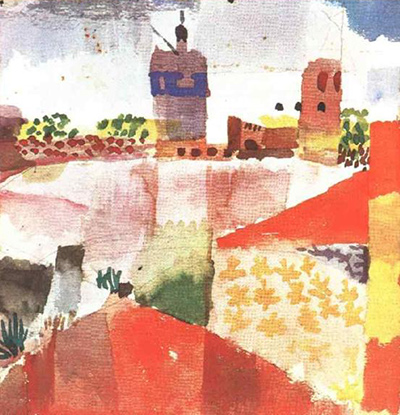
Hammamet with Mosque
1914
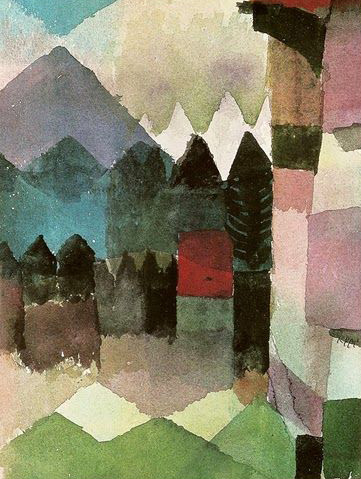
Flower Myth
1918

Angelus Novus
1920
Crystal Gradation
1921
Red Balloon
1922
Senecio
1922
Discussion
Klee made two 1914 watercolours with this title; the one above is held in Bern.
The abstract arrangement keeps Kairouan in its title without identifying a specific street.
Reader Insights
How do the circles change the rhythm of the rectangular bands?
What does the title add to a picture without a legible city view?
Which source would help settle the relationship between works 210 and 211?
Join the Conversation
Share the work and evidence behind your reading.
References
- Zentrum Paul Klee, Mapping Klee (German), “Bildarchitektur” and Tunisia journey. Owner institution’s indexed caption identifies 1914,211, its title, medium, 12.3 × 19.5 cm size and Bern holding; the dynamic site does not expose a full object file to text retrieval. Its essay discusses architecture, colour values and recurring objects in abstract structures, View source.
- Centro Cultural Banco do Brasil / Zentrum Paul Klee, Paul Klee: Equilíbrio Instável (2019), bilingual Portuguese–English catalogue, printed pp. 24–27, illustration 16. Direct full PDF read. Gives the Bern caption and distinguishes trip watercolours, subsequent alteration and the continuation of figuration, View source.
- Fondation Beyeler, Paul Klee – The Abstract Dimension press dossier (2017), English/German exhibition material. Caption for 1914,211 and lower marginal pen stripe; exhibition selection is later curatorial reception. The press image is not a commercial reuse licence, View source.
- Los Angeles County Museum of Art, In the Kairouan Style, Transposed in a Moderate Way, collection entry for the distinct 1914,210, accession M.2005.70.51. Owner record for its size, material, provenance, colonial context and interpretation; none of its object-specific technical or provenance claims are assigned to the Bern work, View source.
- PaulKlee.fr, 1914 works index, visual thumbnail cross-check for the two numbered variants only. Ownership, measurements and rights are established from institutional sources instead, View source.
- Paul Klee Foundation / Zentrum Paul Klee, Catalogue raisonné Paul Klee, vol. 2, works 1913–1918 (Bern, 2000). Bibliographic identification only; the entries for 1914,210 and 1914,211 have not been directly read. Zentrum research access information says its successor database is consulted on site by registration. No unsupported catalogue facts have been imported, View source.
- Rachida Triki, Michael Baumgartner, Nacer Khemir, Olga Malakhova and Alain Nadaud, contributions to La Tunisie de Paul Klee : 2014 Tunis colloquium (French), especially PDF pp. 3, 5–6, 10–18 and 33–39. Directly read. Malakhova's account of later Tunisian landscape painting is a reception argument, not an object record. Nadaud names variants 210/211 and presents music and textile analogies as later interpretations; he states the textile connection is unconfirmed by Klee’s diary, View source.
- Institut National du Patrimoine, Tunisia, “Kairouan” (French), local institutional account of the medina’s morphology, living heritage and principal buildings. Context for the city, not an object identification key, View source.
- Rusty Clark, Walls of the medina of Kairouan, photographed 22 February 2012, Flickr original independently licence-verified by Commons upload bot, Creative Commons Attribution 2.0 Generic. The article’s resized JPEG is a supplementary modern photograph; credit, source, licence and change notice appear in its caption.
- Staatliche Museen zu Berlin, Strassenkaffee in Tunis, Dieter Scholz’s German object essay. Records Klee’s retrospective editing of the Tunisia diary around 1921; that evidence concerns the travel narrative, not construction of 1914,211, View source.
- Zentrum Paul Klee, Archives and research access (French). Confirms the research database succeeds the nine-volume printed catalogue and requires an on-site appointment; direct object-file consultation is still outstanding, View source.