


 by Tom Gurney
Tom Gurney BSc (Hons) is an art history expert with over 20 years experience
Published on June 19, 2020 / Updated on September 27, 2026
Email: tomgurney1@gmail.com / Phone: +44 7429 011000
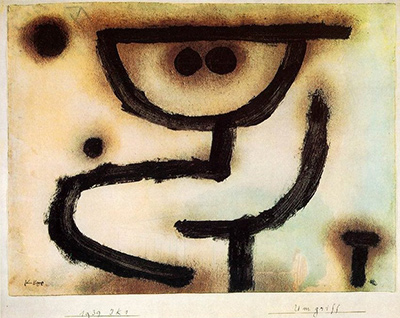
Embrace: a figure made by an encircling line
Paul Klee made Umgriff in 1939. The English title Embrace appears in Claude Cernuschi's catalogue essay for the McMullen Museum of Art, which identifies the work as 1939, no. 1121 and describes its materials as paste colour, watercolour and oil on paper. A Greek-language university study also lists the German title, year, number and mixed media. These catalogued details give a firmer starting point than calling the image simply an abstract painting. The work belongs to Klee's last productive years, when an increasingly broad drawn or painted line could carry much of a composition's meaning.[1][2]
The image seems almost spare enough to read at once: a dark, roughly semicircular shape near the upper edge, two spots within it, a vertical line descending, and curving strokes that bend across the pale ground. Yet the longer one looks, the less simple the figure becomes. The two dark spots can be eyes, while the shape around them is at once a head and a line enclosing a space. A heavy curve at lower left might be an arm, a torso, or the gesture of holding something unseen. The title offers an action, Umgriff, but the picture does not clearly show two separate bodies.[1]
The line and the figure
A nearly horizontal bar stretches across the top of the head. Beneath it, another thick line curves down and back up, leaving a pale area with the two dark eye marks. The result resembles a face reduced to the minimum necessary for recognition. Its open surrounding ground is important: Klee has not filled in cheeks, nose or mouth. The viewer supplies a person from a few marks and the expectation created by the title.[1]
Below this head, a narrow vertical stroke meets a lateral one. The larger curves then move left, down and back toward the centre, as if a limb were sweeping around a body. One dark stroke rises on the right. Their directions suggest enclosure without giving a stable outline of what is enclosed. The right side may be a reaching arm; it can also read as an independent sign. This is where the title becomes productive rather than explanatory: we can see a grasp or embrace forming, but cannot pin down its participants or emotional tone.[1]
Two small black discs sit away from the central form on the left, one above and one below. A further small mark stands near the lower-right edge. They prevent the large figure from occupying a neutral blank. The upper disc has sometimes been interpreted as a heavenly body, and the lower mark as a seal or exclamation, but the photograph alone does not confirm those names. What is clear is their difference in scale: the few small marks make the broad central strokes look heavier and more immediate.[1]
The pale ground shifts through cream, warm brown and cooler blue-green. Dark brown gathers at the edges and around the top of the figure. Those changes keep the black strokes from behaving like lines on white writing paper. They appear within a painted atmosphere, sometimes crisp against it and sometimes softened by it. The reproduction is enough to see these relations, although a conservation record or direct view would be needed to distinguish individual layers of paste colour, watercolour and oil.[1][2]
What does Umgriff mean here?
English-language writers have called the work Embrace. An Italian discussion gives Abbraccio; a French scholarly discussion chooses Enlacement and places it beside the idea of encerclement, or encircling. These translations each stress a different possibility. “Embrace” suggests intimacy, while “encircling” draws attention to the sweep of the large line and can suggest restraint. The German title makes a gesture central without identifying its purpose or recipient.[1][3][4]
The image does not settle whether that gesture is comforting. The large dark figure faces the viewer with eye-like marks while its lower lines reach sideways. It might be reaching to include someone, or it might be enclosing an empty space. Such ambiguity is not a failure of description. It is produced by Klee's decision to let a few thick strokes serve as both body and movement. If another figure is present, it is not separately outlined in the way the head is.[1]
This restraint also cautions against assigning the face a fixed emotion. Its two dark eyes can seem startled, stern or watchful depending on how the curves below are read. The picture offers no mouth to distinguish those responses. Some later commentary has linked the work's disquiet to Klee's illness or to ominous late imagery. Those contexts may influence a viewer, but a diagnosis or allegory cannot be proven by the face alone. The specific visual fact is more interesting: the same economical construction can sustain both an image of contact and one of apprehension.[1][4]
Gesture in Klee's late work
In his catalogue essay Paul Klee and Language, Cernuschi uses Embrace as an example while discussing the apparent spontaneity of Klee's later strokes. He argues that Klee's broad marks can feel calligraphic: the trace of a hand moving across the surface remains visible while a recognisable form emerges. The analogy matters here because the picture's main curve can be followed as an action. It is not merely a boundary around a finished figure; its sweep is part of what the figure does.[1]
Cernuschi also sets such late marks beside Klee's longer interest in the relation between drawing, writing and motion. That is a scholarly framework, not evidence that Umgriff encodes particular letters or a secret script. The two eye-like dots and the bent lines make a figure legible without turning into a stable alphabet. The work holds a visual balance between something we recognise and marks that retain their autonomy.[1]
The mixed media listed in Cernuschi's caption reinforces the point. Umgriff is not simply an ink drawing enlarged with a brush, even if its black forms dominate the reproduction. Paste colour, watercolour and oil on paper allow different kinds of density and translucency. The image's pale washes and dark, substantial lines therefore belong to one built surface. A direct technical examination would be needed to say which visible passage was made with which medium.[1][2]
The work's recorded history
Cernuschi's 2020 caption places the work in the Dr Bernhard Sprengel collection, Hanover. A 1954 exhibition photograph in the Bavarian State Library's archive documents a work called Umgriff on view in a Klee and Kandinsky exhibition at Munich's Haus der Kunst. The photograph's metadata calls it a watercolour, a broad descriptive label that should not override the later mixed-media catalogue caption. The current holding, accession number and full provenance have not been verified from an owning-museum object record. The Sprengel attribution is a published collection statement, not a claim that an accessible current database has been checked.[1][5]
The work's annual number, 1939,1121, is likewise supplied by Cernuschi's caption and the Greek university study. It has not been checked against Klee's handwritten register or the nine-volume printed Catalogue raisonné. That distinction matters for a late Klee work because similar simplified faces and embracing forms appear elsewhere in his production. Here the title, visual match, year and numbered scholarly captions converge on this particular image, while finer object-history questions remain open.[1][2]
Embrace gains its tension from how little it resolves. The eye marks draw us into a face; the wide curve makes us follow a bodily motion; the title invites us to call it an embrace. But the person or thing embraced is difficult to locate, and the grasp can seem tender or unsettling. Klee's broad marks make that uncertainty visible rather than leaving the figure unfinished. Their simplicity is a deliberate way of keeping recognition and open interpretation in play.[1]
Related artworks
Explore eight other Klee works from the researched artwork cluster.
Death and Fire
1940
Insula Dulcamara
1938
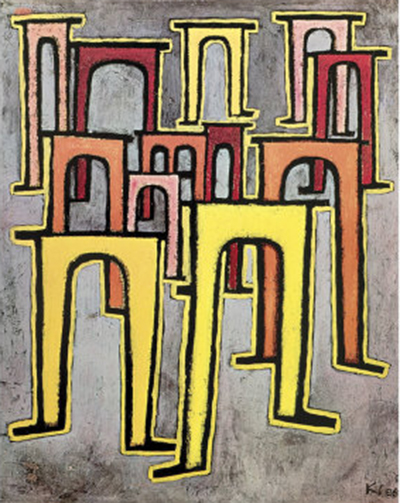
Viaducts Break Ranks
1937
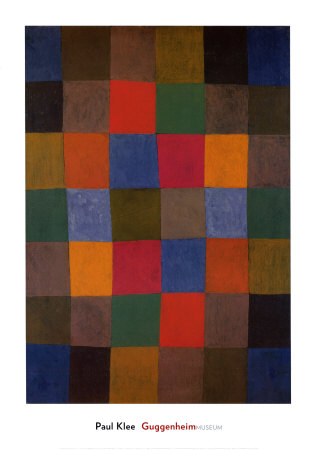
New Harmony
1936
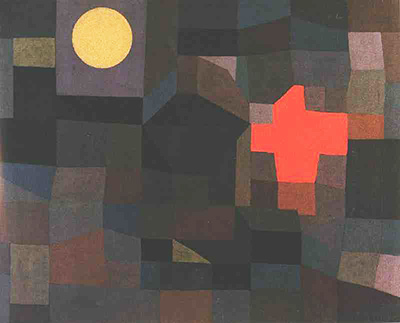
Fire Full Moon
1933
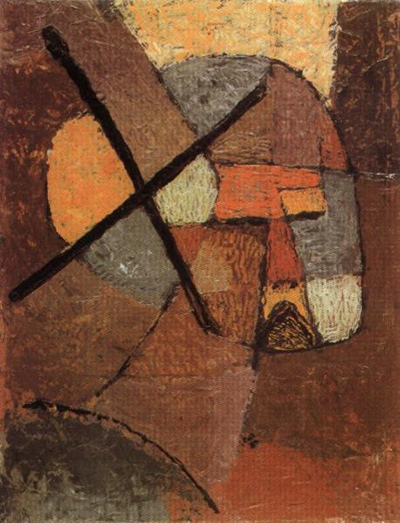
Struck from the List
1933
Ad Parnassum
1932
References
- Claude Cernuschi, “Paul Klee and Language”, in Paul Klee: Philosophical Vision; From Nature to Art (McMullen Museum of Art, 2020), pp. 106–33, especially pp. 124–25 and fig. 29. Directly read English-language scholarly chapter; caption identifies Embrace (Umgriff), 1939/1121, paste colour, watercolour and oil on paper, and Dr Bernhard Sprengel collection, Hanover. The online text renders the second dimension as “131 cm,” an evident digitisation problem; dimensions are withheld pending an owner record, View source.
- Ero Farmaka, master's thesis, Cyprus University of Technology repository, fig. 91 and figure list (in Greek). Also lists Umgriff, 1939,1121, paste colour, watercolour and oil on paper, and the Bernhard Sprengel collection. The printed dimensions are unclear in text extraction and are not adopted here; this may repeat a common catalogue source rather than independently confirm it, View source.
- “Uno scarabocchio è uno scarabocchio è uno scarabocchio” (in Italian), 2015: gives Umgriff/Abbraccio and Dr Bernhard Sprengel collection; used only for the Italian title reception, not object authentication, View source.
- Mélusine, no. 2, Les surréalistes et l'Allemagne, p. 124 of the Klee discussion (in French). Reads Umgriff as enlacement and encerclement in the context of dream imagery and the artist's illness. Its relative dating is imprecise; the numbered 1939 date comes from Cernuschi, View source.
- Bavarian State Library image archive via bavarikon, Felicitas Timpe photograph of the 1954 Klee/Kandinsky exhibition (in German): metadata names an exhibited Umgriff; this is exhibition evidence, not an object-level medium or current ownership record, View source.