


 by Tom Gurney
Tom Gurney BSc (Hons) is an art history expert with over 20 years experience
Published on June 19, 2020 / Updated on September 27, 2026
Email: tomgurney1@gmail.com / Phone: +44 7429 011000
A flower and a bird in a red world
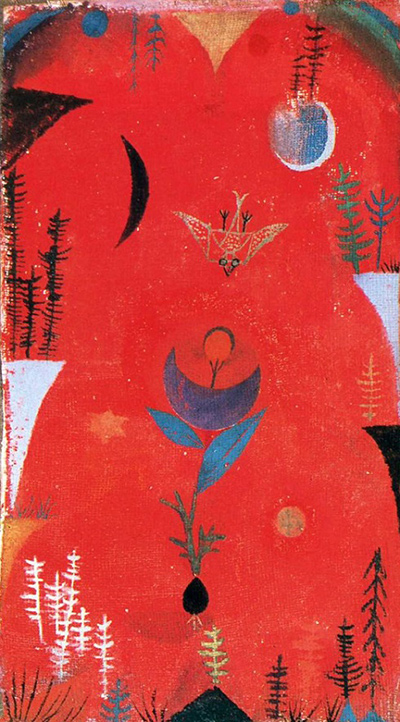
A blue-green flower rises through a red field. Above it, a bird-like figure seems to descend, while crescents, discs and tree-like forms gather around the edges. Paul Klee’s Flower Myth (Blumenmythos, 1918,82) can be read almost at once as an encounter between living things. Its apparent simplicity changes as we look: the flower may be rooted, suspended or even growing into a larger body; the red can act as background, atmosphere or form. The title promises a “myth” without naming a story or a character.[1][2]
The painting belongs to the Sprengel Museum Hannover. It is a small, layered watercolour, with a sheet measuring 29 × 15.8 cm. Those facts matter to the way we see it. This is an intimate work whose force depends on the relationship between a compact painted surface, unusual prepared materials and an image that seems to extend well beyond its narrow rectangle. No known statement by Klee identifies the bird as an aircraft, assigns the flower a single symbolic meaning, or connects the sheet to a particular ancient myth.[1][2][3]
Contents
- Which work is Flower Myth?
- What can we see before assigning a meaning?
- Does the title identify a particular myth?
- What does Thürlemann’s close reading reveal?
- Why has the blue flower prompted a Romantic reading?
- Can the painting be heard as music?
- Is the bird a wartime aircraft?
- How did the work reach Hannover?
- Looking again
Which work is Flower Myth?
The Sprengel Museum records the German title Blumenmythos and the year 1918. Klee’s handwritten title and number, “1918 82 Blumenmythos,” appear at lower left on the card according to its collection record. The 82 is part of his numbering for that year; it is not the month, a second date or the museum’s inventory number. The museum identifies the object as Slg. Sprengel I,112. Its bibliography cites the published catalogue raisonné as no. 1929, volume 2, page 486. That continuous catalogue number is likewise not a claim that the painting was made in 1929.[1]
The museum calls the medium watercolour on chalk preparation on gauze on newsprint on card. Fondation Beyeler’s 2005 exhibition record gives a longer German material description, adding silver-bronze paper between newsprint and card. A German scholarly caption describes chalk-primed Shirting, a textile, and a silver-bronze border. These descriptions agree that Klee painted on a prepared textile-and-paper assembly, rather than on a conventional stretched canvas. They differ on the exact silver-bronze component. Without a conservation examination, the published labels should not be combined into an invented cross-section or used to say which layer is visible at every point.[1][2][4]
The Sprengel Museum specifies 29 × 15.8 cm as the sheet size and 54 × 40.6 × 6 cm as the frame size. The latter measurements describe the later framed presentation, not the image itself. Another illustrated German caption gives 20 × 15.8 cm, but does not explain whether that is a painted area, a component or an error. The owner’s explicit sheet measurement is the soundest figure for the main caption. A small online image can show the broad pattern of colour and forms, but cannot tell us how chalk ground, gauze, newsprint and metallic paper feel or meet in the original.[1][2][5]
What can we see before assigning a meaning?
Red occupies most of the tall rectangle. It is not simply a neutral backdrop: changes in its hue and density make the centre feel active even where few independent signs appear. A long, dark stem rises from a small oval near the lower part of the work into a blue-green flower. The bloom is more complex than a single coloured patch. Its spreading upper parts, narrower shaft and attached small forms make it recognisable while keeping its exact botanical identity uncertain. Calling it a blue flower is useful shorthand, but it is not a botanical identification.[3]
Above and around the flower lie pale circles, arcs and dark crescents. Some suggest moon or stars; others may be read just as strongly as graphic echoes of the flower’s curves. The bird-like figure near the upper centre has a different direction of travel from the rising stem. Its pointed, wing-like parts encourage a reading of descent, although a still image cannot show movement in time. What the viewer experiences as an upward or downward motion arises from placement, tilt, line and the expectations brought to recognisable forms.[3][6]
At the sides and corners, small triangular, branching and evergreen-like signs make a busier border. Their size and repetition distinguish them from the two central figures. The edge feels populated, while the larger red interval around the flower feels comparatively open. Pale marks on one side and dark marks on another resist a completely regular frame. The image has an approximate vertical route through lower oval, flower and bird, but it is not a mechanical diagram with every part mirrored. This loose order gives the flower prominence without isolating it from the surrounding marks.[3][6]
The narrow format makes these relationships unusually concentrated. A viewer can trace a line from the dark lower oval to the flower, then to the bird and the sky-like signs, but must repeatedly look sideways to the trees and triangles. The floral stem may seem to join earth and sky, yet the sheet offers no stable horizon and no ordinary landscape distance. The title does not specify a place or season. A small painted field has become a setting in which scale and direction remain unsettled.[2][3][6]
Does the title identify a particular myth?
Klee named this work Blumenmythos—“Flower Myth.” The title gives the flower a role larger than a specimen in a garden, but it does not name a goddess, an episode from classical literature or a particular tale of creation. Reading one into the work requires evidence beyond the title and the visible forms. The picture invites symbolic connections because its signs are sparse and charged; that invitation is different from a documented key to them.[1][3]
Fondation Beyeler made the work the namesake of a 2005 exhibition about flowers in art. Its curatorial text saw the rising flower as a sign of hidden spiritual forces in nature and contrasted Klee’s recognisable form with Max Ernst’s invented flowers. That is a documented account of how the painting was understood in a later exhibition. It does not establish that Klee had those exact words or that particular comparison in mind in 1918.[2]
The flower’s growth may be the most immediate candidate for a mythic subject. Its dark base, upright stem and opening head could suggest emergence. But the bird’s direction, the ambiguous celestial signs and the unsettled red field complicate any neat cycle from seed to blossom to renewal. The sheet contains possible relations, not a diagram of the whole life cycle. Letting those relations remain open is more faithful to the evidence than saying the picture represents “all creation.”[3]
What does Thürlemann’s close reading reveal?
The art historian Felix Thürlemann devoted a chapter of his 1982 French book on Klee to this work. The analysis was later published in Italian translation and reprinted in French. Those publications transmit one underlying study, not three independent discoveries. Thürlemann separates recognisable things, such as flower and bird, from what he calls the painting’s plastic relations: positions, colours, curves, lines and repeated shapes. His most durable contribution is a way to slow down a viewer who has already decided what the whole scene “means.”[6][7]
He notes the contrast between a relatively open red centre and a more densely marked perimeter. Flower and bird are the two largest, individual figures within that space; several smaller motifs repeat around them. His account follows how pale and dark triangles, straight and curved forms, and upper and lower positions echo or invert one another. Not every curve means sky, nor every straight mark earth. The interest is in how an individual element can connect categories that initially seem separate. For Thürlemann, the flower is a kind of mediator among terrestrial, living and celestial forms.[3][6]
His interpretation then becomes more speculative. He proposes a gendered relation between a male bird and a female flower, and considers whether the red field can be read as a female torso. A viewer may test that possibility by looking at the red shape and the flower’s position within it. The torso is not an uncontested depicted person, and the published analysis is not a statement of Klee’s intention. Its value lies partly in making the steps from seen form to proposed story visible.[6]
In a later French review, Sémir Badir acknowledged the regularities Thürlemann identified but questioned whether a systematic inventory of oppositions can establish a unique meaning for the whole painting. His criticism is useful here. We can accept the close observation that curves recur and that centre and border behave differently without accepting that one fixed myth necessarily follows. Formal analysis can show how an interpretation is built; it cannot on its own prove that it was Klee’s intended account.[8]
Why has the blue flower prompted a Romantic reading?
Kathryn Porter Aichele approaches the work through literature, gender and the experience of the First World War. She associates its blue flower with the famous blue flower of Novalis’s Heinrich von Ofterdingen, and considers Goethe’s idea of a primordial plant. Those associations are plausible lines of literary comparison, particularly for an artist whose work joins growth, imagination and transformed nature. Yet the colour blue and the noun “flower” do not alone prove an allusion to Novalis. Aichele points to Klee’s library and letters as context; the particular volumes and passages need direct checking before the connection can be advanced as a documented source for this sheet.[9][10]
Aichele also reads the red ground as a nearly unrecognisable, fragmented female torso. In her account, the flower, body and bird can carry suggestions of reproduction and violence. She compares the sheet with other 1918 imagery and raises a possible connection with Klee’s memory of his friend Franz Marc. The proposed Marc connection is explicitly conjectural. It should not become a claim that Klee painted Flower Myth as a memorial, just as the possible torso should not be described as an anatomical fact. These ideas ask us to return to the red field and ask whether “background” is an adequate word for it.[3][9]
Aichele knew Thürlemann’s earlier analysis. Their shared interest in an ambiguous body does not make their interpretations identical or independently verify a hidden figure. Thürlemann’s structural approach and Aichele’s literary and wartime approach give different routes through the same visible problem: can the flower be figure and body at once? The unresolved quality of that question is part of the painting’s interest.[6][9]
Can the painting be heard as music?
Writing in Romanian in 2020, Lena Vieru Conta examined Blumenmythos in a study of musical syntax in Klee’s “gardens.” She notices variations of crescent forms, a slightly displaced floral axis and pale accents that appear to move diagonally. She suggests that the red field might be imagined as an ison, a sustained drone beneath changing motifs. This is an analogy for attending to repetition, variation and underlying continuity, not a discovery of a hidden score.[11]
Vieru Conta tests musical labels such as homophony and heterophony and finds the image resistant to a rigid classification. That restraint is valuable. Klee’s interest in music elsewhere in his life does not mean every curve here represents a note. The analogy helps a viewer notice visual rhythm, then reaches its limit. Her description of a female silhouette is another interpretive proposal; her caption’s “pastel ground” is also less reliable for materials than the owner’s chalk-ground record.[1][3][11]
The French, Italian, English, German and Romanian strands of scholarship therefore do more than supply synonyms for a single answer. They emphasise different features: the spatial system of signs, Romantic literary possibilities, a possible body in the red, visual rhythm and the flower’s later curatorial association with nature. Each depends on specific evidence and each has a point beyond which the evidence becomes conjecture. A reader can use them to look again without having to choose one as the painting’s official meaning.[2][6][8][9][11]
Is the bird a wartime aircraft?
Klee made Flower Myth during the First World War. The earlier page for this work suggested that the bird recalls aircraft falling near the military airfield where he served. Such a connection may sound evocative, but no consulted artist statement or object record ties the bird in this particular sheet to a plane or crash. Bird, flower and celestial sign are enough to support a reading of the image’s visible construction; the proposed aircraft narrative needs work-specific evidence.[1][3]
Nor is this the first appearance of birds in Klee’s art. The National Gallery of Art in Washington records Persische Nachtigallen (Persian Nightingales) as 1917,92, a year before Flower Myth, and identifies three birds. The two works differ, but the dated comparison corrects the claim that Klee introduced birds only in 1918. The Berlin collection describes a separate 1920 work, Fliegersturz, in which a bird and aircraft are brought together. A documented hybrid in a later work cannot retroactively identify every earlier bird as a plane.[12][13]
The more fruitful question may be what this bird does within Flower Myth. It sits above the flower but points against the flower’s rise. It is a recognisable living form and a graphic set of angles and curves. Whether it approaches, threatens, protects or simply shares the red world with the flower is left unresolved by the image. A fixed wartime story would close those possibilities too quickly.[3][6]
How did the work reach Hannover?
The Sprengel Museum’s provenance record names Galerie Der Sturm in Berlin, Lothar Schreyer in Hamburg and a 1955 auction at the Stuttgarter Kunstkabinett, before recording the 1969 gift from the Sprengel collection. These entries are an outline, not a fully dated chain of transfers. The museum does not identify which 1955 sale, its lot number or the auction buyer in its public record. The gift date tells us when the work entered the museum, not exactly when Bernhard Sprengel acquired it privately.[1]
The ownership path is historically suggestive. Der Sturm connects the work to an important early forum for modern art, and the later Hannover collection established its public home. But even a plausible narrative needs documents: a sale catalogue or annotated auction copy for the 1955 event, Klee’s original work register for the early dealer notation and the museum’s acquisition file for precise transfer dates. Until those are read, names in the sequence should remain names in a record rather than a story of who bought from whom on a particular day.[1][6]
The 2005 Fondation Beyeler exhibition shows the work’s later visibility beyond Hannover. That institution exhibited and interpreted the Hannover painting; it did not become its owner. Its more detailed material caption and the Sprengel Museum’s current record can be read together, while their small difference concerning silver-bronze paper remains a technical question rather than a reason to erase either source.[1][2]
Looking again
Start at the dark oval below the stem, then follow the flower upward. Look next at the bird and the pale curves before scanning the crowded edges. On a second pass, let the red act as a shape rather than automatically as empty ground. These movements bring out a painting that is at once readable and resistant: a flower, a bird and signs of an environment, with no fixed scale or fully told event.[3][6]
Flower Myth remains a useful title precisely because it makes the image feel larger than its physical size without specifying what the myth must be. The owner’s record secures the object; close looking establishes its forms; later scholars offer distinct routes among them. None requires the painting to illustrate one prescribed story. For related work, see Klee’s materials and techniques, his paintings and the distinct later Cat and Bird.[1][3]
Explore selected works from Klee’s much larger oeuvre. Titles without a link have an authenticated catalogue identity but no reviewed article yet.
Artworks directory
| Name | Date | Medium |
|---|---|---|
| A Gate | 1939 | Painting and mixed media |
| A Woman for Gods | 1938 | Watercolour and mixed media |
| Ab Ovo | 1917 | Watercolour and mixed media |
| Above Mountain Summit | 1917 | Drawing and mixed media |
| Abstract Trio | 1923 | Drawing and mixed media |
| Acrobats | 1915 | Watercolour and mixed media |
| Actor's Mask | 1924 | Painting and mixed media |
| Ad Marginem | 1930 | Drawing and mixed media |
| Ad Parnassum | 1932 | Painting and mixed media |
| Adventurer Ship | 1927 | Drawing and mixed media |
| Affected Place | 1922 | Drawing and mixed media |
| After a Sketch from Zurich | 1914 | Watercolour and mixed media |
| After Drawing | 1919 | |
| After The Floods | 1936 | Watercolour and mixed media |
| All Souls' Picture | 1921 | |
| Ancient Harmony | 1925 | Painting and mixed media |
| Angel Applicant | 1939 | Drawing and mixed media |
| Angel Serves the Desired | 1920 | |
| Angel, Still Female | 1939 | Painting and mixed media |
| Angelus Novus | 1920 | Drawing and mixed media |
| Animal Terror | 1926 | Painting and mixed media |
| Arab Song | 1932 | Painting and mixed media |
| Archangel | 1938 | Painting and mixed media |
| Architecture | 1923 | Painting and mixed media |
| Architecture of the Plain | 1923 | Drawing and mixed media |
| Around the Fish | 1926 | Painting and mixed media |
| Arrival of the Air Steamer | 1921 | Drawing and mixed media |
| Asiatic God | 1924 | Painting and mixed media |
| Astrological Fantasy Portrait | 1924 | Drawing and mixed media |
| Athlete's Head | 1932 | Watercolour and mixed media |
| Aufgehender Stern | 1931 | Painting and mixed media |
| Autumn Flower | 1922 | Painting and mixed media |
| Bad Band | 1920 | Drawing and mixed media |
| Baroque Centaur | 1939 | Painting and mixed media |
| Before the Blitz | 1923 | Drawing and mixed media |
| Before the Snow | 1929 | Drawing and mixed media |
| Besessenes Madchen | 1924 | Watercolour and mixed media |
| Bird Garden | 1924 | |
| Bird Wandering Off | 1926 | Watercolour and mixed media |
| Blossoms in the Night | 1930 | Watercolour and mixed media |
| Blue-Bird-Pumpkin | 1939 | Painting and mixed media |
| Boats in the Flood | 1937 | Painting and mixed media |
| Botanical Theatre | 1934 | Drawing and mixed media |
| Boy in Fancy Dress | 1931 | Watercolour and mixed media |
| Broken Key | 1938 | |
| Brother and Sister | 1930 | Watercolour and mixed media |
| But the Red Roof | 1935 | Painting and mixed media |
| C - C = Fisch | 1931 | Watercolour and mixed media |
| Cacti | 1912 | Painting and mixed media |
| Camel (in Rhythmic Landscape with Trees) | 1920 | Drawing and mixed media |
| Captive Pierrot | 1923 | Drawing and mixed media |
| Castle and Sun | 1928 | Drawing and mixed media |
| Cat and Bird | 1928 | Drawing and mixed media |
| Cathedrals | 1925 | Watercolour and mixed media |
| Chalice of the Heart | 1937 | Painting and mixed media |
| Characters in Yellow | 1937 | Painting and mixed media |
| Chosen Site | 1927 | Mixed media |
| Christmas Picture | 1923 | Drawing and mixed media |
| City of Towers | 1916 | Painting and mixed media |
| Clarification | 1932 | Painting and mixed media |
| Collection of Figurines | 1926 | Painting and mixed media |
| Colorful Architecture | 1917 | Painting and mixed media |
| Comedians' Handbill | 1938 | |
| Comic Opera Singer | 1927 | Painting and mixed media |
| Composition | 1939 | Painting and mixed media |
| Composition with Figures | 1915 | Drawing and mixed media |
| Composition with the Yellow Half-Moon and the Y | 1918 | Watercolour and mixed media |
| Conch–Still Life II | 1939 | Watercolour and mixed media |
| Cosmic Composition | 1919 | Painting and mixed media |
| Crystal Gradation | 1921 | Drawing and mixed media |
| Dance of the Grieving Child | 1922 | Painting and mixed media |
| Dancing Girl | 1940 | Painting and mixed media |
| Das Licht und Etliches | 1931 | Mixed media |
| Death and Fire | 1940 | Painting and mixed media |
| Death for the Idea | 1915 | |
| Demon as Pirate | 1926 | Watercolour and mixed media |
| Diana | 1931 | Painting and mixed media |
| Diavolo Player | 1923 | Drawing and mixed media |
| Die Kapelle | 1917 | Watercolour and mixed media |
| Die Vase | 1938 | Painting and mixed media |
| Doctor | 1930 | Drawing and mixed media |
| Dredger and Sailboat | 1931 | Watercolour and mixed media |
| Ein Tor | 1939 | Painting and mixed media |
| Ein Weib fur Gotter | 1938 | Mixed media |
| Embrace | 1939 | Watercolour and mixed media |
| Episode before an Arab Town | 1923 | |
| Equals Infinity | 1932 | Painting and mixed media |
| Eros | 1923 | Drawing and mixed media |
| Error on Green | 1930 | Watercolour and mixed media |
| Evening Figure | 1935 | Drawing and mixed media |
| Falling Bird | 1919 | |
| Fermata | 1932 | Watercolour and mixed media |
| Fire Clown | 1921 | Watercolour and mixed media |
| Fire Full Moon | 1933 | Watercolour and mixed media |
| Fire in the Evening | 1929 | Painting and mixed media |
| Fish in the Harbour | 1916 | Watercolour and mixed media |
| Fish Magic | 1925 | Watercolour and mixed media |
| Flock of Birds | 1917 | Drawing and mixed media |
| Flora on Sand | 1927 | Watercolour and mixed media |
| Flower Myth | 1918 | |
| Flower Stand with Watering Can and Bucket | 1910 | Watercolour and mixed media |
| Flowering Tree (Abstraction with Reference to a Flowering Tree) | 1925 | Painting and mixed media |
| Flowers in Pots | 1923 | |
| Flowers in Stone | 1939 | Painting and mixed media |
| Forest Witch | 1938 | Painting and mixed media |
| Fright of a Girl | 1922 | Drawing and mixed media |
| Fruits on Red | 1930 | Drawing and mixed media |
| Full Moon | 1919 | Mixed media |
| Föhn Wind in Franz Marc's Garden | 1915 | Watercolour and mixed media |
| Garden in St Germain, The European Quarter near Tunis | 1914 | Watercolour and mixed media |
| Ghost Chamber with the Tall Door (New Version) | 1925 | |
| Ghost of a Genius | 1922 | Drawing and mixed media |
| Girl in Mourning | 1939 | Painting and mixed media |
| Glance of a Landscape | 1926 | Watercolour and mixed media |
| Gluht Nach | 1939 | Drawing and mixed media |
| Golden Fish | 1925 | Watercolour and mixed media |
| Goldfish Wife | 1921 | Watercolour and mixed media |
| Green Plant, Blood, Louse | 1924 | Drawing and mixed media |
| Hafenbild | 1918 | Mixed media |
| Hammamet with Mosque | 1914 | Watercolour and mixed media |
| Harbour with Sailing Ships | 1937 | Painting and mixed media |
| Hauptweg und Nebenwege | 1929 | Painting and mixed media |
| Heavenly and Earthly Time | 1927 | Drawing and mixed media |
| Heroic Fiddling | 1938 | Painting and mixed media |
| Heroic Roses | 1938 | Painting and mixed media |
| Heroic Strokes of the Bow | — | Mixed media |
| Highway and Byways | 1929 | Drawing and mixed media |
| Houses near the Gravel Pit | 1913 | Watercolour and mixed media |
| Howling Dog | 1928 | Painting and mixed media |
| In the Current Six Thresholds | 1929 | Painting and mixed media |
| In the Style of Kairouan | 1914 | Drawing and mixed media |
| Individualized Altimetry of Stripes | 1930 | Painting and mixed media |
| Insula Dulcamara | 1938 | |
| Interior with the Clock | 1913 | Watercolour and mixed media |
| Irma Rossa the Animal Tamer | 1918 | Drawing and mixed media |
| Journey in Corsica | 1927 | Drawing and mixed media |
| Landscape with Bluebirds | 1919 | Watercolour and mixed media |
| Legend of the Nile | 1937 | Painting and mixed media |
| Lemon Harvest | 1937 | Watercolour and mixed media |
| Likeness in the Bower | 1930 | Watercolour and mixed media |
| Limits of Reason | 1927 | Painting and mixed media |
| Little Hope | 1938 | Watercolour and mixed media |
| Magdalena before the Conversion | 1938 | Drawing and mixed media |
| Mask of Fear | 1932 | Painting and mixed media |
| May Picture | 1925 | Painting and mixed media |
| Monument in a Cemetery | 1922 | Watercolour and mixed media |
| Monuments at G | 1929 | Watercolour and mixed media |
| Municipal Jewel | 1917 | Watercolour and mixed media |
| Mural from the Temple of Longing Thither | 1922 | |
| Nach der Uberschwemmung | 1936 | Watercolour and mixed media |
| New Harmony | 1936 | Painting and mixed media |
| New House in the Suburbs | — | Mixed media |
| Old Steamboat | 1922 | Drawing and mixed media |
| On the Edge | 1930 | Drawing and mixed media |
| Once Emerged from the Gray of Night | 1918 | Drawing and mixed media |
| One Who Understands | 1934 | Painting and mixed media |
| Oriental Pleasure Garden | 1925 | Painting and mixed media |
| Park of Idols | 1939 | Watercolour and mixed media |
| Passing by Red Pillars | 1928 | Watercolour and mixed media |
| Persian Nightingales | 1917 | Drawing and mixed media |
| Popular Wall Painting | 1922 | Painting and mixed media |
| Prestidigitator | 1927 | Watercolour and mixed media |
| Rainy Day | 1931 | Watercolour and mixed media |
| Red and White Domes | 1914 | Watercolour and mixed media |
| Red Balloon | 1922 | Drawing and mixed media |
| Redgreen and Violet-Yellow Rhythms | 1920 | Drawing and mixed media |
| Refuge | 1930 | Watercolour and mixed media |
| Rhythmic Rythmical | 1930 | Painting and mixed media |
| Saint of the Inner Light | 1921 | |
| Scaffolding of a New Building | 1930 | Painting and mixed media |
| Scholar in Dealing with Stars | 1926 | Watercolour and mixed media |
| Seated Woman | 1930 | Drawing and mixed media |
| Senecio | 1922 | Painting and mixed media |
| Separation in the Evening | 1922 | Drawing and mixed media |
| Sinbad the Sailor | 1923 | Drawing and mixed media |
| Skeptically Smiling | — | Mixed media |
| Small House in the Garden City | 1928 | Watercolour and mixed media |
| Small Portrait of a Girl in Yellow | 1925 | Painting and mixed media |
| Southern Gardens | 1919 | Watercolour and mixed media |
| Static-Dynamic Gradation | 1923 | Drawing and mixed media |
| Still Life | 1927 | Painting and mixed media |
| Still Life with Gladioli | 1932 | Watercolour and mixed media |
| Strange Garden | 1923 | Drawing and mixed media |
| Stricken City | 1936 | Painting and mixed media |
| Strong Dream | 1929 | Watercolour and mixed media |
| Struck from the List | 1933 | Drawing and mixed media |
| Structural I | 1924 | Drawing and mixed media |
| Sumpflegende | 1919 | Painting and mixed media |
| Temple Gardens | 1920 | Drawing and mixed media |
| The Arrow before the Target | 1921 | Drawing and mixed media |
| The Barbed Noose with the Mice | 1923 | Watercolour and mixed media |
| The Flora of the Heath | 1925 | Watercolour and mixed media |
| The Goldfish | 1925 | Watercolour and mixed media |
| The Hour Before One Night | 1940 | Painting and mixed media |
| The Man in Love | 1923 | |
| The Mask with the Flag | 1925 | Mixed media |
| The Pathos of Fertility | 1921 | |
| The Rhine at Duisburg | 1937 | Painting and mixed media |
| The Way to the Citadel | 1937 | Painting and mixed media |
| Three Houses and a Bridge | 1922 | Watercolour and mixed media |
| Tightrope Walker | 1923 | |
| Tomb in Three Parts | 1923 | Watercolour and mixed media |
| Tomcat's Turf | 1919 | Watercolour and mixed media |
| Tower in Orange and Green | 1922 | Drawing and mixed media |
| Tree and Architecture - Rhythms I | 1920 | Watercolour and mixed media |
| Tree and Architecture - Rhythms II | 1920 | Painting and mixed media |
| Tropical Dawn with the Owl | 1921 | Mixed media |
| Tropische Dammerung | 1921 | Painting and mixed media |
| Twittering Machine | 1922 | Drawing and mixed media |
| Variations (Progressive Motif) | 1927 | Watercolour and mixed media |
| Ventriloquist and Crier in the Moor | 1923 | |
| Viaducts Break Ranks | 1937 | Drawing and mixed media |
| Villa R | 1919 | Painting and mixed media |
| Village Carnival | 1926 | Painting and mixed media |
| Vor dem Blitz | 1923 | Drawing and mixed media |
| Wald-Hexen | 1938 | Painting and mixed media |
| Young Forest | 1925 | Drawing and mixed media |
Related artworks
Explore eight other Klee works, beginning with works close in date to this one.
Discussion
Klee placed a rising flower and bird-like form in a compact red field.
The painting's title names a myth without identifying a particular story.
Reader Insights
Which marks first make the flower and bird recognisable to you?
Does the red feel like open space, a shape, or both?
How do the repeated signs at the edge change your view of the centre?
Join the Conversation
Share the detail or source behind your reading.
References
- Sprengel Museum Hannover, online collection search, inventory Slg. Sprengel I,112, object ID 8123, accessed 26 September 2026 by inventory search: title, annual number, inscription, material line, sheet and frame dimensions, provenance, 1969 gift and bibliography. The session-dependent detail URL is not stable; search by inventory number. Its bibliography cites Catalogue raisonné Paul Klee, vol. 2 (2000), no. 1929, p. 486; that entry itself has not yet been read, View source.
- Fondation Beyeler, Blumenmythos: Von Vincent van Gogh bis Jeff Koons exhibition archive (2005), German institutional text at a French-language site path: Klee’s 1918,82, 29 × 15.8 cm, longer layer description including silver-bronze paper, Sprengel ownership and a curatorial nature reading, View source.
- Existing artwork reproduction in the unchanged page splash, a 400 × 722 pixel local image visually matched to the known composition. It permits general looking observations, not verification of fine surface, layer structure, inscription or exact hue.
- Harriet Zilch, Bamberg dissertation, note 357, German: chalk-primed Schirting on newsprint/card and silver-bronze border; Gregor Wedekind, Theorie² figure list (2014), fig. 3, German caption, 29 × 15.8 cm. Neither is a consulted conservation file.
- German illustrated publisher caption, 2014 sample PDF, 20 × 15.8 cm; the caption does not explain its difference from the museum’s explicit sheet measurement and credits a Sprengel/bpk photograph, View source.
- Felix Thürlemann, Paul Klee: analyse sémiotique de trois peintures (L’Âge d’Homme, Lausanne, 1982), Blumen-Mythos chapter, pp. 17–40; checked through its published Italian translation, “Paul Klee: analisi semiotica di Blumen-Mythos – 1918,” in Lucia Corrain and Mario Valenti, eds., Leggere l’opera d’arte: dal figurativo all’astratto (Esculapio, Bologna, 1991), pp. 107–131, reading copy. The original French wording and reported register/provenance details require direct verification, View source.
- Felix Thürlemann, author’s publication bibliography, identifies the 1982 book, 1991 Italian translation and French reprint in Ateliers de sémiotique visuelle (PUF, 2004), pp. 13–40; these are editions of the same argument, View source.
- Sémir Badir, review of Thürlemann’s Blumen-Mythos analysis, Actes Sémiotiques (2006), French: acknowledges formal regularities while questioning their sufficiency for a single overall meaning, View source.
- Kathryn Porter Aichele, Paul Klee, Poet/Painter (Camden House, 2006), pp. 73–76, notes on pp. 89–91, publisher record; relevant pages checked in a third-party full-text copy. Her Romantic, gender and Marc proposals are interpretations, not verified statements by Klee.
- Zentrum Paul Klee, research archive overview, confirms the preservation of Klee’s library and correspondence but does not by itself identify the Novalis volume or the precise Goethe letters cited by Aichele, View source.
- Lena Vieru Conta, “Sintaxe muzicale în «grădinile» lui Paul Klee”, Revista Muzica 6 (2020), pp. 54–93, especially 70–73, Romanian: work-specific observations and qualified musical analogy. Her material wording differs from the owner’s record, View source.
- National Gallery of Art, Persische Nachtigallen ( Persian Nightingales ), artist number 1917,92, three birds in the museum description, View source.
- Staatliche Museen zu Berlin, Fliegersturz object record, a distinct 1920 bird-aircraft work, View source.