


 by Tom Gurney
Tom Gurney BSc (Hons) is an art history expert with over 20 years experience
Published on June 19, 2020 / Updated on September 27, 2026
Email: tomgurney1@gmail.com / Phone: +44 7429 011000
Explore the details of Fright of a Girl
Select a numbered area to examine its detail at high resolution.
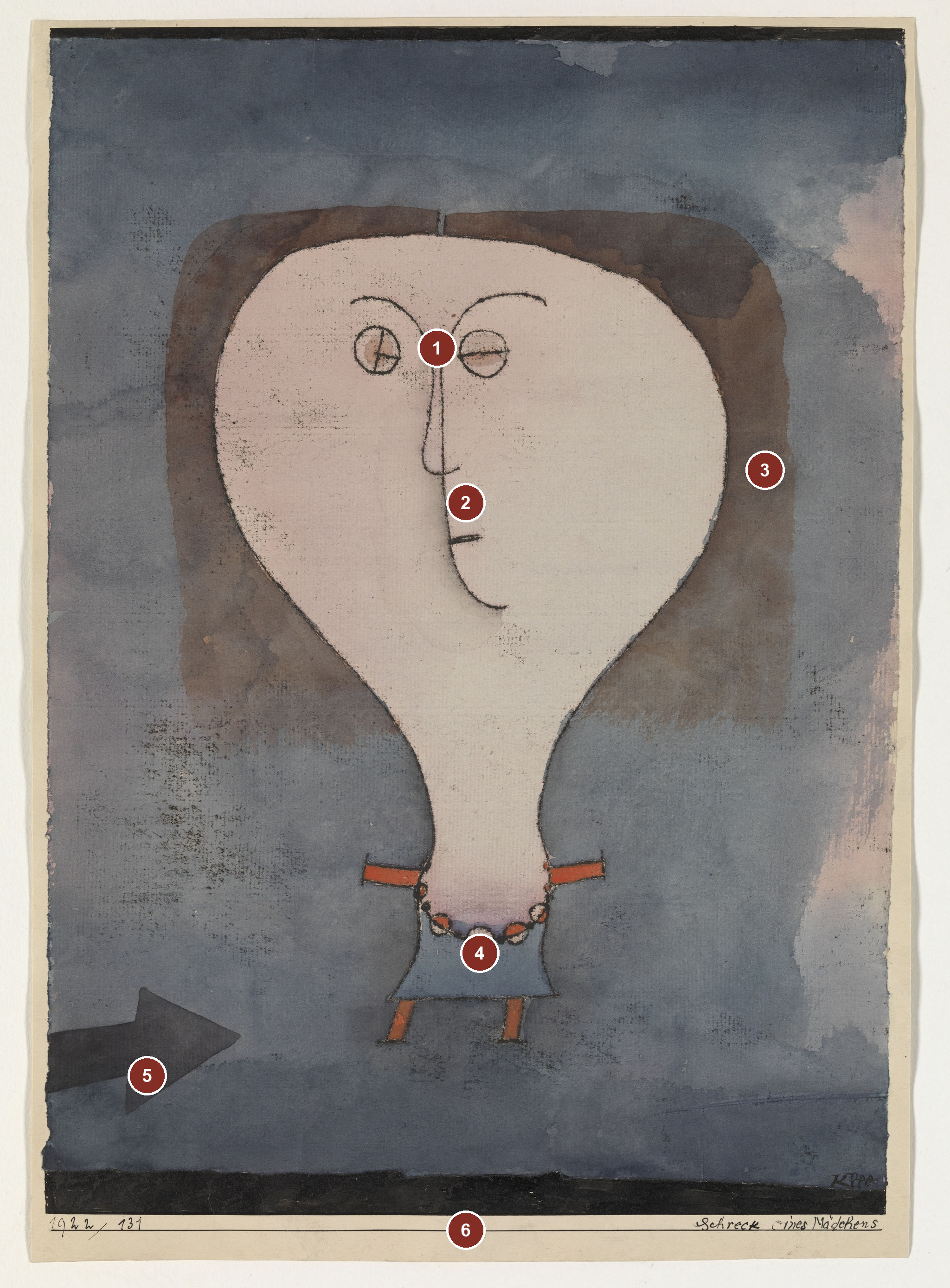
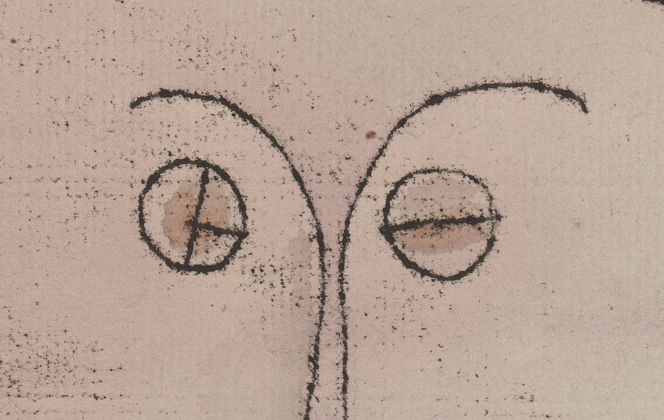
Unequal eyes and curved brows
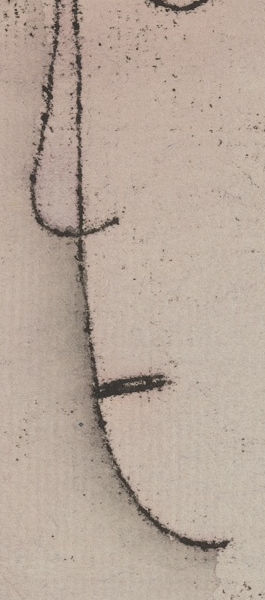
Continuous central line and mouth
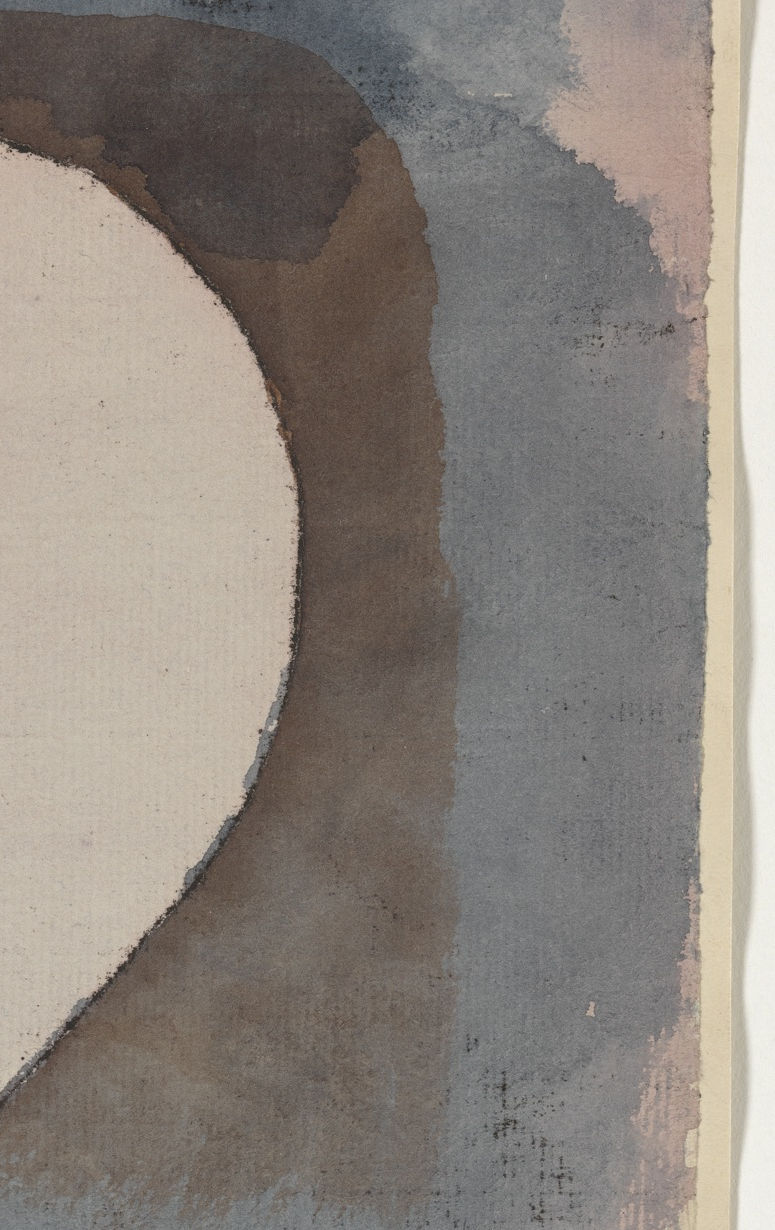
Watercolour at the edge of the head
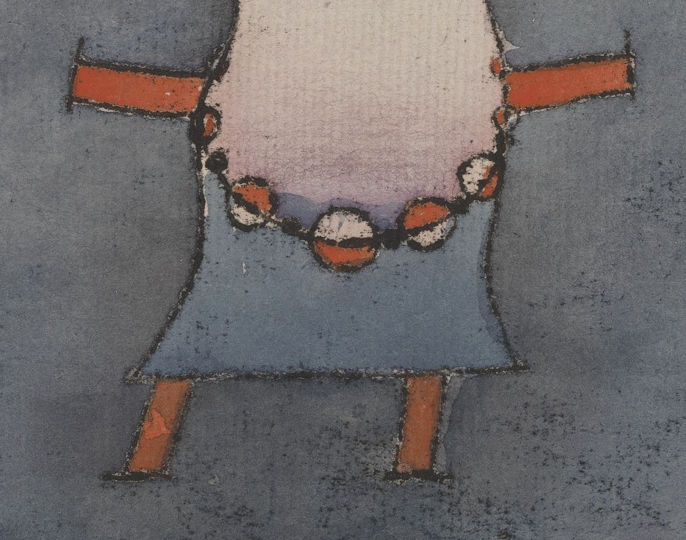
Small dress, arms and bead necklace
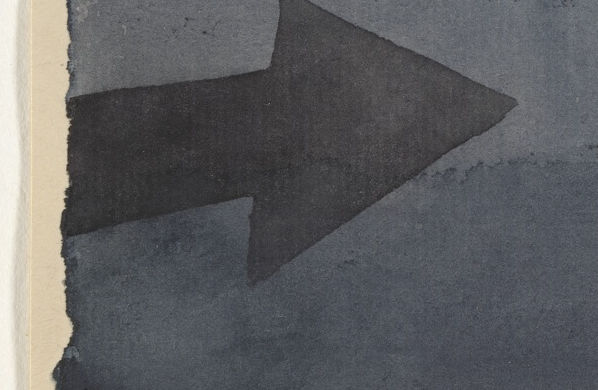
Dark arrow at lower left
Annual number and title on the mount

Fright of a Girl: Klee’s arrow and watchful face
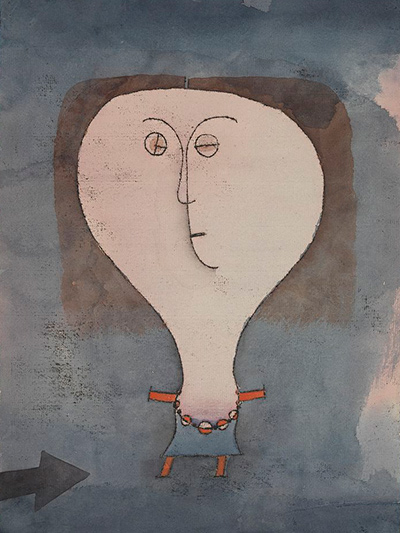
Paul Klee's Fright of a Girl (Schreck eines Mädchens) is a small work on paper from 1922, now in the Solomon R. Guggenheim Museum, New York. The museum-supplied object information identifies watercolour, India ink and oil transfer drawing on paper, with further India ink on the paper mount. Its sheet measures 29.7 × 22 cm; the mount measures 32.7 × 23 cm. The museum's accession number is 48.1172.220. This is a mixed-media drawing and watercolour, rather than a watercolour alone.[1]
One pale head fills much of the picture. Its outline narrows into a long neck above a very small blue dress, orange arms and legs, and a short necklace or chain of coloured beads. A dark arrow enters from the lower left. The background is mainly blue-grey, with darker bands near its upper and lower edges. The face is made with remarkably few lines: paired brows, two round eyes, a continuous central nose-and-mouth stroke, and a short second mark. The title supplies a feeling, while the image gives us almost no information about its cause.[1]
What does the arrow do?
The arrow's point faces right, toward the figure. Its low position brings the viewer into the picture from the margin, but its tip stops well short of the girl's body. It could suggest an approaching force, a direction, an emphatic visual pointer, or something the figure has noticed. The reproduction does not disclose which reading Klee intended. There is no depicted attacker or schoolyard incident, and no documented story attached to the title in the accessible owner record.[1]
The arrow is unusually solid in a picture otherwise dominated by delicate contours and washes. Its broad, dark shaft and triangular point contrast with the narrow legs and the irregular ink line of the face. It also occupies a different scale: the arrowhead is nearly as wide as the dress. These choices make the arrow a visual event in its own right. Whether it threatens the girl or merely directs our attention to her remains open.[1]
At the Zentrum Paul Klee, an account of Klee and Kandinsky in Weimar describes arrows and triangles as devices that indicate direction and movement in their work. That is useful general context for an arrow in a 1922 picture, but the account does not interpret this particular one. Here the arrow's direction is observable; a precise narrative about the fright is not.[3]
A face made from a few strokes
The pale face takes up most of the central field, exaggerating the difference between head and body. It has an almost mask-like simplicity, but its features are not perfectly symmetrical. One eye is crossed by an angular mark, while the other contains a single horizontal bar. The two upper curves meet near the central vertical line. A slight bend in that line can be seen as a nose in profile within a broadly frontal face. The drawing permits this double reading without proving that Klee meant to show two separate viewpoints.[1]
The mouth is no more than a small interruption and short line. It does not supply the theatrical grimace one might expect from a picture titled Fright. The startled effect comes partly from the large pale field around those spare features, and partly from the work's title. A viewer can read the wide eyes as alarm, uncertainty, distraction or stillness. None is a clinical diagnosis of the figure's emotion.[1]
The shoulders and dress are reduced still further. Orange bars become arms and legs; the beads provide one of the few small, bright sequences in the composition. The figure's long, widening neck joins the head to these miniature marks. This imbalance keeps attention on the face while making the body appear fragile or puppet-like. The latter is a visual analogy, not evidence that the work depicts an actual puppet.[1]
Watercolour, ink and oil transfer
The Guggenheim's medium statement matters because the dark drawing is not simply ink painted into wet watercolour. An oil transfer drawing is produced by transferring a traced line through a prepared layer onto another sheet. In its discussion of Klee's Twittering Machine, also dated 1922, the Museum of Modern Art explains how tracing over an oil-coated sheet could produce lines and incidental smudges. MoMA's explanation concerns that other work; it establishes a contemporary Klee technique, not a laboratory account of every mark in Fright of a Girl.[1][2]
The high-resolution museum image reveals fine speckles around parts of the head, dark flecks through the blue-grey ground, and some irregularity at the edges of the washes. The photograph supports describing these visible effects, but it cannot establish the exact order in which Klee transferred, inked and coloured the sheet. It also cannot tell us which flecks are intentional and which arose from handling or the transfer process. The distinction between what can be seen and how it was made should stay clear.[1][2]
The borders are part of the object. The upper and lower dark bands frame the central scene, and at the foot of the mount Klee's handwritten title and “1922/131” are visible. The museum's description specifies India ink on the paper mount. The number is an annual work designation visible on the reproduction; identifying a corresponding entry in the printed Catalogue raisonné requires direct consultation of that volume. The inscription identifies the picture but does not settle the arrow's meaning.[1]
A work from Klee's Weimar years
Klee had begun teaching at the Bauhaus in Weimar in 1921. The Zentrum Paul Klee describes his work in that period as highly varied, spanning narrative figuration and abstraction, and notes his attention to movement and elementary forms. Fright of a Girl sits comfortably within that range: the childlike figure is immediately recognizable, yet her features are reduced to circles and strokes, and an abstract arrow shares the field with her.[3][4]
It is tempting to link the image to every wider account of Expressionist emotion, childhood, or the aftermath of war. The accessible sources do not provide an event, a sitter or an artist's statement for this work. Those themes may be questions for further research, but they should not be presented as established explanations. Likewise, a resemblance to another artist's fearful figure is not proof that Klee was imitating that artist here.[1][3]
The Guggenheim-supplied credit line records the Estate of Karl Nierendorf and acquisition by purchase. The museum's educational material says the Guggenheim Foundation purchased Nierendorf's estate in 1948. That situates the sheet within an important route by which Klee's work entered the New York museum. It does not provide a complete chain of ownership from Klee's studio to Nierendorf, so the earlier provenance remains a research question.[1][5]
The picture's economy is its strength. A face, a tiny body and a large arrow create a charged relationship, yet leave the source of the fright unseen. Klee allows the title to activate the scene without turning it into an illustrated anecdote. We can follow the arrow, inspect the divided eyes, and look closely at the mixed-media surface while keeping the story open.[1]
Related artworks
Explore eight other Klee works from the researched artwork cluster.
Red Balloon
1922
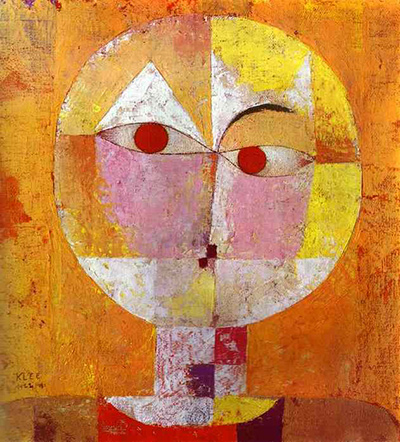
Senecio
1922
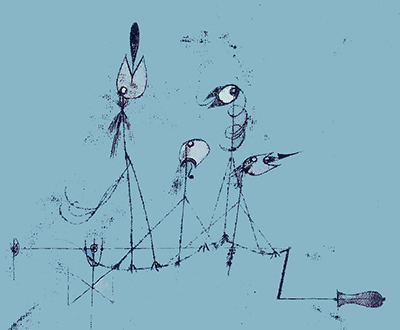
Twittering Machine
1922
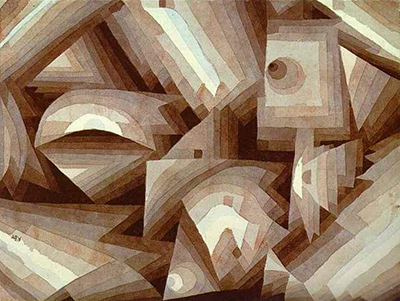
Crystal Gradation
1921
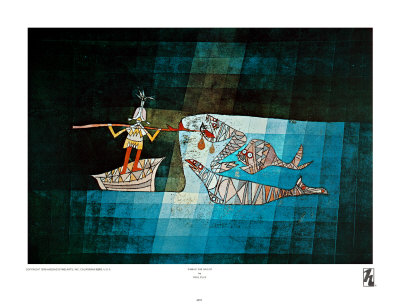
Sinbad the Sailor
1923
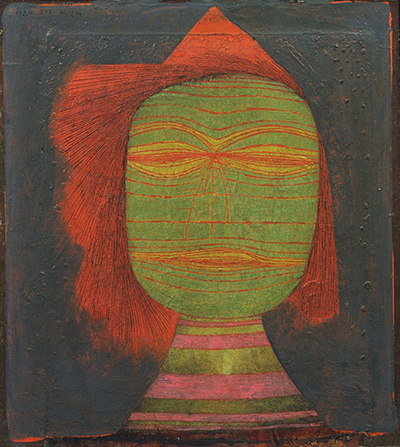
Actor's Mask
1924
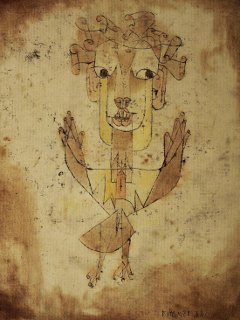
Angelus Novus
1920
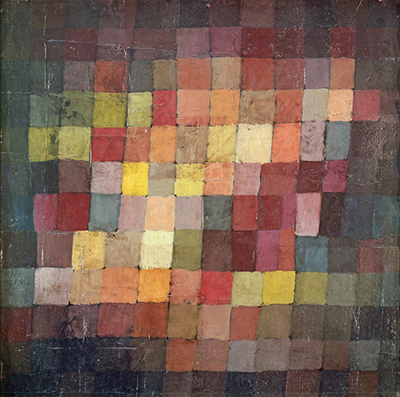
Ancient Harmony
1925
References
- Solomon R. Guggenheim Museum, Fright of a Girl, object 2141, supplemented by the museum-supplied high-resolution file and object metadata on Wikimedia Commons: title in English and German, date, media, sheet/mount sizes, accession, credit line, image and CC0 status. The image's mount visibly reads 1922/131 and the German title. The museum's current object URL is JavaScript-rendered in some clients; the museum-supplied Commons record is directly readable.
- Museum of Modern Art, Twittering Machine: describes Klee's oil transfer method for a distinct 1922 work. Technique comparison only; not an examination of Fright of a Girl, View source.
- Zentrum Paul Klee, “Klee & Kandinsky” (German): Weimar period and arrows as movement devices in both artists' work. Does not identify or interpret Schreck eines Mädchens, View source.
- Zentrum Paul Klee, Mapping Klee exhibition guide (English), section 6: Klee's teaching and varied production during the Weimar Bauhaus years, View source.
- Solomon R. Guggenheim Museum, Visionaries teacher guide: Foundation purchase of Karl Nierendorf's estate in 1948. Context for the object's museum credit line; not a full provenance, View source.
