


 by Tom Gurney
Tom Gurney BSc (Hons) is an art history expert with over 20 years experience
Published on June 19, 2020 / Updated on September 27, 2026
Email: tomgurney1@gmail.com / Phone: +44 7429 011000
Arrows across a painted city
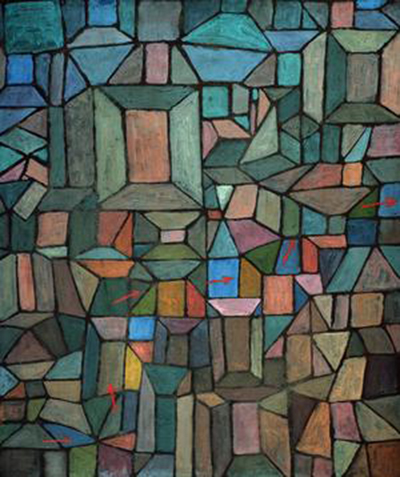
Small red arrows interrupt a closely fitted field of blue, green, rose and ochre compartments. Some shapes look like walls or entrances; others read simply as coloured planes. The title The Way to the Citadel promises a route to a fortified place, but the painting does not offer the clear road or labelled destination of a map. Paul Klee gives a viewer directions while making the space through which to follow them difficult to settle.[1][2]
Klee made this work in 1937. It is now in The Phillips Collection, Washington, DC, where it was acquired in 1940. Its artist's work-list number is 1937,137. The original German title appears in a specialist source as Der Weg zur Stadtburg (Städtebild); a separate Klee index lists the shorter Der Weg zur Stadtburg. The English “citadel” is the Phillips Collection's title, while the precise status of the German parenthesis still needs confirmation from Klee's original register. This distinction matters because even the title can lead the viewer to look for a particular building before the image has established one.[1][2][3]
Explore the details of The Way to the Citadel
Select a numbered area to examine its detail at high resolution.
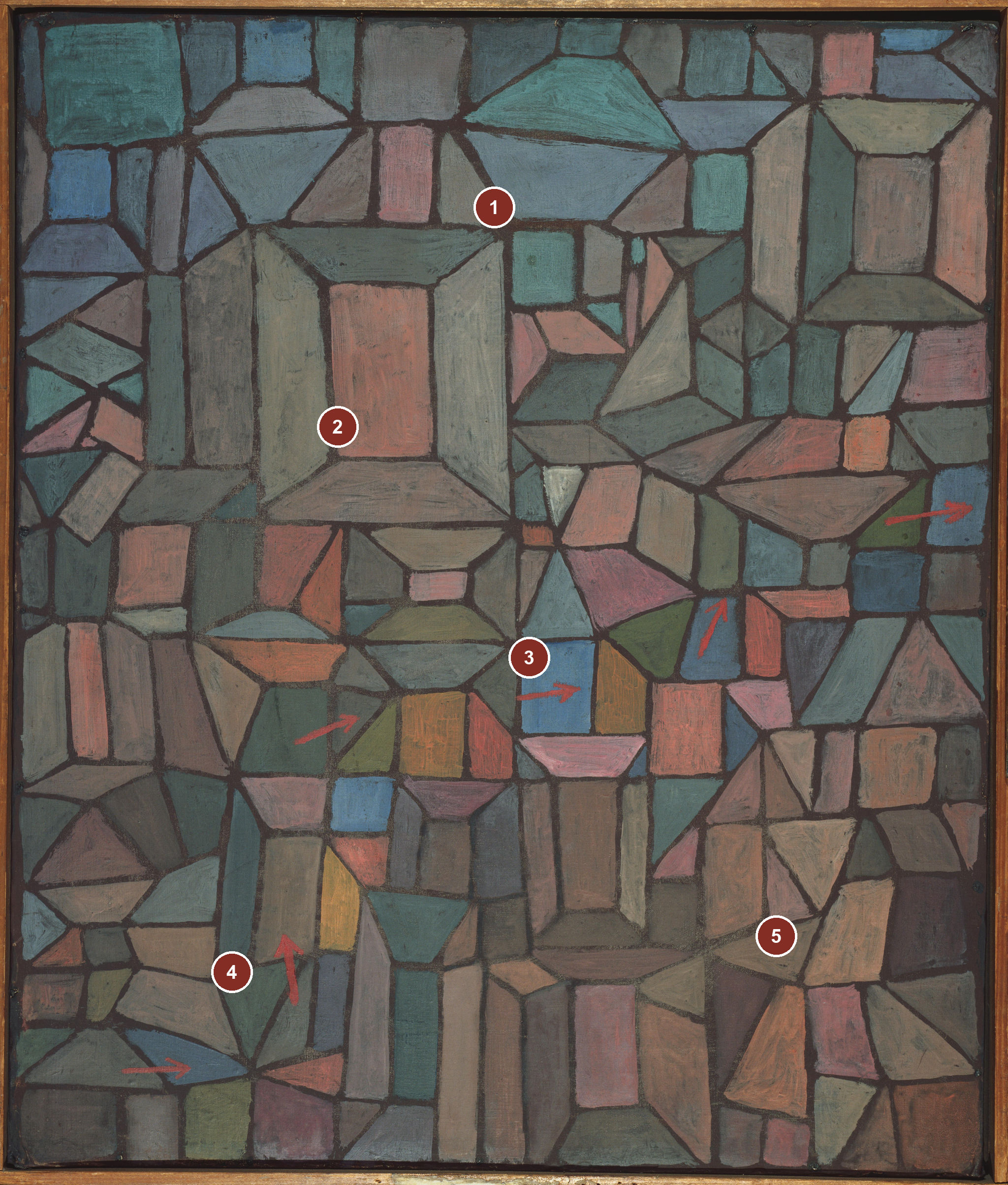
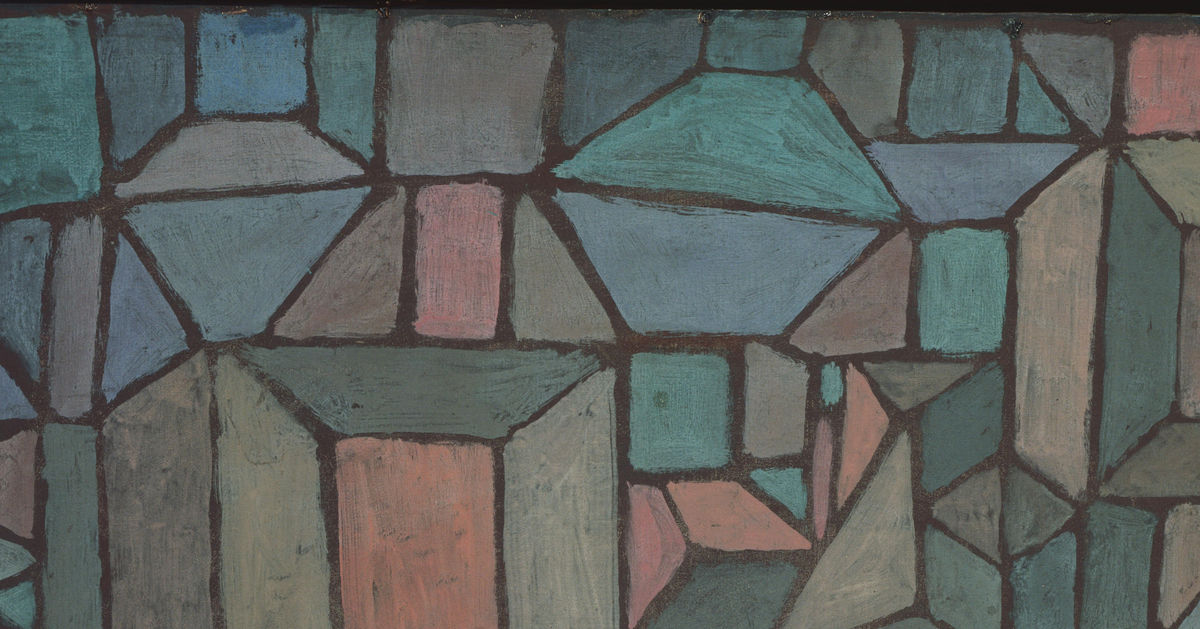
Upper city blocks and roofs
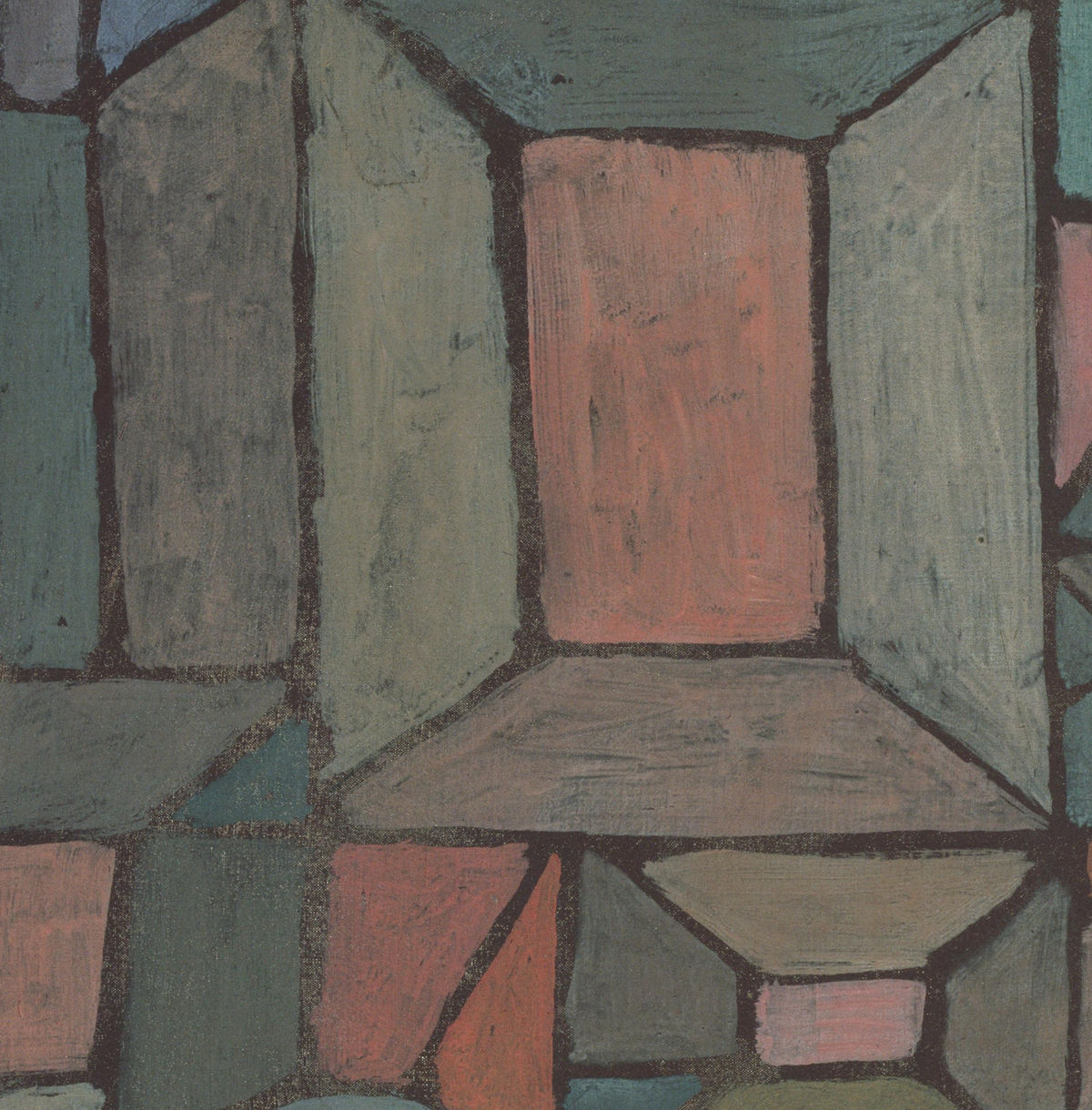
Central doorway-like form
Arrows through the middle
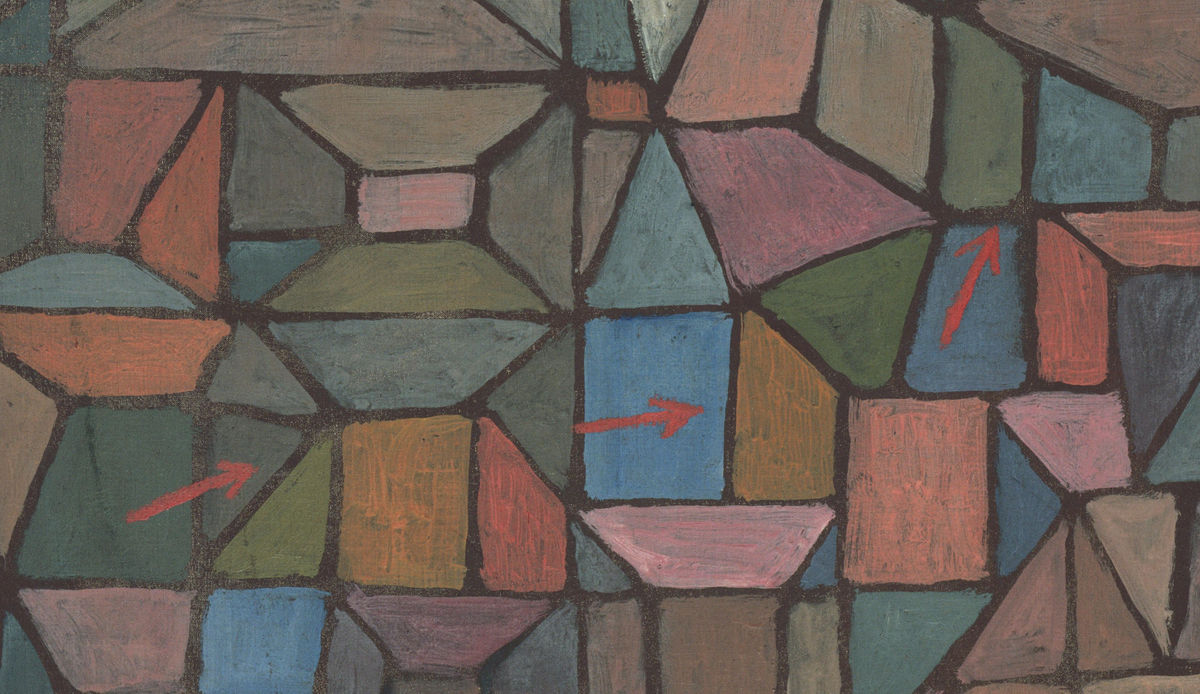
Lower-left directional marks
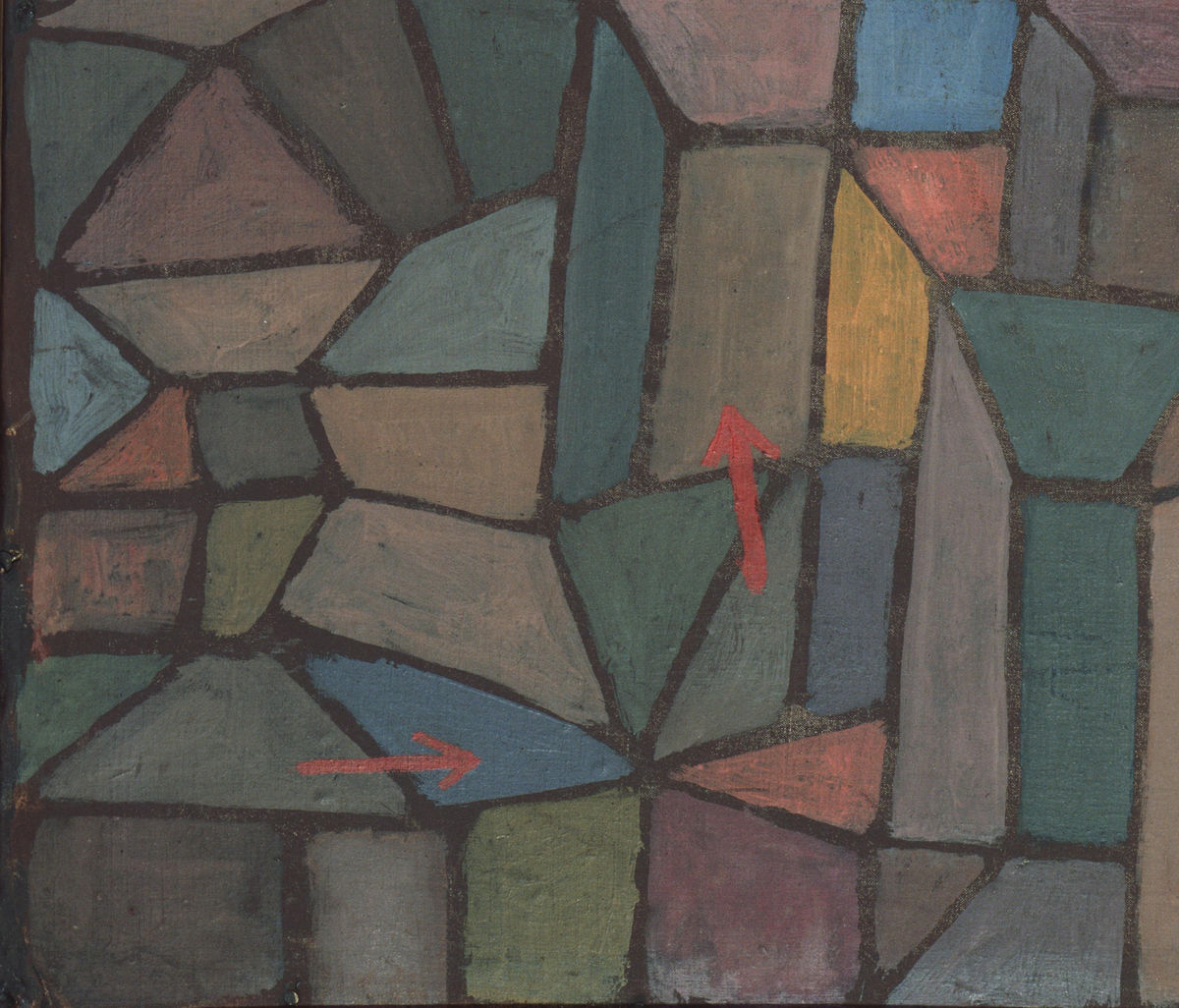
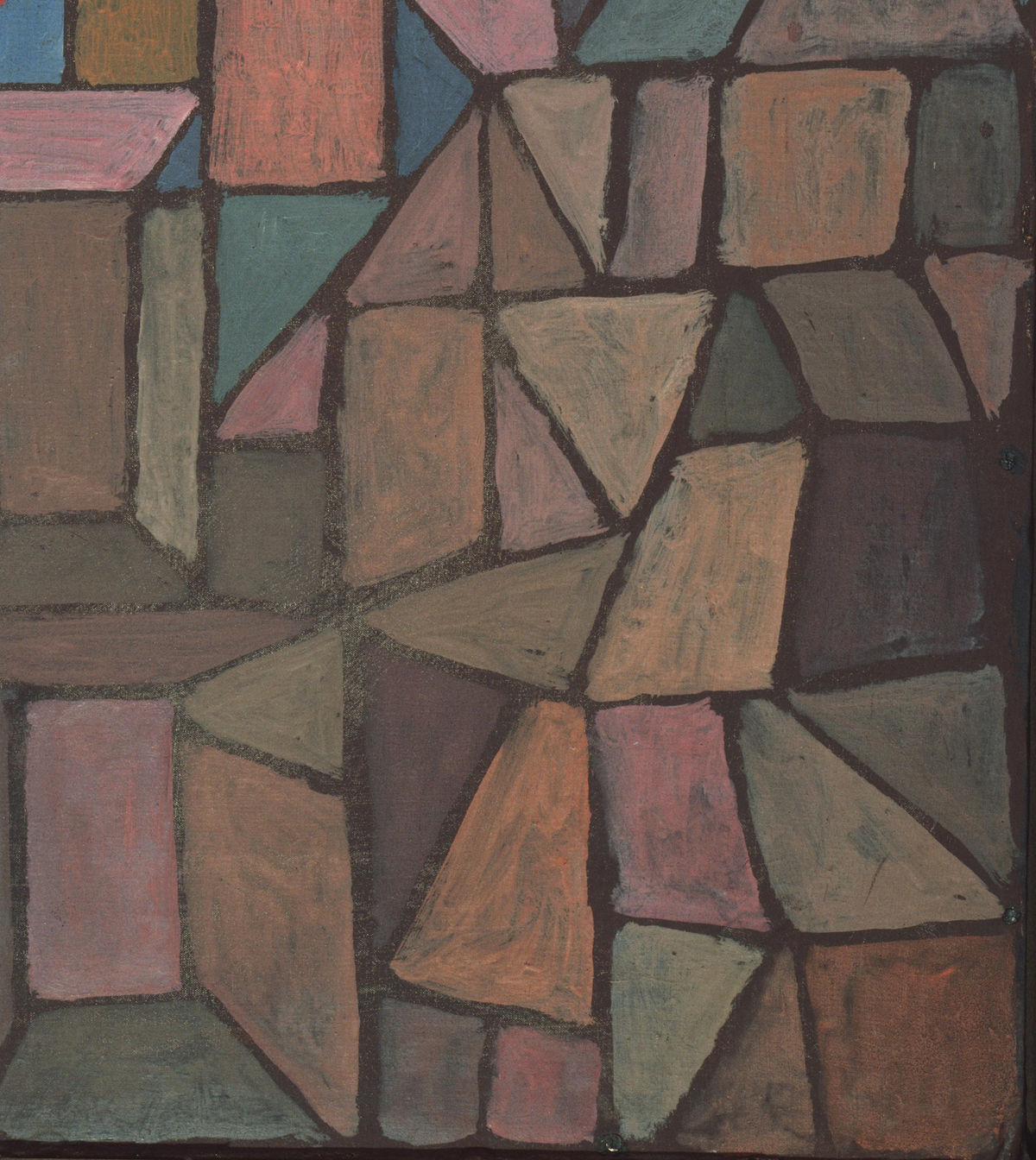
Lower-right faceted buildings
Contents
- The object, its support and its names
- A city made from connected compartments
- The red arrows and the absent destination
- A 1937 painting among Klee's other constructed places
- A Phillips painting and a room for Klee
- Looking through the city again
The object, its support and its names
The Phillips Collection records the painting as oil on fabric mounted on cardboard, 26 3/8 × 22 3/8 inches, or approximately 67 × 56.8 cm. Its object number is 1001. The support is a fabric surface attached to a firmer board; the present museum record does not identify gouache as a second paint medium. The work is relatively large for a Klee painting and upright, a format that lets the enclosed shapes rise in loosely architectural tiers.[1]
An older Phillips educational publication calls the support canvas mounted on cardboard. That may be a more specific description of the same fabric, or it may reflect a change in cataloguing language. The accessible records do not explain the difference. For a current short caption, the owning museum's “fabric” wording is the soundest choice. Neither the older caption nor the current record supports the previous version of this site's claim that the cloth is mounted “onto canvas.” It is also unsafe to infer particular tools or layers from a small digital reproduction.[1][2]
The annual number 1937,137 appears in the Phillips Discovery Pack. It is part of Klee's work-list system, separate from the museum's accession number 1001. The German title is less completely documented online than those numbers. Sotheby's reproduced the Phillips painting when comparing it with another 1937 city picture, and called it Der Weg zur Stadtburg (Städtebild). The parenthetic word means a city picture or townscape, but the available page does not show whether Klee himself wrote it in his title or whether it is a later catalogue qualification. A private multilingual index drops the parenthesis. Until the handlist or catalogue raisonné entry is checked, it is best to present the German wording as a documented title form rather than claim to have transcribed the artist's complete inscription.[2][3]
The noun Stadtburg contains Stadt, “town” or “city,” as well as Burg, a fortified castle or stronghold. “Citadel” conveys the fortification but sounds like one distinct monument. In the picture, however, the apparent buildings, coloured cells and route markers are entangled. The German title can encourage us to see the stronghold as part of an urban fabric; the English title can make us search for a single destination. Neither translation supplies a location for it on the surface.[1][3]
A city made from connected compartments
Dark lines border almost every part of the picture. Their thickness and irregular turns give the field a joined construction: one blue-green plane shares an edge with a grey or pink plane, while another sits above an ochre strip. The units are not uniform squares. Some are long verticals, others are wedges, truncated triangles or nearly rectangular blocks. Near the upper portion, broad horizontal and diagonal edges suggest rooflines or the tops of adjoining walls. Lower down, several vertical shapes resemble narrow passages or façades. Klee makes architecture plausible without fixing the scale of any one unit.[1][2]
The colours help prevent the dark network from becoming a simple diagram. Cool blue and green areas recur in separated places rather than filling one side. Pink, orange and yellow passages punctuate the field; they can look like illuminated openings, but they can just as readily be read as colour contrasts. A tall muted orange compartment toward the upper left, bordered by dark green-grey sides, is especially doorway-like. Farther down, another enclosure has a pale pink cap over an ochre and brown form. Neither has the unambiguous depth, door leaf or address that would turn it into an identified entrance to a castle.[1]
This is why the picture can oscillate between a crowded city and a flat construction. Follow the outlines and they seem to describe adjacent structures. Attend to the colour and many forms remain self-contained patches against the painting's surface. A wedge can become a roof for one moment, then a slanting colour plane for the next. The image does not maintain a single viewpoint from street level or above. Its changes in implied depth make the viewer's progress through it a matter of looking and revising, rather than following a surveyed plan.[1][2]
The local reproduction is only 400 × 477 pixels. It is adequate for describing major lines and colour relations but not for identifying paint application, textile weave, small inscriptions or every arrowhead. Its hues may also differ from the painting as seen in the Phillips. The Phillips image and educational card are useful cross-checks, yet neither accessible record is a conservation examination. Claims about spraying, stamping or a precise sequence of painted layers need object-specific technical evidence; general accounts of Klee's experimental practice cannot establish how he made this work.[1][2]
The red arrows and the absent destination
The arrows are small in relation to the network. They appear chiefly across its middle and lower zones, where red strokes briefly override or interrupt the coloured architecture. Their force is visual before it is symbolic: amid dark borders and muted colour cells, red directional marks stand out. One near the right side appears to point across the field; others appear farther down, so a viewer can attempt to connect them into a path. But the outlines do not open into one continuous, clearly navigable street.[1][2]
At the scale of the retained splash, even the exact count and bearing of the smallest red strokes are uncertain. Some pointed shapes are painted cells rather than direction signs, and a mark at the edge can be hard to read. What can be said securely is that the picture has multiple red arrows and that their positions invite the eye to move from one part of the city-like field to another. A route inferred from them is a viewer's reconstruction, not a line Klee has drawn continuously from entrance to endpoint.[1][2]
The Phillips Discovery Pack addresses this uncertainty directly. It asks where the red arrows might lead and whether the citadel can be seen at all. Those questions are especially useful because they leave open two very different experiences of the picture. Perhaps the stronghold is somewhere within the dense construction, overlooked because we expect a familiar silhouette. Perhaps the route continues outside the edges. Or perhaps “the way” describes the act of searching through the image rather than an arrival we can locate. These are readings prompted by the title and visible forms, not documented statements of Klee's intention.[2]
The absence of a clear endpoint also changes the role of the viewer. A conventional arrow in a sign points to a place whose location the sign maker knows. Here a red mark can make us move, but the painting does not give the stable street grid that would let us verify the instructions. We may begin at the lowest mark and look upward, or start at the uppermost arrow and look for a way down. At either starting point, competing lines and colour boundaries interrupt the journey. The picture balances the assurance of a directional sign against the uncertainty of a built space that refuses to become a usable map.[1][2]
A 1937 painting among Klee's other constructed places
The picture belongs to a year of renewed artistic activity after a severe illness had sharply reduced Klee's production in 1936. Zentrum Paul Klee's chronology places his departure from Germany under Nazi pressure at the end of 1933, his serious illness in 1935, and the low point in output in 1936. A different museum essay says he was able to resume work more fully in February 1937. This history locates The Way to the Citadel in Klee's Bern years. It does not make its arrows a medical diary or its possible fortress a coded self-portrait.[4][5]
The same year had an openly political history around Klee's art. Zentrum Paul Klee records that the National Socialists seized 102 of his works from German museums in 1937, with 15 shown in the Degenerate Art exhibition. Those actions affected his reception and circulation. The Phillips object record, however, does not say that this specific painting was one of the seized works; it was made in 1937 and acquired in Washington in 1940. The historical setting is essential, but the image should not be assigned a particular anti-Nazi allegory without a letter, contemporary testimony or other object-specific evidence.[1][4]
There is a closer formal comparison available. A Sotheby's specialist essay about Klee's different 1937 painting Beginnende Kühle describes its cityscape as tessellated, connects it with the earlier Stadtburg Kr., and reproduces Der Weg zur Stadtburg (Städtebild) as another 1937 example. This is a documented later comparison of Klee's ways of assembling a city from adjoining units. It does not prove that all three pictures show the same city, were made with the same technique, or encode the same journey. Its value here is narrower: it helps us notice that the fitted coloured forms can imply an urban scene without adopting naturalistic streets or perspective.[3]
Klee's Hauptweg und Nebenwege (Highway and Byways, 1929) offers a contrasting way to organise paths. There, a broad central route rises through many smaller divisions, making “main” and “side” roads visually legible even as the subdivisions complicate them. In The Way to the Citadel, there is no comparably dominant continuous road. Instead, detached arrows suggest directional movement through a field in which every neighbouring compartment could become part of the route. The comparison clarifies a difference in picture-making; it does not imply Klee planned the 1937 painting as a sequel to the earlier one.[6]
We should likewise resist an automatic Egyptian explanation. Klee's 1928–29 journey informed some of his gridded and architectural pictures. The auction essay relates Egypt particularly to Beginnende Kühle. That account cannot simply be transferred to the Phillips painting, where no inscription, source record or identified motif currently ties this particular city to Cairo. Its title supplies a citadel, but not a named city. A useful comparison remains one that sharpens what can be seen rather than replacing the picture's unresolved geography with a borrowed location.[3][6]
A Phillips painting and a room for Klee
The Phillips Collection acquired The Way to the Citadel in 1940, Klee's final year. The public object record does not identify the vendor, price or precise transaction route. It does establish that the painting had reached a Washington museum before the better-known 1948 Klee Room opened. The Phillips had already acquired its first Klee, Tree Nursery, in 1930, and organised a solo exhibition in 1938 and a memorial exhibition in 1942. In the museum's own history, this was a sustained programme of collecting and showing his work, not an isolated purchase of one attractive painting.[1][7]
The Phillips says Duncan Phillips assembled 13 Klee works between 1930 and 1953. The museum describes the Klee Room as a nearly continuous display after 1948 and as an important source of inspiration for mid-century American abstract painters, especially Washington artists Gene Davis and Kenneth Noland. That is an account of the collection and room as a whole. It should not be turned into the stronger claim that either artist studied this exact painting or copied its arrows. The museum's 2018 exhibition, Ten Americans: After Paul Klee, itself says the artists' relationships to Klee varied; not all cited him as a direct influence.[7]
One documented later presentation gives this object a clearer place. For its 2011 anniversary programme, the Phillips recreated the Klee Room and used The Way to the Citadel as an illustrated exhibition image. The museum has also used the painting in teaching. Its family Discovery Pack asks children to consider the arrows and visible or invisible citadel, while a Phillips school account describes students examining its geometry and making their own collages and stamped abstractions. Those students' techniques must not be confused with Klee's. Together the records show a painting still capable of prompting close looking and new work without fixing one official reading.[2][8][9]
A separate creative response appeared in 2017. Christopher Philpot's University of Maryland poetry collection The Way to the Citadel explicitly takes its title from Klee's painting. Its abstract compares the work's arrows across a coloured grid with poetry that moves by association while holding together through stanza patterns. Philpot's analogy is evidence that a later writer saw the picture as a model for guided but unpredictable movement. It is not retrospective evidence of what Klee intended in 1937.[10]
Looking through the city again
Begin with a red arrow, then try to continue in its apparent direction without jumping across an enclosed line. Notice how quickly a wall-like border becomes a route-like edge, or a roof-like wedge becomes only a colour patch. Then step back and ask which, if any, compartment seems more like a stronghold than its neighbours. The point is not to solve a puzzle that has a hidden answer key. It is to see how decisively the signs of travel and construction work together even while refusing an ordinary map.[1][2]
The secure facts are a 1937, 1937,137 Klee painting, presently catalogued as oil on fabric mounted on cardboard, acquired by the Phillips in 1940. The most useful reading begins with the actual coloured network and the small red arrows, while distinguishing visible forms, the museum's questions and later interpretations. We can follow the way into the painting; we cannot yet document where Klee meant us to arrive.[1][2]
For other paths and constructed spaces, see Highway and Byways, Ad Parnassum, Klee's colour studies and the paintings overview.
Explore selected works from Klee’s much larger oeuvre. Titles without a link have an authenticated catalogue identity but no reviewed article yet.
Artworks directory
| Name | Date | Medium |
|---|---|---|
| A Gate | 1939 | Painting and mixed media |
| A Woman for Gods | 1938 | Watercolour and mixed media |
| Ab Ovo | 1917 | Watercolour and mixed media |
| Above Mountain Summit | 1917 | Drawing and mixed media |
| Abstract Trio | 1923 | Drawing and mixed media |
| Acrobats | 1915 | Watercolour and mixed media |
| Actor's Mask | 1924 | Painting and mixed media |
| Ad Marginem | 1930 | Drawing and mixed media |
| Ad Parnassum | 1932 | Painting and mixed media |
| Adventurer Ship | 1927 | Drawing and mixed media |
| Affected Place | 1922 | Drawing and mixed media |
| After a Sketch from Zurich | 1914 | Watercolour and mixed media |
| After Drawing | 1919 | |
| After The Floods | 1936 | Watercolour and mixed media |
| All Souls' Picture | 1921 | |
| Ancient Harmony | 1925 | Painting and mixed media |
| Angel Applicant | 1939 | Drawing and mixed media |
| Angel Serves the Desired | 1920 | |
| Angel, Still Female | 1939 | Painting and mixed media |
| Angelus Novus | 1920 | Drawing and mixed media |
| Animal Terror | 1926 | Painting and mixed media |
| Arab Song | 1932 | Painting and mixed media |
| Archangel | 1938 | Painting and mixed media |
| Architecture | 1923 | Painting and mixed media |
| Architecture of the Plain | 1923 | Drawing and mixed media |
| Around the Fish | 1926 | Painting and mixed media |
| Arrival of the Air Steamer | 1921 | Drawing and mixed media |
| Asiatic God | 1924 | Painting and mixed media |
| Astrological Fantasy Portrait | 1924 | Drawing and mixed media |
| Athlete's Head | 1932 | Watercolour and mixed media |
| Aufgehender Stern | 1931 | Painting and mixed media |
| Autumn Flower | 1922 | Painting and mixed media |
| Bad Band | 1920 | Drawing and mixed media |
| Baroque Centaur | 1939 | Painting and mixed media |
| Before the Blitz | 1923 | Drawing and mixed media |
| Before the Snow | 1929 | Drawing and mixed media |
| Besessenes Madchen | 1924 | Watercolour and mixed media |
| Bird Garden | 1924 | |
| Bird Wandering Off | 1926 | Watercolour and mixed media |
| Blossoms in the Night | 1930 | Watercolour and mixed media |
| Blue-Bird-Pumpkin | 1939 | Painting and mixed media |
| Boats in the Flood | 1937 | Painting and mixed media |
| Botanical Theatre | 1934 | Drawing and mixed media |
| Boy in Fancy Dress | 1931 | Watercolour and mixed media |
| Broken Key | 1938 | |
| Brother and Sister | 1930 | Watercolour and mixed media |
| But the Red Roof | 1935 | Painting and mixed media |
| C - C = Fisch | 1931 | Watercolour and mixed media |
| Cacti | 1912 | Painting and mixed media |
| Camel (in Rhythmic Landscape with Trees) | 1920 | Drawing and mixed media |
| Captive Pierrot | 1923 | Drawing and mixed media |
| Castle and Sun | 1928 | Drawing and mixed media |
| Cat and Bird | 1928 | Drawing and mixed media |
| Cathedrals | 1925 | Watercolour and mixed media |
| Chalice of the Heart | 1937 | Painting and mixed media |
| Characters in Yellow | 1937 | Painting and mixed media |
| Chosen Site | 1927 | Mixed media |
| Christmas Picture | 1923 | Drawing and mixed media |
| City of Towers | 1916 | Painting and mixed media |
| Clarification | 1932 | Painting and mixed media |
| Collection of Figurines | 1926 | Painting and mixed media |
| Colorful Architecture | 1917 | Painting and mixed media |
| Comedians' Handbill | 1938 | |
| Comic Opera Singer | 1927 | Painting and mixed media |
| Composition | 1939 | Painting and mixed media |
| Composition with Figures | 1915 | Drawing and mixed media |
| Composition with the Yellow Half-Moon and the Y | 1918 | Watercolour and mixed media |
| Conch–Still Life II | 1939 | Watercolour and mixed media |
| Cosmic Composition | 1919 | Painting and mixed media |
| Crystal Gradation | 1921 | Drawing and mixed media |
| Dance of the Grieving Child | 1922 | Painting and mixed media |
| Dancing Girl | 1940 | Painting and mixed media |
| Das Licht und Etliches | 1931 | Mixed media |
| Death and Fire | 1940 | Painting and mixed media |
| Death for the Idea | 1915 | |
| Demon as Pirate | 1926 | Watercolour and mixed media |
| Diana | 1931 | Painting and mixed media |
| Diavolo Player | 1923 | Drawing and mixed media |
| Die Kapelle | 1917 | Watercolour and mixed media |
| Die Vase | 1938 | Painting and mixed media |
| Doctor | 1930 | Drawing and mixed media |
| Dredger and Sailboat | 1931 | Watercolour and mixed media |
| Ein Tor | 1939 | Painting and mixed media |
| Ein Weib fur Gotter | 1938 | Mixed media |
| Embrace | 1939 | Watercolour and mixed media |
| Episode before an Arab Town | 1923 | |
| Equals Infinity | 1932 | Painting and mixed media |
| Eros | 1923 | Drawing and mixed media |
| Error on Green | 1930 | Watercolour and mixed media |
| Evening Figure | 1935 | Drawing and mixed media |
| Falling Bird | 1919 | |
| Fermata | 1932 | Watercolour and mixed media |
| Fire Clown | 1921 | Watercolour and mixed media |
| Fire Full Moon | 1933 | Watercolour and mixed media |
| Fire in the Evening | 1929 | Painting and mixed media |
| Fish in the Harbour | 1916 | Watercolour and mixed media |
| Fish Magic | 1925 | Watercolour and mixed media |
| Flock of Birds | 1917 | Drawing and mixed media |
| Flora on Sand | 1927 | Watercolour and mixed media |
| Flower Myth | 1918 | |
| Flower Stand with Watering Can and Bucket | 1910 | Watercolour and mixed media |
| Flowering Tree (Abstraction with Reference to a Flowering Tree) | 1925 | Painting and mixed media |
| Flowers in Pots | 1923 | |
| Flowers in Stone | 1939 | Painting and mixed media |
| Forest Witch | 1938 | Painting and mixed media |
| Fright of a Girl | 1922 | Drawing and mixed media |
| Fruits on Red | 1930 | Drawing and mixed media |
| Full Moon | 1919 | Mixed media |
| Föhn Wind in Franz Marc's Garden | 1915 | Watercolour and mixed media |
| Garden in St Germain, The European Quarter near Tunis | 1914 | Watercolour and mixed media |
| Ghost Chamber with the Tall Door (New Version) | 1925 | |
| Ghost of a Genius | 1922 | Drawing and mixed media |
| Girl in Mourning | 1939 | Painting and mixed media |
| Glance of a Landscape | 1926 | Watercolour and mixed media |
| Gluht Nach | 1939 | Drawing and mixed media |
| Golden Fish | 1925 | Watercolour and mixed media |
| Goldfish Wife | 1921 | Watercolour and mixed media |
| Green Plant, Blood, Louse | 1924 | Drawing and mixed media |
| Hafenbild | 1918 | Mixed media |
| Hammamet with Mosque | 1914 | Watercolour and mixed media |
| Harbour with Sailing Ships | 1937 | Painting and mixed media |
| Hauptweg und Nebenwege | 1929 | Painting and mixed media |
| Heavenly and Earthly Time | 1927 | Drawing and mixed media |
| Heroic Fiddling | 1938 | Painting and mixed media |
| Heroic Roses | 1938 | Painting and mixed media |
| Heroic Strokes of the Bow | — | Mixed media |
| Highway and Byways | 1929 | Drawing and mixed media |
| Houses near the Gravel Pit | 1913 | Watercolour and mixed media |
| Howling Dog | 1928 | Painting and mixed media |
| In the Current Six Thresholds | 1929 | Painting and mixed media |
| In the Style of Kairouan | 1914 | Drawing and mixed media |
| Individualized Altimetry of Stripes | 1930 | Painting and mixed media |
| Insula Dulcamara | 1938 | |
| Interior with the Clock | 1913 | Watercolour and mixed media |
| Irma Rossa the Animal Tamer | 1918 | Drawing and mixed media |
| Journey in Corsica | 1927 | Drawing and mixed media |
| Landscape with Bluebirds | 1919 | Watercolour and mixed media |
| Legend of the Nile | 1937 | Painting and mixed media |
| Lemon Harvest | 1937 | Watercolour and mixed media |
| Likeness in the Bower | 1930 | Watercolour and mixed media |
| Limits of Reason | 1927 | Painting and mixed media |
| Little Hope | 1938 | Watercolour and mixed media |
| Magdalena before the Conversion | 1938 | Drawing and mixed media |
| Mask of Fear | 1932 | Painting and mixed media |
| May Picture | 1925 | Painting and mixed media |
| Monument in a Cemetery | 1922 | Watercolour and mixed media |
| Monuments at G | 1929 | Watercolour and mixed media |
| Municipal Jewel | 1917 | Watercolour and mixed media |
| Mural from the Temple of Longing Thither | 1922 | |
| Nach der Uberschwemmung | 1936 | Watercolour and mixed media |
| New Harmony | 1936 | Painting and mixed media |
| New House in the Suburbs | — | Mixed media |
| Old Steamboat | 1922 | Drawing and mixed media |
| On the Edge | 1930 | Drawing and mixed media |
| Once Emerged from the Gray of Night | 1918 | Drawing and mixed media |
| One Who Understands | 1934 | Painting and mixed media |
| Oriental Pleasure Garden | 1925 | Painting and mixed media |
| Park of Idols | 1939 | Watercolour and mixed media |
| Passing by Red Pillars | 1928 | Watercolour and mixed media |
| Persian Nightingales | 1917 | Drawing and mixed media |
| Popular Wall Painting | 1922 | Painting and mixed media |
| Prestidigitator | 1927 | Watercolour and mixed media |
| Rainy Day | 1931 | Watercolour and mixed media |
| Red and White Domes | 1914 | Watercolour and mixed media |
| Red Balloon | 1922 | Drawing and mixed media |
| Redgreen and Violet-Yellow Rhythms | 1920 | Drawing and mixed media |
| Refuge | 1930 | Watercolour and mixed media |
| Rhythmic Rythmical | 1930 | Painting and mixed media |
| Saint of the Inner Light | 1921 | |
| Scaffolding of a New Building | 1930 | Painting and mixed media |
| Scholar in Dealing with Stars | 1926 | Watercolour and mixed media |
| Seated Woman | 1930 | Drawing and mixed media |
| Senecio | 1922 | Painting and mixed media |
| Separation in the Evening | 1922 | Drawing and mixed media |
| Sinbad the Sailor | 1923 | Drawing and mixed media |
| Skeptically Smiling | — | Mixed media |
| Small House in the Garden City | 1928 | Watercolour and mixed media |
| Small Portrait of a Girl in Yellow | 1925 | Painting and mixed media |
| Southern Gardens | 1919 | Watercolour and mixed media |
| Static-Dynamic Gradation | 1923 | Drawing and mixed media |
| Still Life | 1927 | Painting and mixed media |
| Still Life with Gladioli | 1932 | Watercolour and mixed media |
| Strange Garden | 1923 | Drawing and mixed media |
| Stricken City | 1936 | Painting and mixed media |
| Strong Dream | 1929 | Watercolour and mixed media |
| Struck from the List | 1933 | Drawing and mixed media |
| Structural I | 1924 | Drawing and mixed media |
| Sumpflegende | 1919 | Painting and mixed media |
| Temple Gardens | 1920 | Drawing and mixed media |
| The Arrow before the Target | 1921 | Drawing and mixed media |
| The Barbed Noose with the Mice | 1923 | Watercolour and mixed media |
| The Flora of the Heath | 1925 | Watercolour and mixed media |
| The Goldfish | 1925 | Watercolour and mixed media |
| The Hour Before One Night | 1940 | Painting and mixed media |
| The Man in Love | 1923 | |
| The Mask with the Flag | 1925 | Mixed media |
| The Pathos of Fertility | 1921 | |
| The Rhine at Duisburg | 1937 | Painting and mixed media |
| The Way to the Citadel | 1937 | Painting and mixed media |
| Three Houses and a Bridge | 1922 | Watercolour and mixed media |
| Tightrope Walker | 1923 | |
| Tomb in Three Parts | 1923 | Watercolour and mixed media |
| Tomcat's Turf | 1919 | Watercolour and mixed media |
| Tower in Orange and Green | 1922 | Drawing and mixed media |
| Tree and Architecture - Rhythms I | 1920 | Watercolour and mixed media |
| Tree and Architecture - Rhythms II | 1920 | Painting and mixed media |
| Tropical Dawn with the Owl | 1921 | Mixed media |
| Tropische Dammerung | 1921 | Painting and mixed media |
| Twittering Machine | 1922 | Drawing and mixed media |
| Variations (Progressive Motif) | 1927 | Watercolour and mixed media |
| Ventriloquist and Crier in the Moor | 1923 | |
| Viaducts Break Ranks | 1937 | Drawing and mixed media |
| Villa R | 1919 | Painting and mixed media |
| Village Carnival | 1926 | Painting and mixed media |
| Vor dem Blitz | 1923 | Drawing and mixed media |
| Wald-Hexen | 1938 | Painting and mixed media |
| Young Forest | 1925 | Drawing and mixed media |
Related artworks
Explore eight other Klee works, beginning with works close in date to this one.
Viaducts Break Ranks
1937
Insula Dulcamara
1938
New Harmony
1936
Death and Fire
1940
Fire Full Moon
1933
Struck from the List
1933
Ad Parnassum
1932
Mask of Fear
1932
Discussion
The arrows invite movement through a city whose destination remains uncertain.
The Phillips records establish the object while leaving space for different readings.
Reader Insights
Which red arrow do you follow first, and where does it seem to lead?
Can you identify a citadel within the picture, or does it remain outside the frame?
Which shapes read as buildings, and which remain coloured planes?
Join the Conversation
Share an observation or a source that helps explain the painting.
References
- The Phillips Collection, “The Way to the Citadel,” current collection record for object 1001, with date, medium, dimensions and acquisition credit (English; accessed 26 September 2026), View source.
- The Phillips Collection, Discovery Pack: Six Cards, card for The Way to the Citadel, PDF viewer p. 14, artist's 1937,137 number, older support wording and open questions about the arrows and citadel (English), View source.
- Sotheby's, specialist catalogue note for the different work Beginnende Kühle (2014), reproducing and naming Der Weg zur Stadtburg (Städtebild) in a comparison with Stadtburg Kr. and 1937 tessellated city pictures (English with German artwork titles), View source. The shorter German title form is also indexed in the private paulklee.fr 1937 work-list finding aid; it is not treated as a substitute for Klee's original register.
- Zentrum Paul Klee, Kosmos Klee digital-guide chronology, entries for 1933–40, including Bern return, illness, 1936 production and 1937 confiscations (English), View source.
- Zentrum Paul Klee, “Catastrophe of the Sphinx,” catalogue essay on another 1937 work, including the artist's return to painting after illness; used only for contemporary working context (English), View source.
- Museum Ludwig / ZDF, “Paul Klee – Hauptweg und Nebenwege,” object presentation of the 1929 painting (German), View source.
- The Phillips Collection, “Ten Americans: After Paul Klee” (2018), exhibition history, account of the 13-work Klee collection and Klee Room, and qualified account of American reception (English), View source.
- The Phillips Collection, “90th Anniversary Installations” (2011), including its Klee Room recreation and reproduced The Way to the Citadel (English), View source.
- The Phillips Collection, “Prism.K12 Strategies in Action,” account of pupils examining the painting and creating their own geometric art with collage and stamping (English), View source.
- Christopher Philpot, The Way to the Citadel (University of Maryland, 2017), abstract and collection record, later poetic response to the painting (English), View source.