


 by Tom Gurney
Tom Gurney BSc (Hons) is an art history expert with over 20 years experience
Published on June 19, 2020 / Updated on September 27, 2026
Email: tomgurney1@gmail.com / Phone: +44 7429 011000
Evening Figure: a face at the edge of light
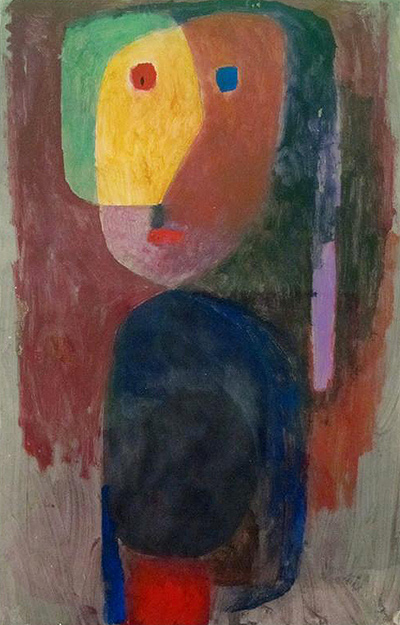
Paul Klee's Abendliche Figur was made in 1935. The owning LaM museum in Villeneuve-d'Ascq calls it Figure le soir in French; an English museum press release calls it Evening Figure. The alternative English label “Evening Shows” does not translate the German title and has no support in the owner record. Evening Figure is the museum-grounded English title used here.[1][2][3]
LaM records the work as gouache and graphite pencil on Ingres watermarked laid paper, 48.5 × 31.2 cm, inventory 979.4.128. It entered the museum through Geneviève and Jean Masurel's 1979 donation. The museum also transcribes the writing on the sheet: Klee's signature at the lower left and, at the lower right in graphite, “1935 L 13 Abendliche Figur”. A separate LaM educational caption gives the annual number 1935, 53. These are different notations in museum material, not a reason to replace the owner's title or date.[1][2][3]
The image shows a single upright form. Two dark oval masses meet at a narrow point: the upper one can be read as a head and the lower as a body. The figure has no clearly described arms or legs. A yellow area lights one side of the head, while green, brown, violet and red passages press against or pass across it. Two small marks establish eyes; a red horizontal touch suggests a mouth. Those few details are enough to make the arrangement seem to look back at the viewer.[2]
How little makes a figure?
LaM's French study of the work asks what makes this an identifiable human figure when so much has been omitted. Its answer begins with the two eyes, mouth, head-like oval and body-like mass. The work's title names a figure, rather than a particular person. There is no portrait sitter in the museum record. The face is legible but unsettled: one eye is a red ring or spot within the bright area; the other is a squarer blue mark against brown. The marks do not match in shape, colour or surrounding light.[1][2]
The large dark body resembles an oval, yet its edge blurs into the surrounding brushwork. It feels weighty at the top and tapers near the bottom. The red patch beneath it anchors the form without becoming clearly a foot, garment or piece of furniture. Reading the picture as a person relies on the meeting of the two ovals and the placement of the few facial signs. A viewer could trace its geometry first and recognise a human presence a moment later. Klee makes the threshold between shape and figure visible.[2]
This is why “Evening Shows” misleads. It can sound like an event or performance and makes “shows” a verb or plural noun. Abendliche Figur points instead to a solitary figure associated with evening. LaM's French Figure le soir and English Evening Figure preserve that subject. The work does not present a group, stage or spectacle. Its uncertainty concerns what this one figure is and how it appears.[1][2][3]
Paint, pencil and a face in layers
The object's material description matters to its appearance. LaM's educational text describes a diluted, partly transparent ground and areas where several layers of paint gather over the figure. Close examination at the museum revealed a preliminary graphite drawing: two ovals touching at one point, rather like a stretched eight. That observation gives a concrete construction behind the seemingly spontaneous figure. It does not prove that Klee knew from the first pencil mark exactly how the final face would develop; the museum itself presents the sequence as a question.[1][2]
Broad colour areas overlap. The green and yellow on the left side of the head form a luminous patch across a darker shape. The museum suggests that this bright oval seems to float over the face like a translucent sheet. In a reproduction, the difference between an actual layer of material and a painted illusion of transparency cannot be measured reliably. The owner's close looking is the stronger evidence for the painted layers, while the image available here shows their broad visual effect.[2]
The upper half is especially economical. A red eye with a dark centre, a blue rectangular eye and a short red mouth emerge from patches that have no hard anatomical contour. Yellow, green and brown make a face only because the eye groups them around those small signs. Below, blue-black paint creates a torso-like weight. Warm red and brown return at its base and sides. The contrasts keep the image from sinking into one uniform nocturnal tone. LaM notes the alternation of warm and cool colours, including orange against blue and red against green.[2]
LaM's object catalogue is more specific about medium than one caption in its educational booklet. The catalogue says gouache and graphite on watermarked Ingres paper and gives 48.5 × 31.2 cm. The booklet's main text also says gouache, but its image caption says watercolour on paper and rounds the dimensions to 48 × 31 cm. For the work's factual description, this page follows the detailed current owner record. The booklet is used for its close visual discussion and its separately printed annual number, with the caption discrepancy made explicit rather than silently blended away.[1][2]
What can evening tell us?
The German adjective abendliche provides a time of day or an evening quality, not a depicted clock time. LaM's study connects the title with reduced light and a melancholy tone. That is a plausible response to the dark surrounding colour and the figure's half-illuminated face. The bright yellow-green oval may suggest a lamp, a late sun or simply a pictorial area of light; the image does not identify a source. The museum itself frames these possibilities as questions.[2]
The date gives the picture a serious historical setting. Klee had lost his Düsseldorf Academy post under the Nazis and had returned to Switzerland by the time he made it. His health also deteriorated during the 1930s. LaM's educational essay mentions these circumstances when it considers whether the lit part of the face might suggest hope amid difficulty. The biographical facts and the painting's visible contrast are secure; the idea of hope is a proposed reading. Nothing in the object record establishes that Klee meant the yellow area as a coded account of his illness or exile.[2]
The relation between figure and ground is more immediate. Brown-red marks descend around the left of the head and body; green and deep blue flank it elsewhere. The person-like form is partly separate from, partly absorbed by, these surroundings. Its lit side seems close, but the dark torso recedes. LaM describes this as an image between figuration and abstraction. That phrase is useful here because the two readings actively depend on each other: the abstract placement of ovals, rectangles and colour fields produces the figure, and the figure gives those fields a psychological pull.[2]
A documented journey into the LaM collection
The museum's published provenance identifies Galerie Simon in Paris by 1938, with an inventory number, and Nierendorf Gallery in New York in 1938. It also lists Daniel-Henry Kahnweiler in Paris, but without a date in the displayed sequence. The work was at Galerie Jeanne Bucher in Paris by 14 January 1952. Jean Masurel acquired it from that gallery, held it until 1979, and donated it with Geneviève Masurel to the public collection. The owner record supports these named stages; it does not fill every gap between them.[1]
LaM has also made the work a focus of later interpretation. Its 2021 educational dossier examines the face's minimum signs, the layering of colour and the uncertainty of its light. In a recent museum collection discussion, LaM compares the figure's ghostly quality with figures in the work of Miriam Cahn. That comparison describes a contemporary curatorial dialogue, not a historical influence of one artist upon the other.[2][4]
Evening Figure gains force from its economy. Two joined ovals and three small facial marks bring a human presence into view. The paper, graphite and layered gouache keep that presence visibly made, while the colour makes one side emerge from shadow. Its original title holds the figure in an evening atmosphere; it does not tell us who the figure is or what it feels. The painting remains compelling because the viewer can see both the painted shapes and the person they almost, but never completely, resolve into.[1][2]
Related artworks
Explore eight other Klee works from the researched artwork cluster.
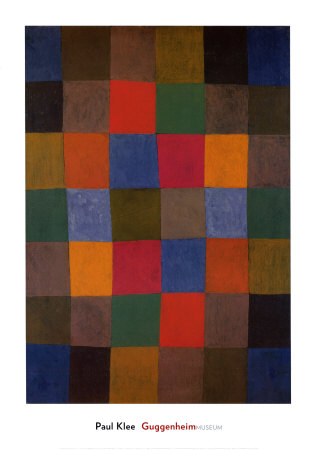
New Harmony
1936
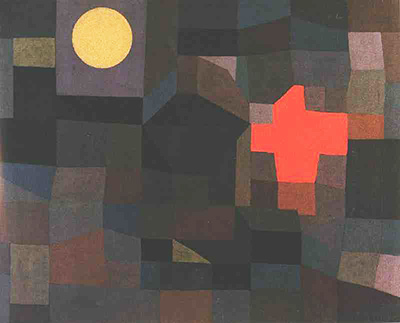
Fire Full Moon
1933
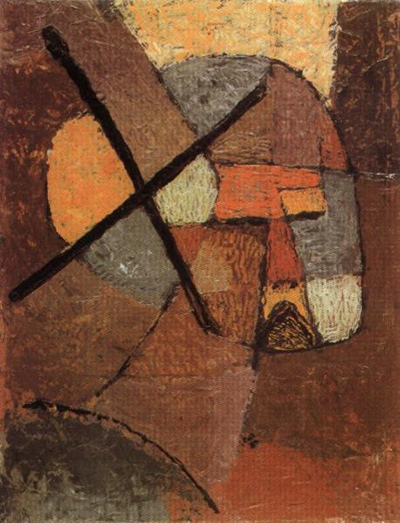
Struck from the List
1933
Viaducts Break Ranks
1937
Ad Parnassum
1932
Insula Dulcamara
1938
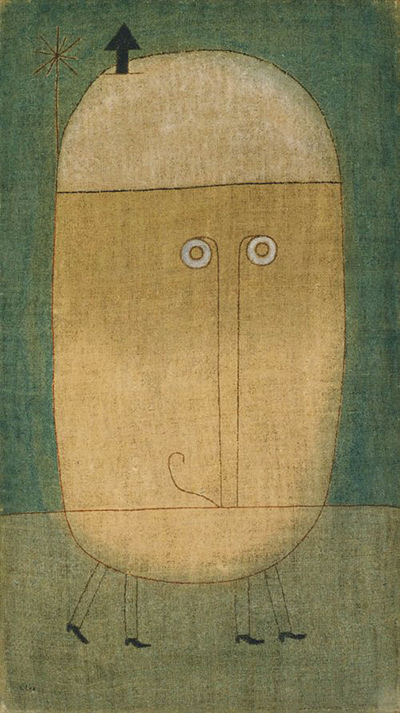
Mask of Fear
1932
References
- LaM, “Abendliche Figur (Figure le soir)” (in French): current owning-museum object record for title, date, medium, dimensions, inventory, inscription, collection and provenance. The page labels the work public domain while crediting its current photograph separately, View source.
- LaM, Paul Klee, entre-mondes: dossier pédagogique (2021), printed pp. 24–25 (in French): close study of Abendliche Figur, its preliminary drawing, colour, layered paint and interpretive questions. The figure caption on p. 25 calls the medium watercolour and rounds the size; the current object record and the dossier's main text say gouache. The caption gives 1935, 53, View source.
- LaM, Paul Klee, Between Two Worlds, English press release (2020), image caption: museum's English title “Evening Figure” and object summary, View source.
- LaM, “La vie de la collection #1” (in French): recent curatorial comparison with Miriam Cahn, explicitly a later dialogue between works, View source.