


 by Tom Gurney
Tom Gurney BSc (Hons) is an art history expert with over 20 years experience
Published on June 19, 2020 / Updated on September 27, 2026
Email: tomgurney1@gmail.com / Phone: +44 7429 011000
A face that walks
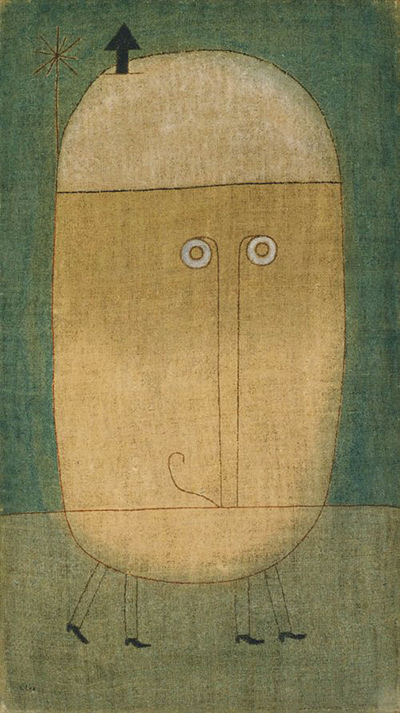
An enormous pale face stands on four thin legs. Its eyes are small circles, a dark arrow points up from its head, and the line where a mouth might be is hard to decide. Paul Klee's Mask of Fear is unsettling and faintly comic at once. The title names an emotion, but the image does not tell us whose fear this is or what caused it. Made in 1932, the painting lets a viewer look at a mask that seems to have become a whole creature.[1][2]
The Museum of Modern Art (MoMA) in New York owns it as 854.1978. The owner records oil on burlap, 100.4 × 57.1 cm, acquired through the Nelson A. Rockefeller Fund. The work's German title in recent institutional checklists is Maske Furcht, and its place in Klee's annual sequence is 1932,286. These identifiers make it possible to distinguish the actual painting from the many later descriptions that have turned its ambiguity into a fixed story.[1][3]
Contents
- Which Mask of Fear is this?
- What is visible in the mask?
- Is the painting about Klee's own fear?
- Why did scholars compare it with an A:shiwi Ahayu:da?
- What changed in the 1984 display?
- What other pictures might the mask recall?
- How did the painting reach MoMA?
- Looking again
Which Mask of Fear is this?
MoMA's object record gives the English title and physical facts. The Jewish Museum's 2026 Klee exhibition checklist records the German Maske Furcht and number 1932,286; MoMA's 2009 Bauhaus checklist uses the same German title. The phrase is compressed compared with a conventional German Maske der Furcht. It could suggest a mask called Fear, a mask worn by fear, or an instruction-like collision of the two nouns. Those are possibilities for reading, not an established account of Klee's intention. The handwritten artist catalogue and catalogue raisonné entry should be checked before treating every nuance of the original spelling as settled.[1][3][4]
The material is equally specific. Burlap is a coarsely woven support, not a synonym for ordinary smooth canvas. The current museum description establishes the support and oil medium; it does not tell us exactly how the ground was prepared, how many paint layers lie over it, or whether every irregularity in a small photograph comes from fabric rather than paint. At about one metre tall but only 57 cm wide, the image is a narrow, upright presence. Its scale can feel more like a standing figure than a small handheld carnival prop.[1]
The painting appeared in MoMA's 1936–37 Fantastic Art, Dada, Surrealism exhibition, according to the museum's installation history, while it was still in private or dealer circulation. In MoMA's 1941 memorial travelling exhibition, its printed catalogue listed Maske Furcht as no. 52, oil on burlap, lent by Allan Roos of New York. This contemporary loan record supports the owner's broad account that the Roos family held the work by 1940. It entered MoMA's own collection in 1978 by purchase, not as a gift from its previous owners. These records complicate the idea that the painting was discovered only late in Klee's reception.[1][13]
What is visible in the mask?
Begin at the outer contour. A large, rounded upper shape fills nearly the entire width of the dark greenish field. A line passes horizontally across it a little below the dome. Two ring-like eyes sit below that line, separated by a long, narrow vertical mark. Another horizontal boundary crosses near the lower part of the face. A single curled stroke bends beside the vertical mark. The contour then rounds into a lower oval, from which two pairs of stick-like legs and dark feet descend. There are no arms.[1][2]
The arrow at the top is dark, blunt and unmistakable. A finer, radiating sign stands near the upper left edge. Together they interrupt the otherwise front-facing stillness. The arrow might suggest direction, a point on a helmet, a warning, or simply one of Klee's mobile graphic signs. Alfred H. Barr Jr. wrote in the 1941 catalogue that arrows recur across Klee's art, sometimes showing moving forces and elsewhere acting as missiles; his examples are other works, not a decoding of this arrow. No one meaning follows automatically from its shape. The green surrounding field, the pale, fabric-textured body and the little feet make the face look both large and oddly vulnerable.[2][13]
Where is the mouth? The curled stroke may resemble a moustache or a smile, as MoMA's 2006 label suggests. It could also be read as the side of a nose, while the lower horizontal stroke supplies a compressed mouth-like boundary. The uncertainty is productive: the eyes appear startled, but the curl can turn the expression toward play. The painting's title pulls it back toward fear. Looking closely means holding those signals together instead of translating every line into one stable facial feature.[1][2]
The four legs pose another question. They might belong to two people behind one enormous facade; this is MoMA's 2006 suggestion. They might make the mask itself into an impossible walking creature. Their tiny scale against the large oval creates both humour and unease. A face normally belongs to a body, but here the supposed face has become the body's main mass. The slender supports make it seem precarious.[1][2]
The local splash is only 400 × 713 pixels. It permits this broad reading of forms, but it cannot settle the fabric weave, colour corrections or the exact joining of painted lines. The page therefore describes visible relations while leaving technical questions to a faithful high-resolution photograph and MoMA's conservation file.[1][2]
Is the painting about Klee's own fear?
The title makes fear a legitimate topic. It does not name Klee as the frightened figure. The picture was made in 1932, when political instability and Nazi electoral gains in Germany were real. Klee had left the Bauhaus for the Düsseldorf Academy in 1931. He was suspended from the academy in April 1933, then formally dismissed later that year; he and Lily returned to Bern in December. Those later events matter to the history of his life and the painting's reception, but they cannot be written backwards as a diary entry painted in 1932.[1][9]
An institutional German reading in the Heidi Horten Collection guide sees Mask of Fear as anxiety in the political circumstances of 1932. That is an attributed curatorial interpretation. William Rubin made an even more specific political proposal in 1984, reading the arrow as a lightning-like sign connected to fascist terror and imagining the little being as sensing it. Rubin supplied no dated statement from Klee linking the painted arrow to the SS or identifying the figure as a portrait of the artist. His vivid hypothesis is part of the work's interpretation, not a secure decoding of it.[5][6]
MoMA's 2006 label calls the figure satirical and places its creation on the eve of Hitler's accession. The timing is sound if kept precise: Hitler became chancellor in January 1933, after this painting's year. The label does not identify a month of execution or prove anticipation of a particular future policy. The older page here claimed to reveal Klee's private fear and compressed his later Nazi persecution into the following year. A better account holds 1932 creation, 1933 removal from teaching, and the later Entartete Kunst exhibition and confiscations as different events.[1][9]
Klee had earlier used a mask metaphor about art and the human being behind it. MoMA's label places that statement beside this picture. Marie Kakinuma's German study traces the thought to much earlier diary and print material associated with Klee's Comedian. It can help a reader ask who might hide behind this face, but it is not a 1932 explanation written for Mask of Fear. The direct diary wording and publication history should be checked before using a verbatim quotation in the final release.[1][10]
Why did scholars compare it with an A:shiwi Ahayu:da?
MoMA's 1984 exhibition “Primitivism” in 20th Century Art placed this painting in a controversial comparison with an Ahayu:da, a sacred being of the A:shiwi (Zuni) people, held at the time by Berlin's Museum für Völkerkunde. Curator William Rubin argued that the two images had striking features in common: rounded upper forms, an arrow above the head, a long narrow central feature and horizontal marks. He conjectured that Klee's small legs could transform feathers on the Berlin figure. These are the specific similarities he saw, and the conjecture is his.[6][7]
Rubin's own 1984 introduction, directly checked in an Italian translation, is more qualified about appearance than later summaries sometimes imply. He acknowledges many differences, including the subdued colouring of Klee's work beside the other figure. He says Klee's conscious memory of it cannot be known, yet remains personally convinced of an influence, perhaps unconscious. His text asserts that Klee visited the Berlin museum in 1906 and likely returned in later years, and that the Ahayu:da was on display. The cited passages do not supply a dated Klee sketch, letter or note recording a sight of that precise object.[6]
Contemporary critic Michael Peppiatt challenged the inference in his 1984 review. He accepted the documented 1906 visit and the comparable arrow and mouthless appearance, but pointed out the twenty-six years between that visit and the painting. In his account no later visit to this object was documented, and visual resemblance alone could not establish what Klee remembered. The two writers therefore agree about certain visual affinities and differ over the strength of the evidence for a direct source. The painting can be studied without declaring either an impossible connection or a proven copying event.[6][8]
MoMA's 2006 label states that Klee was inspired by the Zuni figure he saw at the museum. It is a later institutional adoption of the influence claim. The 1941 Barr catalogue had already grouped Mask of Fear with startling mask works, yet made no work-specific Ahayu:da identification. Its broad comparison does not establish either the 1984 source theory or its opposite. The 2006 object page does not introduce a newly identified Klee document. The older site text went further, asserting that Klee must have seen the figure many times. The accessible evidence does not justify that certainty.[1][6][8][13]
Even the phrase “war god sculpture” comes from a collecting and exhibition history that needs care. For the A:shiwi, Ahayu:da are powerful sacred beings with a continuing religious role. They are not merely visual forms available for a modernist pairing. The comparison is part of the painting's reception, but explaining it responsibly includes what happened to the proposed 1984 display and who objected.[7][11]
What changed in the 1984 display?
Cécile R. Ganteaume, then working with the Museum of the American Indian–Heye Foundation and later a Smithsonian National Museum of the American Indian curator, recounts receiving advance notice of MoMA's plan. Museum staff raised A:shiwi concerns. Assistant director George Eager wrote to MoMA director Richard Oldenburg, opposing the public display of the Berlin Ahayu:da. Ganteaume says MoMA removed the borrowed sacred object from the exhibition. Her account is firsthand institutional testimony about the objection and decision.[7]
The painting remained. A contemporary 1984 Washington Post review describes it next to a photograph of the Zuni figure. Thus the old page's claim that the painting and wooden Ahayu:da were both shown as physical objects is wrong for the display described by this witness. The original correspondence and final installation record would clarify every timing detail, including whether the object travelled before withdrawal; those facts are not supplied by the present sources.[7][12]
This episode has a history beyond Klee. Ganteaume describes an A:shiwi religious concern with the removal and public display of Ahayu:da. A Smithsonian record of a 1987 return of two other Ahayu:da shows the wider repatriation work of Zuni representatives and museum staff. That record must not be used to claim that the Berlin figure was returned; its later disposition remains a separate question. Nor is a new photograph of a sacred being necessary to explain what Rubin compared. This page describes the debate without reproducing that image.[7][11]
What other pictures might the mask recall?
The Zuni comparison is only one art-historical proposal. In MoMA's 2009 Bauhaus catalogue, Leah Dickerman suggests a different visual memory: the egg-shaped Oskar Schlemmer mask worn by a figure in the famous photograph of Marcel Breuer's club chair. She also sees a fragile, almost Humpty Dumpty character and reads the arrow and curled line as potentially recalling the spike and moustache of a Prussian Pickelhaube. These are precise, named comparisons from a museum essay, not proof that Klee copied either object. They show that the same arrow and rounded head can lead a knowledgeable viewer along more than one historical path.[4]
A closer comparison within Klee's own practice is Geschwister (Siblings) of 1930. The Heidi Horten Collection records it as watercolour and oil on a chalk-primed canvas, 70.7 × 45.2 cm. Two joined figures share a single form but retain two pairs of slim legs. The guide explicitly connects that motif with Maske Furcht two years later. The likeness does not turn Siblings into a preparatory sketch; it shows that Klee had already worked with the idea of multiple people inside one compact body. The Horten guide contrasts affection in the earlier picture with anxiety in the later one, a plausible later reading rather than Klee's recorded explanation.[5]
These comparisons need not be combined into a collage of supposed sources. The two pairs of legs can be read as an internal recurrence, a carnival arrangement, or, for Rubin, a transformation of feathers. The arrow may be a graphic sign, an echo of a helmet, or part of a proposed cross-cultural likeness. The painting does not label its component shapes by origin. The task of interpretation is to say who proposed what, what the visible work supports, and where the paper trail ends.[1][4][5][6]
How did the painting reach MoMA?
MoMA's ongoing provenance project begins with Klee in Düsseldorf in 1932. It says the picture was consigned to Galerie Alfred Flechtheim in Düsseldorf/Berlin in 1932–33, and then to Galerie Simon (Daniel-Henry Kahnweiler) in Paris from 1933 to at least January 1937. A Buchholz Gallery (Curt Valentin), New York link appears in brackets, signalling uncertainty. Allan and Beatrice Roos owned the work by 1940 through 1977; MoMA bought it in 1978 from a beneficiary of Beatrice Roos's estate.[1]
Consignment is not the same as a sale to a dealer. Nor does the bracketed Buchholz entry prove a dated transfer. The owner explicitly describes provenance research as ongoing, so the page preserves those qualifications. This chain also explains how a work made in Germany could be exhibited in New York long before the museum acquired it. MoMA records it in the 1936–37 Surrealist exhibition, later in 1984, 2006–07, 2009–10 and 2021–24 presentations. Those are histories of display and interpretation, not evidence that it is hanging in a gallery today.[1]
Looking again
Stand with the face's scale in mind: about a metre of oil paint and burlap, with tiny feet beneath. Move from the rigid arrow to the delicate radiating sign, then down through the open eyes and undecided mouth. The picture's fear is in tension with its comic construction. It can resemble a mask, a creature, or two people hidden together, without becoming a direct portrait of Klee's inner state.[1][2]
The strongest facts remain the exact object: Maske Furcht, 1932,286, oil on burlap, 100.4 × 57.1 cm, now MoMA 854.1978. Its 1984 Zuni comparison has a documented scholarly argument and a documented A:shiwi objection; neither proves a direct source in Klee's studio. Later Bauhaus and within-Klee comparisons keep the visual possibilities open. The page's history is richer when the painting, the people who interpreted it, and the sacred object they discussed are each treated on their own terms. For context, see Klee's Bauhaus years, late work and Klee's materials.[1][3][4][5][6][7]
Explore selected works from Klee’s much larger oeuvre. Titles without a link have an authenticated catalogue identity but no reviewed article yet.
Artworks directory
| Name | Date | Medium |
|---|---|---|
| A Gate | 1939 | Painting and mixed media |
| A Woman for Gods | 1938 | Watercolour and mixed media |
| Ab Ovo | 1917 | Watercolour and mixed media |
| Above Mountain Summit | 1917 | Drawing and mixed media |
| Abstract Trio | 1923 | Drawing and mixed media |
| Acrobats | 1915 | Watercolour and mixed media |
| Actor's Mask | 1924 | Painting and mixed media |
| Ad Marginem | 1930 | Drawing and mixed media |
| Ad Parnassum | 1932 | Painting and mixed media |
| Adventurer Ship | 1927 | Drawing and mixed media |
| Affected Place | 1922 | Drawing and mixed media |
| After a Sketch from Zurich | 1914 | Watercolour and mixed media |
| After Drawing | 1919 | |
| After The Floods | 1936 | Watercolour and mixed media |
| All Souls' Picture | 1921 | |
| Ancient Harmony | 1925 | Painting and mixed media |
| Angel Applicant | 1939 | Drawing and mixed media |
| Angel Serves the Desired | 1920 | |
| Angel, Still Female | 1939 | Painting and mixed media |
| Angelus Novus | 1920 | Drawing and mixed media |
| Animal Terror | 1926 | Painting and mixed media |
| Arab Song | 1932 | Painting and mixed media |
| Archangel | 1938 | Painting and mixed media |
| Architecture | 1923 | Painting and mixed media |
| Architecture of the Plain | 1923 | Drawing and mixed media |
| Around the Fish | 1926 | Painting and mixed media |
| Arrival of the Air Steamer | 1921 | Drawing and mixed media |
| Asiatic God | 1924 | Painting and mixed media |
| Astrological Fantasy Portrait | 1924 | Drawing and mixed media |
| Athlete's Head | 1932 | Watercolour and mixed media |
| Aufgehender Stern | 1931 | Painting and mixed media |
| Autumn Flower | 1922 | Painting and mixed media |
| Bad Band | 1920 | Drawing and mixed media |
| Baroque Centaur | 1939 | Painting and mixed media |
| Before the Blitz | 1923 | Drawing and mixed media |
| Before the Snow | 1929 | Drawing and mixed media |
| Besessenes Madchen | 1924 | Watercolour and mixed media |
| Bird Garden | 1924 | |
| Bird Wandering Off | 1926 | Watercolour and mixed media |
| Blossoms in the Night | 1930 | Watercolour and mixed media |
| Blue-Bird-Pumpkin | 1939 | Painting and mixed media |
| Boats in the Flood | 1937 | Painting and mixed media |
| Botanical Theatre | 1934 | Drawing and mixed media |
| Boy in Fancy Dress | 1931 | Watercolour and mixed media |
| Broken Key | 1938 | |
| Brother and Sister | 1930 | Watercolour and mixed media |
| But the Red Roof | 1935 | Painting and mixed media |
| C - C = Fisch | 1931 | Watercolour and mixed media |
| Cacti | 1912 | Painting and mixed media |
| Camel (in Rhythmic Landscape with Trees) | 1920 | Drawing and mixed media |
| Captive Pierrot | 1923 | Drawing and mixed media |
| Castle and Sun | 1928 | Drawing and mixed media |
| Cat and Bird | 1928 | Drawing and mixed media |
| Cathedrals | 1925 | Watercolour and mixed media |
| Chalice of the Heart | 1937 | Painting and mixed media |
| Characters in Yellow | 1937 | Painting and mixed media |
| Chosen Site | 1927 | Mixed media |
| Christmas Picture | 1923 | Drawing and mixed media |
| City of Towers | 1916 | Painting and mixed media |
| Clarification | 1932 | Painting and mixed media |
| Collection of Figurines | 1926 | Painting and mixed media |
| Colorful Architecture | 1917 | Painting and mixed media |
| Comedians' Handbill | 1938 | |
| Comic Opera Singer | 1927 | Painting and mixed media |
| Composition | 1939 | Painting and mixed media |
| Composition with Figures | 1915 | Drawing and mixed media |
| Composition with the Yellow Half-Moon and the Y | 1918 | Watercolour and mixed media |
| Conch–Still Life II | 1939 | Watercolour and mixed media |
| Cosmic Composition | 1919 | Painting and mixed media |
| Crystal Gradation | 1921 | Drawing and mixed media |
| Dance of the Grieving Child | 1922 | Painting and mixed media |
| Dancing Girl | 1940 | Painting and mixed media |
| Das Licht und Etliches | 1931 | Mixed media |
| Death and Fire | 1940 | Painting and mixed media |
| Death for the Idea | 1915 | |
| Demon as Pirate | 1926 | Watercolour and mixed media |
| Diana | 1931 | Painting and mixed media |
| Diavolo Player | 1923 | Drawing and mixed media |
| Die Kapelle | 1917 | Watercolour and mixed media |
| Die Vase | 1938 | Painting and mixed media |
| Doctor | 1930 | Drawing and mixed media |
| Dredger and Sailboat | 1931 | Watercolour and mixed media |
| Ein Tor | 1939 | Painting and mixed media |
| Ein Weib fur Gotter | 1938 | Mixed media |
| Embrace | 1939 | Watercolour and mixed media |
| Episode before an Arab Town | 1923 | |
| Equals Infinity | 1932 | Painting and mixed media |
| Eros | 1923 | Drawing and mixed media |
| Error on Green | 1930 | Watercolour and mixed media |
| Evening Figure | 1935 | Drawing and mixed media |
| Falling Bird | 1919 | |
| Fermata | 1932 | Watercolour and mixed media |
| Fire Clown | 1921 | Watercolour and mixed media |
| Fire Full Moon | 1933 | Watercolour and mixed media |
| Fire in the Evening | 1929 | Painting and mixed media |
| Fish in the Harbour | 1916 | Watercolour and mixed media |
| Fish Magic | 1925 | Watercolour and mixed media |
| Flock of Birds | 1917 | Drawing and mixed media |
| Flora on Sand | 1927 | Watercolour and mixed media |
| Flower Myth | 1918 | |
| Flower Stand with Watering Can and Bucket | 1910 | Watercolour and mixed media |
| Flowering Tree (Abstraction with Reference to a Flowering Tree) | 1925 | Painting and mixed media |
| Flowers in Pots | 1923 | |
| Flowers in Stone | 1939 | Painting and mixed media |
| Forest Witch | 1938 | Painting and mixed media |
| Fright of a Girl | 1922 | Drawing and mixed media |
| Fruits on Red | 1930 | Drawing and mixed media |
| Full Moon | 1919 | Mixed media |
| Föhn Wind in Franz Marc's Garden | 1915 | Watercolour and mixed media |
| Garden in St Germain, The European Quarter near Tunis | 1914 | Watercolour and mixed media |
| Ghost Chamber with the Tall Door (New Version) | 1925 | |
| Ghost of a Genius | 1922 | Drawing and mixed media |
| Girl in Mourning | 1939 | Painting and mixed media |
| Glance of a Landscape | 1926 | Watercolour and mixed media |
| Gluht Nach | 1939 | Drawing and mixed media |
| Golden Fish | 1925 | Watercolour and mixed media |
| Goldfish Wife | 1921 | Watercolour and mixed media |
| Green Plant, Blood, Louse | 1924 | Drawing and mixed media |
| Hafenbild | 1918 | Mixed media |
| Hammamet with Mosque | 1914 | Watercolour and mixed media |
| Harbour with Sailing Ships | 1937 | Painting and mixed media |
| Hauptweg und Nebenwege | 1929 | Painting and mixed media |
| Heavenly and Earthly Time | 1927 | Drawing and mixed media |
| Heroic Fiddling | 1938 | Painting and mixed media |
| Heroic Roses | 1938 | Painting and mixed media |
| Heroic Strokes of the Bow | — | Mixed media |
| Highway and Byways | 1929 | Drawing and mixed media |
| Houses near the Gravel Pit | 1913 | Watercolour and mixed media |
| Howling Dog | 1928 | Painting and mixed media |
| In the Current Six Thresholds | 1929 | Painting and mixed media |
| In the Style of Kairouan | 1914 | Drawing and mixed media |
| Individualized Altimetry of Stripes | 1930 | Painting and mixed media |
| Insula Dulcamara | 1938 | |
| Interior with the Clock | 1913 | Watercolour and mixed media |
| Irma Rossa the Animal Tamer | 1918 | Drawing and mixed media |
| Journey in Corsica | 1927 | Drawing and mixed media |
| Landscape with Bluebirds | 1919 | Watercolour and mixed media |
| Legend of the Nile | 1937 | Painting and mixed media |
| Lemon Harvest | 1937 | Watercolour and mixed media |
| Likeness in the Bower | 1930 | Watercolour and mixed media |
| Limits of Reason | 1927 | Painting and mixed media |
| Little Hope | 1938 | Watercolour and mixed media |
| Magdalena before the Conversion | 1938 | Drawing and mixed media |
| Mask of Fear | 1932 | Painting and mixed media |
| May Picture | 1925 | Painting and mixed media |
| Monument in a Cemetery | 1922 | Watercolour and mixed media |
| Monuments at G | 1929 | Watercolour and mixed media |
| Municipal Jewel | 1917 | Watercolour and mixed media |
| Mural from the Temple of Longing Thither | 1922 | |
| Nach der Uberschwemmung | 1936 | Watercolour and mixed media |
| New Harmony | 1936 | Painting and mixed media |
| New House in the Suburbs | — | Mixed media |
| Old Steamboat | 1922 | Drawing and mixed media |
| On the Edge | 1930 | Drawing and mixed media |
| Once Emerged from the Gray of Night | 1918 | Drawing and mixed media |
| One Who Understands | 1934 | Painting and mixed media |
| Oriental Pleasure Garden | 1925 | Painting and mixed media |
| Park of Idols | 1939 | Watercolour and mixed media |
| Passing by Red Pillars | 1928 | Watercolour and mixed media |
| Persian Nightingales | 1917 | Drawing and mixed media |
| Popular Wall Painting | 1922 | Painting and mixed media |
| Prestidigitator | 1927 | Watercolour and mixed media |
| Rainy Day | 1931 | Watercolour and mixed media |
| Red and White Domes | 1914 | Watercolour and mixed media |
| Red Balloon | 1922 | Drawing and mixed media |
| Redgreen and Violet-Yellow Rhythms | 1920 | Drawing and mixed media |
| Refuge | 1930 | Watercolour and mixed media |
| Rhythmic Rythmical | 1930 | Painting and mixed media |
| Saint of the Inner Light | 1921 | |
| Scaffolding of a New Building | 1930 | Painting and mixed media |
| Scholar in Dealing with Stars | 1926 | Watercolour and mixed media |
| Seated Woman | 1930 | Drawing and mixed media |
| Senecio | 1922 | Painting and mixed media |
| Separation in the Evening | 1922 | Drawing and mixed media |
| Sinbad the Sailor | 1923 | Drawing and mixed media |
| Skeptically Smiling | — | Mixed media |
| Small House in the Garden City | 1928 | Watercolour and mixed media |
| Small Portrait of a Girl in Yellow | 1925 | Painting and mixed media |
| Southern Gardens | 1919 | Watercolour and mixed media |
| Static-Dynamic Gradation | 1923 | Drawing and mixed media |
| Still Life | 1927 | Painting and mixed media |
| Still Life with Gladioli | 1932 | Watercolour and mixed media |
| Strange Garden | 1923 | Drawing and mixed media |
| Stricken City | 1936 | Painting and mixed media |
| Strong Dream | 1929 | Watercolour and mixed media |
| Struck from the List | 1933 | Drawing and mixed media |
| Structural I | 1924 | Drawing and mixed media |
| Sumpflegende | 1919 | Painting and mixed media |
| Temple Gardens | 1920 | Drawing and mixed media |
| The Arrow before the Target | 1921 | Drawing and mixed media |
| The Barbed Noose with the Mice | 1923 | Watercolour and mixed media |
| The Flora of the Heath | 1925 | Watercolour and mixed media |
| The Goldfish | 1925 | Watercolour and mixed media |
| The Hour Before One Night | 1940 | Painting and mixed media |
| The Man in Love | 1923 | |
| The Mask with the Flag | 1925 | Mixed media |
| The Pathos of Fertility | 1921 | |
| The Rhine at Duisburg | 1937 | Painting and mixed media |
| The Way to the Citadel | 1937 | Painting and mixed media |
| Three Houses and a Bridge | 1922 | Watercolour and mixed media |
| Tightrope Walker | 1923 | |
| Tomb in Three Parts | 1923 | Watercolour and mixed media |
| Tomcat's Turf | 1919 | Watercolour and mixed media |
| Tower in Orange and Green | 1922 | Drawing and mixed media |
| Tree and Architecture - Rhythms I | 1920 | Watercolour and mixed media |
| Tree and Architecture - Rhythms II | 1920 | Painting and mixed media |
| Tropical Dawn with the Owl | 1921 | Mixed media |
| Tropische Dammerung | 1921 | Painting and mixed media |
| Twittering Machine | 1922 | Drawing and mixed media |
| Variations (Progressive Motif) | 1927 | Watercolour and mixed media |
| Ventriloquist and Crier in the Moor | 1923 | |
| Viaducts Break Ranks | 1937 | Drawing and mixed media |
| Villa R | 1919 | Painting and mixed media |
| Village Carnival | 1926 | Painting and mixed media |
| Vor dem Blitz | 1923 | Drawing and mixed media |
| Wald-Hexen | 1938 | Painting and mixed media |
| Young Forest | 1925 | Drawing and mixed media |
Related artworks
Explore eight other Klee works, beginning with works close in date to this one.
Ad Parnassum
1932
Fire Full Moon
1933
Struck from the List
1933
Ad Marginem
1930
Error on Green
1930
Fire in the Evening
1929
Highway and Byways
1929
Discussion
Klee paints an enormous face balanced on four thin legs.
The title names fear, but the image mixes unease and humour.
Reader Insights
Where do you see the mouth, if there is one?
Do the four legs suggest two hidden people or one creature?
Which source best supports your reading of the arrow?
Join the Conversation
Share the detail or source behind your reading.
References
- Museum of Modern Art, Mask of Fear, 854.1978, current object record, 2006 gallery label, installation history, ongoing provenance project and image-licensing notice. The label's Zuni inspiration claim is an institutional interpretation, not accompanied here by a Klee document, View source.
- Existing local splash, visually inspected at 400 × 713 pixels for broad forms only; not a technical photograph or annotation master. The project's internal image-rights ledger records the exact-work high-resolution source as unresolved.
- Jewish Museum, Paul Klee: Other Possible Worlds checklist, 2026, entry 33: Maske Furcht, 1932,286, oil on burlap, MoMA; paired with MoMA's object measurements, View source.
- Museum of Modern Art, Bauhaus 1919–1933: Workshops for Modernity checklist, 2009, and Leah Dickerman, “Bauhaus Fundaments,” in the 2009 exhibition catalogue, pp. 35–37: Schlemmer/Breuer and Pickelhaube readings, presented as her interpretive comparisons. The catalogue PDF was checked in search-readable form where direct PDF extraction failed.
- Heidi Horten Collection, German collection guide, pp. 75–76, Geschwister object data, the explicit two-pairs-of-legs comparison, and an attributed political reading of Maske Furcht, View source.
- William Rubin, “Modernist Primitivism: An Introduction,” in “Primitivism” in 20th Century Art (MoMA, 1984), vol. 1, pp. 29–32, directly read in an Italian translation with OCR limitations; original edition bibliographic record. Formal similarities, acknowledged differences, uncertain conscious memory and political hypothesis are Rubin's claims; original English text and footnotes remain to check.
- Cécile R. Ganteaume, “Respecting Non-Western Sacred Objects”, National Museum of the American Indian article of 15 April 2013 in an attributed full mirror; firsthand account of MAI–Heye Foundation staff concerns, George Eager's letter and MoMA's withdrawal of the Berlin Ahayu:da. Smithsonian researcher profile confirms Ganteaume's institutional role; the original Smithsonian blog URL was unavailable in the research browser.
- Michael Peppiatt, original 1984 exhibition review republished in The Making of Modern Art excerpt, pp. 72–73: acknowledges visual parallels and the documented 1906 Berlin visit while questioning Rubin's inference across the following twenty-six years, View source.
- Zentrum Paul Klee, archival guide to Klee's dismissal, dates the 21 April 1933 suspension; read with Arts in Exile's dated account for departure and later events. Neither is a work-specific explanation of the 1932 painting.
- Marie Kakinuma, German study of Klee's masks and self-images, traces the earlier mask/art thought to diary and print sources; the original diary text remains to check before direct quotation, View source.
- Smithsonian Institution, The Return of the Ahayu:da, record of the 1987 return of two other Ahayu:da, coauthored by Smithsonian curator William Merrill, A:shiwi anthropologist Edmund Ladd and T. J. Ferguson. It does not establish the Berlin object's present status, View source.
- Washington Post, contemporaneous review of MoMA's 1984 exhibition, 30 September 1984, reports the Klee painting next to a photograph of the Zuni figure, rather than the physical object, View source.
- Museum of Modern Art, Paul Klee memorial travelling exhibition catalogue, 1941, printed pp. 5–6 and catalogue no. 52 on p. 10. Barr's revised introduction treats Mask of Fear among unsettling masks and arrows as a recurring Klee sign; the object entry records the 1932 title, oil on burlap and Allan Roos loan. The essay's general arrows are not a documented explanation of this particular painted arrow, View source.