


 by Tom Gurney
Tom Gurney BSc (Hons) is an art history expert with over 20 years experience
Published on June 19, 2020 / Updated on September 27, 2026
Email: tomgurney1@gmail.com / Phone: +44 7429 011000
Paul Klee’s Three Houses by the Bridge
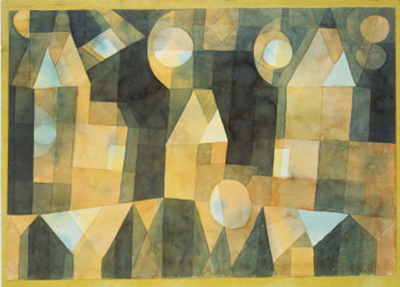
The Miyagi Museum of Art in Sendai holds Paul Klee’s Three Houses by the Bridge, 1922, in its collection as DF 42. The Japanese title is 橋の傍らの三軒の家. A Japanese national collection record, citing the museum’s revised 1992 catalogue, describes watercolour on paper mounted on cardboard, measuring 26.5 × 36.0 cm with a larger 38.4 × 45.0 cm mount. It transcribes 1922/147 on the lower-left mount and a German title at lower right. The inherited page’s claim that the original was a “Giclée” confuses a kind of modern reproduction with the museum’s account of Klee’s physical work.[1][2]
Three houses, several ways to see them
Three tall, pale-roofed forms stand at left, centre and right. Rectangles and triangles join into walls, roofs and smaller foreground shapes, while circles hover around or within the structures. Darker vertical passages separate the houses. The forms can be read as buildings but are also a rhythm of coloured planes. One need not assign every shape to a window, person or landmark to follow the composition.[1][3]
The familiar English title places a bridge beside the houses. The actual route of that bridge is harder to isolate in a small reproduction. A low band of sharp gables and a round form fill the foreground, but the owner’s catalogue title does not mark a single outlined span for the viewer. The old article treated one reading of the lower shapes as a fact and even suggested a circle was a human head. Those are possible visual associations, not identified subjects in the museum record. A better close look asks how the picture moves between architecture and a grid of colours.[1][3]
The reproduced composition agrees with the Miyagi Museum’s view: three pale roofs, a central orange and cream circle, rings above, dark vertical divisions and a lower row of pointed forms. The museum’s view also includes mount edges and faint markings outside the local crop.[1][3]
Names and object number
The current museum-facing English title uses “by the Bridge.” This site’s existing route and older display wording use “and a Bridge.” They can remain useful search terms, but the page should explain that the owner’s phrase is a translation of the German title noted in the collection record. The Art Platform Japan data gives Drei Häuser an der Brücke in its notes, while its transcription of the physical inscription has Häuser an der Brücke without “three.” The published record is also marked as machine translated for some text. Those small differences are reasons to report the wording faithfully, not to claim a single unexamined inscription.[1]
The year and number 1922,147 distinguish this work from other Klee village or house pictures. The number appears in the collection transcription and is identified as Klee’s catalogue entry in the same Japanese record. It is not a shelf location: the museum accession is DF 42. A reproduction seller’s title or a search result with a similar skyline is a weaker identity source than the owner’s number, support and image. The current English route is retained because it leads to this distinct work; no redirect is needed to improve the object description.[1][2]
Watercolour and the effect of light
The coloured architecture is built from muted oranges, yellows, blue-greens and dark overlapping passages. Some planes appear translucent; others feel heavier because their edges or surrounding colours make them stand forward. The museum’s larger image makes the variations in colour and paper more apparent than the tile. It remains a watercolour on paper, mounted on card, under the museum’s current technical description. Other accounts sometimes add pencil or pen, but this page does not import those details as confirmed materials without a direct object or conservation source.[1][3]
The Art Platform Japan note includes a longer German parenthesis about an effect of artificial illumination, apparently from the museum’s earlier catalogue. That phrase is a valuable research lead: the alternating warm and cool blocks make a lighting interpretation conceivable. The online record’s spelling is imperfect and its text is partly machine translated, so the parenthesis should be checked against the printed catalogue or Klee’s own register before it becomes a headline or a firm statement of artistic intention. The visible colour relationships can be described now without pretending to know the precise source of every hue.[1]
The Miyagi Museum listed the work in a 2006 collection exhibition, presented it again in a 2013 exhibition of Klee and Kandinsky, and included it in a 2026 collection checklist. The 2013 text describes the museum’s Klee and Kandinsky holdings as a collection strength and highlights Klee’s colourful watercolours. Those dated records support the continuing collection identity; they do not prove continuous display in the gallery. Visitors should check current museum information before expecting to see the sheet on a wall.[2][4]
The work is a compact example of how Klee could let a legible title coexist with an image that keeps rearranging itself as shape and colour. It rewards a return from the small tile to the owner’s full image and measured record.[1][3]
Related artworks
Explore eight other Klee works from the researched artwork cluster.
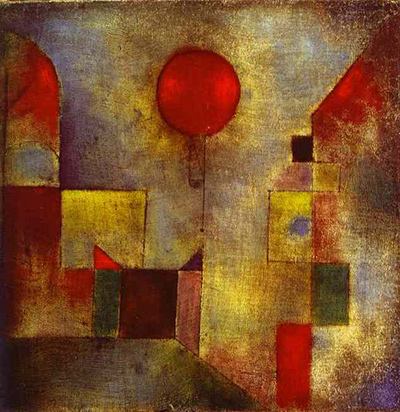
Red Balloon
1922
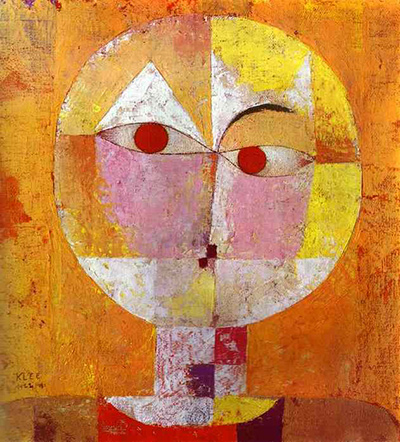
Senecio
1922
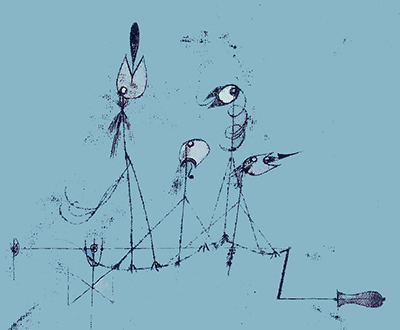
Twittering Machine
1922
Crystal Gradation
1921
Sinbad the Sailor
1923
Actor's Mask
1924
Angelus Novus
1920
Ancient Harmony
1925
References
- Art Platform Japan, Three Houses by the Bridge, bilingual Japanese/English object record drawn from the Miyagi Museum of Art’s revised 1992 collection catalogue; date, medium, dimensions, inscriptions, number and accession. The site flags part of its text as machine translated, View source.
- Miyagi Museum of Art, Klee and Kandinsky I, English exhibition record, 2013; 2026 collection exhibition checklist, Japanese/English object listing.
- Miyagi Museum of Art, high-resolution collection image page, Japanese, published May 2026. The official image was used for visual comparison only; no new site asset was derived from it, View source.
- Miyagi Museum of Art, 2006 collection exhibition notice, Japanese; corroborates the museum’s historic display and title, View source.