


 by Tom Gurney
Tom Gurney BSc (Hons) is an art history expert with over 20 years experience
Published on June 19, 2020 / Updated on September 27, 2026
Email: tomgurney1@gmail.com / Phone: +44 7429 011000
The Sealed Lady: a portrait held by a red mark
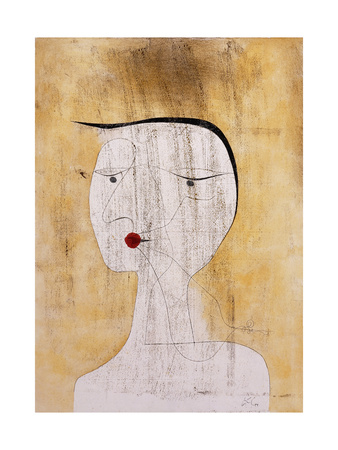
The pale bust in the old “Seated Woman” image has been given the wrong name on this site. It is Paul Klee's versiegelte Dame—The Sealed Lady—a 1930 pen and watercolour work held by the Staatliche Museen zu Berlin's Museum Berggruen. The museum's inventory number is NG MB 140/2000. Its record gives pen and watercolour on paper mounted on cardboard, 49 × 35 cm, including a lower cardboard strip treated with pen and watercolour. A historical Christie's record transcribes the artist's mount as “VIII 1930 P.2. Versiegelte Dame” and identifies the work in Klee's own catalogue as 1930, P 2 (62). The owner's title and the image agree; nothing in these sources calls the subject seated.[1][2]
The title is the key to the portrait's strangeness. A dark red roundel stands where a mouth might be. It can read as lipstick, a mark of silence or a wax seal. Gabriel Montua's German museum essay treats the circular mouth as the image's felt centre and explains the title through this sealing motif. That does not mean the figure is literally covered with wax. It means Klee made a sign for a mouth that also suggests the act of closing something. The portrait allows expression and withheld speech to occupy the same point.[1]
The figure and the line
Against a warm yellow-ochre field, the woman's head and upper torso appear almost white. A black sweep crosses the forehead and bends down at the right, making a severe cap of hair from one strong stroke. Under it sit tiny dark eyes. They are far less emphatic than the red mouth, but the lines around them are restless: one eyelid curves softly while another seems to lengthen into the hairline. The broad blank face encourages a first impression of composure. Closer looking finds several profiles trying to coexist.[1]
The museum description points out that the shoulders and eyes face nearly forward, while the hair suggests a three-quarter view and the nose and ink-hatched lips are closer to a full profile. Klee does not resolve these incompatible views into a conventional portrait. Fine ink lines cross the face, loop around the neck and stray beyond the shoulder. Some help describe a feature; others function more like a drawing's own movement across the paper. The left outline runs upward from the shoulder to the forehead and back through the nose toward the mouth. The same path can be read as body contour, facial profile and a route through the image.[1]
The red circle arrests that movement. It is small compared with the head, yet it is the only strongly saturated note in the face. Its placement gives the sense that many lines converge there, as if a spoken word were being compressed into a single sign. Montua compares the woman's short hair and unreadable expression with Christian Schad's Sonja, a portrait of the New Objectivity. That is a museum-authored visual comparison, not evidence that Klee copied Schad or knew this specific painting. What can be seen directly is that Klee constructs a socially recognisable modern hairstyle and then unsettles the face with several competing viewpoints.[1]
The outline of the upper body is deliberately sparse. It swells into shoulders beneath a long neck, while the pale interior carries faint marks and washes rather than anatomical modelling. The yellow around it is not a neutral printed background. The medium identified by the museum—pen and watercolour—makes both the fine lines and the uneven wash central to the picture. The historical Christie's description is more specific about the Ingres laid paper and the artist's mount, and mentions a narrow brown watercolour band below the image. This is a work on paper with a constructed border, not the rough oil-painted canvas claimed in the old local article.[1][2]
What “sealed” leaves open
The title can tempt an account of a woman rendered silent. That is a possible interpretation, and the red mouth makes it compelling, but the record does not document Klee's intention in those terms. The museum essay says the face conveys little emotion and then reads the red circular mouth as a wax seal. The visual evidence also allows a more playful reading: a bright graphic mark interrupts an otherwise delicate drawing. The portrait's ambiguity comes from keeping these possibilities active. It is not necessary to invent a biography for the sitter or to declare the image a direct statement about a specific political event.[1]
Nor does the old English page title describe what is visible. The picture ends at the shoulders, with no chair, hands or legs to show a seated pose. “Seated Woman” may have come from a commercial image label or an earlier editorial error; its source has not been documented. Retaining that old web address keeps existing links alive, but the article and the H–S catalogue tile now use the verified work title. The original German title remains useful because it carries the double sense of a lady who is marked and a mouth that is closed.[1][2]
Date, catalogue and object history
Christie's recorded the title, month-like Roman numeral VIII, date and P.2 code on Klee's own mount, while the museum's public record dates the work to 1930. The auction record gives an image size of 48.5 × 34.7 cm and a mount size of 60 × 47 cm; the museum rounds the image dimensions to 49 × 35 cm. Those measurements need not be forced into a single number. They are close and appear to measure the image and its constructed support on slightly different bases. The Christie's entry also identifies Klee's work-catalogue number as 1930, P 2 (62). This is more specific than the generic date supplied by the owner page, but the original artist catalogue itself has not been read here.[1][2]
The museum's provenance starts with Klee in 1930 and names Werner Vowinckel, Cologne, from 1930 to 1943. Edith Vowinckel-Diel and then her estate held it through 1966. The museum record next lists Heinz Berggruen, Berlin/Paris, from 25 June 1996 to 2000, and says the museum acquired it in 2000 with support from the German federal government and Berlin. Christie's historical sale description says the seller's father bought it from the artist soon after it was made. The names in the museum's sequence make that early history intelligible, but the two records are not identical document types: the museum gives its current provenance summary, while Christie's preserves the sale's own account. The page keeps that distinction clear.[1][2]
The work has also travelled in exhibitions. A bilingual Japanese and English checklist from the National Museum of Art, Osaka, lists The Sealed Lady as item 79 in a Berlin Berggruen exhibition. Its Japanese title, 封印された女, and its English medium line identify pen and watercolour on paper mounted on cardboard, with the lower border treated in pen and watercolour. This is an independent museum presentation of the same object, not a different “Seated Woman.” It confirms how the work has been named and described outside Germany.[3]
Image and display
The Museum Berggruen online record labels its reproduction Public Domain Mark 1.0 and credits the photograph to Staatliche Museen zu Berlin, Museum Berggruen / Jens Ziehe. A clearer 748 × 997-pixel version from that record replaces the inherited 338 × 450-pixel splash at the same site filename and address; the affiliate image wrapper and class remain in place. The visible credit and the exact source are recorded here and in the image ledger. At the documented 35 cm image width, 748 source pixels represent far less than 300 effective pixels per inch, so this file cannot responsibly serve as a master for detailed annotation crops.[1]
The portrait is best approached as a drawing that keeps reassigning its own lines. A mark can be an eyelid, hair, contour or arabesque depending on where the eye follows it. The red seal makes that motion pause. Klee called the figure a lady and marked her as sealed, but he did not give her a chair or a single fixed viewpoint. Correcting the title restores a more exact encounter with the work's materials and visual wit.
Related artworks
Explore eight other Klee works from the researched artwork cluster.
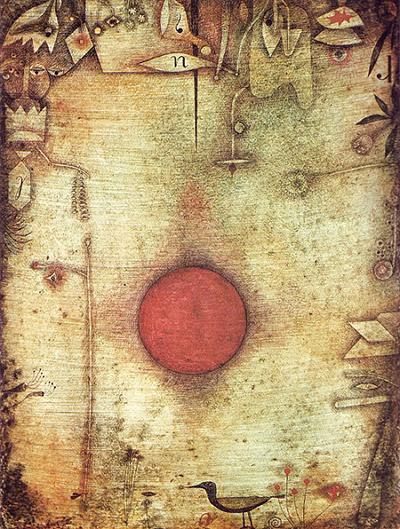
Ad Marginem
1930
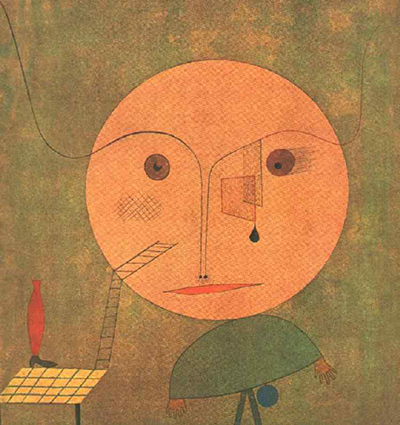
Error on Green
1930
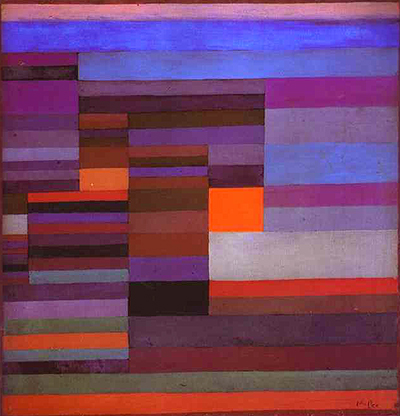
Fire in the Evening
1929
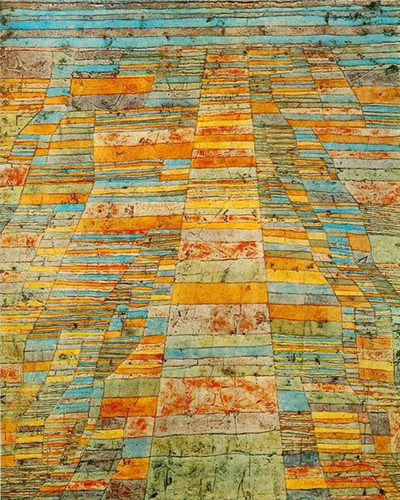
Highway and Byways
1929
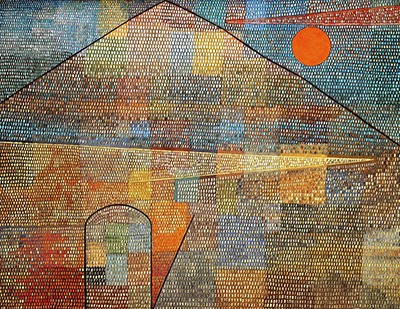
Ad Parnassum
1932
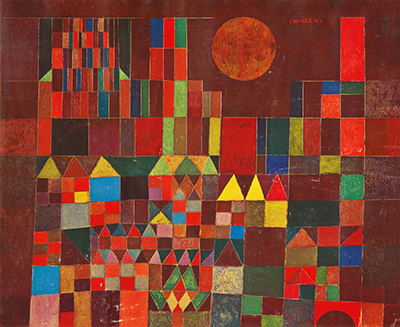
Castle and Sun
1928
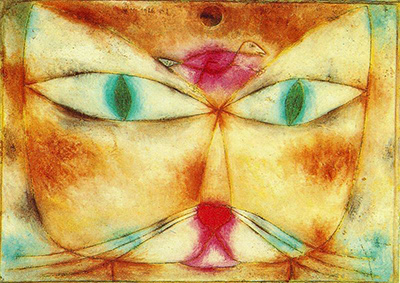
Cat and Bird
1928
Mask of Fear
1932
References
- Staatliche Museen zu Berlin, Museum Berggruen, versiegelte Dame (NG MB 140/2000), German object, image-rights and provenance record, with essay by Gabriel Montua; accessed 27 September 2026, View source.
- Christie's, historical lot record for Versiegelte Dame, mount inscription, materials, measurements, artist work-catalogue reference and early sale provenance; accessed via indexed record 27 September 2026, View source.
- National Museum of Art, Osaka, bilingual Berggruen exhibition checklist, item 79, The Sealed Lady / 封印された女; accessed 27 September 2026, View source.