


 by Tom Gurney
Tom Gurney BSc (Hons) is an art history expert with over 20 years experience
Published on June 19, 2020 / Updated on September 27, 2026
Email: tomgurney1@gmail.com / Phone: +44 7429 011000
Roads across divided colour fields
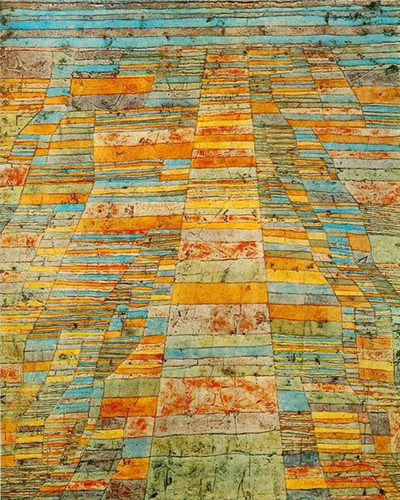
In Paul Klee’s Highway and Byways, one broad, nearly straight road rises through a field of narrow, uneven paths. Blue bands gather at the top; below them, short strips of orange, yellow, green, red and pale grey keep dividing and changing direction. The eye can follow a route toward a distant horizon, then lose it among the smaller ways. The picture offers both a landscape and a deliberate system of lines. Klee’s German title, Hauptweg und Nebenwege, asks us to hold those possibilities together.[1][2]
The work was made in 1929, after Klee returned from Egypt. That journey mattered to the pictures he made that year. Yet the measured division of a surface had a longer history in his teaching and art. The painting is neither a traced map of the Nile Valley nor an exercise in abstract geometry detached from experience. Its roads give a viewer a way into a construction that repeatedly becomes more complex the longer it is examined.[2][3][4]
Explore the details of Highway and Byways
Select a numbered area to examine its detail at high resolution.
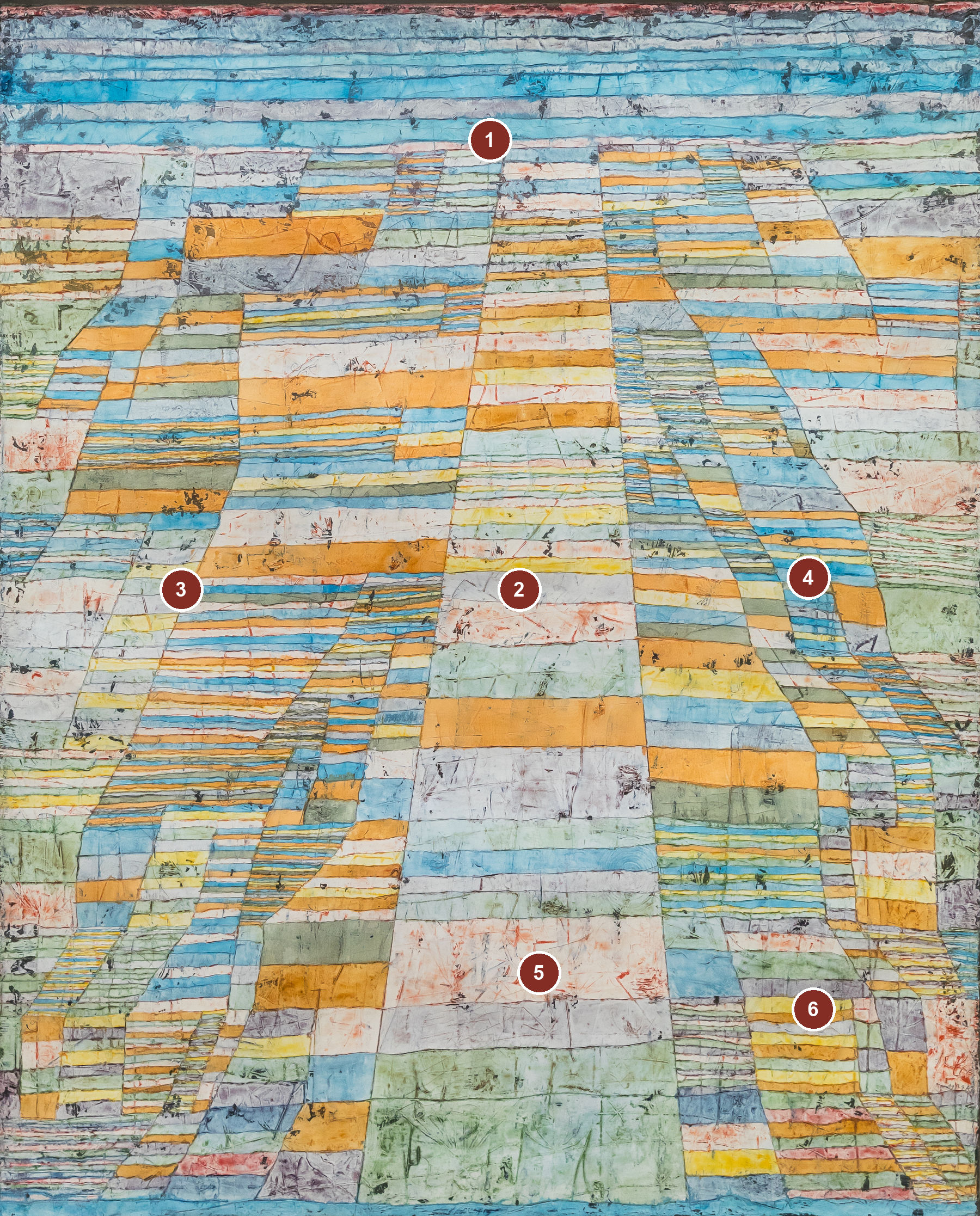
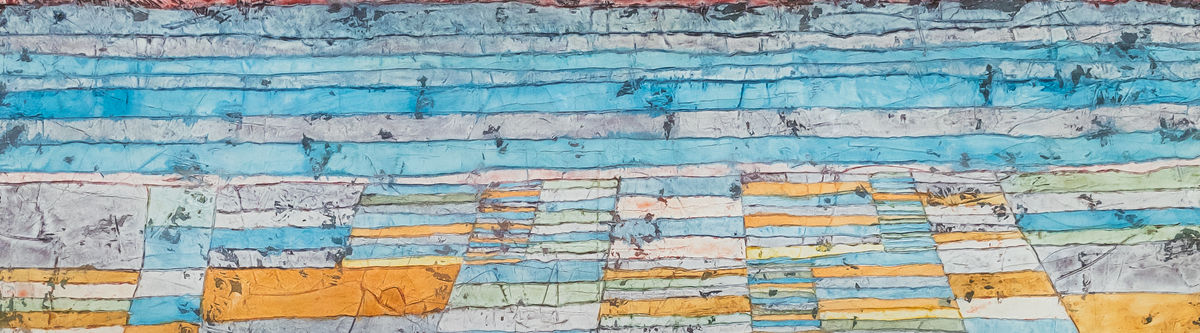
The horizontal blue bands at the upper edge
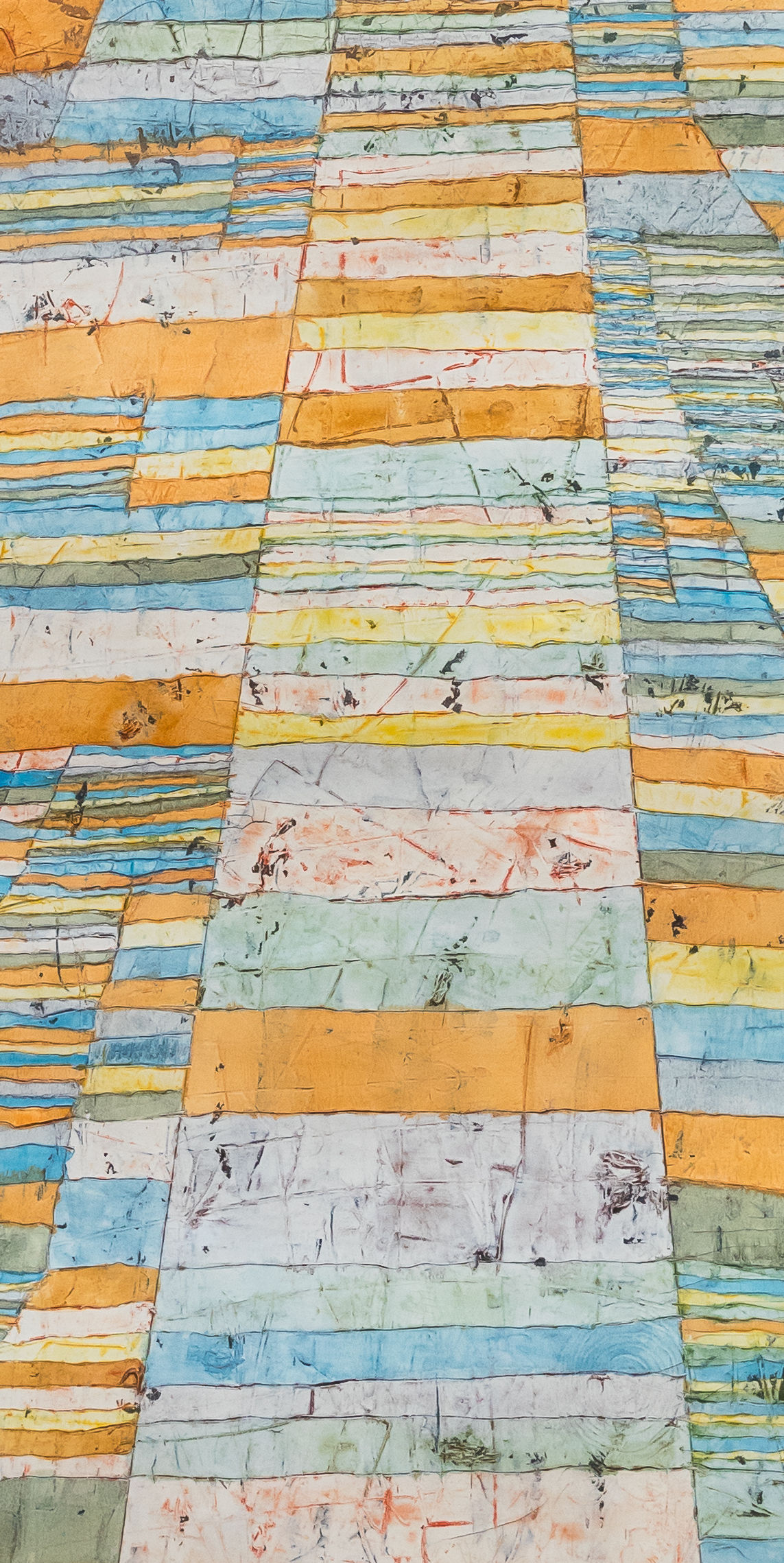
The central road and its straighter borders
The narrow routes dividing at the left
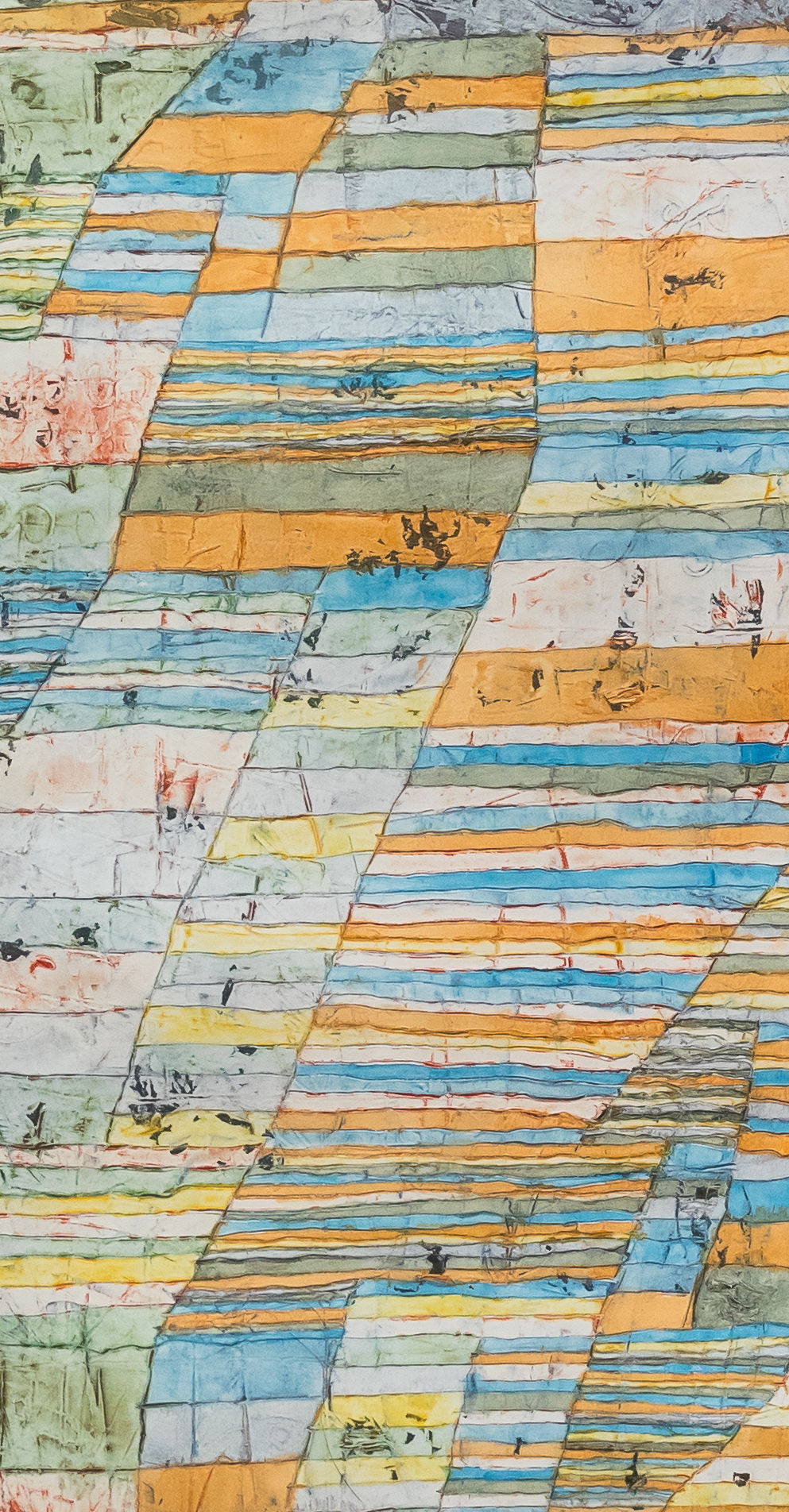
Colour strips and crossing lines at the right
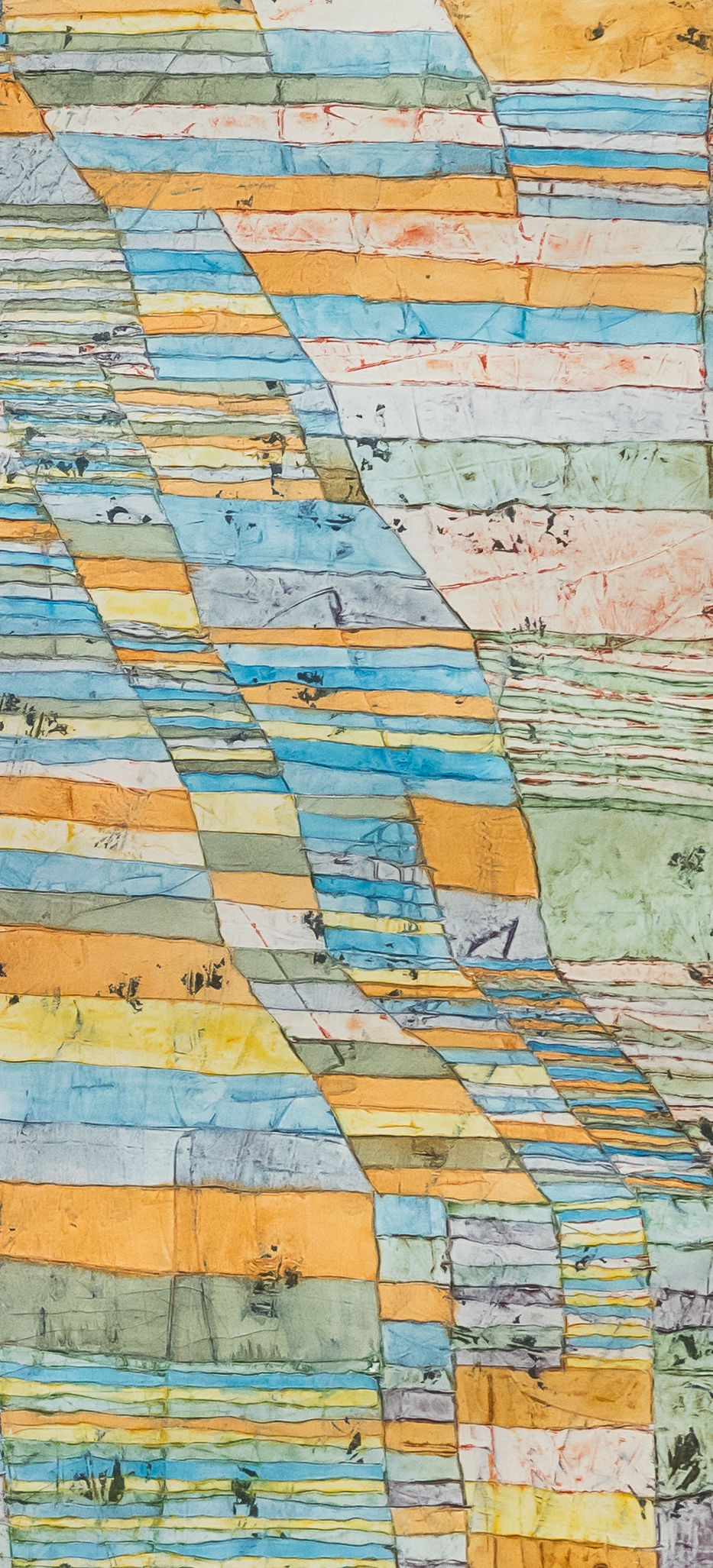
The lower part of the central route
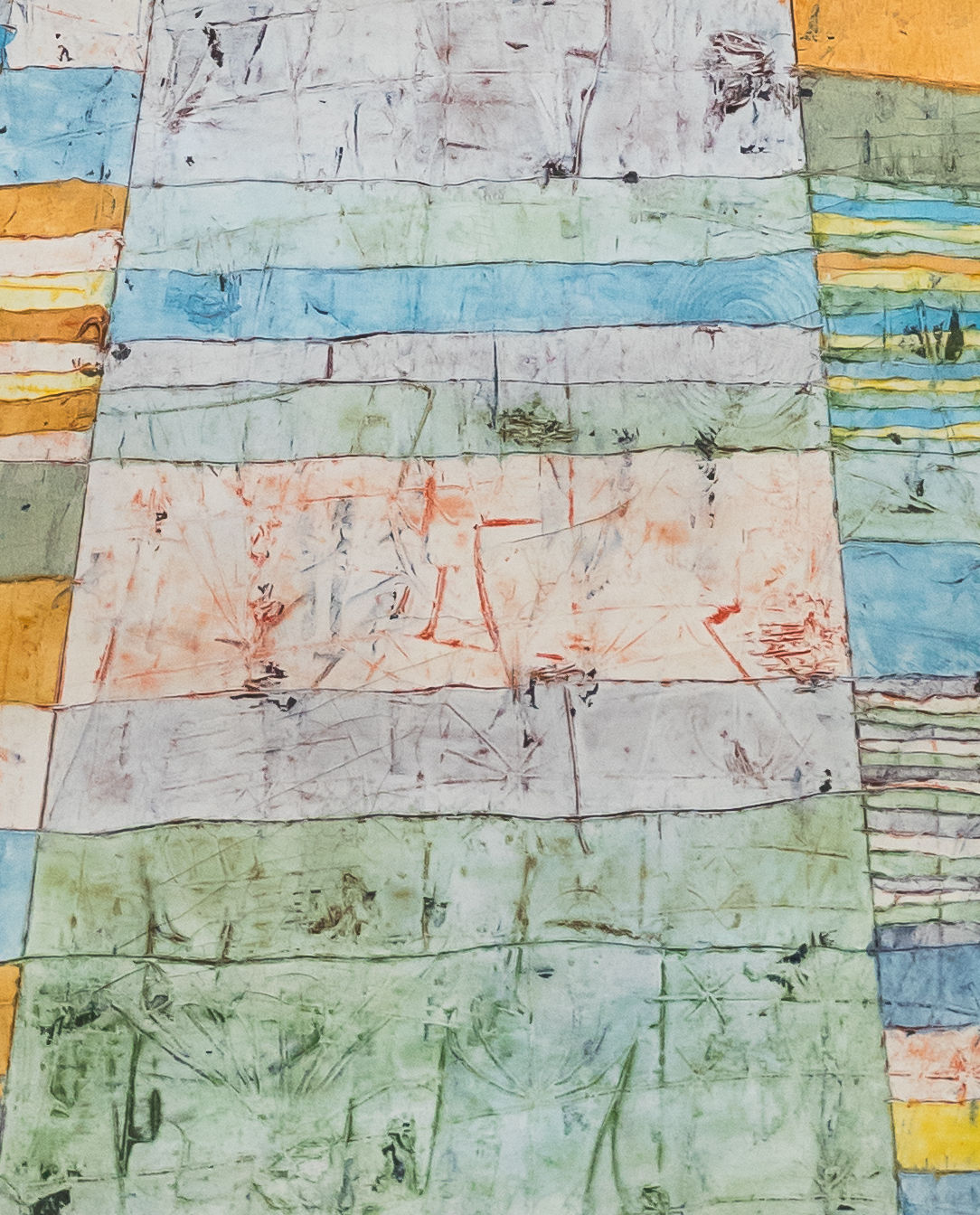
Fine incised and painted marks near the lower right
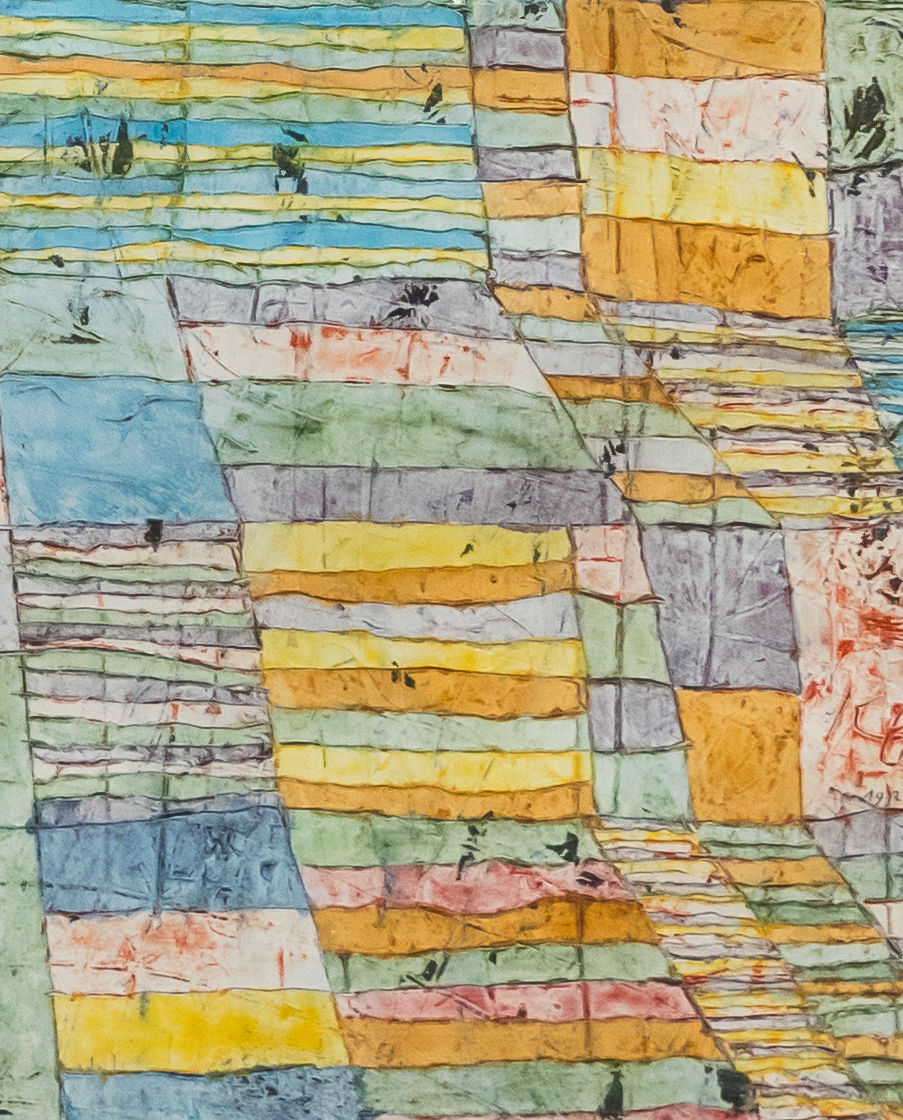
Contents
- One painting, several numbers and names
- Following the main road
- Explore the details of Highway and Byways
- Lines cut into the ground
- Egypt and the picture’s earlier foundations
- Paths as an idea
- From Klee to Cologne
- Looking again
One painting, several numbers and names
Hauptweg und Nebenwege is usually translated as Highway and Byways or Highway and by-ways. The German words more literally distinguish a main road from side roads. An older companion page on this site called the same object “Main Street and Sidewalks”; that translation suggests an urban pavement the painting does not establish. The two titles on the site identify one painting.[1][2]
Klee registered it as 1929,90 in his annual sequence. The later catalogue raisonné assigns it continuous number 4846. Museum Ludwig in Cologne, which holds it, uses inventory number ML 76/3253. These numbers come from different systems: the artist’s work list, a scholarly catalogue and the owning museum. They should not be read as alternative dates or versions of the picture.[1][2]
The museum’s indexed collection record says oil on canvas and measures 83.5 × 67.5 cm. A 2008 Staatliche Museen zu Berlin work list and the Museum Ludwig/ZDF presentation give 83.7 × 67.5 cm; the Berlin list specifies canvas on a stretcher, and the museum’s public presentation describes oil and plaster on canvas. The two published heights differ by two millimetres. There is no documented reason in the available records to prefer an explanation such as a change in measuring convention. A caption can use the owning museum’s current figure while recording the variant rather than hiding it.[1][2][3]
This is a substantial canvas by Klee’s standards in the late 1920s. Art historian Frank Zöllner notes both its relatively large size and the unusual use of an oil-painted, plaster-ground canvas within Klee’s practice to that point. Its physical surface matters: the small cuts, raised edges and marks are part of the painting, not merely outlines reproduced by a printer.[4]
Following the main road
The main route is the broad band rising near the centre. Its boundaries run much more steadily than those of the narrow routes on either side. As it advances upward, its horizontal segments become smaller. A band of blue and grey at the top can appear to be a horizon. The side routes branch, bend, narrow and sometimes seem to stop. This gives the image an apparent direction into distance, even though the coloured strips keep pulling attention back to the flat surface of the canvas.[3][4]
Painting: Museum Ludwig, ML 76/3253. Image: photograph by Raimond Spekking via Wikimedia Commons. The splash, numbered overview and detail crops were resized or cropped from that photograph; image derivatives are shared under CC BY-SA 4.0. Colours in photographs vary with lighting and reproduction.
.jpg)
It helps to look at the horizontal divisions separately from the vertical and diagonal cuts. Across the width, painted fields form successive layers. The upright and slanting edges interrupt them at different points, so an initially simple stack becomes a changing network. Some long strips look continuous for a moment before a cut breaks their course. The central route is comparatively regular, but the neighbouring routes are not accidental scribbles: their irregularity creates the contrast that makes a “main” road visible.[3][4]
Zöllner relates that contrast to Klee’s distinction between dividuell and individuell division in his Bauhaus teaching: a regular subdivision of a shared field against particular, differently placed interruptions. This is a scholarly reading of Klee’s terms applied to the painting, rather than a measurement taken from each coloured cell. The rhythm is visible even without the terminology. A viewer can follow a band sideways and see it change width, colour or apparent direction when it meets the next cut.[4]
In the 2013 Spanish exhibition catalogue Paul Klee: maestro de la Bauhaus, Marianne Keller Tschirren identifies the picture as a particularly familiar example of Klee’s cardinal progression. She gives a sequence of repeated doubling, 1:2:4:8:16:32, unlike a simple count from one to six. This is a generative idea for subdivision. It does not mean that every painted field can be assigned one exact numerical value by looking at a photograph. Her account places the principle among lessons and experiments that precede the Egyptian journey, including a 1919 work with structurally divided fields.[5]
Colour complicates the directional scheme. Warm orange and yellow passages recur on several roads and across the intervals between them; blue appears both in the upper zone and in smaller lower strips. Zöllner describes blue–orange and red–green contrasts in the work. Those relations bring separated cells into conversation, while the road edges keep them apart. Digital images of this painting vary conspicuously in colour balance, including the two older illustrations on this site. A screen cannot establish the painting’s exact original hue, so the best visual account begins with relationships and placement rather than a claim about one definitive shade.[4]
Lines cut into the ground
The linework was not simply drawn on top of finished colour. The Museum Ludwig/ZDF explanation says Klee incised the layout into a fresh plaster ground on canvas before filling its areas with paint. It identifies the main route’s straighter edges as ruler-guided and the side lines as freer marks. This helps explain why the paths feel different even where their colour is similar.[3]
Zöllner’s dedicated study gives a closer sequence. He says Klee cut most of the visible structural lines fairly quickly while the plaster ground was workable. For the two boundaries of the central route, he describes a sharp stylus used with a ruler. Elsewhere he sees a coarser tool guided by hand, which left small ridges in the ground. He then describes the fields being filled with colour; Klee signed and dated a red area near the lower right, and a title and date appear on the stretcher reverse. These are reported observations from Zöllner’s art-historical examination. An independent museum conservation file would be needed to specify the ground’s chemical composition and verify every stage of its application.[4]
Zöllner also reports faint plantlike figures scratched into an earlier ground, before most of the road design was placed into a renewed layer. They can suggest trees, bushes or flowers, but may be hard to see in ordinary reproductions. Earlier scholar Ernst Büchner, whom Zöllner cites, considered them traces of an abandoned composition. Zöllner instead argues that Klee intentionally put an organic foundation beneath the geometric system. The physical traces are relevant to how the picture was made; the reason Klee left them there is debated. They do not entitle us to label every faint form as a particular Egyptian plant.[4]
The preparatory works also resist the idea of a sudden, purely intuitive arrangement. Zöllner identifies two related 1929 drawings, freigelegtes Gelände mit dem Hauptweg and junge Bäume auf freigelegtem Gelände. The first already brings a main route through smaller routes toward a horizon. These drawings show that Klee worked with the road motif before committing it to the larger oil canvas. They also help explain why Zöllner treats this title as unusually deliberate among the layered pictures of 1929.[4]
Egypt and the picture’s earlier foundations
Klee’s Egypt journey ran from 17 December 1928 to 17 January 1929, according to the Zentrum Paul Klee’s itinerary project. The painting belongs to the year after his return, not to a 1929–30 trip. Museum interpretation and the Spanish catalogue connect its colour and spatial breadth with remembered Nile landscapes. The catalogue says the colour can evoke the fertile valley. That is a careful proposition about memory and appearance, not proof that any individual road represents a named canal, plot or town.[3][5][6]
Zöllner places Hauptweg und Nebenwege among the Lagenbilder, works organized in layers or strata that took on a new intensity after Egypt. He also traces their compositional principle to work begun earlier. Egypt provided fresh perceptions that Klee could bring into an existing formal method. The landscape was reconstructed in the studio as a painting rather than copied from a single stop on the itinerary. The bottom blue band may invite a Nile association in Zöllner’s account, but he presents that as a possibility, not an identification.[4]
Egyptologist Dietrich Wildung likewise warns against matching Klee’s divided stripes mechanically to ancient Egyptian art or a particular river view. The artist’s experiments with progression preceded the trip. Italian scholar Michele Dantini discusses this painting with other 1929 Egyptian compositions as part of Klee’s negotiation between exact construction and intuition at the Bauhaus. Dantini’s detailed analysis of five hues and a Giza-like form, however, concerns a different work, Denkmäler bei G. Those features should not be imported into Highway and Byways.[7][8]
The result can recall cultivated land, a route through it and a horizon without fixing a point of view. The painting continually shifts between looking outward at a place and looking closely at the marks that make the place possible. Klee’s travel gave that exchange historical force; his earlier experiments made it possible to build.
Paths as an idea
The title makes roads more than descriptive shapes. A main way and side ways can suggest choices, detours and alternatives. The Museum Ludwig/ZDF presentation proposes a life-path reading. Zöllner finds a longer basis for such an interpretation in Klee’s writings: in an 1898 letter to Hans Bloesch, Klee described visual art as a main road and music as a side road while deciding where to concentrate his work. Later, Klee continued to use related terms for principal and secondary elements in his teaching. That historical vocabulary makes the metaphor worth considering; it does not turn the 1929 canvas into a coded account of a single personal decision.[3][4]
Zöllner connects the picture’s language of routes with Klee’s circumstances near the end of the 1920s. Klee was balancing Bauhaus teaching and time to paint, while considering opportunities beyond the school. Zöllner draws on Klee’s letters and warns against treating the picture as a straightforward autobiographical scene of a person at a crossroads. It is more accurate to say that an artist familiar with the metaphor made a painting in which regularity, deviation and alternatives acquire unusual force. One need not know his private timetable to see those tensions in the image.[4]
The main road itself is not an uncomplicated answer. It is assembled from many colour segments, interrupted horizontally even as its two sides guide it forward. Side routes may narrow or disappear, yet they give the central strip its scale and variety. The painting refuses the neat moral that the broadest route is necessarily the best. The viewer is free to read paths as movement through a landscape, a way of organizing a picture or an analogy for decision. Each reading should be named for what it is rather than presented as Klee’s recorded explanation.[3][4]
From Klee to Cologne
Zöllner reports that the canvas appeared in a 1929 Deutscher Künstlerbund exhibition in Cologne and was acquired that year by collector Werner Vowinckel. He was a founding member of the Klee Society, the collectors’ group that helped finance the artist’s Egypt journey. The owning museum’s indexed provenance record identifies Edith and Werner Vowinckel as acquiring the painting directly from Klee in 1929. The exhibition account and the museum’s direct-from-artist wording should be checked together against sale records; the available accounts agree on the year and collector family but do not on their own establish every step of the transaction.[1][4]
The Vowinckel family retained the work for decades. According to the museum’s indexed record, it was lent to the Wallraf-Richartz-Museum in 1957, first by Edith Vowinckel and later by sons Andreas and Christoph. The Wallraf-Richartz-Museum bought it from the brothers in 1974, assigning number WRM 3253. It was transferred to Museum Ludwig on 23 February 1976, where it became ML 76/3253. Loan and ownership overlap in this story: a museum could display a painting belonging to the family before purchasing it. Museum Ludwig identifies it as part of its permanent collection; whether it is hanging in a gallery on any particular day needs a current display check.[1]
Looking again
Start with the broad route near the centre and follow one edge upward. Then follow a small neighbouring route and notice how often it changes width or direction. Look across the horizontal strips rather than up them. At that angle, the painting becomes an ordering of colour and cuts; looking upward again, it becomes a place to travel through. If a detailed image is available, look for ridges and faint older marks in the ground. They show that the apparent map has a history beneath its visible roads.[3][4]
Highway and Byways is a 1929 oil painting on prepared canvas, numbered 1929,90 by Klee and held by Museum Ludwig. Its relation to the Egypt journey is well supported, but its dividing method and road metaphor had earlier roots. Its original appearance cannot be recovered from one colour-shifted website illustration, and the precise meaning of each path was not left as a key by Klee. What remains open is also what makes the painting productive: a measured surface can keep inviting the experience of walking, remembering and choosing.[1][3][4][5]
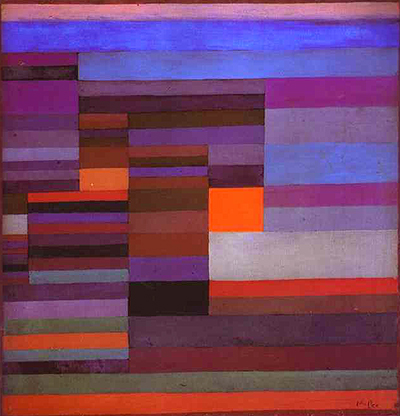
For related work, see Fire in the Evening for another painting from the post-Egypt layered group, Klee’s colour studies for his teaching context, and the paintings overview for a wider chronology.
Explore selected works from Klee’s much larger oeuvre. Titles without a link have an authenticated catalogue identity but no reviewed article yet.
Artworks directory
| Name | Date | Medium |
|---|---|---|
| A Gate | 1939 | Painting and mixed media |
| A Woman for Gods | 1938 | Watercolour and mixed media |
| Ab Ovo | 1917 | Watercolour and mixed media |
| Above Mountain Summit | 1917 | Drawing and mixed media |
| Abstract Trio | 1923 | Drawing and mixed media |
| Acrobats | 1915 | Watercolour and mixed media |
| Actor's Mask | 1924 | Painting and mixed media |
| Ad Marginem | 1930 | Drawing and mixed media |
| Ad Parnassum | 1932 | Painting and mixed media |
| Adventurer Ship | 1927 | Drawing and mixed media |
| Affected Place | 1922 | Drawing and mixed media |
| After a Sketch from Zurich | 1914 | Watercolour and mixed media |
| After Drawing | 1919 | |
| After The Floods | 1936 | Watercolour and mixed media |
| All Souls' Picture | 1921 | |
| Ancient Harmony | 1925 | Painting and mixed media |
| Angel Applicant | 1939 | Drawing and mixed media |
| Angel Serves the Desired | 1920 | |
| Angel, Still Female | 1939 | Painting and mixed media |
| Angelus Novus | 1920 | Drawing and mixed media |
| Animal Terror | 1926 | Painting and mixed media |
| Arab Song | 1932 | Painting and mixed media |
| Archangel | 1938 | Painting and mixed media |
| Architecture | 1923 | Painting and mixed media |
| Architecture of the Plain | 1923 | Drawing and mixed media |
| Around the Fish | 1926 | Painting and mixed media |
| Arrival of the Air Steamer | 1921 | Drawing and mixed media |
| Asiatic God | 1924 | Painting and mixed media |
| Astrological Fantasy Portrait | 1924 | Drawing and mixed media |
| Athlete's Head | 1932 | Watercolour and mixed media |
| Aufgehender Stern | 1931 | Painting and mixed media |
| Autumn Flower | 1922 | Painting and mixed media |
| Bad Band | 1920 | Drawing and mixed media |
| Baroque Centaur | 1939 | Painting and mixed media |
| Before the Blitz | 1923 | Drawing and mixed media |
| Before the Snow | 1929 | Drawing and mixed media |
| Besessenes Madchen | 1924 | Watercolour and mixed media |
| Bird Garden | 1924 | |
| Bird Wandering Off | 1926 | Watercolour and mixed media |
| Blossoms in the Night | 1930 | Watercolour and mixed media |
| Blue-Bird-Pumpkin | 1939 | Painting and mixed media |
| Boats in the Flood | 1937 | Painting and mixed media |
| Botanical Theatre | 1934 | Drawing and mixed media |
| Boy in Fancy Dress | 1931 | Watercolour and mixed media |
| Broken Key | 1938 | |
| Brother and Sister | 1930 | Watercolour and mixed media |
| But the Red Roof | 1935 | Painting and mixed media |
| C - C = Fisch | 1931 | Watercolour and mixed media |
| Cacti | 1912 | Painting and mixed media |
| Camel (in Rhythmic Landscape with Trees) | 1920 | Drawing and mixed media |
| Captive Pierrot | 1923 | Drawing and mixed media |
| Castle and Sun | 1928 | Drawing and mixed media |
| Cat and Bird | 1928 | Drawing and mixed media |
| Cathedrals | 1925 | Watercolour and mixed media |
| Chalice of the Heart | 1937 | Painting and mixed media |
| Characters in Yellow | 1937 | Painting and mixed media |
| Chosen Site | 1927 | Mixed media |
| Christmas Picture | 1923 | Drawing and mixed media |
| City of Towers | 1916 | Painting and mixed media |
| Clarification | 1932 | Painting and mixed media |
| Collection of Figurines | 1926 | Painting and mixed media |
| Colorful Architecture | 1917 | Painting and mixed media |
| Comedians' Handbill | 1938 | |
| Comic Opera Singer | 1927 | Painting and mixed media |
| Composition | 1939 | Painting and mixed media |
| Composition with Figures | 1915 | Drawing and mixed media |
| Composition with the Yellow Half-Moon and the Y | 1918 | Watercolour and mixed media |
| Conch–Still Life II | 1939 | Watercolour and mixed media |
| Cosmic Composition | 1919 | Painting and mixed media |
| Crystal Gradation | 1921 | Drawing and mixed media |
| Dance of the Grieving Child | 1922 | Painting and mixed media |
| Dancing Girl | 1940 | Painting and mixed media |
| Das Licht und Etliches | 1931 | Mixed media |
| Death and Fire | 1940 | Painting and mixed media |
| Death for the Idea | 1915 | |
| Demon as Pirate | 1926 | Watercolour and mixed media |
| Diana | 1931 | Painting and mixed media |
| Diavolo Player | 1923 | Drawing and mixed media |
| Die Kapelle | 1917 | Watercolour and mixed media |
| Die Vase | 1938 | Painting and mixed media |
| Doctor | 1930 | Drawing and mixed media |
| Dredger and Sailboat | 1931 | Watercolour and mixed media |
| Ein Tor | 1939 | Painting and mixed media |
| Ein Weib fur Gotter | 1938 | Mixed media |
| Embrace | 1939 | Watercolour and mixed media |
| Episode before an Arab Town | 1923 | |
| Equals Infinity | 1932 | Painting and mixed media |
| Eros | 1923 | Drawing and mixed media |
| Error on Green | 1930 | Watercolour and mixed media |
| Evening Figure | 1935 | Drawing and mixed media |
| Falling Bird | 1919 | |
| Fermata | 1932 | Watercolour and mixed media |
| Fire Clown | 1921 | Watercolour and mixed media |
| Fire Full Moon | 1933 | Watercolour and mixed media |
| Fire in the Evening | 1929 | Painting and mixed media |
| Fish in the Harbour | 1916 | Watercolour and mixed media |
| Fish Magic | 1925 | Watercolour and mixed media |
| Flock of Birds | 1917 | Drawing and mixed media |
| Flora on Sand | 1927 | Watercolour and mixed media |
| Flower Myth | 1918 | |
| Flower Stand with Watering Can and Bucket | 1910 | Watercolour and mixed media |
| Flowering Tree (Abstraction with Reference to a Flowering Tree) | 1925 | Painting and mixed media |
| Flowers in Pots | 1923 | |
| Flowers in Stone | 1939 | Painting and mixed media |
| Forest Witch | 1938 | Painting and mixed media |
| Fright of a Girl | 1922 | Drawing and mixed media |
| Fruits on Red | 1930 | Drawing and mixed media |
| Full Moon | 1919 | Mixed media |
| Föhn Wind in Franz Marc's Garden | 1915 | Watercolour and mixed media |
| Garden in St Germain, The European Quarter near Tunis | 1914 | Watercolour and mixed media |
| Ghost Chamber with the Tall Door (New Version) | 1925 | |
| Ghost of a Genius | 1922 | Drawing and mixed media |
| Girl in Mourning | 1939 | Painting and mixed media |
| Glance of a Landscape | 1926 | Watercolour and mixed media |
| Gluht Nach | 1939 | Drawing and mixed media |
| Golden Fish | 1925 | Watercolour and mixed media |
| Goldfish Wife | 1921 | Watercolour and mixed media |
| Green Plant, Blood, Louse | 1924 | Drawing and mixed media |
| Hafenbild | 1918 | Mixed media |
| Hammamet with Mosque | 1914 | Watercolour and mixed media |
| Harbour with Sailing Ships | 1937 | Painting and mixed media |
| Hauptweg und Nebenwege | 1929 | Painting and mixed media |
| Heavenly and Earthly Time | 1927 | Drawing and mixed media |
| Heroic Fiddling | 1938 | Painting and mixed media |
| Heroic Roses | 1938 | Painting and mixed media |
| Heroic Strokes of the Bow | — | Mixed media |
| Highway and Byways | 1929 | Drawing and mixed media |
| Houses near the Gravel Pit | 1913 | Watercolour and mixed media |
| Howling Dog | 1928 | Painting and mixed media |
| In the Current Six Thresholds | 1929 | Painting and mixed media |
| In the Style of Kairouan | 1914 | Drawing and mixed media |
| Individualized Altimetry of Stripes | 1930 | Painting and mixed media |
| Insula Dulcamara | 1938 | |
| Interior with the Clock | 1913 | Watercolour and mixed media |
| Irma Rossa the Animal Tamer | 1918 | Drawing and mixed media |
| Journey in Corsica | 1927 | Drawing and mixed media |
| Landscape with Bluebirds | 1919 | Watercolour and mixed media |
| Legend of the Nile | 1937 | Painting and mixed media |
| Lemon Harvest | 1937 | Watercolour and mixed media |
| Likeness in the Bower | 1930 | Watercolour and mixed media |
| Limits of Reason | 1927 | Painting and mixed media |
| Little Hope | 1938 | Watercolour and mixed media |
| Magdalena before the Conversion | 1938 | Drawing and mixed media |
| Mask of Fear | 1932 | Painting and mixed media |
| May Picture | 1925 | Painting and mixed media |
| Monument in a Cemetery | 1922 | Watercolour and mixed media |
| Monuments at G | 1929 | Watercolour and mixed media |
| Municipal Jewel | 1917 | Watercolour and mixed media |
| Mural from the Temple of Longing Thither | 1922 | |
| Nach der Uberschwemmung | 1936 | Watercolour and mixed media |
| New Harmony | 1936 | Painting and mixed media |
| New House in the Suburbs | — | Mixed media |
| Old Steamboat | 1922 | Drawing and mixed media |
| On the Edge | 1930 | Drawing and mixed media |
| Once Emerged from the Gray of Night | 1918 | Drawing and mixed media |
| One Who Understands | 1934 | Painting and mixed media |
| Oriental Pleasure Garden | 1925 | Painting and mixed media |
| Park of Idols | 1939 | Watercolour and mixed media |
| Passing by Red Pillars | 1928 | Watercolour and mixed media |
| Persian Nightingales | 1917 | Drawing and mixed media |
| Popular Wall Painting | 1922 | Painting and mixed media |
| Prestidigitator | 1927 | Watercolour and mixed media |
| Rainy Day | 1931 | Watercolour and mixed media |
| Red and White Domes | 1914 | Watercolour and mixed media |
| Red Balloon | 1922 | Drawing and mixed media |
| Redgreen and Violet-Yellow Rhythms | 1920 | Drawing and mixed media |
| Refuge | 1930 | Watercolour and mixed media |
| Rhythmic Rythmical | 1930 | Painting and mixed media |
| Saint of the Inner Light | 1921 | |
| Scaffolding of a New Building | 1930 | Painting and mixed media |
| Scholar in Dealing with Stars | 1926 | Watercolour and mixed media |
| Seated Woman | 1930 | Drawing and mixed media |
| Senecio | 1922 | Painting and mixed media |
| Separation in the Evening | 1922 | Drawing and mixed media |
| Sinbad the Sailor | 1923 | Drawing and mixed media |
| Skeptically Smiling | — | Mixed media |
| Small House in the Garden City | 1928 | Watercolour and mixed media |
| Small Portrait of a Girl in Yellow | 1925 | Painting and mixed media |
| Southern Gardens | 1919 | Watercolour and mixed media |
| Static-Dynamic Gradation | 1923 | Drawing and mixed media |
| Still Life | 1927 | Painting and mixed media |
| Still Life with Gladioli | 1932 | Watercolour and mixed media |
| Strange Garden | 1923 | Drawing and mixed media |
| Stricken City | 1936 | Painting and mixed media |
| Strong Dream | 1929 | Watercolour and mixed media |
| Struck from the List | 1933 | Drawing and mixed media |
| Structural I | 1924 | Drawing and mixed media |
| Sumpflegende | 1919 | Painting and mixed media |
| Temple Gardens | 1920 | Drawing and mixed media |
| The Arrow before the Target | 1921 | Drawing and mixed media |
| The Barbed Noose with the Mice | 1923 | Watercolour and mixed media |
| The Flora of the Heath | 1925 | Watercolour and mixed media |
| The Goldfish | 1925 | Watercolour and mixed media |
| The Hour Before One Night | 1940 | Painting and mixed media |
| The Man in Love | 1923 | |
| The Mask with the Flag | 1925 | Mixed media |
| The Pathos of Fertility | 1921 | |
| The Rhine at Duisburg | 1937 | Painting and mixed media |
| The Way to the Citadel | 1937 | Painting and mixed media |
| Three Houses and a Bridge | 1922 | Watercolour and mixed media |
| Tightrope Walker | 1923 | |
| Tomb in Three Parts | 1923 | Watercolour and mixed media |
| Tomcat's Turf | 1919 | Watercolour and mixed media |
| Tower in Orange and Green | 1922 | Drawing and mixed media |
| Tree and Architecture - Rhythms I | 1920 | Watercolour and mixed media |
| Tree and Architecture - Rhythms II | 1920 | Painting and mixed media |
| Tropical Dawn with the Owl | 1921 | Mixed media |
| Tropische Dammerung | 1921 | Painting and mixed media |
| Twittering Machine | 1922 | Drawing and mixed media |
| Variations (Progressive Motif) | 1927 | Watercolour and mixed media |
| Ventriloquist and Crier in the Moor | 1923 | |
| Viaducts Break Ranks | 1937 | Drawing and mixed media |
| Villa R | 1919 | Painting and mixed media |
| Village Carnival | 1926 | Painting and mixed media |
| Vor dem Blitz | 1923 | Drawing and mixed media |
| Wald-Hexen | 1938 | Painting and mixed media |
| Young Forest | 1925 | Drawing and mixed media |
Related artworks
Explore eight other Klee works, beginning with works close in date to this one.
Fire in the Evening
1929
Ad Marginem
1930
Castle and Sun
1928
Cat and Bird
1928
Error on Green
1930
Flora on Sand
1927
Ad Parnassum
1932
Around the Fish
1926
Discussion
The straight central road and branching side routes make a landscape and a measured rhythm visible at once.
The evidence distinguishes Egyptian memory, earlier Bauhaus construction and later life-path interpretations.
Reader Insights
How do the divisions change your sense of distance along the central road?
Which side route first makes you notice a break in the horizontal bands?
Which museum record could clarify the two published measurements?
Join the Conversation
Share what you see or a source that helps explain the work.
References
- Museum Ludwig / Kulturelles Erbe Köln, “Hauptweg und Nebenwege,” inventory ML 76/3253, indexed collection and provenance record (German; direct display presented a proof-of-work challenge on 26 September 2026), View source.
- Staatliche Museen zu Berlin, Das Universum Klee work list (2008), entry 1929,90 / catalogue raisonné 4846, medium, dimensions and English title (German/English), View source.
- ZDF with Museum Ludwig, “Paul Klee – Hauptweg und Nebenwege,” Geheimnis der Bilder, object facts and interactive interpretation (German; accessed 26 September 2026), View source.
- Frank Zöllner, “Paul Klee, Hauptweg und Nebenwege, 1929,” Wallraf-Richartz-Jahrbuch 61 (2000), pp. 263–90 according to the author-uploaded electronic text (German; electronic pagination differs from print), View source.
- Marianne Keller Tschirren, “Ritmo,” in Fundación Juan March and Zentrum Paul Klee, Paul Klee: maestro de la Bauhaus (Madrid, 2013), pp. 126–28, on Cardinalprogression and this painting (Spanish), View source.
- Zentrum Paul Klee, Mapping Klee, indexed Egypt itinerary, 17 December 1928–17 January 1929 (German/English), View source.
- Dietrich Wildung, “Altägypten im Werk von Paul Klee,” MAAT 7 (2018), pp. 41–42, on pre-existing structure and qualified Egyptian associations (German), View source.
- Michele Dantini, “«Esattezza» nei territori dell’«intuizione». Paul Klee al Bauhaus,” Disegno 6 (2020), pp. 111–22, especially pp. 120–21 (Italian; editorially supervised invited essay), View source.