


 by Tom Gurney
Tom Gurney BSc (Hons) is an art history expert with over 20 years experience
Published on June 19, 2020 / Updated on September 27, 2026
Email: tomgurney1@gmail.com / Phone: +44 7429 011000
Flowers made of colour fields
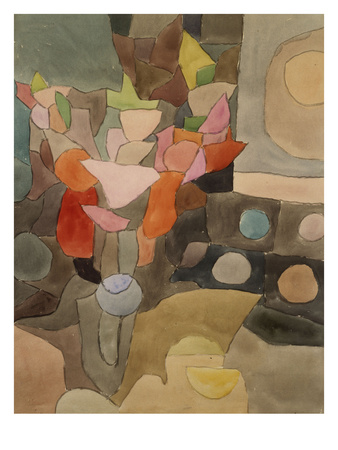
Red and pink shapes spread across the upper half of a vertical sheet. Green points rise among them, while a pale blue-grey vessel seems to hold the arrangement below. It takes a moment to see a bouquet in Paul Klee’s Still Life with Gladioli. The flowers are recognisable, yet each petal or leaf also belongs to a wider pattern of irregular colour areas. Klee made the work in 1932. Its carefully documented title and inscriptions help anchor an image whose spatial relations remain deliberately difficult to settle.[1][2][3]
The Miyagi Museum of Art in Sendai owns this work as DF 45. Current museum material calls it watercolour and ink on paper mounted on card. A 2006 checklist from the same museum instead says watercolour and chalk. That difference has not been resolved by a technical report available to this page. It is more honest to name it than to pretend the dark divisions or pale passages can reveal their chemical makeup in a small reproduction.[1][2][4]
Contents
- Which Still Life with Gladioli is this?
- Is it ink or chalk with the watercolour?
- Where are the gladioli?
- Is a still life allowed to grow?
- What can 1932 tell us about the sheet?
- From the Miyagi collection to local public life
- Looking again
Which Still Life with Gladioli is this?
The German words Gladiolen Stilleben are recorded on the mount at lower right. The same collection-derived record identifies “Klee” at upper right and “1932 V 3” at lower left on the mount. Miyagi’s 2006 exhibition checklist gives the fuller artist number 1932,223 (V 3). These marks matter because they join title, year and object in a way that a generic English flower title does not. They also correct an old claim on this site that Klee “mostly left” this group of works unsigned: this particular sheet is signed. A signature on one work cannot establish a rule for all his pictures of the decade.[1][2]
The Japanese title is グラジオラスの静物 (Gurajiorasu no seibutsu). The museum’s 2026 bilingual list translates it as Still Life with Gladioli. Art Platform Japan, a national collection database using Miyagi’s 1992 revised catalogue, displays the less idiomatic English “Gladiolas-Stillife.” The page uses the museum’s current English display title while retaining Klee’s inscribed German wording. None of these variants points to a second Klee work.[1][4]
The image measures 62.0 × 47.5 cm; with its mount, the recorded size is 63.8 × 49.9 cm. The numbers measure different components rather than competing estimates of the same one. Art Platform Japan cites Miyagi’s 1992 revised collection catalogue, no. 2278, and records a purchase in Japanese fiscal year Heisei 3 (1991–92). That gives an acquisition period, but it does not identify the seller or the painting’s previous owners. The inventory number DF 45 and artist number 1932,223 (V 3) are useful safeguards against similarly named works by other painters or mislabelled prints.[1][4]
Is it ink or chalk with the watercolour?
The Japanese phrase on the collection-derived Art Platform Japan record is 紙、水彩、インク、台紙に貼付: paper, watercolour, ink, mounted on a backing. Miyagi’s 2023 and 2026 display lists repeat watercolour and ink. A Niigata museum loan list from 2011 uses the same pair. The current and repeatedly used museum description therefore provides the main caption here.[1][4][5]
Yet the owner’s 2006 Klee exhibition checklist, item 97, says 紙、水彩・白亜、厚紙に貼付: watercolour and hakua, chalk or white chalk, on paper mounted on card. This is a real institutional variant, not simply a retailer’s mistake. It might record another identified medium, a changed catalogue opinion, or an error in one list. The accessible records do not tell us which. The Niigata list may also inherit Miyagi’s wording, so several agreeing captions should not be counted as several independent conservation examinations.[2][5]
The distinction matters for how we describe the surface. Dark lines in a reproduction may look like ink, but appearance alone cannot establish their composition. Pale passages could be pigment, a white drawing medium, unpainted paper or a product of the image’s colour processing. A technical file, examination by the Miyagi collection team, or the original catalogue raisonné entry would resolve more than speculation from a small splash. This page therefore follows the current owner wording and preserves the 2006 exception as an open question.[1][2][3][4]
The sheet is mounted. Klee’s German title and the annual notation are on that mount according to the database transcription. A cropped image of the painted field would hide part of this object evidence. The support is not a stretched oil canvas. The physical paper, mount and inscriptions are part of why this exact 1932 still life can be distinguished from a vaguely similar printed flower image.[1][3]
Where are the gladioli?
Begin near the top centre and left. Red, orange and pink forms open into irregular petals, interrupted by upright green shapes. A few forms are sharply pointed, while others curve or droop. They do not add up to a botanically precise stem with every flower correctly attached. Their clustering and the title guide recognition. The painted sheet lets a viewer see a bouquet emerging from coloured pieces that can also be followed without naming them.[1][3]
Below the brighter flower forms, a pale blue-grey shape narrows towards the bottom. It can be read as a vase, perhaps containing stems whose exact joins are hard to follow. Around it lie broad brown and grey areas. Some seem to belong to a table or room; others meet the flowers so closely that foreground and background become uncertain. A small pale yellow bowl-like shape near the bottom offers another possible object. The sheet has still-life ingredients, but their boundaries are unstable.[3]
To the right, several circles or discs sit in darker compartments. They may recall flower heads, fruit, plates, reflections or simply spots of colour. The old page called them “round heads” of people and expanded the picture into busy street life and community. Neither the title nor the Miyagi object record supplies a crowd. A face-like impression is something an individual viewer might notice, but it cannot replace the documented subject as the principal account of the painting.[1][3]
The image is tall, giving the floral cluster room to rise. The lower vessel draws the eye back down, while the circles on the right pull it sideways. Dark contours keep the coloured compartments distinct, but they also let the eye cross from one apparent object into the surrounding field. Many still lifes hold objects against a clear tabletop and wall. Here a horizontal division can be sensed, yet no single line fixes the space all the way across. The pleasure of looking comes partly from repeatedly finding and losing the bouquet.[3]
The existing page image has a broad white printed surround. It is useful for the arrangement and large colour relations, but it is not a high-resolution study of Klee’s watercolour surface. The field can be described carefully from it; the exact hue, paper texture, mount edges, inscriptions and material passages need a faithful owner image or the object itself. The page has not substituted a retail print for that evidence.[1][3]
Is a still life allowed to grow?
The title says still life, a genre usually associated with arranged things at rest. Klee’s flower seems less settled. Coloured parts open out as the eye moves upward, and the border between one petal and the next is not always the border between one object and another. It is reasonable to describe a visual effect of growth or expansion. That is a way of following the forms, not a claim that Klee painted an illustrated sequence of plant development.[3]
Miyagi’s 2006 Klee retrospective divided its survey into themes including light, nature and abstraction, energy of form, image play and narrative landscape. Still Life with Gladioli was item 97 in the energy of form section. The next checklist item was another 1932 flower work, Spirally Twisted Flowers 2, loaned from the Sprengel collection. The placement shows how the 2006 curators invited viewers to see movement within a floral subject. It does not prove that the two works were conceived as a pair, nor does it determine a single formal rule for both.[2][6]
A Japanese discussion of Klee’s pictorial theory takes that idea further. It describes the irregular coloured areas as opening upwards and compares their movement from calyx towards petals with Goethe’s idea of an archetypal plant. The online copy ends this and neighbouring object notes with the initials “F.G.” and appears to transcribe material associated with the 2006 exhibition catalogue. Its exact printed page and contributor key have not yet been checked. Fumiko Goto was a curator involved with the exhibition and wrote for its catalogue, so she is a plausible match for the initials, but the attribution of this precise paragraph is not secure from the web copy alone.[6][7]
The growth reading is an interpretation, not a statement written by Klee on the mount. It points to something visible: irregular regions of colour appear to expand from lower to upper parts of the sheet. The Goethe analogy becomes much stronger only if a dated Klee note, a documented book source or a work-specific commentary connects this 1932 picture with the particular botanical theory. Klee’s interest in nature and the teaching of form provides context; it does not turn each flower he painted into an illustration of the Urpflanze.[3][7]
The most useful lesson of the Japanese commentary is methodological. A still-life title can name what we recognise, while the painting shows how recognition happens through coloured intervals, upward movement and changing scale. The sheet holds both a flower and a process of making flower-like forms. This is a close-looking argument that a reader can test without accepting a fixed symbolic code.[3][7]
What can 1932 tell us about the sheet?
The inscription and museum checklist place the work in 1932, during Klee’s period of teaching in Düsseldorf. That historical setting should not become an automatic explanation of the image. Nothing in the available object record says it was made for a class, copied from a classroom plant or intended as an exercise in colour theory. The title, materials and visible construction deserve priority over a generic story about everything Klee taught.[1][2]
The 2006 Miyagi checklist placed the work close to other pieces with natural and abstract forms, but a retrospective’s order is a curatorial choice. A comparison becomes useful only when it tells us something specific: another 1932 flower sheet may share an interest in spiralling or growth, while differing in material, size or treatment of the stem. Without a faithful image and object file for both, a claim of direct derivation would be too strong. The same caution applies to sweeping labels such as “Cubist,” “childlike” or “North African” if they are offered without a passage in this work to examine.[2][3]
The old page also claimed that Picasso and Braque developed similar images later because of this still life. No source there establishes such an influence. Their Cubist still lifes were already well developed long before 1932. Similarity of fragmented forms is not a dated path of influence. The meaningful modernist question for this page is more local: how does Klee let the viewer identify a flower while refusing a single, transparent space around it?[3]
The medium dispute is a reminder that the painting is a made object, not just a set of ideas about modern art. Whether the secondary material is ink or chalk affects the exact account of its line and surface. The annual number, mount and owner file can be investigated; they are better starting points for a technical history than an unsupported stylistic category.[1][2][4]
From the Miyagi collection to local public life
Art Platform Japan records that Miyagi purchased the work in fiscal 1991, and the museum subsequently used it in a number of exhibitions. Its 2006 Klee retrospective made it part of a large survey supported by major German collections. The 2023 and 2026 Miyagi lists show it continuing in collection displays. The current location and repeated cataloguing are documented; the public records consulted do not reconstruct its route from Klee to the Japanese acquisition. That earlier provenance remains a question for the original collection file and the catalogue raisonné.[1][2][4][6]
The painting also entered the visual life of a local school. In a published reflection, the principal of Miyagino High School said that Still Life with Gladioli appeared for many years on the cover of the school’s annual handbook. He encouraged readers to spend time with its apparently irregular colours and look for a sense of harmony. This is a concrete example of Japanese reception: a museum work becoming familiar in a school setting. It is not evidence that Klee painted the sheet to teach harmony or that every viewer must find the same balance.[8]
The museum’s changing exhibition frames are equally revealing. In 2006, the flower joined an “energy of form” sequence; in 2026, a broader collection list placed it among works presented in the context of the 1930s. The object remained the same while the public questions around it changed. The current page can present those choices without mistaking an exhibition heading for a word from Klee’s own title.[2][4][6]
Looking again
Find the upper red and pink cluster, then follow the green points through it. Let the pale vessel pull the eye downward and see how the rounded forms on the right resist a tidy division between flower, object and room. That movement gives the still life its distinctive tension. It is a flower picture that does not freeze every part of a flower into a separate labelled piece.[3]
The documented facts are specific: Gladiolen Stilleben, 1932,223 (V 3), a signed and titled mounted sheet in Miyagi, with an image area of 62.0 × 47.5 cm. The current ink label and older chalk label remain in tension. The later growth reading makes a fruitful question for viewing, while the school’s long use of the image shows another kind of afterlife. None of these accounts requires the painting to depict a crowd, and none turns a small reproduction into a technical examination. For more on Klee’s varied supports, see materials and techniques and the paintings directory.[1][2][3][8]
Explore selected works from Klee’s much larger oeuvre. Titles without a link have an authenticated catalogue identity but no reviewed article yet.
Artworks directory
| Name | Date | Medium |
|---|---|---|
| A Gate | 1939 | Painting and mixed media |
| A Woman for Gods | 1938 | Watercolour and mixed media |
| Ab Ovo | 1917 | Watercolour and mixed media |
| Above Mountain Summit | 1917 | Drawing and mixed media |
| Abstract Trio | 1923 | Drawing and mixed media |
| Acrobats | 1915 | Watercolour and mixed media |
| Actor's Mask | 1924 | Painting and mixed media |
| Ad Marginem | 1930 | Drawing and mixed media |
| Ad Parnassum | 1932 | Painting and mixed media |
| Adventurer Ship | 1927 | Drawing and mixed media |
| Affected Place | 1922 | Drawing and mixed media |
| After a Sketch from Zurich | 1914 | Watercolour and mixed media |
| After Drawing | 1919 | |
| After The Floods | 1936 | Watercolour and mixed media |
| All Souls' Picture | 1921 | |
| Ancient Harmony | 1925 | Painting and mixed media |
| Angel Applicant | 1939 | Drawing and mixed media |
| Angel Serves the Desired | 1920 | |
| Angel, Still Female | 1939 | Painting and mixed media |
| Angelus Novus | 1920 | Drawing and mixed media |
| Animal Terror | 1926 | Painting and mixed media |
| Arab Song | 1932 | Painting and mixed media |
| Archangel | 1938 | Painting and mixed media |
| Architecture | 1923 | Painting and mixed media |
| Architecture of the Plain | 1923 | Drawing and mixed media |
| Around the Fish | 1926 | Painting and mixed media |
| Arrival of the Air Steamer | 1921 | Drawing and mixed media |
| Asiatic God | 1924 | Painting and mixed media |
| Astrological Fantasy Portrait | 1924 | Drawing and mixed media |
| Athlete's Head | 1932 | Watercolour and mixed media |
| Aufgehender Stern | 1931 | Painting and mixed media |
| Autumn Flower | 1922 | Painting and mixed media |
| Bad Band | 1920 | Drawing and mixed media |
| Baroque Centaur | 1939 | Painting and mixed media |
| Before the Blitz | 1923 | Drawing and mixed media |
| Before the Snow | 1929 | Drawing and mixed media |
| Besessenes Madchen | 1924 | Watercolour and mixed media |
| Bird Garden | 1924 | |
| Bird Wandering Off | 1926 | Watercolour and mixed media |
| Blossoms in the Night | 1930 | Watercolour and mixed media |
| Blue-Bird-Pumpkin | 1939 | Painting and mixed media |
| Boats in the Flood | 1937 | Painting and mixed media |
| Botanical Theatre | 1934 | Drawing and mixed media |
| Boy in Fancy Dress | 1931 | Watercolour and mixed media |
| Broken Key | 1938 | |
| Brother and Sister | 1930 | Watercolour and mixed media |
| But the Red Roof | 1935 | Painting and mixed media |
| C - C = Fisch | 1931 | Watercolour and mixed media |
| Cacti | 1912 | Painting and mixed media |
| Camel (in Rhythmic Landscape with Trees) | 1920 | Drawing and mixed media |
| Captive Pierrot | 1923 | Drawing and mixed media |
| Castle and Sun | 1928 | Drawing and mixed media |
| Cat and Bird | 1928 | Drawing and mixed media |
| Cathedrals | 1925 | Watercolour and mixed media |
| Chalice of the Heart | 1937 | Painting and mixed media |
| Characters in Yellow | 1937 | Painting and mixed media |
| Chosen Site | 1927 | Mixed media |
| Christmas Picture | 1923 | Drawing and mixed media |
| City of Towers | 1916 | Painting and mixed media |
| Clarification | 1932 | Painting and mixed media |
| Collection of Figurines | 1926 | Painting and mixed media |
| Colorful Architecture | 1917 | Painting and mixed media |
| Comedians' Handbill | 1938 | |
| Comic Opera Singer | 1927 | Painting and mixed media |
| Composition | 1939 | Painting and mixed media |
| Composition with Figures | 1915 | Drawing and mixed media |
| Composition with the Yellow Half-Moon and the Y | 1918 | Watercolour and mixed media |
| Conch–Still Life II | 1939 | Watercolour and mixed media |
| Cosmic Composition | 1919 | Painting and mixed media |
| Crystal Gradation | 1921 | Drawing and mixed media |
| Dance of the Grieving Child | 1922 | Painting and mixed media |
| Dancing Girl | 1940 | Painting and mixed media |
| Das Licht und Etliches | 1931 | Mixed media |
| Death and Fire | 1940 | Painting and mixed media |
| Death for the Idea | 1915 | |
| Demon as Pirate | 1926 | Watercolour and mixed media |
| Diana | 1931 | Painting and mixed media |
| Diavolo Player | 1923 | Drawing and mixed media |
| Die Kapelle | 1917 | Watercolour and mixed media |
| Die Vase | 1938 | Painting and mixed media |
| Doctor | 1930 | Drawing and mixed media |
| Dredger and Sailboat | 1931 | Watercolour and mixed media |
| Ein Tor | 1939 | Painting and mixed media |
| Ein Weib fur Gotter | 1938 | Mixed media |
| Embrace | 1939 | Watercolour and mixed media |
| Episode before an Arab Town | 1923 | |
| Equals Infinity | 1932 | Painting and mixed media |
| Eros | 1923 | Drawing and mixed media |
| Error on Green | 1930 | Watercolour and mixed media |
| Evening Figure | 1935 | Drawing and mixed media |
| Falling Bird | 1919 | |
| Fermata | 1932 | Watercolour and mixed media |
| Fire Clown | 1921 | Watercolour and mixed media |
| Fire Full Moon | 1933 | Watercolour and mixed media |
| Fire in the Evening | 1929 | Painting and mixed media |
| Fish in the Harbour | 1916 | Watercolour and mixed media |
| Fish Magic | 1925 | Watercolour and mixed media |
| Flock of Birds | 1917 | Drawing and mixed media |
| Flora on Sand | 1927 | Watercolour and mixed media |
| Flower Myth | 1918 | |
| Flower Stand with Watering Can and Bucket | 1910 | Watercolour and mixed media |
| Flowering Tree (Abstraction with Reference to a Flowering Tree) | 1925 | Painting and mixed media |
| Flowers in Pots | 1923 | |
| Flowers in Stone | 1939 | Painting and mixed media |
| Forest Witch | 1938 | Painting and mixed media |
| Fright of a Girl | 1922 | Drawing and mixed media |
| Fruits on Red | 1930 | Drawing and mixed media |
| Full Moon | 1919 | Mixed media |
| Föhn Wind in Franz Marc's Garden | 1915 | Watercolour and mixed media |
| Garden in St Germain, The European Quarter near Tunis | 1914 | Watercolour and mixed media |
| Ghost Chamber with the Tall Door (New Version) | 1925 | |
| Ghost of a Genius | 1922 | Drawing and mixed media |
| Girl in Mourning | 1939 | Painting and mixed media |
| Glance of a Landscape | 1926 | Watercolour and mixed media |
| Gluht Nach | 1939 | Drawing and mixed media |
| Golden Fish | 1925 | Watercolour and mixed media |
| Goldfish Wife | 1921 | Watercolour and mixed media |
| Green Plant, Blood, Louse | 1924 | Drawing and mixed media |
| Hafenbild | 1918 | Mixed media |
| Hammamet with Mosque | 1914 | Watercolour and mixed media |
| Harbour with Sailing Ships | 1937 | Painting and mixed media |
| Hauptweg und Nebenwege | 1929 | Painting and mixed media |
| Heavenly and Earthly Time | 1927 | Drawing and mixed media |
| Heroic Fiddling | 1938 | Painting and mixed media |
| Heroic Roses | 1938 | Painting and mixed media |
| Heroic Strokes of the Bow | — | Mixed media |
| Highway and Byways | 1929 | Drawing and mixed media |
| Houses near the Gravel Pit | 1913 | Watercolour and mixed media |
| Howling Dog | 1928 | Painting and mixed media |
| In the Current Six Thresholds | 1929 | Painting and mixed media |
| In the Style of Kairouan | 1914 | Drawing and mixed media |
| Individualized Altimetry of Stripes | 1930 | Painting and mixed media |
| Insula Dulcamara | 1938 | |
| Interior with the Clock | 1913 | Watercolour and mixed media |
| Irma Rossa the Animal Tamer | 1918 | Drawing and mixed media |
| Journey in Corsica | 1927 | Drawing and mixed media |
| Landscape with Bluebirds | 1919 | Watercolour and mixed media |
| Legend of the Nile | 1937 | Painting and mixed media |
| Lemon Harvest | 1937 | Watercolour and mixed media |
| Likeness in the Bower | 1930 | Watercolour and mixed media |
| Limits of Reason | 1927 | Painting and mixed media |
| Little Hope | 1938 | Watercolour and mixed media |
| Magdalena before the Conversion | 1938 | Drawing and mixed media |
| Mask of Fear | 1932 | Painting and mixed media |
| May Picture | 1925 | Painting and mixed media |
| Monument in a Cemetery | 1922 | Watercolour and mixed media |
| Monuments at G | 1929 | Watercolour and mixed media |
| Municipal Jewel | 1917 | Watercolour and mixed media |
| Mural from the Temple of Longing Thither | 1922 | |
| Nach der Uberschwemmung | 1936 | Watercolour and mixed media |
| New Harmony | 1936 | Painting and mixed media |
| New House in the Suburbs | — | Mixed media |
| Old Steamboat | 1922 | Drawing and mixed media |
| On the Edge | 1930 | Drawing and mixed media |
| Once Emerged from the Gray of Night | 1918 | Drawing and mixed media |
| One Who Understands | 1934 | Painting and mixed media |
| Oriental Pleasure Garden | 1925 | Painting and mixed media |
| Park of Idols | 1939 | Watercolour and mixed media |
| Passing by Red Pillars | 1928 | Watercolour and mixed media |
| Persian Nightingales | 1917 | Drawing and mixed media |
| Popular Wall Painting | 1922 | Painting and mixed media |
| Prestidigitator | 1927 | Watercolour and mixed media |
| Rainy Day | 1931 | Watercolour and mixed media |
| Red and White Domes | 1914 | Watercolour and mixed media |
| Red Balloon | 1922 | Drawing and mixed media |
| Redgreen and Violet-Yellow Rhythms | 1920 | Drawing and mixed media |
| Refuge | 1930 | Watercolour and mixed media |
| Rhythmic Rythmical | 1930 | Painting and mixed media |
| Saint of the Inner Light | 1921 | |
| Scaffolding of a New Building | 1930 | Painting and mixed media |
| Scholar in Dealing with Stars | 1926 | Watercolour and mixed media |
| Seated Woman | 1930 | Drawing and mixed media |
| Senecio | 1922 | Painting and mixed media |
| Separation in the Evening | 1922 | Drawing and mixed media |
| Sinbad the Sailor | 1923 | Drawing and mixed media |
| Skeptically Smiling | — | Mixed media |
| Small House in the Garden City | 1928 | Watercolour and mixed media |
| Small Portrait of a Girl in Yellow | 1925 | Painting and mixed media |
| Southern Gardens | 1919 | Watercolour and mixed media |
| Static-Dynamic Gradation | 1923 | Drawing and mixed media |
| Still Life | 1927 | Painting and mixed media |
| Still Life with Gladioli | 1932 | Watercolour and mixed media |
| Strange Garden | 1923 | Drawing and mixed media |
| Stricken City | 1936 | Painting and mixed media |
| Strong Dream | 1929 | Watercolour and mixed media |
| Struck from the List | 1933 | Drawing and mixed media |
| Structural I | 1924 | Drawing and mixed media |
| Sumpflegende | 1919 | Painting and mixed media |
| Temple Gardens | 1920 | Drawing and mixed media |
| The Arrow before the Target | 1921 | Drawing and mixed media |
| The Barbed Noose with the Mice | 1923 | Watercolour and mixed media |
| The Flora of the Heath | 1925 | Watercolour and mixed media |
| The Goldfish | 1925 | Watercolour and mixed media |
| The Hour Before One Night | 1940 | Painting and mixed media |
| The Man in Love | 1923 | |
| The Mask with the Flag | 1925 | Mixed media |
| The Pathos of Fertility | 1921 | |
| The Rhine at Duisburg | 1937 | Painting and mixed media |
| The Way to the Citadel | 1937 | Painting and mixed media |
| Three Houses and a Bridge | 1922 | Watercolour and mixed media |
| Tightrope Walker | 1923 | |
| Tomb in Three Parts | 1923 | Watercolour and mixed media |
| Tomcat's Turf | 1919 | Watercolour and mixed media |
| Tower in Orange and Green | 1922 | Drawing and mixed media |
| Tree and Architecture - Rhythms I | 1920 | Watercolour and mixed media |
| Tree and Architecture - Rhythms II | 1920 | Painting and mixed media |
| Tropical Dawn with the Owl | 1921 | Mixed media |
| Tropische Dammerung | 1921 | Painting and mixed media |
| Twittering Machine | 1922 | Drawing and mixed media |
| Variations (Progressive Motif) | 1927 | Watercolour and mixed media |
| Ventriloquist and Crier in the Moor | 1923 | |
| Viaducts Break Ranks | 1937 | Drawing and mixed media |
| Villa R | 1919 | Painting and mixed media |
| Village Carnival | 1926 | Painting and mixed media |
| Vor dem Blitz | 1923 | Drawing and mixed media |
| Wald-Hexen | 1938 | Painting and mixed media |
| Young Forest | 1925 | Drawing and mixed media |
Related artworks
Explore eight other Klee works, beginning with works close in date to this one.
Ad Parnassum
1932
Mask of Fear
1932
Fire Full Moon
1933
Struck from the List
1933
Ad Marginem
1930
Error on Green
1930
Fire in the Evening
1929
Highway and Byways
1929
Discussion
Klee's gladioli emerge from patches of red, pink, green and blue-grey.
The museum's records leave a question about the materials used.
Reader Insights
Where do the flowers become most recognisable to you?
Which shapes might be vase, bowl or room rather than flowers?
How does the ink-or-chalk question affect the way you read a reproduction?
Join the Conversation
Share the detail or source behind your reading.
References
- Art Platform Japan, Miyagi Museum collection-derived entry W523816, based on Miyagi’s 1992 revised collection catalogue no. 2278: Japanese/German title,
Klee,1932 V 3, image/mount dimensions, watercolour-and-ink medium, DF 45 and fiscal-1991 purchase. Its English “Gladiolas-Stillife” is database display wording, View source. - Miyagi Museum of Art, Paul Klee: The Story of Creation exhibition checklist (2006), item 97, Japanese: 1932,223 (V 3), 62.0 × 47.5 cm and watercolour plus white chalk on paper mounted on card; item 98 is the separate Spirally Twisted Flowers 2, View source.
- Existing local splash of this work, visually inspected for broad composition. Its printed white surround and limited resolution do not support material analysis, inscription transcription or annotation crops.
- Miyagi Museum of Art, 2026 bilingual collection display list, Japanese/English title, current watercolour-and-ink wording, image/mount measurements and Miyagi ownership; and 2023 display list, same current technique wording.
- Niigata Prefectural Museum, 2011 annual loan list, Japanese, item 4-27, repeats paper/watercolour/ink/card and a loan appearance. It may transmit Miyagi’s description rather than an independent technical study, View source.
- Miyagi Museum of Art, 2006 exhibition overview, Japanese: five curatorial themes, the exhibition’s scope and the Miyagi curator’s role; read with reference 2 for the work’s “energy of form” placement, View source.
- Japanese growth/form commentary, third-party online transcription ending “F.G.”, apparently associated with the 2006 catalogue but not yet matched to its printed contributor key. CiNii Books confirms the catalogue’s bibliographic identity; Keio University records Fumiko Goto’s contributions. The Goethe/growth explanation is attributed interpretation, not documented Klee intent.
- Miyagino High School, principal’s reflection on the school handbook cover, Japanese, an example of local reception, not object or technical authority, View source.
- Miyagi Museum of Art, 2023 press-image application, Japanese, limited exhibition-reporting use and no crops/text overlay for that package. It does not establish a general licence for new commercial body images, View source.