


 by Tom Gurney
Tom Gurney BSc (Hons) is an art history expert with over 20 years experience
Published on June 19, 2020 / Updated on September 27, 2026
Email: tomgurney1@gmail.com / Phone: +44 7429 011000
A Gate: Klee’s narrow doorway and its later meanings
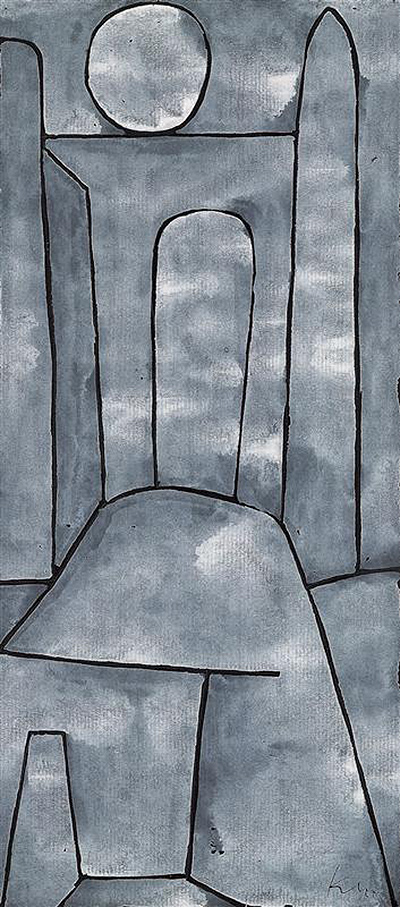
Paul Klee's A Gate is the English title used here for ein TOR, a small, unusually tall work of 1939. The Fondation Beyeler identifies it as 1939, 911 (XX 11), tempera on Ingres paper mounted on cardboard, measuring 31.6 × 14 cm. The work belongs to its collection in Riehen near Basel, inventory 66.1. Those details correct the inherited article's 1938 date and its general description of a grey painting. The artist's own title and dedication also tell us that this was a specific gift, not merely an anonymous architectural fantasy.[1]
Thin, dark lines set out a narrow architectural form against cloudy blue-grey and white. A tall central opening rises above a broad approach that seems to advance towards the viewer. Two upright forms flank it, with a round shape and a pointed one near the top. The image can be read as a gate, but its parts never settle into ordinary building space. They appear to stand upright, recede and hover at the same time. Klee gives us enough geometry to suggest passage, while keeping the destination obscure.[1][2]
The work on paper
The owning museum's material description matters. This is tempera on Ingres paper, a particular paper support, then mounted on cardboard. Its tall, slim size shapes the encounter: at just 14 cm wide, the picture asks the eye to travel upward through a compressed opening. The pale and dark passages do not form a uniformly flat grey field. Broken areas of blue-grey and white vary behind the lines, leaving an impression of atmosphere rather than solid masonry.[1]
The black contours are economical. Long uprights bracket the central void; arcs and curves complicate the geometry. The form that looks like a path or ramp at the bottom is broad where the viewer stands and narrow where it reaches the opening. That suggestion of depth is immediately unsettled by the flat surface and by the way several outlines meet. The picture is architectural without giving a buildable plan. It is tempting to name a portal, courtyard or ancient monument, but none is documented as Klee's model for this work.[1][2]
The German title is emphatic in its capitalization: ein TOR. “A Gate” is a serviceable translation, while the French rendering Une porte places the emphasis on a door. Neither translation can decide what lies beyond. The narrowness of the sheet makes the opening feel like the picture's centre of gravity. Yet a gate is normally a device between two spaces; Klee provides almost no secure account of the second one. That absence is part of the work's effect, not evidence of a particular hidden location.[1][3]
A Christmas dedication
The Fondation Beyeler transcribes Klee's inscriptions. He signed at the lower right. At the lower centre he dated, numbered and titled the work “1939 XX 11 ein TOR”. Beside this, a pencil dedication names Richard Doetsch-Benziger and Christmas 1939. The museum's provenance states that Doetsch-Benziger in Basel received it from the artist in 1939. This is unusually concrete evidence about its first use: the picture was presented to a named person during Klee's lifetime.[1]
It is possible to see a doorway as an invitation or threshold in the context of a gift, but the inscription does not explain what Klee intended the image to mean to Doetsch-Benziger. It supplies recipient and occasion, not a private interpretation. Later stories about death and transcendence should be read alongside that original human setting. The Christmas dedication also makes the work's precise date more than a catalogue correction: it places the picture in the final weeks of a particularly productive year for Klee, shortly before his death in June 1940.[1][4]
The owner's provenance follows the picture after Doetsch-Benziger: his estate from 1958, an heir from 1960, Galerie Roman Norbert Ketterer by 1966, and the Beyeler collection from 1966. It has belonged to the Beyeler Foundation since 1991. The work appeared in a 1956 Basel exhibition of the Doetsch-Benziger collection and later in exhibitions in Madrid, Berlin, Sydney, Rome, Paris, Lugano and elsewhere. These dated entries document its reception; they do not imply continuous public display.[1]
The gate as a threshold
The most influential later reading treats the opening as a passage towards death. Reporting on the Fondation Beyeler's 2003 exhibition of Klee's late work, Swissinfo described this almost entirely grey picture as a possible passage to another world. The wording was conditional. It placed A Gate among late works that viewers and curators connected with mortality, without claiming that Klee wrote such an explanation in 1939.[4]
Philosophical accounts give that reception a more specific history. Irene Borges-Duarte, writing in Portuguese about Heidegger and Klee, recounts Heinrich Wiegand Petzet's memoir of a later encounter with ein TOR. In Petzet's report, Heidegger looked at the picture and interpreted the gate as a passage all must eventually take: death. A French study by Guillaume Fagniez likewise identifies Petzet's memoir as the source and discusses the later Beyeler association with the picture. This is a reported response by a later viewer, transmitted through memoir and scholarship. It is neither a statement by Klee nor proof that the Christmas recipient understood the picture in those terms.[2][3]
Borges-Duarte attends closely to the picture's visual tension: the portal seems imposing yet weightless, with thin lines and clouded pale colour around an opening that does not reveal a solid destination. That helps explain why Heidegger's response could arise from the image. It does not make his reading compulsory. A doorway can be an image of arrival, departure, enclosure or uncertainty as well as death. Klee's withholding of a clearly described beyond lets the work bear more than one thought.[2]
The scholarly record also compares ein TOR with Klee's Das Tor zur Tiefe of 1936. The similar titles invite comparison, but they are distinct works with different dates and compositions. Borges-Duarte uses the earlier picture to frame a philosophical argument about thresholds. The present page treats that comparison as a later interpretation, not as evidence that one picture was a preparatory drawing for the other.[2]
Late work, catalogue and reception
The Fondation Beyeler lists the printed Paul Klee. Catalogue raisonné, volume 8 (the 1939 volume), with this work as no. 8617, illustrated on page 416. This site has checked the owner's bibliography, not the printed volume itself. The catalogue number differs from 1939, 911 (XX 11), the annual designation associated with Klee's own inscription; merging the two would make the identification less precise.[1]
The inherited article called the work a cityscape, likened it to Stonehenge and imagined a grey modern city. The dark outlines might remind a viewer of ancient stone, but there is no cited object evidence for those particular settings. Its broad claim that Klee used only one shade also misses the variations in the reproduced surface. The revised account leaves these unsupported identifications aside and concentrates on what can be seen and documented: a narrow, clouded gate, a dated gift, and a long history of viewers trying to understand its threshold.[1][2][4]
That history is part of the artwork's life, but it should not replace the artwork. Before it became an image in debates about mortality, ein TOR was a small tempera on paper, inscribed for Richard Doetsch-Benziger at Christmas. Its lines permit a passage while refusing to show where that passage ends. The combination of a precise object history and an unresolved visual destination is what gives A Gate its lasting force.[1][2]
Related artworks
Explore eight other Klee works from the researched artwork cluster.
Death and Fire
1940
Insula Dulcamara
1938
Viaducts Break Ranks
1937
New Harmony
1936
Fire Full Moon
1933
Struck from the List
1933
Ad Parnassum
1932
References
- Fondation Beyeler, ein TOR collection record, German: work identity, material, dimensions, inscription, Christmas dedication, provenance, exhibitions and catalogue raisonné bibliographic entry, View source.
- Irene Borges-Duarte, Arte e Técnica em Heidegger, “O Templo e o Portal: De Paestum a Paul Klee”, pp. 92–95, Portuguese: close visual and philosophical reading, Petzet's reported account of Heidegger, and comparison with Das Tor zur Tiefe, View source.
- Guillaume Fagniez, French study of Heidegger's reception of Paul Klee, Cahiers de philosophie de l'université de Caen: identifies Petzet's memoir and discusses the picture's later Beyeler reception. The PDF's indexed passage was consulted; the complete paper was not available through the web reader, View source.
- Ariane Gigon Bormann, “Un Paul Klee méconnu à la Fondation Beyeler,” Swissinfo, 23 August 2003, French: contemporary report on the late-work exhibition and a conditional threshold reading of ein TOR, View source.