


 by Tom Gurney
Tom Gurney BSc (Hons) is an art history expert with over 20 years experience
Published on June 19, 2020 / Updated on September 27, 2026
Email: tomgurney1@gmail.com / Phone: +44 7429 011000
A red rectangle among layered colours
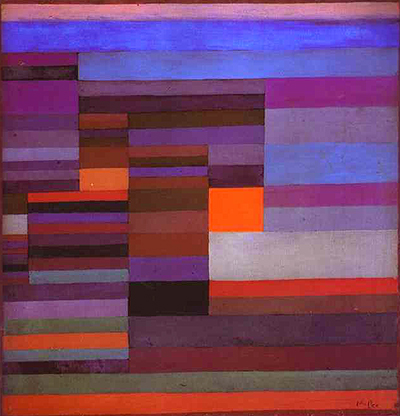
One bright orange-red rectangle interrupts the quieter bands of Paul Klee’s Fire in the Evening. It sits a little right of centre in a near-square field of violets, blues, browns, greens and grey. Other warm strokes recur, especially toward the bottom, but none is as concentrated. The image can feel like a landscape at dusk, a built wall or an arrangement of colours with no fixed place. Klee gave it a title that suggests an event; he painted it without a visible flame, person or horizon that would settle what happened.[1]
The Museum of Modern Art, which owns the work, describes its horizontal bands as suggesting geography or buildings and its red form as evoking a desert fire. That is a gallery interpretation from 2006. It is useful because it shows how the title can guide a viewer, but the title and colour do not establish a witnessed campfire. The painting gives a carefully organized relation of lines and hues, leaving the fire as something the viewer infers rather than an illustrated scene.[1]
Contents
- Name, numbers and physical object
- How the bands organize the picture
- Egypt and a pre-existing way of constructing images
- A letter about another painting
- Reading the red form without forcing a story
- From Klee to MoMA
- Looking again
Name, numbers and physical object
Klee made the picture in 1929 and titled it Feuer abends in German. His annual number was 1929,95, with code S 5; the later catalogue raisonné assigns continuous number 4851. Its English name has varied: MoMA’s 1970 acquisition announcement translated it Fire, Eveningtime, while the current collection page uses Fire in the Evening. Those names point to one object, not a series of separate evening fires.[1][2][3]
MoMA’s accession number is 153.1970. The current record describes oil on cardboard, 33.8 × 33.3 cm, and credits the Mr. and Mrs. Joachim Jean Aberbach Fund. The support is cardboard, not canvas, and the scale is modest: roughly a third of a metre square. It can fill a screen, but its small physical size matters to the way the red block functions as a concentrated mark rather than a large painted blaze. MoMA currently says the work is not on view; that display status can change and is not part of the 1929 object identity.[1]
Other published dimensions differ. Fondation Beyeler’s 2017 press dossier gives approximately 34 × 35 cm, while art historian Frank Zöllner’s 2000 appendix gives 37 × 36 cm. Those figures cannot all be converted into MoMA’s exact 33.8 × 33.3 cm by ordinary rounding. They may reflect older records, sight lines, board edges or different measurement conventions, but none of those explanations is documented in the available sources. The current owning museum’s value is the practical short caption; the disagreement remains an object-file question.[1][2][4]
The German title has appeared as Feuer Abends with historical capitalisation as well as Feuer abends. Keeping a German form beside the English translation helps distinguish Klee’s own naming from later curatorial readings. The English words “fire” and “evening” are evocative, but they do not say where the fire was, who lit it or whether Klee observed it during his travels.[2][3]
How the bands organize the picture
Horizontal divisions create the first order. A broad blue-violet strip near the top spans nearly the whole width. Below it, bands of different depth stack and change colour, interrupted by vertical joins that offset one zone from the next. Some sections extend across the picture; others stop abruptly. No single stripe becomes an uninterrupted horizon. Klee makes the image hold together as a whole while allowing its parts to behave like separate blocks.[1]
The vertical cuts are as important as the horizontals. They turn a stack into a grid without making the grid perfectly regular. At left, short warm and dark strips collect beside cooler zones; toward the middle, divisions shift repeatedly; at right, the red block abuts pale grey and violet. The eye tries to decide whether some blocks lie in front of others. Yet the painting does not give consistent perspective, cast shadow or a vanishing point. Depth is suggested through adjacency, overlap-like interruptions and changes of tone rather than measured space.[1]
The central red rectangle is more forceful because the surrounding colours are subdued and spread thinly across larger areas. Smaller orange strips elsewhere keep it from looking like a colour dropped into an unrelated background. Follow those recurrences downward: a warm note near the left, the compact central rectangle, then a longer reddish band closer to the bottom. The red thus works as both a possible “fire” and a compositional weight. A literal campfire reading can start here, but it cannot account for the entire sequence of horizontal and vertical decisions.[1]
Painter Leslie Roberts, writing after seeing the small work at MoMA in 2020, offers a valuable check on reproductions. To her eye, most of the painting consisted of subtly coloured greys, with a relatively clear blue band near the top and one especially concentrated red block. She observed that many reproductions make the blues, purples and reds more electric than the object looked in the gallery. This is a named artist’s firsthand visual response, not a colour-calibration report. It gives readers a reason to attend to relative intensity and placement without assuming that this page’s small digital image records every original hue faithfully.[8]
The picture’s small changes of width and intensity also resist a simple map. One might see cultivated fields, layered cliffs, walls or an abstract colour score. MoMA allows built structures and geographic formations as possibilities. None can be matched block by block to an identified Nile field or temple stone. Klee's economy of forms lets several experiences inform the image without becoming a coded illustration of one view.[1]
Egypt and a pre-existing way of constructing images
Klee travelled to Egypt in the winter of 1928–29. Fondation Beyeler places Feuer abends among his Lagenbilder, or pictures built from layers or strata, and interprets this group in relation to cities and landscapes encountered on the journey. MoMA’s gallery label makes a similar connection to the Nile Valley’s stratified cliffs and long strips of tilled land. These institutional accounts describe a compelling historical context. They do not say the painting was made outdoors, copied from a particular view or painted on a named evening.[1][2]
Zöllner’s German study of the broader 1929 layered-picture group provides an important qualification. He describes roughly five dozen related drawings, watercolours and paintings, many organized through horizontal fields cut by vertical or diagonal lines. Klee had experimented with bands and construction before Egypt and in Bauhaus teaching. Zöllner argues that the 1929 group applied those earlier formal ideas in a new, more systematic way after the journey. Travel memories and a practiced method worked together; the Nile did not invent the geometry for him.[4]
Zöllner calls a repeated halving principle Cardinalprogression. A long horizontal field is divided where it meets an irregular upright or diagonal line, then divided again as further cuts arrive, producing relationships such as halves, quarters and eighths. He distinguishes the regularly measured strata from the more individually placed interruptions. The visible bands of Fire in the Evening make this account helpful, but a small reproduction cannot prove that every edge was made with exact numerical measurement, nor does the theory identify a physical sequence of paint layers on this particular cardboard support.[4]
Egyptologist Dietrich Wildung likewise cautions against treating every resemblance to Egyptian stripes as an origin story. Writing for the Staatliches Museum Ägyptischer Kunst, he notes that Klee’s line and progression studies predated the Egypt trip and weighs possible impressions of cultivated Nile land and ancient registers without making them mechanical sources for every painting. Wildung’s close examples concern other Klee works; his value here is a historical check on easy visual analogy. The trip could redirect an existing way of making, while the method retained a life of its own.[5]
Zöllner makes a work-specific distinction especially relevant here. He says Feuer abends and in der Strömung sechs Schwellen (In the Current, Six Thresholds) recall Egypt’s physical topography less concretely than some companion pictures. In them he sees stricter construction, calculated colour and sharply bounded bands as recognisable subject matter recedes. By comparison, titles such as Nekropolis or Denkmäler bei G point more directly to Egyptian places or monuments. This does not remove Egypt from Fire in the Evening; it prevents us from labelling each of its coloured strips as a particular river, field, cliff or temple wall.[4]
A letter about another painting
MoMA’s 1970 acquisition announcement offers a richer but more speculative account than the present catalogue data. It says that a fire lit by agricultural workers at dusk may have suggested the red form. Its uncertainty should be preserved. The release also quotes Klee describing a landscape like a view from hills near the Valley of the Kings toward fertile land. Read in isolation, the quotation could seem to describe Fire in the Evening. Zöllner identifies that letter as referring instead to Klee’s watercolour Monument im Fruchtland (Monument in the Fertile Land), another member of the wider group.[6][4]
The distinction is more than a bibliographic nicety. A letter about Monument im Fruchtland provides strong evidence that Klee sometimes turned remembered Egyptian landscapes into structured pictures after his return to Dessau. It does not identify the red block in Feuer abends as a campfire he saw, nor establish the exact scene behind its muted bands. The 1970 museum writer used the letter to introduce a group; our page should not make it a private explanation for this one painting.[6][4]
MoMA’s later label quotes Klee saying related works had moved away from nature and found a way back toward reality. The accessible label does not identify the original German text, date or precise scope of that remark. It is best treated as a museum-presented quotation about the group while its source is traced, not used to claim that Klee gave a recorded interpretation of this specific red rectangle. What we can see independently is a tension between geometry and suggested place: a near-square field of hard-edged bands can still evoke evening, distance or a built environment.[1]
Reading the red form without forcing a story
The painting’s title leads us to search for fire, and the red block offers an obvious candidate. Its flat, rectangular edge is unlike a flame’s changing outline, however. It may stand for a glow, a source of heat, a fire seen from afar or simply the strongest warm colour in a structured composition. MoMA’s 2006 text presents a desert fire as an evocation; the 1970 announcement says a campfire may have suggested it. Neither identifies a witness, date or surviving preparatory study for that event.[1][6]
Some accounts go further, treating the image as a premonition of the Second World War. That interpretation asks a 1929 colour rectangle to foresee later catastrophe without evidence from Klee or a source close to the work. It obscures the picture’s documented problem of making layered forms and colour act together. Likewise, placing it in Suprematism or calling the Egypt journey Klee’s “twilight years” imports labels that do little to explain this particular cardboard painting. The strongest reading starts with the title, visual structure and contemporaneous method, then marks where interpretation begins.[1][4]
The work need not be reduced to pure geometry either. Its colours have emotional and atmospheric effects: pale bands can feel distant, dark purples close in, and the red rectangle can make neighbouring muted tones appear cooler. Those observations are available to a viewer without naming a single field or building. The sense of evening may be generated by relationships among colours as much as by a remembered place. Klee’s title invites that open interplay, not a numbered key to the blocks.[1]
From Klee to MoMA
MoMA’s provenance research traces the painting from Klee in Dessau to Hermann and Margrit Rupf of Bern, who acquired it from him. By 1950–65 it was with Georg Schmidt in Basel-Binningen, probably from the Rupfs; after his death in 1965 it passed by inheritance to Anita Moppert-Schmidt. The museum brackets a 1968 Frank Perls Gallery appearance, signalling qualification. Kornfeld & Klipstein took it on consignment in 1968, and Galerie Beyeler bought it at the Bern sale of 13–15 June 1968, lot 479. MoMA bought it from Beyeler in 1970. The record is explicitly a work in progress, and its “probably” and brackets should stay visible rather than become a seamless, certain chain.[1]
The 1970 purchase also marks a change in how the painting was introduced. MoMA’s acquisition announcement called it Fire, Eveningtime and singled out the red rectangle and Egyptian context for readers. Subsequent exhibitions and labels have rephrased those relations. Fondation Beyeler’s German and French press dossiers included it in a 2017 account of Klee’s Egyptian-associated layered pictures; the Paris–Berlin exhibition index used the French title Feu le soir. These records demonstrate changing translation and reception, not a change in the physical painting’s identity.[6][2][7]
Looking again
Start at the top blue-violet band and follow it toward the right edge. Then descend through the bands, noticing every place a vertical cut stops one colour and begins another. Return to the orange-red rectangle and ask how much of its “fire” comes from the title and how much from its colour against the quieter field. Finally follow the smaller warm strips below it. The picture becomes less like one red sign in a background and more like a measured network of interruptions and echoes.[1][4]
Fire in the Evening is securely a small 1929 oil-on-cardboard painting at MoMA, with a German title, work number and a researched route through the Rupfs, Schmidts and Galerie Beyeler. Its place in the post-Egypt layered-picture group is well supported. A witnessed campfire, a particular Nile view and an exact explanation for every band are not. Zöllner’s direct comparison with companion works suggests that this painting moves further toward calculated colour and structure even as its title keeps a possible evening scene in play. That tension is what makes the red block continue to feel vivid after the eye has counted the layers.[1][2][4]
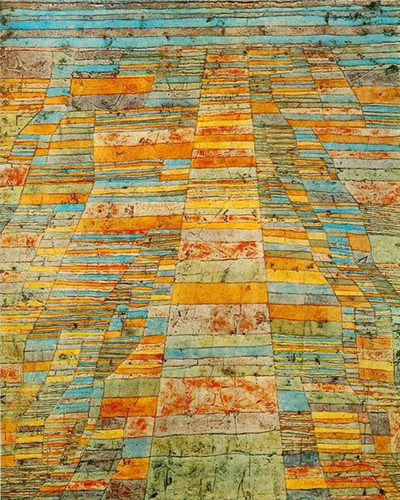
For related work, see Highway and Byways for another 1929 layered composition, Klee’s colour studies for his teaching context, and the paintings overview for a wider chronology.
Explore selected works from Klee’s much larger oeuvre. Titles without a link have an authenticated catalogue identity but no reviewed article yet.
Artworks directory
| Name | Date | Medium |
|---|---|---|
| A Gate | 1939 | Painting and mixed media |
| A Woman for Gods | 1938 | Watercolour and mixed media |
| Ab Ovo | 1917 | Watercolour and mixed media |
| Above Mountain Summit | 1917 | Drawing and mixed media |
| Abstract Trio | 1923 | Drawing and mixed media |
| Acrobats | 1915 | Watercolour and mixed media |
| Actor's Mask | 1924 | Painting and mixed media |
| Ad Marginem | 1930 | Drawing and mixed media |
| Ad Parnassum | 1932 | Painting and mixed media |
| Adventurer Ship | 1927 | Drawing and mixed media |
| Affected Place | 1922 | Drawing and mixed media |
| After a Sketch from Zurich | 1914 | Watercolour and mixed media |
| After Drawing | 1919 | |
| After The Floods | 1936 | Watercolour and mixed media |
| All Souls' Picture | 1921 | |
| Ancient Harmony | 1925 | Painting and mixed media |
| Angel Applicant | 1939 | Drawing and mixed media |
| Angel Serves the Desired | 1920 | |
| Angel, Still Female | 1939 | Painting and mixed media |
| Angelus Novus | 1920 | Drawing and mixed media |
| Animal Terror | 1926 | Painting and mixed media |
| Arab Song | 1932 | Painting and mixed media |
| Archangel | 1938 | Painting and mixed media |
| Architecture | 1923 | Painting and mixed media |
| Architecture of the Plain | 1923 | Drawing and mixed media |
| Around the Fish | 1926 | Painting and mixed media |
| Arrival of the Air Steamer | 1921 | Drawing and mixed media |
| Asiatic God | 1924 | Painting and mixed media |
| Astrological Fantasy Portrait | 1924 | Drawing and mixed media |
| Athlete's Head | 1932 | Watercolour and mixed media |
| Aufgehender Stern | 1931 | Painting and mixed media |
| Autumn Flower | 1922 | Painting and mixed media |
| Bad Band | 1920 | Drawing and mixed media |
| Baroque Centaur | 1939 | Painting and mixed media |
| Before the Blitz | 1923 | Drawing and mixed media |
| Before the Snow | 1929 | Drawing and mixed media |
| Besessenes Madchen | 1924 | Watercolour and mixed media |
| Bird Garden | 1924 | |
| Bird Wandering Off | 1926 | Watercolour and mixed media |
| Blossoms in the Night | 1930 | Watercolour and mixed media |
| Blue-Bird-Pumpkin | 1939 | Painting and mixed media |
| Boats in the Flood | 1937 | Painting and mixed media |
| Botanical Theatre | 1934 | Drawing and mixed media |
| Boy in Fancy Dress | 1931 | Watercolour and mixed media |
| Broken Key | 1938 | |
| Brother and Sister | 1930 | Watercolour and mixed media |
| But the Red Roof | 1935 | Painting and mixed media |
| C - C = Fisch | 1931 | Watercolour and mixed media |
| Cacti | 1912 | Painting and mixed media |
| Camel (in Rhythmic Landscape with Trees) | 1920 | Drawing and mixed media |
| Captive Pierrot | 1923 | Drawing and mixed media |
| Castle and Sun | 1928 | Drawing and mixed media |
| Cat and Bird | 1928 | Drawing and mixed media |
| Cathedrals | 1925 | Watercolour and mixed media |
| Chalice of the Heart | 1937 | Painting and mixed media |
| Characters in Yellow | 1937 | Painting and mixed media |
| Chosen Site | 1927 | Mixed media |
| Christmas Picture | 1923 | Drawing and mixed media |
| City of Towers | 1916 | Painting and mixed media |
| Clarification | 1932 | Painting and mixed media |
| Collection of Figurines | 1926 | Painting and mixed media |
| Colorful Architecture | 1917 | Painting and mixed media |
| Comedians' Handbill | 1938 | |
| Comic Opera Singer | 1927 | Painting and mixed media |
| Composition | 1939 | Painting and mixed media |
| Composition with Figures | 1915 | Drawing and mixed media |
| Composition with the Yellow Half-Moon and the Y | 1918 | Watercolour and mixed media |
| Conch–Still Life II | 1939 | Watercolour and mixed media |
| Cosmic Composition | 1919 | Painting and mixed media |
| Crystal Gradation | 1921 | Drawing and mixed media |
| Dance of the Grieving Child | 1922 | Painting and mixed media |
| Dancing Girl | 1940 | Painting and mixed media |
| Das Licht und Etliches | 1931 | Mixed media |
| Death and Fire | 1940 | Painting and mixed media |
| Death for the Idea | 1915 | |
| Demon as Pirate | 1926 | Watercolour and mixed media |
| Diana | 1931 | Painting and mixed media |
| Diavolo Player | 1923 | Drawing and mixed media |
| Die Kapelle | 1917 | Watercolour and mixed media |
| Die Vase | 1938 | Painting and mixed media |
| Doctor | 1930 | Drawing and mixed media |
| Dredger and Sailboat | 1931 | Watercolour and mixed media |
| Ein Tor | 1939 | Painting and mixed media |
| Ein Weib fur Gotter | 1938 | Mixed media |
| Embrace | 1939 | Watercolour and mixed media |
| Episode before an Arab Town | 1923 | |
| Equals Infinity | 1932 | Painting and mixed media |
| Eros | 1923 | Drawing and mixed media |
| Error on Green | 1930 | Watercolour and mixed media |
| Evening Figure | 1935 | Drawing and mixed media |
| Falling Bird | 1919 | |
| Fermata | 1932 | Watercolour and mixed media |
| Fire Clown | 1921 | Watercolour and mixed media |
| Fire Full Moon | 1933 | Watercolour and mixed media |
| Fire in the Evening | 1929 | Painting and mixed media |
| Fish in the Harbour | 1916 | Watercolour and mixed media |
| Fish Magic | 1925 | Watercolour and mixed media |
| Flock of Birds | 1917 | Drawing and mixed media |
| Flora on Sand | 1927 | Watercolour and mixed media |
| Flower Myth | 1918 | |
| Flower Stand with Watering Can and Bucket | 1910 | Watercolour and mixed media |
| Flowering Tree (Abstraction with Reference to a Flowering Tree) | 1925 | Painting and mixed media |
| Flowers in Pots | 1923 | |
| Flowers in Stone | 1939 | Painting and mixed media |
| Forest Witch | 1938 | Painting and mixed media |
| Fright of a Girl | 1922 | Drawing and mixed media |
| Fruits on Red | 1930 | Drawing and mixed media |
| Full Moon | 1919 | Mixed media |
| Föhn Wind in Franz Marc's Garden | 1915 | Watercolour and mixed media |
| Garden in St Germain, The European Quarter near Tunis | 1914 | Watercolour and mixed media |
| Ghost Chamber with the Tall Door (New Version) | 1925 | |
| Ghost of a Genius | 1922 | Drawing and mixed media |
| Girl in Mourning | 1939 | Painting and mixed media |
| Glance of a Landscape | 1926 | Watercolour and mixed media |
| Gluht Nach | 1939 | Drawing and mixed media |
| Golden Fish | 1925 | Watercolour and mixed media |
| Goldfish Wife | 1921 | Watercolour and mixed media |
| Green Plant, Blood, Louse | 1924 | Drawing and mixed media |
| Hafenbild | 1918 | Mixed media |
| Hammamet with Mosque | 1914 | Watercolour and mixed media |
| Harbour with Sailing Ships | 1937 | Painting and mixed media |
| Hauptweg und Nebenwege | 1929 | Painting and mixed media |
| Heavenly and Earthly Time | 1927 | Drawing and mixed media |
| Heroic Fiddling | 1938 | Painting and mixed media |
| Heroic Roses | 1938 | Painting and mixed media |
| Heroic Strokes of the Bow | — | Mixed media |
| Highway and Byways | 1929 | Drawing and mixed media |
| Houses near the Gravel Pit | 1913 | Watercolour and mixed media |
| Howling Dog | 1928 | Painting and mixed media |
| In the Current Six Thresholds | 1929 | Painting and mixed media |
| In the Style of Kairouan | 1914 | Drawing and mixed media |
| Individualized Altimetry of Stripes | 1930 | Painting and mixed media |
| Insula Dulcamara | 1938 | |
| Interior with the Clock | 1913 | Watercolour and mixed media |
| Irma Rossa the Animal Tamer | 1918 | Drawing and mixed media |
| Journey in Corsica | 1927 | Drawing and mixed media |
| Landscape with Bluebirds | 1919 | Watercolour and mixed media |
| Legend of the Nile | 1937 | Painting and mixed media |
| Lemon Harvest | 1937 | Watercolour and mixed media |
| Likeness in the Bower | 1930 | Watercolour and mixed media |
| Limits of Reason | 1927 | Painting and mixed media |
| Little Hope | 1938 | Watercolour and mixed media |
| Magdalena before the Conversion | 1938 | Drawing and mixed media |
| Mask of Fear | 1932 | Painting and mixed media |
| May Picture | 1925 | Painting and mixed media |
| Monument in a Cemetery | 1922 | Watercolour and mixed media |
| Monuments at G | 1929 | Watercolour and mixed media |
| Municipal Jewel | 1917 | Watercolour and mixed media |
| Mural from the Temple of Longing Thither | 1922 | |
| Nach der Uberschwemmung | 1936 | Watercolour and mixed media |
| New Harmony | 1936 | Painting and mixed media |
| New House in the Suburbs | — | Mixed media |
| Old Steamboat | 1922 | Drawing and mixed media |
| On the Edge | 1930 | Drawing and mixed media |
| Once Emerged from the Gray of Night | 1918 | Drawing and mixed media |
| One Who Understands | 1934 | Painting and mixed media |
| Oriental Pleasure Garden | 1925 | Painting and mixed media |
| Park of Idols | 1939 | Watercolour and mixed media |
| Passing by Red Pillars | 1928 | Watercolour and mixed media |
| Persian Nightingales | 1917 | Drawing and mixed media |
| Popular Wall Painting | 1922 | Painting and mixed media |
| Prestidigitator | 1927 | Watercolour and mixed media |
| Rainy Day | 1931 | Watercolour and mixed media |
| Red and White Domes | 1914 | Watercolour and mixed media |
| Red Balloon | 1922 | Drawing and mixed media |
| Redgreen and Violet-Yellow Rhythms | 1920 | Drawing and mixed media |
| Refuge | 1930 | Watercolour and mixed media |
| Rhythmic Rythmical | 1930 | Painting and mixed media |
| Saint of the Inner Light | 1921 | |
| Scaffolding of a New Building | 1930 | Painting and mixed media |
| Scholar in Dealing with Stars | 1926 | Watercolour and mixed media |
| Seated Woman | 1930 | Drawing and mixed media |
| Senecio | 1922 | Painting and mixed media |
| Separation in the Evening | 1922 | Drawing and mixed media |
| Sinbad the Sailor | 1923 | Drawing and mixed media |
| Skeptically Smiling | — | Mixed media |
| Small House in the Garden City | 1928 | Watercolour and mixed media |
| Small Portrait of a Girl in Yellow | 1925 | Painting and mixed media |
| Southern Gardens | 1919 | Watercolour and mixed media |
| Static-Dynamic Gradation | 1923 | Drawing and mixed media |
| Still Life | 1927 | Painting and mixed media |
| Still Life with Gladioli | 1932 | Watercolour and mixed media |
| Strange Garden | 1923 | Drawing and mixed media |
| Stricken City | 1936 | Painting and mixed media |
| Strong Dream | 1929 | Watercolour and mixed media |
| Struck from the List | 1933 | Drawing and mixed media |
| Structural I | 1924 | Drawing and mixed media |
| Sumpflegende | 1919 | Painting and mixed media |
| Temple Gardens | 1920 | Drawing and mixed media |
| The Arrow before the Target | 1921 | Drawing and mixed media |
| The Barbed Noose with the Mice | 1923 | Watercolour and mixed media |
| The Flora of the Heath | 1925 | Watercolour and mixed media |
| The Goldfish | 1925 | Watercolour and mixed media |
| The Hour Before One Night | 1940 | Painting and mixed media |
| The Man in Love | 1923 | |
| The Mask with the Flag | 1925 | Mixed media |
| The Pathos of Fertility | 1921 | |
| The Rhine at Duisburg | 1937 | Painting and mixed media |
| The Way to the Citadel | 1937 | Painting and mixed media |
| Three Houses and a Bridge | 1922 | Watercolour and mixed media |
| Tightrope Walker | 1923 | |
| Tomb in Three Parts | 1923 | Watercolour and mixed media |
| Tomcat's Turf | 1919 | Watercolour and mixed media |
| Tower in Orange and Green | 1922 | Drawing and mixed media |
| Tree and Architecture - Rhythms I | 1920 | Watercolour and mixed media |
| Tree and Architecture - Rhythms II | 1920 | Painting and mixed media |
| Tropical Dawn with the Owl | 1921 | Mixed media |
| Tropische Dammerung | 1921 | Painting and mixed media |
| Twittering Machine | 1922 | Drawing and mixed media |
| Variations (Progressive Motif) | 1927 | Watercolour and mixed media |
| Ventriloquist and Crier in the Moor | 1923 | |
| Viaducts Break Ranks | 1937 | Drawing and mixed media |
| Villa R | 1919 | Painting and mixed media |
| Village Carnival | 1926 | Painting and mixed media |
| Vor dem Blitz | 1923 | Drawing and mixed media |
| Wald-Hexen | 1938 | Painting and mixed media |
| Young Forest | 1925 | Drawing and mixed media |
Related artworks
Explore eight other Klee works, beginning with works close in date to this one.
Highway and Byways
1929
Ad Marginem
1930
Castle and Sun
1928
Cat and Bird
1928
Error on Green
1930
Flora on Sand
1927
Ad Parnassum
1932
Around the Fish
1926
Discussion
The red rectangle and layered colours invite a landscape reading while retaining a clear geometric order.
The research also separates Klee's Egypt memories from the later idea of an observed campfire.
Reader Insights
Which vertical cuts change your sense of distance among the bands?
How much of the red rectangle's ‘fire’ comes from its colour, and how much from the title?
What original document could settle the source of MoMA's quoted Klee remark?
Join the Conversation
Share what you see or a source that helps explain the work.
References
- The Museum of Modern Art, “Fire in the Evening,” 153.1970, current object record, 2006 gallery label and provenance research (English; accessed 26 September 2026), View source.
- Fondation Beyeler, 2017 Paul Klee exhibition press dossier, entries on Feuer Abends and the Egypt-related Lagenbilder (German; French edition is a translation from the same institution), View source.
- Franziska Fehlmann, study of Eberhard W. Kornfeld, Berner Zeitschrift für Geschichte (German, 2011), note 90 citing Catalogue raisonné Paul Klee vol. 5, no. 4851 and annual 1929, S 5 / 95; printed catalogue entry still to be checked, View source.
- Frank Zöllner, “Paul Klee, Hauptweg und Nebenwege, 1929,” Wallraf-Richartz-Jahrbuch 61 (German, 2000), pp. 263–89, especially layered-picture group discussion and appendix entry for Feuer abends; full text accessible in author-hosted ResearchGate view, View source.
- Dietrich Wildung, “Altägypten im Werk von Paul Klee,” MAAT 7 (German, 2018), pp. 41–42; Egyptologist’s account of pre-existing construction and possible Egyptian impressions, with other paintings as detailed examples, View source.
- The Museum of Modern Art, 1970 acquisition announcement, “Fire, Eveningtime (Feuer abends),” p. 5 of PDF (English; period interpretation, including qualified campfire suggestion), View source.
- Centre Pompidou, Paris–Berlin exhibition catalogue index, “Feu le soir (Feuer Abends)” (French; title and loan crosswalk), View source.
- Leslie Roberts, “Leslie Roberts on ‘Fire in the Evening’ by Paul Klee,” Painters on Paintings (27 January 2020), firsthand painter’s viewing account of scale and colour reproduction, View source.