


 by Tom Gurney
Tom Gurney BSc (Hons) is an art history expert with over 20 years experience
Published on June 19, 2020 / Updated on September 27, 2026
Email: tomgurney1@gmail.com / Phone: +44 7429 011000
A townscape reassembled
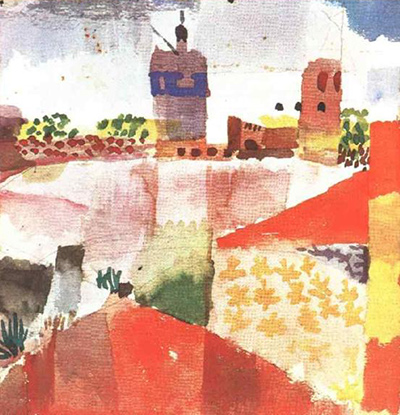
Two towers rise over low buildings and greenery. Beneath them, pale washes of pink, red, yellow, blue and green spread across the paper until the scene becomes difficult to map as a single view. In Hammamet with Its Mosque, Paul Klee kept a recognisable Tunisian town in sight while testing how far colour and cut paper could reorganise it. The mosque is one part of the skyline; specialist research identifies the other prominent tower as a French military optical station that no longer survives. The painting is thus both a constructed image and a record of a place with a particular history.[1][4]
Klee visited Hammamet with August Macke and Louis Moilliet on 14 April 1914, during their brief journey through Tunisia. The Metropolitan Museum of Art owns this watercolour as 1984.315.4. Its current label is useful for identification and a first account of the colour fields, while its earlier acquisition publication, an early German work list, Roger Benjamin's full study and Tunisian heritage records let us ask more exact questions: which paper measurements describe the work, what did Klee move after painting, and what did he choose to leave out?[1][2][3][4][6]
Contents
- Which work is this?
- Where is Hammamet, and what is visible?
- Why are there two towers?
- How does the image move from townscape to coloured construction?
- Was the watercolour cut and reassembled?
- What else did Klee make in Hammamet?
- Did the journey suddenly make Klee a painter?
- How did the painting reach New York?
- Looking again
Which work is this?
The Met titles the object Hammamet with Its Mosque and dates it 1914. Klee's own annual numbering identifies it as 1914,199. A 1920 special issue of Der Ararat, published by his dealer Hans Goltz, lists “Hammamet mit der Moschee” with that number. This early German witness is stronger than a later translated title for identifying the sheet. “Hammamet with Mosque,” the shorter English route label used on this site, refers to the same Met object; it does not identify a separate painting.[1][3]
The Met’s current “Inscriptions and Markings” tab transcribes the signed upper left and the cardboard mount’s lower-left inscription as “1914 199 Hammamet mit der Moschee.” An indexed passage from its 1984–85 acquisitions publication instead gives “Mosche,” without the final e. That is a difference between two Met transcriptions, not evidence of a second work or proof of what Klee’s hand wrote. The current transcription agrees with Goltz’s 1920 list; the older printed passage still needs direct page inspection and the actual mount would settle the letter.[1][2][3]
The Met now calls the medium watercolour and graphite on paper mounted on cardboard and gives 23.8 × 22.2 cm. Its early acquisition entry is more specific about the support: watercolour and pencil on two sheets of laid paper mounted to cardboard, measuring 20.5 × 19.3 cm. Benjamin's 2015 caption gives 20.6 × 19.4 cm, very close to that older pair. It is tempting to say that the smaller figures measure the painted paper and the larger ones the mount, but the accessible museum records do not confirm that measuring convention. Until a conservation or collection file does, it is more accurate to display both and explain the unresolved difference than to manufacture one definitive size.[1][2][4]
The Met’s references tab also identifies the work as no. 1302 in volume 2 of the printed Paul Klee: Catalogue Raisonné (2000). That continuous catalogue number is distinct from Klee’s own annual 1914,199 and the museum accession 1984.315.4. The volume itself has not been read here, so the number is reported as the Met’s bibliographic cross-reference, not as an independently checked entry. The same references preserve a dating dispute: Regula Suter-Raeber’s 1979 account places painting in Tunisia in April and numbering after Christmas 1914, while a 1995 Kersten–Okuda catalogue is cited for entry into Klee’s oeuvre register no earlier than 1916. These are historical interpretations recorded by the museum, not dates this page can resolve from the image.[1]
The two-sheet description also matters because this is an assembled image. A mount is not automatically a neutral backing for Klee: it can carry his title and number, frame painted edges and hold displaced paper. The small legacy reproduction above shows colour and broad structure but cannot prove a precise join, fibre type or inscription letter. Those require direct access to the object or an authorised high-resolution technical image.[1][2][4]
Where is Hammamet, and what is visible?
Hammamet stands on the Gulf of Hammamet at the southern edge of Tunisia's Cap Bon peninsula. It is south of Tunis. The Tunisian Institut National du Patrimoine describes a walled medina around 230 by 200 metres, with a fort at its projecting end, a street plan that is roughly orthogonal yet locally narrow and winding, and a Great Mosque near the medina's edge rather than at a central crossroads. These facts give a more reliable local setting than the Met's older short description, which mistakenly calls the town northwest of Tunis.[1][6]
The surviving mosque remains a functioning religious building in a populated town. The Tunisian heritage record locates it on Rue Sidi Abd El-Kader and describes the quarter around it as an important focus for social and commercial life. A 2019 Arabic-language report by the Nabeul bureau of Al Chourouk discusses the mosque's later repairs and changes; those details are a reminder that the present building is not frozen in Klee's 1914 moment. The picture does not show the town entire, and a present-day photograph cannot simply be placed over it as a perfect tracing.[6][7]
Klee's upper skyline is spare. The left tower has a square body, a dark blue band below its top and an upright finial. Lower reddish structures and green marks stretch across the middle. A warm tower rises to the right, with two dark openings. The gaps, pale sky and broad coloured ground matter as much as the outlines. The Met describes mosque, towers and gardens above partly nonrepresentational colour planes; that is a useful first orientation, although individual coloured patches do not all resolve into identifiable plants or walls.[1]
Why are there two towers?
Roger Benjamin, reconstructing the view with historic postcards, maps, photographs and his own fieldwork, identifies the more recognisable square minaret as part of Hammamet's Great Mosque. The second, he argues, was a Poste Optique on the coastal fort: a French military optical telegraph station that used line-of-sight signals along the coast. It has since been demolished. Benjamin's claim does more than supply a name for an odd form. It restores an element of the French protectorate to a picture sometimes described as though it recorded only old Islamic architecture and sunlight.[4][5]
Benjamin's 2022 account explains the puzzle that led him to this identification. The minaret and optical station stood over 100 metres apart, so their close pictorial pairing raised a question about viewpoint and artistic licence. A historical photograph in the Musée Albert-Kahn collection helped him test their relation. His work makes the combined skyline plausible as a response to an actual site, but it does not fix a surveyed point for Klee's easel. The Met states that he painted from outside the city walls; the exact position and any subsequent changes to the skyline on paper remain matters of reconstruction.[1][4][5]
The minaret itself has a more specific architecture than the painting's handful of shapes. Benjamin describes its square shaft, coloured tile band, paired openings and upper gallery. A modern photograph by Marc Ryckaert shows the surviving minaret's tiled band and paired windows. It is useful for recognising the building Benjamin discusses, while its 2011 date, later repairs and different viewpoint prevent it from serving as proof that Klee painted each architectural detail precisely as it appears today.[4][7][11]
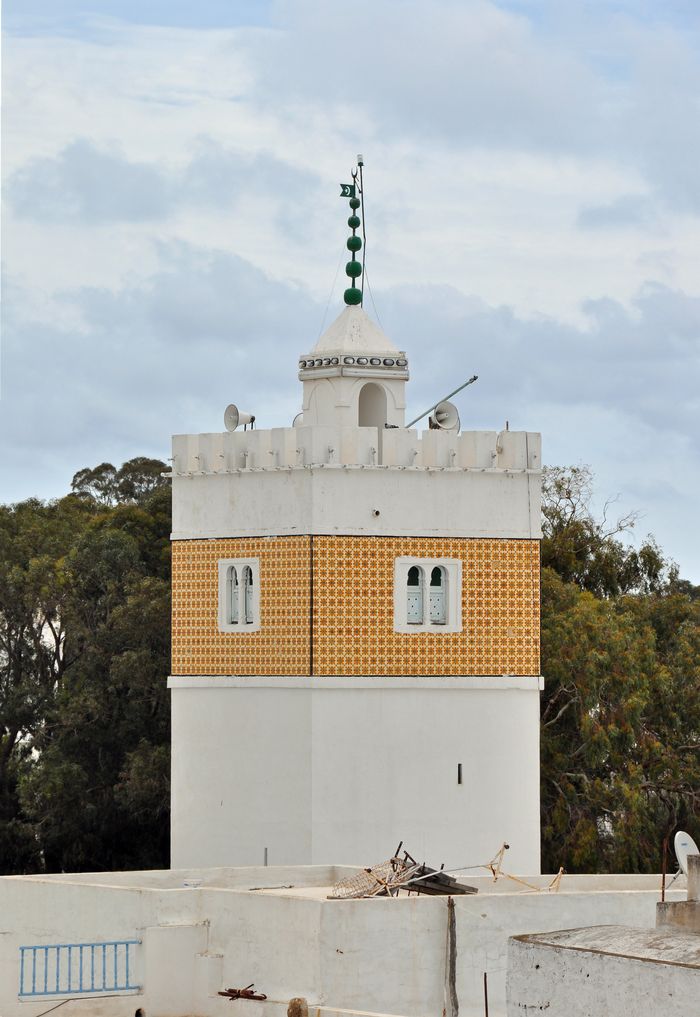
The second tower is no longer available to photograph in the same way. Benjamin's historic-image method is valuable here precisely because the built environment changed. We should not infer from its absence today that Klee invented it. Equally, calling the structure a French military station is a historical identification made from sources, not evidence that Klee intended the painting as an explicit political critique. What the picture represents and what the artist meant by including it are different questions.[4][5]
How does the image move from townscape to coloured construction?
The upper third establishes a horizon, but it is not a conventional panorama. Between the towers, low red and green marks shorten distance into a thin, nearly continuous band. The lower part is more expansive: a reddish diagonal pushes in from the right, a broad pink area opens towards the left, and smaller yellow and green passages accumulate near the bottom. The eye can still look for ground, walls or vegetation, yet the coloured pieces meet as a constructed pattern of edges and intervals.[1][4]
Benjamin describes an X-like meeting of warm planes in the lower area. That account directs attention to crossing diagonals rather than to a single foreground object. We can also see how the upper architectural verticals answer the lower slants. The painted field is neither divided cleanly into a realistic top and an abstract bottom nor dissolved into unrelated decorative blocks. It alternates between cues to a lived town and relations that belong to the surface of the picture.[1][4]
The work's watercolour is central to this effect. Washes allow pale areas of paper and colour to show through one another; stronger red and blue forms interrupt that transparency. Graphite supplies quiet scaffolding, though a 400-pixel splash cannot tell us where every pencil stroke lies beneath the paint. The Met relates the contrast of translucent colour planes to Robert Delaunay, whose experiments Klee knew before the journey. The Centre Pompidou records Klee's Paris meeting with Delaunay in 1912 and his German translation of Delaunay's Sur la lumière for Der Sturm in 1913. This earlier artistic exchange helps explain a vocabulary Klee could bring to Tunisia; it does not make Delaunay the only cause of the Hammamet picture.[1][10]
The town itself offered a system of straight and turning edges. Klee's published diary remembers Hammamet's bends and right angles, ramparts, vegetation and shore. Benjamin tests those remarks against local views but does not claim that every diary detail appears in this sheet. The Institut National du Patrimoine's description of the medina's comparatively regular plan with narrow, sometimes crooked streets provides an independent Tunisian account of a spatial character that Klee noticed. Painting was an act of selection and transformation, not a neutral recording of everything that met his eye.[4][6]
Was the watercolour cut and reassembled?
The early Met description of two sheets of laid paper establishes that the mounted object is materially more complex than a single uninterrupted sheet. Benjamin goes further. In his 2015 chapter he reports that Klee cut a sharply painted reddish strip from the bottom of the original sheet, reversed it and glued it to the backing; in a later first-person account he describes moving that bottom strip towards the top while adding title and date. These are specific scholarly claims, supported by his study of the object and its reproductions, rather than observations that can be verified from this page's small splash.[2][4][5]
The lower coloured planes therefore ask two questions at once. How did Klee transpose buildings, earth and planting into colours? And how did moving an actual piece of painted paper alter the composition after the first act of painting? A cut edge can look like an especially assertive painted boundary. Without a high-resolution image, technical report or direct study of the mount, we cannot label an exact seam on the public page. An annotated crop would be premature. The evidence is strong enough to tell readers what Benjamin argues and why the Met's older two-sheet record is relevant, while leaving the final physical sequence to technical verification.[2][4][5]
This is one of Klee's productive ambiguities: a picture of a place may also be a rearrangement of the material that carries the picture. The moved strip is not a metaphor for abstraction but a proposed physical action. It cautions against reading the watercolour as a single instant of outdoor vision, even if parts of it began from direct observation. The date 1914 does not by itself tell us precisely when each mounting or cut occurred.[1][2][4]
What else did Klee make in Hammamet?
Benjamin discusses several other Hammamet works that should not be confused with the Met sheet. Hammamet, 1914,33, is associated with Klee's diary account of painting near the Hôtel de la Plage; the hotel and plants are arranged into colour blocks. View toward the Harbor of Hammamet, 1914,35, is a much sparser scene of shore, vessel fragments, vegetation and architecture. A drawing of an aged dromedary, 1914,208, attends to a working animal and its harness. These works do not all sit at the same point on a simple ladder from representation to abstraction. They make different choices about what to show and how.[4]
Moilliet drew a vessel on the beach, while Macke painted a busier coastal scene. Benjamin uses those comparisons to show a town with fishing, trade and movement, beyond the narrow view Klee selected for his mosque watercolour. Macke's photograph of Klee removing sand from a foot also documents the travellers' presence without converting a later myth of spontaneous revelation into objective evidence about a particular painting.[4]
Another work with a related name belongs to the Albertina in Vienna: Abstraktion eines Motivs aus Hammamet (Kairouan), 1914,49, a separate small watercolour and pencil sheet. It is not the Met's 1914,199. Benjamin's later essay and a German-language exhibition response describe Klee developing further compositions from the Hammamet motif after the journey; the Albertina object's title and number are reasons to compare them, but its catalogue entry should govern its own materials and provenance. The Met page remains anchored to the mosque sheet, not to a generic group of interchangeable “Hammamet” images.[5][12]
Did the journey suddenly make Klee a painter?
Klee's celebrated declaration that he and colour were one is dated 16 April 1914 in Kairouan, two days after the Hammamet visit. It should not be presented as a sentence written in front of this mosque. The Berlin State Museums note that Klee re-edited his diary around the end of 1921, and the Zentrum Paul Klee cautions that he had explored colour for years before travelling. The diary is an important artist's account of what the journey meant to him, with its own later textual history. It cannot serve as a stopwatch marking the moment this particular sheet became “abstract.”[4][8][9]
The painting itself offers a better way to understand the change. Its minaret and optical tower remain identifiable through research; colour, layout and a reported paper intervention refuse a complete return to mimetic space. This coexistence is more interesting than a binary of “before, drawing” and “after, painting.” Its connected works of 1914 and later recollections show repeated experimentation, not a single solved discovery.[4][5][8]
The trip also took place within colonial Tunisia. Benjamin reconstructs the military station and describes how European travellers wrote about Hammamet, at times calling it timeless while moving through a town with an active economy, religious life and political history. The Institut National du Patrimoine's heritage account foregrounds the medina as a locally structured place rather than an anonymous visual resource. A careful reading can acknowledge the force of Klee's colour without giving the European artist sole ownership of the place he pictured.[4][6]
How did the painting reach New York?
The Met’s current provenance tab traces the sheet to Hermann Probst in Kochel from 1914, then to Mr. and Mrs. Joseph Berchtold Urvater in Brussels by 1956–63. It records their 1963 sale to Galerie Beyeler, Basel, Beyeler’s sale that year to Heinz Berggruen, and Berggruen’s 1984 gift to the Met. A cited 2014 Zentrum Paul Klee exhibition catalogue says Probst bought it from the artist in 1914, although that underlying catalogue account has not yet been read here. This is a documented chain with a gap between Probst and the Urvaters, not a claim that every transfer is known.[1]
The Met’s exhibition tab locates the work in Goltz’s 1920 Munich show, under the Urvaters’ name in Liège in 1956 and Amsterdam and Brussels in 1957, and in the Met’s 1988 Berggruen exhibition. The French and Dutch catalogue titles differ from today’s English label without implying distinct objects. Rewald’s full 1988 entry, pp. 64–67, is identified in the museum references but still needs direct reading for its argument and object details. The current Met record supplies the provenance and exhibition outline; conservation treatment and the exact path into the Urvater collection remain open.[1][13]
Looking again
Start with the two towers, then return to the almost floating colours below. The mosque minaret and the vanished optical station bind Klee's image to a particular Hammamet. The coloured diagonals and mounted paper prevent that location from becoming a simple map. Even the object measurements remind us to look at the physical work: painted sheets and card may each have been measured, but the accessible records have yet to say exactly how.[1][2][4]
The picture's achievement lies in holding those layers together. Its forms arise from a town Klee visited; its surface records choices about colour, cropping and possible rearrangement; its later fame is tied to a diary passage written about another day and later edited. The more precisely these strands are separated, the more vivid the watercolour becomes as a made object rather than an illustration of a ready-made legend.[2][4][5][8]
Explore the wider Tunisia journey, the related In the Style of Kairouan, and Klee's materials and techniques for comparisons of place, memory and paper construction.
Explore selected works from Klee’s much larger oeuvre. Titles without a link have an authenticated catalogue identity but no reviewed article yet.
Artworks directory
| Name | Date | Medium |
|---|---|---|
| A Gate | 1939 | Painting and mixed media |
| A Woman for Gods | 1938 | Watercolour and mixed media |
| Ab Ovo | 1917 | Watercolour and mixed media |
| Above Mountain Summit | 1917 | Drawing and mixed media |
| Abstract Trio | 1923 | Drawing and mixed media |
| Acrobats | 1915 | Watercolour and mixed media |
| Actor's Mask | 1924 | Painting and mixed media |
| Ad Marginem | 1930 | Drawing and mixed media |
| Ad Parnassum | 1932 | Painting and mixed media |
| Adventurer Ship | 1927 | Drawing and mixed media |
| Affected Place | 1922 | Drawing and mixed media |
| After a Sketch from Zurich | 1914 | Watercolour and mixed media |
| After Drawing | 1919 | |
| After The Floods | 1936 | Watercolour and mixed media |
| All Souls' Picture | 1921 | |
| Ancient Harmony | 1925 | Painting and mixed media |
| Angel Applicant | 1939 | Drawing and mixed media |
| Angel Serves the Desired | 1920 | |
| Angel, Still Female | 1939 | Painting and mixed media |
| Angelus Novus | 1920 | Drawing and mixed media |
| Animal Terror | 1926 | Painting and mixed media |
| Arab Song | 1932 | Painting and mixed media |
| Archangel | 1938 | Painting and mixed media |
| Architecture | 1923 | Painting and mixed media |
| Architecture of the Plain | 1923 | Drawing and mixed media |
| Around the Fish | 1926 | Painting and mixed media |
| Arrival of the Air Steamer | 1921 | Drawing and mixed media |
| Asiatic God | 1924 | Painting and mixed media |
| Astrological Fantasy Portrait | 1924 | Drawing and mixed media |
| Athlete's Head | 1932 | Watercolour and mixed media |
| Aufgehender Stern | 1931 | Painting and mixed media |
| Autumn Flower | 1922 | Painting and mixed media |
| Bad Band | 1920 | Drawing and mixed media |
| Baroque Centaur | 1939 | Painting and mixed media |
| Before the Blitz | 1923 | Drawing and mixed media |
| Before the Snow | 1929 | Drawing and mixed media |
| Besessenes Madchen | 1924 | Watercolour and mixed media |
| Bird Garden | 1924 | |
| Bird Wandering Off | 1926 | Watercolour and mixed media |
| Blossoms in the Night | 1930 | Watercolour and mixed media |
| Blue-Bird-Pumpkin | 1939 | Painting and mixed media |
| Boats in the Flood | 1937 | Painting and mixed media |
| Botanical Theatre | 1934 | Drawing and mixed media |
| Boy in Fancy Dress | 1931 | Watercolour and mixed media |
| Broken Key | 1938 | |
| Brother and Sister | 1930 | Watercolour and mixed media |
| But the Red Roof | 1935 | Painting and mixed media |
| C - C = Fisch | 1931 | Watercolour and mixed media |
| Cacti | 1912 | Painting and mixed media |
| Camel (in Rhythmic Landscape with Trees) | 1920 | Drawing and mixed media |
| Captive Pierrot | 1923 | Drawing and mixed media |
| Castle and Sun | 1928 | Drawing and mixed media |
| Cat and Bird | 1928 | Drawing and mixed media |
| Cathedrals | 1925 | Watercolour and mixed media |
| Chalice of the Heart | 1937 | Painting and mixed media |
| Characters in Yellow | 1937 | Painting and mixed media |
| Chosen Site | 1927 | Mixed media |
| Christmas Picture | 1923 | Drawing and mixed media |
| City of Towers | 1916 | Painting and mixed media |
| Clarification | 1932 | Painting and mixed media |
| Collection of Figurines | 1926 | Painting and mixed media |
| Colorful Architecture | 1917 | Painting and mixed media |
| Comedians' Handbill | 1938 | |
| Comic Opera Singer | 1927 | Painting and mixed media |
| Composition | 1939 | Painting and mixed media |
| Composition with Figures | 1915 | Drawing and mixed media |
| Composition with the Yellow Half-Moon and the Y | 1918 | Watercolour and mixed media |
| Conch–Still Life II | 1939 | Watercolour and mixed media |
| Cosmic Composition | 1919 | Painting and mixed media |
| Crystal Gradation | 1921 | Drawing and mixed media |
| Dance of the Grieving Child | 1922 | Painting and mixed media |
| Dancing Girl | 1940 | Painting and mixed media |
| Das Licht und Etliches | 1931 | Mixed media |
| Death and Fire | 1940 | Painting and mixed media |
| Death for the Idea | 1915 | |
| Demon as Pirate | 1926 | Watercolour and mixed media |
| Diana | 1931 | Painting and mixed media |
| Diavolo Player | 1923 | Drawing and mixed media |
| Die Kapelle | 1917 | Watercolour and mixed media |
| Die Vase | 1938 | Painting and mixed media |
| Doctor | 1930 | Drawing and mixed media |
| Dredger and Sailboat | 1931 | Watercolour and mixed media |
| Ein Tor | 1939 | Painting and mixed media |
| Ein Weib fur Gotter | 1938 | Mixed media |
| Embrace | 1939 | Watercolour and mixed media |
| Episode before an Arab Town | 1923 | |
| Equals Infinity | 1932 | Painting and mixed media |
| Eros | 1923 | Drawing and mixed media |
| Error on Green | 1930 | Watercolour and mixed media |
| Evening Figure | 1935 | Drawing and mixed media |
| Falling Bird | 1919 | |
| Fermata | 1932 | Watercolour and mixed media |
| Fire Clown | 1921 | Watercolour and mixed media |
| Fire Full Moon | 1933 | Watercolour and mixed media |
| Fire in the Evening | 1929 | Painting and mixed media |
| Fish in the Harbour | 1916 | Watercolour and mixed media |
| Fish Magic | 1925 | Watercolour and mixed media |
| Flock of Birds | 1917 | Drawing and mixed media |
| Flora on Sand | 1927 | Watercolour and mixed media |
| Flower Myth | 1918 | |
| Flower Stand with Watering Can and Bucket | 1910 | Watercolour and mixed media |
| Flowering Tree (Abstraction with Reference to a Flowering Tree) | 1925 | Painting and mixed media |
| Flowers in Pots | 1923 | |
| Flowers in Stone | 1939 | Painting and mixed media |
| Forest Witch | 1938 | Painting and mixed media |
| Fright of a Girl | 1922 | Drawing and mixed media |
| Fruits on Red | 1930 | Drawing and mixed media |
| Full Moon | 1919 | Mixed media |
| Föhn Wind in Franz Marc's Garden | 1915 | Watercolour and mixed media |
| Garden in St Germain, The European Quarter near Tunis | 1914 | Watercolour and mixed media |
| Ghost Chamber with the Tall Door (New Version) | 1925 | |
| Ghost of a Genius | 1922 | Drawing and mixed media |
| Girl in Mourning | 1939 | Painting and mixed media |
| Glance of a Landscape | 1926 | Watercolour and mixed media |
| Gluht Nach | 1939 | Drawing and mixed media |
| Golden Fish | 1925 | Watercolour and mixed media |
| Goldfish Wife | 1921 | Watercolour and mixed media |
| Green Plant, Blood, Louse | 1924 | Drawing and mixed media |
| Hafenbild | 1918 | Mixed media |
| Hammamet with Mosque | 1914 | Watercolour and mixed media |
| Harbour with Sailing Ships | 1937 | Painting and mixed media |
| Hauptweg und Nebenwege | 1929 | Painting and mixed media |
| Heavenly and Earthly Time | 1927 | Drawing and mixed media |
| Heroic Fiddling | 1938 | Painting and mixed media |
| Heroic Roses | 1938 | Painting and mixed media |
| Heroic Strokes of the Bow | — | Mixed media |
| Highway and Byways | 1929 | Drawing and mixed media |
| Houses near the Gravel Pit | 1913 | Watercolour and mixed media |
| Howling Dog | 1928 | Painting and mixed media |
| In the Current Six Thresholds | 1929 | Painting and mixed media |
| In the Style of Kairouan | 1914 | Drawing and mixed media |
| Individualized Altimetry of Stripes | 1930 | Painting and mixed media |
| Insula Dulcamara | 1938 | |
| Interior with the Clock | 1913 | Watercolour and mixed media |
| Irma Rossa the Animal Tamer | 1918 | Drawing and mixed media |
| Journey in Corsica | 1927 | Drawing and mixed media |
| Landscape with Bluebirds | 1919 | Watercolour and mixed media |
| Legend of the Nile | 1937 | Painting and mixed media |
| Lemon Harvest | 1937 | Watercolour and mixed media |
| Likeness in the Bower | 1930 | Watercolour and mixed media |
| Limits of Reason | 1927 | Painting and mixed media |
| Little Hope | 1938 | Watercolour and mixed media |
| Magdalena before the Conversion | 1938 | Drawing and mixed media |
| Mask of Fear | 1932 | Painting and mixed media |
| May Picture | 1925 | Painting and mixed media |
| Monument in a Cemetery | 1922 | Watercolour and mixed media |
| Monuments at G | 1929 | Watercolour and mixed media |
| Municipal Jewel | 1917 | Watercolour and mixed media |
| Mural from the Temple of Longing Thither | 1922 | |
| Nach der Uberschwemmung | 1936 | Watercolour and mixed media |
| New Harmony | 1936 | Painting and mixed media |
| New House in the Suburbs | — | Mixed media |
| Old Steamboat | 1922 | Drawing and mixed media |
| On the Edge | 1930 | Drawing and mixed media |
| Once Emerged from the Gray of Night | 1918 | Drawing and mixed media |
| One Who Understands | 1934 | Painting and mixed media |
| Oriental Pleasure Garden | 1925 | Painting and mixed media |
| Park of Idols | 1939 | Watercolour and mixed media |
| Passing by Red Pillars | 1928 | Watercolour and mixed media |
| Persian Nightingales | 1917 | Drawing and mixed media |
| Popular Wall Painting | 1922 | Painting and mixed media |
| Prestidigitator | 1927 | Watercolour and mixed media |
| Rainy Day | 1931 | Watercolour and mixed media |
| Red and White Domes | 1914 | Watercolour and mixed media |
| Red Balloon | 1922 | Drawing and mixed media |
| Redgreen and Violet-Yellow Rhythms | 1920 | Drawing and mixed media |
| Refuge | 1930 | Watercolour and mixed media |
| Rhythmic Rythmical | 1930 | Painting and mixed media |
| Saint of the Inner Light | 1921 | |
| Scaffolding of a New Building | 1930 | Painting and mixed media |
| Scholar in Dealing with Stars | 1926 | Watercolour and mixed media |
| Seated Woman | 1930 | Drawing and mixed media |
| Senecio | 1922 | Painting and mixed media |
| Separation in the Evening | 1922 | Drawing and mixed media |
| Sinbad the Sailor | 1923 | Drawing and mixed media |
| Skeptically Smiling | — | Mixed media |
| Small House in the Garden City | 1928 | Watercolour and mixed media |
| Small Portrait of a Girl in Yellow | 1925 | Painting and mixed media |
| Southern Gardens | 1919 | Watercolour and mixed media |
| Static-Dynamic Gradation | 1923 | Drawing and mixed media |
| Still Life | 1927 | Painting and mixed media |
| Still Life with Gladioli | 1932 | Watercolour and mixed media |
| Strange Garden | 1923 | Drawing and mixed media |
| Stricken City | 1936 | Painting and mixed media |
| Strong Dream | 1929 | Watercolour and mixed media |
| Struck from the List | 1933 | Drawing and mixed media |
| Structural I | 1924 | Drawing and mixed media |
| Sumpflegende | 1919 | Painting and mixed media |
| Temple Gardens | 1920 | Drawing and mixed media |
| The Arrow before the Target | 1921 | Drawing and mixed media |
| The Barbed Noose with the Mice | 1923 | Watercolour and mixed media |
| The Flora of the Heath | 1925 | Watercolour and mixed media |
| The Goldfish | 1925 | Watercolour and mixed media |
| The Hour Before One Night | 1940 | Painting and mixed media |
| The Man in Love | 1923 | |
| The Mask with the Flag | 1925 | Mixed media |
| The Pathos of Fertility | 1921 | |
| The Rhine at Duisburg | 1937 | Painting and mixed media |
| The Way to the Citadel | 1937 | Painting and mixed media |
| Three Houses and a Bridge | 1922 | Watercolour and mixed media |
| Tightrope Walker | 1923 | |
| Tomb in Three Parts | 1923 | Watercolour and mixed media |
| Tomcat's Turf | 1919 | Watercolour and mixed media |
| Tower in Orange and Green | 1922 | Drawing and mixed media |
| Tree and Architecture - Rhythms I | 1920 | Watercolour and mixed media |
| Tree and Architecture - Rhythms II | 1920 | Painting and mixed media |
| Tropical Dawn with the Owl | 1921 | Mixed media |
| Tropische Dammerung | 1921 | Painting and mixed media |
| Twittering Machine | 1922 | Drawing and mixed media |
| Variations (Progressive Motif) | 1927 | Watercolour and mixed media |
| Ventriloquist and Crier in the Moor | 1923 | |
| Viaducts Break Ranks | 1937 | Drawing and mixed media |
| Villa R | 1919 | Painting and mixed media |
| Village Carnival | 1926 | Painting and mixed media |
| Vor dem Blitz | 1923 | Drawing and mixed media |
| Wald-Hexen | 1938 | Painting and mixed media |
| Young Forest | 1925 | Drawing and mixed media |
Related artworks
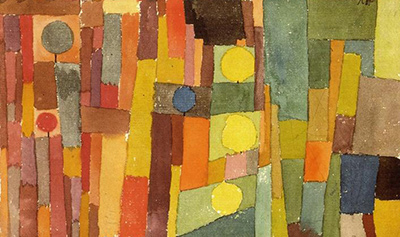
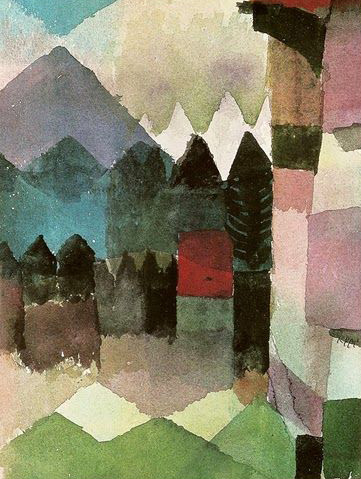
Explore eight other Klee works, beginning with works close in date to this one.

Discussion
Klee's Hammamet watercolour joins a recognisable skyline to rearranged colour planes.
Historic views identify the mosque and a vanished French military optical station.
Reader Insights
Which features of the two towers can you identify in the watercolour?
How might a moved strip of painted paper affect the composition?
What evidence would settle the two published measurements?
Join the Conversation
Share the work and evidence behind your reading.
References
- Metropolitan Museum of Art, Hammamet with Its Mosque, 1984.315.4, current English collection record. Identifies date, medium, current dimensions, 14 April 1914 visit and owner interpretation; its current Inscriptions, Provenance, Exhibition History and References tabs were read on 27 September 2026. Those tabs supply the current inscription transcription, Probst–Urvater–Beyeler–Berggruen ownership outline, selected exhibitions and the museum’s bibliographic pointer to catalogue raisonné vol. 2, no. 1302. Its artwork image is marked © 2026 Artists Rights Society, cannot be enlarged or downloaded, and is not the source of a new derivative here. Its “northwest of Tunis” wording is contradicted by Tunisian heritage geography, View source.
- Metropolitan Museum of Art, Notable Acquisitions 1984–1985, p. 53 (search-indexed text; direct PDF request currently returns HTML). Describes two laid-paper sheets, 20.5 × 19.3 cm, upper-left signature and mount inscription “1914 199 Hammamet mit der Mosche.” The publication page should be inspected directly when the PDF becomes accessible, View source.
- Hans Goltz, ed., Der Ararat : Paul Klee, special issue 2 (Munich, 1920), p. 22, German list item 1914/199 “Hammamet mit der Moschee.” University search-indexed OCR consulted; direct page temporarily blocks access, View source.
- Roger Benjamin, “A Crystalline Hammamet,” chapter 14 of Kandinsky and Klee in Tunisia (University of California Press, 2015), pp. 126–139. Full image-only chapter read from rendered pages: topography, diary, surviving and vanished buildings, related objects and cut/reversed strip. Its own endnotes and wider book remain to consult, View source.
- Roger Benjamin, “My pilgrimage to the site of Paul Klee's Hammamet with Its Mosque ” (2022), author-written essay syndicated from The Conversation. Further account of the historical-photo search, tower separation and motif series; its first-person statements are attributed to Benjamin rather than treated as a conservation report, View source.
- Hanen Werteni, Institut National du Patrimoine, Tunisia, “La ville de Hammamet” (2023), French. Local heritage research on location, medina size/plan, peripheral Great Mosque, quarters, fort and present monument list. This governs the geographic correction to the Met's short label, View source.
- Nabeul bureau, Al Chourouk, “Mosques with a history: the Great Mosque of Hammamet” (18 May 2019), Arabic, through the Turess archive. Used only for the fact of later rebuilding and continuing local religious/cultural use; its early chronology is not reconciled with INP and is not adopted as an exact construction date, View source.
- Zentrum Paul Klee, Landhäuser am Strand digital guide (German). Explicitly cautions that the 1914 diary colour declaration can exaggerate a change already underway for four years, View source.
- Staatliche Museen zu Berlin, Strassenkaffee in Tunis, Dieter Scholz's German object essay. Records Klee's re-editing of the Tunisia diary near the end of 1921; the colour declaration is a retrospective text, not verified as an untouched 14 April entry, View source.
- Centre Pompidou, St. Germain b. Tunis. Landeinwärts, Angela Lampe's French object analysis (from 2008 museum catalogue). Documents the 1912 Delaunay meeting and 1913 German translation; its material account belongs to the separate St. Germain sheet, View source.
- Marc Ryckaert, Hammamet Minaret R01.jpg, photographed 20 May 2011, self-published under Creative Commons Attribution 3.0 Unported. Commercial reuse and resizing permitted with creator credit, licence link and change notice. This is a modern comparison image of the Great Mosque minaret, not a historic record of Klee's viewpoint.
- Albertina, Abstraktion eines Motivs aus Hammamet (Kairouan), German owner record for 1914,49, a distinct watercolour/pencil object. Do not transfer its measurements, inscription or provenance to the Met picture, View source.
- Metropolitan Museum of Art, Sabine Rewald, Paul Klee: The Berggruen Klee Collection in The Metropolitan Museum of Art (1988), publication record only. The full object entry has not yet been read; no specific unpublished provenance claim is drawn from it, View source.