


 by Tom Gurney
Tom Gurney BSc (Hons) is an art history expert with over 20 years experience
Published on June 19, 2020 / Updated on September 27, 2026
Email: tomgurney1@gmail.com / Phone: +44 7429 011000
Brother and Sister: two figures, one shared form
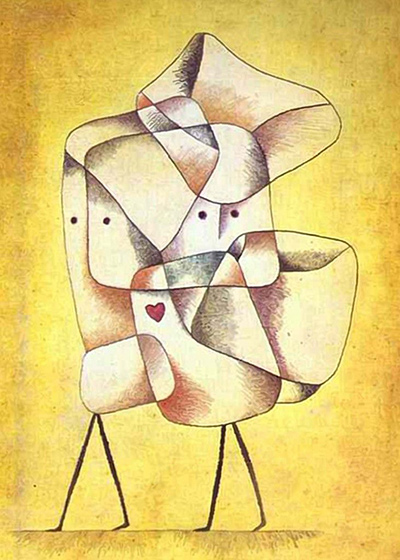
Paul Klee's Geschwister, usually rendered in English as Siblings and called Brother and Sister on this site, was made in 1930. The Heidi Horten Collection in Vienna records watercolour and oil on chalk-primed canvas, 70.7 × 45.2 cm, and says the work entered the collection in 1996. The museum's German and English collection guides agree on these details. Its earlier online collection listing and a 2018 exhibition checklist give the shorter medium “oil on canvas”; the later, more specific guide is the basis for the material description here.[1][2][3]
Two figures occupy nearly the whole upright canvas. Their outlines overlap until the heads and torsos become difficult to separate. Two pairs of tiny dark eyes and two pairs of long, thin legs let us count two beings within the single pale shape. A little red heart sits low in the centre. Against a warm ochre ground, the bodies are mostly cream and soft grey, with hatched passages of muted blue, red and brown. The image is spare, but its crossings make the viewer work out where one figure ends and the other begins.[1]
How Klee makes two from one
The left figure is suggested by a broad, drooping upper shape, a pair of dots and a leg pair below. The right has its own eyes and legs, but the shapes between them are shared. A looping line passes across the top and through the centre, forming an enclosure that can be read as an embrace. The figures are not simply placed side by side. Klee makes their bodies interpenetrate while preserving just enough separate features to keep them plural.[1]
The red heart strengthens that reading because it lies inside the common torso, rather than being held by either figure. The collection guide reads it as a sign of love shared by both siblings. That is a persuasive interpretation of the title and placement, but the painting does not give the pair names, ages or a specific scene. The museum suggests that Klee's close relationship with his older sister Mathilde may have biographical relevance. It states this as a possibility, not as documentary proof that the canvas portrays Paul and Mathilde.[1]
The eyes are no more than dots, and the legs are like drawn sticks. Yet the upper forms are folded, swollen and carefully shaded. The contrast gives the pair both a child's drawing's directness and a worked, almost sculptural body. A diagonal patch crossing the centre has a different tone from the pale forms around it. It acts as a seam, though it cannot be assigned securely to one sibling. Klee uses this uncertainty constructively: the figure is legible at a glance and unstable on closer inspection.[1]
The four legs stand on a single fine horizontal line. Each pair opens like a narrow compass. Their rhythm creates a suggestion of walking together, which the collection guide also notes, but there is no detailed street or landscape. The ochre field carries a few tonal changes and marks. Its warmth makes the pale bodies prominent, while the dark ground line is enough to give them footing. The scene therefore depends on a small number of signs: eyes, legs, heart, contour and the title.[1]
A line that joins as it divides
Klee's contours do two jobs at once. They separate a cream shape from the background, then turn inward to divide one plane of the body from another. At the upper left, the line encloses a broad drooping form; near the centre, curved and diagonal boundaries cross. Some passages are outlined sharply, while others dissolve into hatching or a soft change of colour. The sense of connection comes from this continuous network of lines as much as from the small heart.[1]
The collection guide places Geschwister within a group of pictures begun in summer 1929 whose forms overlap and whose coloured accents are hatched. It calls attention to the figures' cheerfulness, precise technique and cartoon-like clarity. Those terms are the museum's interpretation of a wider group. In this painting, the economy of facial detail and the gentle absurdity of four legs under a shared body make its humour visible. The exact inventory of that group, however, is not supplied by the guide, so individual companion works should not be asserted from it alone.[1]
The support matters. This is canvas with a chalk preparation, carrying both watercolour and oil according to the owner's current guide. The light ground helps the subtle hatching and pale areas remain distinct. A tiny site photograph can make the yellow ground look more uniform and the central crossings harsher. The guide's full-page reproduction shows a broader ochre range and more space around the figures. Neither reproduction permits a claim about the precise order in which Klee applied every layer.[1]
The English site title “Brother and Sister” narrows the German Geschwister. The latter means siblings and does not itself say that one is a boy and the other a girl. The Heidi Horten Collection's English guide chooses Siblings, and its German guide keeps Geschwister. This page retains its established route and familiar heading, but the object should be identified by the owner's original title. The little dots and abstract forms offer no reliable basis for assigning sex to either figure.[1]
A later variation and the work's reception
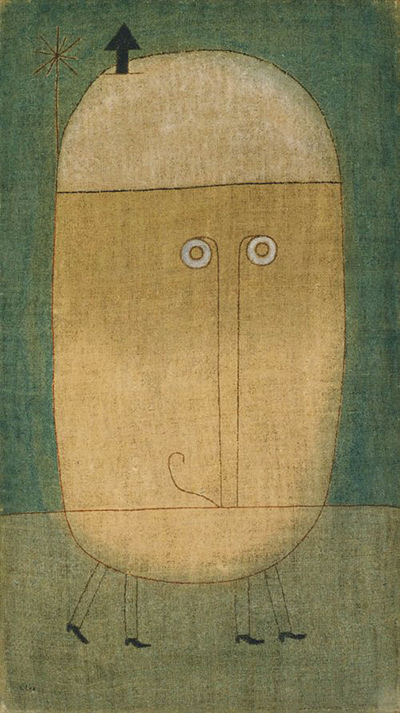
The collection guide compares the picture with Klee's 1932 Maske Furcht (Mask of Fear). It says Klee returned there to the device of two pairs of legs supporting a shared body, while the emotional register changed from lightness to fear amid Germany's political crisis. This is a focused comparison of formal structure and the museum's reading of its historical setting. It should not collapse the two works into versions of the same subject or turn the 1930 heart into a premonition of the later picture.[1]
The picture has also remained visible within the owning collection's public programme. It appeared in the 2018 WOW! exhibition checklist at Vienna's Leopold Museum, there labelled simply oil on canvas. The Heidi Horten Collection used it for The Line, an exhibition on line as a means of forming and connecting images. These records show particular exhibition contexts; they do not establish a permanent hanging position or settle the differing levels of detail in the medium labels.[2][4]
In a visitor selection project reported by the collection, Geschwister ranked first among favourites proposed for display. That response fits its immediate readability: a viewer can find two eyes, four legs and a heart without knowing Klee's theories. Yet the lasting interest lies in how much the drawing refuses to settle. The bodies remain separate and shared, playful and carefully built. Klee makes an image of closeness by letting the line that divides one sibling from the other also hold them together.[1][5]
Related artworks
Explore eight other Klee works from the researched artwork cluster.
Ad Marginem
1930
Error on Green
1930
Fire in the Evening
1929
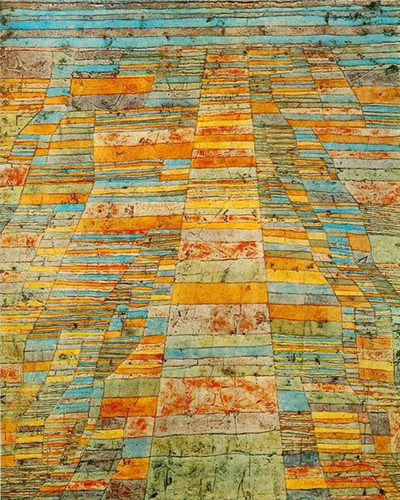
Highway and Byways
1929
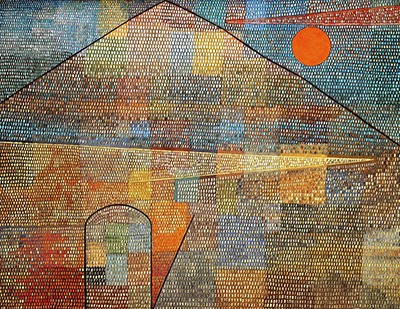
Ad Parnassum
1932
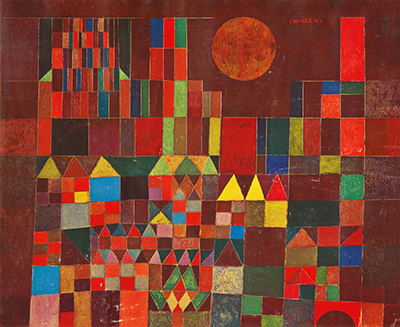
Castle and Sun
1928
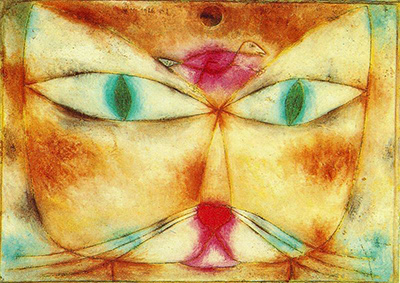
Cat and Bird
1928
Mask of Fear
1932
References
- Heidi Horten Collection, Collection Guide, English, pp. 76–77, and Sammlungsführer, German, pp. 76–77: owner records for title, date, watercolour and oil on chalk-primed canvas, dimensions, acquisition and the museum's interpretation; full-page image inspected against the inherited local file.
- Leopold Museum, WOW! The Heidi Horten Collection, 2018 press image checklist, item 12, German and English: Geschwister / Siblings, 1930, 70.7 × 45.2 cm; shortened “oil on canvas” label, View source.
- Heidi Horten Collection, older online collection listing, German: Geschwister, 1930, 70.7 × 45.2 cm, labelled “Öl auf Leinwand.”, View source.
- Heidi Horten Collection, Die Linie exhibition page, German, identifies Die Geschwister in the exhibition programme and explains its focus on line, View source.
- Heidi Horten Collection, #ARTfluence press information, German: lists Klee's Geschwister first in the visitor selection, View source.