


 by Tom Gurney
Tom Gurney BSc (Hons) is an art history expert with over 20 years experience
Published on June 19, 2020 / Updated on September 27, 2026
Email: tomgurney1@gmail.com / Phone: +44 7429 011000
A red centre and a living edge
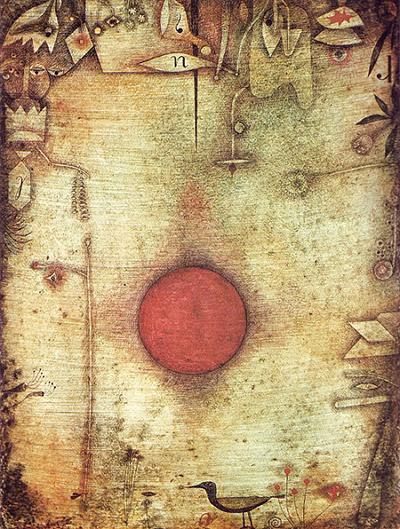
A red disc catches the eye first. Around it, the pale green-grey field seems comparatively open. Then the edges of Paul Klee’s Ad marginem begin to demand attention: thin stems, small creature-like shapes, dark marks that resemble letters, an inverted bird-like form and patches of colour that draw the centre towards the border. What at first looks like a picture of a red sun surrounded by nature becomes harder to name. The red form might suggest a sun or planet, but neither identification is written into the museum’s object record. The marginal forms repeatedly slip between drawing, writing and imagined life.[1][2]
Klee made the work in 1930 and reworked it in 1935–36. That second phase is not a later curator’s speculative date. The Kunstmuseum Basel reports an inscription on the back in Klee’s hand recording the reworking. The two dates make the picture a particularly revealing example of his willingness to return to a work, while leaving a central technical question unanswered: the published record does not say which visible passages he changed in the mid-1930s.[1]
Explore the details of Ad marginem
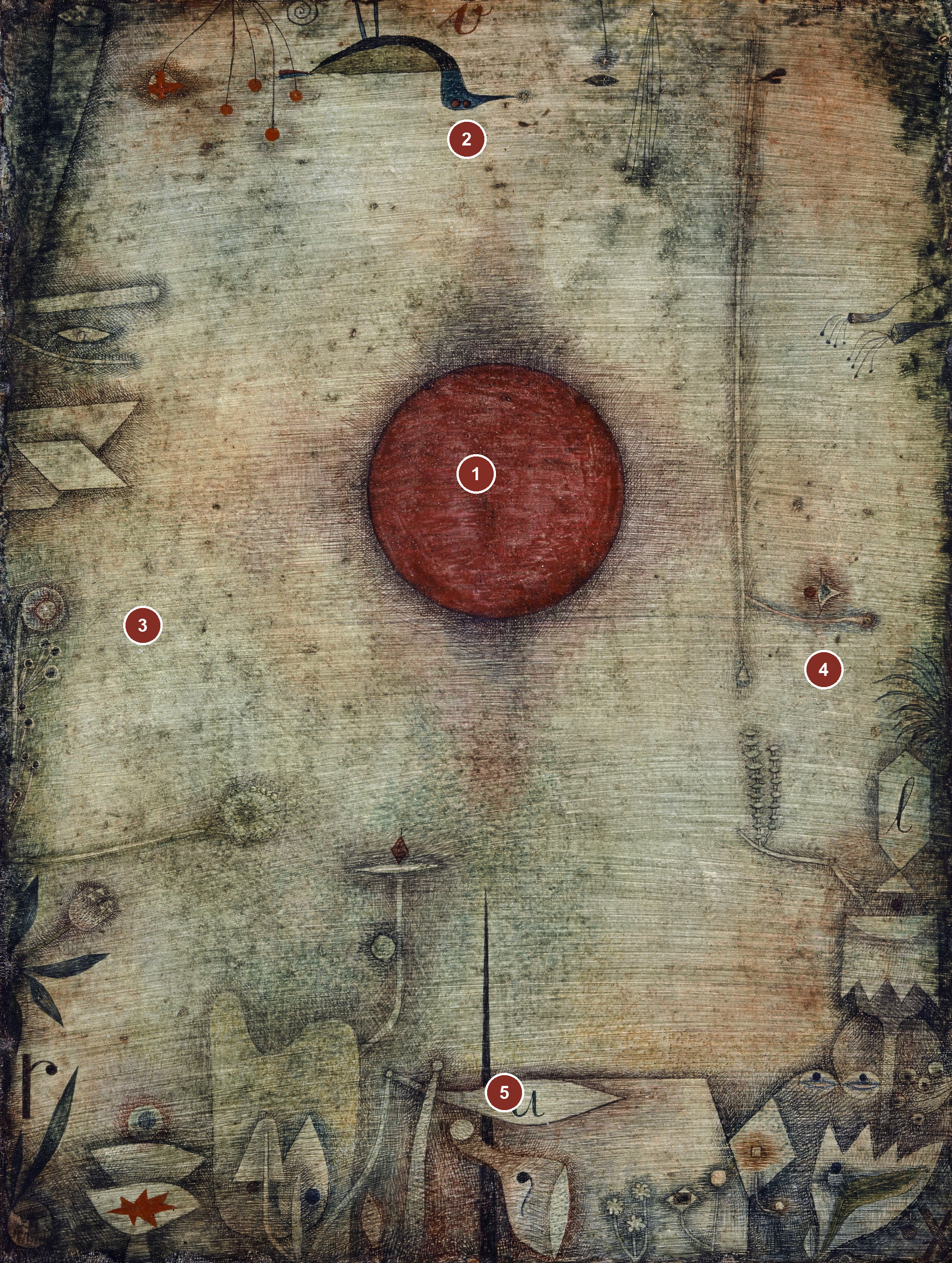
Select a numbered area to examine its detail at high resolution.
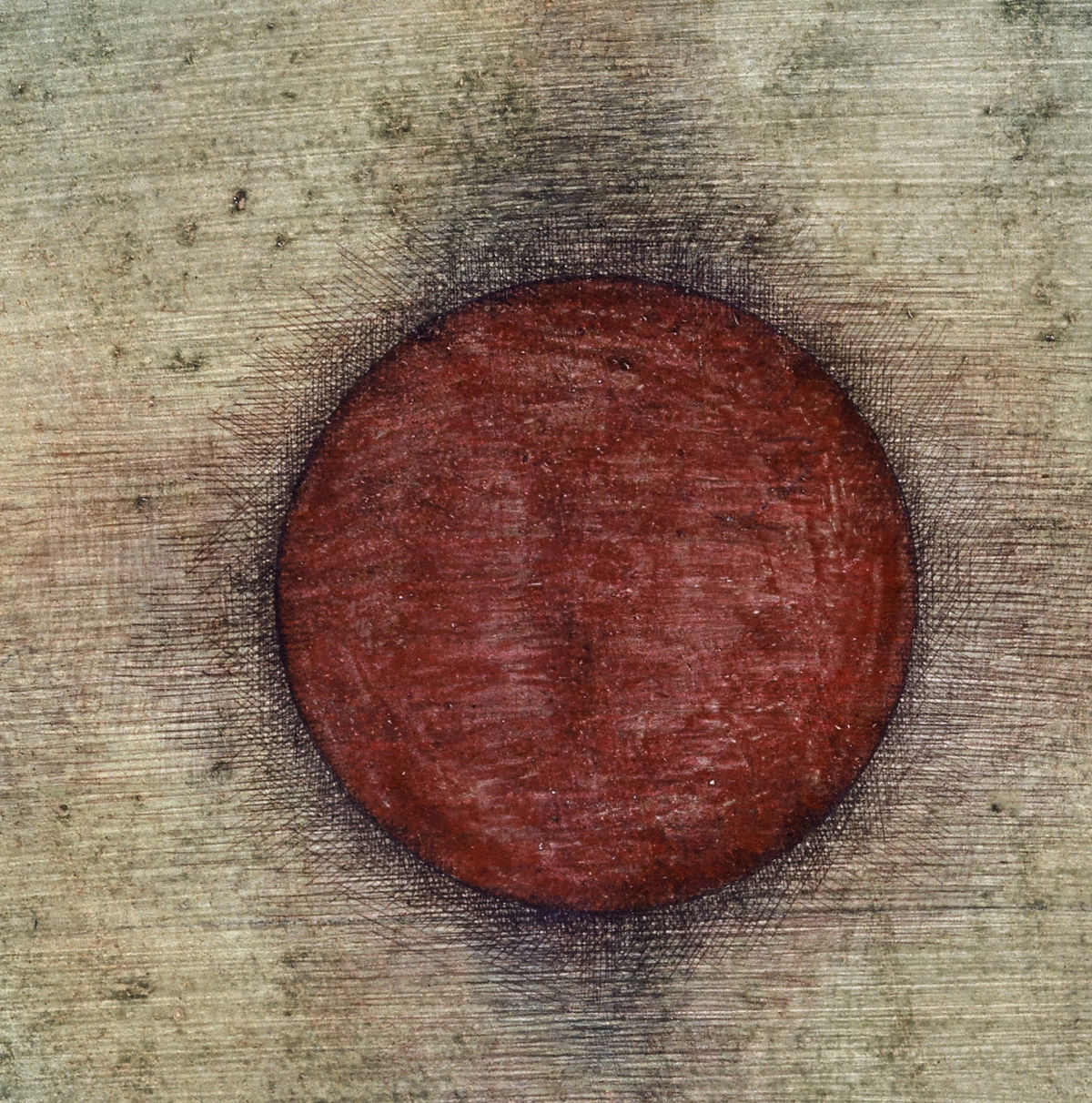
Red disc and surrounding wash
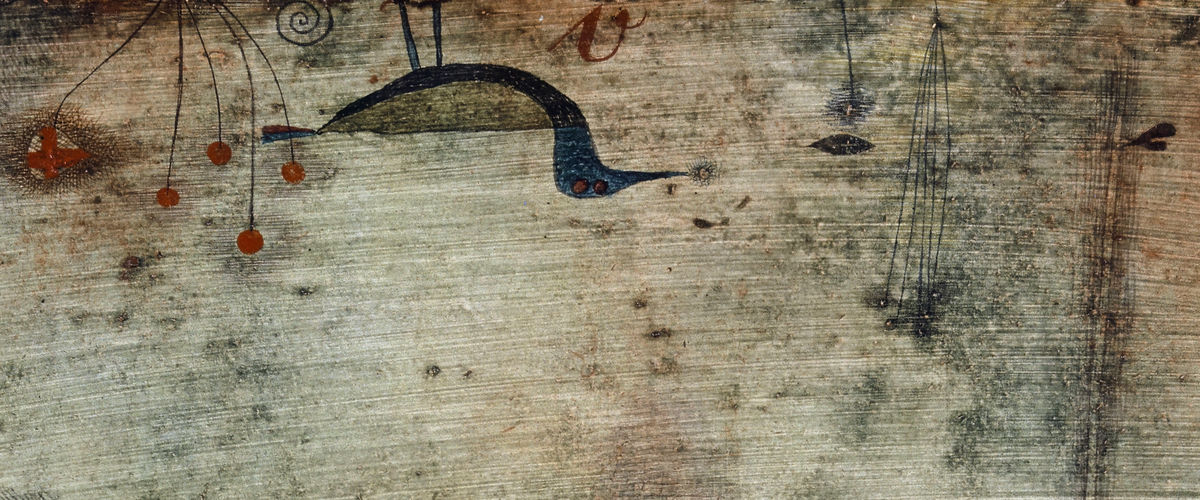
Marks along the upper edge
Signs at the left margin
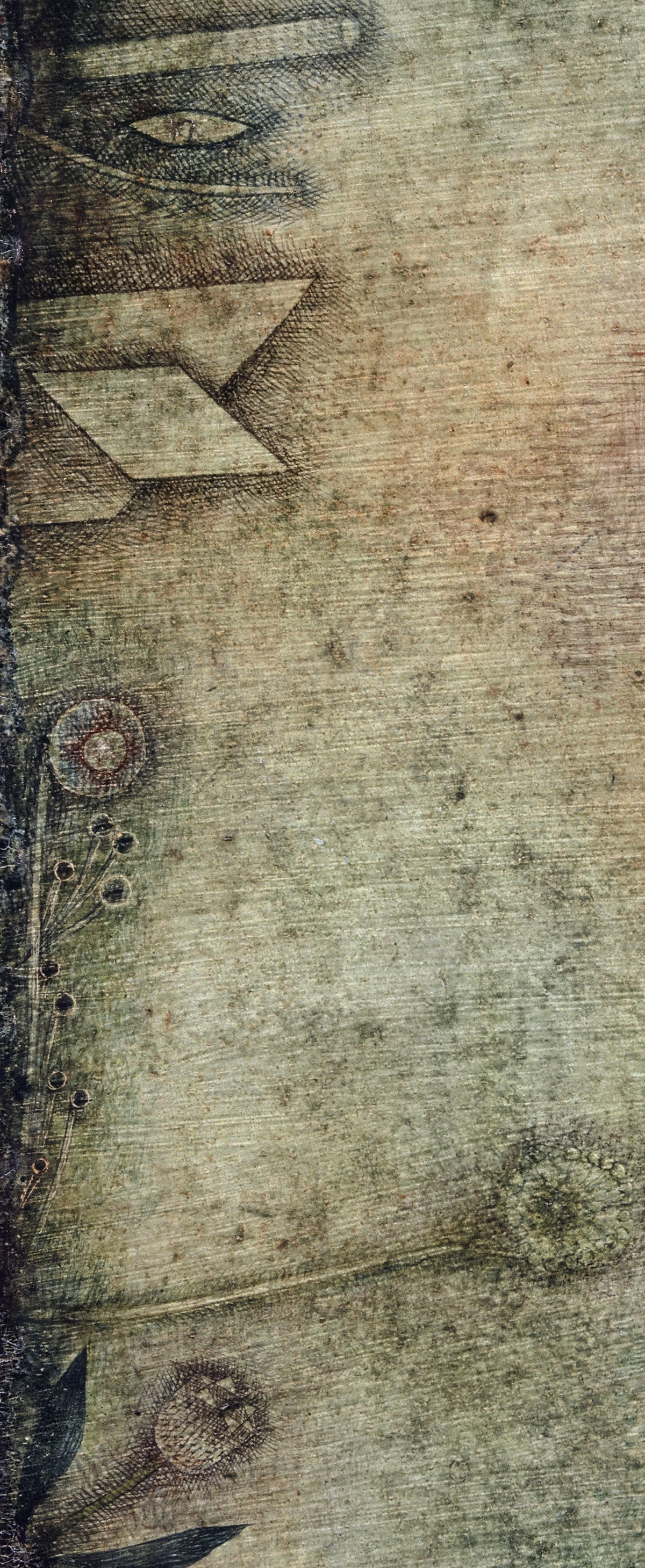
Fine lines at the right margin
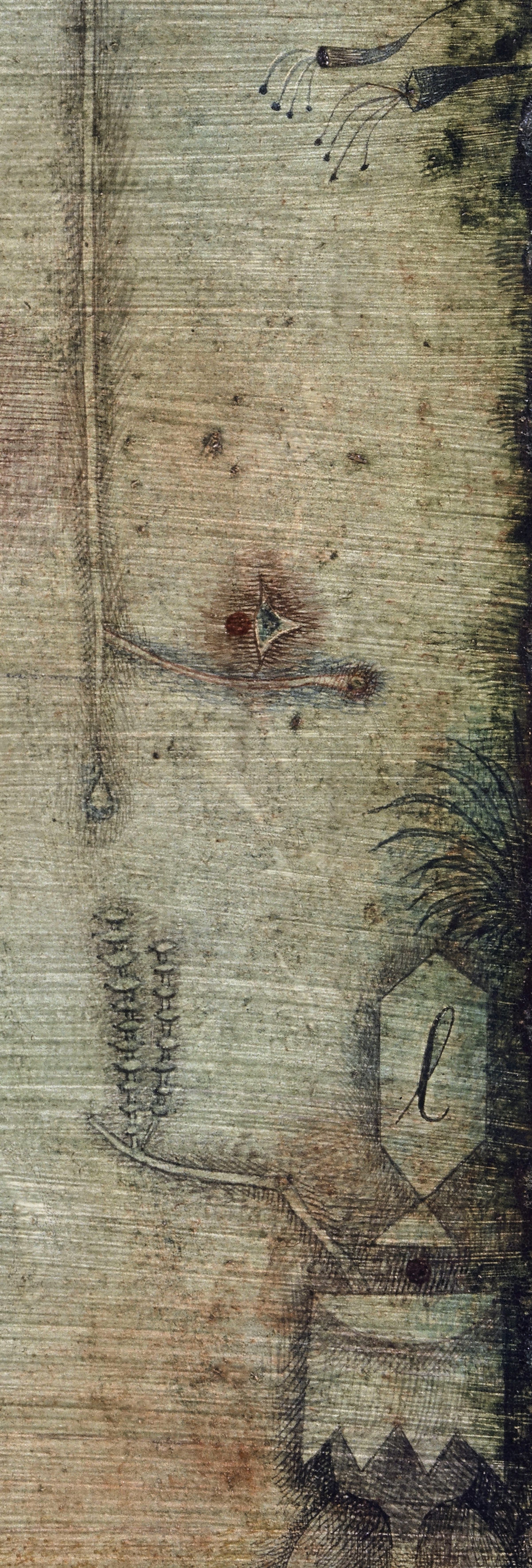
Figures and signs along the base
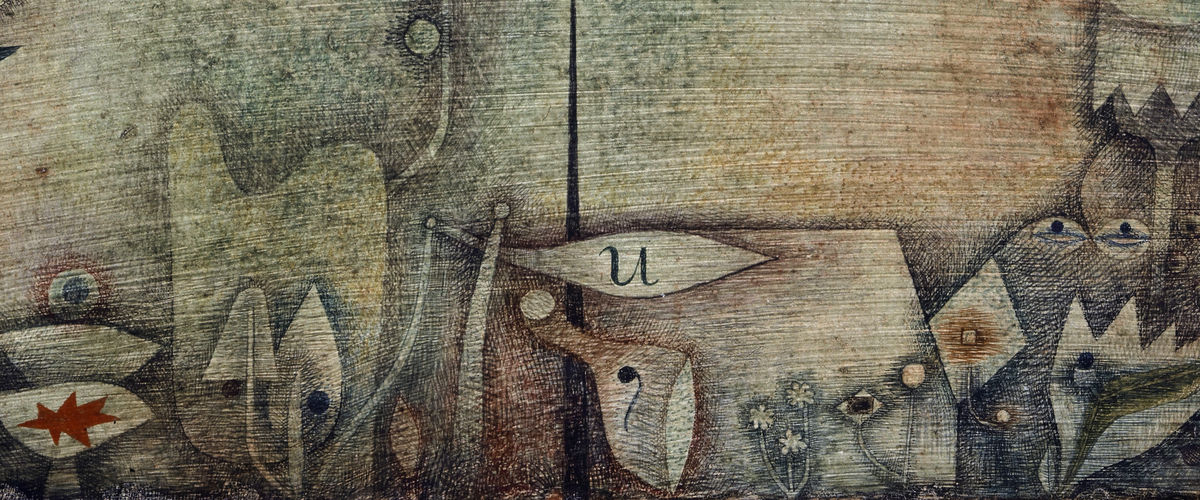
Contents
- What is Ad marginem?
- Why does the title send us to the margin?
- How the red disc changes the rest of the picture
- Follow the four edges
- Are the marks a text we can read?
- What do Klee’s dates add to the interpretation?
- From Klee’s studio to Kunstmuseum Basel
- Looking again
What is Ad marginem?
The Kunstmuseum Basel identifies the picture as Ad marginem, Klee’s work 1930, 210 (E 10), now its inventory G 1960.32. The annual number belongs to Klee’s system of cataloguing his own production; the museum number belongs to Basel’s collection. Its published bibliography identifies the printed Catalogue raisonné Paul Klee, volume 5, entry 5328, pages 506–07. That printed entry has not been directly examined for this page, so the owner museum’s present record is the authority for the details given here.[1]
Basel describes watercolour and pen on a lacquer ground on cardboard, nailed to a stretcher, with a white ground and paint traces on the reverse; the stretcher is covered with gauze. This is a small, materially complex object, measuring 43.5 × 33 cm according to the current collection record. It is not an oil painting, nor simply a loose watercolour sheet. The prepared ground, rigid cardboard and stretcher affect what the work physically is, even when a reproduction shows only its front. A Berlin museum creditline from 2008 gives 46 × 36 cm. The published sources do not explain whether the older figure measures a different component or reflects another convention, so Basel’s current work dimensions are followed without pretending the difference has been solved.[1][3]
The museum transcribes Klee’s signature at upper right. It also records two inscriptions on the back: 1930 E. 10. "ad marginem" on the upper stretcher and überarbeitet 1935/36 K at upper right. The German überarbeitet means “reworked.” The Hyogo Prefectural Museum of Art’s bilingual 2025 exhibition checklist uses “retouched” for the second campaign. That translation should not be mistaken for a conservator’s restoration. It refers to Klee’s own later work on the picture.[1][4]
The reverse paint traces and the two dates are inviting clues, but they do not reveal a layer-by-layer history. A photograph of the front cannot establish whether the red disc, a particular letter, the soft background or a marginal form was made in 1930 or revised five or six years later. Such a reconstruction would require technical evidence that the accessible collection entry does not provide. The right historical description is therefore unusually precise about the existence of reworking and deliberately limited about its appearance.[1]
Why does the title send us to the margin?
The Latin ad marginem can be read as “towards the margin” or “to the edge.” The direction matters more than a neat English substitute. The central disc can hold the viewer’s attention, but the title asks that attention to travel outward. At the border, the coloured band and its tiny occupants become the subject of looking rather than decoration around a supposedly finished central scene.[1][5]
French scholar Florence Rougerie uses the title as the starting point of an essay about writing and painting in Klee. Her argument is that the edge is a meeting place for several kinds of mark: the real boundary of a picture, the internal painted border, letter-like signs within the image and the title outside it. These do different jobs. The title can direct the viewer; a letter drawn in the picture can be seen as both a graphic shape and a possible unit of language; a botanical-looking line can be read without becoming a letter at all. Rougerie studies a wider group of Klee works, so her essay is a way to sharpen questions about this one, not proof that every little mark has a fixed translation.[5]
The picture does not set one compulsory route. A viewer may start with the red centre and move outward, as the title suggests. Another may follow a dark shape around the rim and return to the disc only after circling the image. Both paths make the composition work differently. The unusually active border also complicates a familiar expectation that a frame is a passive line separating a painting from its surroundings. Here Klee puts a second, soft and uneven border inside the depicted area; the small forms seem to sprout from it, cross it or sit partly within it.[2][5][6]
German researcher Andrea Dexheimer calls this an inner framing. She observes that the brownish-red edge zone is itself a painted space, irregular in width, and that its boundary towards the pale middle is less definite than the outer edge of the object. Her reading is useful because it attends to an actual formal feature: one can follow the transition from the darkened edge to individual stems and see how a border becomes part of the scene. Her larger philosophical account of boundlessness, freedom and political resistance is an interpretation. The object and its title alone do not document such a programme from Klee.[6]
How the red disc changes the rest of the picture
The central red shape looks round, warm and concentrated against the cool, thinly varied field. It is not precisely centred in the rectangle. A surrounding glow or wash blurs the point where disc, atmosphere and background separate. The red draws the eye inward, but small reddish accents nearer the edge prevent it from owning the colour entirely. In the high-resolution image, the apparently quiet middle is mottled; looking closely reveals irregular variation rather than a blank, uniformly painted void.[1][2]
It is understandable to call the form a sun. Christina Thomson, quoted in Basel’s catalogue record from the 2008 Berlin exhibition publication, offers a strong cosmic reading in which the red centre gives life to the peripheral world. Marcel Franciscono, also quoted by Basel, connects the tiny forms with a smouldering red source but is more guarded about whether the image divides a metaphysical world from an earthly one. These are different scholarly accounts of the same visible relationship. Neither turns “sun,” “planet” or a theory of creation into an authenticated title or statement of the artist’s intention.[1]
The disc is also not the only circular or rounded event. Small red buds, dots and flower-like tops pick up its colour in other places. Dexheimer follows such repeated points through the lower-right and upper margins. Her detailed account can lead a viewer back and forth between a small red accent and the dominant disc; it is less secure when it converts each repetition into a precise system of forces. We can observe a visual rhyme without assigning a fixed physical law to it.[2][6]
The pale field makes the margin appear lively partly through contrast. A thin branching shape is more conspicuous when it projects into open space than when it lies inside the crowded edge band. Some forms sit like silhouettes on the ground, while others seem to rise out of it. That ambiguity makes it difficult to divide the picture into a flat decorative border and a deep central landscape. The disc can look distant, close, floating or suspended depending on which marginal form the eye has just followed. These are effects of looking, not measurements of depicted distance.[2][6]
Follow the four edges
At the upper edge, small sprigs and curved lines interrupt the darkened band. One form can be seen as a bird viewed upside down in the museum’s normal orientation. The shape is not an instruction to hang the whole picture the other way up. It makes orientation unstable locally: a bird can appear inverted while other signs remain legible with the work upright. Dexheimer points to that tension, and Claude Cernuschi explores it by deliberately reproducing the image inverted in one figure of his 2012 chapter. His inversion is part of an argument about reading, not a correction of Basel’s orientation.[1][2][6][7]
At the left edge, marks move between thin plant-like lines, a small body-like form and a lower-case letter. The shapes are connected to the border, yet they also reach into the central field. Dexheimer sees an almost gesturing creature in the lower left. That is a productive description if kept as a visual possibility: outlines here do not give us a named species or a firm narrative action. The detail rewards looking in both directions, from edge towards centre and from red disc back to the dense left side.[2][6]
At the right edge, angled and branching forms overlap. Some resemble stems with buds; others feel closer to diagrammatic signs. Their thin dark outlines can make them read as separate little things, but the ground colours pass behind and through the group. The edge is therefore not a row of isolated objects like specimens in a case. It is a zone where figures appear, merge and disappear as the eye changes scale.[2][6]
Along the lower edge, small signs and rounded or insect-like figures gather around a darker pointed interruption rising into the interior. One mark resembles a lower-case u. The pointed feature might appear like a split, a thorn or an opening, but its exact identity is uncertain. The red disc above can make it seem to pull these things upward; a viewer starting at the base may instead see the shapes growing into an open field. The high-resolution detail images below allow each part to be inspected without rotating the main reproduction or changing the painting’s documented orientation.[1][2][6]
These are deliberately cautious names for the forms. Calling every shape a plant understates the letter-like marks; calling every mark a symbol overstates their legibility. A careful visual inventory can describe an inverted bird-like figure, stems, a rounded red form and scattered letters while keeping open the ways in which Klee makes one category resemble another.[2][5][6][7]
Are the marks a text we can read?
Art historian Louis Marin gives a particularly close answer. In an essay first published in French in 1988 and read here in its published Italian translation, he describes small signs at the top, left, right and bottom as resembling v, r, l and u. He tests what happens if a viewer imagines turning the picture. A bird-like shape may become easier to recognise, while some letters lose their ordinary orientation. Marin tries possible sound and word relations, but his thought experiment does not establish a complete sentence hidden in the painting. The value of the exercise is that it makes us notice how differently images and letters behave when turned.[8]
Cernuschi also identifies the marginal letters and compares the image with a map: a map combines terrain, drawn forms and text labels, and a reader may change viewpoint to use it. This is a conceptual analogy, not evidence that Klee copied a particular map. Cernuschi’s deliberately inverted reproduction lets the viewer test the problem rather than merely hear it described. Some natural-looking marks still suggest creatures or plants, but familiar letters no longer hold their reading as securely. The difference makes the act of reading itself visible.[7]
Rougerie widens the question. In Klee’s pictures, a written sign may look like drawing and a drawn sign may tempt us to pronounce it. The title can seem to promise a key, yet it may instead bring the gap between seeing and reading into focus. This matters here because the letters do not line up like an ordinary sentence, and the peripheral forms provide no agreed reading order. Even the identification of particular letter shapes differs among scholars when they describe crowded passages. It is more accurate to say that Ad marginem stages a possible encounter with language than that it transmits a decoded message.[5][7][8]
The distinction is not pedantry. Once the forms become a supposed cipher, looking can stop: the painting is treated as a puzzle whose solution replaces its surface. But the surface keeps resisting any final transcription. Soft washes cross behind crisp lines; one small outline begins as a sign and ends as a stalk; the large red form seems simple until its edge dissolves into surrounding colour. The image remains a painting even where it borrows the visual habits of writing.[2][5][7][8]
What do Klee’s dates add to the interpretation?
Klee first made the work in 1930, towards the end of his Bauhaus teaching years. His later inscription records that he reworked it in 1935–36, after the Nazi seizure of power and his return to Switzerland. These dates provide real historical context, but the accessible object record does not say whether a particular feature responds to exile, illness or a personal experience. It would be especially risky to assign a sombre meaning to a mark assumed to be late when the published evidence cannot place that mark in the later campaign.[1][9]
The two dates are interesting even without such a story. A picture whose title sends us to a margin was itself reconsidered after several years. Klee kept the 1930 catalogue identity and made a later addition to its material history. The work therefore joins at least two moments of artistic decision; the image we see now should not be treated as a transparent snapshot of a single day in 1930. That does not allow us to divide its present surface into an original “hopeful” layer and a later “melancholy” layer. No such division is documented in the owner’s published record.[1]
Klee’s teaching, drawing and colour experiments are part of the painting’s historical setting, as is his later return to Bern. The object sources do not connect a particular shape in Ad marginem to Cubism, Surrealism or a documented lecture. The painting’s formal and material evidence is a firmer basis for understanding it than a broad movement label.[1][9]
From Klee’s studio to Kunstmuseum Basel
Basel publishes a clear provenance sequence. Klee kept the work from 1930 to 1937. Richard Doetsch-Benziger of Basel bought it from the artist in 1937 and owned it until his death in 1958. It remained in his estate until 1960, when the Kunstmuseum Basel received it as his bequest. This is more specific than saying vaguely that the work “later entered Basel,” and it matters that its first documented transfer happened after Klee’s own reworking.[1]
The museum’s bibliography lists the work in a 1941 Basel memorial exhibition, a 1945–46 London National Gallery exhibition and later Basel and international catalogues. Those listings show that the object had a public history during and after Doetsch-Benziger’s ownership; they do not tell us exactly what each curator said about its date or signs. The 2008 Berlin loan record and 2025 Hyogo checklist provide independently accessible later exhibition anchors. Hyogo’s entry retains the 1935–36 qualification in a bilingual caption, showing that the double date continues to matter in its present public presentation.[1][3][4]
The image itself has circulated in reproductions, and reproduction can alter the way its margins are read. The correct Basel front view is vertical, with the red disc above the centre and the inverted bird-like figure at the upper edge. One scholarly figure turns it upside down deliberately to ask a question; an accidentally inverted reproduction would make that scholarly experiment look like the painting’s normal state. On this page, the main image follows Basel’s orientation, and the detail images are crops of the same high-resolution source.[1][2][7]
Looking again
Return to the whole picture after examining its details. The red disc may again seize the centre, but the edge is now harder to treat as mere ornament. A tiny u-like form, a bird that seems to stand the wrong way up and stems that look like signs change how the larger shape feels. The title sends the viewer towards the margin; the coloured disc draws the viewer back. Neither direction finally wins. That sustained movement between an almost empty middle and a richly inhabited border is one of the work’s most distinctive achievements.[1][2][5][6][7][8]
For related reading, see Klee’s Bauhaus years and the materials and techniques guide. Insula dulcamara provides a later encounter between ambiguous signs and a pictorial field, while Twittering Machine offers another example of small creature-like forms whose apparent clarity is unsettled by looking closely.
Explore selected works from Klee’s much larger oeuvre. Titles without a link have an authenticated catalogue identity but no reviewed article yet.
Artworks directory
| Name | Date | Medium |
|---|---|---|
| A Gate | 1939 | Painting and mixed media |
| A Woman for Gods | 1938 | Watercolour and mixed media |
| Ab Ovo | 1917 | Watercolour and mixed media |
| Above Mountain Summit | 1917 | Drawing and mixed media |
| Abstract Trio | 1923 | Drawing and mixed media |
| Acrobats | 1915 | Watercolour and mixed media |
| Actor's Mask | 1924 | Painting and mixed media |
| Ad Marginem | 1930 | Drawing and mixed media |
| Ad Parnassum | 1932 | Painting and mixed media |
| Adventurer Ship | 1927 | Drawing and mixed media |
| Affected Place | 1922 | Drawing and mixed media |
| After a Sketch from Zurich | 1914 | Watercolour and mixed media |
| After Drawing | 1919 | |
| After The Floods | 1936 | Watercolour and mixed media |
| All Souls' Picture | 1921 | |
| Ancient Harmony | 1925 | Painting and mixed media |
| Angel Applicant | 1939 | Drawing and mixed media |
| Angel Serves the Desired | 1920 | |
| Angel, Still Female | 1939 | Painting and mixed media |
| Angelus Novus | 1920 | Drawing and mixed media |
| Animal Terror | 1926 | Painting and mixed media |
| Arab Song | 1932 | Painting and mixed media |
| Archangel | 1938 | Painting and mixed media |
| Architecture | 1923 | Painting and mixed media |
| Architecture of the Plain | 1923 | Drawing and mixed media |
| Around the Fish | 1926 | Painting and mixed media |
| Arrival of the Air Steamer | 1921 | Drawing and mixed media |
| Asiatic God | 1924 | Painting and mixed media |
| Astrological Fantasy Portrait | 1924 | Drawing and mixed media |
| Athlete's Head | 1932 | Watercolour and mixed media |
| Aufgehender Stern | 1931 | Painting and mixed media |
| Autumn Flower | 1922 | Painting and mixed media |
| Bad Band | 1920 | Drawing and mixed media |
| Baroque Centaur | 1939 | Painting and mixed media |
| Before the Blitz | 1923 | Drawing and mixed media |
| Before the Snow | 1929 | Drawing and mixed media |
| Besessenes Madchen | 1924 | Watercolour and mixed media |
| Bird Garden | 1924 | |
| Bird Wandering Off | 1926 | Watercolour and mixed media |
| Blossoms in the Night | 1930 | Watercolour and mixed media |
| Blue-Bird-Pumpkin | 1939 | Painting and mixed media |
| Boats in the Flood | 1937 | Painting and mixed media |
| Botanical Theatre | 1934 | Drawing and mixed media |
| Boy in Fancy Dress | 1931 | Watercolour and mixed media |
| Broken Key | 1938 | |
| Brother and Sister | 1930 | Watercolour and mixed media |
| But the Red Roof | 1935 | Painting and mixed media |
| C - C = Fisch | 1931 | Watercolour and mixed media |
| Cacti | 1912 | Painting and mixed media |
| Camel (in Rhythmic Landscape with Trees) | 1920 | Drawing and mixed media |
| Captive Pierrot | 1923 | Drawing and mixed media |
| Castle and Sun | 1928 | Drawing and mixed media |
| Cat and Bird | 1928 | Drawing and mixed media |
| Cathedrals | 1925 | Watercolour and mixed media |
| Chalice of the Heart | 1937 | Painting and mixed media |
| Characters in Yellow | 1937 | Painting and mixed media |
| Chosen Site | 1927 | Mixed media |
| Christmas Picture | 1923 | Drawing and mixed media |
| City of Towers | 1916 | Painting and mixed media |
| Clarification | 1932 | Painting and mixed media |
| Collection of Figurines | 1926 | Painting and mixed media |
| Colorful Architecture | 1917 | Painting and mixed media |
| Comedians' Handbill | 1938 | |
| Comic Opera Singer | 1927 | Painting and mixed media |
| Composition | 1939 | Painting and mixed media |
| Composition with Figures | 1915 | Drawing and mixed media |
| Composition with the Yellow Half-Moon and the Y | 1918 | Watercolour and mixed media |
| Conch–Still Life II | 1939 | Watercolour and mixed media |
| Cosmic Composition | 1919 | Painting and mixed media |
| Crystal Gradation | 1921 | Drawing and mixed media |
| Dance of the Grieving Child | 1922 | Painting and mixed media |
| Dancing Girl | 1940 | Painting and mixed media |
| Das Licht und Etliches | 1931 | Mixed media |
| Death and Fire | 1940 | Painting and mixed media |
| Death for the Idea | 1915 | |
| Demon as Pirate | 1926 | Watercolour and mixed media |
| Diana | 1931 | Painting and mixed media |
| Diavolo Player | 1923 | Drawing and mixed media |
| Die Kapelle | 1917 | Watercolour and mixed media |
| Die Vase | 1938 | Painting and mixed media |
| Doctor | 1930 | Drawing and mixed media |
| Dredger and Sailboat | 1931 | Watercolour and mixed media |
| Ein Tor | 1939 | Painting and mixed media |
| Ein Weib fur Gotter | 1938 | Mixed media |
| Embrace | 1939 | Watercolour and mixed media |
| Episode before an Arab Town | 1923 | |
| Equals Infinity | 1932 | Painting and mixed media |
| Eros | 1923 | Drawing and mixed media |
| Error on Green | 1930 | Watercolour and mixed media |
| Evening Figure | 1935 | Drawing and mixed media |
| Falling Bird | 1919 | |
| Fermata | 1932 | Watercolour and mixed media |
| Fire Clown | 1921 | Watercolour and mixed media |
| Fire Full Moon | 1933 | Watercolour and mixed media |
| Fire in the Evening | 1929 | Painting and mixed media |
| Fish in the Harbour | 1916 | Watercolour and mixed media |
| Fish Magic | 1925 | Watercolour and mixed media |
| Flock of Birds | 1917 | Drawing and mixed media |
| Flora on Sand | 1927 | Watercolour and mixed media |
| Flower Myth | 1918 | |
| Flower Stand with Watering Can and Bucket | 1910 | Watercolour and mixed media |
| Flowering Tree (Abstraction with Reference to a Flowering Tree) | 1925 | Painting and mixed media |
| Flowers in Pots | 1923 | |
| Flowers in Stone | 1939 | Painting and mixed media |
| Forest Witch | 1938 | Painting and mixed media |
| Fright of a Girl | 1922 | Drawing and mixed media |
| Fruits on Red | 1930 | Drawing and mixed media |
| Full Moon | 1919 | Mixed media |
| Föhn Wind in Franz Marc's Garden | 1915 | Watercolour and mixed media |
| Garden in St Germain, The European Quarter near Tunis | 1914 | Watercolour and mixed media |
| Ghost Chamber with the Tall Door (New Version) | 1925 | |
| Ghost of a Genius | 1922 | Drawing and mixed media |
| Girl in Mourning | 1939 | Painting and mixed media |
| Glance of a Landscape | 1926 | Watercolour and mixed media |
| Gluht Nach | 1939 | Drawing and mixed media |
| Golden Fish | 1925 | Watercolour and mixed media |
| Goldfish Wife | 1921 | Watercolour and mixed media |
| Green Plant, Blood, Louse | 1924 | Drawing and mixed media |
| Hafenbild | 1918 | Mixed media |
| Hammamet with Mosque | 1914 | Watercolour and mixed media |
| Harbour with Sailing Ships | 1937 | Painting and mixed media |
| Hauptweg und Nebenwege | 1929 | Painting and mixed media |
| Heavenly and Earthly Time | 1927 | Drawing and mixed media |
| Heroic Fiddling | 1938 | Painting and mixed media |
| Heroic Roses | 1938 | Painting and mixed media |
| Heroic Strokes of the Bow | — | Mixed media |
| Highway and Byways | 1929 | Drawing and mixed media |
| Houses near the Gravel Pit | 1913 | Watercolour and mixed media |
| Howling Dog | 1928 | Painting and mixed media |
| In the Current Six Thresholds | 1929 | Painting and mixed media |
| In the Style of Kairouan | 1914 | Drawing and mixed media |
| Individualized Altimetry of Stripes | 1930 | Painting and mixed media |
| Insula Dulcamara | 1938 | |
| Interior with the Clock | 1913 | Watercolour and mixed media |
| Irma Rossa the Animal Tamer | 1918 | Drawing and mixed media |
| Journey in Corsica | 1927 | Drawing and mixed media |
| Landscape with Bluebirds | 1919 | Watercolour and mixed media |
| Legend of the Nile | 1937 | Painting and mixed media |
| Lemon Harvest | 1937 | Watercolour and mixed media |
| Likeness in the Bower | 1930 | Watercolour and mixed media |
| Limits of Reason | 1927 | Painting and mixed media |
| Little Hope | 1938 | Watercolour and mixed media |
| Magdalena before the Conversion | 1938 | Drawing and mixed media |
| Mask of Fear | 1932 | Painting and mixed media |
| May Picture | 1925 | Painting and mixed media |
| Monument in a Cemetery | 1922 | Watercolour and mixed media |
| Monuments at G | 1929 | Watercolour and mixed media |
| Municipal Jewel | 1917 | Watercolour and mixed media |
| Mural from the Temple of Longing Thither | 1922 | |
| Nach der Uberschwemmung | 1936 | Watercolour and mixed media |
| New Harmony | 1936 | Painting and mixed media |
| New House in the Suburbs | — | Mixed media |
| Old Steamboat | 1922 | Drawing and mixed media |
| On the Edge | 1930 | Drawing and mixed media |
| Once Emerged from the Gray of Night | 1918 | Drawing and mixed media |
| One Who Understands | 1934 | Painting and mixed media |
| Oriental Pleasure Garden | 1925 | Painting and mixed media |
| Park of Idols | 1939 | Watercolour and mixed media |
| Passing by Red Pillars | 1928 | Watercolour and mixed media |
| Persian Nightingales | 1917 | Drawing and mixed media |
| Popular Wall Painting | 1922 | Painting and mixed media |
| Prestidigitator | 1927 | Watercolour and mixed media |
| Rainy Day | 1931 | Watercolour and mixed media |
| Red and White Domes | 1914 | Watercolour and mixed media |
| Red Balloon | 1922 | Drawing and mixed media |
| Redgreen and Violet-Yellow Rhythms | 1920 | Drawing and mixed media |
| Refuge | 1930 | Watercolour and mixed media |
| Rhythmic Rythmical | 1930 | Painting and mixed media |
| Saint of the Inner Light | 1921 | |
| Scaffolding of a New Building | 1930 | Painting and mixed media |
| Scholar in Dealing with Stars | 1926 | Watercolour and mixed media |
| Seated Woman | 1930 | Drawing and mixed media |
| Senecio | 1922 | Painting and mixed media |
| Separation in the Evening | 1922 | Drawing and mixed media |
| Sinbad the Sailor | 1923 | Drawing and mixed media |
| Skeptically Smiling | — | Mixed media |
| Small House in the Garden City | 1928 | Watercolour and mixed media |
| Small Portrait of a Girl in Yellow | 1925 | Painting and mixed media |
| Southern Gardens | 1919 | Watercolour and mixed media |
| Static-Dynamic Gradation | 1923 | Drawing and mixed media |
| Still Life | 1927 | Painting and mixed media |
| Still Life with Gladioli | 1932 | Watercolour and mixed media |
| Strange Garden | 1923 | Drawing and mixed media |
| Stricken City | 1936 | Painting and mixed media |
| Strong Dream | 1929 | Watercolour and mixed media |
| Struck from the List | 1933 | Drawing and mixed media |
| Structural I | 1924 | Drawing and mixed media |
| Sumpflegende | 1919 | Painting and mixed media |
| Temple Gardens | 1920 | Drawing and mixed media |
| The Arrow before the Target | 1921 | Drawing and mixed media |
| The Barbed Noose with the Mice | 1923 | Watercolour and mixed media |
| The Flora of the Heath | 1925 | Watercolour and mixed media |
| The Goldfish | 1925 | Watercolour and mixed media |
| The Hour Before One Night | 1940 | Painting and mixed media |
| The Man in Love | 1923 | |
| The Mask with the Flag | 1925 | Mixed media |
| The Pathos of Fertility | 1921 | |
| The Rhine at Duisburg | 1937 | Painting and mixed media |
| The Way to the Citadel | 1937 | Painting and mixed media |
| Three Houses and a Bridge | 1922 | Watercolour and mixed media |
| Tightrope Walker | 1923 | |
| Tomb in Three Parts | 1923 | Watercolour and mixed media |
| Tomcat's Turf | 1919 | Watercolour and mixed media |
| Tower in Orange and Green | 1922 | Drawing and mixed media |
| Tree and Architecture - Rhythms I | 1920 | Watercolour and mixed media |
| Tree and Architecture - Rhythms II | 1920 | Painting and mixed media |
| Tropical Dawn with the Owl | 1921 | Mixed media |
| Tropische Dammerung | 1921 | Painting and mixed media |
| Twittering Machine | 1922 | Drawing and mixed media |
| Variations (Progressive Motif) | 1927 | Watercolour and mixed media |
| Ventriloquist and Crier in the Moor | 1923 | |
| Viaducts Break Ranks | 1937 | Drawing and mixed media |
| Villa R | 1919 | Painting and mixed media |
| Village Carnival | 1926 | Painting and mixed media |
| Vor dem Blitz | 1923 | Drawing and mixed media |
| Wald-Hexen | 1938 | Painting and mixed media |
| Young Forest | 1925 | Drawing and mixed media |
Related artworks
Explore eight other Klee works, beginning with works close in date to this one.
Error on Green
1930
Fire in the Evening
1929
Highway and Byways
1929
Ad Parnassum
1932
Castle and Sun
1928
Cat and Bird
1928
Mask of Fear
1932
Discussion
The red disc draws the eye inward, while the title and small marginal forms send it outward.
The museum records the two working dates; scholars offer different ways to read the letters, bird and border.
Reader Insights
Which edge detail changes how you see the red disc?
Does turning your head make one shape easier to recognise and another harder to read?
Where does a drawn line begin to resemble a letter or a living form?
Join the Conversation
Share the particular detail or source behind your reading.
References
- Kunstmuseum Basel, Ad marginem, collection item 1210, current German full record: Klee number, medium and dimensions, artist inscriptions, complete published provenance, bibliography, and quotations from Marcel Franciscono, Paul Klee: His Work and Thought (1991), pp. 190–91, and Christina Thomson in Das Universum Klee (2008), p. 88. The original Franciscono and Thomson publications are not independently quoted here, View source.
- Rawpixel, exact-match Ad marginem image, item 3590286, item-level CC0 high-resolution source; visual observations checked against the project’s unenhanced 4450 × 5904 px, native 300 dpi master. The local splash and five detail images derive directly from that source. A reproduction is not a conservation study, View source.
- Staatliche Museen zu Berlin, 2008 Das Universum Klee creditline, institutional loan caption with the older 46 × 36 cm dimensions. It does not explain the difference from Basel’s present 43.5 × 33 cm figure, View source.
- Hyogo Prefectural Museum of Art, bilingual 2025 exhibition checklist, entry 068: owner, technical caption, 1930 and 1935–36 “retouched” dates. The record likely uses lender data and is not an independent technical examination, View source.
- Florence Rougerie, “Ad Marginem, écriture et peinture chez Paul Klee – Aux marges du tableau: titres, légendes, signature”, Textimage (2007), French essay, especially PDF pp. 1–5, for the title, margin and relation of drawing to writing. Later comparisons in the essay concern other Klee works and are not silently applied to this object, View source.
- Andrea Dexheimer, Ad marginem – Die Linie bei Paul Klee & Henri Michaux: Un dispositif contre la pensée totalitaire, doctoral thesis defended 2020, Tübingen repository copy 2022, §2.4, printed pp. 188–214. German close analysis of the internal border, peripheral forms, colour and viewpoint. Its philosophical extrapolations are attributed, not treated as documents of Klee’s intent, View source.
- Claude Cernuschi, “Paul Klee and Language”, in Paul Klee: Philosophical Vision, From Nature to Art (2012), especially discussion of fig. 8 and deliberately inverted fig. 17. Full online chapter read for letters, map analogy and variable viewing orientation, View source.
- Louis Marin, “Aux marges de la peinture: voir la voix,” L’Écrit du temps 17 (winter 1988), pp. 61–72; repr. De la représentation (1994), pp. 329–41. The work-specific argument was read in its published Italian translation, “Ai margini della pittura: vedere la voce”, printed pp. 175–83. The original French edition has not been directly examined here, View source.
- Bauhaus-Archiv, “Unterricht”, German institutional context for Klee’s teaching, and Zentrum Paul Klee, biographical chronology, institutional dates. These establish general chronology, not the motive or visible extent of the painting’s reworking.