


 by Tom Gurney
Tom Gurney BSc (Hons) is an art history expert with over 20 years experience
Published on June 19, 2020 / Updated on September 27, 2026
Email: tomgurney1@gmail.com / Phone: +44 7429 011000
A garden, a mountain wind and colour
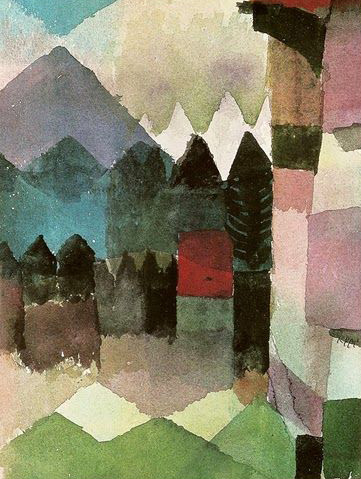
Paul Klee's Föhn im Marc'schen Garten, usually translated Föhn Wind in Franz Marc's Garden, names a place, a friend and a kind of weather. A mountain-like triangle remains visible near the top, while pale and dark colour planes meet below it. The image is neither a conventional view of a flower bed nor an entirely placeless arrangement of shapes. It asks a viewer to recognise a landscape as coloured geometry without fixing every triangle as a peak or every dark point as a tree.[1]
The painting belongs to the Lenbachhaus in Munich. Its own record identifies 1915,102, watercolour on paper mounted on cardboard, signed by Klee, with the German title written on the back of the card. Those facts establish this particular work before any story about Marc, Tunisia or the Blue Rider is attached to it. The museum's interpretation and other sources then help us ask what the weather and garden title contributes. They also leave a real question about whether published measurements refer to the painted sheet or the complete mount.[1]
Contents
- What does the object record establish?
- Why do the published dimensions disagree?
- What is a Föhn?
- Where was Marc's garden?
- What did the friendship mean in 1915?
- How are landscape and colour fitted together?
- Delaunay, Tunisia and a northern landscape
- What has happened to the picture since?
- Look again
What does the object record establish?
The Lenbachhaus lists the original title as Föhn im Marc'schen Garten. It records Klee in ink near the right centre of the image; 1915 102 on the cardboard at lower left; and the title on the back of that card. This makes the numbering and title part of the documented artist-mounted object, rather than an English name invented for a modern reproduction. 1915,102 is Klee's annual work notation. G 13266 is the museum's inventory number; it is not another title or a year of creation.[1]
The museum calls the work watercolour on paper on cardboard and says it purchased it in 1964. It does not name an earlier owner in the current public entry. Nor does its 1964 accession mean the work has hung continuously in Munich since then. The current collection page marks it not on display. A visitor should check the museum's present status before expecting to see the original; its inclusion in a past exhibition photograph is not a promise about today's gallery arrangement.[1][8]
The title has several English forms. “Foehn in Marc's Garden” retains a transliteration of the German weather word; the Albertina has used “Föhn Wind: In Franz Marc's Garden,” which supplies Marc's first name for readers. The local route uses an expanded English title, but the artwork caption should keep Klee's German wording. Marc'schen is a grammatical form of the surname. The title tells us the place is associated with Franz Marc; it does not make him the painter of this watercolour or say that the picture imitates his brushwork.[1][9]
Why do the published dimensions disagree?
The present Lenbachhaus record gives 32.3 × 24.5 cm. A 2015 French-language Swissinfo caption, accompanying a Klee/Kandinsky exhibition, gives 20 × 15 cm for the same German title, medium and museum. Other older and derivative captions repeat the smaller figure. It is plausible that one measurement describes the mounted card and the other the watercoloured sheet. Yet neither the accessible museum entry nor the French caption explicitly identifies the component measured. The page therefore reports the owner's present overall figure and the competing smaller figure without asserting that the difference has been solved.[1][8]
That distinction is more than clerical. A small painted area surrounded by an artist's mount would be experienced differently from an image extending to the outer edge of the whole recorded object. Klee's number appears on the cardboard, and the title is on its back. Cropping an online photograph to just the painted field can hide the mount and make the dimensions appear to contradict each other. The current conservation or catalogue raisonné file is needed to identify exactly what each measurement denotes and whether the mount has changed.[1][8]
What is a Föhn?
In common Alpine usage, Föhn names a dry descending wind on the lee side of mountains, though the exact meteorology depends on conditions. The German Weather Service uses the word in this mountain-weather context. The title therefore makes air and changing light part of the subject, not a visible person or object within the garden. Klee had to suggest a felt and seen condition through colour and relation among shapes. The name does not document what the wind speed was on a particular day or whether he painted outdoors while it blew.[7]
This is why the mountain form matters. A violet-grey triangle can anchor the page in Alpine terrain while lighter planes around it seem to shift. Darker pointed forms collect in the middle, and a vertical arrangement at the right balances them. The old splash is sufficient to see these broad relationships; it is not sufficient to name a particular pine species, building eaves, cloud gap or measured atmospheric effect. The Lenbachhaus describes the mountain as a remaining natural form drawn into a flatter geometric construction, which is a better evidenced way of talking about what the image does.[1]
The word “wind” can tempt a reader to invent a direct emotional diagnosis. The inherited article suggested a Föhn-induced change of painters' moods. No object record, letter or weather report used here establishes that claim for Klee or Marc. Weather can be a pictorial subject without being a medical or psychological explanation of the painter. The watercolours guide follows Klee's use of transparent colour and reserve on paper without needing such a story.[1][7]
Where was Marc's garden?
Franz and Maria Marc had lived at Sindelsdorf, a name often attached to their prewar circle. The German Historical Museum records their move to Ried near Benediktbeuern in 1914. A Zentrum Paul Klee chronology says Paul and Lily Klee visited Maria Marc at Ried early in 1915. A Galerie Kornfeld catalogue, discussing a different 1915 watercolour, places a group of Klee's Upper Bavarian Föhn works in the context of visits to Marc at Ried in 1914 and 1915 and specifically names Föhn im Marc'schen Garten as a leading example. Those sources together make Ried the best-supported setting for the garden in this title.[3][4][5]
Kornfeld's compared work is Oberbayrische Landschaft bei Föhn, Ried, 1915,243. Its own dimensions, ownership and catalogue raisonné number belong to that sheet and must not be copied onto 1915,102. The comparison is valuable because its original title explicitly includes both weather and Ried. It shows that Klee returned to the region and this kind of light as pictorial problems. It does not tell us whether the two pictures show the same viewpoint or were painted on the same afternoon.[4]
The exact date of execution within 1915 remains unverified in the public object record. A recorded early-year visit and the later annual work number can locate a broad setting, but neither supplies a day-by-day painting diary. Klee might have worked before, during or after a specific encounter with the place. The source-supported statement is that the Marcs' home was at Ried by 1915, the Klees visited Maria there, and the related Föhn watercolour group has been linked to those visits. A precise garden map or view would require stronger documentary or topographic evidence.[1][3][4][5]
What did the friendship mean in 1915?
The Zentrum Paul Klee's account of its 2011 Klee–Marc exhibition places their first meeting in 1912 and describes a substantial exchange of letters and images involving Lily Klee and Maria Marc as well as the two painters. Its summary argues that the artistic dialogue mattered to both. The friendship was not simply a famous male painter inspiring an isolated Klee: two households sustained conversations, visits, postcards and shared art. The correspondence, rather than a short museum summary, is the next source needed for the exact words and dates of particular discussions.[2][5]
The First World War changed the setting. The German Historical Museum dates Franz Marc's move to Ried and subsequent military service in 1914. The ZPK joint chronology says Klee criticised Marc's enthusiasm for war in 1915 and that a visit to Maria in Ried involved a difficult discussion. Marc's death near Verdun occurred in March 1916, after the painting's recorded year. The dates place this picture in a strained wartime friendship and a house from which Marc was often absent. They do not license treating each dark painted form as a prophecy of his death or a coded antiwar statement.[3][5]
Marc's name in the title can therefore do several things at once. It identifies a known garden, situates Klee's encounter within the friendship, and evokes a circle of artists for later viewers. The watercolour itself still needs to be read as a watercolour. A historical disagreement about war does not tell us how to label an individual green plane, just as a shared interest in colour does not prove Marc selected Klee's palette. The letters and the original catalogue entry may eventually establish a closer relationship between a particular visit and this sheet.[1][5]
How are landscape and colour fitted together?
The Lenbachhaus's object essay, adapted from Helmut Friedel and Annegret Hoberg's 2007 collection book, describes a loose architecture of colour. It focuses on rhombi, squares and triangles that meet and partly overlap, with some lightening toward transparency. Corresponding coloured units relate sky and earth. The purple mountain triangle remains recognisable, but it participates in the same planar system as the less easily named surrounding areas. This is the museum authors' formal interpretation, supported by looking at the work, not a measured geometric diagram left by Klee.[1]
The composition can be approached by alternating between two readings. In one, a mountain, dark stand of trees and a bright foreground suggest a view out over land. In the other, the whole page is an arrangement of adjacent and superimposed patches whose angles and values move the eye. Neither cancels the other. The title gives enough to orient us in Marc's garden, while the painted divisions prevent a simple topographic reconstruction. That tension is more precise than calling it either wholly abstract or a conventional landscape with decorative colour laid over it.[1]
The transparent quality described by the museum is tied to the physical medium. Watercolour lets light from the paper influence successive washes, and colour can meet or cross at the edges. An online reproduction may flatten those layers. The visible evidence does not support identifying particular pines, roof eaves or a specific cloud opening.[1]
Romanian musicologist Lena Vieru Conta offers a separate, later comparison. She reads repeated and inverted triangles and rectangles in this garden work as motif-like variations, and proposes a movement through the picture somewhat like following a musical score from left to right. Her analysis draws attention to recurrence and changed orientation. It does not demonstrate that Klee transcribed an actual composition or arranged the watercolour in musical time. The music guide explains where a literal Klee diagram of Bach does survive; this sheet supplies a more open analogy.[6]
Delaunay, Tunisia and a northern landscape
The Lenbachhaus essay locates the 1915 watercolour after two significant colour experiences. It describes Klee's 1912 visit to Robert Delaunay's Paris studio and his interest in Delaunay's near-abstract Windows pictures. It then places Klee's April 1914 journey to Tunisia with August Macke and Louis Moilliet in a longer development toward colour. The essay cites Klee's well-known Kairouan diary passage, but the critical edition and original context should be read before treating its familiar short English translation as an untouched travel-day statement. The museum itself describes a slow development, not a switch flipped in a single afternoon.[1]
This earlier history can illuminate the use of overlapping coloured planes in a Bavarian landscape. It cannot prove that one particular triangle is copied from a Delaunay window or a Tunisian street. The Tunisia guide and Hammamet with Its Mosque page examine the southern works on their own materials and locations. Looking from those sheets to this one, a reader can ask how a method of organising colour changes when the subject is Alpine weather and a friend's garden. The question is supported by the Lenbachhaus's comparison, but the answer must remain open to the specific pictures.[1]
The old page called a 1914 work Klee's “first truly abstract” picture and cast the Föhn sheet as the next step in a simple march away from representation. That narrative compresses different subjects, media and dates. Here the mountain is still legible; colour does not erase place. The museum's account of translucent geometry is more useful because it shows how an identifiable landscape can be remade without disappearing. The colour guide follows the broader theory and its limits; this page stays with the 1915 object.[1]
What has happened to the picture since?
The Lenbachhaus records a 1964 purchase and current inventory G 13266. That is the secure public endpoint of the ownership evidence in hand. A later French Swissinfo gallery used a photograph of it in coverage of the 2015 Klee/Kandinsky exhibition and printed the smaller 20 × 15 cm caption. The Albertina has also listed the work among press images for a Blue Rider exhibition.[1][8][9]
The museum's current not-on-display marker matters because an archive image can easily be mistaken for proof that a work is presently hanging. The Lenbachhaus may rotate works on paper for conservation and programming, but this page does not invent a rotation schedule or reason for this particular status. What can be said is that the original belongs to the museum and is not currently listed as displayed on its object page. Readers interested in seeing it should consult that live record.[1]
Look again
Begin with the upper mountain triangle, then follow the darker forms into the middle. Where do the lighter shapes around them suggest air rather than solid ground? Which edges seem to join two planes, and which keep them apart? Finally ask where “garden” becomes visible: in one identifiable object, or in the relationship of land, light and planted-looking dark forms. The title orients the looking without forcing every shape into a label.[1]
Föhn im Marc'schen Garten belongs to a real friendship and a well-supported Upper Bavarian setting, but its strongest evidence is the watercolour itself and its artist-mounted record. The Lenbachhaus gives the work's original title, number, material and acquisition; its 2007 essay offers a close interpretation of geometry and transparent colour. The unresolved measurement difference, incomplete pre-1964 provenance and lack of a cleared detailed image remain visible limits. Within those limits, the picture shows how Klee could make weather and place felt through colour rather than illustrating them point by point.[1][3][4]
Related artworks
Explore eight other Klee works, beginning with works close in date to this one.
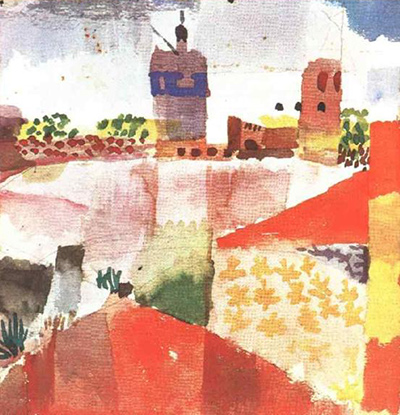
Hammamet with Mosque
1914
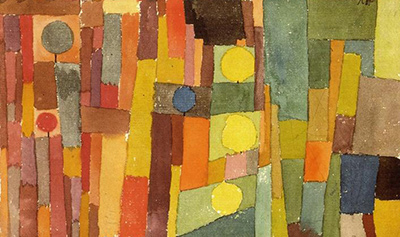
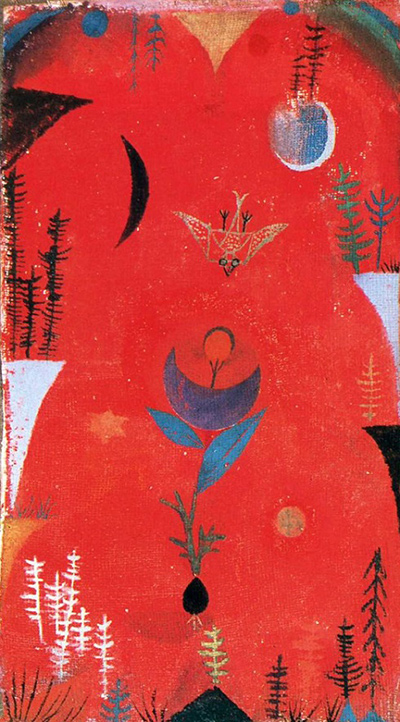
Flower Myth
1918
Angelus Novus
1920
Crystal Gradation
1921
Red Balloon
1922
Senecio
1922
Discussion
The Föhn watercolour connects an identifiable garden with an open arrangement of colour.
Its museum record and early context clarify some questions while leaving the measurements unresolved.
Reader Insights
Which shape makes the image feel most like a landscape to you?
Where do the colour planes seem to overlap or change direction?
What further object record would help settle the sheet and mount sizes?
Join the Conversation
Share the detail and source behind your reading.
References
- Städtische Galerie im Lenbachhaus und Kunstbau München, Föhn im Marc'schen Garten, 1915,102, inv. G 13266, current owner record and object essay adapted from Helmut Friedel and Annegret Hoberg, Der Blaue Reiter im Lenbachhaus München (2007) (German), museum page. Image marked CC BY-NC-SA 4.0; the public text does not clarify components measured, View source.
- Zentrum Paul Klee, Paul Klee–Franz Marc: Dialog in Bildern, 2011 exhibition summary (German), institutional exhibition page, View source.
- Deutsches Historisches Museum, Lutz Walther, “Franz Marc,” LeMO Biografie (German), 1914 Ried move, military service and 1916 death, museum biography, View source.
- Galerie Kornfeld, catalogue for the 12 June 2009 sale, Oberbayrische Landschaft bei Föhn, Ried, 1915,243, printed p. 134 (German), full catalogue PDF. Its mention of Föhn im Marc'schen Garten, 1915,102, supplies comparison and Ried context; the lot is a different artwork, View source.
- Zentrum Paul Klee, Biography: Paul Klee and Franz Marc, joint chronology (English text reproduced by Yumpu), institution-authored chronology. The original correspondence and publication context remain to inspect, View source.
- Lena Vieru Conta, “Sintaxe muzicale în «grădinile» lui Paul Klee,” Revista Muzica 6 (2020), 54–93, especially 69–70 (Romanian, English summary), full article. A later musical-form analogy, not evidence of Klee's intention, View source.
- Deutscher Wetterdienst, discussion of Föhn as Alpine mountain-weather terminology (German), meteorological document, View source.
- Swissinfo, “Klee & Kandinsky: amis, mais aussi rivaux,” 24 June 2015, caption of Föhn im Marc'schen Garten as 20 × 15 cm (French), historic exhibition article. The current owner gives a different, uncomponented measurement, View source.
- Albertina, The Blue Rider exhibition press selection (English), institutional page. Use of the object as a press image is not a commercial reuse grant for this site, View source.