


 by Tom Gurney
Tom Gurney BSc (Hons) is an art history expert with over 20 years experience
Published on June 19, 2020 / Updated on September 27, 2026
Email: tomgurney1@gmail.com / Phone: +44 7429 011000
Colour blocks and the sound of a title
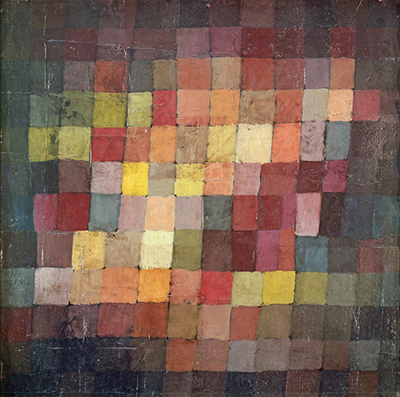
A patch of pale yellow seems to light the middle of a field of small, uneven rectangles. Near it, pink, green, grey and warm ochre change the intensity of the glow. Towards the edges, the same pattern retreats into deep blue, purple, burgundy and nearly black. Paul Klee’s Alter Klang of 1925 is usually called Ancient Harmony or Ancient Sound in English. The painting gives no instruments, performers or written notes. Its title nevertheless asks what a colour arrangement could have to do with sound, and its grid lets the eye move through differences that are felt over time. The first task is to look at those differences rather than declare every square a note.[1][2][3]
The work is compact, almost square and made in oil on cardboard. Klee painted it while teaching at the Bauhaus, at a moment when he was studying the order of visual forms with unusual care. Later scholars have described its light as emerging from darkness; a Munich museum treats it as a starting point for the artist’s subsequent square pictures. Composers have made actual music in response to it. Those are related histories, but not identical kinds of evidence. The visible object, the artist’s own teaching, art historians’ interpretations and the later music each answer a different question.[1][2][4][5]
Explore the details of Ancient Harmony
Select a numbered area to examine its detail at high resolution.
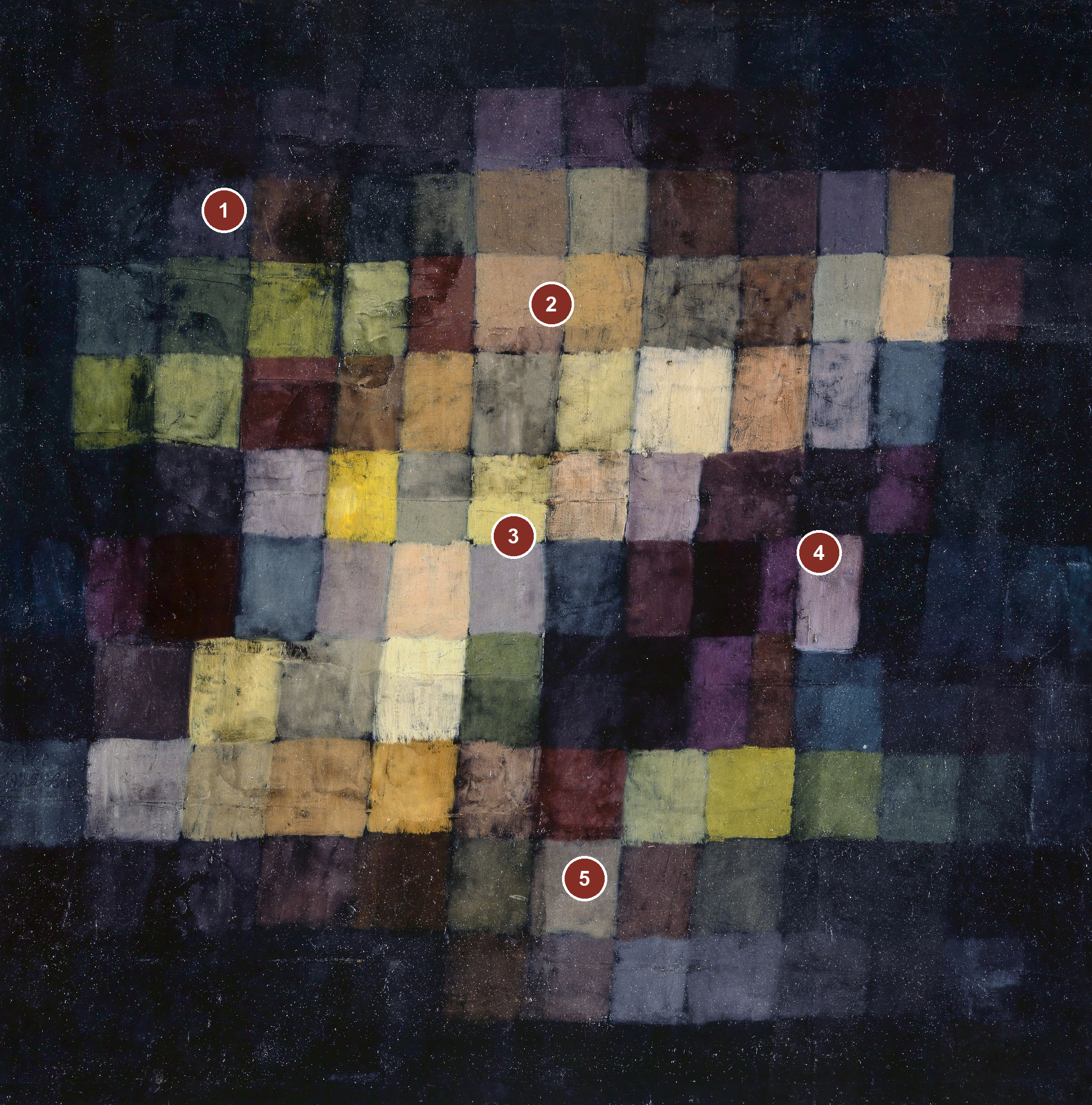
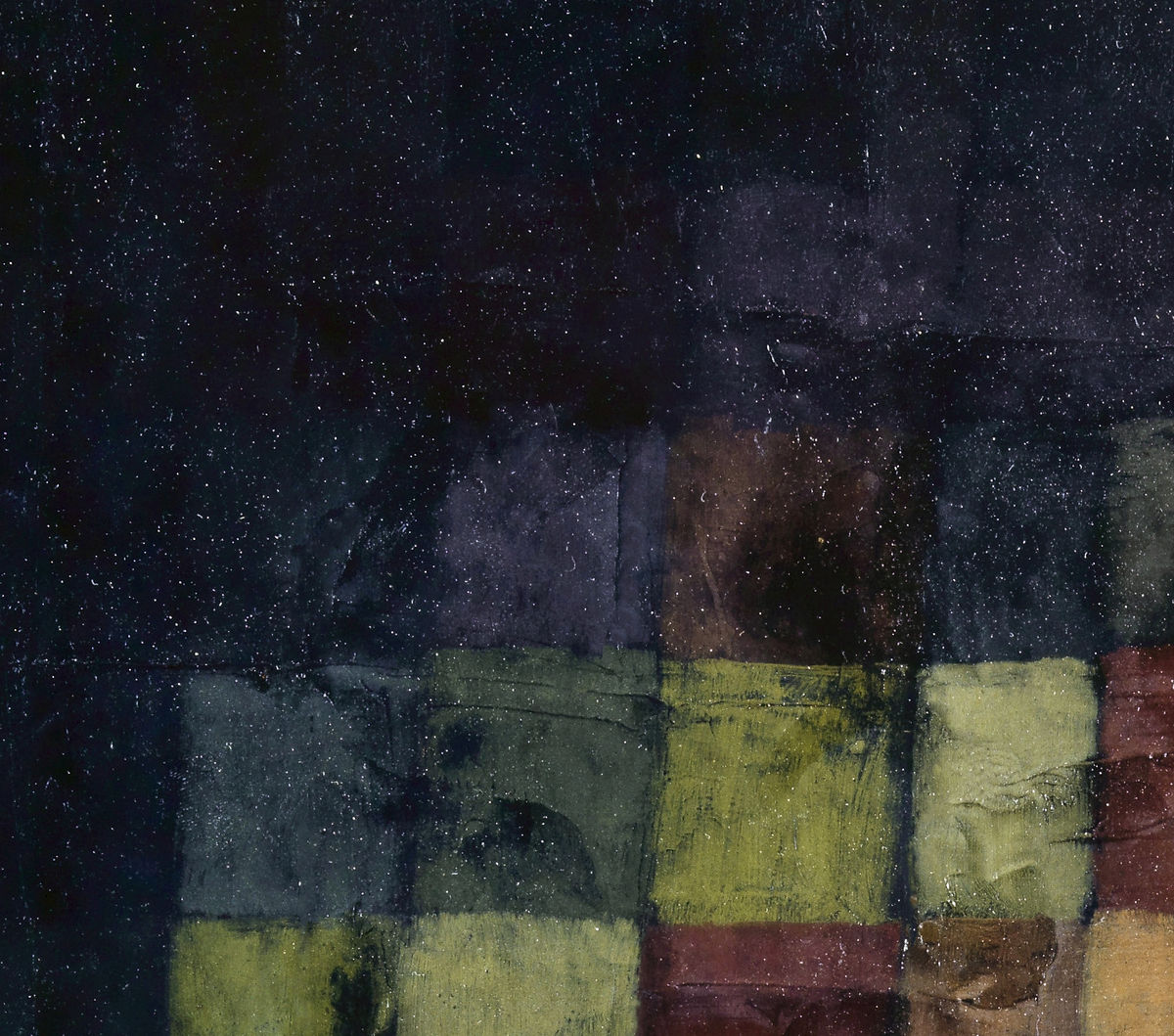
Dark outer field
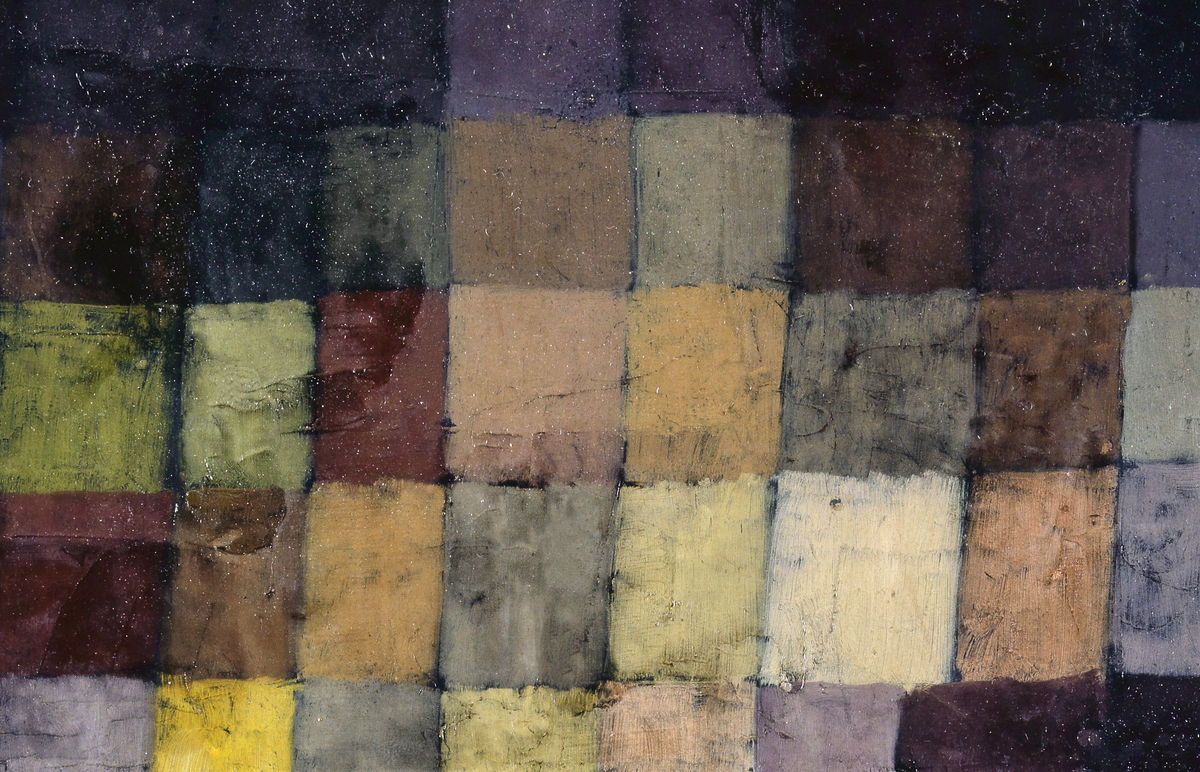
Upper colour grid
Luminous central squares
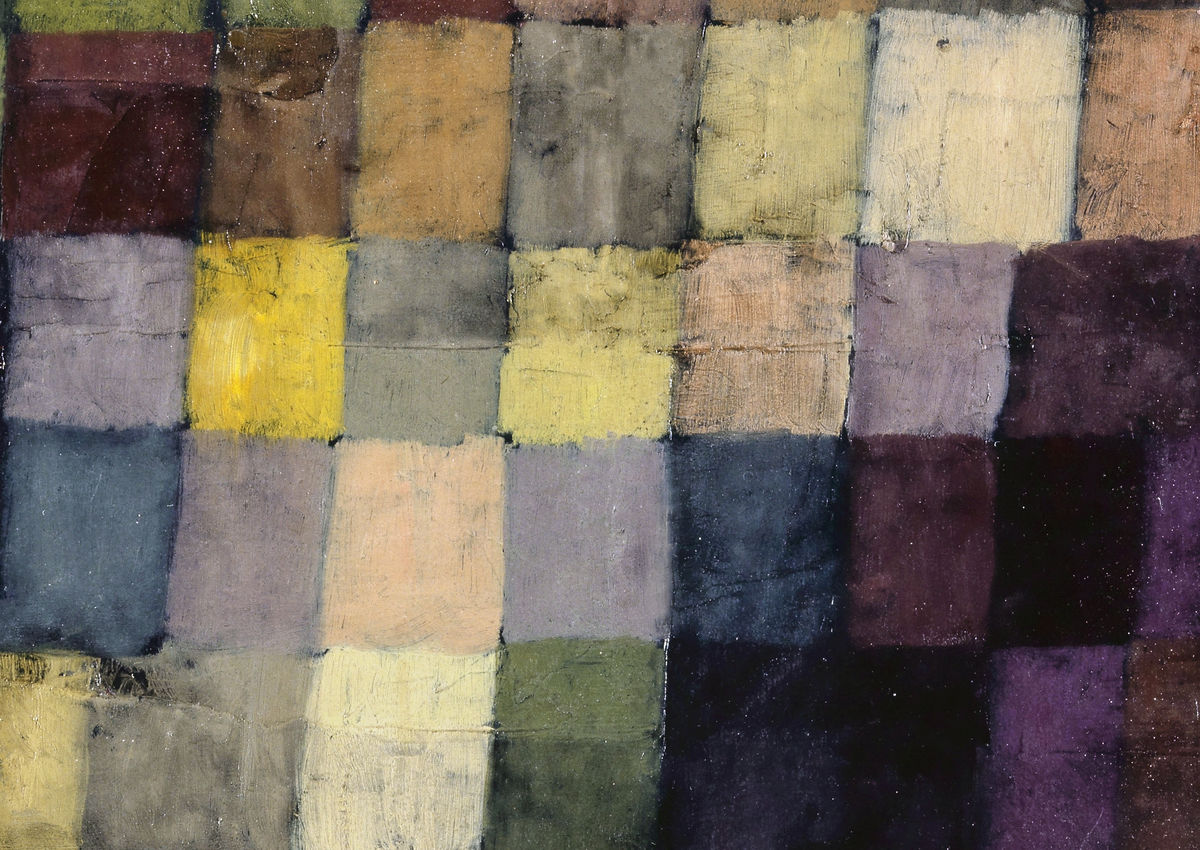
Right-hand colour intervals
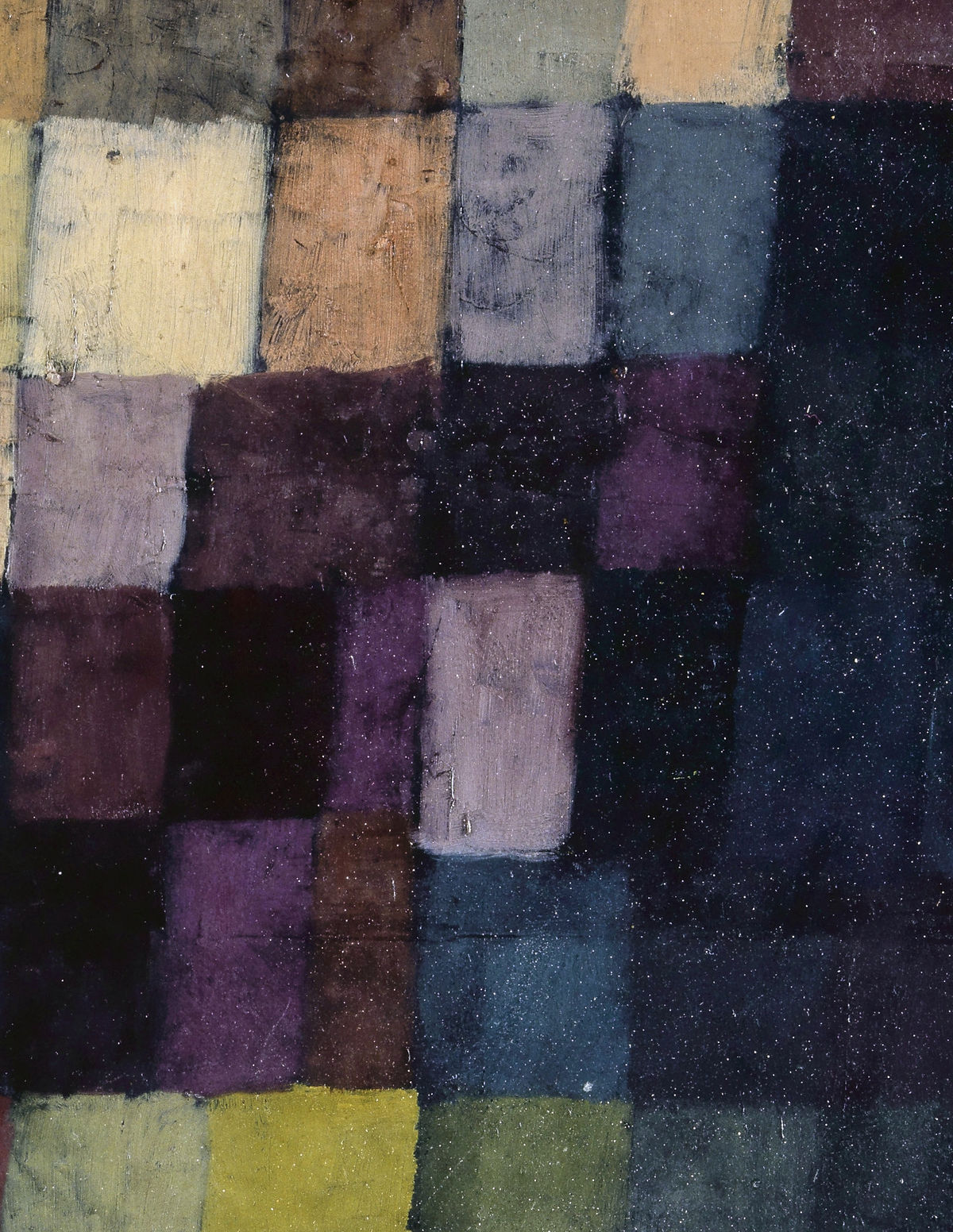
Lower grid fading into darkness
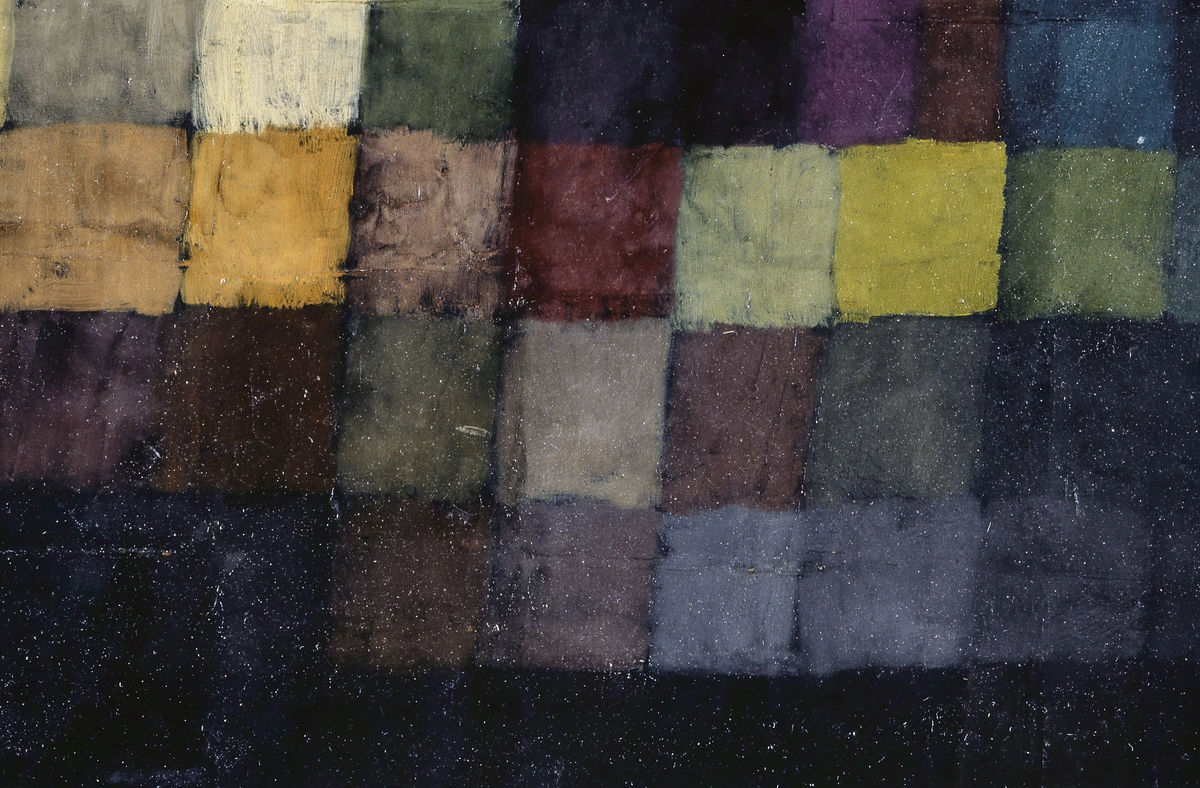
Contents
- The object and its name
- Follow the light through the squares
- Does a colour grid make music?
- From Alter Klang to later square paintings
- Ownership and public afterlives
- Look again without a score
The object and its name
Kunstmuseum Basel records the German title Alter Klang, 1925, 236 (X 6), and inventory G 1960.25. A Spanish state loan document transcribing the museum’s German description gives oil on cardboard nailed to a frame, 38.3 × 38 cm. The museum’s photograph carries the same size, medium, number and bequest credit. It is a painting on a supported cardboard surface, not a watercolour or an oil canvas. The letter-and-number notation in parentheses belongs to the annual work register; it is not a second date. The photograph’s metadata and the Basel accession list agree that the painting entered the museum in 1960 through the bequest of Richard Doetsch-Benziger.[1][6]
The German Klang can mean sound, tone or resonance. “Ancient Sound” keeps the word open; “Ancient Harmony” gives it a more settled musical relation. Both English titles are in established circulation, and the latter is the familiar name of this page. Klee’s documented German title should therefore stay visible. Some later concert programmes and reproductions use a longer English label, “Ancient Sound, Abstract on Black.” The Basel accession record examined here gives only Alter Klang. A descriptive subtitle on a later reproduction should not silently become an inscription by Klee.[1][2][7]
The near-square form is a deliberate visual constraint in the finished painting, whatever its exact construction sequence. The field does not extend across a landscape format or divide into a top and bottom story. Instead, rectangles occupy the plane like adjacent compartments. Their sizes vary, and their boundaries do not add up to a perfectly regulated checkerboard. Close examination of the high-resolution reproduction shows softened edges, visible texture within some colour units, and marks that refuse a purely printed or mechanical regularity. The reproduction makes those details visible, but it cannot establish the type of brush, exact sequence of paint layers or conservation condition. Those require technical examination of the original.[1][3]
Follow the light through the squares
Start at the outer field. The near-black border is not a single uniform band. Cool blue and grey mingle with purple and deep red, and some units barely separate from the surrounding darkness. Moving inward, rectangles acquire distinct greens, ochres and pinks. In the middle and slightly above it, a succession of paler shapes gives a sense of light gathering; the yellow does not work alone. A pink or grey square beside it may make it look warmer or cooler. Follow the colour down and across again, and the supposed centre spreads into several competing paths. That makes the composition more mobile than a simple spotlight painted over a black ground.[3][8]
The German art historian Lorenz Dittmann devoted a close passage to this work in 1989. He describes depths of blue-black, grey-black and red-black out of which citron yellow, salmon pink and pale green emerge. He follows a lighter route rising diagonally towards the right and stresses continual modification: no colour tone repeats in quite the same way. His account is especially useful because it attends to relations among colours rather than treating the grid as a collection of named tiles. Dittmann then reads the emergence and partial concealment of light through a philosophical framework drawn from Heidegger. The colour relationships can be tested against the picture; the philosophical meaning is Dittmann’s interpretation, not an explanation Klee wrote for this painting.[8]
Another way to look is to hold the whole and the parts in view together. Each rectangle is a local event. Its colour has force partly because of what touches it. Yet the joined units form one field, not a pile of samples waiting to be identified. The right edge does not simply repeat the left, and the lower row does not mirror the upper one. The movement of attention from block to block therefore creates visual intervals. “Rhythm” is a reasonable analogy for that experience, as long as it does not imply that the painting specifies a tempo, beats per bar or an audible tune.[3][4][8]
The five existing detail images let readers test these observations. The dark outer field shows how much colour remains within apparently black units. The upper grid has irregular widths and changing hue. The central light squares show the pale cluster without isolating one privileged “lamp.” The right-hand intervals show that dark and light colours keep exchanging places. The lower area moves back toward darkness but still contains yellow, green and grey. These are descriptions of visible regions, not experimentally identified pigments. Comparing a detail to the whole is useful because a cropped square can appear brighter or darker when its neighbours change.[3]
Does a colour grid make music?
Klee was a trained violinist from a musical family. His father taught music and his mother sang. The Zentrum Paul Klee notes his lasting preference for Bach and Mozart, while also observing that modern listeners may hear more experimental music in this geometrically abstract image. The difference between Klee’s own musical tastes and a viewer’s later imagined soundtrack matters. A picture can invite a musical metaphor without translating a specific composer’s piece.[2]
Years before Alter Klang, Klee imagined himself improvising on a “keyboard” of adjoining watercolour pans. Fabienne Eggelhöfer traces that remark to diary entry 873, March 1910, in the critical edition of Klee’s diaries. It is evidence that the artist used a musical comparison to think about colour well before 1925. It is not a statement that he laid out each square in Alter Klang as a key or painted an instrument. The painting is in oil, while the diary image refers to watercolour pans. The metaphor describes a way of choosing and varying colours; the object record describes what the later painting physically is.[9]
Klee’s Bauhaus teaching also made line, light, dark, interval and order subjects of analysis. Dittmann places this painting beside passages from Klee’s written theory in which measured divisions of light and dark and a tension between opposing energies matter. That comparison explains why a patterned field could be more than decorative. But the teaching notes were not a score for this one work. Their precise terms and sequence need to be read in their own context before a diagram is copied onto the 1925 painting.[8][9]
In a Portuguese-language study of Klee’s theory of form, Rosana Costa Ramalho de Castro compares visual modules and subdivisions with divisions of musical time. She reads Alter Klang as a field of colour units through which movement can be felt, then turns to a later picture whose title, Dreitakte im Geviert, refers more explicitly to a musical measure. This is a useful contrast. It is one thing to say Klee explored relations between visual rhythm and music across his practice; it is another to assign a pitch or duration to every coloured compartment here. Castro cites Andrew Kagan’s earlier English-language study and renders part of his argument in Portuguese. Her own prose once calls Alter Klang a watercolour, while her illustration caption correctly gives oil on cardboard. The Basel medium record settles that factual point. Kagan’s detailed reading should be checked in his original book before it is treated as a direct source for this article.[1][10]
Dittmann cites an interview with Klee’s son Felix for the thought that the painting evokes an old sound without representing one particular piece of music. That fits the open quality of the German title, but the interview has not been inspected here in its original setting. It is safest to treat the idea as Dittmann’s attributed report rather than a quotation pulled out of Felix Klee’s voice. Listening imaginatively to the picture is still productive: one can notice recurrence, variation and intervals, then acknowledge that the painting remains silent.[8]
From Alter Klang to later square paintings
The Lenbachhaus in Munich identifies Alter Klang as an early point in Klee’s continuing exploration of checkerboard-like “magic square” compositions. Its essay concerns a different work, Rhythmisches strenger und freier of 1930, but it names the Basel painting and argues that such fields are structured by changing visual relations rather than an ordinary repeating board. The 1930 object is a broad sheet of paste paint on paper mounted on cardboard. Its format, material and visible pattern differ from Alter Klang. The comparison is valuable for a development across five years, not a licence to transfer the later painting’s palette-knife technique back to the earlier oil painting.[4]
The museum’s essay quotes Klee distinguishing the static subdivision of a normal chessboard from a more active system in which units stretch, compress and move. In Alter Klang, the individual compartments may appear close to squares, yet they are not identical. Their colour changes also make the pattern hard to settle into a neutral diagram. In the 1930 work, dark and reddish units interrupt a wide pale field differently. Looking at the two works side by side would let a reader ask how Klee shifted the balance of repeated structure and individual deviation. The Basel painting holds a glow within surrounding darkness; the Munich sheet displays its rhythm across a much wider surface.[3][4]
The 1925 date places the painting in a moment of change at the Bauhaus. The school left Weimar for Dessau that year. According to the Zentrum Paul Klee’s own biography, Klee and his family moved to Dessau in 1926. The work can confidently be placed within his Bauhaus years, but the year alone does not prove that he painted it in his later Dessau house. A precise studio location would require the relevant entry in his handwritten register or other dated documentation.[11]
It is similarly tempting to explain this grid by Klee’s 1914 journey to Tunisia, often retold as his discovery of colour. The journey belongs to his broader artistic development, but it does not document why these particular rectangles, materials and dark edges were chosen eleven years later. Alter Klang is more intelligible when its own object record and observed relations lead the discussion. A general biography can then deepen the context without replacing it.[1][3][9]
Ownership and public afterlives
Basel’s records establish the present museum and its 1960 acquisition, with the bequest of Richard Doetsch-Benziger. They do not, on their own, supply every earlier owner, dealer or exhibition from 1925 onward. Those gaps should remain gaps until the museum’s full provenance record and the relevant printed catalogue entry are read. The support description also has limits: “cardboard nailed to a frame” does not tell us whether every visible dark edge belongs to the original painted surface or exactly how the frame was assembled. The painting’s physical history warrants a closer conservation source.[1][6]
Its image has circulated widely in musical settings. The Zentrum Paul Klee documents appearances on recordings of Paul Hindemith and Takashi Kako, and on a scholarly book cover. These reproductions show how later publishers used the painting as a sign of “music” or of a particular intellectual atmosphere. A cover designer’s choice is a record of reception, not a surviving instruction from Klee about how to hear the 1925 work.[2]
The Spanish composer Benet Casablancas took Alter Klang as the title and stimulus for an orchestral piece. His publisher describes a single-movement score that translates pictorial suggestions into orchestral resources and notes a 2007 Madrid presentation conducted by Josep Pons. The response is explicit and fascinating precisely because it comes later. It cannot establish that Klee composed a hidden orchestral work in paint. It demonstrates what another artist could make by treating the painting’s colour and structure as a prompt.[12]
George Crumb made a different response. The first movement of Metamorphoses, Book II for amplified piano is labelled “Ancient Sound, Abstract on Black” after Klee. A University of Colorado programme describes sustained tones and old-sounding intervals against occasional higher gestures, and compares the musical contrast to the painting’s dark ground and lighter colours. That programme also relays Andrew Kagan’s interpretation of the painting as a major “magic square” and his proposed relation to Leonardo’s St John the Baptist. The latter is Kagan’s art-historical hypothesis through a later programme, not documented evidence of Klee’s model. Crumb’s music helps us hear one possible response, not recover the sound Klee heard while painting.[7]
These later works clarify the title’s openness. Casablancas chose an orchestra and a shifting field of timbres; Crumb chose the amplified piano and a sense of archaic resonance. Dittmann saw colour-light rising through darkness; Castro described visual modules and rhythm. Their accounts need not agree to be useful. Each reveals what aspect of the painting has drawn a viewer or musician’s attention, while the original work remains a grid of oil colour on cardboard.[2][7][8][10][12]
Look again without a score
Return to the pale middle, then move outward. How many apparently black squares contain blue, purple or brown? Where does a row cease to feel regular? Does the eye travel upward along Dittmann’s diagonal, or does a different path through the colour become more convincing? The five details can sharpen the question, but the complete painting is where their relations work together.[3][8]
Alter Klang gives a musical name to a visual event. Its title can suggest age, sound and relation; its coloured compartments make repetition and difference visible. The painting does not need a secret tune to justify its musical associations. Its lasting strength is that the colour field remains specific and inexhaustible even after the music has been imagined.[1][2][3]
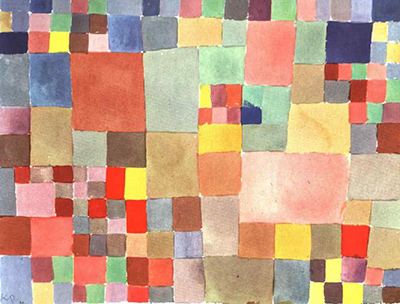
For Klee’s approach to the medium and surface, see materials and techniques. The colour overview and music overview place his work across a longer career. Flora on Sand provides another later experiment in colour and repeated units.
Explore selected works from Klee’s much larger oeuvre. Titles without a link have an authenticated catalogue identity but no reviewed article yet.
Artworks directory
| Name | Date | Medium |
|---|---|---|
| A Gate | 1939 | Painting and mixed media |
| A Woman for Gods | 1938 | Watercolour and mixed media |
| Ab Ovo | 1917 | Watercolour and mixed media |
| Above Mountain Summit | 1917 | Drawing and mixed media |
| Abstract Trio | 1923 | Drawing and mixed media |
| Acrobats | 1915 | Watercolour and mixed media |
| Actor's Mask | 1924 | Painting and mixed media |
| Ad Marginem | 1930 | Drawing and mixed media |
| Ad Parnassum | 1932 | Painting and mixed media |
| Adventurer Ship | 1927 | Drawing and mixed media |
| Affected Place | 1922 | Drawing and mixed media |
| After a Sketch from Zurich | 1914 | Watercolour and mixed media |
| After Drawing | 1919 | |
| After The Floods | 1936 | Watercolour and mixed media |
| All Souls' Picture | 1921 | |
| Ancient Harmony | 1925 | Painting and mixed media |
| Angel Applicant | 1939 | Drawing and mixed media |
| Angel Serves the Desired | 1920 | |
| Angel, Still Female | 1939 | Painting and mixed media |
| Angelus Novus | 1920 | Drawing and mixed media |
| Animal Terror | 1926 | Painting and mixed media |
| Arab Song | 1932 | Painting and mixed media |
| Archangel | 1938 | Painting and mixed media |
| Architecture | 1923 | Painting and mixed media |
| Architecture of the Plain | 1923 | Drawing and mixed media |
| Around the Fish | 1926 | Painting and mixed media |
| Arrival of the Air Steamer | 1921 | Drawing and mixed media |
| Asiatic God | 1924 | Painting and mixed media |
| Astrological Fantasy Portrait | 1924 | Drawing and mixed media |
| Athlete's Head | 1932 | Watercolour and mixed media |
| Aufgehender Stern | 1931 | Painting and mixed media |
| Autumn Flower | 1922 | Painting and mixed media |
| Bad Band | 1920 | Drawing and mixed media |
| Baroque Centaur | 1939 | Painting and mixed media |
| Before the Blitz | 1923 | Drawing and mixed media |
| Before the Snow | 1929 | Drawing and mixed media |
| Besessenes Madchen | 1924 | Watercolour and mixed media |
| Bird Garden | 1924 | |
| Bird Wandering Off | 1926 | Watercolour and mixed media |
| Blossoms in the Night | 1930 | Watercolour and mixed media |
| Blue-Bird-Pumpkin | 1939 | Painting and mixed media |
| Boats in the Flood | 1937 | Painting and mixed media |
| Botanical Theatre | 1934 | Drawing and mixed media |
| Boy in Fancy Dress | 1931 | Watercolour and mixed media |
| Broken Key | 1938 | |
| Brother and Sister | 1930 | Watercolour and mixed media |
| But the Red Roof | 1935 | Painting and mixed media |
| C - C = Fisch | 1931 | Watercolour and mixed media |
| Cacti | 1912 | Painting and mixed media |
| Camel (in Rhythmic Landscape with Trees) | 1920 | Drawing and mixed media |
| Captive Pierrot | 1923 | Drawing and mixed media |
| Castle and Sun | 1928 | Drawing and mixed media |
| Cat and Bird | 1928 | Drawing and mixed media |
| Cathedrals | 1925 | Watercolour and mixed media |
| Chalice of the Heart | 1937 | Painting and mixed media |
| Characters in Yellow | 1937 | Painting and mixed media |
| Chosen Site | 1927 | Mixed media |
| Christmas Picture | 1923 | Drawing and mixed media |
| City of Towers | 1916 | Painting and mixed media |
| Clarification | 1932 | Painting and mixed media |
| Collection of Figurines | 1926 | Painting and mixed media |
| Colorful Architecture | 1917 | Painting and mixed media |
| Comedians' Handbill | 1938 | |
| Comic Opera Singer | 1927 | Painting and mixed media |
| Composition | 1939 | Painting and mixed media |
| Composition with Figures | 1915 | Drawing and mixed media |
| Composition with the Yellow Half-Moon and the Y | 1918 | Watercolour and mixed media |
| Conch–Still Life II | 1939 | Watercolour and mixed media |
| Cosmic Composition | 1919 | Painting and mixed media |
| Crystal Gradation | 1921 | Drawing and mixed media |
| Dance of the Grieving Child | 1922 | Painting and mixed media |
| Dancing Girl | 1940 | Painting and mixed media |
| Das Licht und Etliches | 1931 | Mixed media |
| Death and Fire | 1940 | Painting and mixed media |
| Death for the Idea | 1915 | |
| Demon as Pirate | 1926 | Watercolour and mixed media |
| Diana | 1931 | Painting and mixed media |
| Diavolo Player | 1923 | Drawing and mixed media |
| Die Kapelle | 1917 | Watercolour and mixed media |
| Die Vase | 1938 | Painting and mixed media |
| Doctor | 1930 | Drawing and mixed media |
| Dredger and Sailboat | 1931 | Watercolour and mixed media |
| Ein Tor | 1939 | Painting and mixed media |
| Ein Weib fur Gotter | 1938 | Mixed media |
| Embrace | 1939 | Watercolour and mixed media |
| Episode before an Arab Town | 1923 | |
| Equals Infinity | 1932 | Painting and mixed media |
| Eros | 1923 | Drawing and mixed media |
| Error on Green | 1930 | Watercolour and mixed media |
| Evening Figure | 1935 | Drawing and mixed media |
| Falling Bird | 1919 | |
| Fermata | 1932 | Watercolour and mixed media |
| Fire Clown | 1921 | Watercolour and mixed media |
| Fire Full Moon | 1933 | Watercolour and mixed media |
| Fire in the Evening | 1929 | Painting and mixed media |
| Fish in the Harbour | 1916 | Watercolour and mixed media |
| Fish Magic | 1925 | Watercolour and mixed media |
| Flock of Birds | 1917 | Drawing and mixed media |
| Flora on Sand | 1927 | Watercolour and mixed media |
| Flower Myth | 1918 | |
| Flower Stand with Watering Can and Bucket | 1910 | Watercolour and mixed media |
| Flowering Tree (Abstraction with Reference to a Flowering Tree) | 1925 | Painting and mixed media |
| Flowers in Pots | 1923 | |
| Flowers in Stone | 1939 | Painting and mixed media |
| Forest Witch | 1938 | Painting and mixed media |
| Fright of a Girl | 1922 | Drawing and mixed media |
| Fruits on Red | 1930 | Drawing and mixed media |
| Full Moon | 1919 | Mixed media |
| Föhn Wind in Franz Marc's Garden | 1915 | Watercolour and mixed media |
| Garden in St Germain, The European Quarter near Tunis | 1914 | Watercolour and mixed media |
| Ghost Chamber with the Tall Door (New Version) | 1925 | |
| Ghost of a Genius | 1922 | Drawing and mixed media |
| Girl in Mourning | 1939 | Painting and mixed media |
| Glance of a Landscape | 1926 | Watercolour and mixed media |
| Gluht Nach | 1939 | Drawing and mixed media |
| Golden Fish | 1925 | Watercolour and mixed media |
| Goldfish Wife | 1921 | Watercolour and mixed media |
| Green Plant, Blood, Louse | 1924 | Drawing and mixed media |
| Hafenbild | 1918 | Mixed media |
| Hammamet with Mosque | 1914 | Watercolour and mixed media |
| Harbour with Sailing Ships | 1937 | Painting and mixed media |
| Hauptweg und Nebenwege | 1929 | Painting and mixed media |
| Heavenly and Earthly Time | 1927 | Drawing and mixed media |
| Heroic Fiddling | 1938 | Painting and mixed media |
| Heroic Roses | 1938 | Painting and mixed media |
| Heroic Strokes of the Bow | — | Mixed media |
| Highway and Byways | 1929 | Drawing and mixed media |
| Houses near the Gravel Pit | 1913 | Watercolour and mixed media |
| Howling Dog | 1928 | Painting and mixed media |
| In the Current Six Thresholds | 1929 | Painting and mixed media |
| In the Style of Kairouan | 1914 | Drawing and mixed media |
| Individualized Altimetry of Stripes | 1930 | Painting and mixed media |
| Insula Dulcamara | 1938 | |
| Interior with the Clock | 1913 | Watercolour and mixed media |
| Irma Rossa the Animal Tamer | 1918 | Drawing and mixed media |
| Journey in Corsica | 1927 | Drawing and mixed media |
| Landscape with Bluebirds | 1919 | Watercolour and mixed media |
| Legend of the Nile | 1937 | Painting and mixed media |
| Lemon Harvest | 1937 | Watercolour and mixed media |
| Likeness in the Bower | 1930 | Watercolour and mixed media |
| Limits of Reason | 1927 | Painting and mixed media |
| Little Hope | 1938 | Watercolour and mixed media |
| Magdalena before the Conversion | 1938 | Drawing and mixed media |
| Mask of Fear | 1932 | Painting and mixed media |
| May Picture | 1925 | Painting and mixed media |
| Monument in a Cemetery | 1922 | Watercolour and mixed media |
| Monuments at G | 1929 | Watercolour and mixed media |
| Municipal Jewel | 1917 | Watercolour and mixed media |
| Mural from the Temple of Longing Thither | 1922 | |
| Nach der Uberschwemmung | 1936 | Watercolour and mixed media |
| New Harmony | 1936 | Painting and mixed media |
| New House in the Suburbs | — | Mixed media |
| Old Steamboat | 1922 | Drawing and mixed media |
| On the Edge | 1930 | Drawing and mixed media |
| Once Emerged from the Gray of Night | 1918 | Drawing and mixed media |
| One Who Understands | 1934 | Painting and mixed media |
| Oriental Pleasure Garden | 1925 | Painting and mixed media |
| Park of Idols | 1939 | Watercolour and mixed media |
| Passing by Red Pillars | 1928 | Watercolour and mixed media |
| Persian Nightingales | 1917 | Drawing and mixed media |
| Popular Wall Painting | 1922 | Painting and mixed media |
| Prestidigitator | 1927 | Watercolour and mixed media |
| Rainy Day | 1931 | Watercolour and mixed media |
| Red and White Domes | 1914 | Watercolour and mixed media |
| Red Balloon | 1922 | Drawing and mixed media |
| Redgreen and Violet-Yellow Rhythms | 1920 | Drawing and mixed media |
| Refuge | 1930 | Watercolour and mixed media |
| Rhythmic Rythmical | 1930 | Painting and mixed media |
| Saint of the Inner Light | 1921 | |
| Scaffolding of a New Building | 1930 | Painting and mixed media |
| Scholar in Dealing with Stars | 1926 | Watercolour and mixed media |
| Seated Woman | 1930 | Drawing and mixed media |
| Senecio | 1922 | Painting and mixed media |
| Separation in the Evening | 1922 | Drawing and mixed media |
| Sinbad the Sailor | 1923 | Drawing and mixed media |
| Skeptically Smiling | — | Mixed media |
| Small House in the Garden City | 1928 | Watercolour and mixed media |
| Small Portrait of a Girl in Yellow | 1925 | Painting and mixed media |
| Southern Gardens | 1919 | Watercolour and mixed media |
| Static-Dynamic Gradation | 1923 | Drawing and mixed media |
| Still Life | 1927 | Painting and mixed media |
| Still Life with Gladioli | 1932 | Watercolour and mixed media |
| Strange Garden | 1923 | Drawing and mixed media |
| Stricken City | 1936 | Painting and mixed media |
| Strong Dream | 1929 | Watercolour and mixed media |
| Struck from the List | 1933 | Drawing and mixed media |
| Structural I | 1924 | Drawing and mixed media |
| Sumpflegende | 1919 | Painting and mixed media |
| Temple Gardens | 1920 | Drawing and mixed media |
| The Arrow before the Target | 1921 | Drawing and mixed media |
| The Barbed Noose with the Mice | 1923 | Watercolour and mixed media |
| The Flora of the Heath | 1925 | Watercolour and mixed media |
| The Goldfish | 1925 | Watercolour and mixed media |
| The Hour Before One Night | 1940 | Painting and mixed media |
| The Man in Love | 1923 | |
| The Mask with the Flag | 1925 | Mixed media |
| The Pathos of Fertility | 1921 | |
| The Rhine at Duisburg | 1937 | Painting and mixed media |
| The Way to the Citadel | 1937 | Painting and mixed media |
| Three Houses and a Bridge | 1922 | Watercolour and mixed media |
| Tightrope Walker | 1923 | |
| Tomb in Three Parts | 1923 | Watercolour and mixed media |
| Tomcat's Turf | 1919 | Watercolour and mixed media |
| Tower in Orange and Green | 1922 | Drawing and mixed media |
| Tree and Architecture - Rhythms I | 1920 | Watercolour and mixed media |
| Tree and Architecture - Rhythms II | 1920 | Painting and mixed media |
| Tropical Dawn with the Owl | 1921 | Mixed media |
| Tropische Dammerung | 1921 | Painting and mixed media |
| Twittering Machine | 1922 | Drawing and mixed media |
| Variations (Progressive Motif) | 1927 | Watercolour and mixed media |
| Ventriloquist and Crier in the Moor | 1923 | |
| Viaducts Break Ranks | 1937 | Drawing and mixed media |
| Villa R | 1919 | Painting and mixed media |
| Village Carnival | 1926 | Painting and mixed media |
| Vor dem Blitz | 1923 | Drawing and mixed media |
| Wald-Hexen | 1938 | Painting and mixed media |
| Young Forest | 1925 | Drawing and mixed media |
Related artworks
Explore eight other Klee works, beginning with works close in date to this one.
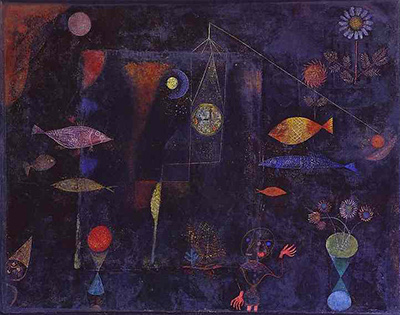
Fish Magic
1925
The Goldfish
1925
Actor's Mask
1924
Around the Fish
1926
Flora on Sand
1927
Sinbad the Sailor
1923
Castle and Sun
1928
Cat and Bird
1928
Discussion
The title invites musical comparisons, while the colour field remains a painting.
Museum records, visual analysis and later compositions answer different questions.
Reader Insights
Where does the light seem to move through the rectangles?
Which squares break the apparent regularity of the grid?
What changes when you compare the painting with later music inspired by it?
Join the Conversation
Share the details or sources behind your reading.
References
- Kunstmuseum Basel, “Eingänge Galerie 1946–1962,” entry G 1960.25, Alter Klang, 1925,236 (X 6) (German), museum accession list; museum-sourced photograph and metadata, Commons file page.
- Zentrum Paul Klee, Dieter Roelstraete, “Alter Klang: Paul Klee und die Musik,” Cover Star Klee guide (German, also English and French), German museum guide, View source.
- Rawpixel, exact-match high-resolution reproduction, item 3590280, stated CC0/public domain and business reuse (English), source page. Visual observations in this article were checked against the original-size local master and the Basel museum-sourced photograph at 1, View source.
- Lenbachhaus, “Paul Klee, Rhythmisches strenger und freier, 1930,” object record and 2007 museum-catalogue essay by Helmut Friedel and Annegret Hoberg (German), museum page, View source.
- Rosana Costa Ramalho de Castro, “O pensamento criativo de Paul Klee: arte e música na constituição da Teoria da Forma,” Per Musi 21 (2010), 7–18 (Portuguese), full article, View source.
- Boletín Oficial del Estado, Spanish state guarantee for the 2015 Kunstmuseum Basel exhibition, transcription of Alter Klang object data (Spanish/German), official record; Moderna Museet, Basel bequest credit in exhibition material, institutional page.
- University of Colorado Boulder College of Music, Margaret Leng Tan recital programme (29 September 2022), pp. C-2–C-4, Crumb’s Metamorphoses, Book II and Klee discussion (English), programme PDF, View source.
- Lorenz Dittmann, “Lichtung und Verbergung in Werken der Malerei,” in Kunst und Technik (Frankfurt am Main, 1989), 311–29, especially 325–27 and fig. 17 (German), full chapter, View source.
- Fabienne Eggelhöfer, Paul Klees Lehre vom Schöpferischen (2012), PDF p. 29, identifying diary no. 873, March 1910, in the 1988 critical diary edition (German), full dissertation, View source.
- Castro, cited at 5, especially printed pp. 15–16; her description and her quoted Portuguese rendering of Andrew Kagan are later scholarly interpretation, not a Klee statement.
- Zentrum Paul Klee, “Paul Klee,” institutional biography, 1925 and 1926 chronology (English), museum page, View source.
- Tritó Edicions, Benet Casablancas, Alter Klang, impromptu para orquesta, publisher’s score record and programme description (Spanish), publisher page, View source.
