


 by Tom Gurney
Tom Gurney BSc (Hons) is an art history expert with over 20 years experience
Published on June 19, 2020 / Updated on September 27, 2026
Email: tomgurney1@gmail.com / Phone: +44 7429 011000
Fruits on Red: Klee’s silk, plants and violin
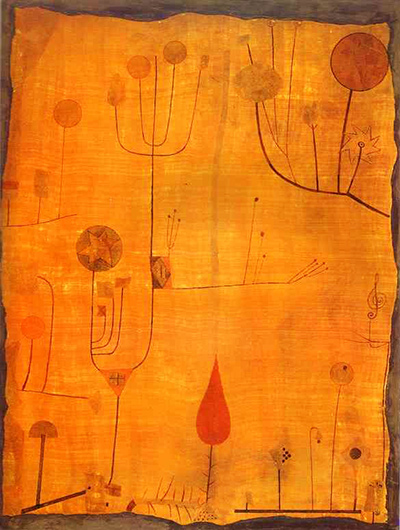
Paul Klee made Früchte auf Rot (Fruits on Red) in 1930. The Lenbachhaus, Munich, identifies it as work 1930, 263 (AE 3), inventory FH 222: watercolour with brush, pen and compass on silk, measuring 61.2 × 46.2 cm. The museum records the work as a loan from BayernLB, acquired on loan in 1971. Those details establish a more specific object than the generic fruit still life described by older reproductions.[1]
The picture is a network of very thin stems and rounded, geometric forms against a warm copper-red ground. Several lines rise from the lower edge, while another group enters from above. A larger branching form occupies the upper right; smaller buds, leaves and fruit-like discs appear at different stages and scales. An isolated drop shape near the lower centre, a small cluster of dark marks and a treble clef at the right add to the sense that this is an invented diagram of growth rather than a bowl of harvested produce.[1]
A silk support with an earlier life
The Lenbachhaus says Klee worked on a fine silk cloth, copper-red in colour, mounted on blue cardboard. The museum's account also describes fruit and leaf shapes cut from silk and attached to the surface; stems were drawn with a fine brush or pen. This makes the work a combination of painting, drawing and collage. The silk is not simply a smooth surface carrying painted fruit: its colour, weave, cut shapes and wavy edges belong to the composition.[1]
The small treble clef near the right edge has a documented explanation. According to the museum, the cloth had previously protected Klee's violin while he played it. The clef points to that earlier use. It is evidence of a connection between the physical material and Klee's musical life; it does not mean a specific melody is encoded in the plant forms, or that one can hear birdsong in the scene.[1]
A German federal cultural-property entry gives the longer identifying label Früchte auf rot Schweißtuch des Geigers, and agrees on 1930, watercolour on silk, and 61.2 × 46.2 cm. The Lenbachhaus's principal object title remains Früchte auf Rot. The extended label is useful as a material-history clue—roughly “the violinist's sweat cloth”—but should not displace the current museum title without studying Klee's own catalogue entry and inscriptions.[1][2]
The owner records “S. Cl. 1930 AE 3” at the lower left of the backing board and “Fruechte auf rot” at the lower right. Its text explains that Klee designated this watercolour Sonderclasse, a special category. The inscriptions tie the pictured growth to a particular made and mounted object. A cropped small reproduction can obscure that evidence, which is one reason to keep the owner record beside the image.[1]
Growth instead of a fruit bowl
The older page named bananas, pears and persimmons and described fruit freshly picked from a tree. The Lenbachhaus offers a more grounded reading: forms develop from tiny berry-like buds through branching shoots and flowers toward fruit. The individual circles need not correspond to identifiable species. The work is concerned with the process of plant development rather than an inventory of ripe items.[1]
Thin vertical lines give many of the forms stems. Some end in discs, some meet forks, and some almost disappear into the field. The upper clusters are larger and more complex than several lower marks. Looking from bottom to top can therefore suggest growth, yet the image does not present a single botanical specimen at one fixed scale. A stem entering from above complicates any simple diagram in which all life rises from one root. Its composition allows multiple paths through an imagined plant world.[1]
The Lenbachhaus's object text reproduces art historian Christian Geelhaar's reading of a plant form that dominates the field like a branching candelabrum. It also identifies small berries and bell flowers low on the right. These are attributed observations in the museum's account; the small image on this page cannot confirm every fine shape independently. Its limited resolution supports the major branches and circles, while the owner source supplies the more detailed interpretation.[1]
The title's colour word matters too. “Red” describes the silk ground, not necessarily the colour of each fruit. The warm field makes the dark stems and paler circles stand apart, but the fabric's copper cast is richer than a flat red background. The blue backing, visible in a full view of the mounted object, creates a further colour boundary. A reproduction that crops tightly to the silk may make the work seem like an ordinary painted sheet and conceal that arrangement.[1]
Between natural study and theatre
The Lenbachhaus connects Früchte auf Rot with Klee's Botanisches Theater, a later work centred on plant growth. It notes a slight form in the upper left that can read as a drawn-back curtain. The connection suggests a stage for the unfolding of botanical forms. It does not prove that Fruits on Red depicts a literal theatre or that every mark is a theatrical prop.[1]
The museum's text invokes Klee's 1923 essay on paths of studying nature to explain an interest in structures hidden inside organic things. In this reading, the artist's finely constructed branches make growth visible by simplifying and recombining it. The comparison is especially apt because the shapes are made partly by cutting and attaching silk: a natural subject is built through conspicuously artificial means. This is a museum-supported interpretation, not a claim that Klee copied a diagram from a botanist's book.[1]
Klee made the work in Dessau, where the Bauhaus had moved from Weimar. The Zentrum Paul Klee documents his teaching at the Bauhaus through 1931 and notes the variety of techniques and degrees of figuration in his work of these years. Such context helps place a silk collage and watercolour within his continued experiments with materials. It does not, by itself, explain the precise choice of this cloth; the Lenbachhaus's violin account does that more directly.[1][3]
What the image can and cannot tell us
A reproduction shows the principal branches, circles and colour field, but it does not reveal the joins of every applied silk shape or the exact character of the weave. The Lenbachhaus's material description is the basis for identifying those features. Direct study of the object could clarify how a drawn stem meets a cutout and whether the underlying cloth remains visible beneath a particular form. Until then, the sequence of Klee's decisions in making the surface should not be invented from a digital image.[1]
The visible thin lines, discs, drops and asymmetrical branches still show a structure of development. The title asks us to see fruit; the silk and clef recall music and use; the cut shapes and drawn stems show Klee constructing an imagined ecology. The work joins those ideas without becoming a conventional still life or a coded musical score.[1][2]
Related artworks
Explore eight other Klee works from the researched artwork cluster.
Ad Marginem
1930
Error on Green
1930
Fire in the Evening
1929
Highway and Byways
1929
Ad Parnassum
1932
Castle and Sun
1928
Cat and Bird
1928
Mask of Fear
1932
References
- Lenbachhaus, Früchte auf Rot (1930), inventory FH 222 (German object text within an English page): owner record for title, annual designation, materials, dimensions, inscriptions, lender and 1971 loan; describes silk cutouts, former violin use, the treble clef, growth imagery and Christian Geelhaar's interpretation. The owner image is labelled CC BY-NC-SA 4.0, View source.
- German Federal Government cultural-property database, “Früchte auf rot Schweißtuch des Geigers” (German): separate official record confirming year, extended identifying label, silk, watercolour and dimensions. It does not replace the Lenbachhaus's current principal title, View source.
- Zentrum Paul Klee, Mapping Klee exhibition guide (English), section 6: Klee's Weimar and Dessau teaching and variety of techniques and figurative/abstract work. General period context only, View source.