


 by Tom Gurney
Tom Gurney BSc (Hons) is an art history expert with over 20 years experience
Published on June 19, 2020 / Updated on September 27, 2026
Email: tomgurney1@gmail.com / Phone: +44 7429 011000
A goldfish and its dark world
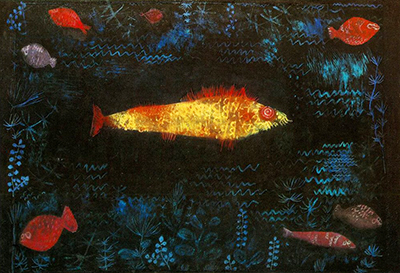
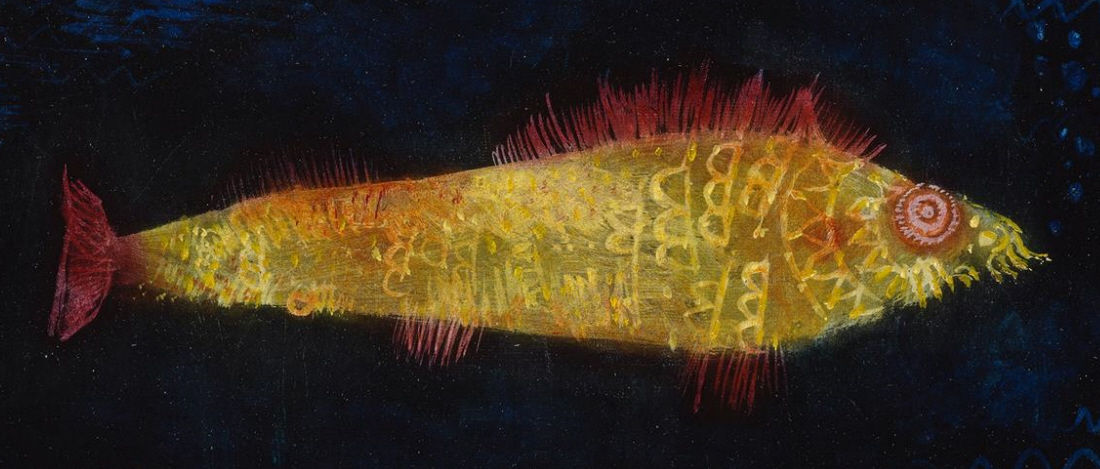
One fish holds the centre of Paul Klee’s der Goldfisch (The Goldfish). Its long yellow body runs almost horizontally through dark blue-black water, with a red tail and fine red spines above and below. Several smaller fish appear nearer the edges. Blue zigzags, branching stems and small star-like marks occupy the water around them. The central creature looks bright because nearly all its surroundings are dark; it is paint, not a light source. Klee built an image that lets us notice the fish first and then discover the many lines that make its environment.[1]
The German title names an ordinary goldfish, yet the central creature is neither a natural-history illustration nor simply a fish enlarged. Its eye is a conspicuous circular target; its fins look combed out into separate strokes; its body contains yellow, orange and pale lines. The smaller fish do not share its scale or its central space. The Hamburger Kunsthalle’s curator Florian Britsch reads their placement as a reverent withdrawal and proposes an almost epiphany-like vision. That is a thoughtful interpretation of the arrangement, not a movement Klee recorded frame by frame. A viewer can see why the reading arose while allowing the painted fish to remain ambiguous.[1]
Explore the details of The Goldfish
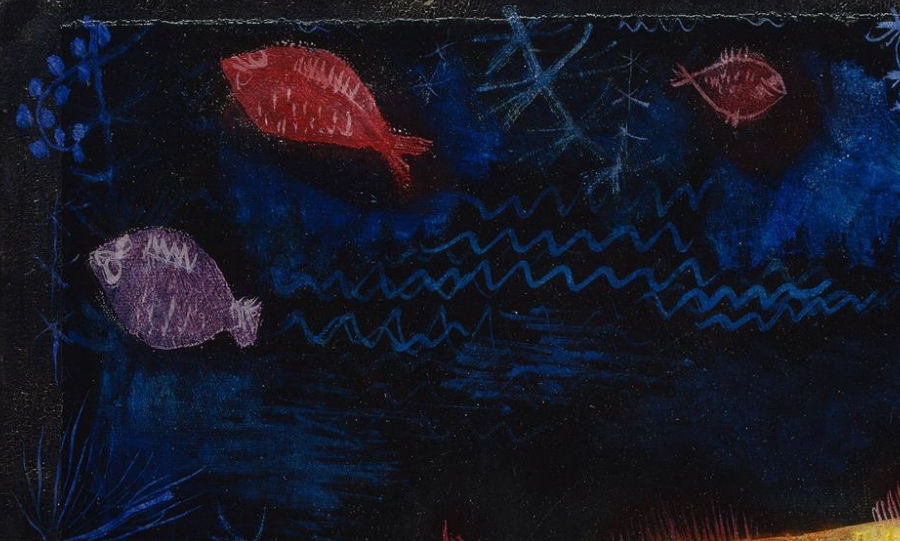
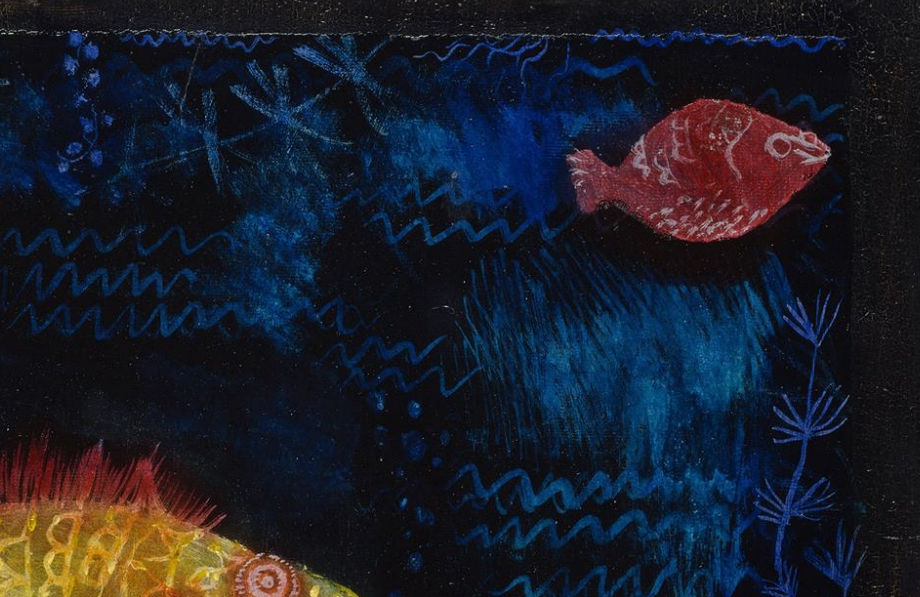
Select a numbered area to examine its detail at high resolution.
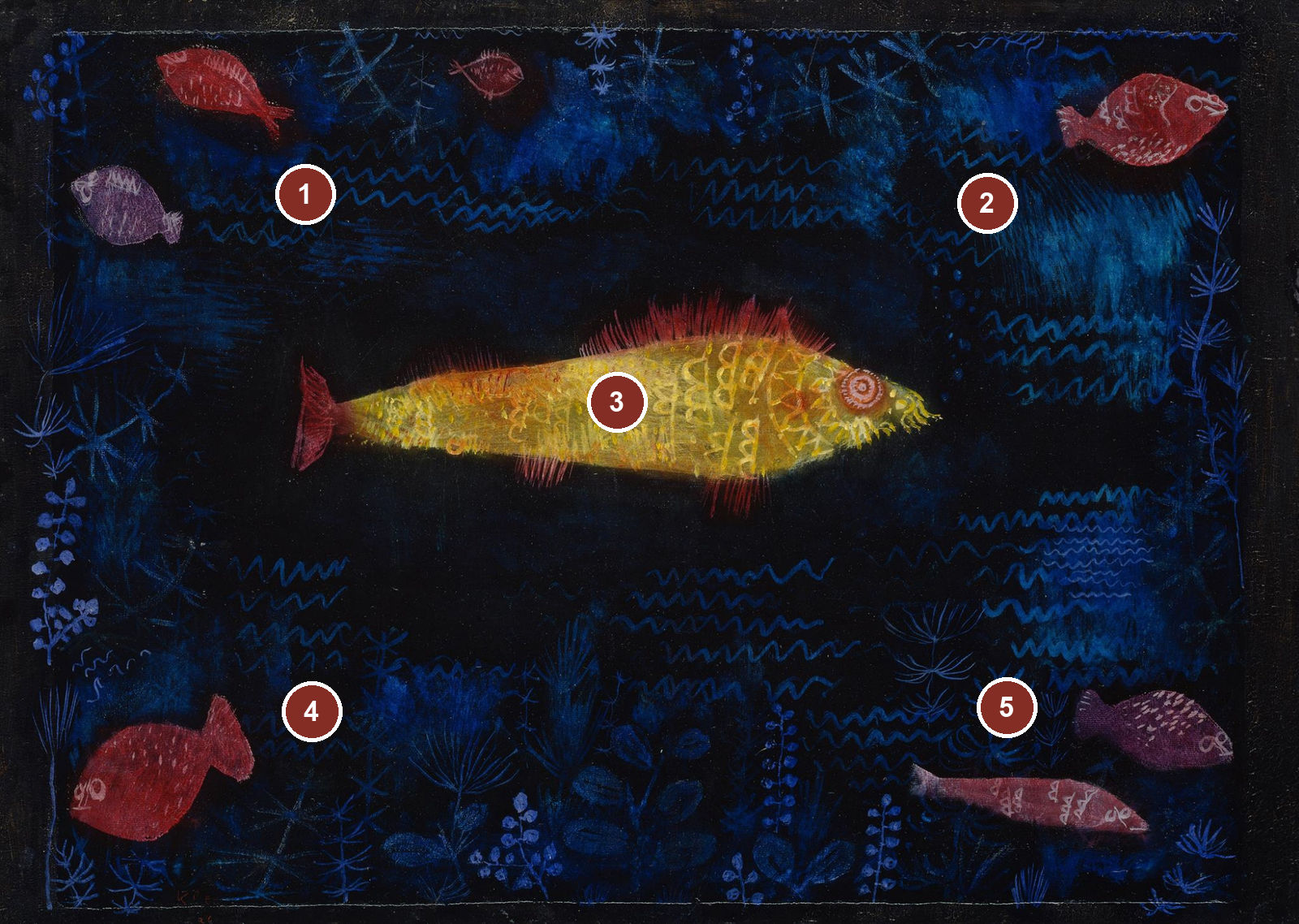
The smaller fish and blue lines in the upper left
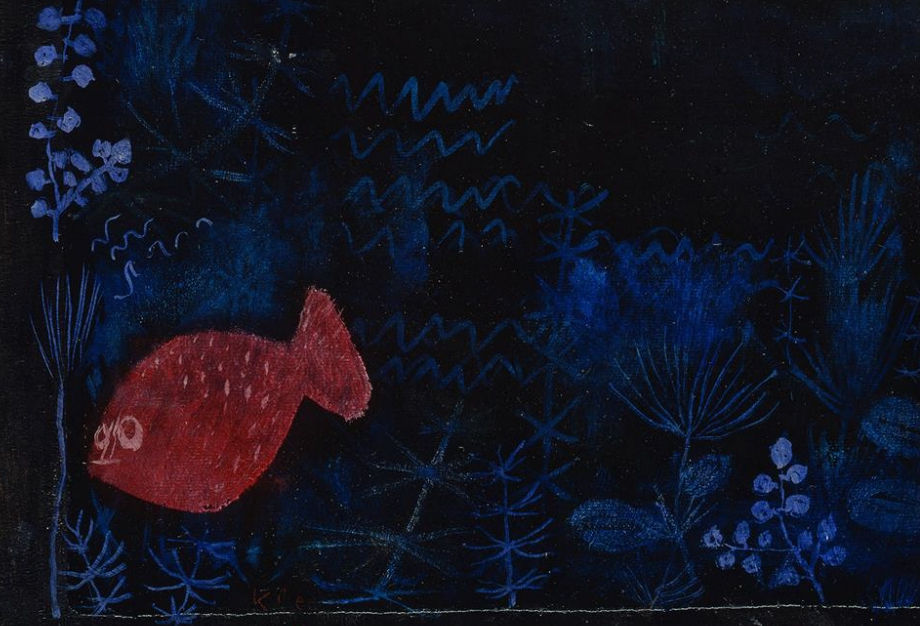
Red fish and blue marks in the upper right
The large goldfish, from tail to mouth
Plants and a red fish at the lower left
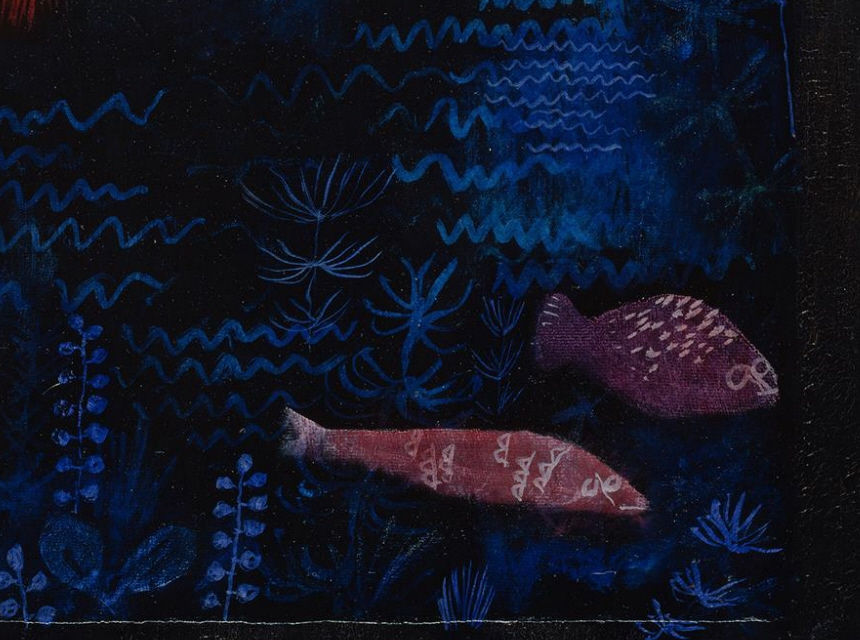
Blue marks and smaller fish at the lower right
Contents
- The object and its names
- How the composition directs attention
- Explore the details of The Goldfish
- Aquariums, observation and an unresolved studio story
- The adjacent work: Fish Magic
- From Berlin to Hamburg
- Looking again
The object and its names
Klee entered the work as 1925,86 in his annual sequence. The catalogue raisonné number is 3767, and the owning Hamburger Kunsthalle identifies it as HK-2982. It measures 49.6 × 69.2 cm as an image; the museum separately gives a 63.5 × 84 cm framed size. The materials are oil paint and watercolour on paper mounted on cardboard. Its broad horizontal proportions matter: the dominant fish can stretch across the field while the smaller fish and marks hold the surrounding water open. The work is not a large canvas or a picture made with actual gold leaf.[1][2]
The Berlin museums’ 2008 exhibition worklist gives the title as lower-case der Goldfisch and translates it The Goldfish. Other catalogues and reproductions sometimes say Der goldene Fisch, The Golden Fish or Le poisson d’or. Those variants can help someone locate the same painting, but the annual number, catalogue number, Hamburg accession and materials are safer identity anchors than a translated adjective. The separate legacy page at /paul-klee/golden-fish/ belongs to this work, rather than documenting another 1925 fish picture.[1][2]
Paper is part of the picture’s construction, not an incidental backing. The watercolour and oil are on the paper surface, which was then mounted on cardboard. The museum’s concise material record does not specify the order of every layer, the exact pigments or how each fine line was made. At ordinary reproduction size some blue marks look scratched into dark paint, but resemblance to a technique is not proof of that technique. A conservation report and a high-resolution examination of the surface would be required to describe it in those terms. This is particularly important because another Klee fish painting from the same year does have an owner-documented scratched surface; the two supports should not be conflated.[1][2][3]
How the composition directs attention
The goldfish is not centred by symmetry alone. Its body occupies a long band across the middle, leaving dark water above and below. The red tail reaches left while the eye and open snout point right. Fine red spines give the silhouette a halo-like edge without turning it into a neat oval. Against the surrounding blues, the yellow body appears to carry its own glow. What creates the effect is a set of contrasts: warm against cool, dense colour against near-black, long horizontal body against short broken lines.[1]
Paul Klee, der Goldfisch, 1925,86. Oil and watercolour on paper mounted on cardboard, 49.6 × 69.2 cm, Hamburger Kunsthalle, HK-2982. Splash and detail images derive from the public-domain-marked Commons file linked to the museum reproduction. The source is 2,000 pixels wide; print-resolution metadata does not add detail or certify exact colour.

The other fish serve more than one compositional purpose. One red fish appears at each upper corner, and smaller red or violet bodies sit nearer the lower and side edges. They differ from the central fish in colour, size and the attention paid to their internal markings. Some face away, some face across the image, and none becomes a convincing ruler of the scene. Britsch’s account imagines them retreating before a majestic apparition. The visual evidence supports a spatial hierarchy; it does not require every fish to be swimming in one direction or to feel awe. Stillness and motion are made uncertain because a fixed painted scene gives no before or after.[1]
The blue marks complicate the emptiness. Waves of short zigzags cross the water; thin branching forms gather near the sides and bottom; fine, star-like or flower-like signs punctuate the darker parts. They may suggest water plants, currents, glints or an underwater realm in which visible things have been reduced to signs. The page’s older description called the marks “ancient runes.” There is no identified alphabet or text here. Looking at the marks as drawing first lets the viewer see their rhythm and placement without pretending to translate them. Britsch uses their emergence from darkness to describe an image of artistic creation: line gradually gives form to a world. That is a curatorial metaphor grounded in these visible strokes, rather than a quoted instruction from Klee about this painting.[1]
The dark ground is active as well. It allows the surrounding marks to vary in visibility. Some blue lines almost disappear; others approach the brightness of the fish. Empty-looking space between them becomes part of the sense of depth. We can imagine an aquarium or a deep sea, but the painting does not provide a glass wall, a waterline or a measured depth. Its underwater world is built from contrasts and signs rather than topographical description. This is why it remains rewarding after the central fish has been identified: the eye travels outward and back, finding a different small structure on each pass.[1]
Aquariums, observation and an unresolved studio story
Klee’s interest in underwater life has institutional support. The Zentrum Paul Klee’s exhibition guide describes his visits to aquariums and his fascination with fish that appear free of gravity. It is reasonable to place The Goldfish among works in which natural observation becomes a starting point for invention. The fact that Klee liked aquariums does not tell us which tank, which animal or which room generated this particular image.[4]
The Hamburger Kunsthalle’s object essay offers a strikingly precise story: Klee admired the aquarium in Naples during his 1902 Italian journey, and a large aquarium stood in his Dessau studio while he worked on The Goldfish in spring 1925. The second detail is chronologically difficult. Christian Geelhaar’s German biography dates Klee’s start teaching in Dessau to 23 June 1925, while the Klee family did not move into the Dessau masters’ house until 1926. Rolf Bothe’s study of another Klee picture likewise describes the family moving from Weimar to Dessau in July 1926, after a period when Klee commuted. An Austrian essay repeats the Dessau aquarium phrase while calling the picture painted in Bern, adding a further incompatible place claim. The available evidence supports Klee’s broader aquarium interest; it does not yet establish a Dessau studio aquarium in spring 1925. Until the museum’s source for that sentence or a dated letter is found, the precise studio anecdote should remain a question rather than become the painting’s origin story.[1][4][5][6]
The distinction matters because we can look closely without reducing the work to a copied tank. A literal aquarium would have finite glass boundaries, a particular collection of fish and a view determined by where Klee stood. The picture gives none of those things. Its scale changes sharply between the central body and the little fish, and its blue marks do not settle into a single physical space. Observation may have fed the image, but selection, simplification and invention organise the result. The work’s achievement lies in the visual world Klee made, not in proving that a particular aquarium had precisely this appearance.[1][4]
The adjacent work: Fish Magic
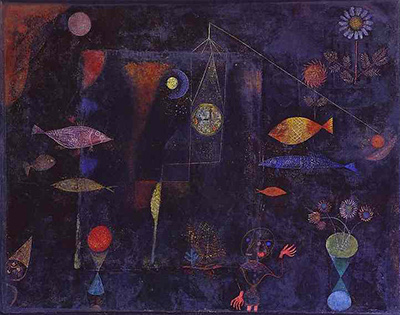
The immediately preceding entry in Klee’s 1925 sequence is Fisch Zauber (Fish Magic), 1925,85, catalogue number 3766. Berlin’s exhibition list places the two one after the other, a useful reason to compare them. It does not supply exact production dates or say that one was a study for the other. The works also have different physical structures: Berlin records Fish Magic on cotton cloth attached to cardboard and stretcher, while The Goldfish is on paper mounted on cardboard. Similar marine subjects do not make their supports interchangeable.[2]
Philadelphia Museum of Art, which holds Fish Magic, describes a delicate black surface covering colours that Klee revealed by scratching and drawing into it. A square of muslin is attached near its centre. The picture brings fish together with clock, plant and celestial imagery. Its scene repeatedly shifts scale and kind: water and sky meet, a curtain-like square is poised to lift, and an ordinary timepiece enters a magical field. The Goldfish is more concentrated. The dark water contains signs and other creatures, but the principal visual event is the elongated gold body at the centre. One picture lets the aquatic merge with a wider theatre; the other gives one creature an extraordinary presence.[3][2]
It is tempting to turn the two works into a single technical recipe because both contain dark grounds and bright fish. Philadelphia’s description applies directly to Fish Magic. For The Goldfish, Hamburg and Berlin establish oil and watercolour on mounted paper, but the accessible object records do not give an equally detailed sequence of scratching, overpainting or attached fabric. If a future conservation study shows a particular incision or underlayer in the Hamburg picture, that finding can be added precisely. Until then, the visible differences and the documented support are enough for a meaningful comparison.[1][2][3]
From Berlin to Hamburg
The picture’s later history changes how we see its survival. Hamburg’s provenance research traces it from Klee through Galerie Goldschmidt & Wallerstein in Berlin, possibly on commission, to a 1926 purchase by the Berlin Nationalgalerie, where it carried inventory number A II 502. An older German biographical entry dates the Nationalgalerie acquisition to 1925. The owning museum’s dated provenance and archive citations make 1926 the working date, but the original acquisition register should settle the discrepancy. Neither date changes the painting’s own 1925 creation year.[1][5]
The Nationalgalerie was an important public setting for modern art. Under the Nazi campaign against art it labelled “degenerate,” The Goldfish was confiscated on 7 July 1937 and assigned inventory number 16138 in the confiscation records. This is a documented act against an already-owned museum object, twelve years after Klee painted it; the confiscation is part of the painting’s provenance, not a scene depicted in the water. The Freie Universität Berlin’s research project explains that the 1937–38 inventory records were compiled around seizures from German museums and are being checked and released in stages. Christoph Zuschlag identifies The Goldfish among the works removed from the Nationalgalerie and later listed at the Düsseldorf stop of the propaganda exhibition. A confiscation, a storage location and an exhibition listing are different kinds of evidence and should be kept distinct.[1][7][8]
Hamburg records the work at Schloss Niederschönhausen, Berlin-Pankow, in 1938 and until 27 January 1939. It then passed through the dealer Karl Buchholz and into the Henssel family’s collection from 1 February 1939. Karl Heinz Henssel is documented with it at least by 1948, when he made it available to Hamburg as a long-term loan. The Kunsthalle purchased it in 1955, funded as a gift by friends honouring the departing director Carl Georg Heise. The museum records a price of 60,000 Deutsche Mark. These are unusually detailed published steps, but the museum still marks its provenance research as ongoing and not fully resolved.[1]
One correction in the museum file is particularly revealing. An earlier chain named a “Ruysch collection” in Rotterdam as the 1939 buyer. Hamburg’s researchers, using Buchholz correspondence and government records, explain that Ruysch was a Buchholz associate, not evidence of an actual Rotterdam collection acquiring the painting. They suggest the foreign-buyer name may have been put forward because the regime barred domestic sales of these seized works. The suggestion about motive should remain attributed to the museum’s research; the practical correction is clear enough: a neat Rotterdam stop should not be repeated as fact. Provenance becomes stronger when revisions and uncertain links remain visible.[1]
Hamburg’s bibliography points to a conservation publication with photographs before and after a later acid attack on the work. That publication has not been read for this page, so the precise damage, treatment and colour changes cannot yet be described responsibly. The present reproduction should also not be treated as a transparent record of its original 1925 condition. The museum’s own provenance status and this conservation lead remind us that the work has a material history as well as an image we recognise.[1]
Looking again
Begin with the outer fish and the tiny blue marks, then return to the gold body. The picture will still have a centre, but its darkness will no longer be empty. Follow the red strokes along the central fish’s back, then compare them with the fine blue stems beneath it. Notice how one kind of line makes an animal vivid while another builds a surrounding world. Britsch’s interpretation of a revelation can be tested here: do the little fish appear to retreat, or does the enormous scale of the central one make them seem subordinate even when their directions differ?[1]
The title identifies a fish, not a hidden myth whose details can be read like a script. The painting makes that fish extraordinary through size, position and colour. Reliable records establish the 1925 number, layered support, dimensions, public collection and difficult route through confiscation to Hamburg. They do not establish a specific studio aquarium in spring 1925, an exact text encoded in the blue marks or a technique borrowed from Fish Magic. Holding those limits lets the viewer see how much Klee accomplished with a creature, a dark field and a network of lines.[1][2][3][4]
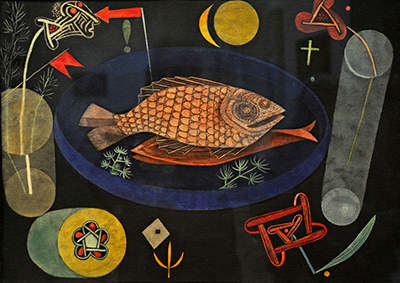
For further context, see Fish Magic for the adjacent 1925 work, Around the Fish for a later arrangement of aquatic imagery, and the paintings overview for Klee’s changing media and subjects.
Explore selected works from Klee’s much larger oeuvre. Titles without a link have an authenticated catalogue identity but no reviewed article yet.
Artworks directory
| Name | Date | Medium |
|---|---|---|
| A Gate | 1939 | Painting and mixed media |
| A Woman for Gods | 1938 | Watercolour and mixed media |
| Ab Ovo | 1917 | Watercolour and mixed media |
| Above Mountain Summit | 1917 | Drawing and mixed media |
| Abstract Trio | 1923 | Drawing and mixed media |
| Acrobats | 1915 | Watercolour and mixed media |
| Actor's Mask | 1924 | Painting and mixed media |
| Ad Marginem | 1930 | Drawing and mixed media |
| Ad Parnassum | 1932 | Painting and mixed media |
| Adventurer Ship | 1927 | Drawing and mixed media |
| Affected Place | 1922 | Drawing and mixed media |
| After a Sketch from Zurich | 1914 | Watercolour and mixed media |
| After Drawing | 1919 | |
| After The Floods | 1936 | Watercolour and mixed media |
| All Souls' Picture | 1921 | |
| Ancient Harmony | 1925 | Painting and mixed media |
| Angel Applicant | 1939 | Drawing and mixed media |
| Angel Serves the Desired | 1920 | |
| Angel, Still Female | 1939 | Painting and mixed media |
| Angelus Novus | 1920 | Drawing and mixed media |
| Animal Terror | 1926 | Painting and mixed media |
| Arab Song | 1932 | Painting and mixed media |
| Archangel | 1938 | Painting and mixed media |
| Architecture | 1923 | Painting and mixed media |
| Architecture of the Plain | 1923 | Drawing and mixed media |
| Around the Fish | 1926 | Painting and mixed media |
| Arrival of the Air Steamer | 1921 | Drawing and mixed media |
| Asiatic God | 1924 | Painting and mixed media |
| Astrological Fantasy Portrait | 1924 | Drawing and mixed media |
| Athlete's Head | 1932 | Watercolour and mixed media |
| Aufgehender Stern | 1931 | Painting and mixed media |
| Autumn Flower | 1922 | Painting and mixed media |
| Bad Band | 1920 | Drawing and mixed media |
| Baroque Centaur | 1939 | Painting and mixed media |
| Before the Blitz | 1923 | Drawing and mixed media |
| Before the Snow | 1929 | Drawing and mixed media |
| Besessenes Madchen | 1924 | Watercolour and mixed media |
| Bird Garden | 1924 | |
| Bird Wandering Off | 1926 | Watercolour and mixed media |
| Blossoms in the Night | 1930 | Watercolour and mixed media |
| Blue-Bird-Pumpkin | 1939 | Painting and mixed media |
| Boats in the Flood | 1937 | Painting and mixed media |
| Botanical Theatre | 1934 | Drawing and mixed media |
| Boy in Fancy Dress | 1931 | Watercolour and mixed media |
| Broken Key | 1938 | |
| Brother and Sister | 1930 | Watercolour and mixed media |
| But the Red Roof | 1935 | Painting and mixed media |
| C - C = Fisch | 1931 | Watercolour and mixed media |
| Cacti | 1912 | Painting and mixed media |
| Camel (in Rhythmic Landscape with Trees) | 1920 | Drawing and mixed media |
| Captive Pierrot | 1923 | Drawing and mixed media |
| Castle and Sun | 1928 | Drawing and mixed media |
| Cat and Bird | 1928 | Drawing and mixed media |
| Cathedrals | 1925 | Watercolour and mixed media |
| Chalice of the Heart | 1937 | Painting and mixed media |
| Characters in Yellow | 1937 | Painting and mixed media |
| Chosen Site | 1927 | Mixed media |
| Christmas Picture | 1923 | Drawing and mixed media |
| City of Towers | 1916 | Painting and mixed media |
| Clarification | 1932 | Painting and mixed media |
| Collection of Figurines | 1926 | Painting and mixed media |
| Colorful Architecture | 1917 | Painting and mixed media |
| Comedians' Handbill | 1938 | |
| Comic Opera Singer | 1927 | Painting and mixed media |
| Composition | 1939 | Painting and mixed media |
| Composition with Figures | 1915 | Drawing and mixed media |
| Composition with the Yellow Half-Moon and the Y | 1918 | Watercolour and mixed media |
| Conch–Still Life II | 1939 | Watercolour and mixed media |
| Cosmic Composition | 1919 | Painting and mixed media |
| Crystal Gradation | 1921 | Drawing and mixed media |
| Dance of the Grieving Child | 1922 | Painting and mixed media |
| Dancing Girl | 1940 | Painting and mixed media |
| Das Licht und Etliches | 1931 | Mixed media |
| Death and Fire | 1940 | Painting and mixed media |
| Death for the Idea | 1915 | |
| Demon as Pirate | 1926 | Watercolour and mixed media |
| Diana | 1931 | Painting and mixed media |
| Diavolo Player | 1923 | Drawing and mixed media |
| Die Kapelle | 1917 | Watercolour and mixed media |
| Die Vase | 1938 | Painting and mixed media |
| Doctor | 1930 | Drawing and mixed media |
| Dredger and Sailboat | 1931 | Watercolour and mixed media |
| Ein Tor | 1939 | Painting and mixed media |
| Ein Weib fur Gotter | 1938 | Mixed media |
| Embrace | 1939 | Watercolour and mixed media |
| Episode before an Arab Town | 1923 | |
| Equals Infinity | 1932 | Painting and mixed media |
| Eros | 1923 | Drawing and mixed media |
| Error on Green | 1930 | Watercolour and mixed media |
| Evening Figure | 1935 | Drawing and mixed media |
| Falling Bird | 1919 | |
| Fermata | 1932 | Watercolour and mixed media |
| Fire Clown | 1921 | Watercolour and mixed media |
| Fire Full Moon | 1933 | Watercolour and mixed media |
| Fire in the Evening | 1929 | Painting and mixed media |
| Fish in the Harbour | 1916 | Watercolour and mixed media |
| Fish Magic | 1925 | Watercolour and mixed media |
| Flock of Birds | 1917 | Drawing and mixed media |
| Flora on Sand | 1927 | Watercolour and mixed media |
| Flower Myth | 1918 | |
| Flower Stand with Watering Can and Bucket | 1910 | Watercolour and mixed media |
| Flowering Tree (Abstraction with Reference to a Flowering Tree) | 1925 | Painting and mixed media |
| Flowers in Pots | 1923 | |
| Flowers in Stone | 1939 | Painting and mixed media |
| Forest Witch | 1938 | Painting and mixed media |
| Fright of a Girl | 1922 | Drawing and mixed media |
| Fruits on Red | 1930 | Drawing and mixed media |
| Full Moon | 1919 | Mixed media |
| Föhn Wind in Franz Marc's Garden | 1915 | Watercolour and mixed media |
| Garden in St Germain, The European Quarter near Tunis | 1914 | Watercolour and mixed media |
| Ghost Chamber with the Tall Door (New Version) | 1925 | |
| Ghost of a Genius | 1922 | Drawing and mixed media |
| Girl in Mourning | 1939 | Painting and mixed media |
| Glance of a Landscape | 1926 | Watercolour and mixed media |
| Gluht Nach | 1939 | Drawing and mixed media |
| Golden Fish | 1925 | Watercolour and mixed media |
| Goldfish Wife | 1921 | Watercolour and mixed media |
| Green Plant, Blood, Louse | 1924 | Drawing and mixed media |
| Hafenbild | 1918 | Mixed media |
| Hammamet with Mosque | 1914 | Watercolour and mixed media |
| Harbour with Sailing Ships | 1937 | Painting and mixed media |
| Hauptweg und Nebenwege | 1929 | Painting and mixed media |
| Heavenly and Earthly Time | 1927 | Drawing and mixed media |
| Heroic Fiddling | 1938 | Painting and mixed media |
| Heroic Roses | 1938 | Painting and mixed media |
| Heroic Strokes of the Bow | — | Mixed media |
| Highway and Byways | 1929 | Drawing and mixed media |
| Houses near the Gravel Pit | 1913 | Watercolour and mixed media |
| Howling Dog | 1928 | Painting and mixed media |
| In the Current Six Thresholds | 1929 | Painting and mixed media |
| In the Style of Kairouan | 1914 | Drawing and mixed media |
| Individualized Altimetry of Stripes | 1930 | Painting and mixed media |
| Insula Dulcamara | 1938 | |
| Interior with the Clock | 1913 | Watercolour and mixed media |
| Irma Rossa the Animal Tamer | 1918 | Drawing and mixed media |
| Journey in Corsica | 1927 | Drawing and mixed media |
| Landscape with Bluebirds | 1919 | Watercolour and mixed media |
| Legend of the Nile | 1937 | Painting and mixed media |
| Lemon Harvest | 1937 | Watercolour and mixed media |
| Likeness in the Bower | 1930 | Watercolour and mixed media |
| Limits of Reason | 1927 | Painting and mixed media |
| Little Hope | 1938 | Watercolour and mixed media |
| Magdalena before the Conversion | 1938 | Drawing and mixed media |
| Mask of Fear | 1932 | Painting and mixed media |
| May Picture | 1925 | Painting and mixed media |
| Monument in a Cemetery | 1922 | Watercolour and mixed media |
| Monuments at G | 1929 | Watercolour and mixed media |
| Municipal Jewel | 1917 | Watercolour and mixed media |
| Mural from the Temple of Longing Thither | 1922 | |
| Nach der Uberschwemmung | 1936 | Watercolour and mixed media |
| New Harmony | 1936 | Painting and mixed media |
| New House in the Suburbs | — | Mixed media |
| Old Steamboat | 1922 | Drawing and mixed media |
| On the Edge | 1930 | Drawing and mixed media |
| Once Emerged from the Gray of Night | 1918 | Drawing and mixed media |
| One Who Understands | 1934 | Painting and mixed media |
| Oriental Pleasure Garden | 1925 | Painting and mixed media |
| Park of Idols | 1939 | Watercolour and mixed media |
| Passing by Red Pillars | 1928 | Watercolour and mixed media |
| Persian Nightingales | 1917 | Drawing and mixed media |
| Popular Wall Painting | 1922 | Painting and mixed media |
| Prestidigitator | 1927 | Watercolour and mixed media |
| Rainy Day | 1931 | Watercolour and mixed media |
| Red and White Domes | 1914 | Watercolour and mixed media |
| Red Balloon | 1922 | Drawing and mixed media |
| Redgreen and Violet-Yellow Rhythms | 1920 | Drawing and mixed media |
| Refuge | 1930 | Watercolour and mixed media |
| Rhythmic Rythmical | 1930 | Painting and mixed media |
| Saint of the Inner Light | 1921 | |
| Scaffolding of a New Building | 1930 | Painting and mixed media |
| Scholar in Dealing with Stars | 1926 | Watercolour and mixed media |
| Seated Woman | 1930 | Drawing and mixed media |
| Senecio | 1922 | Painting and mixed media |
| Separation in the Evening | 1922 | Drawing and mixed media |
| Sinbad the Sailor | 1923 | Drawing and mixed media |
| Skeptically Smiling | — | Mixed media |
| Small House in the Garden City | 1928 | Watercolour and mixed media |
| Small Portrait of a Girl in Yellow | 1925 | Painting and mixed media |
| Southern Gardens | 1919 | Watercolour and mixed media |
| Static-Dynamic Gradation | 1923 | Drawing and mixed media |
| Still Life | 1927 | Painting and mixed media |
| Still Life with Gladioli | 1932 | Watercolour and mixed media |
| Strange Garden | 1923 | Drawing and mixed media |
| Stricken City | 1936 | Painting and mixed media |
| Strong Dream | 1929 | Watercolour and mixed media |
| Struck from the List | 1933 | Drawing and mixed media |
| Structural I | 1924 | Drawing and mixed media |
| Sumpflegende | 1919 | Painting and mixed media |
| Temple Gardens | 1920 | Drawing and mixed media |
| The Arrow before the Target | 1921 | Drawing and mixed media |
| The Barbed Noose with the Mice | 1923 | Watercolour and mixed media |
| The Flora of the Heath | 1925 | Watercolour and mixed media |
| The Goldfish | 1925 | Watercolour and mixed media |
| The Hour Before One Night | 1940 | Painting and mixed media |
| The Man in Love | 1923 | |
| The Mask with the Flag | 1925 | Mixed media |
| The Pathos of Fertility | 1921 | |
| The Rhine at Duisburg | 1937 | Painting and mixed media |
| The Way to the Citadel | 1937 | Painting and mixed media |
| Three Houses and a Bridge | 1922 | Watercolour and mixed media |
| Tightrope Walker | 1923 | |
| Tomb in Three Parts | 1923 | Watercolour and mixed media |
| Tomcat's Turf | 1919 | Watercolour and mixed media |
| Tower in Orange and Green | 1922 | Drawing and mixed media |
| Tree and Architecture - Rhythms I | 1920 | Watercolour and mixed media |
| Tree and Architecture - Rhythms II | 1920 | Painting and mixed media |
| Tropical Dawn with the Owl | 1921 | Mixed media |
| Tropische Dammerung | 1921 | Painting and mixed media |
| Twittering Machine | 1922 | Drawing and mixed media |
| Variations (Progressive Motif) | 1927 | Watercolour and mixed media |
| Ventriloquist and Crier in the Moor | 1923 | |
| Viaducts Break Ranks | 1937 | Drawing and mixed media |
| Villa R | 1919 | Painting and mixed media |
| Village Carnival | 1926 | Painting and mixed media |
| Vor dem Blitz | 1923 | Drawing and mixed media |
| Wald-Hexen | 1938 | Painting and mixed media |
| Young Forest | 1925 | Drawing and mixed media |
Related artworks
Explore eight other Klee works, beginning with works close in date to this one.
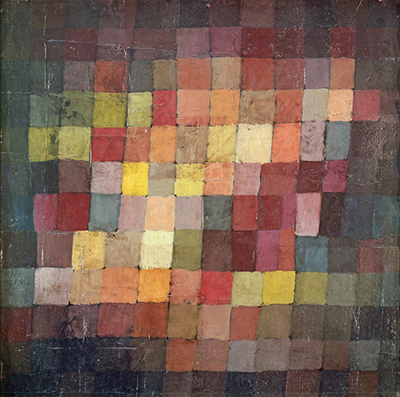
Ancient Harmony
1925
Fish Magic
1925
Actor's Mask
1924
Around the Fish
1926
Flora on Sand
1927
Sinbad the Sailor
1923
Castle and Sun
1928
Cat and Bird
1928
Discussion
The painting's fish, blue lines and dark ground can be described closely before we ask what the scene means.
The museum records also open questions about Klee's aquarium interest, the painting's materials and its route through collections.
Reader Insights
Which blue marks become clearer when you look beyond the central fish?
Do the smaller fish seem to retreat, or does the central fish's scale create that impression?
What evidence would help settle the 1925 studio aquarium story?
Join the Conversation
Share what you observe in the painting and any source that helps explain it.
References
- Hamburger Kunsthalle, “Der Goldfisch,” HK-2982, collection record, essay by Florian Britsch and provenance by Ute Haug and Franka Groon (German; provenance updated 2024), View source.
- Staatliche Museen zu Berlin, Das Universum Klee, exhibition worklist for Fisch Zauber and der Goldfisch (German and English, 2008), p. 5 of PDF, View source.
- Philadelphia Museum of Art, “Fish Magic,” owner collection record and technique description (English), View source.
- Zentrum Paul Klee, Cosmos Klee exhibition guide, aquarium interest and 1926 Dessau chronology (English institutional guide), View source.
- Christian Geelhaar, “Klee, Paul,” Neue Deutsche Biographie 11 (German, 1977), pp. 290–299, View source.
- Rolf Bothe, “Paul Klee, Wasserpark im Herbst, 1926,” Ernst von Siemens Kunststiftung (German, separate-object chronology), View source.
- Christoph Zuschlag, “Paul Klee und die »Entartete Kunst«,” Zwitscher-Maschine 4 (German, 2017), Nationalgalerie seizure and Düsseldorf list, View source.
- Freie Universität Berlin, Research Centre “Degenerate Art,” confiscation-inventory database introduction (German), View source.