


 by Tom Gurney
Tom Gurney BSc (Hons) is an art history expert with over 20 years experience
Published on June 19, 2020 / Updated on September 27, 2026
Email: tomgurney1@gmail.com / Phone: +44 7429 011000
Before the Snow: colour on the edge of winter
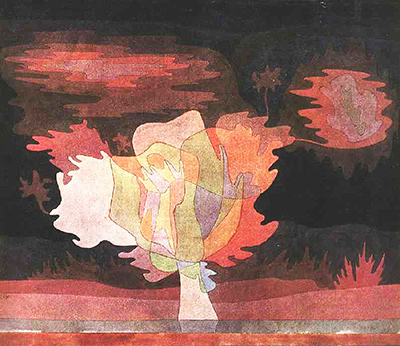
Paul Klee's Before the Snow is Vor dem Schnee, 1929, 319. The work is watercolour over black ink pen on paper mounted on cardboard. A 2016 Galerie Kornfeld catalogue gives the image with its closing line and inscription as 36 × 39.2 cm and the backing cardboard as 49 × 58.6 cm. Klee's title and work number appear on the lower mount, while his signature is recorded at the lower left of the painted image. These are unusually useful identifiers: they connect the English translation to this particular sheet rather than to a general seasonal image.[1][2]
The central form has the scale of a tree but not the ordinary outline of one. Pale pink, yellow, green and violet passages press into one another inside a jagged reddish contour. A narrow trunk-like stem joins it to bands near the bottom. Around it lies a dark blue-black field, touched by small, distant plant-like signs and two pink cloud or foliage shapes. The main form seems to flare with colour just before the scene turns cold. Its brilliance is part of the drama, but the picture does not show a literal fall of snow.[1]
What is about to change?
The German Vor dem Schnee means “before the snow.” Klee names an interval, not the event after it. There is no white blanket covering the ground or tree. A viewer may read the glowing form as late foliage, a flower-like crown or an invented plant. The pale centre and dark surround make the impending change feel stronger than any meteorological detail. This is a title that gives the image time: the moment is defined by what has not yet arrived.[1]
The picture's bottom is particularly important. Rose, brown and muted green horizontal bands make a low platform for the narrow central stem. Above, the dark field is less a naturalistic night sky than a stage on which forms can stand apart. The large central crown and small distant silhouettes do not obey a consistent scale. That discrepancy lets the eye move between landscape and an arrangement of signs. It is possible to call the work an autumnal scene, but the word should describe a reading of its colour and title, not a documented painting location or date in the calendar.[1]
A full-sheet photograph in the Kornfeld catalogue shows more than many reproductions: a pale outer mount, black closing lines, and Klee's inscription below the image. The small crop on this page leaves most of that mount out and looks considerably warmer and more saturated. It remains recognisable as the same image, but its colours should not be used as a precise guide to the original watercolour. The catalogue photograph is also a photograph with its own limitations; direct examination would be needed for pigment and paper questions.[1][2]
Pen, watercolour and the worked mount
Kornfeld describes watercolour over pen in black ink. The contours and dark signs are thus not simply gaps between broad areas of colour. They belong to a graphic structure over which transparent colour operates. At the centre, thin lines subdivide the pale form into pieces without making it a botanical illustration. At the margins, jagged shapes cross the dark field and interrupt the calm horizontal ground. The media explain why the image can feel at once drawn and painted.[1][2]
The catalogue distinguishes the image dimensions from the cardboard dimensions. The visible lower mount carries the written “1929 3. H. 19” and the full title Vor dem Schnee. The work number 319 is Klee's annual sequence, while 5075 is the separate entry number Kornfeld cites from volume 5 of the later printed Catalogue raisonné Paul Klee. Neither number is the 2016 auction lot number 90. Keeping these systems distinct makes it possible to check the work without turning an exhibition or sale number into an artist's inscription.[1][2]
The mount is also coloured in places. Kornfeld's 2016 condition description notes watercolour on the backing cardboard and calls the sheet fresh in colour. That was a specialist sale assessment at that date, not a current conservation report. It does, however, reinforce that the cardboard is part of the visible object rather than disposable packaging. A reproduction cut tightly to the central field hides Klee's lettering and some of the image's constructed frame.[1][2]
The 1929 context
Klee made Before the Snow during his years teaching at the Bauhaus in Dessau. The title and material record do not establish that it was a classroom exercise, and its tree-like form cannot be reduced to a diagram of colour theory. The Bauhaus context is useful because Klee was working with line, colour and the transformation of visible motifs in many settings. Here a seasonal subject is made from a carefully placed pen structure, layered colour and a title that asks the viewer to imagine a change beyond the pictured moment.[1][3]
The Zentrum Paul Klee included the work in its 2016–17 exhibition Paul Klee. Bewegte Bilder (Moving Pictures) as a loan from private ownership. A contemporary listing identifies it as watercolour and pen on paper mounted on cardboard, 1929, 319. Its listed image size, 33.5 × 39 cm, differs from Kornfeld's 36 × 39.2 cm figure measured with line and writing. The sources do not define their measurement boundaries in the same way. The safest practice is to retain their attributed figures rather than imply the object changed size.[1][4]
The exhibition concerned movement across Klee's work. In Before the Snow, motion need not mean an animated figure. It can lie in the repeated jagged edges, the layered central colour, and the viewer's movement between a tree, a flower and a more abstract shape. That is a visual reading of the sheet, not evidence that Klee intended a frame from a film or an illustrated scene from a specific story.[1][4]
A documented route through exhibitions and collections
Kornfeld's provenance starts with Rudolf Probst and Galerie Neue Kunst Fides / Das Kunsthaus in Dresden and Mannheim, where the work was on commission from 1930 to 1933. It returned to Klee in 1933. After his death it passed to Lily Klee's estate and then the Klee-Gesellschaft. The catalogue records Werner Allenbach in Bern from 1946 and then a Swiss private collection. These are the documented stops up to the 2016 sale; the sale record is not proof of a present owner.[1][2]
The work had a public life before its modern auction appearance. Kornfeld lists the Dresden 1930 Klee exhibition, a Hannover showing in 1931, Bern in 1935 and 1940, later displays in Basel, Hamburg, Essen and Martigny, and inclusion in Tate Modern's 2013 Paul Klee: Making Visible catalogue. It also lists a 2015 Leipzig exhibition as a comparison example. These references establish dated appearances, not continuous display or a complete exhibition history.[1][2]
The catalogue's literature list reaches back to Carl Einstein in 1931 and Will Grohmann the same year. Those citations show how early the work entered published discussion. Without reading those passages directly, they should not be made to endorse a particular interpretation of its forms. The strongest evidence here is the object record, inscriptions, provenance and visible composition; the meaning of the imminent snow remains deliberately open.[1][2]
The eye returns to the bright central crown after absorbing the dark field around it. Its colours seem vulnerable because the title names a coming transformation. Klee lets a single poised moment carry the seasonal idea, while the pen lines, coloured mount and written title keep that imagined landscape firmly tied to a particular made object.[1][2]
Related artworks
Explore eight other Klee works from the researched artwork cluster.
Fire in the Evening
1929
Highway and Byways
1929
Ad Marginem
1930
Castle and Sun
1928

Cat and Bird
1928
Error on Green
1930
Flora on Sand
1927
Ad Parnassum
1932
References
- Galerie Kornfeld, Vor dem Schnee, 2016 lot 90, German catalogue within a French interface: work number 1929, 319, materials, inscriptions, literature, exhibition and provenance history, and 2016 assessment, View source.
- Galerie Kornfeld, 2016 illustrated sale catalogue, German, lot 90: full dimensions of image with closing line and writing (36 × 39.2 cm) and backing cardboard (49 × 58.6 cm), signature and inscribed title, and a reference to Catalogue raisonné Paul Klee, vol. 5, no. 5075. That volume itself has not been directly consulted here, View source.
- Zentrum Paul Klee, “Archiv & Forschung”, German: Klee's Bauhaus teaching and surviving pedagogical material. This is historical context, not documentation that Vor dem Schnee was a teaching exercise, View source.
- Zentrum Paul Klee exhibition information reproduced by Kultur-Online, “Paul Klee. Bewegte Bilder”, German, 2016: exhibition dates and listing of Vor dem Schnee, 1929, 319, as a privately owned loan, with a 33.5 × 39 cm measurement. The listing and Kornfeld measurement use different stated boundaries, View source.