


 by Tom Gurney
Tom Gurney BSc (Hons) is an art history expert with over 20 years experience
Published on June 19, 2020 / Updated on September 27, 2026
Email: tomgurney1@gmail.com / Phone: +44 7429 011000
Blossoms in the Night: flowers, eyes and a dark ground
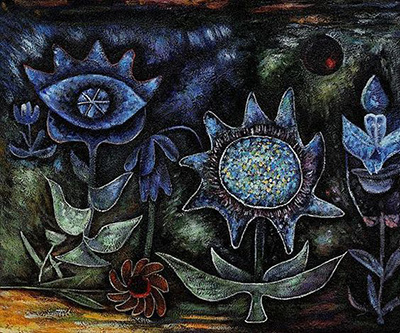
Paul Klee's Blossoms in the Night is Blüten in der Nacht, a work of 1930 in the San Francisco Museum of Modern Art. SFMOMA records watercolour and ink on a prepared ground on paper mounted on board, 23.6 × 31.2 cm, accession 53.6207. The museum acquired it in 1953 as a gift of Charlotte Mack. A German scholarly work index gives Klee's annual entry as 1930, 207 (E 7); that notation is distinct from the museum's accession number.[1][2]
Several flowers appear against a dark blue-green field. At left, a broad blue bloom contains a ring divided like a small wheel or pupil. Its pointed outer petals make it resemble an eye. A second, larger flower occupies the centre-right: a speckled disc surrounded by long, uneven petals and fine radial marks. Smaller blooms sit below and at the right edge. A reddish round form near the upper right may suggest a moon, a dark sun or another floating sign. The title makes the setting nocturnal, but the forms are not arranged as a botanical illustration of known species.[1]
A garden that also seems to look back
The eye-like flower at left changes the viewer's position. Instead of merely looking at plants, one can feel looked at by one of them. Klee builds that ambiguity from familiar parts: a centre, surrounding ring and crown of petals. The central bloom has a different energy. Its multicoloured surface seems to flicker against the dark field, while the pointed petals radiate outward. A thin stem and spreading leaves give it plant structure, yet the circular centre can also appear celestial or mechanical. These shifts are possibilities offered by the image, not a claim that every flower hides a coded human face.[1]
The surrounding darkness is active. The prepared surface visible in SFMOMA's photograph has green and blue undertones and repeated marks, so the background is not a flat black curtain. The museum's medium description confirms a prepared ground beneath the watercolour and ink; it does not specify the exact preparation or permit a reconstruction of every layer. In a small saturated reproduction, the flowers can seem sharply detached from nearly black space. The owner's fuller photograph shows more gradation and surface activity between them.[1]
The reddish orb complicates the word “night.” It may be read as a moon because of its place above the flowers, but its colour and lack of a clear horizon leave that reading open. The flower at the right edge repeats the pointed form on a smaller scale, making the scene feel populated rather than centred on a single emblem. Near the bottom, a red bloom and long, low leaves draw the eye back across the field. Klee arranges differences in scale and brightness to make a garden one can traverse visually, even while its plants remain invented.[1]
The original German title matters. Blüten is plural; the image offers several blooms, not one “night flower.” In der Nacht places them in a condition of darkness rather than identifying a precise place or time. SFMOMA gives both German and English titles. The annual notation 1930, 207 (E 7) appears in Brigitte Uhde-Stahl's published work index; the sampled pages available online include that index, not her full discussion of the picture. The number is a useful cross-check, while the museum remains the source for its current object label.[1][2]
Watercolour over preparation
SFMOMA classifies the object as a painting but describes a work on paper mounted on board. Those statements are compatible: “painting” is a collection category, while the medium tells us what materials make this particular object. Calling it oil on canvas would erase both the watercolour and the prepared paper surface. The small dimensions likewise matter. The apparent scale of the central flower in a reproduction should not be confused with a large easel painting.[1]
The museum photograph includes the light border and drawn lines near the top and bottom. A tighter site crop removes much of this setting, and its colours appear brighter and more violet than the museum photograph. Both images show the same arrangement of the eye-shaped left bloom, central disc, upper orb and small right flower. The crop is sufficient for recognition, but the owner image is the sounder visual evidence for the mounted work and its subdued blue-green range. Neither photograph is a substitute for a technical examination.[1]
Ink helps establish some of the defining edges, while washes and marks create the colour within and around them. The distinction between a bounded flower and the field it grows from is not complete: dark forms seep into petals, and green-blue areas continue across the background. That soft exchange is one reason the scene can evoke growth rather than a set of pasted symbols. It is an observation of the visible image, not a description of a laboratory-verified painting sequence.[1]
How later writers have read the flowers
The art historian Alberto Giacomelli places Blossoms in the Night among Klee's fantastic gardens in a study of Goethe's morphology and changing natural forms. He reads such works through metamorphosis: a painted plant can suggest formation and transformation rather than a fixed specimen. This offers one way to understand the eye-flower and the central disc, which seem to move between recognisable categories. Giacomelli's argument is a later scholarly interpretation. It does not prove Klee assigned a specific Goethean symbol to each petal in this painting.[3]
A Christie's essay for Klee's distinct 1939 work Flora noctis also names the 1930 SFMOMA picture as an earlier night-flower motif and compares it with Flower Myth of 1918. The essay invokes German Romantic writing, including Novalis, while discussing that wider motif. This is useful comparative context, provided the later sale essay is not treated as a contemporaneous artist statement about the 1930 sheet. Flora noctis has its own Latin title, date, materials and object history.[4]
An even closer-looking title belongs to another work: Blüten der Nacht (Fiori della notte in the Italian collection record), 1938, in the Fondazione Cerruti collection. Its owner records pastel on burlap mounted on cardboard, 43 × 39.5 cm. The foundation's essay discusses Klee's later illness and the fragile pastel surface. Those details concern the 1938 object. They should not be transferred to SFMOMA's 1930 watercolour simply because the translated titles resemble one another. The distinction also prevents the 1930 work from being read automatically as a late-life image of illness.[5]
The paintings can still be compared as examples of a recurring interest in nocturnal plants. Klee returned to flower forms and changed their supports, marks and scale. In this 1930 work, the strongest tension is between animated, almost watchful blooms and a dark field that remains visibly coloured. A viewer may sense mystery or metamorphosis without settling on a single allegory. The source evidence establishes the object, and the interpretation can remain open to the image's shifting forms.[1][3][4][5]
SFMOMA currently lists the work as not on view; display status can change. Its collection record, rather than a promise of gallery access, provides the stable point of reference here. The picture's small size and finely differentiated dark ground make direct viewing especially valuable when it is available. For now, its title, material record and photograph let the eye follow a nocturnal garden in which the flowers do more than bloom: one seems to watch, another radiates, and the space between them remains alive with colour.[1]
Related artworks
Explore eight other Klee works from the researched artwork cluster.
Ad Marginem
1930
Error on Green
1930
Fire in the Evening
1929
Highway and Byways
1929
Ad Parnassum
1932
Castle and Sun
1928
Cat and Bird
1928
Mask of Fear
1932
References
- San Francisco Museum of Modern Art, Blüten in der Nacht (Blossoms in the Night), English owner record and full-object image: 1930 date, medium, dimensions, accession 53.6207, 1953 Charlotte Mack gift and current display status, View source.
- Brigitte Uhde-Stahl, Paul Klees geheime Symbolik, publisher's work-index excerpt, German, Gebr. Mann Verlag, 2018, index p. 393: Blüten in der Nacht, 1930, 207 (E 7). The excerpt does not include the indexed interpretive discussion, which is therefore not attributed to the book here, View source.
- Alberto Giacomelli, “Archetype, Urphänomen and Polarity,” Aesthetica Preprint 117, English, 2021, pp. 109–10: a later scholarly reading of Klee's fantastic gardens, explicitly including Blossoms in the Night, through Goethean metamorphosis, View source.
- Christie's, Klee, Flora noctis, lot essay, English: identifies the 1930 SFMOMA work as an earlier night-flower motif alongside Flower Myth. Its Romantic comparison is an attributed later interpretation, not the 1930 work's catalogue record, View source.
- Fondazione Cerruti, Blüten der Nacht / Fiori della notte, Italian collection record by Marie Kakinuma: 1938 pastel on burlap, inventory 0127, a separate work with a similar translated title and different material history, View source.