


 by Tom Gurney
Tom Gurney BSc (Hons) is an art history expert with over 20 years experience
Published on June 19, 2020 / Updated on September 27, 2026
Email: tomgurney1@gmail.com / Phone: +44 7429 011000
Individualized Altimetry of Stripes: Klee’s measured layers
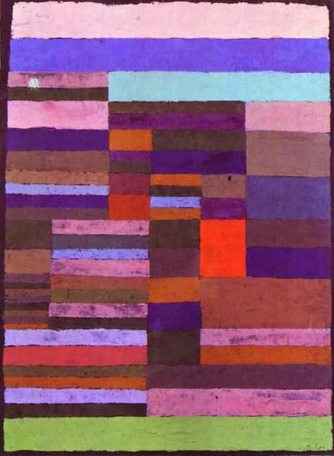
Paul Klee called this 1930 work individualisierte Höhenmessung der Lagen. The familiar English title, Individualized Altimetry of Stripes, survives on this page and in many image indexes, but “measurement of the heights of layers” comes closer to the German. The difference matters: Klee's Lagen are parts of a changing structure, not simply decorative stripes laid side by side. A multilingual work index identifies the piece as 1930,82; an earlier scholarly illustrated catalogue also records that number.[1][2]
The Zentrum Paul Klee describes a composition of twelve horizontal layers crossed by five vertical thresholds. At each threshold, a layer can split or join another. The picture therefore holds two movements at once: a steady succession across its height and a series of interruptions across its width. What first appears to be an orderly stack begins to change as the eye follows it from one side to the other.[3]
What the title asks us to measure
Höhenmessung suggests measuring height; individualisierte prevents that measurement from becoming a mechanical set of equal bands. The title names a procedure that the image repeatedly varies. Long coloured passages run sideways, but few remain identical throughout. A narrow strip may thicken, meet its neighbour or stop at a vertical division. The five thresholds act less like pillars holding a building than like marks at which the visual count must be made anew.[2][3]
The Zentrum Paul Klee locates the rhythm of doubled layers at the right edge. Looking from there into the painting makes its bands seem to divide and reunite in stages. Looking vertically gives a different account: greens below, a forceful red shape around the middle and bright blue toward the top, with paler pink above it. The eye can follow one layer, then lose it in a change of colour or width. This is the practical force of “individualized”: each segment participates in a scheme but acquires a local character.[3]
The red central rectangle is an especially useful point of orientation. Its greater visual weight checks the lateral movement, while adjacent dark and light passages keep the centre from becoming a single fixed block. The blue toward the upper edge and green in the lower area answer the red without producing a regular tricolour diagram. The institution describes a repeated three-colour relation that Klee varies through individual colour decisions. The work's order is legible precisely because its departures from that order can be seen.[3]
The image is relatively small and vertical. One scholarly catalogue caption gives 47.5 × 34.8 cm, while a 2005 published image caption gives 46.8 × 34.8 cm. These figures differ in height, perhaps because different components or measuring conventions were used, but the available captions do not explain the difference. This article therefore does not present one as an unquestioned current museum measurement. Both place the work at Bern, though their holding names reflect different dates and institutional descriptions. A current object record should settle the dimensions and collection wording.[2][4]
Pastel, paste and the dark ground
The old page says that Klee used pastel pigments fixed with flour paste. That was too specific without an object record. The Zentrum Paul Klee calls the painting Kleisterfarben, or colours bound with paste, and explicitly distinguishes it from watercolour. Frank Zöllner's illustrated scholarly article calls its medium pastel and paste colours. A German art-postcard catalogue supplies the more precise description Pastellfarben, kleistergebunden, auf schwarzgrundiertem Papier auf Karton—paste-bound pastel colours on black-ground paper mounted on cardboard. The publisher of that card is a secondary sales source, so its support wording should be checked against the museum record; taken together, the sources support a mixed description involving pastel and paste-bound colour, rather than ordinary watercolour or oil on canvas.[2][3][5]
The dark ground is important to what can be seen. Deep gaps and outlines separate some bands sharply; in other places they make bright colour appear to float above a darker field. The method lets Klee set adjoining colours in contact without losing every edge. Yet a low-resolution image cannot establish the exact sequence in which he applied particular passages, nor prove the recipe for the binder. The painting's surface and materials deserve close study from an authorised high-resolution image or a conservation record, not reconstruction from the small existing reproduction.[3][5]
Egypt and the layered pictures
The Zentrum Paul Klee relates the 1930 picture's formal construction to Klee's Egyptian watercolours. This does not make it an Egyptian landscape in a literal sense: there is no mapped river, field or city in these coloured bands. The relationship is one of ordered horizontal divisions whose intervals can change. Its material differs too. The institution stresses that this work is made with paste colours rather than watercolour.[3]
Art historian Frank Zöllner places the piece among Klee's Lagenbilder, or “layer pictures,” in a study of Hauptweg und Nebenwege. Zöllner connects that family of works to Klee's 1928–29 journey to Egypt and to titles about surveying or measuring land. He notes that this title joins others such as Geländevermessung and vermessene Felder, which evoke measurement. His argument makes a persuasive historical frame for the word Höhenmessung, but it is a scholarly interpretation of a group, not a statement by Klee that this specific picture depicts a particular Nile field.[2]
That distinction allows the image to keep its abstract force. A person need not recognise Egyptian topography to follow its arrangement of layers, changes and colours. At the same time, the title's measuring language gives the structure a meaning beyond a display of pretty strips. The work stages a negotiation between a repeated rule and irregular decisions made within it.[2][3]
A work within Klee's 1930 practice
The picture is often reproduced under an English title that reduces Lagen to “stripes.” Retaining that title helps readers find the work, while the German title restores the structural idea behind it. A French index translates it as Mesure individualisée des niveaux, “individualized measurement of levels,” again pointing toward layers or levels rather than surface stripes alone.[1]
It is tempting to turn the vertical marks into architecture, or the bands into a physical landscape. The evidence supports a more careful reading. The thresholds organise changes; the coloured layers register those changes; the title tells us to compare their heights. Klee makes order visible and then refuses to let it become uniform. That tension gives the small 1930 work its energy.[2][3]
The original page also asserted that Alfred Flechtheim once owned this particular work. Klee's dealings with Flechtheim are documented in the wider literature, but the sources checked for this page do not establish an object-specific ownership chain. The claim is therefore withheld pending a catalogue raisonné or museum provenance entry. The current location and precise support construction likewise need confirmation from a current collection record.[2]
Related artworks
Explore eight other Klee works from the researched artwork cluster.
Ad Marginem
1930
Error on Green
1930
Fire in the Evening
1929
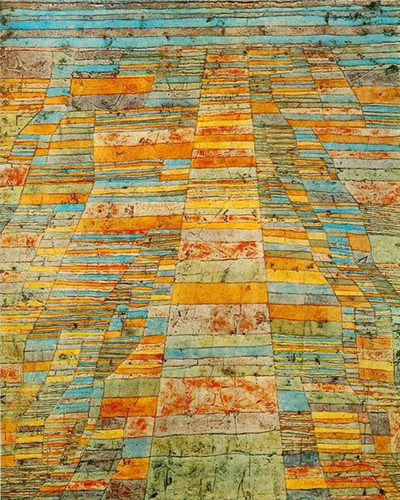
Highway and Byways
1929
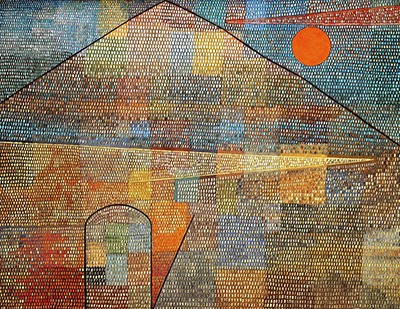
Ad Parnassum
1932
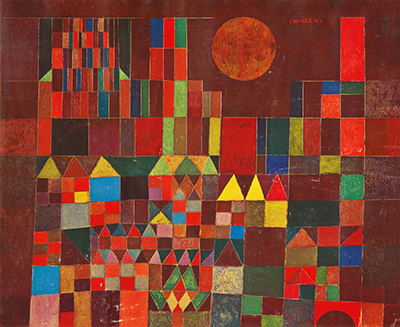
Castle and Sun
1928
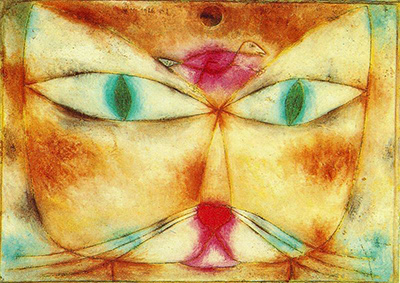
Cat and Bird
1928
Mask of Fear
1932
References
- PaulKlee.fr, multilingual 1930 work index (German, French, Spanish and English), entry 1930,82: title and translation crosswalk. This is a secondary index, not the printed catalogue raisonné, View source.
- Frank Zöllner, “Paul Klee, Hauptweg und Nebenwege, 1929,” Wallraf-Richartz-Jahrbuch 61 (2000), pp. 263–289 (German): discussion of the layer pictures, Egypt and surveying; illustrated-work caption for 1930,82 lists pastel and paste colours, 47.5 × 34.8 cm, and the then Paul-Klee-Stiftung/Kunstmuseum Bern designation. Author manuscript hosted by Heidelberg University; the present consultation used its searchable indexed text because direct PDF opening was blocked, View source.
- Zentrum Paul Klee, video commentary on individualisierte Höhenmessung der Lagen (German, 2017): first-party description of the twelve layers, five thresholds, colour relationships, paste colours and connection to the Egyptian watercolours; transcript presented with the institutional podcast, View source.
- Strahlenschutz PRAXIS 4 (2005), cover caption (German): identifies 1930,82 as pastel on paper on cardboard, 46.8 × 34.8 cm, then listed at Zentrum Paul Klee, Bern; its measurement differs from Zöllner's caption, View source.
- Reisser Kunstpostkarten, Klee postcard listing VD 3485 (German): catalogues paste-bound pastel colours on black-ground paper mounted on cardboard, with Zentrum Paul Klee, Bern. Commercial secondary caption; support wording awaits institutional confirmation, View source.