


 by Tom Gurney
Tom Gurney BSc (Hons) is an art history expert with over 20 years experience
Published on June 19, 2020 / Updated on September 27, 2026
Email: tomgurney1@gmail.com / Phone: +44 7429 011000
Forest Witches: figures found in a forest of lines
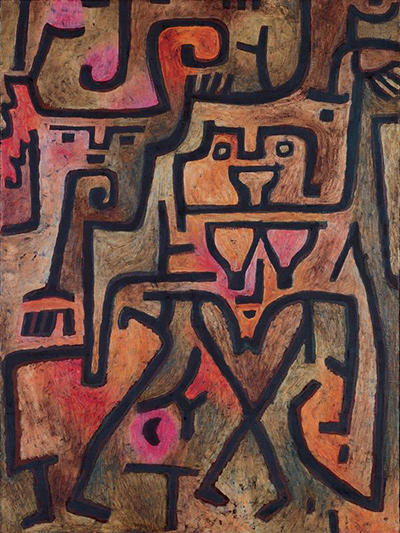
Paul Klee's Wald-Hexen means Forest Witches: the German noun is plural, and the Fondation Beyeler uses the plural in its English exhibition guide. This site inherited the singular Forest Witch as a page title and address. The picture itself is 1938, 145 (K 5), oil on paper mounted on burlap, 99 × 74 cm, in the Beyeler collection as inventory 99.1. Klee signed it at the upper left. Those particulars establish a large, vertical late work whose figures are discovered gradually, rather than an illustration of one named witch.[1][2]
Heavy, dark bands wander across the painted surface and reach its edges. Between them, shorter strokes of olive, ochre, pink, orange and red change the density of the field. Faces and limbs begin to appear from the lines, then can slip back into them as the viewer follows another route through the composition. Klee's title encourages a search for figures in a wood, but neither figures nor wood stay neatly separated. The image holds the moment when a line becomes a sign for a body, a branch or both.[2][3]
Two figures, many possible paths
The Fondation Beyeler's 2017–18 room guide offers a detailed way into the picture. On the right it identifies a nude figure: legs, belly, breasts and a head with a face. On the left it describes another figure, whose face and legs emerge from a dress as she seems to make a dancing step. The guide notes that glowing red zones help those forms come into focus, only for the dark linear network to conceal them again. This account is a close museum reading of the picture. It does not imply that every dark shape has a single fixed anatomical role.[2]
The right-hand figure's head appears around the middle-upper part of the composition, with pale face-like space and dark accents. Its body seems to extend downward through the large angular openings. The left-hand figure is harder to isolate; a pinker face and the gesture of a leg may appear amid the same bands that connect the rest of the image. The title can make these discoveries feel like glimpses through undergrowth. Yet Klee does not paint a conventional recession into a wooded distance. The figures and the apparent branches share the same painted plane.[2][3]
A later 2022 Beyeler room guide emphasizes that formal point. It describes vigorous lines continuing, in the imagination, beyond the image's borders and shorter, dense brushstrokes filling their intervals. The result can feel almost like a relief, with little stable division between foreground and background. The guide proposes that faces and body parts emerge between freer shapes that may be seen as twigs or branches. It treats Wald-Hexen as an inquiry into how a coloured mark comes to convey a recognizable subject. That is why the picture rewards a second or third look: recognition is an activity the viewer performs, not a completed outline delivered at once.[3]
The two museum accounts complement each other. The 2017 guide is more confident in describing the separate women; the 2022 text pays more attention to the unstable conditions that permit us to see them. Together they keep the title and the visible surface in productive tension. A reader can locate possible faces and limbs while noticing that the same lines remain part of a larger, nonliteral pattern. The phrase “Forest Witches” helps but does not dissolve the ambiguity.[2][3]
Oil, paper and burlap
The owning museum's medium is oil on paper on burlap. This is not a direct oil-on-canvas painting, and “burlap” here names the coarse textile support below the worked paper. The size—almost one metre high—makes it much larger than many of Klee's works on paper. It offers space for broad lines that feel bodily in scale while still preserving the layered support typical of his experiments. The museum's material record does not specify the exact order of every stroke or a conservation map of the layers, so those cannot be reconstructed from the small digital image.[1]
Colour matters beyond a simple contrast of dark lines and bright patches. Shorter strokes create mottled fields whose warm and cool tones shift as the eye moves. Red and pink passages can bring a face or torso forward; olive and brown may return it to the network. The dark contours are powerful, but they do not merely surround areas that have already been assigned to figures. They move through the colour and repeatedly change what the viewer thinks a shape is. The impression of relief noted by the 2022 guide comes from this dense interaction, not from a literal sculpted surface.[2][3]
The previous article described the picture as “post-war” and read simultaneous despair and optimism into Klee's feelings. The work dates to 1938, before the Second World War, and no object-specific statement from Klee supports that emotional diagnosis. It also spent much of its space on his childhood musical training rather than on the painting. The revised account begins with the actual support, the museum's image descriptions and the documented history of this particular work.[1][2][3]
Late work and historical setting
Klee made Wald-Hexen in Bern after the Nazi seizure of power drove him from his German teaching post. The 2022 Beyeler guide places it in these late Swiss years. A 2026 Jewish Museum exhibition label describes the painting's all-over heavy lines and shimmering colour as characteristic of Klee's late style, and relates his formal changes to the effects of scleroderma. That is the exhibition's interpretation of artistic development. The painting's look cannot by itself diagnose a bodily symptom, and it would be reductive to treat every thick line as merely a medical consequence.[3][4]
The Jewish Museum also frames the witches through a mythic imagination connected with historical Germanic culture and through a longer forest motif in Klee's art. Those themes give a possible context for the title. The Beyeler's guides, however, are more concerned with how the women appear and disappear within the structure. Neither source identifies a particular legend, named witch or narrative episode that Klee meant to represent. The original title is firm; the story behind it is not.[2][3][4]
There is a useful difference between context and claim. Exile, illness and the late 1930s belong to the work's historical setting. The painting's subject is known through its title and its emerging figures. Saying that the dark network is an exact allegory of political persecution, or that its colours disclose Klee's private despair, would need evidence beyond these records. The image's complexity supports discussion of concealment and revelation without requiring a single psychological explanation.[2][3][4]
From Klee to the Beyeler collection
The Fondation Beyeler gives a short, distinctive provenance. The painting remained with Klee until 1940. From that year it was with Fritz and Camille Gygi in Bern, received from the artist according to the museum record. It then passed to their heirs. The Beyeler Foundation acquired it in 1999. This history is more direct than that of several other Klee works that moved through many dealers and auctions. The owner record does not explain the circumstances of the transfer to the Gygis, so the relationship should not be embellished into a specific commission or gift occasion.[1]
The picture was shown during Klee's lifetime in Paul Klee. Neue Werke at the Kunsthaus Zürich in February–March 1940. Later exhibitions took it through major European museums and New York. Particularly relevant settings include the Beyeler's Magic of Trees in 1998–99, exhibitions on Klee's late work in 2003–04, the Beyeler retrospective in 2017–18, and the Jewish Museum's Paul Klee and Fascism in 2026. Its movement through exhibitions about trees, myth, late work and politics helps explain the range of questions now brought to it. An exhibition list documents past presentation, not permanent display today.[1][4]
The owner's bibliography cites the printed Paul Klee. Catalogue raisonné, volume 7, no. 7347, illustrated on page 378. That entry has been checked through the museum record; the printed volume was not directly inspected for this page. It is separate from Klee's own 1938, 145 (K 5) designation. Preserving both numbers makes the identification more precise than a translated title alone.[1]
Forest Witches is most compelling where its forms refuse to stay settled. The painting's material and history can be named: oil on paper on burlap, a signed work of 1938 that passed from Klee to the Gygis and later to the Beyeler Foundation. Within that certain object, two women keep appearing from and dissolving into a field of lines. The plural title directs attention to them, while the painted network makes looking for them the real event of the picture.[1][2][3]
Related artworks
Explore eight other Klee works from the researched artwork cluster.
Insula Dulcamara
1938
Viaducts Break Ranks
1937
Death and Fire
1940
New Harmony
1936
Fire Full Moon
1933
Struck from the List
1933
Ad Parnassum
1932
References
- Fondation Beyeler, Wald-Hexen collection record, English: original title, annual number, material, dimensions, signature, Gygi provenance, exhibitions and printed catalogue bibliography. The former current-site URL redirects to a collection landing page; this archive URL serves the individual object record, View source.
- Fondation Beyeler, Paul Klee exhibition room guide, English, 2017–18, room 7: plural English title and close description of the two figures appearing and disappearing in the linear network, View source.
- Fondation Beyeler, 25 Years exhibition room guide, German, 2022–23, room 16: oil-on-paper-on-jute label; layered strokes, relief-like effect, figure/ground ambiguity and the relation between marks and signs, View source.
- The Jewish Museum, Paul Klee and Fascism, complete exhibition texts, English, 2026, p. 77: late-style, illness and mythic-context interpretation of Forest Witches. Medical and mythic readings are attributed to the exhibition, not treated as Klee's stated intent, View source.